非银金融

Search documents
中观高频景气图谱(2025.9):上游资源品回暖,电气机械边际修复
Guoxin Securities· 2025-09-28 08:23
Group 1 - The overall performance of upstream resource products remains weak, but there are signs of recovery on a month-on-month basis, with coal prices rising and the oil and petrochemical sectors showing improvement [4] - In the midstream manufacturing sector, electrical equipment shows month-on-month improvement, while machinery performs well on the domestic demand side but faces pressure from external demand; the automotive sector remains at a low level, and the textile and apparel sector exhibits a mixed pattern [4] - The downstream consumer sector shows stable performance in home appliances, with increased consumption resilience; however, the food and beverage sector remains weak under price pressures, and the pharmaceutical and biological sectors show divergence, particularly with a continued decline in traditional Chinese medicine prices [4] Group 2 - Supportive services and finance sectors show month-on-month improvement in banks and a recovery in the funding environment; non-bank financial services remain active but with slowing growth; transportation shows divergence with container shipping rates rebounding while overall shipping rates face pressure; the environmental protection sector shows improvement with positive indicators [4] - The chemical industry shows a mixed performance with excess returns tracking indicators related to fuel oil and methanol futures prices, indicating a correlation with market movements [5][10] - The steel industry shows excess returns correlated with iron ore and steel production metrics, indicating a relationship with operational rates and inventory levels [21][24] Group 3 - The non-ferrous metals sector shows excess returns linked to various high-frequency indicators, including LME base metal indices and copper prices, suggesting a strong correlation with market trends [30][31] - The construction materials sector's excess returns are associated with cement price indices and glass settlement prices, indicating a relationship with construction activity [32][36] - The coal industry shows excess returns linked to thermal coal and coking coal prices, reflecting market dynamics and demand fluctuations [39][42] Group 4 - The oil and petrochemical sector's excess returns are influenced by gasoline and diesel wholesale prices, as well as production capacity utilization rates, indicating a strong correlation with market conditions [46][47] - The electrical equipment sector's excess returns are tracked against the prices of photovoltaic components and polysilicon, suggesting a relationship with renewable energy trends [50][51] - The automotive sector's excess returns are linked to tire production rates and average daily sales of passenger vehicles, indicating a correlation with consumer demand [53][58] Group 5 - The machinery sector's excess returns are associated with various price indices, indicating a relationship with global shipping rates and equipment pricing [60][66] - The transportation sector shows excess returns correlated with container freight indices, reflecting market conditions and trade dynamics [67][70] - The electronic sector's excess returns are linked to indices such as the DXI and NAND flash prices, indicating a relationship with technology market trends [72][74] Group 6 - The light industry sector's excess returns are tracked against TDI prices and real estate transaction metrics, indicating a correlation with housing market activity [78][83] - The textile and apparel sector's excess returns are influenced by various textile price indices, reflecting market conditions and consumer preferences [90][93] - The retail sector shows excess returns linked to order price indices, indicating a relationship with consumer spending trends [97][100] Group 7 - The agriculture, forestry, animal husbandry, and fishery sector's excess returns are correlated with food product price indices and wholesale vegetable prices, indicating a relationship with agricultural market conditions [101][106] - The food and beverage sector's excess returns are influenced by prices of staple food products and agricultural wholesale prices, reflecting market dynamics [113][117] - The pharmaceutical and biological sector's excess returns are linked to traditional Chinese medicine price indices, indicating a correlation with market trends [118][123]
日历效应系列一:国庆节的先抑后扬
Soochow Securities· 2025-09-27 14:02
Group 1 - The report highlights that the National Day holiday has a significant calendar effect, with a tendency for the market to decline before the holiday and rise afterward, indicating a pattern in trading behavior and economic cycles [1][9][8] - Statistical analysis shows that the win rates and median returns for the Shanghai Composite Index are generally negative in the days leading up to the holiday, while they turn positive in the days following it, particularly with a win rate exceeding 80% in the first five days after the holiday [1][9][10] - The report suggests that the best buying opportunity occurs in the two days before the National Day holiday, followed by a rapid market rebound post-holiday, supported by increased trading volume [2][3][4] Group 2 - The report identifies that sectors such as food and beverage, and pharmaceuticals show strong performance before the holiday, while post-holiday, there is an increased focus on large financial sectors [4][12][13] - It notes that the market dynamics shift from large-cap stocks outperforming small-cap stocks before the holiday to small-cap stocks showing greater elasticity and performance after the holiday [3][4][25] - The underlying factors influencing these trends include risk expectations related to the holiday, quarterly settlement demands, and changes in investor behavior due to holiday breaks [2][3][4]
“反内卷”行动初显成效 困境反转概念股走强
Zheng Quan Shi Bao· 2025-09-26 22:35
Market Overview - A-shares experienced slight fluctuations this week, with technology growth stocks performing well, as the ChiNext Index and STAR Market Index reached new highs, while the Shanghai Composite Index and Shanghai 50 Index showed sideways movement [1] - Weekly trading volume decreased to 11.57 trillion yuan, marking a six-week low due to holiday effects [1] Electronic Industry - The electronic sector attracted significant capital, with a net financing purchase exceeding 45.8 billion yuan for the week, marking the 14th consecutive week of net purchases over 10 billion yuan [2] - The electronic industry received a net inflow of over 412 billion yuan from major funds over the week, leading all sectors in net inflow [2] - Other sectors such as power equipment, telecommunications, and computers also saw substantial net purchases, while non-ferrous metals and non-bank financial sectors experienced net selling [2] Wind Power and Chemical Industries - The wind power sector showed strong performance, with the wind power equipment index rising for four consecutive days, reaching a two-and-a-half-year high [3] - The average bidding price for onshore wind turbines increased by 12.8% from 2024 to 2025, indicating a positive trend in the wind power market [3] - The chemical sector also saw collective strength, with new listings and significant price increases in various chemical products, including refrigerants and titanium dioxide [4][5] Future Outlook - Analysts expect certain chemical sub-industries to experience a phase of improvement due to ongoing policy effects, leading to healthier and more sustainable industry development [5] - The technology sector is anticipated to remain a core focus for the market, with structural opportunities expected to arise in the near future [7]
券商四季度策略报告出炉 多数机构看好科技和周期股
Shen Zhen Shang Bao· 2025-09-25 23:18
Group 1 - The overall performance of A-shares is strong, with the Shanghai Composite Index reaching 3800 points, and most institutions are optimistic about the market outlook for Q4 [1][2] - Analysts expect a structural recovery in A-share earnings, driven by resilient export growth, manufacturing investment improvements, and seasonal consumption increases [2][3] - The market is anticipated to experience a "slow bull" trend, with a balanced style shift between growth and value stocks [2][4] Group 2 - The technology sector, particularly in optical communication and semiconductors, has shown strong performance, while cyclical and consumer stocks have lagged [4] - Historical data suggests a style rotation in Q4, with cyclical stocks likely to rebound and technology stocks diversifying beyond just hardware [4][5] - Key sectors to focus on in Q4 include TMT (Technology, Media, Telecommunications), machinery, pharmaceuticals, military, non-ferrous metals, chemicals, and non-bank financials [4][5] Group 3 - Financial analysts predict increased allocation to equity assets by residents in a low-interest-rate environment, with a current equity and fund allocation of 15% among Chinese residents, indicating room for growth [3] - Suggested investment themes for Q4 include precious and industrial metals, renewable energy, AI hardware and applications, and consumer sectors such as pet economy and beauty products [5]
A股战力TOP10城市:京沪深制霸,台州最意外
2 1 Shi Ji Jing Ji Bao Dao· 2025-09-25 22:52
Group 1 - The total market value of A-shares has surpassed 100 trillion yuan for the first time, with the Shanghai Composite Index reaching a ten-year high, attracting numerous companies to pursue IPOs [1][3] - As of September 24, 72 companies successfully listed on A-shares, raising 69.644 billion yuan, a year-on-year increase of 53.3% [1] - Beijing, Shanghai, and Shenzhen continue to dominate the A-share market, but each city has distinct industrial characteristics: Beijing relies on state-owned enterprises and financial giants, Shanghai combines diversified finance with high-end manufacturing, and Shenzhen focuses on hard technology [1][3] Group 2 - The number of listed companies in top cities as of September 24 includes Beijing (475), Shanghai (447), Shenzhen (424), and others, with Beijing holding a significant market share [3][4] - Beijing's listed companies account for 25% of the total A-share market value, driven primarily by 135 state-owned enterprises that contribute 91.48% of revenue and 97.42% of net profit [3][4] - Shenzhen has surpassed Shanghai in total market value, reaching 12.71 trillion yuan, primarily due to its higher number of hard technology companies and their premium valuations [5] Group 3 - Suzhou has outperformed other cities in the number of new A-share listings this year, with six new companies, while also having a strong presence in the science and technology board [6][7] - However, Suzhou's total market value is 2.52 trillion yuan, significantly lower than Hangzhou's 3.36 trillion yuan, indicating a challenge in converting quantity into market value [7][8] - Hangzhou benefits from a concentration of digital economy leaders and provincial state-owned enterprises, contributing to its higher average market value per company [8] Group 4 - The trend of "industrial clustering" is evident, with companies in similar industries increasingly concentrated in specific regions, enhancing collaboration and resource sharing [9][10] - The completion of the Shenzhen-Zhongshan Link has facilitated the listing of two new companies in Zhongshan, demonstrating the impact of regional supply chain integration [10] - Cities like Taizhou have positioned themselves as specialized support zones for advanced manufacturing and digital economy, attracting significant investment and new listings [10][11]
9月25日深证国企股东回报R(470064)指数跌0.26%,成份股山金国际(000975)领跌
Sou Hu Cai Jing· 2025-09-25 10:02
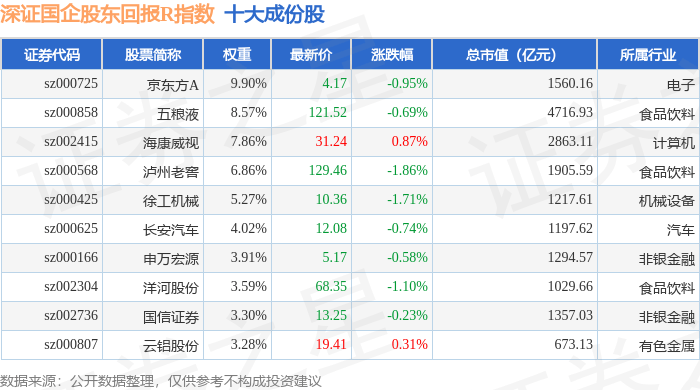
Core Points - The Shenzhen State-Owned Enterprises Shareholder Return Index (470064) closed at 2208.54 points, down 0.26% with a trading volume of 29.484 billion yuan and a turnover rate of 1.28% [1] - Among the index constituents, 13 stocks rose while 37 stocks fell, with Tongling Nonferrous Metals leading the gainers at an 8.12% increase and Shanjin International leading the decliners at a 2.71% decrease [1] Index Constituents Summary - The top ten constituents of the Shenzhen State-Owned Enterprises Shareholder Return Index are as follows: - BOE Technology Group (sz000725) with a weight of 9.90%, latest price at 4.17 yuan, down 0.95%, total market value of 156.016 billion yuan [1] - Wuliangye Yibin (sz000858) with a weight of 8.57%, latest price at 121.52 yuan, down 0.69%, total market value of 471.693 billion yuan [1] - Hikvision (sz002415) with a weight of 7.86%, latest price at 31.24 yuan, up 0.87%, total market value of 286.311 billion yuan [1] - Luzhou Laojiao (sz000568) with a weight of 6.86%, latest price at 129.46 yuan, down 1.86%, total market value of 190.559 billion yuan [1] - XCMG Machinery (sz000425) with a weight of 5.27%, latest price at 10.36 yuan, down 1.71%, total market value of 121.761 billion yuan [1] - Changan Automobile (sz000625) with a weight of 4.02%, latest price at 12.08 yuan, down 0.74%, total market value of 119.762 billion yuan [1] - Shenwan Hongyuan (sz000166) with a weight of 3.91%, latest price at 5.17 yuan, down 0.58%, total market value of 129.457 billion yuan [1] - Yanghe Brewery (sz002304) with a weight of 3.59%, latest price at 68.35 yuan, down 1.10%, total market value of 102.966 billion yuan [1] - Guosen Securities (sz002736) with a weight of 3.30%, latest price at 13.25 yuan, down 0.23%, total market value of 135.703 billion yuan [1] - Yunnan Aluminum (sz000807) with a weight of 3.28%, latest price at 19.41 yuan, up 0.31%, total market value of 67.313 billion yuan [1] Capital Flow Analysis - The index constituents experienced a net outflow of 1.399 billion yuan from institutional investors, while retail investors saw a net inflow of 1.023 billion yuan [1] - The detailed capital flow for selected stocks includes: - Hualing Steel (000932) with a net inflow of 95.616 million yuan from institutional investors [2] - HeSteel (000709) with a net inflow of 29.287 million yuan from institutional investors [2] - XCMG Machinery (000425) with a net inflow of 12.895 million yuan from institutional investors and a net inflow of 14.169 million yuan from speculative funds [2]


融资融券每周观察(2025.9.15-2025.9.19)
申万宏源证券上海北京西路营业部· 2025-09-25 03:04
Market Overview - The Shanghai Composite Index closed at 13,070.86, up by 1.14%, while the Shenzhen Component Index closed at 3,820.09, down by 1.3% [1] - The average daily trading volume for the Shenzhen market increased by 10.05% to 10,728 billion, while the Shanghai market saw a 7.44% increase to 14,178 billion [1] Industry Performance - Among the 31 first-level industries classified by Shenwan, 13 industries saw an increase while 18 experienced a decline [1] - The top three performing industries were coal, electric equipment, and electronics, while the worst performers were banks, non-ferrous metals, and non-bank financials [1] Margin Trading Overview - As of September 19, the total margin trading balance in the market increased by 466 billion to 23,982 billion [1] - The margin financing balance rose by 23.816 billion, while the margin short selling balance remained unchanged at 166 billion [2] Net Buying by Industry - Most industries recorded positive net buying amounts, with notable sectors including electronics, non-bank financials, electric equipment, and automobiles [2] Top Stocks by Margin Financing - The top ten stocks by net margin financing included Shenghong Technology (211.205 million), SMIC (205.644 million), and CITIC Securities (177.497 million) [3] Top ETFs by Margin Financing - The leading ETFs by net margin financing were Huaxia Hang Seng Internet Technology ETF (46.946 million) and E Fund CSI Overseas China Internet 50 ETF (44.124 million) [4] Market Analysis - Following the Federal Reserve's decision to cut interest rates by 25 basis points, the domestic stock market is experiencing fluctuations and consolidation [7] - The Shanghai Composite Index has recently fallen below its 20-day moving average, indicating a need for technical adjustment after a period of continuous growth [7][8] - Despite the recent adjustments, the market remains in a relatively strong position, with some indices still trending upwards, suggesting ongoing structural opportunities [8]
估值与盈利周观察9月第3期:分化
Tai Ping Yang Zheng Quan· 2025-09-24 15:24
Group 1 - The market shows valuation divergence, with the ChiNext Index and STAR 50 performing the best, while financial indices lag behind [3][11] - The overall market ERP has increased, approaching the negative one standard deviation level since 2021 [4][20] - The performance of various sectors indicates that coal, electric equipment, and electronics have the highest gains, while banks, non-bank financials, and non-ferrous metals are the weakest [14][35] Group 2 - The relative PE and PB of the ChiNext Index to the CSI 300 have increased, indicating a shift in valuation dynamics [19][18] - The overall valuation of major indices is at a near one-year high, with the ChiNext Index showing a PE of 43.4, which is at the 99.2 percentile of its historical range [26][25] - The financial and real estate sectors are currently above the 50% historical percentile, while materials, equipment manufacturing, and industrial services are below [27][36] Group 3 - The cheapest valuations are found in the food and beverage, agriculture, forestry, animal husbandry, and social services sectors, which are in the third quadrant of valuation metrics [39][38] - The current PB-ROE values for non-bank financials, agriculture, food and beverage, and social services are relatively low, indicating potential investment opportunities [42][41] - Popular concepts such as semiconductors and technology sectors are at historically high valuation percentiles [45][44] Group 4 - Overall profit expectations across sectors have seen slight adjustments, with media expectations being raised the most and beauty care expectations lowered the most [48]
股债跷跷板未来如何演绎?
2025-09-24 09:35
Summary of Key Points from Conference Call Industry Overview - The conference call discusses the A-share market dynamics, macroeconomic conditions, and the bond market in China, highlighting the interplay between stock and bond investments and the impact of foreign capital inflows on the market. Core Insights and Arguments 1. **A-share Market Support Factors** The passive appreciation of the RMB, narrowing of the US-China interest rate differential, and the shift of household deposits to the stock market are key long-term supports for the A-share market. Notably, there was a significant reduction in household deposits in July and August, while non-bank financial institutions saw an increase in deposits, indicating a clear trend of funds flowing into the stock market [1][4]. 2. **Foreign Capital Inflows** In the first three weeks of September, foreign capital inflows exceeded $10 billion, reflecting optimism towards the A-share market, while sentiment towards the Hong Kong stock market remains weak. Foreign investments have been concentrated in sectors such as pharmaceuticals, finance, commodities, and consumer energy, with a notable outflow from the technology sector [1][5]. 3. **Bond Market Dynamics** The 10-year government bond yield has reached 1.8%, which has sparked a divergence of opinions among investors. The yield range for the year has been between 1.6% and 1.9%, and the current level suggests potential adjustment pressures on fixed-income products. The bond market has experienced multiple yield adjustments throughout the year, with recent trends indicating a cautious outlook [1][6][7]. 4. **Economic Growth Projections** A long-term economic growth target of around 4.5% is deemed reasonable, with a focus on expanding domestic demand, particularly in consumer and service sectors, which presents significant investment opportunities [3][13][15]. 5. **Market Trends and Strategies** The current market is characterized by a "stock-bond seesaw" effect, where the correlation between stocks and bonds has shifted from negative to positive. This indicates a potential change in pricing dynamics, suggesting that investors should maintain a neutral duration strategy for trading in a volatile market [11][12]. 6. **Policy and Economic Conditions** The economic fundamentals show insufficient domestic demand and slow recovery, with various economic indicators reflecting a slowdown. Despite a deflationary environment, there are signs of inflation expectations rising, which could influence market sentiment [8][9]. 7. **Investment in Human Capital** The call emphasizes the importance of investing in human capital through measures such as childcare subsidies and educational support, which are expected to increase in the upcoming planning period [17]. 8. **Major Projects in the 15th Five-Year Plan** The 15th Five-Year Plan will introduce significant projects in infrastructure, including transportation, water conservancy, and energy, which are expected to stimulate investment and support local debt resolution [18]. 9. **Real Estate Development Model** A new model for real estate development is being proposed, focusing on a full industry chain approach, including scientific land planning and compliance with higher construction standards, aimed at promoting healthy market development [19]. 10. **High-Quality Development of Capital Markets** The call highlights the need for high-quality development in capital markets, aiming to attract domestic and foreign investments and improve market infrastructure to foster a healthy bull market [20]. Other Important but Overlooked Content - The call discusses the necessity for monetary policy to balance domestic and international considerations, with potential room for rate cuts if economic conditions worsen. The upcoming peak in special bond issuance is also noted, which may affect liquidity in the market [9][10].
924新政这一年:43家上市公司市值增长超千亿 双创成高增长摇篮
Feng Huang Wang· 2025-09-24 02:46
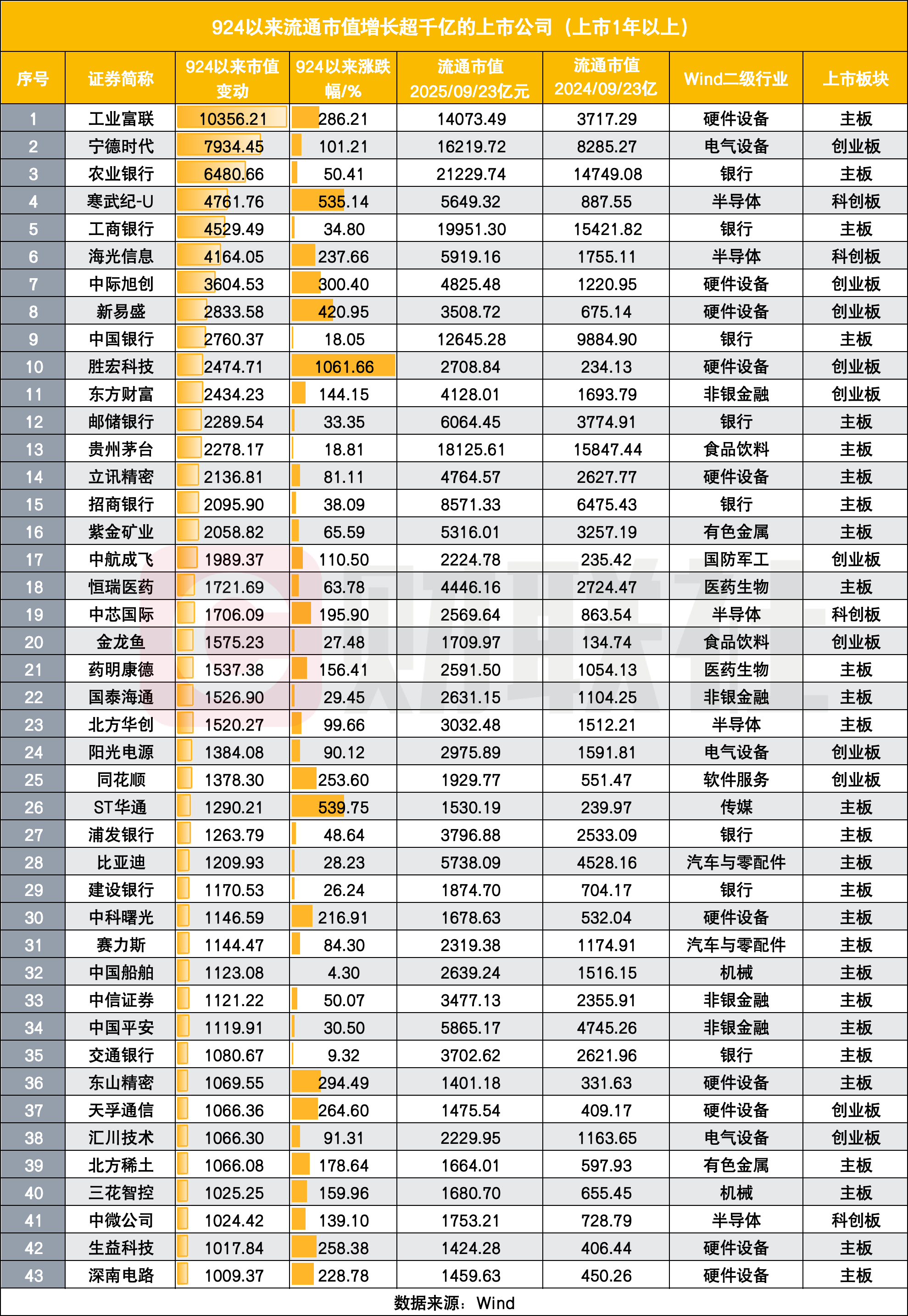
Core Insights - The new policy implemented a year ago has led to significant market capitalization growth for 43 listed companies, totaling over 9.5 trillion RMB, highlighting the emergence of core competitive companies in the A-share market [1][6][11] Industry Performance - The hard technology sector, particularly the semiconductor and hardware equipment industries, has shown remarkable performance, contributing 15 companies to the market capitalization growth, with Industrial Fulian and Cambricon leading the way [1][7][11] - The semiconductor industry saw Cambricon's stock price surge by 535.14%, resulting in a market capitalization increase of 4.76 billion RMB, while Industrial Fulian topped the list with a market capitalization increase of 10.36 billion RMB [1][7][8] Company Highlights - Industrial Fulian achieved a market capitalization increase of 10,356.21 million RMB, with a stock price increase of 286.21% [4][6] - Ningde Times, a leader in the battery sector, saw its market capitalization grow by 7,934.45 million RMB, with a stock price increase of 101.21% [11][12] - Agricultural Bank and Industrial and Commercial Bank recorded market capitalization increases of 6,480.66 million RMB and 4,529.49 million RMB, respectively, indicating a recovery in undervalued blue-chip stocks [6][8] Financial Sector Growth - The financial sector, including banks and non-bank financial institutions, has also experienced significant growth, with several banks seeing market capitalization increases exceeding 2 billion RMB [2][8] - Dongfang Wealth emerged as a standout in the non-bank financial sector, with a market capitalization increase of 2,434.23 million RMB and a stock price increase of 144.15% [10] Market Structure - The ChiNext and Sci-Tech Innovation Board have become important platforms for nurturing high-growth companies, with over 30% of the 43 companies listed on these boards [11][12] - Traditional industry leaders, including Guizhou Moutai and Hengrui Medicine, have also seen value recovery, with Guizhou Moutai's market capitalization increasing by 2,278.17 million RMB [13]