
房地产

Search documents
花样年控股境外债务重组进展:计划债权人单一会议2月20日召开
Xin Lang Cai Jing· 2026-01-26 15:53
Group 1 - The core point of the article is that Fantasia Holdings has announced the latest progress in its offshore debt restructuring, with a court order issued by the Cayman Islands on January 23, 2026, to convene a single meeting of plan creditors to consider and potentially approve the Cayman plan [1] - The meeting is scheduled to take place on February 20, 2026, at 7 PM Hong Kong time / 6 AM Eastern Standard Time, at the office of the law firm in the Alexander House, Chater Road, Hong Kong [1]
开源证券晨会纪要-20260126
KAIYUAN SECURITIES· 2026-01-26 14:41
Group 1: Financial Sector Insights - The banking sector is expected to maintain a proactive lending strategy in early 2026, with new loans in January projected to be around 5.2-5.3 trillion yuan, reflecting a slight year-on-year increase [16] - Large banks are anticipated to have a strong advantage in expanding their balance sheets due to favorable deposit conditions, with total deposits expected to exceed expectations [17] - The wealth management sector saw a significant increase, with the scale reaching 33.29 trillion yuan by the end of 2025, marking an 11.15% year-on-year growth [22] Group 2: Energy and New Energy Sector - The space photovoltaic sector is entering a new era with silicon-based PERC solar cells being adopted for low-orbit satellites, significantly reducing costs compared to traditional III-V multi-junction solar cells [27] - P-type HJT solar cells are identified as the most suitable technology for space applications due to their superior radiation resistance and lower cost [28] - The market for space-based solar power is expected to expand significantly, driven by initiatives like SpaceX's plan to deploy 100GW of solar energy satellites [29] Group 3: Electronics Sector - Major passive component manufacturers have announced price increases due to rising costs of raw materials, leading to a new upward cycle in the passive components market [32] - The demand for passive components is expected to remain strong, particularly in emerging sectors such as AI servers and electric vehicles, potentially extending the current upcycle [35] - The average price of passive components is projected to rise, driven by inflationary pressures and increased demand from high-end applications [36] Group 4: Agriculture and Livestock Sector - The white feather chicken market is experiencing price support due to supply constraints from overseas breeding disruptions, with prices averaging 7.44 yuan/kg in December 2025 [38] - The yellow feather chicken market is under pressure, with prices declining to 11.77 yuan/kg in December, influenced by seasonal demand and reduced breeding activity [39] - Egg prices are also declining, with a significant number of laying hens expected to be culled, which may provide some support for future prices [40] Group 5: Real Estate and Construction Sector - Jianfa Co. is forecasting a significant decline in net profit for 2025, primarily due to poor performance from subsidiaries and increased impairment losses [43] - The company's supply chain operations remain profitable, with overseas business growth of 37% year-on-year, indicating resilience in certain segments [45] - Real estate sales figures are down, with Jianfa's sales amounting to 1220.8 billion yuan, reflecting a 9% year-on-year decrease [46]

资讯日报:日元强劲反弹;金价首次升破每盎司5000美元-20260126
Guoxin Securities Hongkong· 2026-01-26 12:57
Market Overview - The Hang Seng Index closed at 26,750, up 0.45% for the day and 4.37% year-to-date[3] - The Nikkei 225 Index rose 0.29% to 53,847, with a year-to-date increase of 6.97%[3] - The S&P 500 Index ended at 6,916, with a slight increase of 0.03% and a year-to-date gain of 1.02%[3] Commodity and Currency Insights - Gold prices reached a historic high, surpassing $5,000 per ounce, driven by geopolitical tensions[13] - The Japanese yen rebounded strongly, with significant daily gains, as the market anticipates potential government intervention[13] Sector Performance - The commercial aerospace sector saw significant gains, with JunDa shares rising over 51% following the launch of six platforms aimed at accelerating satellite development[9] - The photovoltaic sector also performed well, with notable increases in stocks like KaiSheng New Energy (up 14.44%) and Xinyi Solar (up 11.15%) due to support from Tesla's CEO for solar energy development[9] U.S. Market Dynamics - The U.S. stock market showed mixed results, with the Nasdaq and S&P 500 slightly up, while the Dow Jones fell nearly 0.6%[9] - Notable individual stock movements included Goldman Sachs dropping nearly 4% and Nvidia rising 1.5%[10] Economic Indicators - Japan's core CPI for December 2025 rose 2.4%, aligning with expectations, while the manufacturing PMI for January 2026 increased to 51.5, indicating expansion[13]
智通港股解盘 | 霍尔木兹海峡引发市场忧虑 资产类持续受到追捧
Zhi Tong Cai Jing· 2026-01-26 12:54
Market Overview - The market is currently focused on resilience rather than aggressive movements, with A-shares experiencing ETF sell-offs and the Hang Seng Index showing slight fluctuations, closing up 0.06% [1] - Tensions between the US and Iran are at a peak, with concerns over the Strait of Hormuz affecting oil prices, leading to significant gains for companies like China National Offshore Oil Corporation and China Petroleum [1] - Canadian Prime Minister's visit to China resulted in trade agreements, but US President Trump threatened tariffs on Canadian imports if trade agreements with China were pursued [1] Commodity Prices - International gold and silver prices have surged, with gold reaching a historical high of $5093.18 per ounce and silver surpassing $109 per ounce [2] - High-end gold consumption is increasing, with significant consumer interest noted in SKP stores during the Chinese New Year season [2] - Commodity trading companies like Nanhua Futures have benefited from these price increases, with notable stock price rises [2] Uranium Market - The uranium market is showing strength, with a trust fund planning to issue up to $2 billion in transferable trust shares, indicating a growing demand for uranium [3] - Companies like China General Nuclear Power Corporation have seen stock increases of around 10% due to this positive outlook [3] AI and Technology Sector - Tencent is focusing on AI investments, with plans to enhance its AI platform and engage in competitive activities in the AI application space [4] - Companies like Longi Green Energy and Xunlei have also seen stock increases due to their involvement in AI and data center businesses [3][4] Real Estate Market - Hong Kong real estate stocks are expected to see a price increase of 5% to 10% this year, with reports of a potential spin-off of telecommunications assets by CK Hutchison [5] - The domestic real estate market is showing resilience, with significant increases in second-hand home transactions in major cities [5] Health Sector - The emergence of the Nipah virus in India is expected to increase demand for antiviral medications, benefiting companies like Sihuan Pharmaceutical and CanSino Biologics [6][5] - CanSino is advancing its vaccine development for the Nipah virus, reflecting a proactive approach to emerging health threats [6] Coal Industry - A report indicates that coal supply policies may lead to significant reductions in production capacity, potentially improving coal prices in 2026 [7] - Major coal companies like China Shenhua Energy and Yanzhou Coal Mining are positioned to benefit from these changes in supply dynamics [8] Jewelry Market - Chow Tai Fook has reported strong sales growth, particularly in high-margin gold jewelry, with same-store sales in mainland China increasing by 21.4% [9][10] - The company is optimizing its store network and expanding into Southeast Asia, indicating a strategic approach to growth amid rising gold prices [10]

宝龙地产(01238.HK):附属境内债券重组方案获批 含购回、资产抵债等选项
Ge Long Hui· 2026-01-26 11:49
格隆汇1月26日丨宝龙地产(01238.HK)宣布,公司之附属公司上海宝龙实业发展(集团)有限公司发行的 六笔境内公司债券及资产支持专项计划(统称为「债券」)的重组方案已获相关债券持有人会议审议通 过,将对债券的本息偿付安排进行调整,并向相关债券持有人提供包括购回选项、资产抵债选项、股票 选项、一般债权选项等重组方案选项。公司下一步将根据境内重组方案相关约定,安排债券持有人就其 持有的债券在境内重组方案选项中进行选择及分配。 ...
财务亮红灯!年内7股预警“*ST”!
Xin Lang Cai Jing· 2026-01-26 11:39
Core Viewpoint - The A-share market is experiencing a surge in performance forecasts, with several companies issuing "*ST" warnings, indicating potential delisting risks due to negative net assets and expected losses in 2025 [1][2][5]. Group 1: Company Announcements - Ba Yi Steel announced on January 25 that its stock may face delisting risk warnings, with an expected net asset value of -1.76 billion to -1.95 billion yuan by the end of 2025 [2][9]. - As of January 26, a total of seven companies have disclosed potential "*ST" warnings, with five of them indicating negative net assets [2][10]. Group 2: Financial Forecasts - The five companies expected to have negative net assets include Ba Yi Steel, ST Saiwei, Huaxia Happiness, Yijing Photovoltaic, and ST Huapeng, all of which are facing mandatory delisting indicators due to financial performance [3][10]. - Huaxia Happiness is projected to incur the largest loss, with an estimated net loss of 16 billion to 24 billion yuan for 2025, while Ba Yi Steel and ST Saiwei are expected to report losses of 1.85 billion to 2.05 billion yuan and 720 million to 1.02 billion yuan, respectively [5][12]. Group 3: Market Impact - Following the announcement, Ba Yi Steel's stock price fell to the limit down price of 3.24 yuan per share, resulting in a total market capitalization of 4.967 billion yuan [2][6]. - The overall market sentiment is affected as all seven companies are expected to report net losses for 2025, indicating a challenging financial environment [5][12].

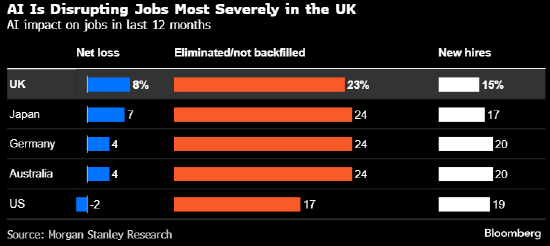
摩根士丹利称英国受人工智能裁员冲击最重 岗位净流失超过德、日等国
Xin Lang Cai Jing· 2026-01-26 11:27
Core Insights - The number of jobs lost in the UK due to artificial intelligence (AI) has exceeded the number of jobs created, with the job loss rate outpacing similar economies globally [1][5] - Despite the significant benefits brought by AI technology, UK workers are bearing a heavy cost, exacerbating an already cooling labor market [1][5] Job Loss Statistics - UK businesses reported a net job decrease of 8% over the past 12 months due to AI, which is the highest rate among surveyed countries, double the international average [1][5] - The report indicates that employers in the UK are most likely to cut entry-level positions requiring two to five years of experience [9] Productivity Gains - The report surveyed companies that have used AI for at least a year across five sensitive industries: consumer staples and retail, real estate, transportation, medical devices, and automotive [3][7] - UK companies reported an average productivity increase of 11.5% due to AI, with nearly half of the companies experiencing even greater gains [3][7] - In contrast, US companies achieved similar productivity improvements but created more jobs than they cut due to AI [3][7] Labor Market Impact - Analysis of online job vacancy data from the UK’s Office for National Statistics shows a general reduction in job postings across industries, with a notably faster decline in positions likely affected by AI, such as software developers and consultants [3][7] - The findings serve as an "early warning signal" for how AI will reshape the labor market, according to Rachel Fletcher, co-author of the study and head of sustainable development research for Europe, the Middle East, and Africa [10]

北交所周报(1.19-1.23):本周建筑材料赛道涨幅居前,北交所新股申购资金首次突破万亿元关口
ZHONGTAI SECURITIES· 2026-01-26 10:35
Investment Rating - The industry investment rating is maintained at "Add" [2] Core Insights - The overall market performance of the North Exchange shows a positive trend, with the North Exchange 50 Index increasing by 2.58% to close at 1588.66 points as of January 23, 2026. In comparison, the Shanghai and Shenzhen 300 Index decreased by 0.68%, while the ChiNext Index and the Sci-Tech 50 Index increased by 0.36% and 3.11%, respectively [5][12] - The top five performing sectors in the A-share market this week were building materials, steel, non-ferrous metals, chemicals, and real estate, with respective increases of 7.50%, 6.32%, 5.49%, 4.47%, and 4.08% [18] - Among the 290 stocks listed on the North Exchange, 217 stocks rose, 72 fell, and 1 remained flat, resulting in a rise ratio of 75% [20] Summary by Sections North Exchange Market Overview - As of January 23, 2026, there are 290 constituent stocks in the North Exchange, with an average market capitalization of 3.335 billion [12] - The average daily trading volume for the North Exchange A-shares was 26.8 billion, which is a decrease of 35% from the previous week, with a turnover rate of 5.44% [15][16] North Exchange New Stocks - No new stocks were issued this week. As of January 19-23, 2026, 17 companies updated their review status to "inquired," 4 companies were approved by the listing committee, 3 companies were registered, and 1 company had its listing committee meeting postponed [25] North Exchange News - On January 25, 2026, the new stock Meidele announced that its online effective subscription amount reached 1,058.86 billion, marking the first time the subscription funds for new stocks on the North Exchange exceeded 1 trillion, setting a historical record [27] North Exchange Investment Strategy - The report suggests focusing on high-quality development in 2026, with recommended sectors including: 1. Data Centers: KLT and Shuguang Data Creation 2. Robotics: Suzhou Axis, Audiwei, JunChuang Technology, and Fuheng New Materials 3. Semiconductors: Hualing Co. and Kaide Quartz 4. Consumer Goods: Taihu Snow, Baixinglong, Lusi Co., Kangbiter, and Thunder God Technology 5. Military Information Technology: Chengdian Guangxin and Xingtuzhihui [28]
瑞安房地产(00272):于2029年到期的3亿美元9.75%优先票据发行已完成
智通财经网· 2026-01-26 09:49
智通财经APP讯,瑞安房地产(00272)发布公告,董事会欣然宣布,于2026年1月26日,购买协议项下的 所有先决条件已获达成,且票据(将由Shui On Development发行于2029年到期的3亿美元9.75%优先票据) 发行亦已完成。 ...

开源证券给予建发股份“买入”评级,公司信息更新报告:全年业绩短暂承压下滑,供应链运营业务稳健盈利
Sou Hu Cai Jing· 2026-01-26 08:30
Group 1 - The core viewpoint of the report is that the company Jianfa Co., Ltd. (600153.SH) is given a "buy" rating by Open Source Securities due to various factors affecting its performance [1] - The expected net profit attributable to the parent company for Meikailong and Lianfa Group is projected to be negative, which will impact the overall performance of Jianfa Co., Ltd. for the year [1] - The supply chain operation business is performing steadily with profitable results, and the scale of overseas business has increased year-on-year [1] - There is a noted decline in real estate sales data, indicating potential challenges in the property market [1]