
家电

Search documents
解锁新场景释放新活力,“共享计划”长株潭好物乐购汇圆满落幕
Xin Lang Cai Jing· 2026-01-18 15:20
Core Insights - The event "Changsha Second Industrial Products Supply and Demand Matching Conference" successfully attracted 150,000 visitors and facilitated over 20,000 transactions, with more than 1,000 intended bulk purchases [1] Group 1: Event Overview - The event showcased a wide range of products across various categories, including food, health, textiles, automotive, home appliances, and artificial intelligence, covering an exhibition area of 10,000 square meters with over 180 booths [2] - The event adopted a "direct sales" model, eliminating intermediaries and providing significant price discounts, allowing consumers to enjoy lower prices than online shopping [2] Group 2: Consumer Engagement - The event featured a popular "AI" section, attracting many visitors to experience cutting-edge technologies like exoskeleton robots and AI health advisors [2] - Online live streaming attracted tens of thousands of viewers, expanding brand influence and reducing buyer search costs for those unable to attend in person [3] Group 3: Economic Impact - The event served as a catalyst for high-quality development in the Changsha-Zhuzhou-Xiangtan consumer goods industry, providing a platform for local enterprises to enhance brand recognition and market reach [4] - Over 100 local enterprises achieved breakthroughs in product sales and established partnerships for raw material procurement, production collaboration, and channel sharing, enhancing supply chain efficiency [4] - The Changsha Industrial and Information Technology Bureau plans to continue promoting the "Shared Plan" to facilitate resource sharing and industry complementarity among the three cities, aiming for greater breakthroughs in brand building, technological innovation, and industry integration [4]

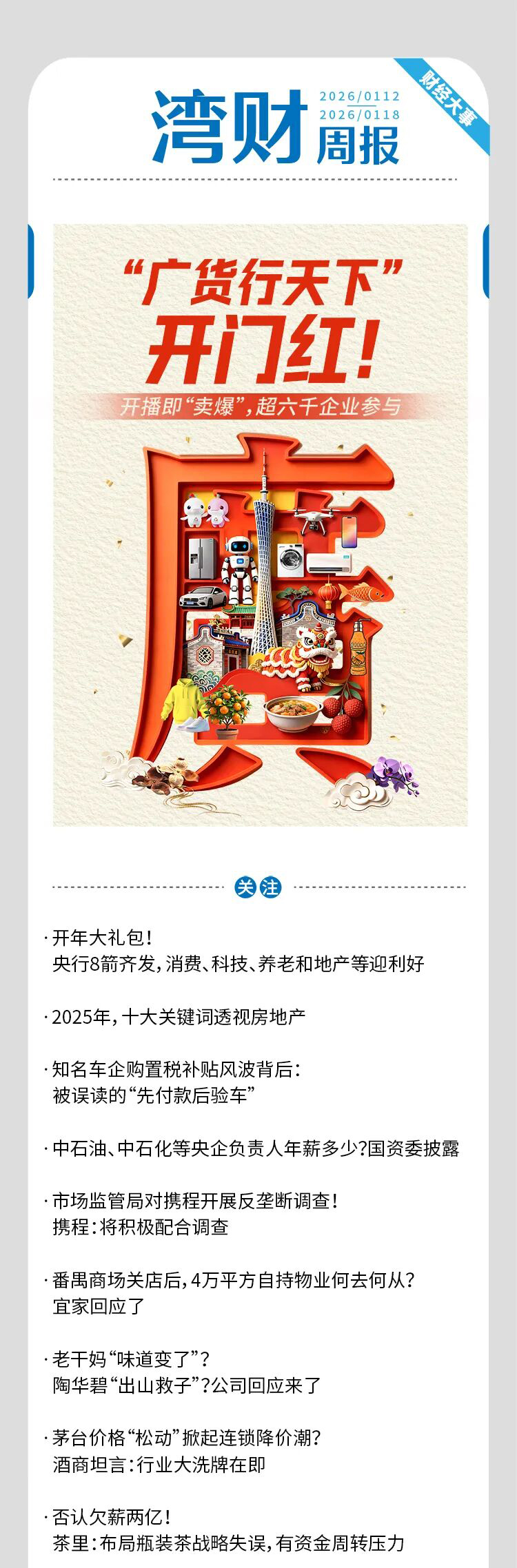
湾财周报 | 大事记 “广货行天下”开门红;央行发大礼包;携程被立案调查
Nan Fang Du Shi Bao· 2026-01-18 15:11
Group 1 - The "Guanghuo Hang Tianxia" spring campaign launched in Guangdong, with over 1,300 local appliance companies participating, aiming to boost sales through online and offline promotions [5] - The campaign will feature 12 synchronized promotional events throughout the first quarter, targeting over 6,000 enterprises to enhance online sales of quality products [5] Group 2 - The People's Bank of China announced eight major policy measures to support economic transformation, including a 0.25 percentage point reduction in various structural monetary policy tool rates and a special relending quota of 1 trillion yuan for private enterprises [6] - The measures also include increasing relending quotas for technological innovation to 1.2 trillion yuan and lowering the minimum down payment for commercial housing to 30% [6] Group 3 - In 2025, the national real estate market continued to adjust, with new residential sales area declining by 4.9% year-on-year to approximately 390 million square meters, and sales value dropping by 10% to around 5.4 trillion yuan [7] - The total transaction volume of new and second-hand residential properties reached 839 million square meters, indicating stable demand from residents [7] Group 4 - Zeekr Automotive clarified its cross-year vehicle purchase tax subsidy policy, stating that it has covered the tax subsidy for 8,125 users who placed orders in 2025 and received their vehicles in January 2026 [9] - The confusion arose from the overlap of two policies, leading to misinterpretations regarding payment and vehicle delivery [10] Group 5 - The State-owned Assets Supervision and Administration Commission disclosed the 2024 salary information for over 80 central enterprise leaders, showing a stable salary range without extreme high salaries [11] - The top earners are primarily from telecommunications and energy sectors, with China Mobile's former chairman leading at a pre-tax salary of 1.2582 million yuan [11] Group 6 - The State Administration for Market Regulation has initiated an antitrust investigation into Trip.com Group for suspected monopolistic behavior [12] - Trip.com has committed to cooperating with the investigation and ensuring normal business operations [12] Group 7 - IKEA announced the closure of its Guangzhou Panyu store, raising questions about the future of its 40,000 square meters of self-owned property [13] - IKEA is currently evaluating arrangements for the asset and will comply with relevant laws and regulations [13] Group 8 - CHALI Tea clarified rumors regarding a 200 million yuan salary debt, admitting to cash flow pressures due to strategic missteps in bottled tea, while assuring that its core bagged tea business remains operational [16] - The company is addressing salary issues for departing employees in batches, although some employees have expressed ongoing concerns about unpaid wages [16] Group 9 - The white wine market is experiencing a price decline, influenced by the price adjustments of flagship products like Moutai, leading to a broader price reduction across various brands [15] - The industry is facing inventory pressures, prompting some distributors to lower prices to stimulate sales, indicating a shift towards a "price for volume" strategy [15]

餐饮、潮玩及家电行业周报-20260118
Haitong Securities International· 2026-01-18 14:34
Investment Rating - The report assigns an "Outperform" rating to several companies including Pop Mart, Anta Sports, Huazhu Group, Li Ning, Miniso, Atour Group, and Xtep International, with target prices ranging from 6.99 to 354.00 [1]. Core Insights - The integration of AI and advertising models is gradually taking effect, with Generative Engine Optimization (GEO) expected to dominate the traffic competition in the AI-driven search era. The GEO market is projected to grow significantly, with a forecasted global market size of USD 11.2 billion in 2025, reaching USD 100.7 billion by 2030 [3][13]. - Key companies in the sector, such as Qingmu Technology, are actively developing their e-commerce ecosystems and leveraging proprietary systems to enhance their market position [4]. Company Performance - Top performers this week include Guoquan (+11.9%), Haidilao (+10.7%), Nayuki (+6.5%), SuperHi (+5.4%), and Hisense (+3.8%). Conversely, underperformers include JS Global Life (-4.6%), Roborock (-5.2%), TCL Electronics (-6.3%), Chagee (-8.2%), and Pop Mart (-9.3%) [6][14]. - Haidilao has appointed Zhang Yong as CEO, aiming to bring new perspectives and enhance board efficiency [8][15]. Industry Dynamics - Qdama and YUEN KEE FOOD have submitted listing applications to the Hong Kong Stock Exchange, with projected revenues showing growth [11][12]. - Big Catering has also submitted a listing application, with significant revenue growth reported for 2024 and Q3 2025 [12].


家电零部件行业延续领涨,智能厨电行业快速发展
Xiangcai Securities· 2026-01-18 12:22
Investment Rating - The report maintains an "Overweight" rating for the home appliance industry [1][8]. Core Views - The home appliance industry has experienced a decline of 0.34% this week, with the home appliance components sub-industry leading the gains [3][10]. - The valuation of the home appliance industry is at a historical low, indicating potential for upward movement, with a current PE ratio of 15.63, ranking 25th among 31 industries [4][26]. - The smart kitchen appliance sector is rapidly developing, highlighted by Boss Electric's investment of 100 million RMB in Youte Smart Kitchen, focusing on the cooking robot market, which is projected to grow significantly [5][47]. Summary by Sections Industry Performance - The home appliance industry has shown a relative performance of -0.2% over the past month, +2.7% over three months, and -13.0% over the past year compared to the CSI 300 index [2][3]. Valuation Insights - The home appliance industry's PE ratio of 15.63 is higher than the CSI 300's 13.50, with a valuation percentile of 39.2%, indicating a more attractive investment opportunity compared to the broader market [4][26]. Smart Kitchen Appliances - The cooking robot market in China is expected to reach 3.7 billion RMB by 2025 and exceed 11.7 billion RMB by 2030, reflecting a significant growth trajectory [5][47]. Investment Recommendations - The report suggests focusing on three main lines for investment in 2026: 1. Companies with stable market positions and high dividend yields in the white goods sector [6][54]. 2. Companies innovating with new products and technologies in niche markets such as cleaning robots and smart home devices [6][54]. 3. Opportunities arising from the "trade-in" policy and advancements in AI and smart home technologies [6][54].
大消费行业周报:细分赛道出现分化-20260118
Ping An Securities· 2026-01-18 12:06
Investment Rating - The industry investment rating is "stronger than the market," indicating an expected performance that exceeds the market by more than 5% within the next six months [25]. Core Insights - The report highlights a divergence in the performance of various segments within the consumer sector, with a stable overall market performance but most sub-sectors underperforming compared to the broader market [4][6]. - There is an expectation for consumer demand to improve ahead of the Lunar New Year, driven by sufficient market liquidity [4]. - The tourism sector is showing potential for growth, with leading companies responding effectively to changing consumer demands [4]. - The beauty industry is experiencing steady growth, with a focus on companies that adapt quickly to market dynamics [4]. - The food and beverage sector is seeing a recovery in supply-demand relationships, particularly in dairy products, while the restaurant supply chain is stabilizing [4]. - In the liquor segment, leading companies are expected to maintain market share despite recent profit adjustments [4]. Market Performance Review - The Shanghai Composite Index fell by 0.57% during the week of January 12-16, with the media sector rising by 3.34% while other sectors like food and beverage and agriculture saw declines of 2.03% and 3.49% respectively [6][8]. Social Services - The report emphasizes the importance of companies that actively respond to changes in consumer demand, particularly in tourism and beauty sectors [4]. Industry Dynamics - The People's Bank of China has introduced measures to enhance structural monetary policy support, which may positively impact consumer spending and economic recovery [10]. - The Philippines has announced visa-free entry for Chinese citizens, which could boost tourism [11]. Company Announcements - Companies like Giant Biological and Proya are making strategic moves, such as product approvals and share buybacks, indicating proactive management in response to market conditions [13][19]. - The report notes significant developments in the liquor industry, including the launch of premium products and partnerships for promotional events [20].

家用电器行业周度跟踪:安克UV打印机出货加速,各CES新品国内预售逐步开启-20260118
Western Securities· 2026-01-18 11:49
Investment Rating - The industry investment rating is "Overweight" [5] Core Views - The report maintains the "Overweight" rating, indicating expectations for the industry to outperform the market benchmark by over 10% in the next 6-12 months [5][9] - The report highlights significant developments in the home appliance sector, including Midea Group's successful bid for a centralized procurement project with China Mobile, which is expected to enhance its market position [1] - Anker's UV printer shipments have accelerated, with a notable increase in output, reflecting strong demand in the consumer technology segment [3] Summary by Relevant Sections White Goods & Small Appliances - Midea Group has won a centralized procurement project from China Mobile for high-pressure centrifugal chillers, which will support data center cooling needs [1] - The company has previously provided cooling systems for a large-scale liquid-cooled intelligent data center in the Guangdong-Hong Kong-Macao Greater Bay Area [1] Consumer Technology - Anker's E1 printer has seen a significant increase in shipments, with 4,950 units shipped as of January 15, 2026, compared to earlier figures of 100 units in December [3] - Stone Technology has announced a pre-sale for its flagship model G30S Pro, with a starting price of 5,499 yuan, and a new P20 Ultra model priced at 3,899 yuan [3] Company Performance Forecasts - Beiding Co. expects Q4 revenue and net profit to be 30 million and 3 million yuan, respectively, with a year-on-year increase of 20.9% in revenue but a decrease of 9.8% in net profit [2] - For the full year 2025, Beiding anticipates revenue of 95 million yuan and a net profit of 11 million yuan, representing increases of 26.0% and 59.1% year-on-year [2] Investment Recommendations - The report suggests focusing on three main investment lines: 1. White goods, recommending Haier Smart Home, Midea Group, and Gree Electric, with a particular emphasis on Haier due to its transformation success and benefits from the overseas interest rate cycle [7] 2. Selective consumer technology stocks, including Anker Innovation and Ecovacs, while also monitoring Stone Technology and others in the 3D printing supply chain [7] 3. Companies with good growth prospects in international markets, such as TCL Electronics and Chunfeng Power [7]



春节消费市场供需两旺,政策红包与多元业态驱动
Xin Lang Cai Jing· 2026-01-18 09:27
Group 1 - The national consumer market is experiencing a surge in demand driven by policy incentives and diverse business models, with a focus on regional consumption characteristics and the influence of younger demographics [1] Group 2 - Policy incentives such as subsidies for replacing old cars and home appliances have shown significant results, with over 7,600 registrations for car replacements in Ningxia and a 319 million yuan boost in consumption from home appliances [2] - Special consumption vouchers in cities like Shanghai and Zhejiang have effectively stimulated consumer spending, with a redemption ratio of 1:8 in Huangpu District [3] Group 3 - Northern regions are leading in consumption trends, particularly in the ice and snow economy, with Harbin's Ice and Snow World attracting over 1.4 million visitors in a single day [4] - Southern regions are seeing a rise in tourism and festive consumption, with a 253% increase in duty-free business in Sanya and significant sales of fresh produce in Fujian [5] Group 4 - The younger consumer demographic, particularly those born after 2000, is becoming the main force in consumption, driving trends in experiential and digital consumption, with a 500% increase in searches for New Year's Eve events [6] Group 5 - Market stability is being supported by increased inventory levels and price monitoring, with a 30% rise in stock levels in certain supermarkets [8] - Innovative cultural and commercial events are being introduced to enhance consumer engagement, such as the 1,500 "Min-style New Year" events in Fujian [9] Group 6 - There are challenges in policy implementation, with uneven execution across regions and a 40% reduction in subsidies for low-priced electric vehicles, which may affect consumer willingness [10] - Infrastructure is under pressure, as seen with the closure of tourist sites due to weather conditions and rising return flight prices in Sanya [11]

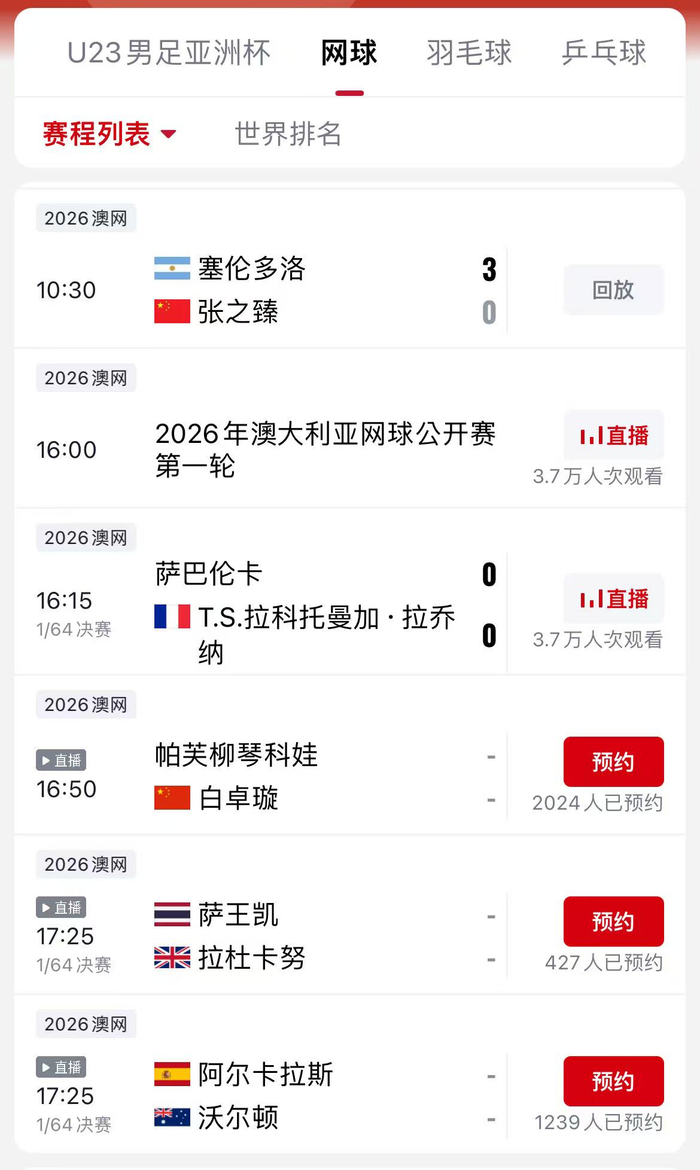
澳网奖金同比增长16%创新高,周杰伦和中国大公司添了一把火
Xin Lang Cai Jing· 2026-01-18 09:17
Group 1 - The Australian Open 2026 has set a record total prize money of AUD 111.5 million (approximately USD 75 million), an increase of 16% from the previous year, marking the highest total prize pool in history [4][5] - The singles champions will each receive AUD 4.15 million (approximately USD 2.8 million), a 19% increase from last year's AUD 3.5 million [5] - The event has seen a significant increase in attendance, with 120,000 spectators in 2025 and 136,248 in the first four days of the 2026 opening week, setting a new record [6] Group 2 - The Australian Open's revenue growth is attributed to various factors, including celebrity participation and diverse activities that attract fans, such as the "opening week" events [6][12] - The number of sponsors has increased from 36 in 2025 to 46 in 2026, indicating a growing commercial interest in the event [6][7] - Major sponsors include Kia Motors and Chinese liquor brand Luzhou Laojiao, which has seen a 236% increase in sales in Australia since partnering with the Australian Open [8][12] Group 3 - The partnership with the Australian Open has allowed Luzhou Laojiao to enhance its brand visibility, achieving significant media exposure and sales growth in the Australian market [12][13] - Other sponsors like Luckin Coffee and Haier are also leveraging the event to expand their presence in overseas markets, with Luckin Coffee upgrading its sponsorship status over the years [12][13] - The continuous increase in prize money reflects the growing commercial value of global tennis and the influence of the Chinese market on the event's development [13]

【广发宏观贺骁束】1月经济初窥
郭磊宏观茶座· 2026-01-18 08:56
Core Viewpoint - The article discusses the current state of various industries in China, highlighting the impact of the Lunar New Year timing on production and sales, as well as the mixed performance across different sectors. Group 1: Power Generation and Industrial Activity - As of January 8, the cumulative power generation from coal-fired power plants increased by 2.6% year-on-year, contrasting with a decline of 8.5% in December [1][6] - The industrial operating rates show mixed trends, with steel production rates improving while chemical production rates decline. The average operating rate of 247 blast furnaces rose by 1.4 percentage points year-on-year [7][8] - The average daily crude steel production from key enterprises increased by 11.8% month-on-month but decreased by 4.1% year-on-year as of January 10 [2][9] Group 2: Construction and Funding - The funding availability rate for construction sites decreased by 0.3 percentage points, indicating a lack of momentum in physical work [11] - The asphalt operating rate fell to 26.3%, down 2.1 percentage points month-on-month, reflecting a decline in construction activity [11][12] Group 3: Consumer Behavior and Sales - The average daily subway ridership in major cities increased by 15.8% year-on-year due to the Lunar New Year timing, indicating a slight recovery in consumer mobility [3][12] - Real estate sales showed a significant decline, with a 38.6% drop in daily average transactions in major cities compared to the same period last year [15] - Retail sales of passenger vehicles fell by 32% year-on-year, with wholesale volumes down by 40% [16] Group 4: Industry-Specific Insights - The photovoltaic industry manager index decreased to 133.0 points, reflecting a slight decline in industry sentiment [13] - The BPI index for industrial products reached a near one-year high, with significant price increases in coal and chemical products [22][23] - Port container throughput increased by 6.3% year-on-year, indicating resilience in logistics despite fluctuations in shipping volumes to the U.S. [18][20]

从星辰到算力,春季躁动基础仍在?
ZHONGTAI SECURITIES· 2026-01-18 08:46
Report Industry Investment Rating - The report does not explicitly mention the industry investment rating [1][2][3] Core Viewpoints of the Report - The spring rally in the A-share market at the beginning of the year was driven by the fear of missing out, but after the regulatory adjustment of the minimum margin ratio for margin trading, the market shifted from a rapid rise to a slow bull market. The two - margin funds did not leave but switched from high - leverage to low - leverage sectors. The left - hand force of the spring rally came from institutional investors, while foreign capital and margin trading formed the right - hand acceleration, with foreign capital participating more actively [2][15] - The AI industry chain is the main direction where funds form a consensus. The logic of "storage driving computing power, and computing power leading to applications" is expected to be a popular investment direction. Insurance in the financial sector can contribute absolute returns, and industries such as chemicals, home appliances, and panels can be considered for portfolio investment [3][28][29] Summary According to the Directory Market Review: From High - Speed Growth to Active Cooling - At the beginning of the year, the A - share market experienced a spring rally. From the beginning of the year to January 13, the Sci - tech Innovation 50 index rose 9.33%, and sectors such as media, computer, and national defense and military industry led the gains. The proportion of margin trading turnover in the total turnover reached 11.5%, approaching the upper limit of the historical average plus twice the standard deviation [8] - On January 14, the regulatory authorities announced an increase in the margin ratio from 80% to 100%, which was a measure to cool down the over - heated market sentiment. After the adjustment, there was a "hot - cold switch" in the broad - based index and industry structure. In the broad - based index, leveraged funds shifted from small - cap to large - cap stocks. In the industry structure, funds shifted from high - volatility themes to undervalued blue - chips [11][12][13] Slow Bull Trend Established, Leverage Cooling, but Bullish Sentiment Remains - Margin trading accelerated the spring rally but was not the dominant force. The spring rally was mainly driven by domestic institutional investors, with foreign capital and margin trading accelerating on the right - hand side, and foreign capital's participation was more significant. Comparing the trading volume ratios of 9 trading days before and after New Year's Day, the trading volume ratio of north - bound funds increased from 10.2% to 11.6%, while that of margin trading only increased from 11.0% to 11.4% [15] - While broad - based ETFs experienced large - scale outflows, theme - based ETFs continued to see inflows. For example, from January 14 to 16, the average daily net outflow of the CSI 300 ETF reached 14.71 billion yuan, while sectors such as non - ferrous metals, consumption, securities, and medical devices saw capital inflows [19][20] Tightening Micro - environment Accelerates Stock Game, with Both Offensive and Defensive Strategies - The marginal tightening of the micro - liquidity environment led to a stock game and structural optimization. The AI industry chain remained the main line, and some funds flowed back to sectors such as home appliances and chemicals with high safety margins [25] - The capital flow in the AI industry showed a "spiral relay" pattern, starting from storage chips and commercial aerospace, moving to AI applications, and then flowing back to storage and spreading to embodied intelligent robots. The semiconductor and media ETFs remained at the forefront, indicating strong market recognition of the AI industry chain [26] Index Uptrend Slows, Strong Focus on the AI Industry Chain - The AI industry chain's "storage - computing power - application" logic is expected to be a popular investment direction. The performance of US stocks provides a strong reference, and the continuous strength of overseas technology giants has raised the valuation ceiling for A - share counterparts [28] - Insurance in the financial sector can contribute absolute returns. It benefits from the bull market and the rise of the technology sector in terms of asset - side profitability and has defensive properties when offensive sectors adjust [28] - For portfolio investment, technology sectors can provide high returns and elasticity, while sectors such as chemicals, home appliances, and panels with improving fundamentals and healthy chip structures can be used as stable investment options [29]