公用事业

Search documents
【五矿信托研报】8月资产配置月度报告:“反内卷”推升风险偏好,美联储降息概率大增
Sou Hu Cai Jing· 2025-08-11 01:56
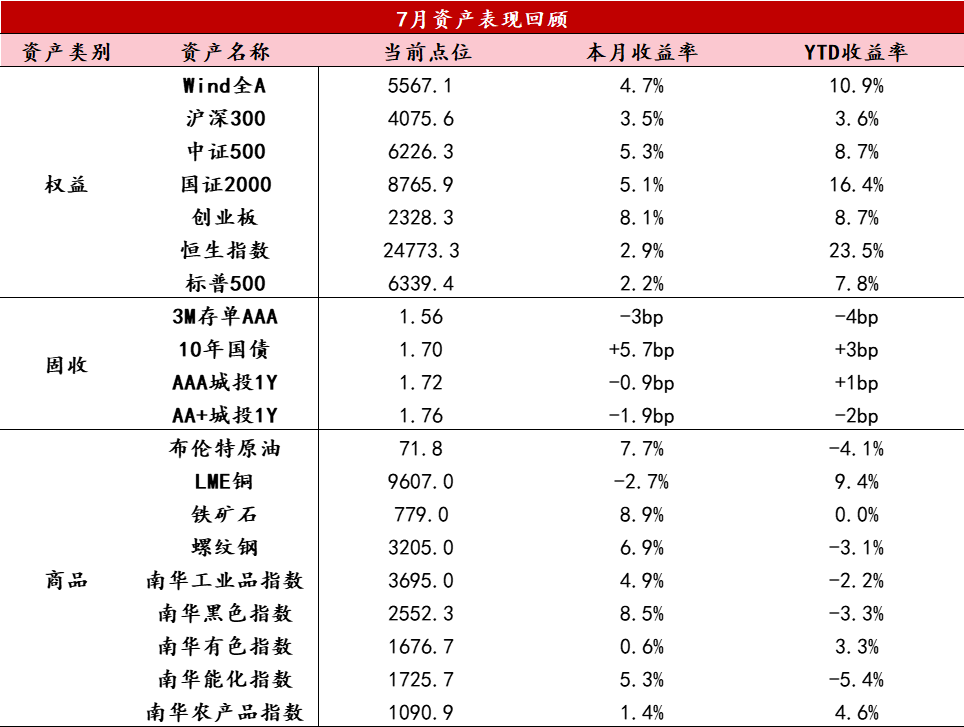
Economic Overview - In July, the US economy showed resilience, with market risk aversion decreasing and the probability of a Federal Reserve rate cut in September fluctuating [1] - Emerging markets continued to outperform developed markets, while domestic "anti-involution" policies and the Yajiang hydropower project led to a surge in commodity futures prices [1] - The Shanghai Composite Index broke through 3600 points, reaching a new high for the year, with the Wind All A Index rising by 4.75% for the month [1][3] Market Performance - The Hang Seng Index recorded a 2.91% gain in July, with southbound funds net buying approximately 124 billion yuan [1] - The bond market remained stable in early July but adjusted later in the month due to the impact of "anti-involution" policies and market sentiment fluctuations [1] - By the end of July, the yield on 10-year government bonds rose by nearly 6 basis points to 1.70%, indicating a steepening yield curve [1] Commodity Market - The commodity market experienced overall fluctuations, with precious metals showing high volatility; international gold prices fell by 0.72% to $3288.26 per ounce [2] - Oil prices showed a strong upward trend, with Brent crude oil rising by 7.73% to $71.78 per barrel [2] - The black metal sector rebounded significantly, with rebar prices increasing by 6.94% to 3205 yuan per ton [2] Economic Data - The National Bureau of Statistics reported that China's GDP for the first half of the year was 66,053.6 billion yuan, growing by 5.3% year-on-year [3][4] - Industrial production accelerated, with a year-on-year increase of 6.4% in the first half of the year, driven by strong export resilience and domestic demand policies [3] - Retail sales growth slowed to 5.0% year-on-year, with June's growth at 4.8%, below market expectations [4] Policy Insights - The Political Bureau of the Central Committee emphasized the need for stable and flexible macroeconomic policies to support employment and market expectations [7][8] - The meeting highlighted the importance of maintaining policy continuity and implementing proactive fiscal policies alongside moderate monetary easing [7] - The focus on expanding domestic demand and improving consumption was reiterated, with an emphasis on high-quality development [7] Investment Strategies - The market showed a significant increase in trading volume, with daily average turnover rising to approximately 1.6 trillion yuan [11] - The A-share financing balance reached a five-year high of 1.98 trillion yuan, indicating increased investor confidence [11] - The overall market sentiment remains positive, with expectations of a potential "risk-on" environment driven by favorable monetary policies and economic data [12][18]

华泰证券:香港本地股表现强势,获得超额收益
Jin Rong Jie· 2025-08-11 00:04
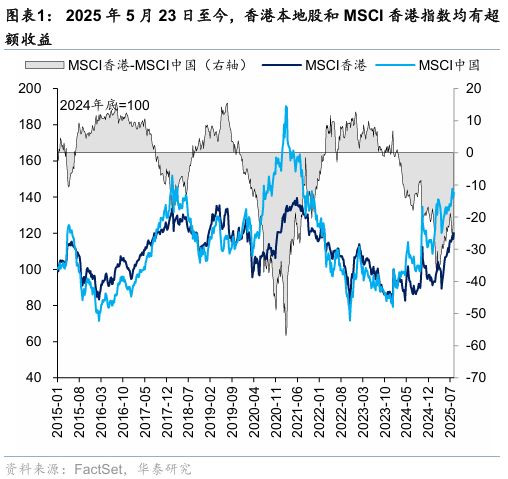
来源:华泰睿思 在 《港股重估蓄势待发》(深度研究 港股重估蓄势待发,2025.5.23)等报告中,华泰总量及行业团队 提出需战略性重视香港的配置,除了投资者熟知的香港中资股外,也强调关注香港本身作为小型开放经 济体的修复(【华泰宏观 专题】香港资产相对优势凸显,2025.5.22),以及香港地产(华泰 房地产: 把握资产重估预期下的香港地产机遇,2025.5.25)、银行(华泰 银行:重视中国资产重估下港银机 会,2025.5.23)、非银(《港交所:人民币升值预期下的价值重估》,2025.8.10)等资产重估机会。 2025年5月23日至今,香港本地股和MSCI香港指数分别上涨10.2%和12.4%,相对恒生指数(5.3%)和 MSCI中国指数(5.9%)均有超额收益 。 核心观点 香港本地股特征:重金融地产、高股息,ROE已修复但估值不高 我们以香港本地收入占比高于20%(接近友邦保险比例)作为香港本地股的划分依据。目前全部港股共 2649只,总流通市值约44万亿港币;香港本地股663只,总流通市值6.6万亿港币;其中个股流通市值大 于200亿港币和纳入港股通的香港本地股分别31和42只,总流通市值都接 ...

十大券商一周策略:A股仍处于牛市中继,避免参与似是而非的资金接力
Zheng Quan Shi Bao· 2025-08-10 23:59
Group 1 - The current market for small and micro-cap stocks needs to slow down, as high valuations and negative TTM profits make it difficult to justify further upward movement [2] - The five strong industry trends (non-ferrous metals, telecommunications, innovative pharmaceuticals, gaming, and military industry) have more reasonable valuations compared to the small and micro-cap stocks [2] - The main drivers of small and micro-cap stocks are liquidity and retail investor contributions, but their overall profit growth is not as strong as in 2015 [2] Group 2 - A rebound in A-shares was observed, driven by trading funds, with a focus on themes like dividends and small micro-cap stocks [3] - The two financing balance reached a nearly 10-year high, indicating that liquidity-driven market conditions may still have incremental support [3] - The PPI has shown signs of bottoming out, and the "anti-involution" policy is beginning to show effects, suggesting a stable economic outlook [3] Group 3 - July exports exceeded expectations, particularly in competitive manufacturing sectors like machinery, automobiles, and integrated circuits [4] - The PPI decline has stabilized, benefiting from price rebounds in sectors like black metals, non-ferrous metals, coal, and photovoltaics [4] - The basic economic fundamentals are showing a trend of steady improvement, with recommendations to focus on sectors with high growth or improvement in earnings [4] Group 4 - The two financing balance has risen above 2 trillion yuan, but remains at historical mid-levels compared to the peak in 2015 [5] - The market is expected to maintain a high volatility range, with a focus on sectors with strong earnings performance during the concentrated reporting period [5] - The "anti-involution" concept is anticipated to be a recurring theme in the market, alongside opportunities in growth sectors driven by AI and emerging industries [5] Group 5 - The current bull market atmosphere is not expected to dissipate easily, with potential mainline directions including domestic technological breakthroughs and competitive manufacturing sectors [6] - The market is likely to maintain its characteristics of sector rotation and high micro-level activity, with small-cap growth stocks continuing to outperform [6] - There are new opportunities for participation, particularly in event-driven individual stocks [6] Group 6 - Short-term upward movement in A-shares may face resistance, but the market remains in a bull market continuation phase [7] - The focus is on new low-level niche products in emerging sectors, with significant potential in areas like brain-computer interfaces and liquid cooling technologies [7] - The military sector is expected to have a short-term rally, with attention on new combat capabilities and military trade-related stocks [7] Group 7 - The current market rally is supported by various sources of incremental capital, with a notable increase in M1-M2 growth rates indicating enhanced liquidity [8] - The two financing balance reaching a 10-year high reflects a rising risk appetite among individual investors [8] - The focus on new technologies and growth directions, such as domestic computing power and robotics, is expected to drive future market trends [8] Group 8 - There is a divergence in judgment regarding the liquidity-driven bull market, with the potential for significant resident capital inflow into the stock market [9] - Historical patterns suggest that the initial phases of a bull market often see improvements in specific channels before broader participation [9] - The current market's rise is still modest compared to previous bull markets, indicating that concerns about a major downturn may be premature [9] Group 9 - The current market adjustment is seen as a structural shift rather than a peak in the broader cycle, with manageable index fluctuations [11] - The market is transitioning from traditional cyclical sectors to technology sectors, driven by policies similar to previous economic stimulus measures [11] - Continued focus on technology sectors, including AI and robotics, is recommended for future investment strategies [11]
固收周报20250810:“债不弱,股不强”格局下转债仍将扮演必要角色-20250810
Soochow Securities· 2025-08-10 13:47
Group 1: Report Industry Investment Rating - The report does not explicitly mention the industry investment rating [1] Group 2: Core Views of the Report - Maintain a relatively optimistic view of the convertible bond market in the second half of the year, due to the continuous imbalance between supply and demand and the "asset shortage" situation, the important role of convertible bonds in the asset portfolio, and the need to conduct high - low switching [1] - In the context of a slow - bull equity market, there are still opportunities for bank convertible bonds [1] - The top ten high - rating, medium - low - price convertible bonds with the greatest potential for par premium rate repair next week are Hexing Convertible Bond, Guangda Convertible Bond, etc. [1] Group 3: Summary According to the Directory 1. Week - to - Week Market Review 1.1. Equity Market Overall Rise, Most Industries Rise - From August 4th to 8th, the equity market rose overall, with the Shanghai Composite Index up 2.11%, the Shenzhen Component Index up 1.25%, the ChiNext Index up 0.49%, and the CSI 300 up 1.23%. The average daily trading volume of the two markets decreased by about 1121.60 billion yuan to 16748.23 billion yuan, a week - on - week decrease of 6.28% [6][8] - Among the 31 Shenwan primary industries, 25 industries closed up, with National Defense and Military Industry, Non - Ferrous Metals, etc. leading the gains [12] 1.2. Convertible Bond Market Overall Rise, Most Industries Fall - From August 4th to 8th, the CSI Convertible Bond Index rose 2.31%. Among the 29 Shenwan primary industries, 4 industries closed up, with Automobile, Social Services, etc. leading the gains. The average daily trading volume of the convertible bond market was 895.48 billion yuan, a significant increase of 72.55 billion yuan, a week - on - week change of 8.82% [15] - About 92.46% of convertible bond issues rose, and 51.72% of them had a gain of over 2% [15] - The overall market conversion premium rate rebounded, with an average daily conversion premium rate of 41.62%, an increase of 0.98 pct compared to last week [22] - 20 industries saw an expansion in the conversion premium rate, and 17 industries had an increase in conversion parity [28][33] 1.3. Stock - Bond Market Sentiment Comparison - From August 4th to 8th, the weekly weighted average and median of the convertible bond and underlying stock markets were positive, and the underlying stocks had a larger weekly gain. The trading volume of the convertible bond market increased by 5.07% week - on - week, and that of the underlying stock market decreased by 6.84% week - on - week. The trading sentiment of the underlying stock market was better [34] 2. Outlook and Investment Strategy - Maintain the previous view, be relatively optimistic about the convertible bond market in the second half of the year. In the context of a slow - bull equity market, there are still opportunities for bank convertible bonds [1][38] - The top ten high - rating, medium - low - price convertible bonds with the greatest potential for par premium rate repair next week are Hexing Convertible Bond, Guangda Convertible Bond, etc. [1]




如何抓住香港本地股的配置机遇
HTSC· 2025-08-10 10:37
证券研究报告 策略 如何抓住香港本地股的配置机遇 2025 年 8 月 10 日│中国内地 策略周报 香港本地股表现强势,获得超额收益 在《港股重估蓄势待发》,2025.5.23 等报告中,华泰总量及行业团队提出 需战略性重视香港的配置,除了投资者熟知的香港中资股外,也强调关注香 港本身作为小型开放经济体的修复(《香港资产相对优势凸显》,2025.5.22), 以及香港地产(《把握资产重估预期下的香港地产机遇》,2025.5.25)、 银行(《重视中国资产重估下港银机会》,2025.5.23)、非银(《港交所: 人民币升值预期下的价值重估》,2025.8.10)等资产重估机会。2025 年 5 月 23 日至今,香港本地股和 MSCI 香港指数分别上涨 10.2%和 12.4%,相 对恒生指数(5.3%)和 MSCI 中国指数(5.9%)均有超额收益。 免责声明和披露以及分析师声明是报告的一部分,请务必一起阅读。 华泰研究 易峘 研究员 SAC No. S0570520100005 SFC No. AMH263 李雨婕 研究员 SAC No. S0570525050001 SFC No. BRG962 香港本 ...
要盯紧保险资金动向了
Ge Long Hui· 2025-08-09 12:00
Market Overview - Since July, the A-share market has shown strong performance, recovering from a dip and reaching new highs for the year, approaching the previous peak of 3674 points from October 8, 2022 [3] - There are mixed sentiments among investors, with some optimistic about breaking through 3674 points and potentially reaching 4000 points, while others are concerned about high valuations and overly optimistic economic growth expectations [3] Fund Flows and Market Dynamics - The direction of the market is ultimately determined by the flow of funds, with net inflows driving market uptrends [4] - In 2017, the A-share market experienced a significant rally led by blue-chip stocks, with the Shanghai Stock Exchange 50 Index rising nearly 30% [4] - In 2020-2021, the A-share market saw extreme volatility, with the CSI 300 Index reaching a historical high of 5930 on February 18, 2021, with a PE ratio of 17.5, significantly above the 10-year average of 12.3 [5] Institutional Investment Trends - The expansion of actively managed public funds has been a key driver of the recent market rally, with public funds' share of A-share free float market value increasing from 11.6% in 2020 to 13.6% in 2021 [7] - As of 2024, the banking sector has shown strong performance, with the Shanghai Composite Index and other indices posting gains of 22.2%, 19.6%, 16.5%, and 16.2% respectively [7] - The A-share ETF market has grown significantly, with a total market size of 3.7 trillion yuan, reflecting an 83% increase since the beginning of the year [8] Future Fund Inflows - Insurance funds are expected to become a major source of incremental capital in the market, with their holdings in stocks increasing from over 2 trillion yuan to nearly 3 trillion yuan [9] - The potential for insurance funds to drive market trends is supported by recent policy changes encouraging long-term investments in A-shares [18] - The shift in focus towards high-dividend stocks is anticipated, particularly in the banking sector, as insurance funds seek stable returns [9][10] Sector Performance and Outlook - The market may see a shift back to conservative styles, focusing on dividend-related sectors, particularly banks, utilities, and cyclical stocks [20][21] - The cyclical dividend stocks are viewed as a better investment choice due to their potential for recovery and growth, especially in light of ongoing economic reforms [22] - Recent performance has shown significant gains in cyclical sectors, with steel up 20.8% and construction materials up 17.9%, while utilities and banks have lagged behind [22]

要盯紧保险资金动向了
格隆汇APP· 2025-08-09 11:52
Core Viewpoint - The A-share market has shown strong performance since July, with expectations of a bull market, but concerns about high valuations and overly optimistic economic growth predictions persist [2][3]. Market Dynamics - The direction of the market ultimately depends on the capital flow; when net inflows exceed outflows, the market rises, and vice versa [3]. - The dominant capital influences market style, as seen in previous years where specific funds drove significant market movements [4][5]. Fund Flows and Market Performance - In 2017, northbound capital significantly contributed to the blue-chip rally, with net purchases nearing 200 billion yuan, surpassing the total of the previous three years [5]. - The public fund sector has expanded, with its share of A-share free float market value increasing from 6.8% in 2019 to 13.6% in 2021 [8]. - As of 2024, the banking sector has surged by 53%, driven by substantial inflows into ETFs and insurance funds, with the Shanghai Composite Index and other indices showing notable gains [9][10]. Institutional Investor Landscape - Retail investors hold the largest share of A-shares at 54%, but institutional investors, including public funds, insurance, and private equity, dominate market influence [11][14]. - The decline in public fund market share from 13.6% in 2021 to 10.3% in 2024 indicates a shift in market dynamics [15]. Future Capital Inflows - Future capital inflows are likely to come from ETFs and insurance funds, with the latter expected to play a significant role in the second half of 2024 and beyond [18][19]. - Policy changes aimed at increasing insurance capital investment in A-shares are anticipated to drive further market participation [20][21]. Sector Focus - The market may shift towards dividend-related sectors, particularly banks, utilities, and cyclical stocks, as insurance funds seek stable returns [24][25]. - The cyclical dividend sector is viewed as a better investment choice due to its potential for recovery and growth, despite some segments already showing high valuations [25].

结构性行情主导A股“攻守兼备”策略重要性凸显
Zhong Guo Zheng Quan Bao· 2025-08-08 21:03
Group 1 - The A-share market has shown significant activity, with the Shanghai Composite Index stabilizing above 3600 points and a year-to-date increase of 8.45% as of August 8, with an average daily trading volume exceeding 1.4 trillion yuan [1][2] - The current market rally is driven by both liquidity and positive policy expectations, with a notable increase in investor participation and financing balances since late June [2][3] - Analysts suggest a dual strategy of investing in both technology growth and high-dividend assets, emphasizing the importance of long-term patience to avoid frequent trading due to short-term profit chasing [1][4] Group 2 - The market is believed to have substantial upside potential, with the current valuation levels being lower compared to previous instances when the index surpassed 3600 points, indicating a higher concentration of emerging industries, particularly hard technology [3][4] - Investment strategies for the second half of the year should focus on stability first, followed by aggressive positioning as uncertainties diminish, with key areas of interest including industrial metals, lithium batteries, innovative pharmaceuticals, and AI-related sectors [3][4] - The shift in investment strategy from short-term trading to a more patient, long-term holding approach is recommended, with an emphasis on diversifying investments across multiple promising sectors and maintaining a balanced portfolio [5][6]
周期、制造多主题走出主升形态
Huafu Securities· 2025-08-08 12:44
Group 1 - The strategy report focuses on a theme investment database aimed at identifying high-quality price-volume patterns and monitoring the peak rhythm of popular themes and the adjustment levels of leading stocks [2][9]. - The report highlights the construction of a data tracking system for theme investment, concentrating on two aspects: quantitative screening of four types of patterns for high-yield theme opportunities and the development of trading heat indicators to grasp the peak rhythm of popular themes [2][9]. - In the current period, the number of theme indices showing bottoming, breakout, main rise, and acceleration patterns are 0, 3, 25, and 0 respectively, with the breakout indices primarily in the non-ferrous metals and public utilities sectors, while the main rise indices are mainly in machinery equipment, electronics, and military industries [12]. Group 2 - The trading heat for the humanoid robot theme has rebounded to 80%, with the closing price of Changsheng Bearing exceeding the MA60 by 25.7%. For the Deepseek theme, the trading heat remains at 73%, with the closing price of Daily Interaction above the MA60 by 3.4% [3][18].
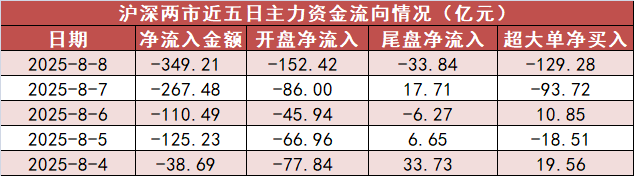
【8日资金路线图】公用事业板块净流入28亿元居首 龙虎榜机构抢筹多股
Zheng Quan Shi Bao· 2025-08-08 12:07
8月8日,A股市场整体下跌。 截至收盘,上证指数收报3635.13点,下跌0.12%,深证成指收报11128.67点,下跌0.26%,创业板指收报2333.96点,下跌0.38%,北证50指数下跌1.22%。 A股市场合计成交17365.31亿元,较上一交易日减少1162.09亿元。 2.沪深300今日主力资金净流出73.22亿元 沪深300今日主力资金净流出73.22亿元,创业板净流出200.99亿元,科创板净流出6.92亿元。 | | 各板块最近五个交易日主力资金净流入数据(亿元) | | | | --- | --- | --- | --- | | 日期 | 沪深300 | 创业板 | 科创板 | | 2025-8-8 | -73. 22 | -200. 99 | -6.92 | | 2025-8-7 | -61.39 | -142.85 | 11. 84 | | 2025-8-6 | -23.60 | -19.36 | -21.98 | | 2025-8-5 | 0. 38 | -74. 03 | -1. 38 | | 2025-8-4 | -5. 10 | -25.07 | -19.58 | | | ...