服务业

Search documents
如何理解PMI与EPMI背离?
申万宏源宏观· 2025-03-31 08:10
Core Viewpoint - The divergence between PMI and EPMI is primarily due to the differentiation in the economic conditions of emerging and traditional industries, with the former showing stronger performance in March [1][8]. Manufacturing Sector - In March, the manufacturing PMI increased moderately by 0.3 percentage points to 50.5%, which is below market expectations [1][8]. - The EPMI for strategic emerging industries rose significantly by 10.6 percentage points to 59.6%, indicating a strong recovery in these sectors [1][8]. - High-tech and equipment manufacturing sectors saw substantial PMI increases of 1.4 and 1.2 percentage points, reaching 52.3% and 52% respectively, while traditional sectors like consumer goods manufacturing only saw a marginal increase of 0.1 percentage points to 50% [2][13]. - The production index for EPMI surged by 21.6 percentage points, contrasting with a slight increase of 0.1 percentage points in the manufacturing PMI production index, which reached 52.6% [2][17]. Non-Manufacturing Sector - The non-manufacturing PMI rose by 0.4 percentage points to 50.8%, with the construction sector's PMI increasing by 0.7 percentage points to 53.4%, although this was weaker than seasonal expectations [3][5]. - The service sector's PMI increased by 0.3 percentage points to 50.3%, but this was also below the same period in previous years [3][5]. - The construction sector remains constrained by weak real estate investment, while the service sector is limited by the performance of life services [3][22]. Future Outlook - There are increasing risks to exports, but potential improvements in the economy may arise from accelerated import substitution and recovery in the service sector and real estate sales [3][31]. - The manufacturing sector may receive support from accelerated import substitution in industries like electrical and mechanical equipment, while the construction and service sectors show signs of recovery [3][31]. Regular Tracking - The manufacturing PMI continues to show a mild recovery, with production and new order indices slightly increasing [4][37]. - The non-manufacturing PMI reflects a general improvement, with both construction and service sectors showing slight increases [5][46].


西安大力发展首店首发经济
Xi An Ri Bao· 2025-03-28 02:48
Group 1 - The core idea is that Xi'an is actively developing its "first store economy," significantly diversifying and internationalizing its consumer market, with a projected addition of 436 new brand first stores in 2024, representing a 24.5% increase from 2023 [1][3] - Among the new first stores, 367 are domestic brands (84.1%) and 69 are international brands (15.8%), indicating a strong focus on local brand development [1] - In terms of store levels, Xi'an will see 13 national first stores, 168 Northwest first stores, 10 Shaanxi first stores, and 245 Xi'an first stores in 2024, with the Northwest first stores accounting for 38% of the total new first stores, showing a significant increase of 76.8% from 95 stores in 2023 [1] Group 2 - The Xi'an Municipal Bureau of Commerce aims to leverage the city's resource advantages and cultural heritage to stimulate large-scale consumption, expand service consumption, and develop new consumption models, including the first store economy, silver economy, night economy, and holiday economy [2] - The focus will also be on promoting digital, green, health, and service consumption, indicating a comprehensive approach to enhancing the consumer landscape in Xi'an [2]
又一份“坏数据”?美国3月商业活动回暖,但信心进一步恶化
美股研究社· 2025-03-27 11:55
Core Viewpoint - The article discusses the recent recovery in U.S. business activity in March, while highlighting concerns over import tariffs and significant government spending cuts that may impact market sentiment and economic outlook for the remainder of the year [3][4]. Group 1: Economic Indicators - The S&P Global survey indicates that the new orders index rose from 51.9 in February to 53.3 in March, while the employment index increased slightly from 49.4 in January to 50.6 [3]. - The composite PMI output index for the U.S. rose from 51.6 in February to 53.5 in March, indicating expansion in the private sector [4]. - The annualized growth rate of the U.S. economy in March was reported at 1.9%, with a quarterly annualized growth rate of only 1.5%, suggesting a slowdown compared to the end of 2024 [5]. Group 2: Inflation and Pricing - The input prices index surged from 58.4 in February to 60.9 in March, marking the highest level since April 2023, driven by tariffs and rising labor costs [5]. - The prices charged index for goods and services increased from 52.3 to 53.6, indicating that manufacturers are passing higher costs onto consumers, although service sector firms face challenges in raising prices due to slowing demand [6]. - The core PCE inflation rate is projected to rise by 2.8% this year, up from a previous estimate of 2.5%, reflecting ongoing inflationary pressures [5].


德国放宽“债务刹车”限制
Ren Min Ri Bao· 2025-03-25 22:01
Group 1 - Germany's President Steinmeier signed a constitutional amendment to relax the "debt brake" restrictions, allowing the federal government to establish a special fund of €500 billion for infrastructure projects without being constrained by debt limits [1] - The reform is viewed as a fiscal cornerstone for the new German government, with expectations that large-scale fiscal spending will stimulate economic growth and create more jobs, enhancing Germany's economic competitiveness [1] - Goldman Sachs and Nomura Securities predict that this move will boost Germany's economic growth, positively impacting other European countries as well [1] Group 2 - Germany's economy has faced challenges, with GDP contracting by 0.2% in Q4 2024 and a year-on-year decline of 0.2%, marking the second consecutive year of negative growth [2] - Key sectors such as manufacturing saw a 3% decline in output, particularly in machinery and automotive industries, while service sectors experienced a modest growth of 0.8% [2] - Domestic household consumption increased slightly by 0.3%, with notable growth in health and transportation sectors, rising by 2.8% and 2.1% respectively [2] Group 3 - Forecasts indicate a gradual recovery for the German economy starting this year, with the Munich Institute for Economic Research reporting an increase in the business climate index from 85.3 to 86.7 in March [3] - The IMF predicts a 0.3% growth in Germany's GDP for 2025, while the European Commission expects domestic demand to rebound, projecting GDP growth of 0.7% in 2025 and 1.3% in 2026 [3] - Germany's inflation rate has been declining, dropping from a peak of 11.6% in October 2022 to 2.4% in October 2024, contributing to positive economic outlooks [3] Group 4 - The German central bank's president, Nagel, expressed concerns about increased uncertainty for the German economy due to U.S. tariffs on EU steel and aluminum imports, suggesting a potential for recession in 2025 [4]
“软数据”继续恶化,美国费城联储服务业调查指数跌至疫情来最低
Hua Er Jie Jian Wen· 2025-03-25 13:46
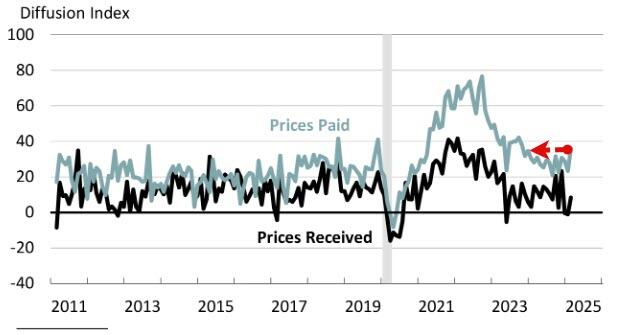
25日,根据费城联储最新公布的数据,服务业部门当前活动指数从-13.1急剧下跌至-32.5,跌至2020年5月以来的最低水平。 通常,"软数据"主要是指基于调查、情绪和预期的经济指标,而"硬数据"是具有明确、客观的数值和统计基础的数据。分析认为,至 少在软数据方面,这些数据似乎表明,美国大选后的"蜜月期"已经结束,服务业增长前景黯淡。 未来预期指数四连跌,首次转为负值 费城联储报告显示,企业层面的未来活动扩散指数暴跌了34点至-19.8,这是该指数连续第四次下降,也是自2020年4月以来的首次负 值读数。 "软数据"继续恶化,美国费城联储服务业调查指数跌至疫情来最低 美国费城联储服务业调查数据降至疫情以来最低点,服务部门衰退警报拉响。 一般活动指数、新订单指数和销售/收入指数均保持在负值区间,其中前两项进一步下滑。不过,价格指数有所上升,表明整体价格 仍在上涨。 更令人担忧的是,未来活动预期指标的表现甚至更为糟糕。这与近期多项"软数据"恶化趋势一致,尽管"硬数据"仍相对稳健。 全职就业指数下降了10点至-7.5,这是自去年8月以来的首次负值。服务业就业前景正在恶化。 这种软数据与硬数据之间的分化值得投资者密切 ...
罗志恒:如何理解1-2月经济数据“开门红”?丨宏观经济
清华金融评论· 2025-03-19 10:11
以下文章来源于持志以恒2020 ,作者罗志恒 持志以恒2020 . 思索天地自然、社会与人心……在这里,追求自由与思想。 文/ 粤开证券研究院副院长、首席宏观研究员 罗志恒 今年以来中国经济总体延续去年926政治局会议以来的恢复态势,1- 2月 经济数据"开门红",工业和服务业、消费和投资同比增速均高于去年全年 增速。一季度GDP同比或达5.5%左右,为实现全年" 5%左右"的增速目标 奠定良好基础。 经济数据"开门红"的三大动能 今年以来中国经济总体延续去年926政治局会议以来的恢复态势,生产供给稳定增长、消费投资稳中有 升,为一季度经济开局奠定良好基础。1-2月经济数据"开门红",一季度GDP同比或达5.5%左右。生产 方面,1-2月规模以上工业增加值和服务业生产指数同比分别增长5.9%和5.6%,较去年全年分别加快0.1 和0.4个百分点;需求方面,社会消费品零售总额和固定资产投资完成额同比分别增长4%和4.1%,较去 年全年分别加快0.5和0.9个百分点。 值得注意的是,今年1-2月经济数据受到两大不利因素拖累,在这样的背景下,当前成绩更显不易。一 是工作日减少带来的不可比因素,受闰年和平年、元旦和春 ...

宏观点评:如何看待1-2月经济数据?-2025-03-18
GOLDEN SUN SECURITIES· 2025-03-18 00:53
如何看待 1-2 月经济数据? 事件:2025 年 1-2 月工业增加值同比 5.9%(前值 6.2%),社零同比 4.0%(前值 3.7%);1-2 月固投同比 4.1%(前值 3.2%),地产投资同 比-9.8%(前值-10.6%),广义基建投资同比 10.0%(前值 9.2%),制 造业投资同比 9.0%(前值 9.2%)。 核心观点:1-2 月经济开局平稳、有强有弱、分化明显,最大亮点可谓 地产销售跌幅明显收窄、属于"小阳春"。往后看,经济走势的不确定 性较大,一是地产销售的持续性有待进一步观察;二是两会政策将逐 步落地,有望对经济基本面构成有利支撑;三是特朗普关税的扰动大, 对我国出口的冲击可能进一步显现。 宏观点评 证券研究报告 | 宏观研究 gszqdatemark 2025 03 17 年 月 日 1、整体看,1-2 月经济基本平稳、有强有弱、分化明显,结构上延续 "供给偏强、需求偏弱",其中:偏强的是,1-2 月工业生产、基建投 资、制造业投资增速维持高位,消费、地产投资环比改善,地产销售跌 幅明显收窄则可谓最大的亮点;偏弱的是,1-2 月 CPI、PPI 整体延续 低位,进口增速大幅走低, ...
粤开宏观:如何理解1-2月经济数据“开门红”?
Yuekai Securities· 2025-03-17 12:19
Investment Rating - The report indicates a positive outlook for the industry, suggesting an "increase" rating based on expected returns exceeding the benchmark index by more than 5% in the upcoming period [30]. Core Insights - The Chinese economy has shown a recovery trend since the 926 Politburo meeting, with January-February economic data indicating a strong start to the year, with GDP growth expected to reach around 5.5% year-on-year in Q1 [7][14]. - The recovery is supported by stable production and increasing consumption and investment, with industrial output and service sector growth rates improving compared to the previous year [7][8]. - The report highlights the importance of macroeconomic policies in sustaining this recovery, emphasizing the need for continued policy support to enhance internal growth momentum and establish a virtuous cycle of economic improvement [19][20]. Summary by Sections Economic Data "Opening Red" Dynamics - The report identifies three main drivers for the positive economic data in early 2025: stable production growth, steady consumption, and investment increases [7]. - Industrial value-added and service production indices grew by 5.9% and 5.6% year-on-year, respectively, while retail sales and fixed asset investment increased by 4% and 4.1% [7][8]. Current Economic Risks and Challenges - Despite the positive data, the report warns of external challenges, including intensified global trade tensions and insufficient domestic demand, which could hinder sustained economic recovery [14][15]. - The real estate market remains a concern, with ongoing credit risks for real estate companies and a need for stabilization in housing prices [15][16]. Annual Economic Outlook and Policy Recommendations - The report forecasts that consumption and infrastructure investment will be the main drivers of economic growth in 2025, while exports may act as a drag on growth [18][19]. - It recommends that fiscal policies should focus on enhancing consumer purchasing power and improving the overall economic environment to stimulate demand [20][21].
坚定信心、相信未来——申万宏源2025资本市场春季策略会
2025-03-13 03:23
Summary of Key Points from the Conference Call Industry Overview - The conference call focuses on the **Chinese economy** and its macroeconomic trends for **2025**. Core Insights and Arguments - **Shift from Demand to Supply**: The macroeconomic trend for 2025 will transition from demand-driven to supply-driven, with key areas of focus being the recovery of consumer supply, expansion of service sector investment, and optimization of real estate inventory policies, which are expected to release pent-up demand and excess savings [3][4][20]. - **Impact of Weak External Demand**: Weak external demand will significantly affect Chinese exports, with developed countries' import growth slowing down. Even if the U.S. economy remains resilient, Chinese exports will face downward pressure [5][20]. - **Manufacturing Investment Risks**: Manufacturing investment is expected to decline in 2025 due to a weakening natural renewal cycle and limited impact from equipment renewal policies, posing a potential drag on the economy [6][20]. - **Real Estate Market Adjustments**: The primary issues in the real estate market stem from supply-side policy adjustments and completion risks, which lead to deferred demand. Optimizing inventory policies and controlling residential increments can stabilize housing prices and release pent-up demand [8][11][20]. - **Service Sector Investment**: The government aims to expand service sector investment to alleviate supply constraints on service consumption, which has been declining. This is a response to the imbalance between goods and services consumption [10][12][20]. - **Fiscal Policy Adjustments**: The fiscal policy for 2025 is expected to be more proactive, focusing on expanding financing to support key areas such as science and technology, debt servicing, and national defense, while also emphasizing consumer and livelihood protection [3][20][28]. Additional Important Content - **Excess Savings**: There is a significant amount of excess savings (approximately 13 trillion yuan) accumulated by residents over the past four years, which is expected to gradually support domestic demand [7][20]. - **Service Consumption Recovery**: Service consumption is showing signs of recovery, with increased fixed asset investment in the accommodation and catering sectors, indicating a potential rebound in service demand [18][20]. - **Regional Consumption Dynamics**: The central and western regions of China are becoming important consumption destinations due to improved infrastructure and rising disposable incomes, which support cross-regional consumption [19][20]. - **Government Support for Vulnerable Groups**: The government has implemented measures to support vulnerable groups, including increased unemployment benefits and social assistance, to prevent further declines in consumer confidence [33][20]. - **Long-term Institutional Reforms**: The government is focusing on long-term reforms to enhance social security and support for the elderly and children, which will have a significant impact on consumption patterns in the future [41][45][20]. This summary encapsulates the key points discussed in the conference call regarding the Chinese economy's outlook for 2025, highlighting the transition in macroeconomic drivers, potential risks, and government policy responses.

小非农大幅不及预期,美国经济又添危险信号?
美股研究社· 2025-03-06 10:32
Core Viewpoint - The recent ADP employment data indicates a slowdown in private sector job growth, raising concerns among economists and investors about the overall economic environment [2][4]. Employment Data Summary - In February, the ADP reported an increase of 77,000 jobs, significantly below the expected 140,000, with the previous month's figure revised up to 186,000, marking the smallest increase since July 2024 [2]. - Job losses were primarily concentrated in the services sector, particularly in trade, transportation, utilities, education, and healthcare [2]. - Employment changes by sector in February: - Trade/Transportation/Utilities: Decreased by 33,000 jobs, following an increase of 56,000 in January [2]. - Construction: Increased by 26,000 jobs, up from 3,000 in January [2]. - Professional/Business Services: Increased by 27,000 jobs, compared to 14,000 in January [2]. - Manufacturing: Increased by 18,000 jobs, reversing a decrease of 13,000 in January [2]. - Financial Services: Increased by 26,000 jobs, up from 13,000 in January [2]. Economic Outlook - ADP's Chief Economist Nela Richardson noted that uncertainty in policy and a slowdown in consumer spending may have contributed to the recent layoffs and hiring hesitance [4]. - The rising number of unemployment claims and concerns about future unemployment rates are indicative of a cooling labor market [4]. - Market attention is focused on the upcoming government non-farm payroll report, which could further confirm fears of an economic slowdown and influence Federal Reserve monetary policy decisions [4][5]. - Economists expect the non-farm payroll report to show an increase of 153,000 jobs, with the unemployment rate remaining at 4% [5].