
军工

Search documents
军工攻势再起!高人气军工ETF华宝上演V型逆转!菲利华续创历史新高
Xin Lang Ji Jin· 2026-02-26 02:45
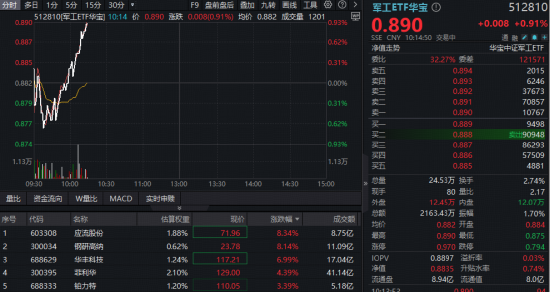
Core Viewpoint - The military industry sector is experiencing a significant upward movement, with the military ETF Huabao (512810) rising nearly 1% and achieving a five-day consecutive increase, driven by strong performances from constituent stocks like Gangyan Gaona and Feili Hua, which saw gains of over 9% and 4% respectively [1][2]. Group 1: Short-term Outlook - The demand for commercial aerospace and aviation is expected to grow significantly over the next five years, with both sectors representing trillion-level markets, likely to attract continued market interest [1]. - The year 2026 marks the beginning of a new inventory cycle as part of the "14th Five-Year Plan," with upstream supply chains expected to benefit first, and order momentum potentially starting as early as this year [1]. Group 2: Medium-term Outlook - Military trade demand is anticipated to reach a significant turning point, leading to a simultaneous increase in both quantity and price of equipment demand, benefiting main engine and key subsystem manufacturers [2]. - Strong demand for AI in the power generation sector is expected to sustain the momentum of the gas turbine industry chain [2]. Group 3: Long-term Outlook - By 2027, coinciding with the centenary of the military, national defense spending is projected to maintain a high growth rate of around 7%, alongside accelerated iterations of next-generation main battle equipment and rising demands for new combat capabilities, indicating sustained high prosperity in the military industry [2]. Group 4: Investment Tool - The military ETF Huabao (512810) covers various popular themes such as large aircraft, commercial aerospace, low-altitude economy, satellite navigation, military informatization, and controllable nuclear fusion, serving as an efficient tool for investing in core military assets [2].


AI基建带动燃机需求,国防ETF(512670)冲击5连涨
Xin Lang Cai Jing· 2026-02-26 02:40
Group 1 - The core viewpoint of the articles highlights the increasing demand for gas turbines driven by AI infrastructure, with a significant rise in global data center electricity consumption projected by Gartner [1] - Gartner forecasts that electricity consumption in data centers will surge by 160% from 2023 to 2027, with new AI-optimized servers expected to consume 500 terawatt-hours annually, which is 2.6 times the consumption in 2023 [1] - Longjiang Securities indicates that the explosive demand for electricity is forcing upgrades in energy infrastructure, with gas turbines being essential for peak shaving and backup power, leading to nearly 60 GW of new installed capacity globally by 2024 [1] Group 2 - As of January 30, 2026, the top ten weighted stocks in the China Securities Defense Index (399973) include Aerospace Electronics, Aero Engine Corporation of China, AVIC Shenyang Aircraft Corporation, and others, collectively accounting for 42.4% of the index [2] - The Defense ETF (512670) closely tracks the China Securities Defense Index, which includes listed companies under the ten major military groups and those providing weaponry and equipment to the armed forces [1][2]
日本竟公开宣布:在距台湾110公里小岛,5年内部署导弹
Bei Jing Ri Bao Ke Hu Duan· 2026-02-26 00:46
Group 1 - Japan's ruling Liberal Democratic Party has approved a proposal to relax restrictions on the export of defense equipment, which is expected to be submitted to the government next month and may take effect in spring 2023 [1][7] - The proposal will allow the export of military equipment such as fighter jets and destroyers, with provisions for exporting to countries currently engaged in combat, subject to review by Japan's National Security Council [2][7] - Japan's current "Three Principles on Defense Equipment Transfer" limits exports to non-combat purposes, but Prime Minister Fumio Kishida has expressed intentions to modify these rules to enhance deterrence and defense capabilities [2][8] Group 2 - Japan plans to deploy missile units on the Yonaguni Island, located approximately 110 kilometers from Taiwan, with the deployment expected by 2030 [3][9] - The missile units will utilize the Type 03 medium-range surface-to-air missile system, aimed at strengthening Japan's defense capabilities in response to potential conflicts involving Taiwan [3][9] - Analysts suggest that this deployment is part of Japan's broader strategy to establish a multi-layered air defense system in coordination with U.S. military operations in the region [9] Group 3 - Concerns have been raised by China regarding Japan's military movements, with Chinese officials urging the international community to remain vigilant against Japan's perceived resurgence of militarism [1][10] - There is significant public opposition within Japan, with protests occurring against the government's push for constitutional amendments and military expansion, reflecting fears of a return to militarism [5][10]
黄萌萌:当德国开始反思对美依赖
Xin Lang Cai Jing· 2026-02-25 23:03
Group 1: Strategic Autonomy and Economic Competitiveness - The core themes in Chancellor Merz's speeches include "strategic autonomy," "economic competitiveness," and "reducing technological dependence," reflecting a shift in Germany's relationship with the U.S. [1] - Germany is beginning to reassess its reliance on the U.S., as trust in the transatlantic alliance has significantly declined [1]. Group 2: Defense Spending and NATO - Germany is facing a trust crisis regarding U.S. defense commitments, with NATO countries agreeing to increase defense spending to 5% of GDP by 2035 [2]. - Germany has amended its constitution to allow for increased defense spending, aiming to meet NATO's standard of 3.5% of GDP by 2029 [2]. - Despite these commitments, Germany's concessions on NATO defense spending have not resulted in respect from the U.S. regarding European opinions on issues like the Russia-Ukraine negotiations [2]. Group 3: Trade Relations and Economic Impact - The consensus on global free trade between Germany and the U.S. is diminishing, leading to a cooling of bilateral economic relations [3]. - Direct investment from Germany to the U.S. has halved, with a 45% year-on-year decrease, and exports to the U.S. have dropped by approximately 9% [3]. Group 4: Crisis of Transatlantic Values - The transatlantic value community is in crisis, with growing divergences in values and interests between Germany and the U.S. since the Trump administration [4]. - The historical context of U.S. support for Germany post-World War II is being overshadowed by current disagreements on multilateralism and global governance [4]. Group 5: Reflection on U.S. Dependence - A significant portion of the German public perceives the relationship with the U.S. negatively, with 73% of respondents indicating poor relations prior to the Greenland crisis [5]. - The German political landscape is beginning to reflect on the detrimental effects of uncritical dependence on the U.S. in diplomatic, military, and economic spheres [5].
军工ETF(512660)收涨近2%,市场聚焦商业航天与装备升级
Mei Ri Jing Ji Xin Wen· 2026-02-25 14:00
Group 1 - The military industry ETF (512660) rose nearly 2% on February 25, with market focus on commercial aerospace and equipment upgrades [1] - The "14th Five-Year Plan" is expected to drive high-quality advancement in national defense and military modernization, shifting from quantity to quality improvements [1] - There are significant structural opportunities in military equipment demand, with new growth expected in areas such as new domains, unmanned intelligence, advanced weapons, and low-cost equipment [1] Group 2 - Progress in reusable rockets is a key catalyst in the commercial aerospace sector, with advancements expected to lower launch costs and enhance satellite companies' capacity [1] - The military ETF tracks the CSI Military Industry Index (399967), which selects major military-related listed companies to reflect the overall performance of the military industry [1] - The index covers core military fields such as aviation, aerospace, shipbuilding, and weaponry, with a focus on industrial, raw materials, and information technology sectors, exhibiting a small to mid-cap style [1]
沙特国防部在防务展上签署28份合同
Shang Wu Bu Wang Zhan· 2026-02-25 13:34
Core Insights - Saudi Arabia's Ministry of Defense signed 28 contracts with local and international defense companies during the World Defense Exhibition held in Riyadh [1] Group 1: Contracts Overview - The contracts include four agreements with European missile manufacturer MBDA, Raytheon Saudi Arabia, Hanwha Aerospace, and Leonardo [1] - Eight contracts were signed with companies from Saudi Arabia, France, Turkey, South Korea, and Italy [1] - Sixteen contracts were established with various defense companies [1] Group 2: Strategic Objectives - The agreements aim to enhance the operational capabilities of the Saudi armed forces, improve operational efficiency, ensure the sustainability of defense systems, and support the localization of the military industry [1] - According to Saudi Arabia's Vision 2030, over 50% of military equipment and service expenditures will be localized to support domestic manufacturing and technological development [1]
天合光能、双良节能、英集芯等9位董秘被警示,6家长三角公司在列,上交所严控互动蹭热点 | 长三角资本局
Xin Lang Cai Jing· 2026-02-25 11:37
Core Viewpoint - In early 2026, approximately 9 listed company secretaries have been warned by regulators due to issues related to information disclosure on interactive platforms and public accounts, with some facing investigations [1][9][10] Group 1: Regulatory Actions - The regulatory stance is clear: interactive platforms, WeChat public accounts, and investor relations activity records are considered extensions of information disclosure [1][10] - All cases occurred within the Shanghai Stock Exchange system, covering both the main board and the Sci-Tech Innovation Board [1][9] - Six out of the nine companies involved are from the Yangtze River Delta region, indicating a concentration of manufacturing and tech firms in this area [1][10] Group 2: Company Profiles and Issues - Tianhe Solar's secretary, Wu Qun, misrepresented a partnership with SpaceX, leading to regulatory scrutiny [3][11] - Shuangliang Energy's Yang Likang failed to adequately disclose the scale and uncertainty of an overseas order related to SpaceX, which constituted about 0.11% of revenue [3][12] - Yingjixin's Wu Renchao did not sufficiently clarify the sales scale of a brain-machine interface chip, which was still in the market cultivation phase [4][12] - Hangxiao Steel's Yao Jianfeng exaggerated the impact of a project related to commercial space, which accounted for less than 1% of annual revenue [4][12] - Electric Science Digital's Hou Zhiping did not provide adequate details on the development stage and sales scale of satellite and AI products, which were less than 0.1% of total orders [4][13] - Woge Optoelectronics' Gong Qingyu failed to reflect the development stage and uncertainty of products mentioned in disclosures [5][13] - Guokai Military's Deng Weiyong did not sufficiently disclose the uncertainty of R&D partnerships, which were still in the development phase [5][13] - Yahui Long's Wang Mingyang provided inconsistent information regarding a strategic cooperation agreement, leading to regulatory concerns [6][14] - Tianpu's Kang Xiao faced scrutiny for not adequately warning about risks related to new AI business plans amid stock price fluctuations [6][14] Group 3: Common Themes and Implications - The secretaries share a common background of familiarity with capital markets and internal operations, indicating a shift in their roles from mere information transmitters to key participants in capital narratives [4][14] - The concentration of companies in the Yangtze River Delta reflects the region's industrial structure, with a high density of firms in solar energy, new energy equipment, semiconductors, and military technology [7][14] - The recent regulatory tightening emphasizes the importance of complete and accurate information disclosure, particularly in sensitive market contexts [8][15]

中美俄经济数据出炉!美国30万亿,俄罗斯2.5万亿,中国这个数!
Sou Hu Cai Jing· 2026-02-25 10:51
Economic Overview - The United States maintains its position as the world's largest economy with a GDP of $30.62 trillion, driven primarily by consumer spending and technology [2] - Russia's GDP stands at $2.54 trillion, heavily reliant on energy exports, while China's GDP reaches $19.4 trillion, supported by manufacturing and services [2] United States Economic Insights - The U.S. economy is projected to grow by 2.0% in 2025, with consumer spending accounting for over 70% of this growth, positively impacting retail and real estate markets [4] - The technology sector attracts significant investment, particularly in artificial intelligence and semiconductors, aiding in production expansion [4] - The U.S. debt exceeds $35 trillion, with interest payments consuming a substantial portion of the budget, leading to tight fiscal resource allocation [4][12] Russian Economic Insights - Russia's economy grows by 0.6% under Western sanctions, with energy exports constituting nearly half of total exports, generating revenue from sales to Asian countries [6] - The military-industrial sector sees a 20% increase in production, focusing on defense and export sales [6][14] - Inflation reaches 8%, impacting the real value of pensions and increasing living costs for retirees [6] Chinese Economic Insights - China's economy is expected to grow by 5.0% in 2025, reaching a GDP of $19.6 trillion, leading growth among emerging markets [8] - Manufacturing value-added increases by 6.1%, with high-tech product exports making up 30% of total exports [8][16] - Service sector growth is significant, with record revenues in tourism and dining during holidays, supported by policy adjustments like interest rate cuts [8][16] Comparative Analysis - Economic growth rates differ significantly: the U.S. at 2.0%, Russia at 0.6%, and China at 5.0%, reflecting varying external influences [10] - The U.S. relies on its dollar status for imports, Russia on energy for fiscal stability, and China on exports for trade balance [10] Future Projections - The U.S. growth is expected to slow to 1.7% in 2026, while Russia is projected at 0.8% and China at 4.5% [20] - Increased cooperation between China and Russia through trade agreements is noted, with U.S. companies increasing investments in China [20]
稀土库存全面告急,英美破防:美媒:中国再不批准,谈判形同作废
Sou Hu Cai Jing· 2026-02-25 07:36
Group 1 - China has gradually strengthened export controls on rare earth elements since 2023, initially targeting dual-use materials like gallium and germanium, which has put pressure on Western companies [1] - By the end of 2023, China banned the export of rare earth extraction and separation technologies, blocking foreign companies from independent processing [1] - In response to the U.S. chip ban, China fully banned the export of strategic minerals such as gallium, germanium, and antimony by the end of 2024, prompting companies to accelerate stockpiling of rare earth resources [1] Group 2 - In April 2025, China's Ministry of Commerce announced an export licensing system for seven heavy rare earth elements, including samarium, gadolinium, terbium, dysprosium, lutetium, scandium, and yttrium, widely used in defense and high-end manufacturing [3] - The immediate cause of this policy was the tariffs imposed by the Trump administration, leading to a surge in rare earth prices, particularly dysprosium, which reached $850 per kilogram in Europe, three times the original price [3] Group 3 - Export approval processes became stricter, requiring exporters to provide detailed usage statements, with military-related requests being denied, complicating transshipment trade [4] - By early May, U.S. defense contractors reported that their inventories could only support one to two months of production needs, severely impacting the production of F-35 engine components and missile guidance systems [4] - Over 80% of U.S. defense components rely on these rare earth minerals, leading to increased costs for wind turbines and electric vehicle batteries in the UK [4] Group 4 - In May 2025, U.S. and China engaged in further negotiations in Geneva, resulting in a temporary 90-day delay of the tariff dispute, but export approvals remained strict, primarily favoring European automotive suppliers and Vietnamese electronics manufacturers [6] - Rare earth prices increased significantly, with some heavy varieties rising nearly tenfold, while certain materials became scarce [6] Group 5 - By May, U.S. companies faced near depletion of inventories, causing production halts for F-35 and missile systems, with samarium prices reaching sixty times normal levels [8] - The fragility of the current supply chain was highlighted, with U.S. dependence on refined rare earths from China reaching critical levels [8] Group 6 - In June 2025, U.S. and China held a second round of talks in London, resulting in a supplemental framework agreement, with China approving some compliant applications while maintaining strict regulations [10] - Despite some adjustments in export pace, the regulatory policies remained tight, with China expanding the control to five additional rare earth elements by October 2025 [10] Group 7 - Defense assessments indicated that F-35 jets require approximately 9,200 pounds of rare earth magnets, with U.S. dependence on China for rare earths reaching 70% for imports [12] - The tight inventory situation led to supply disruptions for contractors, while China approved civilian export licenses to alleviate demand, excluding military enterprises [12] Group 8 - As U.S.-China tensions escalated, media outlets criticized China's rare earth export controls for causing global supply shortages and price surges across various sectors, including smartphones and military equipment [14] - Analysts noted that China's policy is a tactical negotiation strategy aimed at weakening U.S. military capabilities to force concessions [14] Group 9 - Experts predict that the continuation of China's export controls will lead to rising component prices and slow down global production rates, with U.S. defense contractors facing an imminent inventory crisis [15] - Despite increased domestic development efforts in the U.S., the reliance on China's rare earth market is expected to persist for the next decade [15]
国防ETF(512670)深度受益AI涨价通胀品种+国产链卫星,冲击4连阳
Xin Lang Cai Jing· 2026-02-25 06:58
Group 1 - The average lifespan of the U.S. power grid has reached 35-40 years, making it one of the oldest grids globally, which is significantly beyond its design lifespan [1] - The global gas turbine market is experiencing a supply-demand mismatch, with leading companies having orders far exceeding their current production capacity, prompting capacity expansion efforts [1] - Domestic component manufacturers are benefiting from overseas demand and have begun to serve international clients, indicating potential for domestic gas turbines to enter foreign markets [1] Group 2 - The Blue Arrow-Zhuque III project has important milestones, with recoverable capabilities expected in Q2 and reusability anticipated in Q4 [2] - As of February 25, 2026, the CSI Defense Index (399973) has risen by 1.54%, with significant gains in constituent stocks such as Feilihua (up 18.76%) and Aerospace Electronics (up 6.15%) [2] - The CSI Defense Index tracks companies under the top ten military industrial groups and those providing weaponry to the armed forces, reflecting the overall performance of defense industry listed companies [2]