
国防军工

Search documents
ETF及指数产品网格策略周报(2025/10/21)
华宝财富魔方· 2025-10-21 09:08
Core Viewpoint - The article discusses various ETFs that are positioned to benefit from specific economic trends and government policies, highlighting their potential for investment returns. Group 1: Saudi ETF (159329.SZ) - Saudi Arabia's "Vision 2030" aims to diversify its economy away from oil dependency, targeting a non-oil GDP export share increase from 16% to at least 50% [3] - The ETF's holdings reflect this diversification, with over 40% in the financial sector and more than 20% in consumer and technology sectors, while traditional fossil fuels account for only about 10% [3] - A proposed amendment by the Saudi Capital Market Authority could allow foreign ownership in listed companies to exceed 50%, potentially attracting more foreign investment [4] Group 2: Bank ETF (512800.SH) - A policy initiative encourages large state-owned insurance companies to increase their investments in A-shares, which may lead to a sustained inflow of long-term capital [6] - The ETF tracks the CSI 800 Bank Index, which had a dividend yield of 4.40% as of September 30, 2025, significantly higher than the market average and the yield on ten-year government bonds [7] Group 3: Military Industry ETF (515660.SH) - China's defense budget for 2025 is set at 1.81 trillion yuan, a 7.2% increase, but still below 1.3% of GDP, compared to 3.5% for the U.S. and 6.3% for Russia [10] - The ETF tracks the CSI Defense Index, focusing on core areas such as aviation equipment, missiles, and new materials, which are expected to benefit from improvements in the defense sector's fundamentals [10]


ETF及指数产品网格策略周报-20251021
HWABAO SECURITIES· 2025-10-21 08:28
Group 1: Overview of Grid Trading Strategy - The essence of "grid trading" is a high buy low sell strategy, which differs from trend trading that relies on long-term market predictions. Grid trading is based on price fluctuations and aims to profit from natural price movements within a certain range, making it suitable for frequently fluctuating markets. In a volatile market, investors can enhance returns by repeatedly capturing small price differences before adjusting positions and strategies when a new market direction becomes clear [4][12]. Group 2: Characteristics of Suitable Grid Trading Targets - Suitable characteristics for grid trading targets include: 1) selection of on-market targets; 2) stable long-term trends; 3) low transaction costs; 4) good liquidity; 5) high volatility. Based on these characteristics, equity ETFs are considered relatively suitable for grid trading [4][12]. Group 3: Analysis of ETF Grid Trading Targets - The report highlights three key ETFs for grid trading: 1. **Saudi ETF (159329.SZ)**: This ETF is one of the two domestic tools linked to the Saudi capital market, capturing the long-term economic transformation benefits under Saudi's "Vision 2030". The plan aims to reduce oil dependency and diversify the economy, with strategic goals including increasing the non-oil GDP share from 16% to at least 50% and elevating Saudi's global economic ranking from 19th to 15th. As of October 20, the financial sector accounted for over 40% of the ETF's holdings, with consumer and technology sectors exceeding 20%, while traditional fossil energy represented only about 10% [4][13]. 2. **Banking ETF (512800.SH)**: This ETF, tracking the CSI 800 Banking Index, has a dividend yield of 4.40% as of September 30, 2025, significantly higher than the market average and the ten-year government bond yield. It is expected to remain a key allocation direction for medium to long-term funds, particularly from insurance companies, as they seek to mitigate the impact of declining interest rates and address "asset scarcity" [5][15]. 3. **Military Industry ETF (512660.SH)**: The report notes that China's defense budget for 2025 is set at 1.81 trillion yuan, a 7.2% increase year-on-year, marking a historical high. However, this budget still represents less than 1.3% of GDP, significantly lower than the U.S. and Russia. The ETF tracks the CSI Defense Index, focusing on core areas such as aviation equipment, missiles, and new materials, and is expected to benefit from improvements in the defense sector's fundamentals [6][7][17]. Group 4: Recommendations for Grid Trading Strategy - Investors are advised to use grid trading strategies by selecting several suitable ETFs with low correlation to form a diversified portfolio. This can include combinations of different types of ETFs, such as "broad-based + sector" or "A-shares + Hong Kong stocks", which not only helps to spread risk but also enhances capital utilization through rotation effects [20][21].
国防军工多股预告业绩,最高增超22倍!“512810”上探1.47%,最新单日吸金超7700万!
Xin Lang Ji Jin· 2025-10-21 02:23
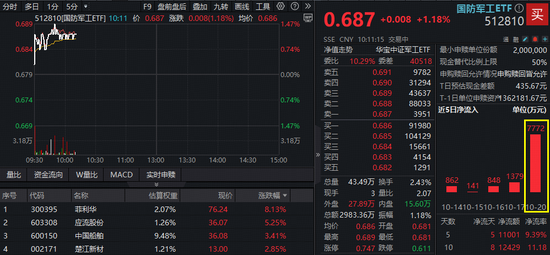
Group 1 - The defense and military industry sector is experiencing a strong performance, with the core Defense and Military ETF (512810) rising by 1.47% [1] - There has been significant capital inflow into the Defense and Military ETF, with an increase of 77.72 million yuan in a single day, marking seven consecutive days of accumulation totaling over 150 million yuan [1] - The third-quarter earnings forecasts for the five constituent stocks of the Defense and Military ETF indicate collective growth, with Chujiang New Materials expected to see a net profit increase of over 22 times year-on-year [3][4] Group 2 - The earnings forecasts for the constituent stocks show substantial increases, with China Shipbuilding and Zongshen Power projecting net profit growth rates exceeding 100% [3][4] - The defense and military industry is anticipated to enter a new growth cycle, driven by the focus on next-generation equipment and the rapid expansion of information and intelligent systems [4] - The changing landscape of the Middle East arms trade is expected to expand China's potential demand, alongside the expectations from the "14th Five-Year Plan" and the upcoming "15th Five-Year Plan" [4] Group 3 - The Defense and Military ETF (512810) serves as an efficient tool for investing in core assets of the defense and military sector, covering various trending themes such as controlled nuclear fusion, commercial aerospace, and military AI [5]



有色金属行业今日跌1.34% 主力资金净流出46.99亿元
Zheng Quan Shi Bao Wang· 2025-10-20 09:13
Market Overview - The Shanghai Composite Index rose by 0.63% on October 20, with 26 out of the 28 sectors experiencing gains, led by the communication and coal industries, which increased by 3.21% and 3.04% respectively [1] - The metal sector faced the largest decline, dropping by 1.34% [1] Capital Flow Analysis - The main capital outflow from the two markets totaled 4.601 billion yuan, with 12 sectors seeing net inflows [1] - The communication sector had the highest net inflow of 4.397 billion yuan, followed by the coal sector with 1.148 billion yuan [1] - The metal sector experienced the largest net outflow, totaling 4.699 billion yuan, with the computer sector following with a net outflow of 2.390 billion yuan [1] Nonferrous Metals Sector Performance - The nonferrous metals sector had 137 stocks, with 66 stocks rising and 70 stocks falling on the day [2] - Among the stocks, 1 reached the daily limit up, while 2 hit the daily limit down [2] - The top three stocks with the highest net inflow in the nonferrous metals sector were: - Antai Technology: 274 million yuan - Dongfang Tantalum: 125 million yuan - Yun Aluminum: 85.5 million yuan [2] - The stocks with the largest net outflow included: - Baiyin Nonferrous: 500 million yuan - Zijin Mining: 481.8 million yuan - Zhongjin Gold: 454 million yuan [4]
上周融资余额减少超120亿元,这些个股被显著加仓
Sou Hu Cai Jing· 2025-10-20 04:08
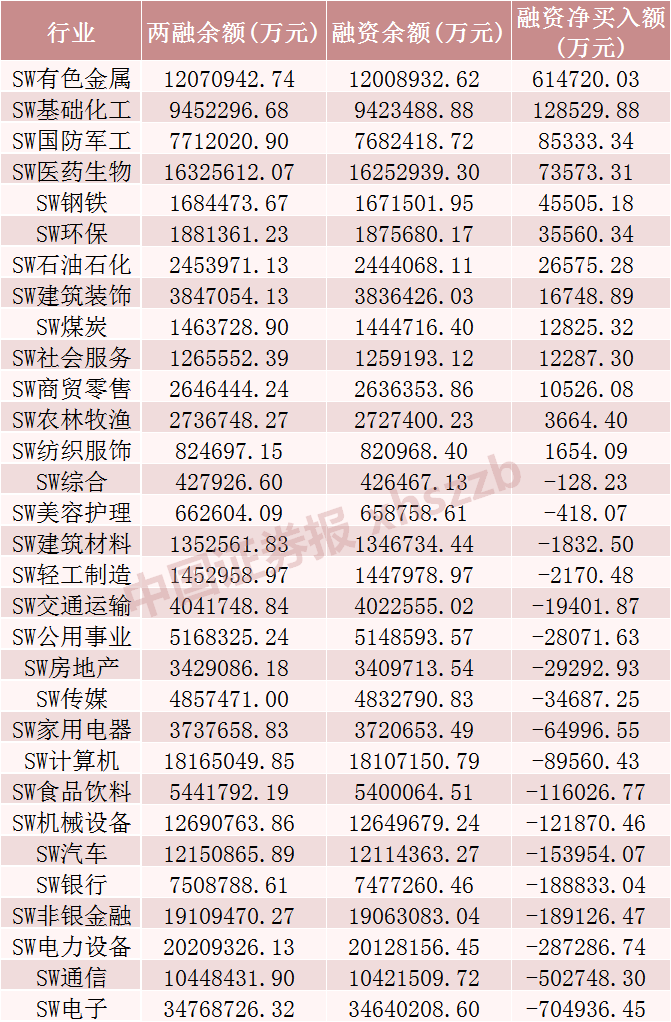
Market Overview - The A-share market experienced fluctuations last week, with the margin balance reaching 24,293.85 billion yuan as of October 17, marking a decrease of 12.82 billion yuan in financing balance over the week [1] - On October 16, both the margin balance and financing balance hit historical highs [1] Financing Balance Changes - During the last week, the financing balance increased on four days: October 13 (+2.24 billion yuan), October 14 (+2.34 billion yuan), October 15 (+2.31 billion yuan), and October 16 (+7.59 billion yuan), while it decreased significantly on October 17 (-27.30 billion yuan) [1] - Out of 31 industries, 13 saw an increase in financing balance, with the non-ferrous metals, basic chemicals, and defense industries leading in net buying amounts of 6.15 billion yuan, 1.29 billion yuan, and 0.85 billion yuan respectively [1][3] Industry Performance - The industries with the largest net selling amounts included electronics (-7.05 billion yuan), communications (-5.03 billion yuan), and electric power equipment (-2.87 billion yuan) [1][3] - The detailed financing balance for selected industries shows significant variations, with the non-ferrous metals industry having a total margin balance of 120.71 billion yuan and a financing balance of 120.09 billion yuan [3] Individual Stock Activity - A total of 104 stocks saw an increase in financing amounts exceeding 1 billion yuan, with the top ten stocks being Zijin Mining, Zhongjin Gold, and Beijing Junzheng, among others [4] - The largest net buying stock was Zijin Mining with a net purchase of 1.58 billion yuan, despite a price drop of 2.27% [5] - The stock with the highest increase in price was Antai Technology, which rose over 19% [4]





中银量化大类资产跟踪:风险资产博弈与波动显著提升
Bank of China Securities· 2025-10-20 02:17
- The report does not contain any specific quantitative models or factors for analysis[1][2][3] - The report primarily focuses on market trends, style indices, valuation metrics, and fund flows without detailing quantitative models or factor construction[4][5][6] - No formulas, construction processes, or backtesting results for quantitative models or factors are provided in the report[7][8][9]
浙商早知道-20251020
ZHESHANG SECURITIES· 2025-10-19 23:30
Group 1: Key Recommendations - The report highlights the strong growth potential of the company "October Rice Field" (09676) in the health food sector, driven by the launch of new products and expansion into high-potential sales channels [6] - The company has exceeded expectations in both new product sales and channel expansion, with corn products emerging as a significant growth driver alongside rice products [6] - Revenue projections for "October Rice Field" are estimated at 6.951 billion, 8.371 billion, and 9.884 billion yuan for 2025-2027, reflecting year-on-year growth rates of 21%, 20%, and 18% respectively [6] Group 2: Industry Insights - The mechanical equipment sector is experiencing a cyclical reversal and growth, emphasizing the importance of self-sufficiency and domestic substitution due to trade tensions [8] - The report suggests that the military industry is poised for growth, with increased domestic demand and potential for foreign trade expansion leading to a revaluation of the sector [10] - The telecommunications industry is expected to maintain steady growth, with significant opportunities arising from advancements in computing power and satellite internet technologies [10][11] Group 3: Investment Opportunities - The report identifies generative recommendation technology as a key area for investment, with major internet companies exploring its potential to enhance business outcomes [11] - Companies that successfully implement generative recommendation technology are expected to achieve substantial commercial value, surpassing industry averages [11] - Catalysts for growth in this area include improved advertising conversion rates and successful implementation by leading internet firms [11]
“十五五”规划前瞻:要点与投资机遇
2025-10-19 15:58
Summary of Key Points from the Conference Call Industry or Company Involved - The conference call discusses the "Fifteen Five" planning period in China, focusing on economic growth, investment opportunities, and industry development. Core Points and Arguments 1. **Economic Growth Targets**: The "Fifteen Five" plan is expected to set clear economic growth targets between 4.6% and 4.8% to address internal and external uncertainties, following the policy directions established in the 20th National Congress and the Third Plenary Session [4][1][2]. 2. **Expansion of Domestic Demand**: The main line of the "Fifteen Five" plan is to expand domestic demand by increasing disposable income and creating consumption scenarios, with a focus on supporting service consumption and reducing consumption restrictions [5][1][2]. 3. **Investment Focus**: The plan emphasizes a combination of investments in physical assets and human capital, increasing infrastructure and livelihood investments, and identifying high-efficiency projects to address declining marginal returns [6][1][2]. 4. **Industry Development**: The development of new productive forces will be tailored to local conditions, enhancing total factor productivity across traditional, emerging, and future industries [7][1][2]. 5. **High-Level Security**: The plan will focus on high-level security in finance, supply chains, food and energy, and military sectors, promoting high-quality development through effective governance [8][1][2]. 6. **Economic Structure Shift**: The economic structure is expected to shift from manufacturing to services, with an increase in the proportion of service enterprises in the A-share market leading to a rise in overall market valuation [9][10][1][2]. 7. **Carbon Emission Control Policies**: The dual control policy on carbon emissions will transition to a focus on intensity control, complemented by total control, enhancing the national carbon trading market and establishing product carbon footprint management systems [11][1][2]. 8. **Fiscal and Tax Reforms**: Key reforms include improving the budget system, shifting consumption tax collection to local levels, and increasing local non-tax revenue management authority, which will incentivize local governments to enhance the consumption environment [12][1][2]. 9. **Land System Reforms**: The reforms aim to activate the secondary market for construction land and improve land use efficiency, addressing mismatches in land resources and promoting middle and low-end consumption through increased farmers' property income [13][14][1][2]. 10. **Anti-Competition Policies**: The plan will implement anti-involution policies to address irrational and disorderly competition, focusing on sustainable operations and optimizing industry structures [15][16][1][2]. Other Important but Possibly Overlooked Content 1. **Investment Opportunities**: Short-term investment opportunities include infrastructure projects, advanced manufacturing, defense spending, RMB internationalization, and green low-carbon sectors [19][1][2]. 2. **Long-Term Investment Lines**: The main lines of the "Fifteen Five" plan include expanding domestic demand, developing new productive forces, ensuring safety, promoting reform and opening up, and achieving green dual carbon goals [20][1][2]. 3. **Service Consumption Growth**: Service consumption is projected to grow significantly, with an expected increase of nearly 20 trillion yuan by 2030, accounting for 52% of total demand [21][20][1][2]. 4. **Photovoltaic and Energy Storage Prospects**: The photovoltaic and energy storage sectors are expected to see significant growth due to supply-demand improvements and the push for carbon peak requirements by 2030 [22][1][2].
军工行业周复盘、前瞻:两大商业卫星星座密集发射,关注二十届四中全会召开
CMS· 2025-10-19 14:35
Investment Rating - The report maintains a "strongly recommend" rating for several key companies in the military industry, including 中航西飞, 中航光电, 航天彩虹, and others [10]. Core Insights - The military industry is experiencing a significant rebound, with the SW National Defense Military Index increasing by 13.28% year-to-date as of October 17, 2025, although it has underperformed compared to the CSI 300 Index [14][20]. - Key events include the successful launches of two major commercial satellite constellations, which are expected to enhance the industry's growth potential [22][24]. - The upcoming 20th Central Committee's Fourth Plenary Session from October 20 to 23, 2025, is anticipated to outline new directions for the military industry, particularly in unmanned, intelligent, and systematic combat equipment [24]. Summary by Sections Market Review - The military industry has shown a decline of 4.70% in the SW National Defense Military Index this week, underperforming the CSI 300 Index by 2.48 percentage points [14]. - The overall industry has ranked 16th among 31 sub-industries in terms of performance [14]. Key Events - The report highlights the recent launches of the 星网 and 千帆 satellite constellations, with 星网 completing five launches in 21 days and 千帆 planning to accelerate its launch schedule significantly [22][23]. Catalysts - The report emphasizes the importance of the upcoming 20th Central Committee's Fourth Plenary Session, which will focus on the 15th Five-Year Plan and its implications for the military industry [24]. Company Performance - The report lists several companies with strong performance expectations, including 中航沈飞, 中航西飞, and 航发动力, all rated as "strongly recommend" [10]. - The report also notes the financial metrics of these companies, indicating a robust outlook for their earnings per share (EPS) and price-to-earnings (PE) ratios [10]. Industry Valuation - The military industry maintains a high valuation, with the current PE ratio at 83.33 times earnings, reflecting strong investor interest despite recent market fluctuations [20].


医药多主题出现见底形态:投资要点:
Huafu Securities· 2025-10-19 12:48
Group 1 - The report emphasizes the establishment of a thematic investment database aimed at identifying high-potential opportunities and monitoring peak trends in popular themes, particularly focusing on quantitative screening of four types of patterns and trading heat indicators [2][9]. - The report identifies a total of 13 thematic indices showing a bottoming pattern, primarily in the pharmaceutical and biotechnology sectors, while 17 indices have broken out, mainly in non-bank financials, utilities, food and beverage, and defense industries [12][9]. - The report highlights a decline in trading heat for humanoid robots and Deepseek themes, with humanoid robots' trading heat dropping to 61% and Deepseek's to 42%, indicating a potential cooling in market interest [3][16]. Group 2 - The report outlines the monitoring of leading stocks corresponding to popular themes, noting that the closing price of Changsheng Bearing is 12.8% below its 60-day moving average, while Daily Interaction is 10.8% below its 60-day moving average [16][20]. - The report indicates that there are currently no thematic indices in an accelerated upward trend, with only three indices showing a main rising pattern, primarily in coal and textile sectors [12][9]. - The report suggests that the thematic investment data system will be updated regularly to provide investors with objective references for capturing market trends [2][9].