建筑

Search documents
行业轮动周报:ETF资金持续净流出医药,雅下水电站成短线情绪突破口-20250728
China Post Securities· 2025-07-28 06:19
- Model Name: Diffusion Index Model; Construction Idea: The model is based on the principle of price momentum, capturing industry trends through diffusion indices; Construction Process: The model tracks the weekly and monthly changes in the diffusion indices of various industries, ranking them accordingly. The formula for the diffusion index is not explicitly provided; Evaluation: The model has shown varying performance over the years, with significant drawdowns during market reversals[24][25][28] - Model Name: GRU Factor Model; Construction Idea: The model utilizes GRU (Gated Recurrent Unit) deep learning networks to process minute-level volume and price data, aiming to capture trading information; Construction Process: The model ranks industries based on GRU factors, which are derived from the deep learning network's analysis of trading data. The specific formula for GRU factors is not provided; Evaluation: The model has performed well in short cycles but has shown general performance in longer cycles[31][32][35] - Diffusion Index Model, Average Weekly Return: 0.89%, Excess Return Since July: -3.47%, Excess Return YTD: -0.45%[28] - GRU Factor Model, Average Weekly Return: 4.27%, Excess Return Since July: 1.34%, Excess Return YTD: -4.25%[35] - Factor Name: Diffusion Index; Construction Idea: The factor is based on the momentum of industry prices, capturing upward trends; Construction Process: The factor is calculated by observing the weekly and monthly changes in the diffusion indices of various industries. The specific formula is not provided; Evaluation: The factor has shown varying performance, with significant drawdowns during market reversals[24][25][28] - Factor Name: GRU Factor; Construction Idea: The factor is derived from GRU deep learning networks, capturing trading information from minute-level volume and price data; Construction Process: The factor is calculated by ranking industries based on the GRU network's analysis of trading data. The specific formula is not provided; Evaluation: The factor has performed well in short cycles but has shown general performance in longer cycles[31][32][35] - Diffusion Index Factor, Top Industries: Comprehensive Finance (1.0), Steel (1.0), Non-Bank Finance (0.999), Comprehensive (0.998), Non-Ferrous Metals (0.997), Home Appliances (0.995)[25] - GRU Factor, Top Industries: Banking (3.3), Real Estate (0.58), Oil & Petrochemicals (-1.26), Textile & Apparel (-1.73), Light Manufacturing (-2.49), Electric Power & Utilities (-2.83)[32]
机构论后市丨科创板有望迎来补涨行情;“反内卷”下周期行情可能持续
Di Yi Cai Jing· 2025-07-27 10:37
Core Viewpoint - The market is expected to experience a volatile upward trend, with a focus on three main lines of investment, particularly in the technology sector and the potential for a rebound in the STAR Market [1][3]. Group 1: Market Performance - The Shanghai Composite Index rose by 1.67% this week, the Shenzhen Component Index increased by 2.33%, and the ChiNext Index gained 2.76% [1]. - The current market has shown characteristics typical of a "water buffalo" trend, indicating a potential for further upward movement [1]. Group 2: Investment Strategies - Citic Securities suggests that the STAR Market may see a rebound due to the accumulation of retail investor inflows and the strengthening narrative of "anti-involution" [1]. - The recommendation includes focusing on sectors such as non-ferrous metals, telecommunications, innovative pharmaceuticals, military industry, and gaming during the upcoming reporting season [2]. Group 3: Sector Focus - Everbright Securities highlights three main lines for medium to long-term investment: domestic consumption, technological self-reliance, and dividend stocks [3]. - Xiangcai Securities emphasizes the importance of defensive dividend stocks, particularly in banking and insurance, as well as consumer-related sectors like education and passenger vehicles [4]. Group 4: Policy Impact - Huajin Securities notes that the current cycle of rising sectors is driven by policy improvements in fundamental expectations and low valuations in certain industries [5]. - Suggested industries benefiting from the "anti-involution" policy include automotive, new energy, chemicals, construction, and coal [5].
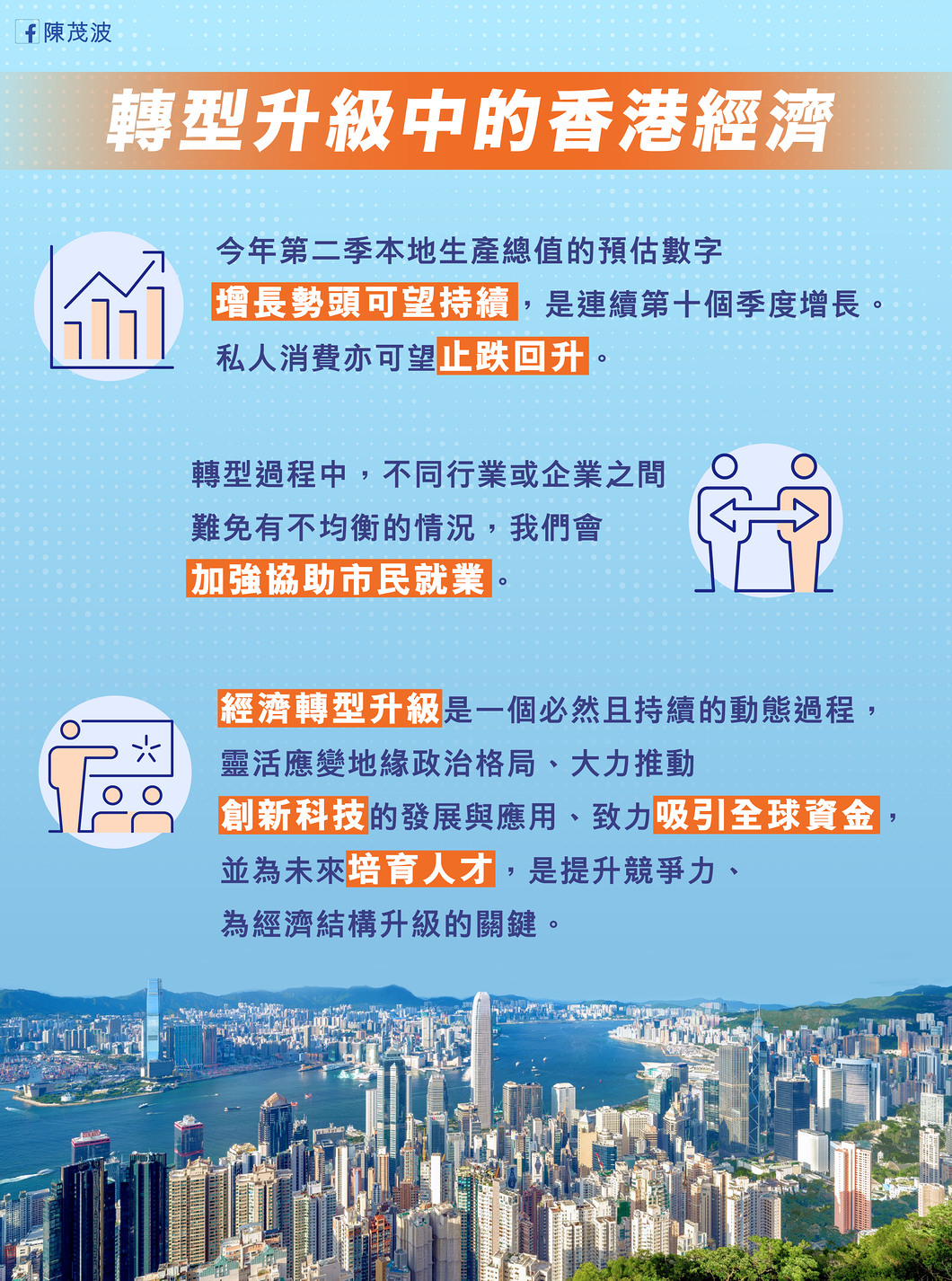
陈茂波:香港第二季经济上升势头可望持续 将是连续第十个季度增长
智通财经网· 2025-07-27 07:04
Economic Growth - Hong Kong's economy has shown resilience, with a growth of 3.1% in Q1 2023 following a 2.5% growth in 2022, and is expected to continue this upward trend for the tenth consecutive quarter [1][3] - The growth is driven by export activities, overall investment, and private consumption, with optimistic forecasts for the upcoming Q2 GDP figures [1][3] Private Consumption - Private consumption is gaining momentum due to sustained economic activity, inflow of funds, a favorable stock market, and a stabilizing property market [3][4] - Retail sales recorded their first year-on-year growth in 14 months in May, indicating a recovery in consumer sentiment, with expectations for a positive June [4] Employment and Wages - The employment market in Hong Kong remains stable, with a notable increase in median monthly income for full-time employees, rising by 6.8% year-on-year to HKD 25,000 [4][5] - New industries are developing rapidly, and traditional sectors are also adapting, leading to increased hiring and wage adjustments, although some labor-intensive sectors like retail and dining face challenges [5] Government Initiatives - The government is actively seeking new economic growth points and supporting innovation and technology development to attract more businesses and create high-quality jobs [5][6] - Efforts are being made to explore overseas markets and develop supply chain management centers to enhance Hong Kong's competitiveness in a complex geopolitical landscape [6]

2025年8月宏观及大类资产月报:临近筹码密集区,关注中央政治局会议-20250727
Chengtong Securities· 2025-07-27 06:51
Group 1: Macro and Market Overview - The A-share market showed positive performance in July, with the Shanghai Composite Index, CSI 300, and ChiNext Index rising by 4.3%, 4.9%, and 8.7% respectively [1][10] - The bond market weakened, with an overall decline of 0.6%, and government bond yields increased, with 1-year, 5-year, and 10-year yields rising by 4.3bp, 10.3bp, and 8.3bp respectively [1][10] - The external markets also performed well, with the Hang Seng Index rising by 5.5% and major US indices, including the Dow Jones, Nasdaq, and S&P 500, increasing by 1.8%, 3.6%, and 3.0% respectively [1][10] Group 2: A-share Market Analysis - The A-share market is approaching a critical trading zone, with the Shanghai Index nearing the October 2024 trading volume of 3 trillion, indicating potential resistance to breaking through this level [2][22] - External risks are increasing, particularly regarding US-China tariff negotiations and potential sanctions from the EU against Chinese financial institutions [2][22] Group 3: Sector Focus and Investment Strategy - Investment strategies should focus on technology and anti-involution sectors, with particular attention to humanoid robotics and the broader AI industry [3][23] - The anti-involution strategy is expected to drive demand policies, suggesting investments in undervalued chemical blue-chip stocks, vitamins, phosphorus chemicals, TDI, and coking coal sectors [3][25] - The technology sector is highlighted for potential growth, especially with upcoming IPOs in humanoid robotics and increased capital expenditure in AI services [3][24] Group 4: Bond Market Strategy - The upcoming Central Political Bureau meeting is expected to address the current economic situation and may reinforce anti-involution policies, which could lead to rising inflation expectations and government bond yields [3][27] - The 10-year government bond yield has been on an upward trend, reaching approximately 1.73% as of late July, with expectations of continued increases [3][27][30]

国盛证券:后续还有哪些重大项目可以期待?
智通财经网· 2025-07-27 06:07
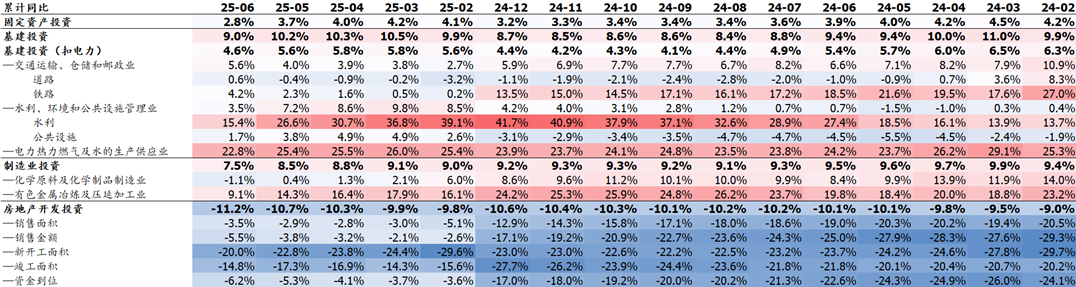
Core Viewpoint - The launch of the Yaxia Hydropower Station indicates a clear trend of central government leverage, with expectations for a series of major projects and regional development strategies to stabilize overall infrastructure investment and total demand [1][2] Infrastructure Investment and Major Projects - The central government is expected to introduce significant projects and regional strategies to maintain infrastructure investment and total demand, especially in light of declining economic indicators such as fixed asset investment and real estate sales [2][6] - Key upcoming projects include major transportation initiatives like the China-Kyrgyzstan-Uzbekistan Railway and the New Tibet Railway, with substantial investments planned [6][10] Beneficiaries of Infrastructure Projects - Recommended beneficiaries include leading state-owned construction enterprises such as China Energy Engineering, China State Construction, and China Railway Construction, which are expected to benefit from large-scale infrastructure projects [1][7] - Specific companies highlighted for their roles in construction and materials include China Communications Construction, China Railway Group, and regional players like Qing Song Jian Hua in Xinjiang [1][10] Canal Projects and Economic Impact - The development of major canal projects is anticipated to enhance logistics efficiency and stimulate economic growth, with significant investments planned for projects like the Pinglu Canal and the Zhejiang-Jiangxi-Guangdong Canal [11][14] - The estimated total investment for these canal projects is approximately 620.4 billion, which is expected to provide strong support for investment in 2023 [11][14] Xinjiang Regional Strategy and Coal Chemical Industry - The Xinjiang region is expected to receive increased support from the central government, with significant investments in coal chemical projects projected to exceed 800 billion by 2025 [16][19] - Key players in this sector include China Chemical Engineering and local construction firms, which are well-positioned to capitalize on the anticipated growth in coal chemical investments [16][19] Strategic Hinterland Development - Sichuan has been identified as a strategic hinterland for national development, with policies expected to support infrastructure and investment growth in the region [21][24] - Companies involved in transportation infrastructure, such as Sichuan Road and Bridge, are likely to benefit from these strategic initiatives [21][24]
金融工程市场跟踪周报:短线冲高或有压力,中长线仍维持乐观-20250726
EBSCN· 2025-07-26 13:57
The provided content does not contain any specific quantitative models or factors, nor does it include detailed construction processes, formulas, or backtesting results for such models or factors. The report primarily focuses on market analysis, index performance, valuation levels, and fund flows. Therefore, there are no quantitative models or factors to summarize based on the given content.



A股市场运行周报第51期:攻势延伸行情升级,耐心持、择机增-20250726
ZHESHANG SECURITIES· 2025-07-26 13:00
Core Insights - The market is experiencing a strong upward trend, with the offshore RMB showing signs of breaking out against the USD. This is expected to create a bullish mid-term outlook for A-shares, with the Shanghai Composite Index potentially aiming beyond the previous high of 3674 points set on October 8, 2024 [1][4][54] - Short-term fluctuations are anticipated due to profit-taking, but key support levels such as recent short-term gaps and the 20-day moving average are expected to provide stability [1][4][54] Weekly Market Overview - Major indices collectively rose, with the STAR 50 leading the gains. The Shanghai Composite Index, Shanghai 50, and CSI 300 increased by 1.67%, 1.12%, and 1.69% respectively, while the STAR 50 surged by 4.63% [2][12] - The cyclical sector showed strong performance, with coal, steel, non-ferrous metals, building materials, and construction leading the gains, rising by 8.00%, 7.55%, 7.10%, 6.44%, and 6.21% respectively [2][13][53] - Market sentiment improved significantly, with average daily trading volume rising to 1.83 trillion RMB, indicating increased investor activity [2][19] Fund Flow Analysis - The margin trading balance increased significantly to 1.94 trillion RMB, with the proportion of financing purchases rising to 10.56% [2][28] - Stock ETFs saw a net inflow of 4.04 billion RMB, with infrastructure ETFs attracting the most inflow while securities ETFs experienced the largest outflow [2][28] Sector Configuration Recommendations - The report suggests maintaining a balanced allocation strategy of "1+1+X," focusing on large financial institutions (banks and brokerages) alongside sectors like military, computing, media, electronics, and new energy [5][56] - In light of increased market risk appetite, a shift from large banks to smaller banks is recommended to enhance portfolio flexibility [5][56] - Continuous investment in brokerage firms is advised to mitigate upward risks, while switching from high-performing stocks to those near their annual moving averages is suggested [5][56]
基本面高频跟踪报告:债市温度计
SINOLINK SECURITIES· 2025-07-26 12:03
Report Summary 1. Industry Investment Rating No information provided in the report regarding the industry investment rating. 2. Core Viewpoints - In the week from July 20th to July 26th, among the 49 updated high - frequency indicators in Guojin Securities' fixed - income fundamental monitoring system, the number of "bullish" and "bearish" indicators is 27 and 22 respectively. "Bullish" factors are mainly reflected in the start - up rates of most industries, real estate transaction areas, consumption, travel, exports, and most agricultural product prices, while "bearish" factors are mainly shown in coal consumption, crude steel production, real estate prices, industrial product inventory and demand, etc. [2][17] - The signals released by the ten interest rate synchronous indicators are mainly "bearish", accounting for 6/10. Compared with last week, the US dollar index sent a "bearish" signal. [3][19] 3. Summary by Directory 3.1 Fundamental Thermometer - **Overview**: Among the 49 updated high - frequency indicators, 27 are "bullish" and 22 are "bearish" for the bond market. [2][17] - **High - frequency Indicator Tracking**: - **Absolute Value Tracking**: Many indicators are monitored, such as economic growth (e.g., daily coal consumption and crude steel production), industrial production (e.g., start - up rates of various industries), real estate (e.g., housing and land transaction areas), infrastructure, inventory, consumption, travel, and inflation. The qualitative judgment for each indicator is provided, with some being "bullish" and some "bearish". [14] - **Monthly Year - on - Year Tracking**: Similar to the absolute value tracking, various economic aspects are covered, and the year - on - year changes and qualitative judgments for each indicator are presented. [16] 3.2 Interest Rate Synchronous Indicators - **Overview**: The signals released by the ten interest rate synchronous indicators are mainly "bearish", with a proportion of 6/10. The US dollar index sent a "bearish" signal compared with last week. [3][19] - **Specific Indicators**: - **Enterprise Medium - and Long - Term Loan Balance Growth Rate**: 8.3%, lower than the previous value of 8.4%, "bullish". [3][18][19] - **Building Materials Composite Index**: 113.9, higher than the previous value of 111.3, "bearish". [3][18][19] - **BCI: Enterprise Recruitment Prospective Index**: 49.1%, lower than the previous value of 50.5%, "bullish". [3][18][19] - **Unemployment Benefit Eligibility Internet Search Index Year - on - Year (6MMA)**: 105.2%, lower than the previous value of 105.7%, "bearish". [3][18][19] - **PMI New Export Orders Trend Value**: - 0.25%, lower than the previous value of - 0.24%, "bullish". [3][18][19] - **PMI Supply - Demand Balance Trend Value**: 0.17%, higher than the previous value of 0.16%, "bearish". [3][18][19] - **Durable Goods Price**: 0.943, lower than the previous value of 0.944, "bullish". [3][18][19] - **Bill Financing**: 14.7 trillion, lower than the previous value of 15.1 trillion, "bearish". [3][18][19] - **US Dollar Index**: 97.5, lower than the previous value of 98.4, "bearish". [3][18][19] - **Copper - Gold Ratio**: 17.0, higher than the previous value of 16.6, "bearish". [3][18][19]
钢材:市场情绪推涨,钢材震荡上行
Yin He Qi Huo· 2025-07-26 11:38
Report Industry Investment Rating - Not provided in the content Core Viewpoints - The steel market is driven by market sentiment, with prices fluctuating upward. Overall, steel itself may lack price drivers and will maintain a volatile and slightly strong trend in the short term, following raw materials. If over - production verification is implemented, it may raise the price center of steel, while the disk profit will continue to shrink [1][7] - The trading strategy suggests maintaining a wait - and - see attitude for single - side trading, opportunistically intervening in positive spreads when the basis is low for arbitrage, and waiting and seeing for options [9] Summary by Directory Chapter 1: Steel Market Summary and Outlook Summary - **Supply**: This week, the small - sample production of rebar was 211,960 tons (+2,900), and that of hot - rolled coil was 317,490 tons (-3,650). The daily average pig iron output of 247 blast furnaces was 242,230 tons (-210). The capacity utilization rate of 49 independent electric arc furnace steel mills was 30.2% (+1.6). Short - process steel production resumed due to full profit in off - peak electricity, and long - process steel profit increased to over 100, with pig iron production remaining high. The daily consumption of scrap steel increased to over 510,000 tons [4] - **Demand**: The small - sample apparent demand for rebar was 216,580 tons (+10,410), and that for hot - rolled coil was 315,240 tons (-8,550). The apparent demand for building materials rebounded significantly, while that for hot - rolled coil declined seasonally. The growth rate of fixed - asset investment in China from January to June decreased month - on - month, and the real estate market was still weak. The manufacturing PMI expanded, and the automobile industry maintained positive growth in production and exports, but the profit was shrinking. The home appliance industry entered the off - season, and the export situation might continue to decline [4] - **Inventory**: Rebar inventory decreased by 46,200 tons in total, hot - rolled coil inventory increased by 22,500 tons in total, and the total inventory of five major steel products decreased by 11,600 tons [4] - **Outlook**: The steel production reduction slowed down, rebar inventory decreased while hot - rolled coil inventory increased. The apparent demand for building materials rebounded, and market sentiment improved. The steel market will maintain a volatile and slightly strong trend in the short term, and attention should be paid to overseas tariffs and domestic macro - policies [7] Chapter 2: Price and Profit Review Summary - **Spot Prices**: On Friday, the rebar summary price in Shanghai was 3,410 yuan (+160), and in Beijing was 3,340 yuan (+150). The hot - rolled coil price in Shanghai was 3,470 yuan (+130), and in Tianjin was 3,410 yuan (+200) [13] - **Profit**: The long - process steel profit increased to over 100. The flat - rate electricity profit of the East China electric furnace was - 23.75 yuan (+133), and the off - peak electricity profit was +141 yuan (+133) [4][29] Chapter 3: Important Domestic and Overseas Macroeconomic Data Summary - **Domestic Macroeconomy**: The Yarlung Zangbo River downstream hydropower project started, with a total investment of about 1.2 trillion yuan. The National Energy Administration will conduct a coal production verification. The National Development and Reform Commission and the State Administration for Market Regulation solicited opinions on the revised draft of the Price Law. In June, the new social financing was 4.2 trillion yuan, and the growth rate of M1 - M2 improved. From January to June 2025, the cumulative year - on - year growth rate of China's fixed - asset investment was +2.8%, with a continued decline in growth rate [35][45] - **Overseas Macroeconomy**: In the US, the initial jobless claims decreased, and the manufacturing PMI remained stable. In the Eurozone, the manufacturing PMI showed signs of stabilization [4] Chapter 4: Steel Supply, Demand, and Inventory Situation Summary - **Supply**: The daily average pig iron output of 247 blast furnaces was 242,230 tons (-210), and the capacity utilization rate of 49 independent electric arc furnace steel mills was 30.2% (+1.6). The small - sample production of rebar was 211,960 tons (+2,900), and that of hot - rolled coil was 317,490 tons (-3,650) [65][69] - **Demand**: The small - sample apparent demand for rebar was 216,580 tons (+10,410), and that for hot - rolled coil was 315,240 tons (-8,550). The construction material demand showed a certain recovery, and the cement usage also reflected the demand situation. The export of steel was still high, but the demand in the manufacturing off - season was under pressure [72][83] - **Inventory**: Rebar inventory decreased by 46,200 tons in total, and hot - rolled coil inventory increased by 22,500 tons in total [4]
0.2、0.3、0.5、0.6,连续调升!“出口亮眼+政策发力”外资对中国经济增速预期信心不减
Yang Shi Wang· 2025-07-26 02:36
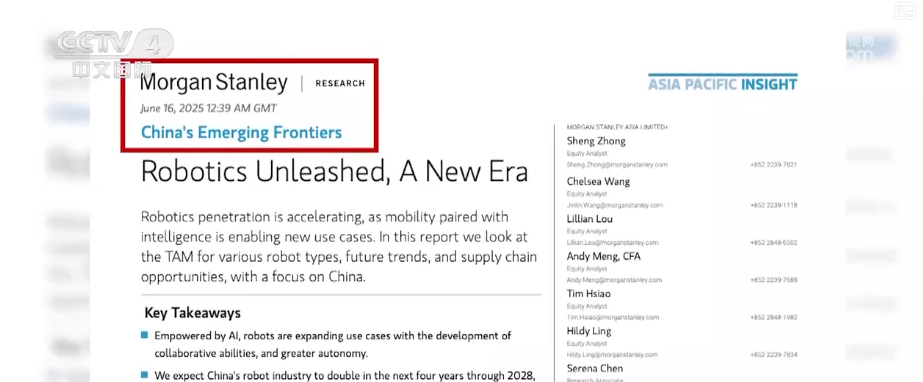
Group 1 - Several foreign financial institutions and international investment banks have raised their economic growth forecasts for China following the release of the second-quarter economic data [1] - Morgan Stanley increased its 2025 economic growth forecast for China by 0.3 percentage points, while other institutions like UOB, Nomura, and Goldman Sachs raised their forecasts by 0.3, 0.5, and 0.6 percentage points respectively [2] - The strong performance of the industrial production sector, including electricity, construction, and manufacturing, has been a key driver of economic activity, maintaining growth for 15 consecutive months [4] Group 2 - The net inflow of funds from domestic goods trade remains high, with strong export data contributing positively [6] - Demand for Chinese exports from economies outside the United States has remained robust, supporting export scale and achieving a trade surplus in the first half of the year [7] - Continuous policy support aimed at boosting domestic consumption and enhancing market confidence has been crucial in attracting foreign investment and adjusting growth expectations [7]