
公用事业

Search documents
产业债发行十一年复盘
CMS· 2025-07-03 03:33
2024 年,全市场非金融产业债发行规模 76266 万元,较 2023 年增长 22%,且 为历史新高。从历年发债规模走势来看,2014 年-2016 年产业债发行规模增长 较快。2017 年监管政策相对收紧,产业债发行规模大幅回落。2018 年以来维 持震荡增长。另一方面,2024 年产业债净融资规模 16600 亿元,为历史次高, 仅低于2015年的19305亿元。2014年以来,产业债仅在2017年和2021年-2023 年两个周期内净融资为负值,均为融资政策相对较严的政策区间。 二、2024 年以来产业债发行期限整体延长 2014 年至 2016 年,产业债加权平均发行期限分别为 2.11 年、1.98 年和 2.1 年, 但随着 2017 年融资环境收紧,产业债发行期限也随之缩短。2017 年至 2023 年,产业债加权平均发行期限均在 2 年以内,其中 2021 年达到最低值 1.54 年。 但随着 2023 年"一揽子化债"启动和债市持续走牛,2024 年和 2025 年 1-5 月,产业债加权平均发行期限分别达到 3.09 年和 3.29 年,增长幅度较大。 三、近年来产业债平均发行成本持续 ...
7月防御性资产或成首选!机构最新观点
券商中国· 2025-07-02 23:19
Core Viewpoint - The global market is closely monitoring the outcome of the US tariff negotiations, which are expected to influence market pricing for July, with a general bearish outlook on the US dollar due to increased uncertainty surrounding tariffs and fiscal policies [2][4]. Group 1: US Tariff Negotiations and Dollar Outlook - The market is anticipating the results of the US tariff negotiations set for July 9, with a significant focus on the implications for the US dollar and non-US currencies [3][4]. - Since the announcement of "reciprocal tariffs" in April, the US dollar index has declined over 7%, while Asian currencies have rebounded to new highs since October of the previous year [2][3]. - The Senate's passage of the "big and beautiful" tax and spending bill is expected to exacerbate the US fiscal deficit, further impacting the dollar's sustainability [3][4]. Group 2: Defensive Assets and Hong Kong Market - In light of the uncertainty surrounding US trade policies, defensive assets have become a primary choice for investors, with the Hong Kong stock market positioned to attract more capital due to its low absolute valuations [2][6]. - The Hong Kong interbank offered rate (Hibor) has seen a significant decline, with one-month Hibor dropping to 0.52% and overnight Hibor nearing 0%, indicating strong market liquidity [7]. - The Hong Kong market is viewed as a new safe haven for global capital, with expectations of a multi-year depreciation cycle for the US dollar, leading to increased international investment in Hong Kong stocks [7][8]. Group 3: Valuation and Investment Trends in Hong Kong - The valuation of Hong Kong stocks remains significantly lower than that of US markets, with the Hang Seng Index projected to have a price-to-earnings ratio of 11 times and a dividend yield of 3.2% by 2025 [8]. - The influx of global and southbound capital is driving a revaluation of undervalued blue-chip stocks in Hong Kong, with notable growth in the Hong Kong central enterprise dividend ETF [8].


2025信用月报之六:下半年信用债怎么配-20250702
HUAXI Securities· 2025-07-02 13:52
Group 1: Report Summary - Investment Rating: Not provided in the report - Core View: In the second half of 2025, credit bond investment should focus on three elements: the trend of funds and interest rates, the supply - demand pattern of credit bonds, and the cost - effectiveness of different varieties. Interest rates may continue to decline in a volatile manner, making the coupon value of credit bonds prominent, but the valuation volatility may increase. The overall supply of credit bonds may be difficult to expand, and the configuration demand may weaken from August to December. Different investment strategies are recommended for different periods and varieties [1][18] Group 2: 1. Steady Coupon as the Foundation, Grasp the Trading Rhythm 1.1. Short - to Medium - Duration Credit Spread Compression for Coupon Income, Seize Phased Opportunities in Long - Duration Bonds - H1 2025 Review: The credit bond market experienced an increase in yields and a widening of credit spreads from January to mid - March, followed by a rotation of the market to medium - to long - duration and then ultra - long - duration bonds from April to June. The main factors in the first quarter were the tight funds and the change in wealth management scale. In mid - to late March, the bond market recovered, driven by supply shrinkage and the cost - effectiveness of varieties. From April to June, the market was affected by interest rate fluctuations and the shift of the funds' central point [12][13] - June 2025 Highlights: The long - duration credit bond market was activated, mainly due to the compression of short - to medium - duration credit spreads to historical lows and the increased demand from funds, insurance, and other products. The scale of credit bond ETFs increased by 7.7 billion yuan in June, which also drove the demand for some long - duration component bonds [14][16] - H2 2025 Outlook: Interest rates may continue to decline in a volatile manner. The supply of credit bonds may be difficult to expand, with the decrease in urban investment bonds offset by the increase in industrial bonds. The wealth management scale usually increases significantly in July but weakens from August to December. The rectification of wealth management's net - value smoothing methods may suppress the demand for ultra - long - duration and low - rated medium - to long - duration bonds. It is recommended to increase positions in July, take profits in August, and reduce credit bond positions from August to December, switching to inter - bank certificates of deposit and interest - rate bonds [18][19][21] - Variety Cost - Effectiveness: The 10Y high - grade credit bonds have relatively large potential for credit spread compression. As of June 30, the credit spreads of 10Y high - grade medium - term notes are still 8 - 11bp higher than the average. Short - to medium - duration credit spread compression may still be the dominant strategy. Bonds with a yield of 2.0% - 2.2% in the 1 - 3 - year AA and AA(2) categories have high allocation value. High - grade 5 - year bonds can be considered when the credit spread adjusts to the mean + 1 standard deviation [22][30][35] 1.2. Grasp the Trading Rhythm of Bank Capital Bonds 1.2.1. Difficult for Bank Capital Bond Supply to Expand in H2 2025 - H1 2025 Review: The supply of bank capital bonds increased slightly. The net financing of secondary capital bonds increased year - on - year, while that of perpetual bonds decreased. The city commercial banks increased their issuance scale, while the supply from rural commercial banks was weak [39] - H2 2025 Outlook: The demand for new capital bonds from the Big Four banks may decrease after the capital injection in June. Although small and medium - sized banks may increase issuance if the cost is low, the overall net supply is difficult to expand [40] 1.2.2. Narrower Bandwidth for Band - Trading in Bank Capital Bonds, Reverse Trading May Yield Higher Win - Rates - H1 2025 Review: The yields of bank capital bonds showed differentiation. The yields of 1 - 5Y large - bank bonds generally increased, while those of 10Y secondary capital bonds and 1 - 4Y small - and medium - bank bonds mostly decreased. The credit spreads of most varieties compressed, with short - duration and low - grade bonds performing better [44] - H2 2025 Outlook: The bank capital bonds still have trading opportunities following interest - rate bonds, but the credit spread compression space is limited. Reverse trading (increasing positions during adjustments) may have a higher win - rate. The 4 - year and 6 - year bonds have higher riding yields and better holding experiences [50][51] Group 3: 2. Urban Investment Bonds: Negative Net Financing in H1, a Historical First - H1 2025 Supply: The supply of urban investment bonds shrank, with negative net financing for the first time in history. From January to June, the issuance was 2.9464 trillion yuan, a year - on - year decrease of 382.9 billion yuan, and the net financing was - 71.7 billion yuan, a year - on - year decrease of 218.5 billion yuan, mainly due to the tightening of bond - issuing policies [55] - Issuance Characteristics: The overall issuance sentiment was good, with a high proportion of over - subscribed issuances. The proportion of 3 - 5 - year issuances increased, while that of within - 1 - year issuances decreased. The issuance interest rates decreased overall, with greater declines in short - to medium - term bonds [55][56] - Regional Differences: The net financing performance of urban investment bonds varied by region. Most regions had negative net financing, mainly affected by district - level and park - level platforms. Guangdong and Shandong had relatively high positive net financing, while Jiangsu, Hunan, and Chongqing had large negative net financing [58] - Yield and Credit Spread: The yields of urban investment bonds generally decreased in H1, with high - grade long - duration and AA - low - grade bonds performing better. The credit spreads of all maturities and grades narrowed, with low - grade bonds performing more strongly [62][63] - Secondary Market: Since mid - March, the buying interest in the secondary market has been high, with a high proportion of TKN transactions and low - valuation transactions. There was a trend of increasing duration in transactions, and the proportion of AA(2) low - grade transactions remained high [66] Group 4: 3. Industrial Bonds: Supply Increase, Longer Durations in Both Primary and Secondary Markets - H1 2025 Supply: The issuance and net financing of industrial bonds increased year - on - year. From January to June, the issuance was 3.8718 trillion yuan, a year - on - year increase of 309.2 billion yuan, and the net financing was 1.0788 trillion yuan, a year - on - year increase of 40 billion yuan. The new regulations on science and technology innovation bonds contributed to the increase in issuance [18] Group 5: 4. Bank Capital Bonds: Low - Rated Bonds Perform Better, Weak Trading Sentiment - H1 2025 Performance: The yields of bank capital bonds showed differentiation, with short - duration and low - rated bonds performing better. The credit spreads of most varieties compressed, with 1 - 4Y small - and medium - bank capital bonds and 1 - 3Y AA - perpetual bonds having significant spread compression [44] - Trading Rhythm: The trading bandwidth of large - bank long - duration capital bonds has been narrowing, making band - trading more difficult. Reverse trading may be a better strategy. The 4 - year and 6 - year bonds have higher riding yields [48][51]
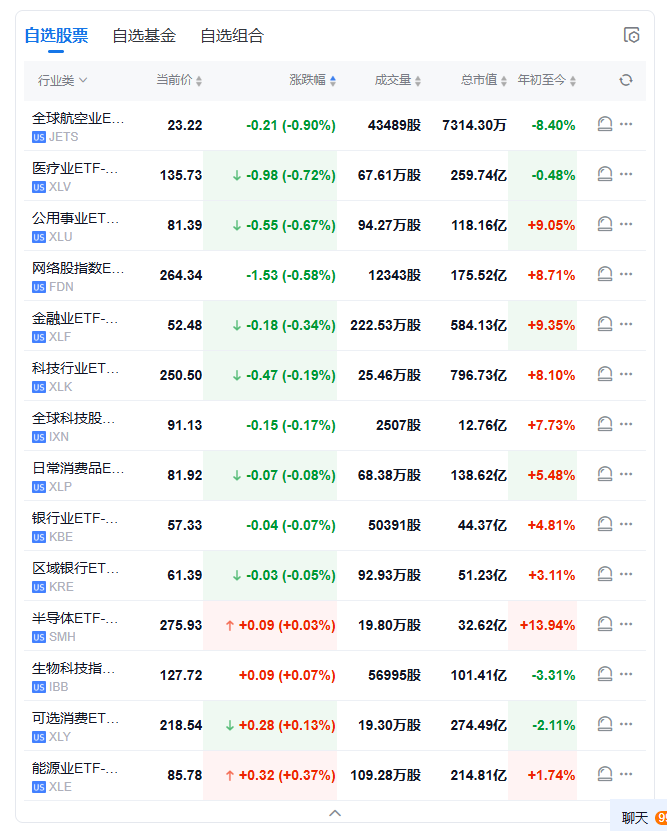
美股盘初,主要行业ETF多数下跌,全球航空业ETF跌0.9%,医疗业ETF跌0.72%,公用事业ETF跌0.67%。
news flash· 2025-07-02 13:40
Market Overview - Major industry ETFs in the US experienced a decline, with the global airline industry ETF down by 0.9%, the healthcare ETF down by 0.72%, and the utilities ETF down by 0.67% [1] Industry Performance - The global airline industry ETF is priced at $23.22, reflecting a decrease of $0.21 or 0.90% with a trading volume of 43,489 shares and a total market value of $73.14 million, showing an 8.40% decline year-to-date [2] - The healthcare ETF is priced at $135.73, down by $0.98 or 0.72%, with a trading volume of 676,100 shares and a total market value of $259.74 billion, indicating a year-to-date decrease of 0.48% [2] - The utilities ETF is priced at $81.39, down by $0.55 or 0.67%, with a trading volume of 942,700 shares and a total market value of $11.81 billion, reflecting a year-to-date increase of 9.05% [2] - The financial sector ETF is priced at $52.48, down by $0.18 or 0.34%, with a trading volume of 2.23 million shares and a total market value of $584.13 billion, showing a year-to-date increase of 9.35% [2] - The technology sector ETF is priced at $250.50, down by $0.47 or 0.19%, with a trading volume of 254,600 shares and a total market value of $796.73 billion, indicating a year-to-date increase of 8.10% [2] - The energy sector ETF is priced at $85.78, up by $0.32 or 0.37%, with a trading volume of 1.09 million shares and a total market value of $21.48 billion, reflecting a year-to-date increase of 1.74% [2]
金融工程定期:港股量化:南下资金累计流入达2024年91%,7月增配成长
KAIYUAN SECURITIES· 2025-07-02 12:15
- Model Name: Hong Kong Stock Selection 20 Portfolio; Model Construction Idea: The model selects the top 20 stocks with the highest scores based on four types of factors (technical, capital, fundamental, and analyst expectations) from the Hong Kong Stock Connect sample stocks and constructs an equal-weighted portfolio at the end of each month; Model Construction Process: The model uses the Hong Kong Composite Index (HKD) (930930.CSI) as the benchmark. The specific construction process involves selecting the top 20 stocks with the highest scores based on the four types of factors and constructing an equal-weighted portfolio at the end of each month[3][37][39]; Model Evaluation: The model has shown excellent performance in the Hong Kong Stock Connect sample stocks[37] - Factor Name: Technical Factors; Factor Construction Idea: Technical factors are constructed based on the price and volume data of stocks; Factor Construction Process: The specific construction process involves calculating various technical indicators such as moving averages, relative strength index (RSI), and moving average convergence divergence (MACD) to evaluate the stock's price trend and momentum[37][38]; Factor Evaluation: Technical factors have shown good performance in the Hong Kong Stock Connect sample stocks[37] - Factor Name: Capital Factors; Factor Construction Idea: Capital factors are constructed based on the capital flow data of stocks; Factor Construction Process: The specific construction process involves calculating the net capital inflow and outflow of stocks to evaluate the stock's capital flow trend[37][38]; Factor Evaluation: Capital factors have shown good performance in the Hong Kong Stock Connect sample stocks[37] - Factor Name: Fundamental Factors; Factor Construction Idea: Fundamental factors are constructed based on the financial data of stocks; Factor Construction Process: The specific construction process involves calculating various financial ratios such as price-to-earnings (P/E) ratio, return on equity (ROE), and total market value to evaluate the stock's financial health and valuation[37][38]; Factor Evaluation: Fundamental factors have shown good performance in the Hong Kong Stock Connect sample stocks[37] - Factor Name: Analyst Expectation Factors; Factor Construction Idea: Analyst expectation factors are constructed based on the analyst ratings and target prices of stocks; Factor Construction Process: The specific construction process involves collecting and analyzing the analyst ratings and target prices of stocks to evaluate the stock's future performance expectations[37][38]; Factor Evaluation: Analyst expectation factors have shown good performance in the Hong Kong Stock Connect sample stocks[37] Model Backtest Results - Hong Kong Stock Selection 20 Portfolio, Annualized Excess Return: 13.3%, Excess Return Volatility Ratio: 1.0[4][40][41] Factor Backtest Results - Southbound Capital, Average Return: 25.7%[32][36] - Foreign Capital, Average Return: 13.5%[32][36] - Domestic Capital, Average Return: 14.0%[32][36] - Hong Kong Capital and Others, Average Return: 10.2%[32][36]
可转债周报:从波动率把握转债的机会区间-20250702
Changjiang Securities· 2025-07-02 10:15
丨证券研究报告丨 固收资产配置丨点评报告 [Table_Title] 从波动率把握转债的机会区间 ——可转债周报 20250628 报告要点 [Table_Summary] 当周(2025 年 6 月 23 日–2025 年 6 月 28 日),可转债市场回暖,指数整体走强,市场风格 转向高弹性博弈。估值端,低平价区间个券有所分化,中高平价区间个券估值普遍拉升,市场 风险偏好温和回升,隐含波动率小幅抬升,交易情绪有所改善。当前万得全 A 风险溢价处于高 分位,权益市场相对债市或具备一定性价比。我们认为,转债市场波动率相关指标均有所回升, 反映市场情绪温和回暖。整体来看,当前转债市场风格自防御向进攻切换,建议兼顾弹性与安 全边际,关注具备事件驱动与业绩兑现预期的结构性机会。 分析师及联系人 [Table_Author] 赵增辉 熊锋 SAC:S0490524080003 SAC:S0490524120004 SFC:BVN394 请阅读最后评级说明和重要声明 %% %% %% %% research.95579.com 1 [Table_Title 从波动率把握转债的机会区间 2] ——可转债周报 202506 ...
帮主郑重:鲍威尔降息吹风会,中长线机会在哪里?
Sou Hu Cai Jing· 2025-07-02 01:15
各位老铁,我是帮主郑重。今儿美联储主席鲍威尔又出来"吹风"了,说绝大多数委员都觉得今年晚些时候会降息。这事儿对咱们中长线投资有啥影响?咱 们好好唠唠。 第三,中长线布局策略。既然美联储大概率降息,咱们可以提前埋伏三个方向:一是高股息资产,比如公用事业和消费龙头,降息周期里这类股票能提 供稳定收益;二是成长股,尤其是科技和医疗,低利率环境下它们的估值弹性更大;三是黄金,历史数据显示,降息预期升温时黄金通常会走牛。但要 避开那些对利率敏感的行业,比如房地产,现在美国房贷利率已经很高,降息可能只是杯水车薪。 先得把这事儿的背景搞清楚。鲍威尔在葡萄牙辛特拉开会的时候,被问到如果没有特朗普的关税政策,美联储是不是早就降息了。他直接承认:"没错, 如果不是关税导致通胀预测大幅上升,我们2025年就已经开始降息,现在政策会更宽松。"这就像你本来打算给孩子买玩具,结果突然要交一笔意外税 费,只能先把玩具钱攥在手里。特朗普4月份搞的"对等关税",让进口商品成本上升,直接打乱了美联储的节奏。 不过鲍威尔也留了活口,他说"绝大多数委员预计今年晚些时候降息是合适的"。这就像老师虽然没明说考试范围,但暗示重点在某几章。根据6月份的点 ...

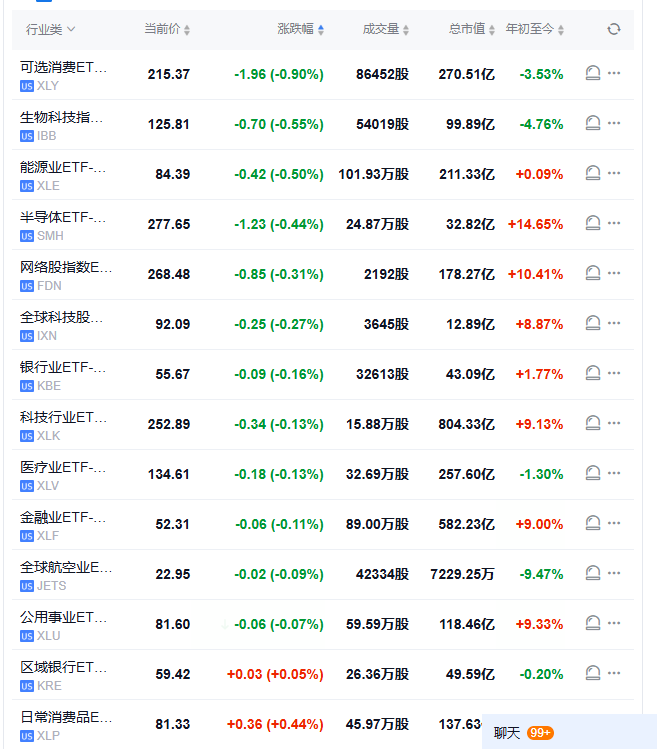
美股盘初:主要行业ETF多数普跌,可选消费ETF跌约1%,生物科技指数ETF跌0.55%,能源业ETF跌0.5%。
news flash· 2025-07-01 13:36
Market Overview - Major industry ETFs mostly declined, with the Consumer Discretionary ETF down approximately 1%, the Biotechnology Index ETF down 0.55%, and the Energy ETF down 0.5% [1] Industry Performance - Consumer Discretionary ETF (US XLY) current price: $215.37, down $1.96 (-0.90%), with a trading volume of 86,452 shares and a total market value of $27.051 billion, down 3.53% year-to-date [2] - Biotechnology Index ETF (US IBB) current price: $125.81, down $0.70 (-0.55%), with a trading volume of 54,019 shares and a total market value of $9.989 billion, down 4.76% year-to-date [2] - Energy ETF (US XLE) current price: $84.39, down $0.42 (-0.50%), with a trading volume of 1.0193 million shares and a total market value of $21.133 billion, up 0.09% year-to-date [2] - Semiconductor ETF (US SMH) current price: $277.65, down $1.23 (-0.44%), with a trading volume of 248,700 shares and a total market value of $3.282 billion, up 14.65% year-to-date [2] - Internet Index ETF (US FDN) current price: $268.48, down $0.85 (-0.31%), with a trading volume of 2,192 shares and a total market value of $17.827 billion, up 10.41% year-to-date [2] - Global Technology ETF (US IXN) current price: $92.09, down $0.25 (-0.27%), with a trading volume of 3,645 shares and a total market value of $1.289 billion, up 8.87% year-to-date [2] - Banking ETF (US KBE) current price: $55.67, down $0.09 (-0.16%), with a trading volume of 32,613 shares and a total market value of $4.309 billion, up 1.77% year-to-date [2] - Technology Sector ETF (US XLK) current price: $252.89, down $0.34 (-0.13%), with a trading volume of 158,800 shares and a total market value of $804.33 billion, up 9.13% year-to-date [2] - Healthcare ETF (US XLV) current price: $134.61, down $0.18 (-0.13%), with a trading volume of 326,900 shares and a total market value of $25.760 billion, down 1.30% year-to-date [2] - Financials ETF (US XLF) current price: $52.31, down $0.06 (-0.11%), with a trading volume of 890,000 shares and a total market value of $58.223 billion, up 9.00% year-to-date [2] - Global Airlines ETF (US JETS) current price: $22.95, down $0.02 (-0.09%), with a trading volume of 42,334 shares and a total market value of $72.293 million, down 9.47% year-to-date [2] - Utilities ETF (US XLU) current price: $81.60, down $0.06 (-0.07%), with a trading volume of 595,900 shares and a total market value of $11.846 billion, up 9.33% year-to-date [2] - Regional Banks ETF (US KRE) current price: $59.42, up $0.03 (+0.05%), with a trading volume of 263,600 shares and a total market value of $4.959 billion, down 0.20% year-to-date [2] - Consumer Staples ETF (US XLP) current price: $81.33, up $0.36 (+0.44%), with a trading volume of 459,700 shares and a total market value of $137.63 million [2]
公用事业行业今日净流入资金8.60亿元,华银电力等7股净流入资金超5000万元
Zheng Quan Shi Bao Wang· 2025-07-01 10:31
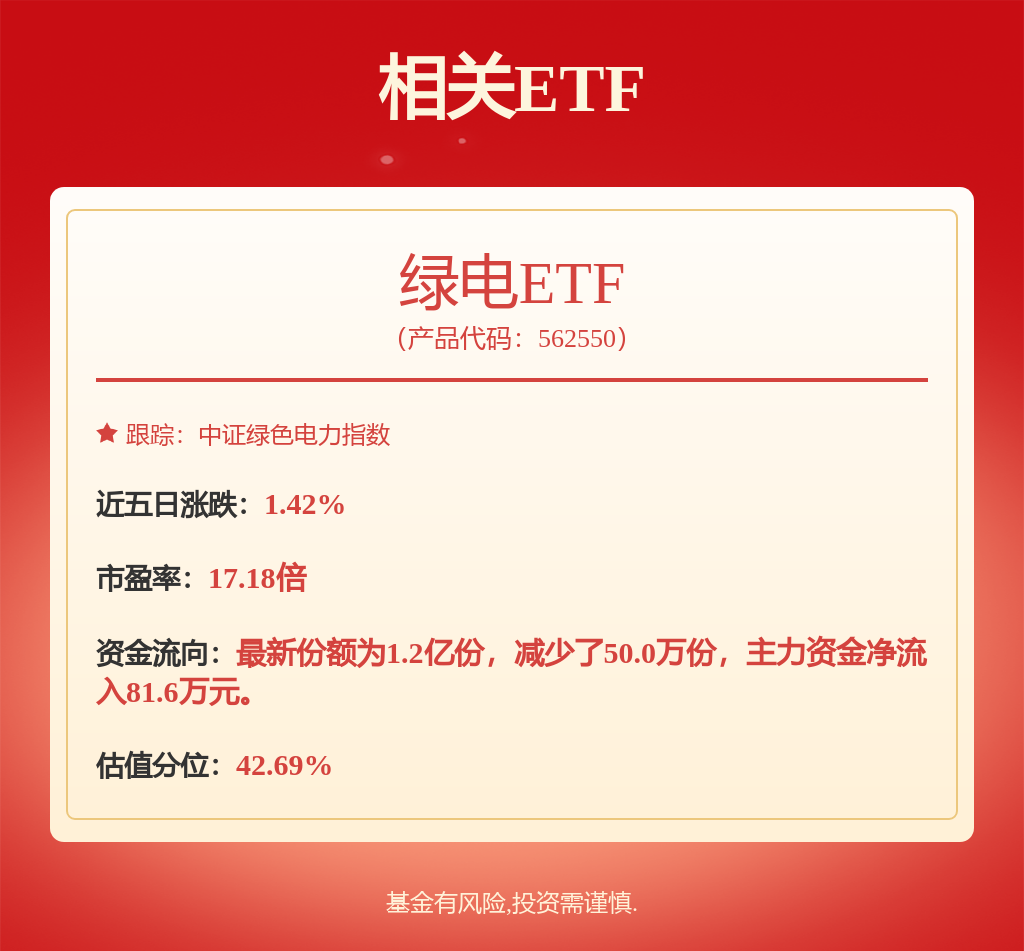
Market Overview - The Shanghai Composite Index rose by 0.39% on July 1, with 20 out of 28 sectors experiencing gains. The top-performing sectors were Comprehensive and Pharmaceutical & Biological, with increases of 2.60% and 1.80% respectively [1] - The Utilities sector saw a rise of 1.05%, with a net inflow of 860 million yuan in main funds. Out of 131 stocks in this sector, 93 rose, and 3 hit the daily limit [1] Utilities Sector Performance - In the Utilities sector, 69 stocks experienced net inflows, with 7 stocks receiving over 50 million yuan in net inflows. The top stock for net inflow was Huayin Electric, with 364 million yuan, followed by Huadian Energy and Changjiang Electric with 105 million yuan and 102 million yuan respectively [1] - The stocks with the highest net outflows included Xiexin Energy Technology, Sheneng Co., and Gansu Energy, with net outflows of 219 million yuan, 53 million yuan, and 44 million yuan respectively [2] Top Gainers in Utilities Sector - The top gainers in the Utilities sector included: - Huayin Electric: +9.98%, turnover rate 7.72%, main fund flow 364.48 million yuan - Huadian Energy: +9.83%, turnover rate 5.33%, main fund flow 104.96 million yuan - Changjiang Electric: +0.76%, turnover rate 0.25%, main fund flow 102.34 million yuan [1] Top Losers in Utilities Sector - The top losers in the Utilities sector included: - Xiexin Energy Technology: +2.37%, turnover rate 17.60%, main fund flow -219.26 million yuan - Sheneng Co.: +0.23%, turnover rate 0.56%, main fund flow -53.37 million yuan - Gansu Energy: -1.10%, turnover rate 2.56%, main fund flow -44.23 million yuan [2] Related ETF - The Green Power ETF (Product Code: 562550) tracks the China Securities Green Power Index, with a recent five-day change of +1.42% and a price-to-earnings ratio of 17.18 times. The latest share count is 12 million, a decrease of 500,000 shares, with a net inflow of 816,000 yuan [4]





粤开市场日报-20250701
Yuekai Securities· 2025-07-01 08:41
Market Overview - The A-share market showed mixed performance today, with the Shanghai Composite Index rising by 0.39% to close at 3457.75 points, while the Shenzhen Component Index increased by 0.11% to 10476.29 points. However, the Sci-Tech Innovation 50 Index fell by 0.86% to 994.80 points, and the ChiNext Index decreased by 0.24% to 2147.92 points. Overall, 2628 stocks rose, 2542 fell, and 247 remained unchanged across the market [1]. - The total trading volume in the Shanghai and Shenzhen markets was 14660 billion, a decrease of 208.42 billion compared to the previous trading day [1]. Industry Performance - Among the Shenwan first-level industries, sectors such as comprehensive, pharmaceutical biology, banking, non-ferrous metals, public utilities, and building materials led the gains, while computer, retail, telecommunications, media, power equipment, and real estate sectors experienced declines [1]. Sector Highlights - The top-performing concept sectors today included China Shipbuilding System, innovative drugs, antibiotics, vitamins, generic drugs, low-priced stocks in the ChiNext, hydropower, biotechnology, advanced packaging, superhard materials, pet economy, CRO, medical material exports, selected banks, and brain-computer interfaces [1].