
债券

Search documents
美债总额创9.16万亿新高,英国疯狂买入,中国加拿大却在抛售
Sou Hu Cai Jing· 2025-09-22 06:54
前言 7月美国财政部数据显示,外国投资者持有美债总额达9.16万亿美元,创下历史新高。 然而数据背后却是截然不同的选择:英国单月狂买413亿美元,中国却减持257亿美元,加拿大更是抛售571亿美元。 各国为何出现如此分化?这种趋势会持续多久? 创纪录背后的真相:增长神话正在破灭 数字不会说谎。 而中国、加拿大、印度却是实打实的大规模减持。 这就好比一场聚会,表面上人数创新高,但仔细一看,有人在拼命往里挤,有人却在悄悄往外走。 换句话说,这份"创新高"的成绩单,更像是头部个别国家在撑场面。 而多数其他国家在悄然撤退,只是动作还不够明显。 从增量结构来看,官方机构和私营部门的操作也在分化。 私营部门忙着卖短期国债,转而观望,而官方机构则在选择性加仓长期债券。 这种背道而驰的操作,反映出投资者对未来美国利率走势和财政稳定性的分歧越来越大。 翻开美国财政部最新的TIC报告,9.16万亿美元这个数字确实刷新了外国投资者持有美债的历史纪录。 但仔细一看,这个"创纪录"背后,藏着一个让人意外的事实:增长速度其实在放缓。 7月份的总增量只有319亿美元,而6月份是802亿美元。 增长速度直接砍半。 更有意思的是,这个增长还掺 ...


大类资产早报-20250922
Yong An Qi Huo· 2025-09-22 05:33
Global Asset Market Performance - 10 - year Treasury yields of major economies on September 19, 2025: US 4.128%, UK 4.714%, France 3.553%, etc. Latest changes, weekly, monthly and yearly changes vary by country [3] - 2 - year Treasury yields of major economies on September 19, 2025: China (1Y) 3.520%, US 3.976%, UK 2.019%, etc. with corresponding changes [3] - Dollar exchange rates against major emerging - economy currencies on September 19, 2025: South Africa zar 5.324, Russia 17.344, etc. with different changes over different periods [3] - RMB data on September 19, 2025: on - shore RMB 7.118, off - shore RMB 7.119, etc. with various changes [3] - Stock indices of major economies on September 19, 2025: Dow Jones 6664.360, S&P 500 46315.270, etc. with percentage changes over different time frames [3] - Credit bond indices: latest changes, weekly, monthly and yearly changes of emerging - economy investment - grade, high - yield, US investment - grade, etc. are presented [3][4] Stock Index Futures Trading Data - A - share closing prices: A - share 3820.09, CSI 300 4501.92, etc. with corresponding percentage changes [5] - Valuation data: PE(TTM) of CSI 300 is 13.96, S&P 500 is 27.73, etc. with环比 changes [5] - Risk premium: 1/PE - 10 - year interest rate of S&P 500 is - 0.52, German DAX is 2.38 with环比 changes [5] - Fund flow data: latest values and 5 - day average values of A - shares, main board, etc. are given [5] - Trading volume data: latest values and环比 changes of Shanghai and Shenzhen stock markets, CSI 300, etc. are shown [5] - Futures basis and premium/discount data: IF basis is - 37.52, IH basis is 3.66, etc. with corresponding percentages [5] Treasury Futures Trading Data - Treasury futures closing prices: T00 107.835, TF00 105.675, etc. with percentage changes [6] - Fund interest rates: R001 1.4993%, R007 1.5160%, SHIBOR - 3M 1.5620% with daily changes in basis points [6]
第一创业晨会纪要-20250922
First Capital Securities· 2025-09-22 05:12
Group 1: Cobalt Market Insights - The Democratic Republic of Congo (DRC) will extend its cobalt export ban until October 15, 2025, with an annual export quota of 18,125 tons for the remainder of 2025 and 96,600 tons for 2026 and 2027 [3] - DRC is expected to account for approximately 70% of global cobalt production in 2024, with exports exceeding 200,000 tons, leading to a significant reduction in cobalt exports this year [3] - The long-term outlook suggests that cobalt prices will remain elevated due to reduced export volumes and lower quotas compared to 2024 [3] Group 2: Pharmaceutical Industry Developments - The National Healthcare Security Administration released the 11th batch of centralized procurement documents, requiring bidding companies to commit to not pricing below cost, which will raise the average price control anchor by 34% to 170% compared to previous selections [4] - This new pricing strategy is expected to significantly alleviate the price reduction pressure on participating pharmaceutical companies, indicating a positive trend for domestic generic drug leaders' profitability [4] Group 3: Energy Storage Sector Growth - In August 2025, the CESA Energy Storage Application Association tracked 236 new energy storage bidding projects with a total scale of 10.25 GW/33.8 GWh, marking a 60% year-on-year increase [7] - The total landed scale of energy storage projects in August reached 28 GW/89 GWh, a 232% year-on-year growth, setting a new monthly record [7] - The competitive landscape in the energy storage sector is intensifying, with a shift towards longer-duration storage systems (4 hours and above) to achieve lower cost per kilowatt-hour [7][8] Group 4: Dairy Industry Performance - In the first half of 2025, Miaokelando achieved revenue of 2.567 billion yuan, a year-on-year increase of 7.98%, with a net profit of 102 million yuan, up 80.10% [10] - Revenue from cheese, trade products, and liquid milk segments grew by 14.85%, 3.7%, and 0.6% respectively, indicating a strong performance in the cheese segment [10] - The company's profitability improvement is attributed to product structure adjustments and cost control measures, signaling a new growth cycle following industry adjustments [10] Group 5: Bond Market Overview - The bond market experienced fluctuations last week, with yields showing minimal overall change and a slight steepening of the curve [12] - The market sentiment improved early in the week due to expectations of central bank bond purchases, but weakened again towards the end of the week [12] - Current conditions suggest that it may not yet be the right time to increase bond positions, with potential for interest rate cuts in the fourth quarter [12]
美债高利率和美元信用再定价:剖析与展望
Jin Rong Shi Bao· 2025-09-22 03:36
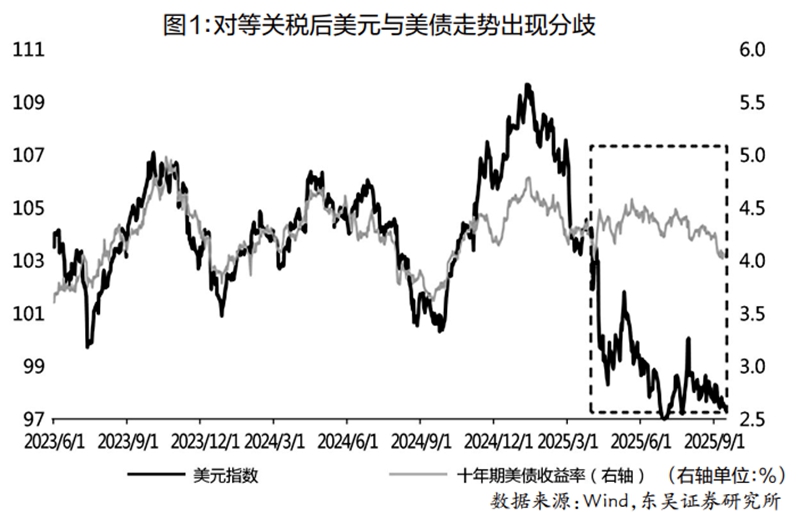
Core Viewpoint - The divergence between U.S. Treasury yields and the U.S. dollar index has become a focal point in financial markets, with long-term Treasury yields rising above 4.5% since April, while the dollar index has weakened to a two-year low. This phenomenon is influenced by complex economic, policy, and market factors [1][2]. Group 1: U.S. Treasury Yield Pricing Logic and Debt Sustainability - The significant rise in U.S. Treasury yields is primarily influenced by concerns over the sustainability of U.S. debt amid ongoing debt ceiling negotiations. The total federal government debt surpassed $37 trillion as of August 11, 2025, with a debt-to-GDP ratio of approximately 126.8% [4][5]. - The 2017 tax reform, which significantly reduced corporate tax rates, has led to decreased fiscal revenue while government spending has not been adequately reduced, exacerbating the fiscal deficit [5]. - Moody's downgraded the U.S. sovereign credit rating from Aaa to Aa1 due to increasing debt and interest payments, which has heightened market concerns and contributed to rising Treasury yields [6]. Group 2: Global Liquidity and Capital Flows - The recent rise in U.S. Treasury yields reflects a reallocation of funds between dollar assets and non-dollar assets, with the dollar depreciating by up to 6.77% since the announcement of tariffs [7][10]. - Investor confidence in dollar assets has been shaken by the uncertainty surrounding the Trump administration's trade and fiscal policies, leading to a shift towards non-dollar assets [10]. - The performance of major currencies has diverged, with the dollar weakening while currencies like the Swiss franc, euro, and yen have appreciated [10]. Group 3: Future Outlook for U.S. Treasury Yields and Dollar Index - Short-term forecasts suggest that long-term Treasury yields may oscillate between 4% and 4.5%, while the dollar index could maintain support around 98. The final version of the "budget reconciliation bill" will significantly impact both Treasury yields and the dollar index [29]. - In the medium to long term, the trajectory of Treasury yields will be influenced by the sustainability of U.S. fiscal policy, economic fundamentals, and Federal Reserve statements. Rising risk premiums may favor gold over dollar assets [30][31]. - Long-term debt risks may undermine the dollar's status as the world's primary reserve currency, with potential challenges from emerging economies and alternative currencies like the euro and yuan [33].
华西证券混沌时刻
HUAXI Securities· 2025-09-22 03:33
Market Dynamics - The bond market is experiencing intense competition for pricing power, particularly with the 10-year government bond rate fluctuating between 1.75% and 1.80%[1] - Major banks have net purchased 9.3 billion CNY of 7-10 year government bonds since September, reversing an 8-month trend of net selling[2] - The overall bond fund size reached approximately 11.15 trillion CNY by mid-2025, with institutional investors holding about 8.99 trillion CNY[3] Central Bank Actions - There is uncertainty regarding whether the central bank will restart bond purchases, as recent buying behavior may not indicate a policy shift but rather internal bank strategies[2] - The central bank's recent operations, including a reform of the 14-day reverse repurchase agreement, aim to stabilize liquidity across quarters and holidays[4] Redemption Fees and Market Sentiment - The punitive redemption fee rates for bond funds may lead to capital outflows if not optimized, potentially increasing pressure on bond yields[3] - The market sentiment remains cautious, with bearish forces slightly dominating, necessitating a defensive strategy while awaiting clearer signals from the central bank[5] Risk Factors - Potential risks include unexpected adjustments in monetary policy, liquidity changes, and fiscal policy shifts that could impact market stability[7]
关注科创债ETF未“超涨”成分券
Orient Securities· 2025-09-22 03:11
1. Report Industry Investment Rating No relevant content provided. 2. Core Viewpoints of the Report - After the issuance of the second batch of Sci - tech Bond ETFs, the "over - rising" spread of component bonds remained stable at around 7 - 8bp, with no "front - running" phenomenon. If the scale of the second - batch ETFs expands rapidly, component bonds with a smaller "over - rising" margin may experience an excessive decline in valuation. Bonds with a maturity of more than 5 years or perpetual bonds have a smaller "over - rising" margin [5][8]. - Although the bond market fluctuated last week, credit bonds performed relatively stably. Credit bonds are still a choice for pursuing certainty, and medium - term bonds of 2 - 3 years can be quickly deployed. It is recommended to use the idea of mining based on the issuer's yield curve [5][12]. - Credit bonds are still the choice for pursuing certainty, and the 2 - 3Y medium - term can be quickly deployed. The idea of mining based on the issuer's yield curve is continued to be recommended, and riding opportunities or "convex points" of individual bonds can be found during the exploration towards the medium - and long - term [5][12]. 3. Summary According to the Directory 3.1 Credit Bond Weekly Viewpoint - The second batch of Sci - tech Bond ETFs completed fundraising on September 12, with a total issuance of approximately 40.8 billion yuan and are scheduled to be listed on September 24. The "over - rising" spread of component bonds is stable, and the probability of large - scale redemptions and negative feedback is low. Component bonds with a smaller "over - rising" margin may see an excessive decline in valuation if the ETF scale expands [5][8]. - Last week, the bond market fluctuated, but credit bonds were stable. Credit bonds are a good choice for certainty, and 2 - 3Y medium - term bonds can be deployed. The idea of mining based on the issuer's yield curve is recommended [5][12]. 3.2 Credit Bond Weekly Review 3.2.1 Negative Information Monitoring - From September 15 to September 21, 2025, Wuhan Contemporary Technology Investment Co., Ltd. failed to pay the principal and interest of bond H20 Technology 4 on time. Shanghai Shimao Construction Co., Ltd., Sichuan Bluetown Development Co., Ltd., and Shanghai Shimao Co., Ltd. had major negative events such as overdue debts, being included in the list of dishonest被执行人, and large - scale litigation [16][17]. 3.2.2 Primary Issuance - From September 15 to September 21, the primary issuance of credit bonds was 326.1 billion yuan, a 25% increase from the previous period. The total repayment amount increased to 236.5 billion yuan, and the net inflow was 89.6 billion yuan, remaining the same as the previous period. The cost of new bonds for high - grade issuers increased, and 3 bonds were cancelled or postponed for issuance, with a total scale of 1.55 billion yuan [17][18][20]. 3.2.3 Secondary Trading - The valuation of credit bonds was generally stable, fluctuating within ±2bp, and credit spreads were passively narrowed by about 4bp. The 5Y - 1Y term spreads of all grades widened, while the 3Y - 1Y spreads were flat or slightly narrowed. The AA - AAA grade spreads were stable or declined. The credit spreads of urban investment bonds in each province narrowed by about 1bp on average, and only Ningxia widened. The spreads of industrial bonds in each industry also narrowed by about 1bp, with the media industry having the largest narrowing of 2bp. The liquidity of credit bonds improved, with the turnover rate increasing by 0.24pct to 1.77%. The top five real - estate companies with widening spreads were Times Holdings, Country Garden, Rongqiao, Logan Group, and Pearl River Investment [22][26][29].
利率策略周报(2025-09-21):继续防守策略-20250921
CMS· 2025-09-21 14:02
Group 1 - The core view of the report emphasizes a defensive strategy in the bond market, with a focus on mid-to-short duration credit bonds being relatively advantageous, while long-duration bonds are approached with a trading strategy [3][4]. - Recent adjustments in the bond market were influenced by the easing of real estate policies, particularly a new policy introduced in Shanghai, which has led to a slight recovery in market sentiment and a decrease in long-term bond yields [1][2]. - The report indicates that the rise in risk appetite, particularly following the Federal Reserve's interest rate cuts, is a primary factor contributing to the upward pressure on long-term bond yields in China [2][3]. Group 2 - The bond market tracking section notes that mid-to-short duration bonds have shown relatively strong performance, while long-end yields have experienced slight adjustments [7]. - Economic activity indicators, such as the high-frequency economic activity index, are currently in a seasonal decline, with the index at 1.01% as of September 16 [17][18]. - The report highlights that the transaction volume in the real estate market remains at historical lows, with 30 major cities recording a total sales area of 21.00 million square meters [34]. Group 3 - The monetary and liquidity section reports fluctuations in the DR001 weighted average interest rate, which ranged from 1.4140% to 1.5127% during the week of September 15-19 [58]. - The report also notes that the 1-year interbank certificate of deposit rates fluctuated between 1.625% and 1.650%, indicating a narrowing of the 1Y-3M spread by 0.74 basis points [58][59].
债券策略周报20250921:持券过节?怎么看-20250921
Minsheng Securities· 2025-09-21 13:42
Group 1 - The report discusses the need to hold bonds during the upcoming National Day holiday, emphasizing that capital gains are limited unless certain conditions are met, such as a drop in bond yields to attractive levels and improved market sentiment [1][6][34] - It highlights that the current 10-year government bond yield is around 1.8%, with potential for both upward and downward movement, but the expectation for bond profit is weak [1][6][34] - The report suggests that short-term bond strategies focusing on 1Y deposits, 1-2Y credit sinking, and 2-3Y high-grade credit are advisable, while caution is advised for 5Y and longer credits due to limited capital gain potential [2][7][35] Group 2 - The yield curve is currently steep, particularly in the medium to long-term segments, with short-term bonds expected to be more resilient against declines [2][7][35] - The report recommends maintaining a slightly lower duration in bond portfolios and suggests that investors wait for further adjustments before seeking rebound opportunities [2][7][36] - It emphasizes the importance of flexibility in portfolio management due to the weak market environment, advocating for a barbell strategy focusing on short-term deposits and higher-yielding credits [2][7][36] Group 3 - The report identifies specific bonds to focus on, including 7Y and 10Y government bonds, and suggests monitoring the liquidity of certain bonds for potential trading opportunities [3][8][9] - It notes that the current basis level for the TL2512 futures contract is relatively low, indicating that futures prices are cheaper compared to cash bonds [3][11] - The report provides a weekly review of bond market performance, indicating that long-term rates have shown weakness while mid-term rates performed slightly better [12][17]
周观:央行重启买入国债将如何影响债市?(2025年第37期)
Soochow Securities· 2025-09-21 13:32
证券研究报告·固定收益·固收周报 固收周报 20250921 周观:央行重启买入国债将如何影响债市? (2025 年第 37 期) [Table_Summary] [Table_Summary] 观点 ◼ 央行重启买入国债预期再度发酵,如何看待其可能性及对债市影响?本 周(2025.9.15-2025.9.19),10年期国债活跃券收益率从上周五的1.7895% 上行 0.55bp 至 1.795%。周度复盘:周一(9.15),2025 年 8 月经济数据 公布,1-8 月固定资产投资累计同比 0.5%,前值 1.6%;8 月社会消费品 零售总额当月同比 3.4%,前值 3.7%;8 月规模以上工业增加值当月同 比 5.2%,前值 5.7%。受偏弱数据的推动,利率略有下行。午后,两则 消息打压债市情绪。一是《求是》发表习近平总书记重要文章《纵深推 进全国统一大市场建设》,文章中强调着力整治企业低价无序竞争乱象, 二是国新办将于周三下午举行发布会,介绍扩大服务消费有关政策措 施。这两则消息引发政策加码的预期,利率转而大幅上行,全天 10 年 期国债活跃券收益率上行 1.05bp。周二(9.16),早盘受夜盘双焦 ...
近期债市思考:多空之争
ZHONGTAI SECURITIES· 2025-09-21 12:09
Report Industry Investment Rating - The industry rating is not explicitly mentioned in the report regarding the bond market. However, the general tone seems to suggest a cautious view on the bond market, with potential risks and adjustments ahead [27]. Core View of the Report - The bond market has been weakening recently with a divergence in bond varieties. Both bulls and bears in the bond market are currently confused. The report presents multiple reasons for both bullish and bearish outlooks on the bond market and concludes that the risk in the bond market has not been eliminated, with potential for further adjustments within the year [2][6]. Summary by Related Catalogs Bullish Reasons - **Bond Supply Mismatch in Q4**: This year, the fiscal bond issuance has been front - loaded, with the remaining quotas for national and local bonds in Q4 at 21.5% and 22.1% respectively, lower than last year's 26.3% and 30.5%. Q4 is also the insurance "opening - up" period, leading to increased allocation demand from insurance companies [7]. - **Favorable Economic Data**: The corporate loans in the social financing data have weakened for two consecutive months, and the economic data in August was generally weak. The production slowed down, with the industrial added - value growth rate in August at 5.2%, down 0.5pct from the previous month. The fixed - asset investment also slowed down. Weak economic data is beneficial for the bond market [8]. - **Monetary Policy and Treasury Bond Transactions**: With a weakening economy, weak social financing and credit, and the Fed's rate cut, there is an increased probability of rate cuts and reserve requirement ratio cuts in Q4. The adjustment of the 14 - day reverse repurchase operation by the central bank implies a potential rate cut. The discussion on government bond issuance management and central bank's treasury bond transactions also provides room for speculation [12]. Bearish Reasons - **Nominal GDP and Re - inflation**: The "anti - involution" policy has a positive impact on inflation. PPI has shown signs of bottoming out. Nominal GDP may rise due to the narrowing of the GDP deflator, which could be unfavorable for bond yields. Expectations of inflation are also increasing [16]. - **Mutual Fund Redemption Chain Reaction**: Due to weakening profitability and the potential redemption fee, mutual bond funds may face scale shrinkage, which could lead to liquidity and valuation spread pressures on certain bond varieties favored by mutual funds [20]. - **Weak Monetary Policy Coordination**: The monetary policy has not adjusted policy rates. To cooperate with the "anti - involution" policy, interest rates may not be further reduced. The desired growth rate of loans may decline, and the current interest rate level may be appropriate [23]. - **Sustained Breakthrough in the Equity Market**: The equity market has shifted from a situation of "no fundamental support" to "having performance support from specific sectors". This may lead to a long - term trend of capital flowing from the bond market to the equity market [24]. Outlook for Monday - Two news events, a news conference on the "14th Five - Year Plan" and a positive phone call between the Chinese and US presidents, may boost risk appetite. The bond and equity markets are likely to have a "risk - on" trading pattern. The risk in the bond market has not been eliminated, and there is still room for adjustment within the year [27].