房地产

Search documents
莱坊:2026年香港楼价有望明显回暖 全年升幅或介于5%至8%
Zhi Tong Cai Jing· 2025-12-29 03:35
Core Viewpoint - The Federal Reserve is expected to cut interest rates by 25 basis points in December to stimulate the economy, which may lead to a recovery in the Hong Kong property market after the Lunar New Year, with a potential price increase of 5% to 8% in 2026 [1] Group 1: Property Market Performance - The Hong Kong private residential property price index reached 297.3 points in November, showing a month-on-month increase of 0.92%, marking six consecutive months of growth, and a year-on-year increase of 1.99%; the cumulative increase for the first 11 months of the year is 2.8% [1] - The overall property market is expected to perform better in 2025 compared to 2024, with both price and transaction volume increasing [1] - The adjustment of stamp duty is expected to help the transaction volume of lower-priced properties, but the most significant stimulus for the overall market comes from interest rate cuts [1] Group 2: Market Sentiment and Future Projections - Market sentiment is showing signs of recovery, but high inventory levels and the inability of Hibor to remain low are limiting significant reductions in mortgage rates [1] - The property market is anticipated to see a noticeable improvement in prices after the Lunar New Year, with a forecasted increase of about 3% in 2025 [1] - The Hong Kong government's talent programs are expected to slightly increase the labor force and high-income population, providing stable support for residential rental demand, with rental prices projected to rise by 3% to 5% in 2026 [1]
春季行情启幕,2025年市场有望完美收官
Sou Hu Cai Jing· 2025-12-29 03:25
Group 1: Policy and Economic Recovery - The macroeconomic policy for 2026 is focused on expanding domestic demand, with a core emphasis on creating a long-term mechanism to boost consumption through supply and demand coordination [2] - The central government aims to stabilize the real estate market by implementing differentiated credit policies and subsidies to support housing demand [2] - The National Development and Reform Commission (NDRC) will dynamically introduce incremental policy tools to stimulate consumption, stabilize investment, and cultivate new economic drivers [2] Group 2: Overseas Liquidity and Capital Flow - The improvement in the overseas liquidity environment is expected to support the A-share market, driven by the easing of global liquidity concerns and the improvement of the China-US interest rate differential [3] - The Federal Reserve's anticipated rate cuts in 2026 are expected to alleviate the pressure on the RMB exchange rate and attract cross-border capital back to China [3] - The valuation discount of RMB assets globally is expected to diminish as the Fed enters a monetary easing cycle, enhancing the attractiveness of Chinese assets to foreign investors [3] Group 3: Industry Transformation and Capital Support - The A-share market is currently experiencing a phase of industrial transformation and an influx of incremental capital, which is expected to optimize market profitability and valuation structures [4] - The "14th Five-Year Plan" emphasizes the construction of a modern industrial system and technological innovation, particularly in emerging sectors like new energy and aerospace [5] - The rapid development of new industries is reflected in the increasing number of new economy companies listed on the A-share market, indicating a shift in profit structures towards high-growth sectors [6] Group 4: Investment Opportunities in Key Sectors - The commercial aerospace sector is expected to lead the market in 2026, driven by policy support, technological advancements, and growing demand [11] - The non-ferrous metals sector is poised for growth due to an improving supply-demand balance, particularly for copper, which is seeing increased demand from AI infrastructure and electric vehicles [12] - The energy storage sector is gaining traction as a core support in the global energy transformation, with Chinese companies leading in global market share [13] Group 5: Market Stability and Investor Confidence - The ongoing reforms in the capital market have significantly improved transparency and investor protection, laying a solid foundation for long-term market health [8][9] - The continuous influx of long-term capital, including from insurance funds and foreign investments, is expected to provide liquidity support and stabilize market fluctuations [7] - The establishment of a robust framework for protecting small investors enhances market fairness and justice, further supporting healthy market development [9] Group 6: Conclusion on Market Outlook - The A-share market is expected to have a solid foundation to stabilize above the 4000-point mark, driven by the leading sectors of commercial aerospace, non-ferrous metals, and energy storage [14] - The anticipated market rally is expected to boost investor sentiment and initiate a new upward cycle in the market [14]
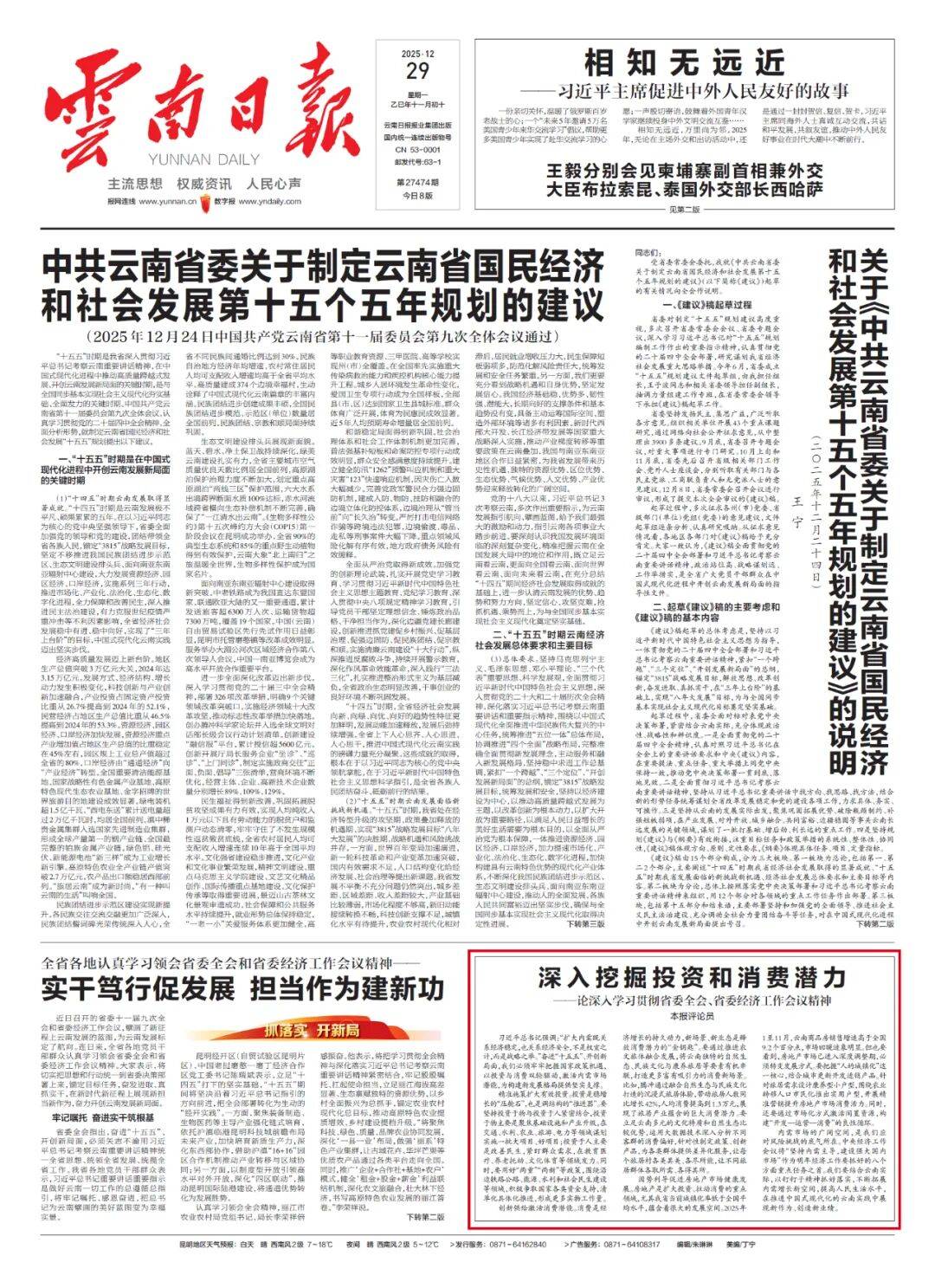
《云南日报》刊评:深入挖掘投资和消费潜力
Sou Hu Cai Jing· 2025-12-29 03:16
Core Viewpoint - The article emphasizes the importance of leveraging investment and consumption to stimulate economic growth in Yunnan Province, aligning with national policies to create a robust domestic market and support the new development pattern [7]. Investment and Consumption Potential - The "14th Five-Year Plan" period is identified as a critical time for Yunnan's development, focusing on enhancing investment and consumption as dual drivers to unlock market potential [6][9]. - Investment is highlighted as a stabilizing force for growth and a catalyst for structural adjustment, with a focus on infrastructure and human capital [9]. - Specific sectors for investment include transportation, water conservancy, agriculture, tourism, and energy, with an emphasis on improving public services in education, healthcare, and cultural sectors [9]. Economic Growth and Structural Adjustment - The article notes that Yunnan's economy has surpassed 3 trillion yuan, with a target for further growth in 2024 [3]. - The province's real estate market is seen as a key area for expanding investment and consumption, with sales growth outpacing the national average by 9.2 percentage points from January to November 2025 [10]. Consumer Market Activation - New consumption scenarios and business models are essential for unlocking consumer potential, with a focus on integrating Yunnan's unique natural and cultural resources into tourism and wellness experiences [9]. - The example of Tengchong shows a 42% increase in tourism numbers and a rise in per capita spending to 13,000 yuan, indicating significant potential in the tourism sector [9]. Real Estate Market Development - The real estate sector is positioned as a priority for investment and consumption, particularly given Yunnan's urbanization rate is below the national average, suggesting substantial growth opportunities [10]. - Strategies include designing housing that meets the needs of urbanizing populations and enhancing marketing efforts to stimulate market activity [10].

香港差估署︰11月楼价指数环比升0.92% 全年升2.8%
智通财经网· 2025-12-29 02:57
智通财经APP获悉,香港差饷物业估价署数据显示,今年11月香港私人住宅楼价指数报297.3点,月环 比微升0.92%,连升6个月,同比升1.99%;今年首11个月累升2.8%。另外,11月份租金指数为200.7点, 月环比升0.2%,同比升4.59%;今年首11个月累升4.26%。 ...
国内宏观和产业政策周观察(1222-1228):住建会议定调2026房地产
Huafu Securities· 2025-12-29 02:44
Group 1: Macro and Industry Policy Tracking - The report highlights a focus on multi-field collaborative advancement in industry policies, including the cultivation of emerging industries such as integrated circuits and low-altitude economy, as well as strengthening 6G research [1][10] - The housing and urban-rural construction meeting emphasizes stabilizing the real estate market and developing a new model characterized by the sale of existing homes, with a focus on policies tailored to individual cities [1][12] - The transportation department predicts that yacht and cruise consumption will evolve towards mass-market and large-scale development, indicating a shift in consumer behavior [1][13] Group 2: Financial Regulations - The financial regulatory authority has standardized the information disclosure of asset management products to protect investor rights, ensuring transparency and accountability in financial products [1][16] Group 3: Energy and Technology Developments - The energy sector is promoting the large-scale development of solar thermal power and has introduced the world's first mandatory standard for electric vehicle energy consumption, which will enhance vehicle performance and consumer experience [1][18] - A significant technological breakthrough was achieved in the field of superconducting magnetic levitation, with a test speed of 700 km/h, marking a milestone in China's technological advancement [1][19] Group 4: Stock Market Performance - The A-share market showed mixed performance, with the top five sectors by growth being industrial trade and comprehensive (+7.34%), non-ferrous metals (+6.55%), chemicals (+5.86%), national defense and military industry (+5.81%), and hardware equipment (+4.99%) [1][22] Group 5: Popular Concepts Tracking - The report identifies the top five popular concepts this week, with lithium battery electrolyte (+17.80%), Hainan Free Trade Port (+10.98%), 6G (+9.40%), RF and antennas (+9.27%), and power batteries (+8.78%) showing significant growth [2][25]
沪指八连阳,跨年行情可期?丨周度量化观察
申万宏源证券上海北京西路营业部· 2025-12-29 02:43
Market Overview - The Shanghai Composite Index achieved an eight-day winning streak, with a weekly increase of 1.88%, indicating a "steady rise" trend [2] - The Shenzhen Component Index and ChiNext Index performed better, with weekly gains of 3.55% and 3.90% respectively [2] - The Wande Commercial Aerospace Index surged by 8.36%, marking its largest weekly gain in the second half of the year [2] - The overall market sentiment showed improvement, with increased trading volumes, indicating a recovery in risk appetite [4] Equity Market - The average daily trading volume in the Shanghai and Shenzhen markets significantly increased to 1.95 trillion yuan, surpassing 2 trillion yuan on Friday [4] - Growth style stocks outperformed value style stocks, suggesting a shift in market preference [4] - The market is showing signs of breaking out of the consolidation phase, with a need to closely monitor changes in trading volume [4] Bond Market - The bond market showed a recovery, with both interest rate bonds and credit bonds strengthening, supported by a balanced funding environment [2][29] - The central bank's measures have maintained liquidity, alleviating initial concerns about market adjustments [5] - A cautious approach is recommended for long-term bonds due to supply pressures, with a focus on short to medium-term bond strategies [5] Commodity Market - COMEX gold prices continued to rise, reaching new highs, driven by a weaker dollar and geopolitical tensions [2] - The South China Commodity Index increased by 4.00%, with significant gains in precious metals and non-ferrous metals [33] - The outlook for gold remains positive in the medium to long term, supported by factors such as central bank purchases and limited supply capacity [6] Overseas Market - The U.S. stock market showed resilience, with the S&P 500 reaching new highs, supported by strong economic data [2] - The U.S. GDP for Q3 was reported at an annualized rate of 4.3%, exceeding expectations, which has led to a slight reduction in interest rate cut expectations [2] - Investors are encouraged to consider diversified overseas investments through QDII funds, balancing asset classes and regional exposures [7]

信达国际控股港股晨报-20251229
Xin Da Guo Ji Kong Gu· 2025-12-29 02:20
Market Overview - The Hang Seng Index has short-term support at the 25,000 point level, with expectations of two interest rate cuts in 2026 following the Federal Reserve's recent 0.25% rate cut, which brings the federal funds rate to a range of 3.5% to 3.75% [1][4] - The market anticipates a dovish monetary policy stance post-2026 leadership change, but further observation of economic data is necessary [1] - The Chinese economy is facing a supply-demand imbalance, with a focus on stabilizing investment and the real estate market, while the US-China tariff war has paused, limiting the incentive for aggressive policy adjustments in the short term [1] Company News - Xiaomi's co-founder Lin Bin plans to sell up to $2 billion worth of shares, with proceeds intended for establishing an investment fund [10] - Leapmotor has received a premium subscription from FAW for nearly 75 million shares, amounting to over 4.1 billion RMB [10] - ByteDance is expected to purchase Huawei's Ascend chips next year, with total orders potentially exceeding 40 billion RMB, marking a significant increase from nearly zero in 2025 [10] - UBTECH Robotics has acquired a 43% stake in Fenglong for approximately 1.665 billion RMB, focusing on garden machinery and automotive components [10] - Vanke's domestic bond extension proposal was not approved, but a grace period extension was passed, allowing for a 30-day extension [10] Industry Insights - The National Development and Reform Commission (NDRC) is addressing "involution" competition in new energy vehicles and related industries, emphasizing price monitoring and quality checks to prevent disorderly competition [9] - The Chinese government is set to implement a more proactive fiscal policy in 2026, focusing on boosting consumption and effective investment in key areas [9] - The industrial profits in China fell by 13.1% year-on-year in November, indicating challenges in the industrial sector [9] - The Ministry of Industry and Information Technology forecasts a 5.9% growth in industrial value added for the year, with significant growth in high-tech manufacturing [9]
中泰期货晨会纪要-20251229
Zhong Tai Qi Huo· 2025-12-29 02:06
Report Industry Investment Rating There is no information provided in the content about the report industry investment rating. Core Viewpoints of the Report - The A-share market showed a volatile upward trend, with the Shanghai Composite Index rising 0.10% to 3963.68 points, achieving an 8 - day consecutive increase. It is advisable to pay attention to the sustainability and structure of liquidity restoration. If realized, the index may strengthen, and focus on the IH contract [14]. - The medium - and short - term bonds may fluctuate with a slight upward bias, but the odds are more important than the direction [15]. - Steel products are expected to fluctuate and consolidate, with a medium - to long - term trend of bottom - building. Iron ore is recommended to be short - sold on rallies [18]. - The prices of coking coal and coke may rise in the short term, but the upside space and strength may be limited due to the pressure on the steel industry chain profits [19]. - For ferroalloys, it is recommended to short on rallies in the medium term. Silicon iron is still stronger than manganese silicon in terms of the disk performance [20]. - For soda ash, it is advisable to wait and see; for glass, it is recommended to try long positions after the market sentiment stabilizes [22]. - For Shanghai zinc, it is recommended to wait and see or short on rallies within a range [24]. - For Shanghai lead, it is recommended to wait and see, and aggressive investors can enter short positions at high levels [25]. - The price of lithium carbonate may continue to be strong in the short term, but beware of significant fluctuations [26]. - For industrial silicon, pay attention to the opportunity of selling out - of - the - money call options on rallies; for polysilicon, pay attention to the opportunity of buying on pullbacks [28]. - Cotton is in a stage of loose supply in the short term but is expected to strengthen in the long term due to supply contraction expectations. It shows a volatile upward trend [30]. - For sugar, it is advisable to wait and see or short on rallies at high levels after the valuation repair [32]. - For eggs, the upside space of the near - term contracts is limited, and the far - term contracts may maintain strength in the short term but are also limited in the upside [35]. - The apple market may fluctuate, and attention should be paid to the price changes in the sales area [37]. - Corn may fluctuate strongly in the short term. It is advisable to wait and see, and aggressive investors can short the 03 contract on rallies [38]. - The jujube market is expected to fluctuate, and attention should be paid to the market performance during the consumption peak season [39]. - The upward trend of the live - pig spot price is expected to be unsustainable, and it is recommended to short on rallies for the main contract [41]. - Crude oil prices may fluctuate mainly, and attention should be paid to geopolitical conflicts in Venezuela and the Middle East [44]. - Fuel oil prices will follow the fluctuations of crude oil prices [46]. - Polyolefins are expected to be in a state of slightly strong fluctuations, with large supply pressure but some support from upstream losses [47]. - For rubber, it is recommended to reduce long positions on rallies and hold the remaining positions for observation [48]. - For synthetic rubber, it is advisable to exit the arbitrage strategy and wait and see. Be cautious about chasing up on the long side [49]. - For methanol, the near - term contracts may have a slight rebound, and the far - term contracts can be considered for long positions after the inventory is reduced smoothly [50]. - For caustic soda, the near - term 02 contract should be treated with a short - bias mindset, and the far - term 05 contract can be held dynamically with long positions [51]. - The fluctuation range of asphalt prices is expected to increase, and the focus is on the price bottom after the winter storage game [52]. - For the polyester industry chain, it is advisable to consider the positive spread opportunity between the 5 - 9 contracts of PX and PTA [53]. - The price of LPG is likely to fall rather than rise in the short term, and the market focuses on the delivery logic [55]. - For pulp, it is advisable to wait and see in the short term. If the spot price is stable, one can sell out - of - the - money call options on the 03 contract at high levels [57]. - For logs, the market is expected to be in a state of weak supply - demand balance and fluctuate [57]. - For urea, it is recommended to take a short - bias approach in the short term due to large supply pressure [58]. Summary According to Relevant Catalogs Macro Information - The convening time of the 2026 National Two Sessions has been determined. The Fourth Session of the 14th National Committee of the Chinese People's Political Consultative Conference will be held in Beijing on March 4, 2026, and the Fourth Session of the 14th National People's Congress will be held on March 5. Reviewing the draft outline of the "14th Five - Year Plan" is included in the proposed agenda of the 2026 National People's Congress [10]. - From January to November, the total profits of industrial enterprises above the designated size in the country reached 6,626.86 billion yuan, a year - on - year increase of 0.1%. In November, the profits of industrial enterprises above the designated size decreased by 13.1% year - on - year [10]. - The Shanghai Stock Exchange issued guidelines to support commercial rocket enterprises in the critical period of large - scale commercialization to list on the Science and Technology Innovation Board using the fifth set of listing standards [10]. - The National Venture Capital Guidance Fund was officially launched, with 100 billion yuan of fiscal investment at the national level and expected to leverage trillions of yuan of social capital at the regional and sub - fund levels. Strategic emerging and future industries will be the key investment areas [11]. - The central bank pointed out in the "China Financial Stability Report (2025)" that relevant departments will improve the institutional and policy environment for long - term investment, increase the scale and proportion of medium - and long - term funds investing in A - shares, and promote the improvement of the quality of listed companies [11]. - The National Conference on Industry and Information Technology deployed ten key tasks for 2026, including rectifying "involution - style" competition, supporting artificial intelligence research, and promoting the commercialization of new services such as satellite Internet of Things [11]. - The Ministry of Industry and Information Technology studied and deployed key tasks for the "14th Five - Year Plan" period of the information and communication industry, emphasizing the research and development of 6G technology and the improvement of platform economy supervision [11]. - In response to the US arms sales to Taiwan, China decided to take counter - measures against 20 US military - related enterprises and 10 senior managers [12]. - The State Administration for Market Regulation carried out compliance guidance on standardizing price competition in the photovoltaic industry, emphasizing the importance of rectifying "involution - style" competition [12]. - The core CPI in Tokyo, Japan, rose 2.3% year - on - year in December, significantly slower than the previous value of 2.8% and lower than the market expectation of 2.5%, hitting a 14 - month low [12]. - Vanke's second 3.7 - billion - yuan bond extension plan has not been passed [12]. Macro Finance Stock Index Futures - The A - share market showed a volatile upward trend, with the Shanghai Composite Index rising 0.10% to 3963.68 points, achieving an 8 - day consecutive increase. It is advisable to pay attention to the sustainability and structure of liquidity restoration. If realized, the index may strengthen, and focus on the IH contract [14]. Treasury Bond Futures - The medium - and short - term bonds may fluctuate with a slight upward bias, but the odds are more important than the direction. The central bank's open - market operations led to a net injection of funds, and the short - term bond sentiment was good, while the ultra - long - term bonds were still weak. If there is no interest rate cut, the market sentiment may decline, and the bonds within 10 years will remain volatile [15][16]. Black Steel and Ore - From a policy perspective, the Central Economic Work Conference met market expectations without new policies. In the short term, there are no other important macro - level meetings. Attention should be paid to the end - of - year deployment requirements of the Ministry of Industry and Information Technology for next year [17]. - In terms of fundamentals, the real - estate new - home sales data weakened year - on - year, and the new construction of housing decreased significantly. The overall demand for building materials was weak, while the demand for rolled products was good. The steel mill's profits were at a low level, and the iron ore and coking coal prices fluctuated. The inventory of five major steel products decreased month - on - month but remained high compared with last year [17]. - Steel products are expected to fluctuate and consolidate, with a medium - to long - term trend of bottom - building. Iron ore is recommended to be short - sold on rallies [18]. Coking Coal and Coke - The prices of coking coal and coke may rise in the short term, but the upside space and strength may be limited due to the pressure on the steel industry chain profits. Attention should be paid to the production of coal mines, safety inspections, and the progress of downstream winter storage [19]. Ferroalloys - The commodity sentiment has warmed up, but the black sector lacks its own driving force. The double - silicon products are the least volatile in the black sector. It is recommended to short on rallies in the medium term. Silicon iron is still stronger than manganese silicon in terms of the disk performance [20]. Soda Ash and Glass - The soda ash and glass industry chain fluctuates with the market atmosphere. The supply of soda ash is at a low level, and new production capacity needs to be observed. The glass spot sentiment is still weak, and there is an expectation of production reduction. For soda ash, it is advisable to wait and see; for glass, it is recommended to try long positions after the market sentiment stabilizes [22]. Non - ferrous Metals and New Materials Shanghai Zinc - As of December 25, the inventory of zinc ingots in seven major regions decreased. The zinc concentrate processing fee remained low, and the supply was tight, supporting the zinc price. It is recommended to wait and see or short on rallies within a range [24]. Shanghai Lead - As of December 25, the social inventory of lead ingots decreased. The supply was restricted by raw material shortages and environmental protection measures, and the demand was weak. The market was in a state of weak supply and demand. It is recommended to wait and see, and aggressive investors can enter short positions at high levels [25]. Lithium Carbonate - The short - term price of lithium carbonate may continue to be strong, but beware of significant fluctuations. The demand is expected to be good in the long term, but the current market sentiment is mainly driven by expectations [26]. Industrial Silicon and Polysilicon - For industrial silicon, pay attention to the opportunity of selling out - of - the - money call options on rallies. For polysilicon, pay attention to the opportunity of buying on pullbacks. The industrial silicon market is in a state of loose balance during the dry season, and the polysilicon price is expected to be strong under the influence of policies [28]. Agricultural Products Cotton - Cotton is in a stage of loose supply in the short term but is expected to strengthen in the long term due to supply contraction expectations. The price is supported by cost and policy expectations and shows a volatile upward trend [30]. Sugar - The domestic sugar market is in a season of strong supply and demand. After the significant rebound of Zhengzhou sugar for valuation repair, attention should be paid to the pressure of hedging positions. It is advisable to wait and see or short on rallies at high levels [32]. Eggs - The upside space of the near - term contracts is limited due to the loose supply - demand pattern. The far - term contracts may maintain strength in the short term but are also limited in the upside due to high valuations [35]. Apples - The apple market may fluctuate. The current market shows limited transactions in the production area and slow sales in the sales area. Attention should be paid to the price changes in the sales area [37]. Corn - Corn may fluctuate strongly in the short term. It is advisable to wait and see, and aggressive investors can short the 03 contract on rallies. The key factor affecting the corn price is the farmers' selling sentiment [38]. Jujubes - The jujube market is expected to fluctuate. Attention should be paid to the market performance during the consumption peak season. Currently, the market is in the stage of digesting new arrivals, with supply pressure and limited upward price momentum [39]. Live Pigs - The upward trend of the live - pig spot price is expected to be unsustainable, mainly driven by short - term supply - demand mismatches. It is recommended to short on rallies for the main contract [41]. Energy and Chemicals Crude Oil - Crude oil prices may fluctuate mainly, with the core contradiction being the land issue between Russia and Ukraine and frequent geopolitical issues in the Middle East. The supply of crude oil is in a state of surplus, and attention should be paid to geopolitical conflicts in Venezuela and the Middle East [44]. Fuel Oil - Fuel oil prices will follow the fluctuations of crude oil prices. The supply - demand structure of fuel oil is loose, and the demand is weak. The short - term trading focus is on the geopolitical influence dominated by the US and Russia [46]. Plastics - Polyolefins are expected to be in a state of slightly strong fluctuations. The supply pressure is large, but there is some support from upstream losses. The downstream demand is relatively weak [47]. Rubber - For rubber, it is recommended to reduce long positions on rallies and hold the remaining positions for observation. The trading sentiment has increased, but the fundamental supply - demand situation has no obvious contradiction [48]. Synthetic Rubber - For synthetic rubber, it is advisable to exit the arbitrage strategy and wait and see. Be cautious about chasing up on the long side. It is expected to be slightly strong in the short term under the influence of cost and policy expectations [49]. Methanol - The near - term contracts of methanol may have a slight rebound, and the far - term contracts can be considered for long positions after the inventory is reduced smoothly. The supply of methanol may be affected by factors such as the shutdown of Iranian plants [50]. Caustic Soda - For caustic soda, the near - term 02 contract should be treated with a short - bias mindset, and the far - term 05 contract can be held dynamically with long positions. The spot price is weak, while the far - term contract has more macro - level positive expectations [51]. Asphalt - The fluctuation range of asphalt prices is expected to increase, and the focus is on the price bottom after the winter storage game. The geopolitical issues in Venezuela have increased the uncertainty of asphalt raw materials [52]. Polyester Industry Chain - For the polyester industry chain, it is advisable to consider the positive spread opportunity between the 5 - 9 contracts of PX and PTA. The prices of PX, PTA, ethylene glycol, and short - fiber have all declined due to factors such as weak oil prices and downstream negative feedback [53]. Liquefied Petroleum Gas (LPG) - The price of LPG is likely to fall rather than rise in the short term, and the market focuses on the delivery logic. The supply is abundant, and the demand is seasonally supported in the civil market but weak in the chemical industry [55]. Pulp - For pulp, it is advisable to wait and see in the short term. The fundamentals are gradually improving, but there may be pressure from hedging positions. If the spot price is stable, one can sell out - of - the - money call options on the 03 contract at high levels [57]. Logs - The log market is expected to be in a state of weak supply - demand balance and fluctuate. The domestic and foreign spot markets are relatively stable, and the price of foreign - sourced logs may decline due to lower freight rates [57]. Urea - Near the end of the year, the supply pressure of urea is relatively large, and it is recommended to take a short - bias approach in the short term. The spot price is stable to weak, and the trading volume is low [58].
机构展望2026年香港楼市:楼价最高再涨15%
Ge Long Hui· 2025-12-29 02:02
Core Viewpoint - The Hong Kong residential property market has reached a four-year high in transactions, driven by a low interest environment and active stock market, with property prices reversing a three-year decline and increasing nearly 4%. Forecasts for 2026 suggest property prices may rise between 5% to 15% [1][2]. Group 1: Market Predictions by Real Estate Firms - JLL expresses confidence that property prices have bottomed out this year, with a cautiously optimistic outlook for 2026, predicting a 5% increase in small to medium-sized residential prices and a similar rise in medium-sized rental prices. Luxury property prices are expected to remain stable, with rental increases of 0-5% anticipated. New developments and younger properties are expected to see more significant price increases [1]. - CBRE forecasts that residential transaction volumes next year will be similar to this year's levels, with property price increases capped at 5%. Rental growth is expected to slow slightly to around 3% [1]. - Knight Frank predicts luxury property prices will rise by 3-5%, while general residential prices are expected to increase by 5-8%, with both general and luxury rental prices rising by 3-5% [1]. - Savills anticipates a continued upward trend in the residential market next year, with price increases expected to be more pronounced, estimated at around 3-5% [1]. - Hong Kong Property anticipates further increases in both primary and secondary market transactions and prices next year, driven by sustained demand for self-use, rental, and short-term investment, with optimistic scenarios suggesting price increases of 10-15% [1]. Group 2: Additional Insights - Citi predicts that with continuous interest rate cuts in the U.S., alongside a notable recovery in rental prices and improved supply-demand dynamics, Hong Kong property prices are expected to rise by 5% next year [2].
Home Sales, Fed Meeting Minutes, and Manufacturing Data to Usher in the New Year
Barrons· 2025-12-29 01:00
Group 1 - The week will be shortened due to the holiday, impacting the release schedule of economic data [1] - Key economic data to be released includes home prices, construction spending, and manufacturing [1] - The Federal Reserve minutes from the December meeting will also be published, providing insights into monetary policy [1]