生猪养殖

Search documents
上游出栏,猪价承压
Zhong Xin Qi Huo· 2025-07-17 01:20
1. Report Industry Investment Rating Most of the industries in the report are rated as "oscillating", with the exception of the log industry which is rated as "oscillating weakly", and the sugar industry which is expected to "oscillate weakly" in the long - term and "oscillate" in the short - term [7][8][9][10][12][14][16][17][18]. 2. Core View of the Report The report analyzes multiple agricultural and related industries, finding that most industries are currently in an oscillating state. Some industries face supply - demand imbalances, such as the oversupply in the hog industry; others are affected by factors like weather, policies, and trade relations, such as the possible weather - related speculation in natural rubber and the impact of trade agreements on protein meal [1][7][8]. 3. Summary by Variety 3.1 Oils and Fats - **View**: Oscillating and differentiating, with soybean and rapeseed oils oscillating strongly yesterday. - **Logic**: Good growth of US soybeans, a decrease in US soybean oil inventory, an increase in the expected demand for soybean oil in biodiesel, and the Brazilian biodiesel blending ratio increase. However, there is also pressure from the increase in palm oil production and the high inventory of domestic rapeseed oil [7]. 3.2 Protein Meal - **View**: Due to the signing of the Sino - Australian trade memorandum of understanding, the double - meal oscillated and slightly declined. - **Logic**: Abroad, the growth of US soybeans is smooth, but the export prospects are worrying; Brazil's exports are still high. Domestically, the signing of the Sino - Australian memorandum implies new Australian seed imports, with supply pressure leading to weak spot prices, but concerns about Sino - US trade support the futures prices. It is expected to oscillate in the short - term and be strong in the long - term [8]. 3.3 Corn/Starch - **View**: Spot transactions are light, and futures and spot prices oscillate weakly. - **Logic**: Futures prices rebounded slightly during the day and then fell back. On the spot side, supply at ports and deep - processing plants decreased, and there were price adjustments at some deep - processing plants. Deep - processing production and consumption data changed slightly, and there is a risk of supply shortage before the new grain is listed in large quantities [9][10]. 3.4 Hogs - **View**: Upstream slaughtering puts pressure on hog prices. - **Logic**: In the short - term, large hogs are being slaughtered at an accelerated pace, but the average weight has bottomed out and rebounded, and farmers are still reluctant to sell standard hogs. In the medium - term, the number of new - born piglets has been increasing, and there is room for an increase in hog slaughter in the second half of the year. In the long - term, the current production capacity is still high. The demand for pork has increased week - on - week, and the weight - reduction trend is blocked. In the short - term, the market has positive sentiment, but in the medium - and long - term, there is supply pressure in the third quarter [1][10]. 3.5 Natural Rubber - **View**: There may be weather - related speculation, but the expected increase is limited. - **Logic**: The rubber price rose rapidly at the end of trading yesterday, possibly due to weather - related speculation about a typhoon landing in Hainan Island or external capital. The trading logic follows the macro - sentiment, and the fundamentals are currently stable. The supply is affected by the rainy season, and the demand is relatively stable [12][13]. 3.6 Synthetic Rubber - **View**: The futures price rebounded after a decline. - **Logic**: The futures price followed the commodity adjustment and then rebounded due to the impact of natural rubber. The upward driving force is not obvious, but there is support from the macro - environment and the improvement in butadiene trading. It is expected to oscillate within a range [14]. 3.7 Cotton - **View**: Cotton prices increased with increased positions, breaking through the 14,000 - yuan mark. - **Logic**: In the medium - and long - term, the cotton market is loose, and the new cotton in Xinjiang is expected to increase in production. The demand is in the off - season, but the current commercial inventory is low. Yesterday, the futures price increased with increased positions, but there are multiple factors restricting further increases, and there is a risk of decline when new cotton is listed in large quantities [14]. 3.8 Sugar - **View**: Sugar prices fluctuated within a narrow range. - **Logic**: In the medium - and long - term, sugar prices are under downward pressure due to the expected supply surplus in the 25/26 sugar - making season. In the short - term, the decline in Brazilian sugar production and high domestic sales rates support sugar prices, but the increase in Brazilian production and exports and domestic imports will increase supply pressure [16]. 3.9 Pulp - **View**: The trend is dominated by the macro - environment, with a stalemate - type fluctuation. - **Logic**: The futures price fluctuated horizontally, and the supply - demand relationship is in a stalemate. The upward driving force comes from the macro - environment, but there is pressure at 5200 - 5300 yuan. In the short - term, there is a slight rebound space, and in the medium - term, there may be a phased increase, but the height is limited [17]. 3.10 Logs - **View**: There are few fundamental contradictions, and the short - term futures price oscillates. - **Logic**: Spot prices are weak due to the impact of delivery products, and the cost of importers has increased. Although it is the off - season, the overall demand is stable, and the market is in the bottom - building stage. There is no clear driving force for upward or downward movement in the short - term [18][19].
775家深市公司“剧透”上半年业绩 近六成实现正增长
Shang Hai Zheng Quan Bao· 2025-07-16 23:46
截至7月15日,深市已有775家上市公司披露2025年半年度业绩预告,其中453家公司预计上半年净利润 实现同比增长,占比近六成。 据统计,超110家公司预计上半年净利润同比增长超过100%,355家公司预计上半年净利润同比增速超 过50%,405家公司预计上半年净利润同比增长超过30%。此外,近百家公司预计将扭亏为盈。 截至7月15日,已披露半年度业绩预告的深市公司涉及30个申万一级细分行业,其中20个行业的预计净 利润上限合计为正,25个行业的预计净利润上限实现正增长。盈利规模排名靠前的行业包括农林牧渔、 电子、有色金属、基础化工、机械设备等。 龙头公司继续发挥引领作用 深市市值排名前100的公司中,21家已披露业绩预告,其中20家实现同比增长,预计合计实现净利润512 亿元至569亿元,牧原股份、新易盛、TCL科技等公司净利润同比增速超过100%,继续发挥引领作用。 7月10日,牧原股份发布2025年半年度业绩预告称,预计上半年实现归母净利润102亿元至107亿元,同 比增长1129.97%至1190.26%。经营业绩大幅提升的主要原因是公司生猪出栏量较去年同期上升,导致 收入上升,且生猪养殖成本较去年 ...
如何解读6月生猪产能数据
2025-07-16 15:25
Summary of Conference Call on Pig Industry Data Industry Overview - The conference call focuses on the pig farming industry in China, specifically discussing the trends in pig production, pricing, and government policies affecting the sector. Key Points and Arguments Pig Production and Capacity - From January to June 2025, the external sales of pork decreased by 3.6% year-on-year, while the number of sows eliminated increased by 7.6% year-on-year, indicating structural adjustments in production capacity [1][2] - The overall capacity of breeding sows is slightly declining, with a current count of approximately 4,050 heads compared to a peak of 4,080 heads earlier this year [3] - In June 2025, the capacity of breeding sows showed a slight increase across all scales of farms, although specific government data has not been released [6] Pricing Trends - The price of fat pigs remained stable overall, with fluctuations observed in May and June, where prices rebounded from nearly 14 yuan to close to 16 yuan due to the sales strategies of large enterprises [4] - The average price for the year is projected to be around 15.4 yuan, slightly lower than the previous year's average of 15.6 yuan, but profits remain higher due to effective supply control [5] Government Policies and Market Impact - The government aims to reduce the number of breeding sows, but the actual trend shows a slight increase in numbers across various farm sizes [8] - Policies implemented include reducing the average weight of slaughtered pigs and banning the issuance of breeding permits, which are expected to take effect fully on July 20 [8][10] - The government is expected to strengthen regulations on slaughter permits to combat the issue of "secondary breeding," which has been driving up market prices [9][11] Supply and Demand Dynamics - The supply situation from January to June 2025 is slightly lower or stable compared to the previous year, with a cumulative slaughter increase of 14% reported [5] - The birth rate of piglets has shown fluctuations, with a strong demand from large enterprises and a reduction in the number of breeding sows by smaller enterprises [7][21] - The overall supply for the second half of the year is expected to be higher than the first half, particularly in the fourth quarter, which will see increased supply compared to the third quarter [18][19] Future Price Expectations - The weight of fat pigs is expected to be controlled around 120 kg, with prices projected to range between 14 and 16 yuan for the year [17] - If consumer demand improves during the peak season, prices may see a slight increase, but overall growth is expected to be limited [17] Miscellaneous Insights - The impact of the current pandemic on national production capacity has been minimal, with quick recovery observed even in affected regions [20] - The monitoring data indicates that the weight of fat pigs has remained stable at around 124.2 kg for the past four months, despite some discrepancies with third-party data [13] This summary encapsulates the key insights from the conference call regarding the pig farming industry, highlighting production trends, pricing dynamics, government interventions, and future expectations.
2025年上半年生猪产业数据的相关思考
Ge Lin Qi Huo· 2025-07-16 08:10
Report Summary 1. Report Industry Investment Rating No information provided. 2. Core Viewpoints - The 'year-on-year growth' of the current data has limited practical significance, and the market should focus on the relative strength between the current supply increase and the increase already reflected in the futures market [7]. - The current pig price is in the second half of the small cycle of passive capacity reduction due to diseases, and active/passive capacity reduction has not yet started [10]. - The most likely way to reduce capacity this year is passive capacity reduction driven by diseases, but large - cycle market trends still await active capacity reduction driven by low prices [12]. - The main trading logic of live - hog futures this year is the bearish logic of continuous supply recovery. After the bearish expectations are basically fulfilled, it trades the basis repair logic under different drivers [13]. 3. Summary by Directory 3.1 'Year - on - Year Growth' Effective Significance Is Insufficient - Due to capacity adjustments in 2023 - 2024, the year - on - year growth in 2025 supply was expected and already reflected in the futures market. Comparing 2025 data with 2023 shows that although the number of live - hogs in the first quarter of 2025 was higher than in 2024 but lower than in 2023, the increase in pork output was due to higher slaughter weights [7][8]. - Comparing the first half of 2025 with the same period in 2024 and 2023, the decline in the number of live - hog inventories in the second quarter of 2025 narrowed compared to 2023, and the year - on - year growth rate of live - hog slaughter in the first half of the year increased compared to the first quarter, indicating a continuous recovery in inventory. However, the contribution of weight to pork output in the second quarter weakened compared to the first quarter, and overall supply pressure still exists [8][9]. 3.2 Pig Capacity Cycle Issues and Thoughts 3.2.1 Current Stage of the Pig Capacity Cycle - As of the end of the second quarter, the number of breeding sows increased quarter - on - quarter. The current pig price is in the second half of the small cycle of passive capacity reduction due to diseases, and active/passive capacity reduction has not yet started [10]. 3.2.2 How to Achieve Capacity Reduction - There are three ways to reduce capacity: active capacity reduction driven by low prices (currently ineffective as pigs and piglets are profitable); passive capacity reduction caused by diseases (need to pay attention to winter disease prevention at the end of the year); and forced capacity reduction driven by environmental protection policies (the most likely way currently, which will promote large - scale development) [11]. 3.2.3 Main Trading Logic of Live - Hog Futures - The main trading logic this year is the bearish logic of continuous supply recovery. After the bearish expectations are fulfilled, it trades the basis repair logic. In the long - term, maintain a short - selling strategy unless the number of newborn piglets decreases; in the medium - term, it may operate in a wide range around the expected support and pressure of spot pig prices; in the short - term, it is trading the repair of the futures discount driven by the weight - reduction expectation [13].
宠物和生猪板块推荐观点更新
2025-07-16 06:13
Summary of Conference Call Industry and Company Involved - The conference call primarily discusses the **agriculture industry**, focusing on the **pet sector** and **livestock farming**, particularly **swine farming** and **pet medical care**. Key Points and Arguments Pet Sector 1. The company has been continuously recommending the **pet sector**, with a recent emphasis on the **breeding sector** as well. The focus includes **pet food** and **pet medical care** [1][8] 2. Recent offline surveys indicate a shift in the pet market towards **fresh food** and **differentiated products**, highlighting the competitive landscape driven by product innovation [9][10] 3. The pet market is currently characterized by high marketing costs and increased competition, necessitating a focus on product quality and consumer education [13][14] 4. Domestic leading brands are gaining traction, particularly in the mid to high-end market segments, despite facing competition from foreign brands [15][16] Livestock Farming 5. The company has started to recommend the **swine farming sector** due to favorable market conditions and stable pig prices, which have remained between **14 to 15 yuan** per kilogram since the Chinese New Year [3][4] 6. There has been a significant increase in the average weight of pigs post-Chinese New Year, with an increase of nearly **8 kilograms**, indicating a positive trend in livestock growth [4] 7. Despite the current stability, there is a bearish outlook on pig prices due to high supply pressures, presenting a potential buying opportunity in the livestock sector [6] Pet Medical Care 8. The pet medical care sector is viewed as having substantial growth potential, with expectations for the market to develop into a **billion-dollar industry** [18][19] 9. The domestic pet medical market is still in its early stages compared to mature markets like the U.S., indicating significant room for growth in pet health management and spending [19] 10. Companies with strong R&D capabilities and a focus on pet vaccines and pharmaceuticals are expected to thrive in the evolving market landscape [20][22] Financial Performance and Projections 11. The company anticipates a **20%** growth rate over the next two to three years, supported by the launch of new products in the pet medical sector [24] 12. Current valuations suggest that the company is trading at less than **18 times** earnings, indicating a favorable investment opportunity [24] Additional Insights 13. Recent policy changes are expected to accelerate trends in the livestock sector, with ongoing adjustments in regulations impacting market dynamics [6][7] 14. The competitive landscape in the pet food market is shifting towards product-driven strategies, with an emphasis on health and premium offerings [11][12] Conclusion The conference call highlights a positive outlook for both the pet and livestock sectors, driven by product innovation, market stability, and favorable growth projections. The emphasis on R&D and adapting to consumer trends is crucial for companies operating in these industries.

建信期货生猪日报-20250716
Jian Xin Qi Huo· 2025-07-16 01:50
Group 1: Report Overview - Report Title: Pig Daily Report [1] - Report Date: July 16, 2025 [2] Group 2: Market Review and Operation Suggestions Market Review - Futures: On July 15, the main 2509 contract of live pigs opened lower, then rose and fell back, closing with a negative line. The highest price was 14,360 yuan/ton, the lowest was 14,230 yuan/ton, and the closing price was 14,250 yuan/ton, up 0.04% from the previous day. The total open interest of the index decreased by 230 lots to 162,061 lots [7]. - Spot: On July 15, the average price of ternary pigs nationwide was 14.54 yuan/kg, down 0.07 yuan/kg from the previous day [7]. Market Analysis - Demand: The price difference between fat and standard pigs widened slightly, and the utilization rate of pigsties increased, indicating higher enthusiasm for secondary fattening. Due to hot weather, terminal demand was weak, slaughterhouse orders were average, and the slaughter rate and volume remained low. On July 15, the slaughter volume of sample slaughterhouses was 133,600 heads, an increase of 11,000 heads from the previous day and 29,000 heads from a week ago [8]. - Supply: According to Yongyi data, the planned pig slaughter volume of sample enterprises in July was 23.88 million heads, a month-on-month decrease of 1.19% from June. There was phased pressure on栏 and reduced slaughter in the first ten days, and the slaughter weight increased slightly. Currently, the slaughter progress has recovered, and there are still secondary-fattened pigs to be slaughtered in the future [8]. Market Outlook - Short - term: The short - term reduction in slaughter boosted the rebound of futures and spot prices. Currently, the group's slaughter volume has recovered, and prices have slightly corrected [8]. - Medium - to - long - term: Pig supply will continue to increase. From mid - to - late July, group - owned farms may increase supply to meet monthly targets, and demand is in the off - season, so pig prices may face pressure. Futures contracts are slightly at a discount to the spot. The spot market's supply reduction to maintain prices has driven the rebound of futures and spot prices. In addition, the domestic anti - involution initiative is beneficial to the medium - to - long - term performance of pig prices, and the increasing environmental protection efforts in some areas support market sentiment [8]. Group 3: Data Overview - Profit: As of the week of July 11, the average profit per self - bred and self - raised pig was 165 yuan/head, a week - on - week decrease of 6 yuan/head; the average profit per pig purchased as a piglet was - 44 yuan/head, a week - on - week decrease of 58 yuan/head [17]. - Piglet Price: In the week of July 10, the average market sales price of 15kg piglets was 539 yuan/head, an increase of 10 yuan/head from the previous week [17]. - Utilization Rate: In late June, the utilization rate of fattening pigsties was 53.9%, a ten - day increase of 9 percentage points [17]. - Price Difference: In the week of July 10, the price difference between 150 - kg fat pigs and standard pigs was 0.10 yuan/jin, the same as the previous week [17]. - Slaughter Weight: As of the week of July 11, the average slaughter weight of pigs nationwide was 129.03 kg, an increase of 0.39 kg from the previous week, a month - on - month increase of 0.30% [17].
中金7月数说资产
中金· 2025-07-16 00:55
Investment Rating - The report maintains a positive outlook on the A-share market, suggesting potential for a breakthrough of last year's high points in the second half of the year, driven by favorable policies and low valuations [1][5]. Core Insights - The report highlights a significant decline in GDP by 1.3% year-on-year in Q2, marking the ninth consecutive quarter of negative growth, primarily due to a downturn in the construction sector and reduced export contributions, while investment and consumption showed some improvement [1][3]. - A strong performance in the A-share market is noted, attributed to market sentiment and liquidity, with a recommendation to adopt a dual strategy of retaining dividend assets and strategically positioning in sectors like AI computing, innovative pharmaceuticals, military industry, and non-ferrous metals [1][6]. - Financial data for June indicates a recovery in credit demand, with social financing and loans exceeding expectations, reflecting improved corporate cash flow and consumer risk appetite [11][13]. Economic Performance - In June, the total retail sales of consumer goods grew by 4.8% year-on-year, with a slowdown in growth rate compared to previous months, influenced by e-commerce promotional activities [2][21]. - The report notes a mixed performance in the real estate market, with a 2% year-on-year decline in the second-hand housing market, indicating ongoing pressure on housing prices and a potential for policy intervention [1][18][20]. Sector Analysis - The report identifies AI computing, innovative pharmaceuticals, military industry, and non-ferrous metals as sectors with promising growth prospects and investment value, likely to benefit from economic recovery [1][6]. - The commodity market shows a varied performance, with energy sectors like crude oil and natural gas experiencing growth, while agricultural products like soybean meal face downward pressure [8][9]. Financial Market Outlook - The bond market is viewed positively, with expectations of a downward adjustment in benchmark interest rates, potentially leading to lower yields on government bonds [7]. - The report emphasizes the importance of monitoring policy-driven financial tools and real estate stimulus measures as key factors influencing future financial data trends [17].
7月消费新观察:关注边际改善与出口链复苏
2025-07-16 00:55
Summary of Key Points from Conference Call Records Industry Overview - **Consumer Retail Sector**: The retail sales growth rate in June 2025 fell to 4.8%, but the overall consumption trend has been improving since September 2024, with significant growth in post-real estate cycle products like home appliances (+32.4%) and furniture (+28.7%) [1][5] - **Service Industry**: The service sector saw a 5.3% year-on-year growth in sales in the first half of 2025, marking the highest overall consumption growth rate in the past year at 5.2% [6] - **Alcohol and Beverage Sector**: The liquor sector is experiencing short-term demand fluctuations, with major brands like Moutai performing steadily despite a seasonal downturn in Q2. The beverage sector showed strong performance in H1 2025, with companies like Yanjing Beer and Zhujiang Beer maintaining high growth [9][12] Core Insights and Arguments - **Retail Sales Trends**: The decline in retail sales growth in June was attributed to the early timing of the 618 e-commerce promotion and the temporary suspension of consumption subsidies in several regions. Retail sales growth fell by 1.2 percentage points to 5.3%, while the restaurant sector saw a significant drop from 5.9% in May to 0.9% in June [2] - **Consumer Pressure**: The disposable income growth rate for residents slowed to 5.1% in Q2, down 0.4 percentage points from Q1, with the real estate market cooling significantly impacting durable goods demand [7] - **Policy Opportunities**: Potential policy measures to stimulate consumer demand in the second half of the year may focus on stabilizing prices and addressing supply-demand dynamics, similar to past supply-side reforms [8] Important but Overlooked Content - **Jewelry and Beauty Sector**: The jewelry and beauty industry is entering a relatively quiet season in Q3, with gold prices expected to remain high. June saw a 6.1% year-on-year increase in gold and silver jewelry sales, with a focus on companies like Chow Tai Fook for product structure improvements [15] - **Pork Supply Side Reform**: The supply-side reform in the pork industry is expected to enhance pig price forecasts for the second half of 2025 and 2026, with key companies to watch including Muyuan Foods and Wen's Foodstuffs [27][30] - **Snack Industry Dynamics**: The snack industry is experiencing rapid store openings, with major players like Mingming and Wancheng Group leading the expansion. However, single-store revenue is declining, which may impact future growth despite the overall market potential [34][35] Investment Recommendations - **Beverage Companies**: Focus on leading companies like Nongfu Spring, Uni-President, and Dongpeng Beverage, which are expected to exceed market expectations in their mid-year reports [12] - **Pork Industry Stocks**: Companies like Muyuan Foods and Wen's Foods are recommended due to their strong fundamentals and expected profit increases despite production adjustments [31] - **Jewelry Brands**: Chow Tai Fook is highlighted for its improved product structure and store upgrades, while companies like Lao Pu Gold and Changhong Ji are also noted for their strong profit expectations [15] This summary encapsulates the key insights and trends from the conference call records, providing a comprehensive overview of the current state and future outlook of various industries.
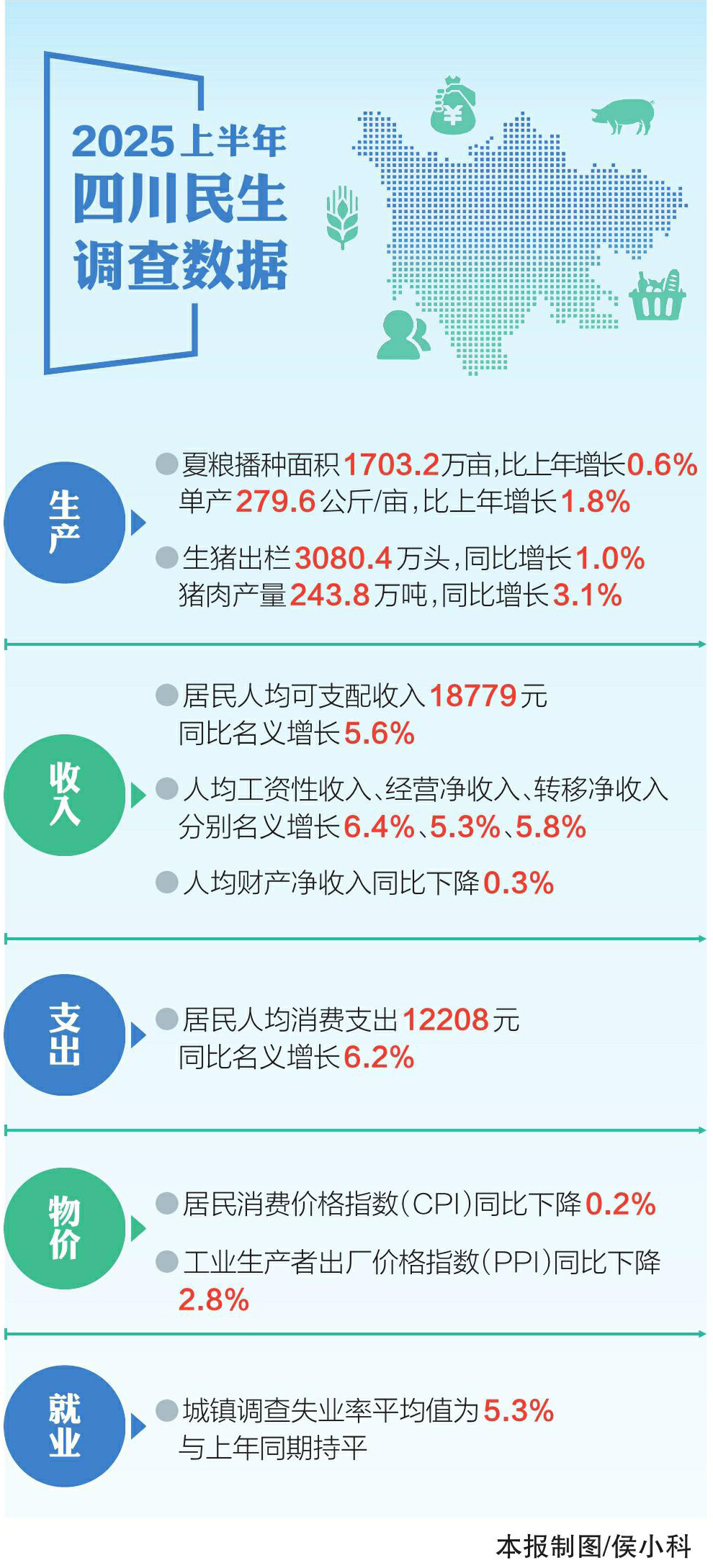
四川发布上半年民生调查数据 政策加力扩围,八大类消费实现增长
Si Chuan Ri Bao· 2025-07-16 00:32
Economic Overview - In the first half of 2025, Sichuan's economy showed stable growth in production demand, with overall economic operation remaining steady and improving [4] - The average urban unemployment rate was 5.3%, unchanged from the same period last year [4] Income and Consumption - The per capita disposable income reached 18,779 yuan, a nominal increase of 5.6%, with a real growth of 5.8% after adjusting for price factors [4] - Per capita consumption expenditure was 12,208 yuan, with a nominal growth of 6.2%, outpacing the growth of disposable income by 0.6% [11] - The growth in consumption was driven by policies promoting the replacement of old consumer goods and strong holiday economic activities [11] Agricultural Production - The summer grain planting area was 17.032 million mu, an increase of 0.6% year-on-year, with a yield of 279.6 kg/mu, up by 1.8% [4] - Total grain production reached 4.762 million tons, a year-on-year increase of 2.4% [4] Livestock and Meat Production - The number of pigs slaughtered was 30.804 million, a year-on-year increase of 1.0%, with pork production at 2.438 million tons, up by 3.1% [6] - Pork prices have been declining, attributed to increased supply and seasonal demand fluctuations [6] Price Trends - The Consumer Price Index (CPI) in Sichuan decreased by 0.2% year-on-year, consistent with national trends [7] - The core CPI, excluding food and energy prices, increased by 0.3%, indicating a better performance than the overall CPI [9] - Service prices rose by 0.3% due to increased consumer spending in services, while food prices fell by 0.7% [8] Industrial Price Index - The Producer Price Index (PPI) decreased by 2.8% year-on-year, with a more significant decline compared to the previous year [9] - However, some sectors, particularly high-tech industries, showed price increases, with electronic components rising by 2.7% and integrated circuits by 4.4% [10]

新希望时隔4年实现半年度盈利 养殖业务扭亏饲料主业加速出海
Chang Jiang Shang Bao· 2025-07-15 23:13
Core Viewpoint - New Hope has returned to profitability in the first half of 2025 after four years of losses, with projected net profits between 680 million and 780 million yuan, marking a significant turnaround from a loss of 1.217 billion yuan in the same period last year [1][2] Group 1: Financial Performance - The company expects a net profit of 680 million to 780 million yuan for the first half of 2025, a growth of approximately 155.85% to 164.07% compared to a loss of 1.217 billion yuan in the previous year [2] - The projected non-recurring net profit is estimated to be between 627 million and 727 million yuan, a significant increase from a loss of 1.316 billion yuan in the same period last year, reflecting a growth of about 147.63% to 155.23% [2] - In the first half of 2025, New Hope sold 8.4493 million pigs, a slight decrease of 239,300 pigs compared to the previous year, generating sales revenue of 12.053 billion yuan, down from 13.048 billion yuan [3] Group 2: Business Operations - The improvement in profitability is attributed to enhanced production management and biosecurity measures in the pig farming sector, leading to reduced costs despite lower pig prices [2][3] - The company has achieved a significant reduction in breeding costs, with the top 25% of farms reducing costs to 13.6 yuan per kilogram in 2024 and aiming for 12.5 yuan per kilogram in the first quarter of 2025 [3] - New Hope's feed business, which has been a core operation for over 40 years, achieved a total sales volume of 25.96 million tons in 2024, accounting for 8.2% of the national total production [4][6] Group 3: International Expansion - New Hope is accelerating its overseas feed business expansion, targeting a sales volume of 6 million tons in 2025, with plans to potentially increase production capacity by 3 to 4 million tons in the next 3 to 5 years [5][6] - The company has established a clear market presence in overseas regions, including Indonesia, Vietnam, and Egypt, and is focusing on expanding its footprint in these markets [6] - New Hope has initiated an employee stock ownership plan aimed at core employees involved in overseas operations, indicating a commitment to international growth [6]