
农产品

Search documents
匈牙利宣布将维持乌克兰农产品进口禁令
Xin Lang Cai Jing· 2025-11-04 13:16
Core Viewpoint - Hungary's Agriculture Minister Nagy asserts that Hungary will maintain its ban on Ukrainian agricultural products despite EU threats, emphasizing that this is the only way to protect the interests of Hungarian consumers and farmers [1] Group 1: Hungary's Position - Hungary's stance is that the EU's approach to agricultural product monitoring differs significantly from Ukraine's, which lacks comprehensive oversight from farm to table [1] - The minister highlights that the ban is essential not only for farmers' interests but also for consumer protection [1] Group 2: EU-Ukrainian Trade Dynamics - The EU has eliminated tariffs and VAT on Ukrainian agricultural products compared to pre-Russia-Ukraine conflict levels, allowing for significant imports of honey (35,000 tons), chicken (120,000 tons), and wheat (1.3 million tons) at low prices [1] - The minister calls for Brussels to choose between supporting Kyiv's interests or those of EU member states [1]

新丝路文旅控股股东新华联国际出售公司约28.50%股权予中国农产品
Zhi Tong Cai Jing· 2025-11-04 12:33
Core Viewpoint - New Silk Road Cultural Tourism (00472) announced the sale of 914 million shares, representing approximately 28.50% of its issued share capital, to China Agricultural Products Co., Ltd. for a cash consideration of about HKD 149 million, equivalent to HKD 0.163 per share, with the transaction expected to complete within 30 days from the signing of the sale agreement [1][2]. Group 1 - The sale agreement was established between New Silk Road's controlling shareholder, Xinhua Lian International, and China Agricultural Products, which has not commenced operations and is fully owned by Shouguang Vegetable Research and Development in the Field of Basic and Advanced Agriculture–L.L.C–O.P.C. [1] - Following the completion of the sale, Yingxin Development's shareholding through Xinhua Lian International will decrease from 1.757 billion shares (approximately 54.79% of the issued share capital) to 843 million shares (approximately 26.29% of the issued share capital), making China Agricultural Products the largest single shareholder of the company [2]. - The board anticipates that the sale will not have any significant adverse impact on the group's daily operations [3].

国投期货软商品日报-20251104
Guo Tou Qi Huo· 2025-11-04 12:16
Report Industry Investment Ratings - Cotton: Neutral (White star) [1] - Pulp: Neutral (White star) [1] - Sugar: Neutral (White star) [1] - Apple: Slightly bearish (One star) [1] - Timber: Neutral (White star) [1] - 20 - rubber: Neutral (White star) [1] - Natural rubber: Bullish (Three stars) [1] - Butadiene rubber: Neutral (White star) [1] Core Views - The short - term trend of Zhengzhou cotton may be volatile, and it is advisable to wait and see for now [2] - Sugar prices are expected to remain weak, and attention should be paid to policy implementation and weather conditions [3] - Apple prices are high with insufficient bullish factors, and attention should be paid to the storage situation [4] - The rubber market sentiment is pessimistic, and it is advisable to wait and see while paying attention to cross - variety arbitrage opportunities [6] - The short - term fundamentals of pulp are weak, and mid - term conditions may improve; it is advisable to wait and see or conduct short - term operations [7] - Low inventory provides some support for log prices, and it is advisable to wait and see [8] Summary by Categories Cotton & Cotton Yarn - Zhengzhou cotton declined today, and the spot sales basis of cotton remained stable. As of November 1, the cumulative national cotton inspection volume was 1.844 million tons. The spot trading was mediocre, and the downstream pure - cotton yarn followed the price increase weakly. The trading in the general cotton yarn market became dull. It is recommended to wait and see for now [2] Sugar - Overnight, US sugar fluctuated. In Brazil, the production data in the first half of October was neutral. In China, Zhengzhou sugar was relatively strong. There are expectations of syrup import control policies, and the market's trading focus has shifted to the next season's production estimate. Sugar prices are expected to remain weak [3] Apple - The futures price dropped significantly. The market's trading logic has shifted from cold - storage inventory volume to sales expectations. The inventory progress in Shandong is slow, and the initial cold - storage inventory of apples in the new season is uncertain. The high price and poor quality of apples this year may affect the destocking speed. It is recommended to wait and see [4] 20 - rubber, Natural rubber & Synthetic rubber - Today, RU, NR, and BR all declined. The domestic natural rubber spot price rose steadily, while the synthetic rubber spot price continued to fall. The global natural rubber supply has entered the high - yield period, and the domestic butadiene rubber plant operating rate declined significantly last week. The domestic tire operating rate increased slightly, and the finished - product inventory of tire enterprises continued to increase. Rubber inventory has increased, and it is recommended to wait and see while paying attention to cross - variety arbitrage opportunities [6] Pulp - Today, pulp futures declined slightly, and the spot prices remained stable. As of October 30, 2025, the mainstream import sample inventory of Chinese pulp was 2.061 million tons, a cumulative increase of 6,000 tons from the previous period. The domestic pulp import volume in September increased year - on - year. The short - term fundamentals are weak, and mid - term conditions may improve. It is advisable to wait and see or conduct short - term operations [7] Log - The futures price was weak. The supply of logs is expected to remain low in the short term, and the demand provides some support for prices. The total log inventory is low, and it is recommended to wait and see [8]
商品量化CTA周度跟踪-20251104
Guo Tou Qi Huo· 2025-11-04 12:16
Report Overview - Report Title: Commodity Quantitative CTA Weekly Tracking [1] - Report Date: November 4, 2025 [2] - Report Author: Guotou Futures Research Institute, Financial Engineering Group [2] Investment Rating - No investment rating information is provided in the report. Core Viewpoints - This week, the proportion of short positions in commodities has rebounded, mainly due to the decline in the factor strength of the black sector and the rebound in agricultural products. Currently, the sectors with relatively strong cross - section are non - ferrous metals and agricultural products, while the relatively weak ones are black and energy sectors [3]. - The short - term momentum of the black sector has declined, with a decrease in the positions of iron ore and rebar, indicating a more cautious sentiment after the realization of positive factors [3]. - The cross - section of agricultural products has reversed, with the short - term momentum of soybean oil slightly decreasing and that of soybean meal increasing, and soybean meal is relatively strong in the short - term cross - section [3]. Summary by Related Content Commodity Market Conditions - **Sector Performance**: The cross - section of non - ferrous and agricultural sectors is strong, while the black and energy sectors are weak. Gold's time - series momentum has marginally rebounded, and the decline in silver's positions is small. In the non - ferrous sector, the position factor has marginally rebounded, and the long - term momentum continues to rise, with copper being strong and alumina being weak. In the black sector, coking coal is relatively strong in the cross - section. The short - term momentum cross - section of the energy - chemical sector has expanded, and the chemical sector is on the short side of the cross - section [3]. - **Factor Performance**: The supply factor increased by 0.98% last week, the demand factor decreased by 0.64%, the inventory factor decreased by 0.48%, and the synthetic factor weakened by 0.62%. This week, the comprehensive signal is short [4]. Specific Commodity Analysis Methanol - **Strategy Net Value**: Last week, the inventory factor decreased by 0.05%, the spread factor weakened by 0.05%, and the synthetic factor decreased by 0.04%. This week, the comprehensive signal is long [15]. - **Fundamental Factors**: The supply side is neutral to short, the demand side is long, the inventory side is short, and the spread side is long [15]. Iron Ore - **Strategy Net Value**: The supply factor increased by 0.49%, the demand factor strengthened by 0.47%, the spread factor decreased by 0.09%, and the synthetic factor strengthened by 0.2%. This week, the comprehensive signal remains short [13]. - **Fundamental Factors**: The supply side signal remains long, the demand side signal turns neutral, the inventory side signal remains neutral, and the spread side signal remains neutral [13]. Glass - **Strategy Net Value**: The supply factor increased slightly, the demand factor is long, the inventory factor is short, and the spread factor is long. This week, the comprehensive signal is long [15]. - **Fundamental Factors**: The supply side is neutral to short, the demand side is long, the inventory side is short, and the spread side is long [15].
南华期货油料产业周报:预期重启美豆采购,内盘跟随外盘反弹-20251104
Nan Hua Qi Huo· 2025-11-04 11:13
Report Industry Investment Rating No information provided in the report. Core Viewpoints - The trading focus of the soybean meal futures is on the export demand of US soybeans under the context of Sino-US negotiations. With the expectation of 12 million tons of exports to China being gradually priced in, the ending stocks are expected to remain around 300 million bushels, and the price oscillation range will shift slightly upwards. However, there is limited upward momentum due to the expected smooth planting of Brazilian soybeans. The domestic soybean meal is constrained by high near-term inventories, so the rebound space is limited. If the purchase of US soybeans is effectively initiated, it will bring a downward drive for the far-term, but the downward range is also limited due to the cost support from the rebound of the external market. For rapeseed meal, due to the ongoing Sino-Canadian negotiations affecting market expectations, the near-term futures performance is slightly stronger, but it is not advisable to chase the long side [1]. - The far-month soybean import profit has slightly recovered but remains at a low level, indicating limited far-term soybean purchases. With the easing of Sino-US trade relations, the market expects the resumption of US soybean purchases, alleviating the far-term supply gap. For rapeseed meal, there is a near-term supply gap due to Sino-Canadian tariffs, but demand is expected to weaken simultaneously. With the supply of rapeseed from other sources, the inventory is expected to decrease in the fourth quarter and slightly recover in the first quarter of next year. The "anti-involution" policy for downstream pigs is unlikely to effectively reduce demand, so the demand reduction is expected to be limited. The planting progress of Brazilian soybeans has returned to normal, laying a foundation for a smooth harvest, while the soil moisture in Argentina is still slightly dry. The subsequent pressure of a bumper harvest will be transmitted to the domestic meal market in the form of basis [15]. Summary by Directory Chapter 1: Core Contradictions and Strategy Recommendations 1.1 Core Contradictions - **Soybean Meal**: The external market focuses on US soybean exports to China, with limited upward momentum. The domestic market is constrained by high near-term inventories, and the far-term may face downward pressure if US soybean purchases resume [1]. - **Rapeseed Meal**: Affected by Sino-Canadian negotiations, the near-term performance is slightly stronger, but chasing the long side is not recommended. The domestic rapeseed import has decreased significantly this year, and the market is in a state of weak supply and demand in the fourth quarter. With the expected resumption of Sino-Canadian talks and the arrival of Australian rapeseed, the subsequent demand increase is limited, and supply is expected to recover [1][2]. 1.2 Trading Strategy Recommendations - **Trend Judgment**: The market is expected to oscillate within a range. The M2601 contract is expected to oscillate between 2800 - 3200, and it is difficult to break through this range [23]. - **Strategy Suggestions**: Unilateral long positions can be reduced; consider a covered call strategy with options, selling 3300 call options for the M2601 contract; sell 2600 call options for the rapeseed meal 2601 contract [23]. - **Basis, Spread, and Arbitrage Strategies**: Use accumulating option purchases to reduce basis pricing risks, and view the basis as likely to return to positive and strengthen. Hold the positive spread positions for M3 - 5 and M1 - 3. Short the spread between soybean meal and rapeseed meal 2601 contracts when the spread is between 650 - 700 [24]. 1.3 Industry Client Operation Suggestions - **Price Range Forecast**: The soybean meal price is expected to range between 2800 - 3300, and the rapeseed meal price between 2250 - 2750 [26]. - **Hedging Strategies**: Traders with high protein inventories can short soybean meal futures to lock in profits. Feed mills with low inventory can buy soybean meal futures to lock in procurement costs. Oil mills worried about excessive imports can short soybean meal futures to lock in profits [26]. 1.4 Basic Data Overview - **Futures Prices**: The closing prices of soybean meal and rapeseed meal futures contracts showed different changes, with some rising and some falling. The CBOT yellow soybean price remained unchanged, and the offshore RMB exchange rate increased slightly [27]. - **Spreads and Basis**: The spreads between different contracts of soybean meal and rapeseed meal showed various trends, and the basis of soybean meal and rapeseed meal also changed. The import costs and压榨 profits of US and Brazilian soybeans and Canadian rapeseed were also provided [28]. Chapter 2: This Week's Important Information and Next Week's Key Events 2.1 This Week's Important Information - **Positive Information**: The US Department of Agriculture will release the production report and the World Agricultural Supply and Demand Estimates (WASDE) on November 14 (originally scheduled for November 10, but the release is uncertain due to the government shutdown). As of October 30, the planting progress of Brazilian soybeans in the 2025/26 season was 47%, higher than the previous week but lower than the same period last year. The soybean planting area in Mato Grosso state has reached 76.13% of the expected area [31]. - **Negative Information**: Chinese importers have booked Brazilian soybeans due to price advantages. If China purchases 12 million tons of US soybeans by January next year, it can meet the USDA's export target for the 2024/25 season, but it may not drive a continuous price increase. The short-term price increase sustainability needs to be observed, and if the agreement implementation falls short of expectations, there may be technical profit-taking pressure [32]. - **Spot Transaction Information**: Downstream buyers continue to purchase on a just-in-time basis [33]. 2.2 Next Week's Key Events - Monitor whether the USDA releases the supply and demand report on November 10. Also, pay attention to various reports such as the USDA export inspection report, Brazilian Secex weekly and monthly reports, USDA crop growth report, and CFTC agricultural product position report [37][40]. Chapter 3: Futures Market Interpretation 3.1 Price, Volume, and Capital Interpretation - **Domestic Market**: The soybean meal futures rebounded due to short covering and the increase in external market costs. Rapeseed meal generally followed the trend of soybean meal, with a stronger rebound due to reduced warehouse receipt pressure and Sino-Canadian trade relationship uncertainties. The capital flow shows that foreign institutional short positions were closed, and institutional long positions were reduced in the second half of the week, indicating limited upward space. The put-call ratio (PCR) of soybean meal options shows a return of bearish sentiment [38]. - **Month Spread Structure**: The futures month spreads of soybean meal and rapeseed meal generally show a B structure in the first half of the year and a C structure in the second half, related to their seasonal supply patterns. This week, the 1 - 5 month spread of soybean meal first rose and then fell, and the 1 - 5 month spread of rapeseed meal strengthened due to the unilateral increase in the 01 contract [43]. - **Basis Structure**: The basis of soybean meal and rapeseed meal declined this week due to the faster increase in futures prices than spot prices. The spot price difference between soybean meal and rapeseed meal slightly decreased [47]. - **External Market**: The external and domestic markets showed a more consistent trend this week. After the expectation of Sino-US trade talks and the news of soybean purchases, US soybeans rebounded significantly, and the domestic market followed suit. The net long positions of CBOT soybean management funds have returned above the zero line, indicating a short-term return of long funds [52][56]. Chapter 4: Valuation and Profit Analysis 4.1 Production Area Profit Tracking - The crushing profit in the US soybean production area has weakened due to the decline in soybean product prices, but the monthly crushing volume remains at a high level for the year. The crushing profits in South American production areas (Brazil and Argentina) have also weakened, while the domestic crushing profit of Canadian rapeseed has increased due to the decline in rapeseed prices [58]. 4.2 Import and Export Crushing Profit Tracking - The crushing profit of Brazilian soybeans has declined recently due to the increase in import costs after the rebound of the US market, but it is still better than the current US soybean crushing profit under a 13% tariff. China will continue to mainly import Brazilian soybeans. The available export volume of Brazilian soybeans in the future is limited, and the domestic soybean crushing volume is expected to decline seasonally around holidays. Although the import of rapeseed shows a crushing profit, due to the import margin requirement, future purchases are expected to remain cautious [63]. Chapter 5: Supply, Demand, and Inventory Projections 5.1 International Supply and Demand Balance Sheet Projections - For the new crop balance sheet in September, the planting area is expected to marginally increase after a significant downward revision in August, and the yield per acre is expected to marginally decrease after being adjusted to the highest level in history. The total production is expected to remain between 4.2 - 4.3 billion bushels. On the demand side, the crushing volume is expected to continue to grow due to domestic biodiesel policies, while exports will remain weak due to Sino-US trade relations. If Sino-US trade resumes, exports are expected to recover to above-normal levels. The ending stocks are expected to remain moderately tight [68]. 5.2 Domestic Supply and Projections - Considering the potential import of US soybeans, the domestic soybean imports are expected to decline in the fourth quarter and then recover in the first quarter of next year. The import of rapeseed will continue to remain at a low level [70]. 5.3 Domestic Demand and Projections - The domestic soybean crushing volume is expected to remain high due to the carry-over inventory from the third quarter and the arrival of soybeans in the fourth quarter. After the previous high-level stocking, the subsequent consumption growth of domestic soybean meal is expected to be limited [74]. 5.4 Domestic Inventory and Projections - The domestic soybean inventory is currently at a seasonal high but is expected to decline in the fourth quarter as imports decrease and then stabilize and recover in the first quarter of next year. The domestic soybean meal inventory will also remain high despite the decline in raw material inventory and crushing volume [76].
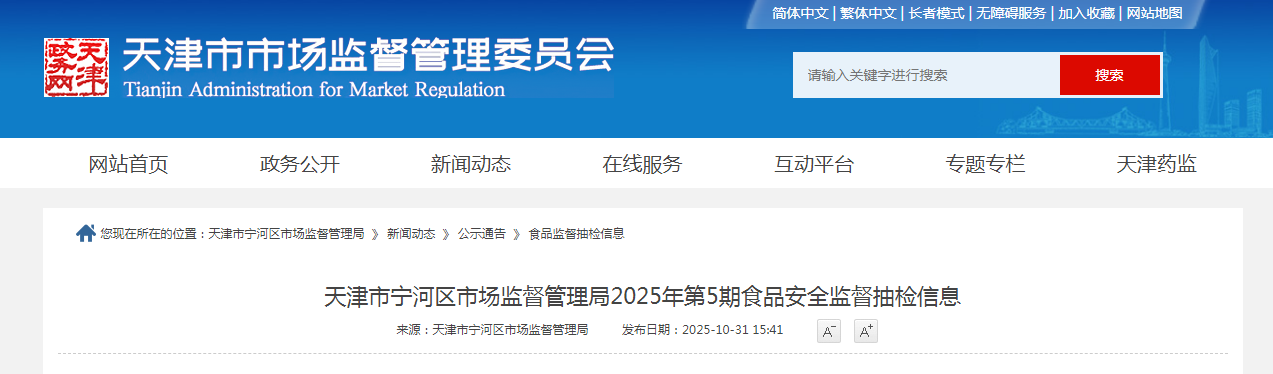
天津市宁河区市场监督管理局2025年第5期食品安全监督抽检信息
Zhong Guo Zhi Liang Xin Wen Wang· 2025-11-04 08:07
Core Points - The Tianjin Ninghe District Market Supervision Administration conducted food safety supervision and sampling inspections, testing a total of 450 batches, with 8 batches found to be non-compliant [3]. Non-compliant Products Information - The non-compliant products included various food items such as lychee, green onions, and peppers, with detected pesticide residues exceeding the standard limits. For instance, lychee contained 0.31 mg/kg of chlorpyrifos, exceeding the standard of 0.1 mg/kg [3]. - Other products like green onions and peppers were found with pesticide residues of 1.2 mg/kg and 0.13 mg/kg respectively, surpassing the allowable limits of 0.3 mg/kg and 0.05 mg/kg [3]. - The inspections were part of the ongoing efforts to ensure food safety and compliance with national standards, highlighting the importance of monitoring pesticide levels in agricultural products [3].

西南期货早间评论-20251104
Xi Nan Qi Huo· 2025-11-04 06:46
Group 1: Investment Ratings - Not provided in the given report Group 2: Core Views - The report covers various sectors including bonds, stocks, precious metals, and commodities, providing analyses and trading suggestions for each sector. For example, it expects that treasury bond futures may not have a trending market and advises caution; stock index futures are expected to have limited downside risk and suggests seizing opportunities to go long; precious metals are currently over - priced, and it is recommended to take profits on long positions and then wait and see [6][9][11]. Group 3: Sector - Specific Summaries Bonds - **Treasury Bonds**: The previous trading day saw mixed results for treasury bond futures. The central bank conducted 783 billion yuan of 7 - day reverse repurchase operations, resulting in a net withdrawal of 259 billion yuan. China's October S&P manufacturing PMI showed a slowdown in the expansion trend. Given the current economic situation, treasury bond futures are expected to have no trending market, and caution is advised [5][6]. Stocks - **Stock Index**: The previous trading day, stock index futures showed mixed performance. With the release of new immigration and entry - exit policies, and considering the current economic situation (stable but with weak recovery momentum), combined with low domestic asset valuations and sufficient economic resilience, along with the inflow of incremental funds and the easing of Sino - US economic and trade uncertainties, it is expected that there is limited downside risk, and opportunities to go long can be seized [8][9]. Precious Metals - **Gold and Silver**: The previous trading day, gold and silver futures showed small increases. Fed officials' remarks suggest potential interest rate cuts. The complex global trade and financial environment, the "de - globalization" and "de - dollarization" trends, and the slowdown of the US labor market are all favorable for precious metals. However, due to the recent large increase in prices, it is recommended to take profits on long positions and then wait and see [11]. Commodities - **Steel Products (Thread, Hot - Rolled Coil)**: The previous trading day, steel product futures slightly declined. In the medium term, the price of steel products is dominated by industrial supply - demand logic. The demand for rebar is still in a year - on - year decline, and the supply side has over - capacity issues. Considering the current high inventory, the price of rebar is expected to remain weak, and hot - rolled coils may follow a similar trend. Investors can focus on short - selling opportunities at high prices during rebounds [13][14]. - **Iron Ore**: The previous trading day, iron ore futures significantly declined. The demand for iron ore has decreased, while the supply is expected to increase year - on - year in the fourth quarter, and the port inventory is rising. The market supply - demand pattern has weakened, and investors can focus on short - selling opportunities at high prices [16]. - **Coking Coal and Coke**: The previous trading day, coking coal and coke futures continued to decline. The supply of coking coal is slightly tight, and the price of coke is facing an upward adjustment. From a technical perspective, the futures may continue to be strong in the short term, and investors can focus on buying opportunities during pullbacks [18][19]. - **Ferroalloys**: The previous trading day, ferroalloy futures showed small increases. The supply of ferroalloys is currently in a state of over - supply, but the cost is rising, and the downward space is limited. There may be short - term disturbances in supply reduction expectations, and investors can consider long - position opportunities at low prices [21][22]. - **Crude Oil**: The previous trading day, INE crude oil oscillated upward. The increase in the number of US drilling rigs does not necessarily lead to an increase in production. US sanctions on Russian oil companies and OPEC's decision to suspend production increases are all favorable for oil prices. Investors can focus on long - position opportunities [23][24]. - **Fuel Oil**: The previous trading day, fuel oil oscillated upward. The recovery of Singapore's fuel oil supply is negative for prices, while the sanctions on Russia and the reduction of Sino - US trade frictions are positive. Investors can focus on long - position opportunities [26][27]. - **Polyolefins**: The previous trading day, the PP and LLDPE markets showed some adjustments. In November, the impact of maintenance is expected to be high, and the inventory is low. November is the peak season for demand, so the market is expected to rebound. For now, it is recommended to wait and see [29]. - **Synthetic Rubber**: The previous trading day, synthetic rubber futures declined. The cost side is weak, and the price is expected to have limited downward space. It is recommended to pay attention to raw material prices and supply changes. The market is expected to oscillate [31][33]. - **Natural Rubber**: The previous trading day, natural rubber futures declined. The supply is affected by bad weather, and the demand is weak. The inventory is decreasing. It is recommended to pay attention to production area conditions and demand expectations, and there may be long - position opportunities [34][35]. - **PVC**: The previous trading day, PVC futures declined. The current supply - demand situation is still oversupplied, but the downward space is limited. It is recommended to pay attention to export and supply reduction after the festival [36][37]. - **Urea**: The previous trading day, urea futures declined. In the short term, it is necessary to pay attention to export policies and seasonal recovery signals of agricultural demand. The price is expected to fluctuate within a narrow range, and the downward space is limited [38]. - **PX**: The previous trading day, PX futures increased. The supply - demand structure has improved, and the cost side is affected by crude oil fluctuations. The price is expected to oscillate, and investors can participate within a certain range while paying attention to crude oil changes and macro - policies [39]. - **PTA**: The previous trading day, PTA futures increased. The supply side has some adjustments, and the demand side is relatively stable. The processing fee is low, and the inventory is low. The price is expected to oscillate, and investors should be cautious and pay attention to oil prices [40]. - **Ethylene Glycol**: The previous trading day, ethylene glycol futures declined. The supply is increasing, and the inventory may accumulate slightly. However, the demand is expected to improve, and the cost side sentiment is positive. The price is expected to oscillate, and investors can participate within a certain range while paying attention to port inventory and imports [41]. - **Short - Fiber**: The previous trading day, short - fiber futures declined. The supply is at a relatively high level, and the demand is improving, but the cost - driving force is limited. The price is expected to oscillate with the cost, and investors should pay attention to cost changes and macro - policy adjustments [42]. - **Bottle Chips**: The previous trading day, bottle chip futures increased. The processing fee has decreased, the supply is increasing slightly, and the export growth is slowing down. The price is expected to oscillate with the cost, and investors should control risks [43]. - **Lithium Carbonate**: The previous trading day, lithium carbonate futures declined. The supply is at a high level, and the demand is also strong, with the inventory gradually decreasing. It is recommended to pay attention to the sustainability of consumption [44][45]. - **Copper**: The previous trading day, copper futures declined. The Sino - US trade negotiation is in a stalemate, and the Fed's interest rate cut has a complex impact on copper prices. The supply of copper concentrate is tight, and high prices suppress demand. The price is expected to enter a sideways consolidation phase [46][47]. - **Aluminum**: The previous trading day, aluminum futures showed mixed results. The supply of alumina is in an oversupply situation, and the production of electrolytic aluminum may be affected by winter restrictions. High prices may suppress demand, but the inventory is decreasing. The price is expected to remain at a high level [48][49][50]. - **Zinc**: The previous trading day, zinc futures increased. The supply of zinc concentrate is tight, and the production of refined zinc is limited. The demand is weak. The price is expected to continue to oscillate [51][52]. - **Lead**: The previous trading day, lead futures increased. The supply of primary lead is increasing, and the supply of recycled lead is recovering slowly. High prices suppress demand. The price is supported by low inventory and cost, but the upward space is limited, and it is recommended to be cautious when going long [53][54]. - **Tin**: The previous trading day, tin futures declined. The supply of tin ore is tight, and the demand has certain support. The inventory is decreasing. The price is expected to oscillate strongly [54]. - **Nickel**: The previous trading day, nickel futures declined. The macro - environment has improved, but the supply - demand situation is complex. The supply of high - grade nickel ore is tight, and the demand is weak. The price is expected to oscillate [55]. - **Soybean Oil and Soybean Meal**: The previous trading day, soybean meal futures increased, and soybean oil futures decreased. Sino - US trade relations are expected to improve, and the Brazilian soybean sowing is progressing smoothly. The supply of soybeans is relatively loose, and the demand for soybean meal is expected to grow moderately, while the demand for soybean oil is suppressed. It is recommended to consider taking profits on long - positions in soybean meal and wait and see for soybean oil [56][57]. - **Palm Oil**: The previous trading day, palm oil futures declined. The supply is increasing, and the market is expected to be weak. It is recommended to focus on short - selling opportunities during rebounds [60]. - **Rapeseed Meal and Rapeseed Oil**: The previous trading day, rapeseed meal and rapeseed oil futures increased. The supply of eggs is high, and the demand is weak. It is recommended to hold short - positions and consider adding short - positions during rebounds [61][62]. - **Cotton**: The previous trading day, cotton futures oscillated. Sino - US trade relations are favorable in the long - term, but short - term international cotton prices are under pressure. Domestic cotton has a strong production expectation, and the demand is neutral - weak. The price is expected to have limited upward space [63][64]. - **Sugar**: The previous trading day, sugar futures rebounded. Brazilian sugar production is expected to increase, and the global sugar supply is expected to be in surplus, which restricts price rebounds. The domestic supply pressure in the fourth quarter is not large, and the price has certain support at the bottom [65][66][67]. - **Apple**: The previous trading day, apple futures declined. The quality of this year's apples is poor, and the opening price is higher than last year. The price is expected to be strong in the short term [69][70][71]. - **Live Pigs**: The previous trading day, live pig futures declined. The pig price is expected to be weak, and the supply is increasing. It is recommended to focus on short - selling opportunities during rebounds [72][73]. - **Eggs**: The previous trading day, egg futures increased. The supply of eggs is high, and the demand is weak. It is recommended to hold short - positions and consider adding short - positions during rebounds [74][75]. - **Corn and Starch**: The previous trading day, corn and starch futures increased. The price of corn is affected by the rise in soybean prices. The inventory situation is complex, and the demand is growing slightly. The price of corn is expected to be under pressure, and starch may follow the trend of corn [76][77].
国投期货综合晨报-20251104
Guo Tou Qi Huo· 2025-11-04 06:39
Overall Key Points - The report analyzes the overnight performance and future trends of various commodities and financial products, including energy, metals, agricultural products, and financial derivatives [2][3][4] Group 1: Energy Crude Oil - Overnight international oil prices fluctuated. The oil market has been rapidly accumulating inventory since September, with a 2.8% increase in inventory in the fourth quarter, including a 5.9% increase in crude oil inventory and a 2.1% decrease in refined oil inventory. The inventory accumulation of upstream crude oil is concentrated in the transit link. The OPEC+ meeting last Sunday slightly exceeded expectations, and the suspension of production increase in the first quarter of next year reflects the organization's management of the downward risk. However, according to the current production increase path, the market supply-demand surplus in the fourth quarter and the first quarter of next year still faces marginal expansion. Short-term oil prices are expected to fluctuate, and attention should be paid to the entry opportunity of the short-selling portfolio after the geopolitical risk is priced again [2] Fuel Oil & Low-Sulfur Fuel Oil - The fuel oil market shows a structural differentiation. The medium-term supply pattern of high-sulfur fuel oil tends to be loose, and the previous high valuation faces correction pressure. The low-sulfur market has received short-term support, and the supply of low-sulfur fuel oil is expected to tighten. The price difference between high and low sulfur is expected to further widen [22] Asphalt - In late October, some refineries in Shandong and Hebei switched to producing residual oil and shut down, and the weekly output decreased. The construction in the north is gradually declining, and the construction in the northeast and northwest has gradually stopped under the influence of low temperatures. The south still has the demand for rush construction. Since late October, the year-on-year change in the shipment volume of 54 asphalt sample enterprises has shown a negative growth for the first time, and it is likely to continue the trend of negative year-on-year growth in the future. The decline of the overall commercial inventory has slowed down, and the social inventory has increased year-on-year for the first time at the end of October [23] Liquefied Petroleum Gas (LPG) - The LPG contract continued to fluctuate narrowly. The weekly LPG commodity volume decreased slightly, while the arrival volume increased significantly. The improvement of chemical profit has promoted the increase of demand, and the cooling in many places has driven the improvement of combustion demand. The market expects the overall demand to improve. The refinery storage capacity ratio decreased slightly, and the port storage capacity ratio increased. The marginal improvement of the fundamental expectation still supports LPG [24] Group 2: Metals Precious Metals - Overnight, precious metals continued to fluctuate. The US ISM manufacturing PMI in October was slightly lower than expected and the previous value. Recently, many Fed officials have spoken out against a rate cut in December, reflecting internal differences. The US government shutdown is still in the game stage, and the non-farm payroll data this week may not be released. The market is waiting for new drivers, and precious metals have built a high-level shock platform. It is recommended to wait and see for the time being [3] Base Metals - **Copper**: Overnight, LME copper fell in late trading. The market is evaluating the copper consumption at the end of the year. The US ISM manufacturing PMI has contracted for the eighth consecutive month, and the high copper price in China has suppressed demand. However, compared with the second quarter of last year, the spot side has improved its passive adaptability in the environment of "weak supply and demand". At the same time, the domestic social inventory has accumulated to more than 200,000 tons, and there is still a certain space from the critical point of the lagging reflection of supply and demand. After the short-term copper price reached a high, there is a certain risk of correction. Attention should be paid to the support toughness of the MA20 moving average. Some long positions can be held based on the key moving average [4] - **Aluminum**: Overnight, SHFE aluminum fluctuated. At the beginning of the week, the social inventory of aluminum ingots increased by 0.8 million tons compared with Thursday. Since October, the domestic inventory and spot performance have been average, and the apparent consumption is basically flat year-on-year. The macro sentiment dominates, and the resonance of the aluminum market fundamentals is limited. In the short term, it fluctuates strongly towards the high point in November 2024, but the upward space is cautiously viewed for the time being [5] - **Zinc**: The zinc ingot export window is open, the LME zinc inventory has increased slightly, and the SMM zinc social inventory has decreased to 161,700 tons. The divergence of the inventory between the domestic and foreign markets has temporarily stopped, and the cross-market arbitrage funds have the demand to take profits. The domestic mine TC continues to decline to 2,850 yuan/metal ton, and the imported mine TC also declines synchronously. The short-term rebound momentum of SHFE zinc is relatively strong. Short-term long positions can be participated, and the high rebound range is temporarily seen at 23,000-23,500 yuan/ton [8] - **Lead**: On Monday, the SMM lead social inventory slightly increased to 30,200 tons, which is generally low. The correction of SHFE lead is not smooth, and the fundamentals are mixed. The funds are more cautious to enter the market. The raw material overlap between recycled lead and primary lead smelters is increasing day by day. Under the background of winter storage, the smelting capacity is surplus, and the shortage of lead concentrate is intensifying. The price of waste batteries remains high and stable, and the cost of SHFE lead is strongly supported. The refined scrap price difference is 75 yuan/ton, and the SMM 1 lead is at a discount of 125 yuan/ton to the nearby contract. Downstream enterprises tend to purchase low-priced recycled lead, and the trading of electrolytic lead is slightly sluggish. Affected by the game between cost and demand, SHFE lead is expected to fluctuate in the range of 17,300-17,500 yuan/ton [9] - **Nickel & Stainless Steel**: SHFE nickel fluctuated narrowly, and the market trading was light. The weak downstream demand dominates the market. Although there are news of stainless steel mills reducing production, the actual implementation still needs to be observed. The premium of Jinchuan nickel is 2,600 yuan, the premium of imported nickel is 400 yuan, and the premium of electrowinning nickel is 50 yuan. The price of high-nickel pig iron is quoted at 926 yuan per nickel point, and the support brought by the rebound of the upstream price is weakening, which may drag down the price level of the entire nickel industry chain. The pure nickel inventory decreased by 700 tons to 48,800 tons, the nickel pig iron inventory increased by 500 tons to 29,000 tons, and the stainless steel inventory increased by 400 tons to 947,000 tons. SHFE nickel is running weakly, and the center of gravity tends to move down [10] - **Tin**: Overnight, the tin price fluctuated weakly. The tin market lacks clear guidance and mainly follows the rhythm of the copper price. In addition to the interference of the rainy season on the transportation rhythm, the closure of the Dar es Salaam port in Tanzania may also affect the export speed of tin products. The tin price fluctuated at a high level for a long time in October, and the inventory of middle and downstream enterprises is generally average, but there is still demand for spot pricing. Last week, the social inventory of SMM and Steel Union continued to flow out slightly. Subjectively, it is recommended to short on rallies or wait for the right-side trading opportunity after a clear break [11] Ferrous Metals - **Iron Ore**: Overnight, the iron ore futures fluctuated weakly, and the basis fluctuated recently. On the supply side, the global shipment volume decreased this period but is still at a high level in the same period. The shipments from Australia and Brazil both decreased, but the Brazilian shipment is still at a high level in the same period. The domestic arrival volume increased significantly this period and reached a new high this year. On the demand side, the molten iron output decreased significantly last week, and the profitability of steel mills reached a new low this year, with further production reduction pressure in the future. The progress of the Sino-US trade agreement has alleviated the concern about weak exports, and an important domestic meeting has been held. After the short-term rebound of the iron ore futures, the market tends to realize some benefits. It is expected that the iron ore will fluctuate weakly at a high level [16] - **Coke**: The price fluctuated downward during the day. There is an expectation of a third round of price increase for coking coal. The coking profit is average, and the daily output decreased slightly. The coke inventory hardly changed. Currently, downstream enterprises purchase on demand in small quantities, and the inventory increased slightly. The purchasing intention of traders is average. Overall, the supply of carbon elements is abundant, and the downstream molten iron production remains at a high level, which supports the raw materials. However, the profit level of steel is average, and the pressure to reduce the price of raw materials is strong. The coke futures are at a premium, and the market has certain expectations for the safety production assessment in the main coking coal producing areas. The price may be more likely to rise than to fall [17] - **Coking Coal**: The price fluctuated downward during the day. The market sentiment declined rapidly due to the resumption of production of a small number of coal mines in the Wuhai production area after meeting the environmental protection standards, but most of the coal mines facing resource integration have not resumed production. It is judged that the price is difficult to continue to decline. The output of coking coal mines increased slightly, the spot auction transactions improved, and the transaction prices generally increased. The terminal inventory increased. The total coking coal inventory increased slightly month-on-month, and the production-side inventory decreased slightly. As the safety inspection team is about to enter the main coal-producing areas, attention should be paid to the relevant impacts. Overall, the supply of carbon elements is abundant, and the downstream molten iron production remains at a high level, which supports the raw materials. However, the profit level of steel is average, and the pressure to reduce the price of raw materials is strong. The coking coal futures are at a discount to the Mongolian coal, and the market has certain expectations for the safety production assessment in the main coking coal producing areas. The price may be more likely to rise than to fall [18] - **Silicon Manganese**: The price fluctuated during the day. On the demand side, the molten iron output remained at a high level above 2.36 million tons. The weekly output of silicon manganese decreased slightly, and the production remained at a high level. The silicon manganese inventory decreased slightly, and the spot and futures demand is still good. The forward quotation of manganese ore increased slightly month-on-month, and the spot ore was boosted by the futures. The manganese ore inventory decreased slightly, and the contradiction is not prominent. The price is likely to fluctuate narrowly [19] - **Silicon Iron**: The price fluctuated during the day. On the demand side, the molten iron output remained at a high level above 2.36 million tons. The export demand increased to about 40,000 tons, with a marginal impact. The output of magnesium metal increased slightly month-on-month, and the secondary demand increased marginally. The overall demand is acceptable. The supply of silicon iron remained at a high level, and the on-balance-sheet inventory continued to decline. The price is likely to fluctuate narrowly [20] Group 3: Chemicals Polyolefins - **Polypropylene & Plastic & Propylene**: The market is still dragged down by the demand side, and the bearish expectation of market participants remains unchanged. However, the positive impact of the maintenance of the Binzhou PDH unit will provide a window for bargain hunting and is expected to drive propylene to stop falling to a certain extent. For polyethylene, the number of domestic petrochemical maintenance units decreased, and the capacity of Guangxi Petrochemical was put into operation, resulting in an increase in domestic supply. The demand for greenhouse films and mulch films weakened, and other downstream industries showed no bright spots. The enthusiasm of factories for raw material procurement was dull, and the overall trading volume was limited. For polypropylene, the impact of new capacity and the weakening of unit maintenance intensity are expected to increase the supply pressure. The downstream operating rate is stable, with rigid demand support, but the downstream profit is limited, and the raw material procurement is cautious. The demand is difficult to release continuously, which still suppresses the market [29] Other Chemicals - **Methanol**: The methanol futures continued to decline significantly at night. The import supply is expected to remain sufficient, and the port inventory may continue to accumulate. The profits of most downstream products are not good, and the overall support for the methanol market is insufficient. Some coastal MTO units have maintenance plans in the future, and the demand of traditional downstream industries is expected to enter the off-season as the weather gets colder. The situation of high port inventory and high import supply of methanol is difficult to reverse in the short term, and the weak downstream demand further suppresses the market. The inflection point of port inventory has not appeared, and it is necessary to wait for the substantial implementation of supply reduction and demand improvement [26] - **Pure Benzene**: The chemical products fell overall at night, and the price of general benzene fell below 5,500 yuan/ton again. The arrival volume increased and the提货 volume decreased, and the port inventory increased significantly on Monday. The units restarted this week, and the operating rate of pure benzene increased slightly. The purchasing sentiment for low-price spot goods is good, but there are negative factors such as high import volume and falling demand in the medium term. Attention should be paid to the port inventory accumulation rhythm in the future, and the monthly spread reverse arbitrage is recommended [27] - **Styrene**: The cost support is insufficient, and the improvement of the supply-demand situation is limited. The overall pressure remains. Although new units have been put into operation, the overall supply has still decreased slightly due to the sudden maintenance of individual units. The demand remains stable, and the supply-demand balance continues, but the high inventory structure is difficult to resolve, which keeps the price under pressure [28] - **PVC & Caustic Soda**: The price of calcium carbide decreased, and the cost support weakened. Under the weak reality, PVC is operating at a low level. Enterprises' inventory increased, and the social inventory decreased, but the industry inventory pressure is still large. The maintenance of some enterprises such as Shandong Xinfa, Xinjiang Tianye Tianneng Production Area, and Hangjin Technology has ended, and the supply is expected to continue to increase. The domestic demand is stable, and the export is mainly on the sidelines due to the Indian holiday and anti-dumping duties. With weak cost support and high supply and low demand, PVC may operate at a low level. The price of liquid chlorine in Shandong has become negative again, and the profit has narrowed. Some caustic soda enterprises have slightly raised the price, and it is operating strongly during the day. The industry continues to accumulate inventory, and the inventory pressure is large. The enterprises' maintenance has recovered, and the supply has increased. The profit of alumina has been compressed, and the operating rate has decreased slightly. Currently, the raw material inventory is high, and the replenishment intention is not strong. The non-aluminum demand growth is limited. The supply pressure of caustic soda is high, and the purchasing price of alumina has been lowered again. The downstream demand is average. It is expected that the futures price will operate at a low level. Further attention should be paid to the price trend of liquid chlorine. If the price continues to fall, the caustic soda price may rebound at a low level under the cost support [30] - **PX & PTA**: The prices of PX and PTA closed with a doji at night, and the center of gravity moved down. The units of Wuhua Petrochemical and Fujia Dahua restarted, and the supply of PX and PTA increased. The supply and demand of PX increased simultaneously, the polyester load was stable, and PTA has the pressure of inventory accumulation. Currently, the downstream demand is acceptable, but there is an expectation of weakening in the medium term. Under the expectation of PTA inventory accumulation, the reverse arbitrage idea is continued. Attention should be paid to the oil price fluctuation [31] - **Ethylene Glycol**: The weekly output of ethylene glycol decreased slightly, the port arrival forecast increased, and the inventory increased slightly on Monday. The Zhenhai Refining & Chemical unit is planned to restart, and the supply pressure will be further manifested. The ethylene glycol futures fell with increasing volume and open interest. The demand is expected to weaken in the medium term, and the inventory accumulation is expected to continue. The reverse arbitrage is recommended. Attention should be paid to the possibility of unit production reduction after the benefit decline [32] Group 4: Agricultural Products Grains - **Soybeans & Soybean Meal**: The soybean meal futures fluctuated strongly at night. The US soybeans are expected to have better sales due to the easing of Sino-US negotiations and continue to be strong. After the preliminary consensus was reached in the Sino-US-Malaysian economic and trade consultations, President Xi Jinping held a meeting with US President Trump in Busan, South Korea, and Sino-US relations may tend to ease. However, as of the time of publication, there is no official policy adjustment. There are already news that China has purchased some US soybeans, but it has not been confirmed through official channels. Currently, the domestic soybean arrival volume is sufficient, the soybean crushing volume is stable, the crushing profit has been repaired, and the soybean meal inventory has increased slightly this week. The atmosphere of Sino-US trade easing is strong, and attention should be paid to the policy adjustment of China's import of US soybeans in the future. According to Jin10 Data, the latest US soybean premium quotation is roughly the same as that of Brazil. A significant reduction in the tariff on US soybeans is needed to resume Sino-US soybean trade. Attention should be paid to the opportunity of buying on dips after the Sino-US trade eases [36] - **Corn**: The Dalian corn futures corrected at night. The new corn in the Northeast continues to be supplied, and the price is stable with a slight
农产品日报:栖霞晚富士扎点收购,崔尔庄红枣陈货更受青睐-20251104
Hua Tai Qi Huo· 2025-11-04 05:10
Report Industry Investment Rating - Apple: Neutral to bullish [4] - Red dates: Neutral [8] Core Viewpoints - Apple: The new - season Fuji apple's storage work has started. Due to continuous rainfall, the storage volume is expected to be lower than last year. The market shows a "two - tiered" pattern, with high - quality goods prices remaining stable and firm in the short term, and the storage volume and structure being key factors for future market trends [3][4] - Red dates: As red dates are about to be harvested, the futures prices have dropped significantly, increasing market competition. Attention should be paid to changes in purchase prices and actual yields [8] Summary by Sections Apple Market News and Important Data - Futures: The closing price of the apple 2601 contract yesterday was 9104 yuan/ton, a change of - 134 yuan/ton or - 1.45% from the previous day. - Spot: The price of Shandong Qixia 80 first - and second - grade late Fuji was 3.75 yuan/jin, unchanged from the previous day; the price of Shaanxi Luochuan 70 and above semi - commercial late Fuji was 4.15 yuan/jin, also unchanged. The spot basis AP01 - 1604 for Qixia and AP01 - 804 for Luochuan both changed + 134 from the previous day [1] Recent Market Information - The storage work in late Fuji producing areas continues. In Shandong, the ground transactions are increasing, with high - quality goods prices remaining stable and firm. In Shaanxi, the storage work is gradually starting, and in Gansu, it is almost finished. The prices vary by quality, and the market is expected to remain "two - tiered" in the short term. The storage progress has slightly accelerated [2] Market Analysis - The apple futures price fluctuated and declined yesterday. The ground transactions are entering the later stage, with a "two - tiered" market pattern. High - quality goods prices are expected to remain stable and firm. The storage work in the west is slow, while in Shandong, it is concentrated after the Frost's Descent and also slow [3] Strategy - Neutral to bullish. Due to continuous rainfall, the expected storage volume in November is lower than last year [4] Red Dates Market News and Important Data - Futures: The closing price of the red date 2601 contract yesterday was 10280 yuan/ton, a change of + 135 yuan/ton or + 1.33% from the previous day. - Spot: The price of first - grade grey dates in Hebei was 9.40 yuan/kg, unchanged from the previous day. The spot basis CJ01 - 880 changed - 135 from the previous day [5] Recent Market Information - In Xinjiang, the purchase progress varies by region. Some areas have basically completed the purchase, while others are still in progress. The purchase price is based on quality. In the Hebei market, the price has slightly decreased, and the market mainly trades old goods. In the Guangdong market, the price is stable [6] Market Analysis - The red date futures price rose significantly yesterday. The purchase in Xinjiang is at a critical stage. The downstream market has weak demand, and the purchase enthusiasm of merchants in Xinjiang has decreased. The price in the Hebei market has slightly declined [7] Strategy - Neutral. With red dates about to be harvested, the futures price has dropped significantly, and attention should be paid to purchase price changes and actual yields [8]
农产品日报:现货价格提涨,豆粕偏强震荡-20251104
Hua Tai Qi Huo· 2025-11-04 05:03
Report Industry Investment Rating - The investment rating for both the粕类 (bean meal and rapeseed meal) and corn sectors is "Cautiously Bearish" [3][6] Report's Core View - For the粕类 market, the overall supply is relatively loose as the US harvest is progressing smoothly and South American sowing is also going well. In China, the arrival of soybeans is sufficient, and the inventory of soybeans and bean meal remains high. Attention should be paid to import conditions and changes in the cost of imported US soybeans after the China-US negotiations [2] - For the corn market, the inventory of deep - processing and feed enterprises is relatively low, with a weak willingness to build inventory and a strong wait - and - see attitude. The new grain is concentrated on the market, and the situation of oversupply remains unchanged. The selling progress of farmers and the inventory strength of traders should be monitored [4] Summary by Related Catalogs 粕类 (Bean Meal and Rapeseed Meal) Market News and Important Data - **Futures Prices**: The closing price of the bean meal 2601 contract was 3026 yuan/ton, up 5 yuan/ton (+0.17%) from the previous day; the rapeseed meal 2601 contract was 2491 yuan/ton, up 103 yuan/ton (+4.31%) [1] - **Spot Prices**: In Tianjin, the bean meal spot price was 3070 yuan/ton, up 50 yuan/ton; in Jiangsu, it was 2990 yuan/ton, up 20 yuan/ton; in Guangdong, it was 2990 yuan/ton, up 10 yuan/ton. The rapeseed meal spot price in Fujian was 2680 yuan/ton, up 80 yuan/ton [1] - **Market Information**: As of October 31, the soybean sowing area in Mato Grosso, Brazil, in the 2025/26 crop year had reached 76.13% of the estimated area, an increase of 16.08 percentage points from the previous week [1] Market Analysis - The overall supply is loose, putting pressure on prices. In China, the supply of soybeans and bean meal is also abundant, and post - negotiation import conditions and cost changes need attention [2] Strategy - Cautiously bearish [3] Corn Market News and Important Data - **Futures Prices**: The closing price of the corn 2511 contract was 2141 yuan/ton, up 11 yuan/ton (+0.52%); the corn starch 2511 contract was 2453 yuan/ton, up 13 yuan/ton (+0.53%) [3] - **Spot Prices**: In Liaoning, the corn spot price was 2150 yuan/ton, unchanged from the previous day; in Jilin, the corn starch spot price was 2550 yuan/ton, unchanged from the previous day [3] - **Market Information**: As of last Saturday, the planting of the first - season corn in Brazil in the 2025/26 season was 40.0% completed, compared with 33.2% last week, 36.8% in the same period last year, and a five - year average of 39.6% [3] Market Analysis - Enterprises have low inventory, weak willingness to build inventory, and a strong wait - and - see attitude. The new grain is concentrated on the market, and the oversupply situation persists. Monitor farmers' selling progress and traders' inventory strength [4] Strategy - Cautiously bearish [6]