传媒

Search documents
ST板块牛股成群,这些公司有摘帽潜力
Zheng Quan Shi Bao· 2025-09-29 04:52
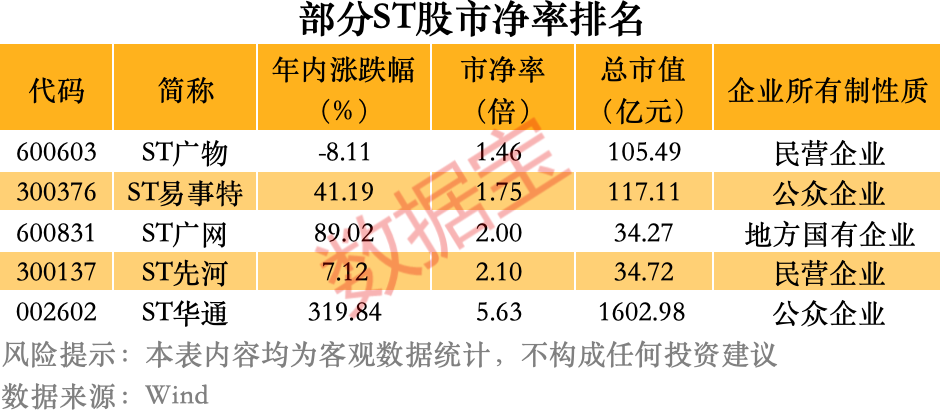
Group 1 - The article highlights the emergence of two tenfold stocks this year, namely Shouwen New Materials and *ST Yushun, driven by themes related to intelligent robotics and advancements in artificial intelligence computing power respectively [1] - The overall performance of the ST sector has rebounded this year, with a cumulative increase of over 22%, and nine stocks have doubled in value, including *ST Yushun, *ST Yazhen, ST Huatong, ST Xintong, and *ST Yatai, primarily due to transformation expectations and strong performance [1] - ST Huatong reported a net profit of nearly 2.7 billion yuan in the first half of the year, a year-on-year increase of over 129%, and has potential for delisting from the ST category [1] Group 2 - ST Guangwang has a low price-to-book ratio of 2, and it is the only state-owned enterprise among the listed companies, focusing on cable television network operations, advertising agency, and film production [2] - The company is transitioning from a traditional cable television operator to a converged media operator, developing a comprehensive business system that includes high-definition digital television and various interactive value-added services [2] - ST Guangwang plans to apply for the removal of risk warnings according to the Shanghai Stock Exchange regulations and has strong transformation expectations, focusing on core competencies and engaging in mergers and acquisitions in related fields [3]


二季度财报更新,A股港股上市公司的盈利增长情况如何?|第406期精品课程
银行螺丝钉· 2025-09-29 04:01
Group 1 - The core viewpoint of the article emphasizes the importance of monitoring the earnings growth of listed companies as a key driver for market performance [8][74] - A-share companies release four periodic reports annually: quarterly reports, semi-annual reports, quarterly reports, and annual reports, while Hong Kong stocks have similar requirements but with more flexible disclosure timelines [4][5] - The earnings growth of listed companies is crucial for the long-term upward trend of stock indices, as it influences both valuation and dividends [8][9] Group 2 - The overall earnings situation of A-shares can be observed through the CSI All Share Index, which showed a significant earnings growth of over 20% in 2021, but faced stagnation in 2023 and 2024, with a slight decline of approximately 0.23% in 2024 compared to 2023 [21][23] - In Q1 2025, A-share companies experienced a year-on-year earnings growth of about 4.46%, which slowed to approximately 2.19% in Q2 2025, influenced by external factors such as tariff crises and declining profits in major state-owned energy enterprises [23][24][25] - The CSI 300 index, representing large-cap stocks, showed stable earnings growth, with a year-on-year increase of around 3%-5% in recent quarters, reflecting the resilience of large companies during economic fluctuations [27][28] Group 3 - The CSI 500 index, representing mid-cap stocks, exhibited significant earnings volatility, with a year-on-year growth of 6.51% in Q1 2025 and 3.6% in Q2 2025, indicating recovery after previous declines [30][31] - The CSI 1000 index, representing small-cap stocks, had a remarkable earnings growth of 68.02% in 2021, but faced declines in 2023 and 2024, with a recovery in Q1 2025 at 16.13%, followed by a slowdown to 0.44% in Q2 2025 [34][36] - The ChiNext Index, representing growth-oriented stocks, showed a strong earnings growth of 30.79% in Q1 2025, which decreased to 13.39% in Q2 2025, reflecting the inherent volatility of growth stocks [36] Group 4 - The Hang Seng Index, representing Hong Kong stocks, experienced a year-on-year earnings growth of 16.32% in Q1 2025, but saw a significant drop to only 0.14% in Q2 2025, with technology and healthcare sectors performing well while energy sector profits declined [38][40] - The H-share Index, representing large-cap Hong Kong stocks, displayed stable earnings growth, similar to the Hang Seng Index, but also faced a slowdown in Q2 2025 [40][41] - The Hang Seng Consumer Index showed a strong recovery with a year-on-year growth of 29.48% in Q2 2025, driven by new consumer companies listing in Hong Kong [62][63] Group 5 - The healthcare sector in Hong Kong, represented by the Hang Seng Healthcare Index, demonstrated significant earnings growth, with a year-on-year increase of 172.89% in Q1 2025 and 59.75% in Q2 2025 [68][70] - The Hong Kong technology sector also showed robust earnings growth, with a year-on-year increase of 128.92% in Q1 2025 and 51.24% in Q2 2025, indicating a strong recovery in this sector [72]

“申”挖数据 | 估值水温表
申万宏源证券上海北京西路营业部· 2025-09-29 02:10
Core Viewpoint - The current PE valuations of the food and beverage and agriculture, forestry, animal husbandry, and fishery sectors are below the 20th percentile of the past decade, indicating potential investment opportunities [7]. Valuation Analysis - The current Buffett indicator for A-shares is 87.08%, which is relatively high and above the safe zone [5][22]. - Major broad market indices have PE valuations (TTM) above 20%, with the Shanghai Composite Index at 94.86% and the ChiNext Index at 190.32%, suggesting a higher relative valuation [6][30]. Industry Valuation Levels - The PE valuations for the food and beverage sector and agriculture, forestry, animal husbandry, and fishery sectors are at 7.84% and 10.96% of their historical percentiles, respectively, indicating they are undervalued compared to historical levels [7]. - Other sectors such as coal, automotive, steel, media, retail, electronics, computing, and real estate have PE valuations at 80.37% to 99.71% of their historical percentiles, suggesting caution in investment [7]. Market Overview - The total market capitalization for the Shanghai market is approximately 615.37 billion, with an average PE ratio of 15.64 [18]. - The Shenzhen market has a total market capitalization of about 416.68 billion, with an average PE ratio of 30.66 [20]. Industry-Specific Valuation Levels - The food and beverage sector has a current PE of 20.99, which is down by 4.94% [35]. - The agriculture, forestry, animal husbandry, and fishery sector has a PE of 14.95, reflecting a decrease of 4.54% [35]. - The coal sector shows a PE of 12.57, with an increase of 3.22% [37].

3个行业获融资净买入 25股获融资净买入额超1亿元
Zheng Quan Shi Bao Wang· 2025-09-29 01:41
Core Viewpoint - On September 26, among the 31 primary industries tracked by Shenwan, three industries experienced net financing inflows, with the communication industry leading at a net inflow of 1.053 billion yuan [1] Industry Summary - The communication industry had the highest net financing inflow on September 26, amounting to 1.053 billion yuan [1] - Other industries that saw net financing inflows included media and automotive [1] Company Summary - A total of 1,413 individual stocks experienced net financing inflows on September 26, with 68 stocks having inflows exceeding 50 million yuan [1] - Among these, 25 stocks had net inflows surpassing 100 million yuan [1] - Zhongji Xuchuang topped the list with a net inflow of 597 million yuan, followed by companies such as Sairisi, CATL, Jinghe Integration, Xinyi Sheng, Cambridge Technology, and Goldwind Technology [1]





有色金属行业、石化化工行业稳增长工作方案印发丨盘前情报
2 1 Shi Ji Jing Ji Bao Dao· 2025-09-29 00:29
A-share Market Performance - A-shares saw collective gains across the three major indices from September 22 to September 26, with the Shanghai Composite Index closing at 3828.11 points, up 0.21% for the week [2][3] - The Shenzhen Component Index closed at 13209.00 points, up 1.06%, while the ChiNext Index ended at 3151.53 points, up 1.96% [2][3] - Over 30% of stocks experienced gains during the week, with 126 stocks rising over 15% and 50 stocks declining over 15% [2] Sector Performance - According to the Shenwan industry classification, sectors such as electric equipment, non-ferrous metals, electronics, environmental protection, media, and public utilities saw increases [2] - Conversely, sectors including social services, comprehensive, retail, light industry manufacturing, and textiles and apparel experienced declines [2] International Market Overview - The New York stock market indices rose on September 26, with the Dow Jones Industrial Average increasing by 299.97 points to close at 46247.29 points, a gain of 0.65% [4][5] - The S&P 500 index rose by 38.98 points to 6643.70 points, up 0.59%, and the Nasdaq Composite increased by 99.37 points to 22484.07 points, up 0.44% [4][5] - European indices also saw gains, with the FTSE 100 rising by 70.85 points to 9284.83 points, up 0.77%, and the CAC 40 increasing by 75.26 points to 7870.68 points, up 0.97% [4][5] Commodity Prices - International oil prices increased, with light crude oil futures for November delivery rising by $0.74 to $65.72 per barrel, a gain of 1.14% [4][5] Economic Policies and Initiatives - The State-owned Assets Supervision and Administration Commission (SASAC) held a meeting to discuss the economic operation of state-owned enterprises, focusing on stabilizing electricity and coal prices and preventing excessive competition [6] - The Ministry of Commerce announced that starting January 1, 2026, export licenses will be required for pure electric passenger vehicles to promote healthy trade in new energy vehicles [6] - The People's Bank of China suggested enhancing monetary policy regulation to improve effectiveness and match monetary supply growth with economic growth [7][8] Industry Growth Plans - The Ministry of Industry and Information Technology (MIIT) and other departments issued a growth plan for the non-ferrous metals industry, targeting an average annual growth of around 5% in value added from 2025 to 2026 [9] - A similar plan for the petrochemical industry was also released, emphasizing policy support and financial backing for technological innovation and equipment upgrades [9] Industrial Profit Trends - From January to August, profits of large-scale industrial enterprises in China grew by 0.9%, reversing a previous decline, with significant growth observed in August [10] Market Outlook - Analysts from Everbright Securities expect the A-share market to continue rising post-holiday, with a focus on the TMT sector as a key driver [11] - Open-source Securities suggests a dual-driven market with technology leading, and recommends focusing on high P/E stocks as the market transitions [11][12]





一场5万变1亿的虚拟冒险
虎嗅APP· 2025-09-29 00:19
Core Viewpoint - The article discusses the journey of small investors in the A-share market, highlighting the different phases of market behavior and strategies for maximizing returns, particularly during bull markets and the emergence of "hot stocks" [5][7]. Group 1: Market Phases - The investment journey is divided into three key phases: the "Newbie Village" during the 924 bull market, the "Chaos Period" characterized by the rise of "hot stocks," and the "Ultimate King" phase where investors align with large capital [8][29]. - In the "Newbie Village," investors are encouraged to familiarize themselves with the market mechanisms and identify strong stocks, particularly in a bull market where many stocks are rising [11][8]. - The "Chaos Period" involves navigating a market with multiple main lines and identifying leading stocks, known as "hot stocks," which can yield significant returns [16][18]. Group 2: Investment Strategies - During the "Newbie Village," a hypothetical investment of 50,000 yuan in Tianfeng Securities could grow to 103,500 yuan within a short period, demonstrating the potential for quick gains in a rising market [13]. - In the "Chaos Period," investors can achieve substantial returns by identifying and investing in stocks like Shuangcheng Pharmaceutical and Risheng Dongfang, which saw significant price increases due to market narratives and trends [19][20]. - The article emphasizes the importance of understanding market narratives and the emotional dynamics of trading, as these factors can drive stock prices significantly [24]. Group 3: Role of Large Capital - The "Ultimate King" phase highlights the dominance of large capital in the market, with institutional investors and state-owned funds playing a crucial role in stabilizing and driving market trends [30][31]. - Large capital is increasingly focused on technology stocks, which have shown substantial growth potential, contrasting with traditional sectors that have limited growth prospects [34][38]. - The article notes that successful investments in the current market environment require aligning with large capital and understanding the underlying fundamentals of technology-driven companies [39][42].



市场全天震荡调整,创业板指盘中跌超2.5%
Dongguan Securities· 2025-09-28 23:30
Market Overview - The A-share market experienced a day of volatility with the ChiNext index dropping over 2.5% during the session [2] - Major indices closed in the red, with the Shanghai Composite Index at 3828.11 (-0.65%), Shenzhen Component at 13209.00 (-1.76%), and the ChiNext at 3151.53 (-2.60%) [1][2] Sector Performance - The top-performing sectors included Oil & Petrochemicals (+1.17%), Environmental Protection (+0.38%), and Public Utilities (+0.35%) [1] - Conversely, the weakest sectors were Computer (-3.26%), Electronics (-2.75%), and Media (-2.65%) [1] Investment Insights - The report highlights a robust performance of the basic pension insurance fund, which has reached an investment operation scale of 2.6 trillion, doubling since the end of the 13th Five-Year Plan [3] - The average annual investment return of the pension fund stands at 5.15%, indicating effective value preservation and growth [3] Future Market Outlook - The market is expected to show a trend of oscillating upward rather than a one-sided increase, with a focus on whether growth policies can effectively translate into improved corporate earnings [4] - Key sectors to watch include TMT (Technology, Media, and Telecommunications), Public Utilities, Non-ferrous Metals, and Financials [4]
一场10万过亿的虚拟冒险
Hu Xiu· 2025-09-28 23:23
Core Insights - The article presents a metaphorical guide for stock trading in the A-share market, likening it to a game where players progress from novice to expert levels, with the potential for significant financial gains [1][3]. Group 1: Market Phases - The journey of small capital investment in the A-share market is divided into three key phases: the novice phase, the chaos phase, and the ultimate king phase [3][9]. - In the novice phase, the focus is on understanding the A-share market mechanisms and acquiring initial resources [9]. - The chaos phase involves navigating through various market trends and identifying leading stocks, particularly "妖股" (mythical stocks) [14][23]. - The ultimate king phase emphasizes aligning with large capital players and adopting a following strategy to maximize returns [26][27]. Group 2: Investment Strategies - During the novice phase, a hypothetical investment of 50,000 yuan in Tianfeng Securities could yield a return of 10.35 million yuan within a short period [11][12]. - In the chaos phase, stocks like 双成药业 (Shuangcheng Pharmaceutical) and 日出东方 (Rising East) exemplify the potential for rapid gains through strategic investments based on market narratives and trends [15][17]. - The ultimate king phase highlights the importance of large institutional investors, such as the "国家队" (national team), which have significant influence over market pricing and trends [27][28]. Group 3: Market Dynamics - The article discusses the influx of capital into the A-share market, with a notable increase in trading volume from 500 billion to over 3 trillion yuan during peak periods [5][6]. - It also notes the shift in market dynamics, where large institutional investors have gained more control, leading to a more stable market environment characterized by slow growth and structural trends [31][32]. - The performance of stocks in the technology sector, such as 寒武纪 (Cambricon), is highlighted as a key driver of market growth, contrasting with traditional sectors like banking and oil [34][36]. Group 4: Risks and Challenges - The article emphasizes the inherent risks in the "妖股" trading strategy, where the rapid rise in stock prices can lead to equally swift declines if market narratives fail [23]. - It also points out that while small investors make up a significant portion of the market, they face greater challenges in achieving consistent profits compared to larger institutional players [43].
A股板块轮动加速 基金净值“跑偏”泄露调仓动向
Zheng Quan Shi Bao· 2025-09-28 18:26
Group 1 - The A-share market has experienced significant fluctuations since September, with various sectors such as solid-state batteries, robotics, non-ferrous metals, and gaming emerging as new hotspots, indicating a notable acceleration in market rotation [1] - Funds heavily invested in AI computing have shown signs of portfolio adjustments, with some funds deviating from their holdings, suggesting a shift in strategy [2][3] - The performance of certain funds has diverged from their estimated returns, indicating potential reallocation of assets despite the underlying stocks' performance [2][3] Group 2 - Consumer funds have also exhibited signs of "cutting losses" and reallocating their portfolios, with some funds showing gains despite their major holdings declining [4][5] - Fund managers are increasingly focusing on emerging trends, such as the rise of domestic brands and innovative consumer products, indicating a shift in investment strategy towards sectors with higher growth potential [5][6] - The current market environment presents challenges for active management, as rapid sector rotation requires fund managers to adapt their strategies dynamically [7] Group 3 - There is an expectation of increased stock differentiation as market valuations rise, with a continued focus on AI computing-related assets, while new opportunities may arise in adjacent sectors like AR glasses and the Apple supply chain [8] - Fund managers are optimistic about the prospects of AI computing assets, particularly in relation to the global AI industry chain, while also recognizing the growing connection between AI and Chinese semiconductor companies [8]
富国观市丨持股过节还是持币过节?
Sou Hu Cai Jing· 2025-09-28 15:42
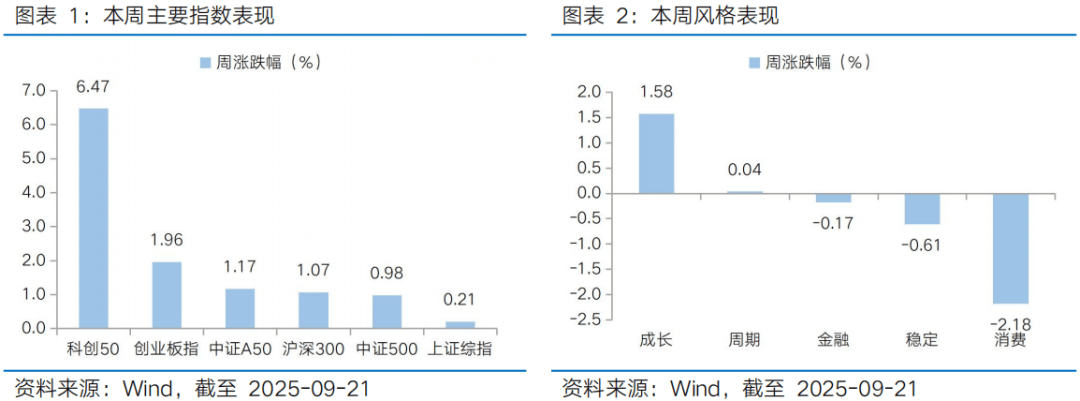
Part 1: A-share Market Analysis - The A-share market saw most major indices close in the green this week, with the STAR Market particularly strong due to semiconductor sector stimulation, while broader indices like the Shanghai Composite Index had limited gains [1] - The Shanghai Composite Index rose by 0.21%, the ChiNext Index increased by 1.96%, and the STAR Market surged by 6.47%. Growth and cyclical stocks performed relatively well, while consumer and stable sectors lagged [1][4] - Among the Shenwan first-level industries, the top performers included power equipment (3.86%), non-ferrous metals (3.52%), and electronics (3.51%), while social services (-5.92%) and retail (-4.32%) were among the worst performers [1] - Notable concept sectors included semiconductor silicon wafers (13.06%) and semiconductor equipment (11.22%), while tourism (-8.39%) and circuit boards (-4.89%) faced declines [1] Part 2: Market Sentiment and Future Outlook - The A-share market is expected to experience a "calendar effect" around the National Day holiday, with historical data indicating a tendency for the market to decline before the holiday and rebound afterward [4][5] - The market's trading volume remains above 2 trillion yuan but has shown a marginal decline, influenced by holiday effects and a lack of clear catalysts [4] - The upcoming U.S. economic data releases, including the ISM Manufacturing PMI and non-farm employment figures, may further adjust market expectations regarding interest rate cuts [4][5] - The technology sector is anticipated to remain a key focus, driven by liquidity and positive fundamentals, despite recent adjustments [6][7] Part 3: Hong Kong Market Analysis - The Hong Kong market faced collective declines, with the Hang Seng Index down 1.57% and the Hang Seng Tech Index down 1.58%, primarily due to tariff impacts and market risk aversion [10][14] - The recent U.S. tariff announcements have raised concerns about trade tensions, particularly affecting sectors like construction and pharmaceuticals, although the core drivers of the Hong Kong market remain focused on domestic economic recovery and global liquidity [15][16] - Despite the tariff-induced volatility, there is a strong inflow of southbound capital, indicating long-term confidence in Hong Kong stocks [15][16] Part 4: Upcoming Macro Events - Key macroeconomic indicators to watch include China's official manufacturing PMI for September, expected at 50.1, and various U.S. employment data releases [17]