
资产管理

Search documents
当达里奥再次悲观
虎嗅APP· 2025-08-28 10:15
Core Viewpoint - The article discusses Ray Dalio's new book "Why Nations Fail," which explores the long-term debt cycle and its implications for the U.S. economy, emphasizing the historical patterns of debt accumulation and the eventual consequences of unsustainable debt levels [9][20][196]. Group 1: Economic Machine Operation - The economic machine can be divided into five macroeconomic sectors: households, businesses, government, finance, and overseas sectors [22][23]. - The private sector, comprising households and businesses, is the main wealth creator, with employment and customer relationships being key dynamics [26][30]. - The wealth distribution structure in the U.S. is highlighted, with 1% of the population holding significant wealth, while the bottom 50% are primarily in debt [41][44]. Group 2: Government and Debt - The government acts as the economic manager, with tax revenue being a crucial source of government credit [56][58]. - The U.S. government has a history of budget deficits, with expenditures exceeding revenues, leading to a national debt exceeding $36 trillion [70][72]. - The government often rolls over debt, creating a cycle of borrowing to pay off existing debt, which raises concerns about the sustainability of this approach [73][75]. Group 3: Long-term Debt Cycle - Dalio identifies an 80-year long-term debt cycle, where each cycle leads to significant debt accumulation and eventual crises [197]. - The short-term debt cycle typically lasts around 6 years, with the current cycle starting in 2020 and nearing completion [193][194]. - The article emphasizes that during the later stages of the long-term debt cycle, the government may resort to debt monetization, leading to currency devaluation as a means to manage debt [205][206]. Group 4: Economic Participants and Behavior - The main participants in the economic machine include borrowers, lenders, banks, central governments, and central banks, each with distinct motivations and behaviors [127][131]. - The article discusses the nature of debt and credit, highlighting that debt represents a promise to pay in the future, while credit is a commitment to repay borrowed funds [140][145]. - The relationship between debt and money supply is explored, indicating that increases in debt often correlate with economic fluctuations and purchasing power changes [155][181]. Group 5: Implications for Investment - The article suggests that understanding the dynamics of the economic machine and the long-term debt cycle can provide insights into potential investment opportunities and risks [20][196]. - The current state of the U.S. economy, characterized by high government debt and pressures on fiscal sustainability, may influence market behavior and investment strategies [119][225]. - The historical patterns of debt crises and government responses can serve as a framework for anticipating future economic developments and investment landscapes [124][205].


日本央行再有高层放风:目前加息环境较4月更加成熟
Hua Er Jie Jian Wen· 2025-08-28 09:21
Core Viewpoint - The Bank of Japan (BOJ) is considering further interest rate hikes if economic and inflation conditions meet expectations, as indicated by BOJ policy committee member Nakagawa Junko [1][2]. Group 1: Economic Conditions - Nakagawa stated that the current economic environment is more favorable for interest rate hikes compared to April [1]. - The market's expectation for a rate hike has risen to approximately 60% by the end of October, up from 40% in early August [1][2]. Group 2: Inflation and Monetary Policy - Japan's core consumer price index reached 3.3% in June, exceeding the BOJ's 2% target for over three years, prompting calls for a shift to a more hawkish policy stance [2]. - Nakagawa emphasized that the BOJ will continue to support the economy through current monetary easing until there is more certainty regarding inflation and economic performance [1][3]. Group 3: Labor Market Dynamics - The strong labor market is seen as a key reason supporting the case for interest rate hikes, with wage growth expanding from large enterprises to small and medium-sized businesses [4]. - Nakagawa noted that companies are increasingly inclined to raise wages and prices, reflecting expectations of continued labor market tightness [5].
资管年会共议大资管再造竞争力:应对市场新变化 实现能力重塑
Sou Hu Cai Jing· 2025-08-28 07:20
Core Insights - The asset management industry is facing significant market volatility in 2023, prompting institutions to optimize asset allocation strategies and enhance product competitiveness to adapt to market changes [1][3][4] Group 1: Industry Challenges and Opportunities - The asset management sector has experienced profound adjustments over the past year, with traditional asset scarcity continuing while the equity market shows signs of improvement [4] - There is an increasing demand for wealth reallocation among residents, leading to a rise in the need for wealth management products [4] - The public fund industry is witnessing new growth opportunities due to favorable external conditions and regulatory support [4][9] Group 2: Strategic Focus Areas - Institutions are encouraged to shift towards market-oriented mechanisms, enhancing multi-asset acquisition and combination capabilities [3][7] - Improving research and customer service capabilities is deemed essential for rebuilding competitiveness in the asset management sector [3][7] - Companies are advised to prepare for market changes by restructuring product systems, cultivating core research capabilities, and enhancing customer service frameworks [3][7] Group 3: Asset Allocation and Product Development - The importance of combination management is highlighted, particularly in "fixed income plus" products that blend fixed income assets with equities to enhance returns [5][6] - There is a notable shift in asset allocation, with an increasing proportion of equity investments in various institutions [6][9] - The focus on long-term capital entering the market is reshaping market dynamics and investment strategies [9][10] Group 4: Future Industry Landscape - The future of the asset management industry will depend on establishing independent market mechanisms, enhancing multi-asset capabilities, and improving customer service [7][8] - Companies are encouraged to differentiate themselves in a competitive landscape by focusing on comprehensive financial services rather than solely on yield [8] - The industry is urged to adopt self-regulation to promote fair competition and healthy development [8] Group 5: Economic Outlook and Growth Drivers - China's economy is showing resilience, with GDP growth rates exceeding expectations, supported by strong domestic demand [10][11] - Future economic growth is expected to be driven by expanding domestic demand, new production capabilities, and fixed asset investment opportunities [11]

高波动、低利率时代,机构共议多元化挖掘收益
2 1 Shi Ji Jing Ji Bao Dao· 2025-08-28 06:11
Group 1: Conference Overview - The "2025 Asset Management Conference" was held in Shanghai, focusing on diverse asset allocation strategies in a low-interest-rate environment [1][3] - Experts from various asset management firms discussed key topics such as asset allocation strategies, stock and bond market trends, and the outlook for gold and dollar assets [3] Group 2: Low-Interest Rate Environment - The low-interest-rate environment has fundamentally altered investors' risk preferences and behavior, with the ten-year government bond yield fluctuating between 1.6% and 1.9% [4][5] - The policy support for the capital market since September 2022 has been significant, with long-term funds entering the market, enhancing market confidence [4][5] Group 3: Asset Allocation Strategies - The concept of "asset scarcity" has emerged as a major challenge, prompting innovative strategies such as "seeking returns internally" and "seeking returns externally" [7] - The focus on high-dividend assets reflects the demand for stable returns amid the ongoing asset scarcity [9] Group 4: Equity Market Insights - The equity market is characterized by structural differentiation, with technology and manufacturing sectors gaining attention [9][10] - High-dividend companies are expected to perform steadily, even if their overall returns may not be as impressive in the near term [10] Group 5: Gold and Dollar Dynamics - Gold remains a focal point for discussion, driven by long-term factors such as the weakening status of the dollar and central banks' increasing gold reserves [11][12] - The "fixed income + dollar" and "fixed income + gold" strategies have gained popularity, but caution is advised due to potential risks associated with currency exposure and market volatility [12]

日本10月加息预期压不住了?长债收益率大涨,短债拍卖遇冷
Jin Shi Shu Ju· 2025-08-28 05:45
Group 1 - The Bank of Japan (BOJ) maintains a neutral stance despite market speculation about potential interest rate hikes as early as October, leading to a rise in long-term bond yields and a weak demand for short-term bond auctions [2][3] - BOJ committee member Junko Nakagawa emphasized that the central bank will continue to raise policy rates if economic and inflation conditions allow, while also highlighting trade-related uncertainties [3] - The yield on Japan's 10-year government bonds reached a 17-year high earlier this week, driven by stable economic activity and persistent inflation, further fueling speculation about interest rate hikes [3] Group 2 - The auction demand for Japan's two-year government bonds fell to its weakest level in 16 years, with an average bid-to-cover ratio of 2.84, the lowest since 2009 [4] - The weak auction results are attributed to speculation about BOJ interest rate hikes and expectations of increased short-term bond issuance, making it difficult for investors to establish positions at the short end of the curve [4] - Overall, the poor auction results across various maturities indicate weakening market demand amid improved economic prospects and hawkish signals from the BOJ [4]
资管机构拥抱被动投资浪潮 共同破局低利率时代“资产荒”
2 1 Shi Ji Jing Ji Bao Dao· 2025-08-28 03:47
Core Insights - The rise of passive investment, particularly index-based investment, is becoming a significant focus for asset management institutions as they adapt to changing market dynamics [1][2][3] - The total scale of ETFs listed in China has officially surpassed 5 trillion yuan, marking a historical high and indicating the growing importance of passive investment in capital markets [1][2] Group 1: Factors Driving ETF Growth - Regulatory support and guidance from authorities have been crucial in the rapid development of the ETF market [2] - Significant capital inflows from large institutional investors have provided a solid funding base for ETFs [2] - The supply side has seen public funds increasingly view ETFs as a key growth area, allocating substantial resources to this segment [2] - The ecosystem surrounding ETFs is maturing, with innovations in sales, research, and advisory services further promoting market development [2] Group 2: Characteristics and Trends in Passive Investment - Passive investment is characterized by its transparency, tradability, large capacity, and convenience, making ETFs one of the best tools for asset management companies to engage in equity market investments [2][3] - The structure of stock market investors is rapidly changing, with institutional investors now holding over 50% of the market, which influences the index curves that passive investments track [3] Group 3: Challenges in the Passive Investment Market - The passive investment market faces issues of significant homogeneity and concentrated supply, leading to potential resource wastage within the industry [3][4] - Many asset management firms are grappling with the decision to enter the passive investment space, as competition is fierce and often results in many participants exiting the market [3] Group 4: Strategies for Asset Management Institutions - Asset management institutions are exploring various strategies to provide stable and sustainable returns to investors, particularly in a low-risk environment [5][6] - Institutions are focusing on multi-asset allocation opportunities and enhancing their research capabilities to improve investor returns and client experiences [9][10] - The need for diversified asset allocation is emphasized, as single asset classes may not effectively navigate market cycles [9][10] Group 5: Innovations and Future Directions - Institutions are increasingly adopting quantitative strategies within passive index investment, with trends such as "passive active" and "active passive" emerging [7] - Wealth management institutions are enhancing their strategy for index products and focusing on investor education to promote the value of ETFs [8]
法国总理政治豪赌引发“多事之秋”!总统马克龙也被拉下水?
Jin Shi Shu Ju· 2025-08-28 03:38
Group 1 - The French Prime Minister François Bayrou's decision to hold a confidence vote has plunged the Eurozone's second-largest economy back into crisis, raising significant economic risks and concerns about a potential recession [2] - Business leaders in France express that the uncertainty surrounding the political situation is likely to lead consumers to delay spending decisions, which could severely impact the economy [2][3] - France's economy grew by 0.3% in the second quarter, primarily supported by a rebound in household spending, but this reliance on consumption raises concerns about recession risks [2][3] Group 2 - Bayrou's proposed budget tightening plan of €44 billion includes measures such as canceling two public holidays and freezing most public spending, amidst rising debt and deficit levels [3] - Polls indicate that a significant majority of the French public prefers new national elections, with support for this approach ranging from 56% to 69% [3][4] - The political landscape shows that 41% of respondents favor the far-right National Rally leading the next government, although 59% oppose this party's leadership [4] Group 3 - The decision to hold a confidence vote has triggered significant market sell-offs, narrowing the yield spread between French and Italian 10-year bonds, while the French 30-year bond yield reached a 14-year high of 4.45% [5] - Analysts suggest that whether a new Prime Minister is appointed or early elections are called, both scenarios could lead to prolonged uncertainty in the market [5] - Upcoming credit rating assessments could act as catalysts for the bond market, with Fitch planning to evaluate France shortly after the confidence vote [5]
欧债阴霾从未远离!英国长债收益率逼近1998年高点,面临“滞胀”风险
Hua Er Jie Jian Wen· 2025-08-28 03:29
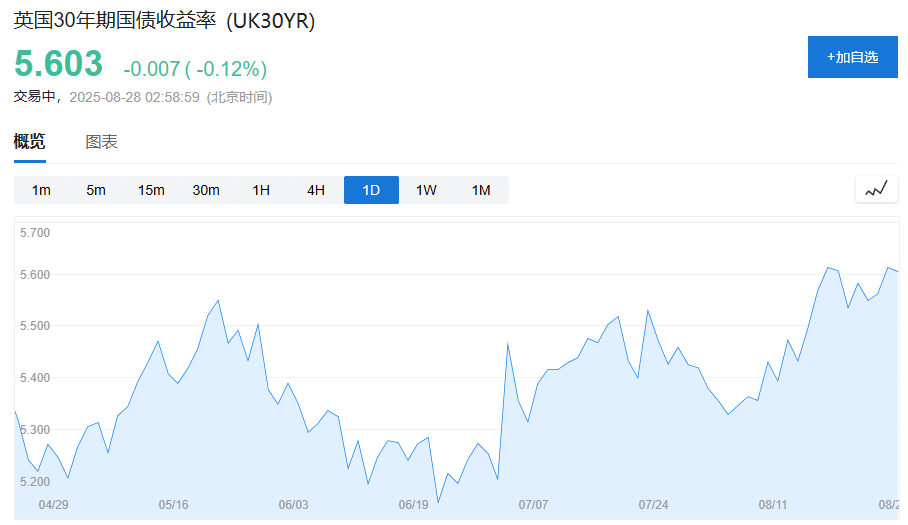
Core Viewpoint - The UK is facing significant economic challenges, with rising bond yields leading to increased borrowing costs and heightened concerns over "stagflation" risks [1][4][5]. Group 1: Bond Market Dynamics - The yield on the UK 30-year government bond surged to 5.64%, the highest in four months, approaching historical highs set in 1998 [1]. - Since early August, the UK 30-year bond yield has increased by 0.23 percentage points, significantly outpacing increases in Germany (0.13 percentage points) and the US (0.06 percentage points) [4]. - The divergence in central bank policy expectations is a key factor, with the market anticipating only one rate cut from the Bank of England in the next 12 months, compared to four from the Federal Reserve [4]. Group 2: Economic Outlook and Fiscal Pressure - The UK is experiencing a "stagflation" risk, characterized by high inflation and stagnant economic growth, complicating the Bank of England's ability to lower interest rates [5][6]. - Current inflation in the UK is near 4%, limiting the government's ability to stimulate the economy through rate cuts [5]. - If current yield levels persist, the fiscal space for the Chancellor of the Exchequer, Rachel Reeves, could shrink from £9.9 billion to £5.3 billion, necessitating the raising of up to £27 billion in the upcoming budget [5]. Group 3: Central Bank Challenges - The surge in bond yields is increasing pressure on the Bank of England, with calls to slow or halt its quantitative tightening (QT) program [6]. - The Bank of England is reducing its balance sheet by £100 billion annually, which is believed to be further depressing bond prices and increasing yields [7]. - Concerns over inflation and the credibility of UK policy are rising, with warnings that without government spending cuts and a halt to QT, the fiscal gap may widen, potentially leading to market turmoil [7].
走向“奇点”--AI重塑资管业
Hua Er Jie Jian Wen· 2025-08-28 03:03
Core Insights - UBS believes that artificial intelligence is triggering a profound revolution in asset management, characterized by human-machine collaboration rather than machine replacement of humans [1] - The report emphasizes that the most successful investors in the next decade will be those who can leverage both quantitative and traditional stock-picking methods, using AI as a force multiplier [1] AI's Key Tools - AI is no longer a distant concept but a toolbox of data-driven technologies deeply embedded in investment processes, driven by data explosion, computational advancements, and the democratization of AI tools [2] - The three most impactful technologies in asset management are identified as machine learning, neural networks, and large language models [2] Machine Advantages - Machines excel in speed, breadth, and consistency, processing data at a scale and speed far beyond human capabilities [3][6] - A machine can analyze thousands of earnings call transcripts daily, identifying anomalies and shifts in market sentiment [6] Human Advantages - Humans possess strengths in context, complexity, and causal inference, allowing them to interpret unique events that models struggle to learn, such as regulatory changes or management shifts [4] - Ethical and value-based judgments are areas where human oversight is irreplaceable, crucial for managing reputation and operational risks [8] Machine Learning and Neural Networks - Machine learning models predict outcomes by identifying patterns in data, enhancing accuracy in signal generation and risk modeling [5] - Neural networks, particularly deep learning architectures, excel in processing high-dimensional, unstructured data, although they face challenges in interpretability and training costs [5] The Singularity of Investment - The traditional barriers between quantitative and fundamental investing are being dismantled, leading to a convergence point referred to as "The Singularity" [9] - Quantitative investors are increasingly integrating fundamental analysis by utilizing AI tools to process both structured and unstructured data [10] Fundamental Managers Embracing Scale - AI tools significantly expand the research scope for fundamental teams, allowing analysts to focus on high-value activities while automating data processing tasks [11] Human-Machine Collaboration - UBS's quantitative research team conducted an experiment validating the "Singularity" theory, showing that a hybrid model combining human insights and machine predictions generated strong returns across a broad stock pool [12][14] - The report highlights that successful investment management firms will build teams that integrate human contextual understanding with machine capabilities [12] Understanding Complexity and Unknowns - Humans are better at constructing investment logic and understanding the interplay of multiple driving factors, especially in complex scenarios where AI models may fail [13] - In times of regime shifts, human adaptability through qualitative judgment is crucial, as AI relies on historical data that may not apply [13]

柳工在北京成立资产管理新公司
Zheng Quan Shi Bao Wang· 2025-08-28 02:48
Group 1 - Recently, Zhongheng Rui'an (Beijing) Asset Management Co., Ltd. was established, with Wei Mingwei as the legal representative [1] - The company's business scope includes asset management services using self-owned funds, engaging in investment activities with self-owned funds, and leasing construction machinery and equipment [1] - The company is wholly owned by Liugong [1]
