
焦炭

Search documents
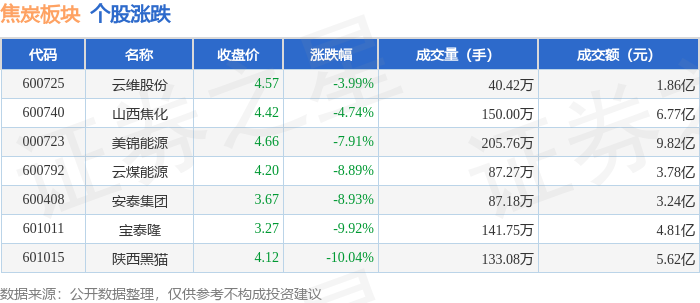
焦炭板块2月2日跌7.64%,陕西黑猫领跌,主力资金净流出3.43亿元
Zheng Xing Xing Ye Ri Bao· 2026-02-02 09:23
Core Viewpoint - The coking coal sector experienced a significant decline, with a 7.64% drop on February 2, led by Shaanxi Black Cat, amidst a broader market downturn reflected in the Shanghai Composite Index and Shenzhen Component Index [1] Group 1: Market Performance - On February 2, the Shanghai Composite Index closed at 4015.75, down 2.48%, while the Shenzhen Component Index closed at 13824.35, down 2.69% [1] - The coking coal sector saw individual stock performances with notable declines, including Shaanxi Black Cat down 10.04% and Meijin Energy down 7.91% [1] Group 2: Trading Volume and Capital Flow - The coking coal sector experienced a net outflow of 343 million yuan from main funds, while retail investors saw a net inflow of 366 million yuan [1] - The trading volume for key stocks included 1.86 billion yuan for Yunwei Co. and 6.77 billion yuan for Shanxi Coking [1] Group 3: Individual Stock Analysis - Major declines in individual stocks included: - Shaanxi Black Cat: 4.12 yuan, down 10.04%, with a trading volume of 1.33 million shares [1] - Meijin Energy: 4.66 yuan, down 7.91%, with a trading volume of 2.06 million shares [1] - The table of individual stock performances indicates significant losses across the board, with the highest decline being 10.04% for Shaanxi Black Cat [1][2]


《黑色》日报-20260202
Guang Fa Qi Huo· 2026-02-02 02:08
1. Report Industry Investment Ratings No information provided in the reports. 2. Core Views of the Reports Steel Industry - The steel industry shows low and stable production, declining apparent demand, seasonal inventory accumulation with a lower - than - year - on - year rate. Rebar continues to accumulate inventory while hot - rolled coils maintain de - stocking. Steel prices fluctuate with market sentiment, staying in a range. The spread between hot - rolled coils and rebar widens, and the basis of rebar weakens while that of hot - rolled coils strengthens. In February, due to the Spring Festival off - season, supply and demand are weak. Steel prices are expected to continue seasonal inventory accumulation, with de - stocking pressure after the festival. The price is constrained by weak domestic demand on the upside and supported by macro sentiment and supply - side policies on the downside. Rebar is expected to fluctuate between 3050 - 3250 yuan, and hot - rolled coils between 3200 - 3350 yuan [1]. Iron Ore Industry - Iron ore is in a situation of strong supply and weak demand. With high inventory, stagnant resumption of iron - making production, and the fulfillment of steel mills' restocking, iron ore prices are under pressure. Supply shows a marginal decrease in the shipping center but is still at a relatively high level compared to historical periods. Demand sees a slight decline in iron - making production and a drop in steel mills' profitability. Terminal demand for steel exports weakens, and the manufacturing industry faces an off - season. Before the Spring Festival, it is difficult to resume iron - making production, and negative feedback is also hard to observe. Port inventory continues to accumulate, and steel mills' inventory increases significantly. Before the Spring Festival, the price is expected to be under pressure, and one can try short - selling around 800 yuan, but beware of macro and market sentiment disturbances [3]. Coke and Coking Coal Industry - Coke futures showed a trend of rising first and then falling in January. The fourth - round price cut of coke was implemented on January 1st, followed by price increases from major coke producers. The first - round price increase was officially accepted by steel mills on January 28th and executed on the 30th. The supply side has lagging price adjustments of coke compared to coking coal, resulting in pressure on coking profits and a slight decline in production. The demand side has a slight resumption of production by steel mills after New Year's Day, with low - level iron - making production and a rebound in steel prices. In terms of inventory, coke - making plants and steel mills accumulate inventory, while ports reduce inventory. The overall inventory is slightly increased at a medium level, and the supply - demand situation of coke improves. Before the Spring Festival, the market is expected to be volatile and slightly strong, with a reference range of 1650 - 1850 yuan. - Coking coal futures also showed a trend of rising first and then falling. Spot prices in Shanxi showed signs of decline, and Mongolian coal prices fluctuated with futures. The supply side has an increase in daily coal output from mines and faster de - stocking. Imported coal has a high - level inventory at ports, and the customs clearance of Mongolian coal has rebounded rapidly after New Year's Day. The demand side has limited growth in demand for downstream restocking before the Spring Festival due to low - level iron - making production, declining coking profits, and reduced production. In terms of inventory, coke - making plants, steel mills, and ports accumulate inventory, while mines, coal - washing plants, and ports reduce inventory. The overall inventory is slightly increased at a medium level. The market is expected to be volatile and slightly strong before the Spring Festival, with a reference range of 1050 - 1250 yuan. An arbitrage strategy of going long on coking coal and short on coke is recommended, but beware of the supply - demand situation turning loose after the festival [5]. Ferrosilicon and Ferromanganese Industry - For ferrosilicon, supply shows a slight decline, with stable production recently and an increase in the operating rate of manufacturers. The absolute weekly production is at a historically low level. Inner Mongolia's production rises steadily, Ningxia's production is stable, and southern regions may see a contraction in production due to potential electricity price hikes. Steel - making demand is expected to have stable iron - making production before the Spring Festival. The contradiction in the finished - product market is relatively limited, and the resumption of iron - making production can suppress inventory contradictions. However, the resumption space is limited by off - season demand, and negative feedback is hard to observe. The inventory in factories is still high, mainly concentrated in Ningxia, but the warehouse - receipt level is relatively low. The cost of alloy manufacturers' coal - mine replenishment is rising. The overall non - steel demand is marginally weakening. In the short term, the supply - demand contradiction of ferrosilicon is limited, and the fundamentals are relatively healthy. The cost side also provides support. The price is expected to fluctuate widely, and attention should be paid to macro - sentiment fluctuations [6]. - For ferromanganese, supply has a slight increase in production, basically remaining stable from the previous period. Most production areas' output is flat compared to last week, with a slight increase in Ningxia's output. Inner Mongolia's settlement electricity price in January is expected to rise, and attention should be paid to the change in settlement electricity prices in other production areas. Before the Spring Festival, the production of ferromanganese is expected to be stable. Steel - making demand is expected to have stable iron - making production before the Spring Festival. The contradiction in the finished - product market is relatively limited, and the resumption of iron - making production can suppress inventory contradictions. However, the resumption space is limited by off - season demand, and negative feedback is hard to observe. Hebei Iron and Steel Group's next - month procurement volume is reduced compared to last month, and attention should be paid to the pricing. The non - steel demand is weakening, and the price is falling. The cost of manganese ore is expected to rise, but the increase is limited. In the short term, the high inventory still suppresses the price, and the fundamentals lack impetus. The price of ferromanganese is expected to fluctuate widely, with a reference range of 5600 - 6000 yuan, and attention should be paid to macro - sentiment fluctuations [6]. 3. Summary by Relevant Catalogs Steel Industry Steel Prices and Spreads - Rebar: Spot prices in East China, North China, and South China are 3250 yuan/ton, 3170 yuan/ton, and 3290 yuan/ton respectively. Futures prices for the 05, 10, and 01 contracts are 3128 yuan/ton, 3177 yuan/ton, and 3211 yuan/ton respectively. - Hot - rolled coils: Spot prices in East China, North China, and South China are 3270 yuan/ton, 3170 yuan/ton, and 3290 yuan/ton respectively. Futures prices for the 05, 10, and 01 contracts are 3288 yuan/ton, 3311 yuan/ton, and 3336 yuan/ton respectively [1]. Cost and Profit - Steel billet price is 2940 yuan/ton, down 10 yuan. Plate - billet price is 3730 yuan/ton, unchanged. - Jiangsu electric - furnace rebar cost is 3239 yuan/ton, unchanged, and converter rebar cost is 3168 yuan/ton, down 15 yuan. - East China hot - rolled coil profit is 16 yuan/ton, North China hot - rolled coil profit is - 94 yuan/ton, down 1 yuan, and South China hot - rolled coil profit is 16 yuan/ton, down 1 yuan. East China rebar profit is - 14 yuan/ton, up 9 yuan, North China rebar profit is - 104 yuan/ton, down 1 yuan, and South China rebar profit is 146 yuan/ton, down 11 yuan [1]. Production - Daily average iron - making production is 228.00 thousand tons, down 0.1 thousand tons. - Total production of five major steel products is 823.20 thousand tons, up 3.6 thousand tons. Rebar production is 199.80 thousand tons, up 0.3 thousand tons, including 32.20 thousand tons of electric - furnace products, down 1.1 thousand tons, and 167.60 thousand tons of converter products, up 1.4 thousand tons. Hot - rolled coil production is 309.20 thousand tons, up 3.8 thousand tons [1]. Inventory - Total inventory of five major steel products is 1278.50 thousand tons, up 21.4 thousand tons. Rebar inventory is 475.50 thousand tons, up 23.4 thousand tons. Hot - rolled coil inventory is 355.60 thousand tons, down 2.2 thousand tons [1]. Transaction and Demand - Building materials transaction volume is 5600 tons, down 1700 tons. Apparent consumption of five major steel products is 801.70 thousand tons, down 7.8 thousand tons. Apparent consumption of rebar is 176.40 thousand tons, down 9.1 thousand tons. Apparent consumption of hot - rolled coils is 311.40 thousand tons, up 1.5 thousand tons [1]. Iron Ore Industry Iron Ore - Related Prices and Spreads - Warehouse - receipt costs of different iron ore powders show different changes. For example, the warehouse - receipt cost of PB powder is 845.7 yuan/ton, down 9.9 yuan. The 05 - contract basis of different iron ore powders also changes, and the 5 - 9 spread is 19.0 yuan/ton, down 0.5 yuan, and the 1 - 5 spread is - 31.5 yuan/ton, up 1.5 yuan [3]. Spot Prices and Price Indexes - Spot prices of iron ore in Rizhao Port decline. For example, the price of PB powder is 790.0 yuan/ton, down 9.0 yuan. The price of the Singapore Exchange 62% Fe swap is 105.6 dollars/ton, down 0.1 dollars [3]. Supply - The weekly arrival volume at 45 ports is 25.30 million tons, down 1.297 million tons. The global weekly shipping volume is 29.783 million tons, up 0.484 million tons. The national monthly import volume is 119.647 million tons, up 9.107 million tons [3]. Demand - The weekly average daily iron - making production of 247 steel mills is 228.00 thousand tons, down 0.1 thousand tons. The weekly average daily port - clearance volume at 45 ports is 332.30 thousand tons, up 21.6 thousand tons. The national monthly pig - iron output is 60.722 million tons, down 1.621 million tons, and the national monthly crude - steel output is 68.177 million tons, down 1.694 million tons [3]. Inventory Changes - The 45 - port inventory is 170.2226 million tons, up 2.557 million tons. The imported - ore inventory of 247 steel mills is 99.686 million tons, up 5.798 million tons. The inventory - available days of 64 steel mills is 27 days, up 4 days [3]. Coke and Coking Coal Industry Coking Coal - Related Prices and Spreads - Coking coal prices in Shanxi and Mongolia remain stable. The 05 - and 09 - contract prices of coking coal decline, and the basis and spreads show corresponding changes [5]. Coke - Related Prices and Spreads - Coke prices in Shanxi and Rizhao Port change. The 05 - and 09 - contract prices of coke decline, and the basis and spreads change accordingly [5]. Supply - The weekly coke output of all - sample coking plants is 62800 tons, down 500 tons, and the weekly output of 247 steel mills is 47000 tons, up 100 tons. The weekly output of Fenwei sample coal mines shows a decline [5]. Demand - The weekly iron - making production of 247 steel mills is 228.00 thousand tons, down 0.1 thousand tons. The weekly coke output of all - sample coking plants is 62800 tons, down 500 tons [5]. Inventory Changes - Coke inventory increases. The inventory of all - sample coking plants is 84400 tons, up 2900 tons, and the inventory of 247 steel mills is 678200 tons, up 16600 tons. The port inventory is 198100 tons, up 2000 tons. Coking coal inventory also changes, with some increasing and some decreasing [5]. Ferrosilicon and Ferromanganese Industry Spot Prices and Spreads - Ferrosilicon and ferromanganese spot prices in different regions show different changes. The main - contract closing prices of ferrosilicon and ferromanganese decline [6]. Cost and Profit - The production costs and profits of ferrosilicon and ferromanganese in different regions change. For example, the production cost of ferrosilicon in Inner Mongolia is 5866.2 yuan/ton, up slightly [6]. Supply - The weekly output of ferrosilicon is 98000 tons, up slightly, and the operating rate is 29.1%. The weekly output of ferromanganese is 192000 tons, down slightly, and the operating rate is 36.2% [6]. Demand - The weekly demand for ferrosilicon and ferromanganese calculated by Steel Union shows little change. The weekly average daily iron - making production of 247 steel mills is 228.00 thousand tons, down 0.1 thousand tons [6]. Inventory Changes - The inventory of 60 - sample ferrosilicon enterprises is 37300 tons, up slightly, and the average available days for downstream ferrosilicon use increase. The inventory of ferromanganese and its average available days also change [6].
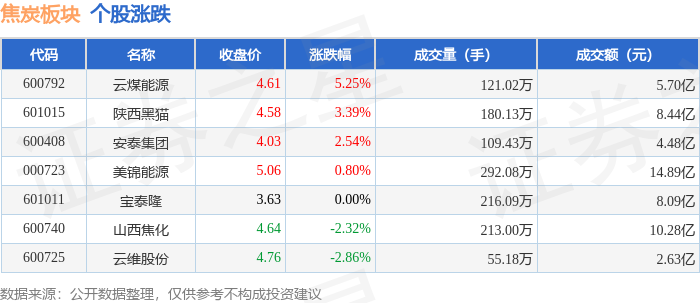
焦炭板块1月30日涨0.59%,云煤能源领涨,主力资金净流入2.49亿元
Zheng Xing Xing Ye Ri Bao· 2026-01-30 09:00
Core Viewpoint - The coking coal sector experienced a slight increase of 0.59% on January 30, with Yunmei Energy leading the gains, while the overall Shanghai Composite Index fell by 0.96% [1] Group 1: Market Performance - The Shanghai Composite Index closed at 4117.95, down 0.96% [1] - The Shenzhen Component Index closed at 14205.89, down 0.66% [1] - The coking coal sector stocks showed mixed performance, with Yunmei Energy rising by 5.25% to a closing price of 4.61 [1] Group 2: Stock Performance - Yunmei Energy (600792) led the sector with a closing price of 4.61 and a rise of 5.25%, with a trading volume of 1.21 million shares and a transaction value of 570 million [1] - Shaanxi Black Cat (601015) increased by 3.39% to 4.58, with a trading volume of 1.80 million shares and a transaction value of 844.7 million [1] - Antai Group (600408) rose by 2.54% to 4.03, with a trading volume of 1.09 million shares and a transaction value of 448 million [1] - Meijin Energy (000723) saw a modest increase of 0.80% to 5.06, with a trading volume of 2.92 million shares and a transaction value of 1.489 billion [1] - Shandong Jiao Hua (600740) decreased by 2.32% to 4.64, with a trading volume of 2.13 million shares and a transaction value of 1.028 billion [1] - Yunwei Co. (600725) fell by 2.86% to 4.76, with a trading volume of 551,800 shares and a transaction value of 263 million [1] Group 3: Capital Flow - The coking coal sector saw a net inflow of 249 million from main funds, while retail investors experienced a net outflow of 2.42 billion [1] - The main fund inflow for Meijin Energy was 126 million, accounting for 8.48% of its total [2] - Yunmei Energy had a main fund inflow of 100 million, representing 17.62% of its total [2] - Shaanxi Black Cat recorded a main fund inflow of 70.28 million, making up 8.33% of its total [2] - Antai Group had a main fund inflow of 32.66 million, which is 7.29% of its total [2] - Shandong Jiao Hua experienced a significant net outflow of 12.58% from main funds [2]


国投证券国际:关注焦炭板块投资机会 推荐中国旭阳集团
Zhi Tong Cai Jing· 2026-01-30 08:04
Group 1 - The core viewpoint of the articles indicates that the coking coal sector in both Hong Kong and A-shares has collectively risen due to market expectations regarding demand and inflation, suggesting a potential turning point for the sector as overall valuations are at historical lows [1] - The report highlights that the rise in the coking coal sector is primarily driven by a collective resonance in the resource sector, with coal and coking coal being positively influenced by the performance of non-ferrous metals and oil [1] - The recommended stock for investment is China Xuyang Group (01907) [1] Group 2 - For 2025, the total coking coal production is projected to be 504 million tons, reflecting a year-on-year increase of 2.9%, while crude steel production is expected to be 960 million tons, showing a year-on-year decline of 4.4% [1] - In the first half of 2025, coking coal prices are expected to decline due to relaxed supply, weak demand, and the impact of imported Mongolian coal on coal prices [1] - The implementation of the "overproduction check" policy in the second half of 2025 is anticipated to restrict excessive production by coal mining companies, leading to a rebound in coal prices and subsequently coking coal prices [1] Group 3 - In 2026, it is crucial to monitor the policy direction, including the ongoing enforcement of the coal "overproduction check" policy and the execution of capacity replacement and shutdown policies for non-compliant capacities in the coking coal industry [2] - Attention should also be given to the recovery of the downstream real estate sector, as demand from real estate will significantly impact the coking coal industry [2] - Current market expectations indicate a certain level of recovery in the real estate sector, which could influence the coking coal industry positively [2]
国投证券国际:关注焦炭板块投资机会 推荐中国旭阳集团(01907)
智通财经网· 2026-01-30 07:59
Group 1 - The core viewpoint of the report is that the coke sector in both Hong Kong and A-shares has collectively risen due to market expectations regarding demand and inflation, indicating a potential turning point as the overall valuation of the coke sector is at a historical low [1] - The main reason for the sector's rise is attributed to the collective resonance of resource sectors, with the coal and coke sectors being significantly boosted by the performance of non-ferrous metals and oil [1] - The recommended stock for investment is China Xuyang Group (01907) [1] Group 2 - For 2025, the total coke production is projected to be 504 million tons, representing a year-on-year increase of 2.9%, while downstream crude steel production is expected to be 960 million tons, reflecting a year-on-year decrease of 4.4% [1] - In the first half of 2025, due to relaxed supply, weak demand, and the impact of imported Mongolian coal on coal prices, coke prices continued to decline [1] - The "overproduction check" policy was introduced in the second half of 2025 to limit excessive production by coal mining companies, leading to a rebound in coal prices and subsequently in coke prices [1] Group 3 - By December 2025 and January 2026, coal enterprises began to resume production, but the demand side remained weaker than expected, resulting in a decline in both coal and coke prices [1] - As of January 20, 2026, the price of premium metallurgical coke was 1,346.4 yuan per ton, down 50 yuan per ton from the beginning of the month [1] - In 2026, attention should be paid to the execution strength of policies regarding coal "overproduction checks" and the replacement of coke industry capacity, as well as the shutdown of non-compliant capacity [2]
焦炭行业动态点评:供需预期改善,关注焦炭板块的投资机会
Guosen International· 2026-01-30 02:20
Investment Rating - The report suggests a positive outlook for the coking coal sector, indicating potential investment opportunities as the sector's overall valuation is at historical lows [1][2]. Core Insights - Coking coal prices are currently at a five-year low, with a projected coking coal production of 504 million tons in 2025, reflecting a year-on-year increase of 2.9%. However, crude steel production is expected to decline by 4.4% to 960 million tons [1]. - The second half of 2025 may see a recovery in coking coal prices due to the enforcement of policies limiting overproduction in coal mines, which could positively impact coking coal prices [1]. - The report emphasizes the importance of monitoring policy directions, particularly regarding the enforcement of overproduction checks and the shutdown of non-compliant capacities in the coking coal industry [1]. Summary by Sections Industry Data - The coking coal sector is experiencing a collective rise in stock prices, driven by the overall resource sector's performance, including non-ferrous metals and oil [2]. - The report highlights that the current valuations of companies in the coking coal sector are at historical lows, suggesting a potential turning point for the industry [2]. Recommended Stocks - China Xuyang (1907.HK) is identified as the largest independent coking coal producer globally, with a projected coking coal output of 23.8 million tons in 2024. The company has successfully launched a 4.8 million ton coking project in Indonesia [3]. - In the first half of 2025, China Xuyang reported total revenue of 20.549 billion RMB, a year-on-year decrease of 18.5%, and a net profit of 87 million RMB, down 34% due to falling coking coal prices. Despite this, the company remains profitable, showcasing strong cost control capabilities [3]. - The current market capitalization of China Xuyang is 11.3 billion HKD, with a price-to-book ratio of 0.83x, indicating a historically low valuation level. The report suggests that as environmental policies are implemented and domestic demand increases, the company may see a resurgence in performance [3].
《黑色》日报-20260130
Guang Fa Qi Huo· 2026-01-30 01:26
| | 材产业期现日报 | | | | | | --- | --- | --- | --- | --- | --- | | 投资咨询业务资格:证监许可 【2011】1292号 2026年1月30日 | | | 哥敏歌 | ZOOJOSSO | | | 钢材价格及价差 | | | | | | | 品种 | 现值 | 即值 | 涨跌 | 其左 | 单位 | | 螺纹钢现货 (华东) | 3260 | 3240 | 20 | 32 | | | 螺纹钢现货(华北) | 3170 | 3160 | 10 | -58 | | | 螺纹钢现货(华南) | 3290 | 3280 | 10 | 62 | | | 螺纹钢05合约 | 3157 | 3126 | 31 | 103 | | | 螺纹钢10合约 | 3203 | 3174 | 29 | 57 | | | 螺纹钢01合约 | 3228 | 3199 | 29 | 32 | | | 热卷现货 (华东) | 3290 | 3270 | 20 | -60 | 元/吨 | | 热卷现货 (华北) | 3180 | 3170 | 10 | -170 | | | 热卷现货(华南) ...
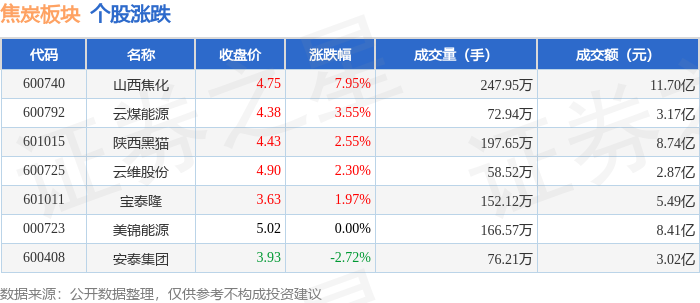
焦炭板块1月29日涨2.27%,山西焦化领涨,主力资金净流出5359.97万元
Zheng Xing Xing Ye Ri Bao· 2026-01-29 09:00
Core Viewpoint - The coking coal sector experienced a 2.27% increase on January 29, with Shanxi Coking Coal leading the gains, while the overall market showed mixed results with the Shanghai Composite Index rising by 0.16% and the Shenzhen Component Index falling by 0.3% [1] Group 1: Coking Coal Sector Performance - Shanxi Coking Coal (600740) closed at 4.75, up 7.95% with a trading volume of 2.4795 million shares and a transaction value of 1.17 billion [1] - Yunmei Energy (600792) closed at 4.38, up 3.55% with a trading volume of 729,400 shares and a transaction value of 317 million [1] - Shaanxi Black Cat (601015) closed at 4.43, up 2.55% with a trading volume of 1.9765 million shares and a transaction value of 874 million [1] - Yunwei Co. (600725) closed at 4.90, up 2.30% with a trading volume of 585,200 shares and a transaction value of 287 million [1] - Yutai Jiao (601011) closed at 3.63, up 1.97% with a trading volume of 1.5212 million shares and a transaction value of 549 million [1] - Meijin Energy (000723) remained unchanged at 5.02, with a trading volume of 1.6657 million shares and a transaction value of 841 million [1] - Antai Group (600408) closed at 3.93, down 2.72% with a trading volume of 762,100 shares and a transaction value of 302 million [1] Group 2: Capital Flow Analysis - The coking coal sector saw a net outflow of 53.5997 million from main funds, while retail funds experienced a net inflow of 17.4584 million [1] - Shanxi Coking Coal had a main fund net inflow of 122 million, but retail funds saw a net outflow of 86.6706 million [2] - Yunwei Co. had a main fund net inflow of 43.8864 million, with retail funds experiencing a net outflow of 33.044 million [2] - Yunmei Energy had a main fund net outflow of 9.3187 million, but retail funds saw a net inflow of 1.2962 million [2] - Shaanxi Black Cat experienced a main fund net outflow of 27.2503 million, while retail funds had a net inflow of 15.9837 million [2] - Antai Group had a significant main fund net outflow of 47.4988 million, but retail funds saw a net inflow of 46.0136 million [2] - Meijin Energy faced a main fund net outflow of 115 million, while retail funds had a net inflow of 75.557 million [2]

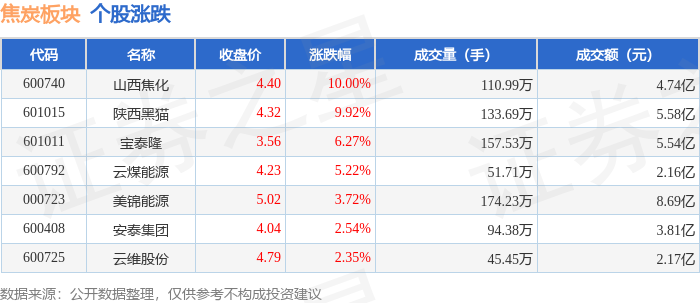
焦炭板块1月28日涨5.79%,山西焦化领涨,主力资金净流入4.12亿元
Zheng Xing Xing Ye Ri Bao· 2026-01-28 09:04
Core Viewpoint - The coking coal sector experienced a significant increase of 5.79% on January 28, with Shanxi Coking Coal leading the gains, reflecting positive market sentiment in this industry [1] Group 1: Market Performance - The Shanghai Composite Index closed at 4151.24, up by 0.27%, while the Shenzhen Component Index closed at 14342.9, up by 0.09% [1] - Key stocks in the coking coal sector showed notable price increases, with Shanxi Coking Coal rising by 10.00% to a closing price of 4.40, and Shaanxi Black Cat increasing by 9.92% to 4.32 [1] Group 2: Trading Volume and Capital Flow - The coking coal sector saw a net inflow of 4.12 billion yuan from main funds, while retail investors experienced a net outflow of 2.96 billion yuan [1] - The trading volume for Shanxi Coking Coal reached 1.1099 million shares, with a total transaction value of 4.74 billion yuan [1] Group 3: Individual Stock Analysis - Shanxi Coking Coal had a main fund net inflow of 950.59 million yuan, accounting for 20.07% of its trading volume, while retail investors had a net outflow of 530.89 million yuan [2] - Shaanxi Black Cat reported a main fund net inflow of 1.25 billion yuan, representing 22.33% of its trading volume, with retail investors showing a net outflow of 8.21 million yuan [2]
2025年中国焦炭产量为5亿吨 累计增长2.9%
Chan Ye Xin Xi Wang· 2026-01-28 03:28
Core Viewpoint - The report highlights the growth trends in China's coke industry, projecting a steady increase in production and emphasizing the importance of strategic investment in this sector [1]. Industry Overview - According to the National Bureau of Statistics, China's coke production in December 2025 is expected to reach 40 million tons, reflecting a year-on-year growth of 1.9% [1]. - The cumulative coke production in China for the year 2025 is projected to be 500 million tons, with a cumulative growth rate of 2.9% [1]. Companies Involved - Listed companies in the coke industry include International Industry (000159), Meijin Energy (000723), Blue Flame Holdings (000968), Shanxi Coking Coal (000983), Changchun Gas (600333), Antai Group (600408), and Yunwei Co., Ltd. (600725) [1]. Research Report - The report titled "Investment Strategy Analysis and Development Prospects of China's Coke Industry from 2026 to 2032" was published by Zhiyan Consulting, a leading industry consulting firm in China [1].


