
黑色金属冶炼及压延加工业

Search documents
有色金属观点更新
2025-10-09 14:47
Summary of Key Points from Conference Call Records Industry Overview - The conference call primarily discusses the non-ferrous metals industry, particularly focusing on iron ore, copper, cobalt, tin, and antimony markets, as well as the implications of geopolitical factors on these sectors [1][2][3][4][5][6][19][21]. Core Insights and Arguments Guinea Simandou Iron Ore Project - The Guinea Simandou iron ore project is expected to export without the need for a supporting smelting plant due to inadequate local power infrastructure [1][4]. - The project is projected to start logistics in 2025, with potential exports reaching 30 million to 60 million tons in 2026, and possibly 120 million tons in the next 2-3 years, significantly impacting global shipping trade [3]. Iron Ore Trade and Market Reactions - A potential pause in cooperation between China and BHP over settlement currency issues could significantly affect iron ore trade, although current overseas market reactions are muted [1][5]. - Domestic investors are more sensitive to these developments, as evidenced by stock movements in related companies [5]. Steel Industry Dynamics - Short-term control of iron ore imports to manage steel production is unlikely, with supply-side reforms being crucial for long-term industry health [1][6]. - High-quality companies like Baosteel and Hualing Steel are identified as having medium to long-term investment value due to low valuations and high dividend yields [6]. Copper Market Supply and Demand - The copper market is expected to face significant supply disruptions, with major producers like Teck Resources and Efenhau Mine lowering production forecasts [1][8]. - Global copper supply is projected to be tight in the first half of 2026, with prices potentially reaching historical highs of $12,000 to $14,000 per ton [1][12]. AI and Data Center Demand for Copper - The demand for copper is significantly driven by AI and data centers, with each cabinet now using approximately 300 kg of copper, leading to an annual increase in demand of about 100,000 tons from AI-related equipment alone [9][12]. Cobalt Market Trends - Cobalt prices have risen to around 350,000 RMB per ton, with expectations to reach 400,000 to 450,000 RMB in Q4 2025 [1][16]. - Companies like Huayou Cobalt are expected to see profit increases due to rising cobalt prices [1][16]. Tin and Antimony Market Outlook - China's antimony exports have shown a significant increase since August 2025, highlighting its strategic value amid U.S. supply chain concerns [2][19]. - Huaxi Nonferrous is projected to increase tin production by 66%, with profits potentially reaching 1.6 billion RMB [2][19]. Strategic Metal Valuation - The valuation of strategic metals like copper and silver is expected to rise due to increased global focus on these resources [13]. - Companies like Zijin Mining are projected to have significant profit potential based on current market conditions [13]. Other Important Insights - The overall performance of the non-ferrous metals market has been strong, with steel markets also showing positive trends influenced by the Guinea Simandou project [3]. - The importance of supply chain security and strategic resource management is emphasized, particularly in light of geopolitical tensions and trade restrictions [21][25]. - The recovery of tin and antimony supply chains is critical, with disruptions in Indonesia and Myanmar affecting global supply [19][20]. This summary encapsulates the key points discussed in the conference call, providing insights into market dynamics, company performance, and future trends in the non-ferrous metals industry.



工业企业利润高增探究
SINOLINK SECURITIES· 2025-09-30 06:58
Group 1: Profit Growth Analysis - In August, industrial enterprises' profits increased significantly by 21% year-on-year to 19.8%, driven by low base effects, improved upstream industry gross margins, and investment income recognition[4] - The low base contributed 6.7 percentage points to the profit growth, ranking as the third-largest factor[4] - August profits totaled 672.6 billion yuan, with an increase of 111.4 billion yuan year-on-year, where upstream manufacturing contributed 49.9% of this growth[7] Group 2: Sector-Specific Insights - The substantial improvement in upstream industrial profits was primarily from the black metal and non-ferrous metal smelting industries, which saw profit increases of 336 billion yuan and 128 billion yuan respectively[8] - The gross margin for black metal smelting rose to 7% in August from 2% in the same month last year, leading to a gross profit increase of 329 billion yuan[8] - Investment income in August rose by 502 billion yuan, a year-on-year increase of 66.6%, contributing 45% to the overall profit growth[9] Group 3: Future Outlook and Risks - As the base effects diminish and investment income support weakens, profit growth may decline in September[12] - The price index for production materials has been declining, with a 0.5% decrease in the average from early September, indicating potential impacts on commodity prices and enterprise profits[12] - Risks include increased volatility in exports and profit declines due to U.S.-China trade tensions and global supply chain adjustments[3]
2025年7月中国角钢及型钢出口数量和出口金额分别为66万吨和3.61亿美元
Chan Ye Xin Xi Wang· 2025-09-19 03:46
Core Insights - The report by Zhiyan Consulting highlights significant growth in China's angle steel and section steel exports, with a notable increase in both quantity and value in July 2025 compared to the previous year [1]. Export Data Summary - In July 2025, China's angle steel and section steel export volume reached 660,000 tons, representing a year-on-year increase of 49.7% [1]. - The export value for the same period was $36.1 million, showing a year-on-year growth of 31.1% [1]. Industry Analysis - Zhiyan Consulting is recognized as a leading industry consulting firm in China, specializing in in-depth industry research and providing comprehensive consulting services, including feasibility studies and business plans [1]. - The firm emphasizes its commitment to delivering high-quality services and market insights to empower investment decisions [1].


永兴材料:9月10日召开董事会会议
Mei Ri Jing Ji Xin Wen· 2025-09-10 12:54
Group 1 - The company Yongxing Materials (SZ 002756) held its first temporary board meeting of the seventh session on September 10, 2025, to discuss the election of the chairman and other related matters [1] - For the first half of 2025, Yongxing Materials reported that its revenue composition was 76.65% from black metal smelting and rolling industry, and 23.35% from lithium mining and lithium salt manufacturing [1] - As of the report date, Yongxing Materials has a market capitalization of 19.3 billion yuan [1]

黄金:突破新高白银:冲顶前高铜:市场情绪回暖,价格上涨
Guo Tai Jun An Qi Huo· 2025-09-03 02:01
Report Industry Investment Ratings No specific industry investment ratings are provided in the report. Core Views - The report provides short - term trend forecasts for various commodities, including precious metals, base metals, energy, chemicals, and agricultural products, based on their fundamentals, market sentiment, and macro - industry news [2][5]. Summary by Commodity Precious Metals - **Gold**: Expected to break through new highs, with a trend strength of 2 [2][7][9]. - **Silver**: Likely to reach the previous high, with a trend strength of 2 [2][7][9]. Base Metals - **Copper**: Market sentiment has improved, leading to price increases, trend strength is 1 [2][11][13]. - **Zinc**: Expected to trade in a range, trend strength is 0 [2][14][15]. - **Lead**: Decreasing inventory supports prices, trend strength is 0 [2][17]. - **Tin**: Expected to trade in a range, trend strength is 1 [2][20][23]. - **Aluminum**: Expected to be slightly bullish in a volatile market, trend strength is 0 [2][24][26]. - **Alumina**: Expected to trade in a range, trend strength is 0 [2][24][26]. - **Cast Aluminum Alloy**: Attention should be paid to policy implementation progress, trend strength is 0 [24][26]. - **Nickel**: Narrow - range fluctuations based on fundamentals, with sentiment influenced by news, trend strength is 0 [2][28][33]. - **Stainless Steel**: Steel prices are expected to fluctuate in a narrow range, trend strength is 0 [2][28][33]. Energy and Chemicals - **Carbonate Lithium**: The basis is slightly repaired, and the weak - side oscillation continues, trend strength is 0 [2][34][36]. - **Industrial Silicon**: Market sentiment is more volatile, and attention should be paid to the registration of warehouse receipts, trend strength is 0 [2][37][39]. - **Polysilicon**: Short - term fluctuations are significantly amplified, trend strength is 0 [2][37][39]. - **Iron Ore**: Macroeconomic expectations are volatile, leading to wide - range fluctuations, trend strength is 1 [2][40]. - **Rebar**: Excessive inventory accumulation leads to price oscillations and corrections, trend strength is 0 [2][42][44]. - **Hot - Rolled Coil**: Excessive inventory accumulation leads to price oscillations and corrections, trend strength is 0 [2][42][44]. - **Silicon Ferroalloy**: Expected to trade in a wide range, trend strength is 0 [2][46][48]. - **Manganese Ferroalloy**: Expected to trade in a wide range, trend strength is 0 [2][46][48]. - **Coke**: Expected to trade in a wide range, trend strength is 1 [2][49]. - **Coking Coal**: Expected to trade in a wide range, trend strength is 1 [2][49]. - **Log**: Prices are expected to fluctuate repeatedly, trend strength is 0 [2][51][54]. - **Para - Xylene**: Supply - demand is in a tight balance, and a long - position spread strategy is recommended [2][55]. - **PTA**: A long - position spread strategy for monthly differences, and partial profit - taking for the long - PTA and short - MEG strategy [2][55]. - **MEG**: Partial profit - taking for the long - PTA and short - MEG strategy [2][55]. Others - **LPG**: Macroeconomic risks are increasing, and crude oil costs are rising [5]. - **Propylene**: Spot prices are still supported, but attention should be paid to the risk of price decline [5]. - **PVC**: The downward trend persists, with pressure on prices [5]. - **Fuel Oil**: Prices declined at night, and it may continue to be weaker than low - sulfur fuel oil in the short term [5]. - **Low - Sulfur Fuel Oil**: Volatility has increased, and the price spread between high - and low - sulfur fuels in the overseas spot market has risen significantly [5]. - **Container Shipping Index (European Line)**: Expected to trade in a wide range [5]. - **Short - Fiber**: Expected to consolidate in a range, and a long - PF and short - PR strategy is recommended [5]. - **Bottle Chip**: Expected to consolidate in a range [5]. - **Offset Printing Paper**: Trading at a low level with limited upward momentum [5]. - **Pure Benzene**: Expected to trade with a weak - side oscillation [5]. - **Palm Oil**: Influenced by macro factors, prices are expected to rebound in a volatile market [5]. - **Soybean Oil**: Prices are expected to fluctuate at a high level, and the spread between soybean oil and palm oil is expected to narrow [5]. - **Soybean Meal**: The significant decline in the good - quality rate of US soybeans has a positive impact on prices [5]. - **Soybean No. 1**: Prices are expected to rebound and fluctuate, and attention should be paid to the market sentiment of the soybean market [5]. - **Corn**: Prices are expected to trade in a range [5]. - **Sugar**: Conab has lowered the production forecast for Brazil [5]. - **Cotton**: Attention should be paid to the listing of new crops [5]. - **Egg**: There is strong near - end game - playing [5]. - **Live Pig**: Market expectations have weakened [5]. - **Peanut**: Attention should be paid to the listing of new peanuts [5].
重庆钢铁股份(01053) - 海外监管公告(2025年半年度报告)
2025-08-27 10:11
香 港 交 易 及 結 算 所 有 限 公 司 及 香 港 聯 合 交 易 所 有 限 公 司 對 本 公 告 的 內 容 概 不 負 責 , 對 其 準 確 性 或 完 整 性 亦 不 發 表 任 何 聲 明 , 並 明 確 表 示,概不 對 因 本 公 告 全 部 或 任 何 部 分 內 容 而 產 生 或 因 倚 賴 該 等 內 容 而 引 致 的 任 何 損 失 承 擔 任 何 責 任。 海外監管公告 本公告乃根據《香港聯合交易所有限公司證券上市規則》第 13.10B 條作出。 茲載列重慶鋼鐵股份有限公司(「本公司」)於 2 0 2 5 年 8 月 2 8 日在上海 證券報及上海證券交易所網頁(www.ss e . c om. c n)(股票代碼:60 1 0 0 5) 及上海證券報刊載之《2 0 2 5 年半年度報告》。 承 董 事 會 命 重 慶 鋼 鐵 股 份 有 限 公 司 匡 雲 龍 董 事 會 秘 書 中國重慶,2025 年 8 月 27 日 於 本 公 告 日 期 , 本 公 司 的 董 事 為 : 王 虎 祥 先 生 ( 執 行 董 事 ) 、 孟 文 旺 先 生 ( 執 行 董 事 ...
重庆钢铁: 2025年半年度报告
Zheng Quan Zhi Xing· 2025-08-27 09:59
Core Viewpoint - The report indicates a significant decline in revenue and net profit for Chongqing Iron and Steel Co., Ltd. in the first half of 2025, attributed to a focus on cost reduction and efficiency improvement amidst challenging market conditions [2][3]. Company Overview and Financial Indicators - The company reported a total revenue of approximately 13.09 billion RMB, a decrease of 13.26% compared to the same period last year [2][3]. - The total profit for the period was a loss of approximately 129.92 million RMB, an improvement from a loss of 812.92 million RMB in the previous year [2][3]. - The net profit attributable to shareholders was approximately -131.02 million RMB, compared to -689.21 million RMB in the previous year [2][3]. - The company's total assets increased slightly to approximately 35.51 billion RMB, up 0.10% from the previous year [2][3]. Industry and Main Business Situation - The steel industry experienced a decline in crude steel production by 3% year-on-year, while steel product output increased [3][4]. - The average price of imported iron ore decreased by 17.7% year-on-year, impacting the overall cost structure of steel production [3][4]. - The average steel price index in China fell by 13.35% year-on-year, reflecting a challenging pricing environment for steel products [3][4]. Operational Performance Analysis - The company focused on cost reduction and efficiency improvements, achieving a reduction in iron water costs by 490 RMB per ton compared to 2024 [4][5]. - The company reported a 7% increase in cash flow from operating activities, totaling approximately 880.44 million RMB [2][3]. - The company implemented quality management initiatives, resulting in a 40% reduction in quality losses compared to 2024 [4][5]. Future Outlook - The company plans to enhance efficiency across various operational aspects, including resource allocation and inventory management, to mitigate risks associated with the long-term downturn in the steel industry [4][5].

物价数据|为何反内卷政策下PPI改善低于市场预期?(2025年7月)
Sou Hu Cai Jing· 2025-08-10 09:29
Core Insights - The July PPI improved on a month-on-month basis but remained unchanged year-on-year at -3.6%, slightly below market expectations, indicating a disconnect in price transmission from upstream raw materials to downstream industries [1][2] - The "anti-involution" policy has led to significant price increases in key commodities such as coal, steel, and lithium, but these increases have not effectively translated into higher industrial product prices [2][3] - The ongoing "pig cycle misalignment" has resulted in CPI slightly exceeding market expectations, driven by unexpected price increases in core goods, energy, and other services [5][6] PPI Analysis - The month-on-month PPI improved due to rising commodity prices, but the year-on-year figure did not show improvement, highlighting weak downstream demand and limited pricing power for enterprises [1][3] - The analysis framework indicates that while upstream raw material prices have improved, the PPI for downstream industries has continued to decline, particularly in the export chain [4] - The dual impact of supply-side policies and demand-side pressures is evident, with the export chain facing significant downward pressure [4] CPI Insights - The CPI for July was reported at 0.0% year-on-year, slightly above the expected -0.1%, driven by durable goods benefiting from trade-in subsidies and rising energy prices [5][6] - The increase in CPI was significantly influenced by the price hikes in gold and platinum jewelry, contributing approximately 0.22 percentage points to the overall CPI [5] - Expectations for CPI improvement are projected for September, considering the ongoing misalignment in the pig cycle and slow recovery in consumer spending [6] Market Implications - The bond market may experience low volatility as CPI and PPI figures align closely with market expectations, with a focus on inflation recovery and potential demand-side policies [7] - The overall economic environment remains sensitive to both domestic policy effectiveness and international trade dynamics, which could influence future market performance [7]
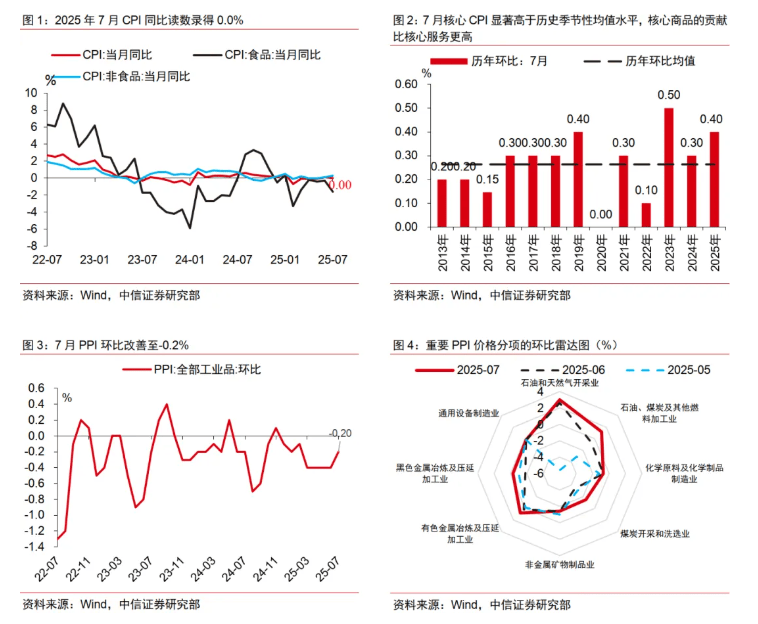
“反内卷”后的首个PMI
CAITONG SECURITIES· 2025-08-01 05:46
Price Index Insights - In July, the main raw material purchase price index and the factory price index were 51.5% and 48.3%, respectively, increasing by 3.1 and 2.1 percentage points from the previous month[8] - The main raw material purchase price index returned above the threshold for the first time in five months, indicating a strong response from enterprises to price expectations under the "anti-involution" policy[8] - The black metal smelting and rolling industry had the highest factory price index at 88.9%, with a month-on-month increase of 80.1 percentage points and a year-on-year increase of 74.5 percentage points[14] PMI Performance by Sector - The comprehensive PMI for "anti-involution" industries recorded 48% in July, up from 47.8% in the previous month, but still below the critical point[21] - Non-"anti-involution" industries maintained a PMI of 50.1%, down from 50.9%, indicating continued expansion[21] - Different enterprise sizes showed varied performance, with large, medium, and small enterprises' PMI at 50.3%, 49.5%, and 46.4%, respectively, reflecting a decline for large and small enterprises while medium enterprises improved[25] Policy and Seasonal Effects - The July Politburo meeting calibrated market expectations for the "anti-involution" policy, suggesting that the manufacturing PMI may remain below the threshold in August[26] - Extreme weather conditions, including record rainfall in Hebei and Inner Mongolia, are expected to further impact production in July and August, leading to a weaker PMI outlook[39] - The "anti-involution" policy's first month showed a divergence in PMI across sectors and enterprise types, influenced by both policy and seasonal effects[25] Risk Factors - Potential risks include domestic policy effectiveness falling short of expectations and unexpected changes in international geopolitical situations[45] - Measurement errors in PMI indicators related to "anti-involution" industries may arise due to incomplete industry self-regulation[45]
黑色产业数据每日监测-20250731
Jin Shi Qi Huo· 2025-07-31 10:25
Group 1: Report Industry Investment Rating - Not provided Group 2: Core Viewpoints of the Report - The futures prices of coking coal and coke declined due to market sentiment fluctuations, but the spot market maintained low inventories and strong rigid demand, with price support still in place. The supply - demand of coking coal and coke remained slightly tight, and the fifth round of price increase for coke started. There was a policy bottom, and buying opportunities after price corrections could be considered [1] Group 3: Summary by Related Catalogs Market Overview - On July 31, all black - series commodity futures turned down. The closing price of rebar was 3205 yuan/ton, down 4.19%; the hot - rolled coil futures closed at 3390 yuan/ton, down 3.56%; the iron ore futures closed at 779 yuan/ton; coking coal and coke declined, with coking coal hitting the daily limit down [1] Market Analysis - The decline in the futures market cooled the previous positive sentiment. Some traders sold to realize profits, and the increase in auctions narrowed. Extreme rain in coal - producing areas led to a temporary reduction in coal supply. Coking coal demand remained strong due to high downstream coke - enterprise operating rates and high pig - iron production. Coal mine pre - sales would last until mid - August. The inventory of washed coal plants and coking coal mines reached low levels. After the fourth round of price increases for coke, the profits of coke enterprises continued to shrink, some reduced production, and supply tightened. Steel mills and traders had good procurement enthusiasm, and coke inventories at coking plants were low. The coking industry decided to raise coke prices starting from July 31 [1] Investment Suggestions - For iron ore, pay attention to supply - demand changes and inventory levels and avoid chasing high prices. For rebar, take a short - term oscillatory approach and focus on the spread between hot - rolled coil and rebar. For hot - rolled coil, take a short - term high - level consolidation approach and focus on supply - demand changes. For coking coal and coke, pay attention to the oscillatory market after the decline stabilizes or the strength - weakness relationship between the two [1]