橡胶

Search documents
天然橡胶周报:市场情绪扰动,橡胶宽幅波动-20260119
Guo Mao Qi Huo· 2026-01-19 05:57
投资咨询业务资格:证监许可【2012】31号 【天然橡胶周报(RU&NR)】 市场情绪扰动,橡胶宽幅波动 国贸期货 能源化工研究中心 2026-01-19 叶海文 从业资格证号:F3071622 投资咨询证号:Z0014205 本报告非期货交易咨询业务项下服务,其中的观点和信息仅供参考,不构成任何投资建议;期市有风险,投资需谨慎 01 PART ONE 主要观点及策略概述 天然橡胶:市场情绪扰动,橡胶宽幅波动 | 影响因素 | 驱动 | 主要逻辑 | | --- | --- | --- | | 供给 | 偏多 | (1)国内产区:目前国内产区停割,暂无原料分析。(2)泰国产区:。泰国整体降雨扰动减少,进入季节性割胶高产期。近期部分泰国工厂有烟片补库 需 求,胶水出现分流,采购价格持续上涨。欧盟需求改善,工厂订单好转,带动杯胶价格上涨。(3)越南产区:本周越南产区天气气温呈现小幅回升态势, | | | | 但原料干含延续季节性下滑,叠加月底中北部地区停割 临近,整体原料产出呈季节性减产,部分工厂为停割提前备货,推动原料价格整体走高。 | | 需求 | 偏多 | (1)截至上周中国全钢 轮胎样本企业产能利用率为6 ...
利多因素消化橡胶冲高回落:橡胶周报-20260119
Bao Cheng Qi Huo· 2026-01-19 02:49
1. Report's Investment Rating for the Industry - No information provided regarding the industry investment rating in the report. 2. Core Viewpoints - Rubber futures in China initially rose due to better - than - expected domestic auto production and sales data but later retreated as positive data was digested and the energy - chemical sector corrected. The RU2605 contract of Shanghai rubber futures reached a maximum of 16,480 yuan/ton and ended the week with a cumulative decline of 1.22% to 15,835 yuan/ton; the TS2603 contract of standard rubber futures reached 13,305 yuan/ton and dropped 1.58% to 12,745 yuan/ton; the NR2603 contract of synthetic rubber futures reached 12,470 yuan/ton and fell 2.07% to 11,815 yuan/ton. With the previous positive factors realized, the rubber market is at a stage of divergence between bulls and bears, and it is expected that rubber futures will maintain a high - level consolidation trend in the future [5][14][59]. 3. Summary by Relevant Catalogs 3.1 Market Review - **1.1 Spot price slightly declined, and basis discount converged** - In the week of January 16, 2026, the spot price of Shanghai Yunnan state - owned whole latex (SCRWF) oscillated around 15,650 yuan/ton, with a week - on - week decrease of 50 yuan/ton. The basis between the spot price of SCRWF and the futures price of the RU2605 contract was at a discount of 185 yuan/ton, and the degree of discount slightly converged [9]. - **1.2 Positive factors digested, and rubber prices rose first and then fell** - Benefiting from better - than - expected domestic auto production and sales data, domestic rubber futures rose initially. However, as the positive data was digested and the energy - chemical sector corrected, rubber prices gave back their gains. The RU2605 contract of Shanghai rubber futures reached a maximum of 16,480 yuan/ton and ended the week with a cumulative decline of 1.22% to 15,835 yuan/ton; the TS2603 contract of standard rubber futures reached 13,305 yuan/ton and dropped 1.58% to 12,745 yuan/ton; the NR2603 contract of synthetic rubber futures reached 12,470 yuan/ton and fell 2.07% to 11,815 yuan/ton [13][14]. 3.2 Global Rubber Market Supply - Demand Improvement in Q3 2025 - **2.1 Output of Southeast Asian rubber - producing countries increased slightly year - on - year, and consumption decreased slightly year - on - year** - From May to November, rubber - producing areas in Yunnan and Hainan in China and Southeast Asian countries are in the peak tapping season. In November 2025, the total rubber production of ANRPC member countries was 1.1677 million tons, a month - on - month decrease of 0.0057 million tons and a year - on - year decrease of 0.0674 million tons (a decline of 5.46%). From January to November 2025, the total production was 10.3887 million tons, a slight increase of 0.0482 million tons (an increase of 0.47%) compared with the same period last year. In November 2025, the total rubber consumption of ANRPC member countries was 0.9116 million tons, a month - on - month increase of 0.0112 million tons and a year - on - year increase of 0.011 million tons (an increase of 1.22%). From January to November 2025, the total consumption was 9.9974 million tons, a slight decrease of 0.2243 million tons (a decline of 2.19%) compared with the same period last year. Due to normal tapping in Southeast Asian countries and weakening global demand, the rubber market supply - demand structure is weakening, and rubber prices may face pressure in the future [26][30]. - **2.2 China's rubber imports increased significantly in November 2025** - China's natural rubber import dependence is about 80%. In November 2025, China imported 790,000 tons of natural and synthetic rubber (including latex), a year - on - year increase of 11%. From January to November 2025, the total import was 7.572 million tons, a year - on - year increase of 16.5% [33]. - **2.3 Growth rate of domestic tire production slowed down, and industry operating rate declined slightly** - In November 2025, the output of Chinese rubber tire casings was 101.828 million pieces, a year - on - year decrease of 2.6%. From January to November 2025, the cumulative output was 1.103115 billion pieces, a slight year - on - year increase of 0.6%, and the growth rate slowed down significantly compared with the first half of the year. As of January 16, 2026, the capacity utilization rate of Chinese semi - steel tire sample enterprises was 72.53%, a week - on - week increase of 8.75 percentage points and a year - on - year decrease of 5.03 percentage points; the capacity utilization rate of full - steel tire sample enterprises was 63.02%, a week - on - week increase of 7.52 percentage points and a year - on - year increase of 5.21 percentage points [36]. - **2.4 China's auto production and sales increased significantly year - on - year in 2025** - In 2025, China's auto production and sales reached 34.531 million and 34.4 million vehicles respectively, a year - on - year increase of 10.4% and 9.4%. Passenger vehicle production and sales were 30.27 million and 30.103 million vehicles, a year - on - year increase of 10.2% and 9.2%. Commercial vehicle production and sales were 4.261 million and 4.296 million vehicles, a year - on - year increase of 12% and 10.9%. Auto exports exceeded 7 million vehicles, reaching 7.098 million vehicles, a year - on - year increase of 21.1%. In December 2025, the inventory warning index of Chinese auto dealers was 57.7%, a year - on - year increase of 7.5 percentage points and a month - on - month increase of 2.1 percentage points. The logistics prosperity index in December 2025 was 52.4%, a month - on - month increase of 1.5 percentage points. In December 2025, China's heavy - truck market sold about 95,000 vehicles, a month - on - month decrease of about 16% and a year - on - year increase of about 13%. In 2025, the total sales volume of the heavy - truck market reached a new high in the past four years, with 1.137 million vehicles, a year - on - year increase of about 26% [40][41]. - **2.5 Shanghai Futures Exchange (SHFE) warehouse receipts increased significantly, and Qingdao Bonded Area inventory increased slightly** - As of the week of January 16, 2026, the SHFE rubber futures inventory increased significantly week - on - week, with registered warehouse receipts increasing by 3,900 tons to 108,390 tons compared with the week of January 9. As of January 4, 2026, the total inventory of natural rubber in Qingdao's bonded and general trade was 548,300 tons, a week - on - week increase of 23,500 tons (a growth rate of 4.48%). The general trade inventory increased by 16,900 tons to 460,300 tons (a growth rate of 3.80%), and the bonded area inventory increased by 8.16% [57]. 3.3 Conclusion - Currently, the natural rubber production areas in Yunnan and Hainan in China are in the non - tapping season, and the supply pressure of domestic whole latex has significantly decreased. However, Southeast Asia has not entered the low - production season, and supply pressure still exists. The domestic auto production and sales data in the downstream of the rubber market are optimistic, and the heavy - truck sales data in December are better than expected. However, the crude oil price has given back its geopolitical premium, and the correction of the energy - chemical sector has dragged down the high - level adjustment of rubber futures. As the previous positive factors are gradually realized, the rubber market is at a stage of divergence between bulls and bears, and it is expected that rubber futures will maintain a high - level consolidation trend in the future [59].
橡胶板块2026年1月第3周报-20260119
Yin He Qi Huo· 2026-01-19 02:30
1. Report Industry Investment Rating No information provided in the content. 2. Core Viewpoints of the Report - The BR - RU spread is the best tool to reflect the supply difference in the rubber sector, offsetting most macro and consumption disturbances and highlighting the supply differences between synthetic and natural rubber [58]. - The ENSO index suggests that in the first half of 2026, natural rubber supply is likely to increase, putting downward pressure on RU. The fixed - asset investment in the chemical raw materials and chemical products manufacturing industry indicates limited production pressure, and BR is expected to stabilize [58]. - As of the end of 2025, the absolute spread of BR - RU has reached a stage low. Before the third quarter of 2026, a strategy of going long on synthetic rubber and short on natural rubber is recommended [58]. 3. Summary by Relevant Catalogs 3.1 Rubber Comprehensive Analysis - **Spot Prices**: The price center of RMB - denominated rubber has generally risen. The price of Shanghai full - latex increased by 115 yuan to 15,750 yuan/ton, a 0.74% increase. The price of Shandong STR20 mixed rubber rose by 166.5 yuan to 15,069 yuan/ton, a 1.12% increase. The price of North China BR9000 first rose rapidly and then fell, closing at 11,500 yuan/ton on Thursday, down 100 yuan from last Thursday, but the weekly average price of 11,510 yuan was still 230 yuan higher, and the year - on - year decline narrowed to around 17% [2]. - **Supply**: For natural rubber, domestic production areas have fully stopped tapping. Overseas, the tapping season in northern Thailand and Vietnam is coming to an end, and only southern Thailand is in the peak production stage, showing a pattern of "decreasing supply at home and increasing supply abroad". For cis - polybutadiene rubber, the average operating rate of domestic high - cis cis - polybutadiene plants was 75.9%, the same as last week. The overall output was stable [2]. - **Demand**: After the festival, the operating rate of tire factories increased, and rigid demand procurement rose. However, the rising price center suppressed buying sentiment, and there was only limited replenishment on dips during the week, with limited real - deal follow - up [3]. - **Inventory**: The total inventory of natural rubber in Qingdao increased by 1.96 million tons to 563,900 tons, a 3.6% increase. The inventory of cis - polybutadiene rubber in production enterprises decreased by 3.24% month - on - month, but the social inventory increased slightly. The overall inventory level was still lower than the same period last year [3]. 3.2 Strategy Recommendations - **Single - sided Trading**: Hold short positions in the RU main 05 contract, with the stop - loss price lowered to the recent high of 16,115 points. Try short positions in the NR main 03 contract at an appropriate time, with a stop - loss set at the recent high of 12,970 points. Try a small number of short positions in the BR main 03 contract, with a stop - loss set at the previous low of 11,945 points [4]. - **Arbitrage**: The spread of BR2603 - NR2603 (2 lots vs. 1 lot) closed at - 850 points. Adopt a wait - and - see approach and pay attention to the support at the recent low of - 945 points [4]. - **Options**: Adopt a wait - and - see approach [4]. 3.3 Synthetic Rubber Supply - **Apparent Consumption**: In November 2025, the apparent consumption of butadiene increased to 556,300 tons, a year - on - year increase of 17.4%. The apparent consumption of cis - polybutadiene rubber decreased to 131,100 tons, a year - on - year increase of 0.9%. The net import volume of butadiene and cis - polybutadiene rubber decreased year - on - year, which was slightly positive for the BR - RU spread [14][16]. - **Inventory**: The domestic inventory of cis - polybutadiene rubber increased to 34,900 tons, a 5.50% month - on - month increase. Due to strong downstream resistance to high - price raw materials, the inventory of sample production enterprises and sample trading enterprises increased to varying degrees [18]. - **Supply Scale and Cost Support**: In December 2025, the apparent consumption of BR&BR (calculated) increased to 3.28 million tons. In January, the explicit inventory of BD&BR increased for five consecutive months to 47,000 tons. The combined figure of the above two items was 375,000 tons, a year - on - year increase of 8.0%, which was positive for the BR - RU spread. In January, the price of Brent crude oil fell for four consecutive months to $60.8 per barrel, a year - on - year decrease of 25.4%, which was negative for the BR - RU spread [27]. - **Capacity Utilization and Profit**: The profit of the C4 extraction process was 2,376 yuan/ton, an increase of 234 yuan/ton from the previous period. The profit of the oxidative dehydrogenation process was 681 yuan/ton, an increase of 595 yuan/ton from the previous period. The theoretical production cost of cis - polybutadiene rubber increased significantly, and the production profit decreased [37]. - **Processing Margin**: In January, the margin of domestic butadiene oxidative dehydrogenation plants improved for two consecutive months to - 50 yuan/ton, and the margin of domestic butadiene C4 extraction method increased for two consecutive months to 1,877 yuan/ton. The domestic production margin of cis - polybutadiene rubber decreased for two consecutive months to 211 yuan/ton. The BD margin - BR margin was reported at + 0.17 million yuan/ton, a year - on - year decline of - 0.37 million yuan/ton, which was negative for the BR - RU spread [41][45]. - **Margin Variance and Import Margin**: In January, the FOB price of butadiene in South Korea and the CFR price in China both increased for two consecutive months. The margin of BD to South Korea was reported at - 35.0 US dollars/ton, a year - on - year increase of + 7.5 US dollars/ton, which was positive for the BR - RU spread. The variance of the three margins was reported at 7.3×10^5, a year - on - year decline of - 188.2%, which was negative for the BR - RU spread [52]. 3.4 Rubber Supply: Synthetic Rubber Production vs. Natural Rubber Climate - Although the valuation of the chemical industry has been under pressure due to oversupply during the "14th Five - Year Plan" period, the BR - RU spread can reflect the supply difference in the rubber sector. The ENSO index is favorable for the increase of natural rubber supply in the first half of 2026, and the fixed - asset investment in the chemical industry indicates limited production pressure on synthetic rubber. Before the third quarter of 2026, a strategy of going long on synthetic rubber and short on natural rubber is recommended [58]. 3.5 Natural Rubber Supply: ANRPC Member Countries' Production and Export - In October, the total production of natural rubber in the ANRPC increased to 1.144 million tons, a year - on - year increase of 1.6% with a narrowing growth rate. The total export volume increased to 826,000 tons, a year - on - year decrease of 5.9% with a narrowing growth rate for four consecutive months [64]. 3.6 Micro - consumption - The average year - on - year production increase of automobiles in China and South Korea was 7.7%, which was positive for the single - sided trading of BR. In November, the export value of domestic tires increased to 1.82 billion US dollars, a year - on - year decrease of 0.5%, which was negative for the single - sided trading of BR [65][70]. 3.7 Micro - consumption: Tires - The semi - steel tire market was weak, with sufficient supply and mainly rigid - demand replenishment in the channel. The all - steel tire market continued to be weak, with low purchasing willingness among merchants. As of January 15, the average inventory turnover days of semi - steel tire sample enterprises was 47.92 days, a month - on - month increase of 0.56 days and a year - on - year increase of 5.49 days. The average inventory turnover days of all - steel tire sample enterprises was 46.1 days, a month - on - month increase of 1.48 days and a year - on - year decrease of 1.56 days [77]. 3.8 Macro - consumption - In a series of data affecting the downstream consumption of the rubber sector, the data farther away from rubber had larger increases, while the data closer to rubber had not yet stabilized. For example, the CSI 1000 index declined for two consecutive months but still had a year - on - year increase, the global auto industry index rebounded for two consecutive months with a narrowing growth rate, the domestic rubber and plastic industry electricity consumption declined with a narrowing growth rate, and the cumulative production of domestic and foreign tires increased year - on - year with a marginal increase for two consecutive months [86].
宝城期货橡胶早报-20260119
Bao Cheng Qi Huo· 2026-01-19 02:05
1. Report Industry Investment Rating - No relevant information provided. 2. Core View of the Report - The report predicts that both domestic Shanghai rubber futures and synthetic rubber futures may maintain a volatile and weak trend on Monday. The Shanghai rubber futures (RU2605) are expected to be weak in the short - term, medium - term, and intraday, while the synthetic rubber futures (BR2603) also have a similar outlook [1][5][7]. 3. Summary by Related Catalogs 3.1 Shanghai Rubber (RU) - **Price Trend**: Short - term: volatile; Medium - term: volatile; Intraday: weak; Overall reference: weak operation [1][5] - **Core Logic**: With Thailand and Cambodia's armistice, the expected decline in Southeast Asian rubber supply due to geopolitical risks has disappeared, weakening the bullish drive. China's Yunnan and Hainan natural rubber producing areas are in the off - season, reducing the supply pressure of domestic full - latex, but Southeast Asia is in the peak tapping season. The downstream domestic automobile production and sales data are optimistic, and the heavy - truck sales data in December are better than expected. As the upward trend of the energy and chemical sector weakens, the Shanghai rubber futures maintained a volatile and weak trend on the night of last Friday [5]. 3.2 Synthetic Rubber (BR) - **Price Trend**: Short - term: volatile; Medium - term: volatile; Intraday: weak; Overall reference: weak operation [1][7] - **Core Logic**: Affected by the tight circulation of northern goods and downstream replenishment demand, the spot price of butadiene has risen significantly. The rapid increase in raw material costs has squeezed the profits of synthetic rubber manufacturers, resulting in some production facilities reducing production or shutting down, and the supply is expected to decline. The downstream domestic automobile production and sales data are optimistic, and the heavy - truck sales data in December are better than expected. Coupled with the volatile and strong pattern of crude oil futures, the cost support has increased. As the upward trend of the energy and chemical sector weakens, the synthetic rubber futures showed a high - level correction on the night of last Friday [7].
能源化工日报-20260119
Wu Kuang Qi Huo· 2026-01-19 00:57
1. Report Industry Investment Rating No information provided in the content. 2. Core Views of the Report - For urea, the current situation of internal - external price differences has opened the import window, and with the expected improvement in production at the end of January, negative fundamental expectations are approaching, so it is recommended to take profits at high prices [3]. - For methanol, the current valuation is low, and the outlook for the coming year is marginally improving with limited downside. Despite short - term negative pressures, geopolitical instability in Iran has brought certain geopolitical expectations, making it feasible to buy on dips [6]. - For crude oil, although the geopolitical premium has disappeared and OPEC's production increase is minimal with supply not yet surging, oil prices should not be overly shorted in the short term. A range - trading strategy of buying low and selling high is maintained, but it is recommended to wait and see in the short term to verify OPEC's export price - support willingness [9]. - For rubber, the seasonal pattern is weak. A short - term bearish view is adopted. If RU2605 falls below 16000, a short - term short - selling strategy can be considered, and partial position - building is suggested for the strategy of buying NR main contract and short - selling RU2609 [14]. - For PVC, fundamentally, corporate comprehensive profits are at a moderately low level. Supply reduction is limited with production at a historical high, and domestic demand is entering the off - season. Although there may be short - term export rush before April 1st due to the cancellation of export tax rebates, the overall situation of strong supply and weak demand persists, and a short - term long position is supported by electricity price expectations and export rush, while a short - selling strategy on rallies is recommended in the medium term [16]. - For pure benzene and styrene, currently, styrene non - integrated profits are moderately low with large upward valuation repair space. The supply of pure benzene is still abundant, and styrene production is increasing with continuous inventory reduction at ports. It is advisable to go long on styrene non - integrated profits before the first quarter [19]. - For polyethylene, OPEC+ plans to suspend production growth in Q1 2026, and crude oil prices may have bottomed. PE valuation has further downward space. With no new production capacity planned in H1 2026, inventory may decline from a high level, and it is advisable to go long on the LL5 - 9 spread on dips [22]. - For polypropylene, the EIA monthly report predicts a slight reduction in global oil inventories, and the supply surplus may ease. With no new production capacity planned in H1 2026, the supply pressure is relieved. In the context of weak supply and demand with high inventory pressure, the futures price may bottom out after the supply surplus pattern changes in Q1 next year [25]. - For PX, the current load is high, and downstream PTA has many maintenance plans. It is expected to maintain an inventory accumulation pattern before the maintenance season. After the Spring Festival, both supply and demand with downstream PTA will be strong, and there are medium - term opportunities to go long following crude oil on dips [28]. - For PTA, the supply side will maintain high maintenance in the short term, and the demand side is under profit pressure and will gradually reduce load due to the off - season. It is expected to enter the inventory accumulation stage during the Spring Festival. There is room for valuation increase after the Spring Festival, and medium - term opportunities to go long on dips should be grasped [31]. - For ethylene glycol, the overall load is still high, and the port inventory accumulation cycle will continue. There is an expectation of further profit compression and load reduction under the pressure of new plant commissioning. The valuation is currently neutral year - on - year, and there is a risk of a rebound in the short term due to the tense situation in Iran. In the medium term, the valuation is expected to be compressed without further domestic production cuts [33]. 3. Summary by Related Catalogs Urea - **Market Information**: Regional spot price changes in Shandong, Henan, etc., with a total basis of - 41 yuan/ton. The main futures contract decreased by 10 yuan/ton to 1791 yuan/ton [2]. Methanol - **Market Information**: Regional spot price changes in Jiangsu, etc., the main futures contract increased by 45 yuan/ton to 2239 yuan/ton, and MTO profit increased by 53 yuan [5]. Crude Oil - **Market Information**: INE main crude oil futures fell 13.60 yuan/barrel, a 3.01% decline, to 438.80 yuan/barrel; high - sulfur and low - sulfur fuel oil futures also declined. Singapore ESG oil product weekly data showed inventory accumulation for gasoline, diesel, fuel oil, and total refined oil products [8]. Rubber - **Market Information**: Rubber prices fluctuated weakly with a technical bearish signal. Bulls cited seasonal and demand expectations, while bears pointed to weak demand and uncertain macro expectations. As of January 15, 2026, Shandong tire enterprise full - steel tire and semi - steel tire operating rates changed, and as of January 11, 2026, China's natural rubber social inventory increased. Spot prices of some rubber products decreased [11][12][13]. PVC - **Market Information**: The PVC05 contract fell 10 yuan to 4868 yuan, with a basis change. Cost - end prices were stable, the overall operating rate was 79.6% with changes in different methods. The downstream operating rate was 43.9% and decreased slightly. Factory and social inventories changed [15]. Pure Benzene & Styrene - **Market Information**: The spot and futures prices of pure benzene decreased, and the basis narrowed. The spot price of styrene was unchanged, and the futures price increased with a weakened basis. Upstream operating rate, port inventory, and downstream operating rates of related products changed [18]. Polyethylene - **Market Information**: The main contract closing price of polyethylene decreased by 90 yuan/ton to 6695 yuan/ton, and the spot price decreased. The basis strengthened. The upstream operating rate increased, and production enterprise and trader inventories decreased. The downstream average operating rate decreased slightly [21]. Polypropylene - **Market Information**: The main contract closing price of polypropylene decreased by 96 yuan/ton to 6496 yuan/ton, and the spot price decreased. The basis strengthened. The upstream operating rate decreased slightly, and production enterprise, trader, and port inventories decreased. The downstream average operating rate decreased slightly [23][24]. PX - **Market Information**: The PX03 contract fell 132 yuan to 7130 yuan, and the PX CFR decreased. The basis and 3 - 5 spread changed. PX and PTA loads decreased, some domestic and overseas plants had load - adjustment operations. January imports from South Korea increased, and November - end inventory increased [27]. PTA - **Market Information**: The PTA05 contract fell 68 yuan to 5048 yuan, and the East China spot price decreased. The basis and 5 - 9 spread changed. PTA and downstream loads decreased, some plants had load - adjustment operations, and social inventory decreased [30]. Ethylene Glycol - **Market Information**: The EG05 contract fell 50 yuan to 3817 yuan, and the East China spot price decreased. The basis and 5 - 9 spread changed. The supply - side load increased slightly with different changes in different production methods. Some domestic and overseas plants had load - adjustment operations. Downstream loads decreased, import arrivals were expected, and port inventory increased. Valuation and cost - related profits and prices changed [32].
2025年12月:终端需求改善 石油和化工行业景气指数上涨
Zhong Guo Hua Gong Bao· 2026-01-19 00:46
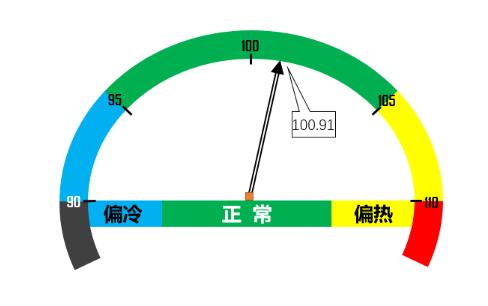
Core Insights - The oil and chemical industry prosperity index rose to 100.91 in December 2025, indicating signs of recovery with a month-on-month increase of 3.7 percentage points [2][10] - The sub-indices show significant divergence: the oil and gas extraction sector continues to decline due to low oil prices, while the fuel processing industry benefits from cost advantages, leading to a rebound [2][10] - The chemical raw materials and products manufacturing sector experienced a decline due to reduced downstream purchasing demand, while the rubber, plastic, and other polymer products manufacturing sector saw a recovery through active inventory reduction [2][10] Industry Overview - The oil and gas extraction sector's prosperity index fell to 93.20, a decrease of 3.52 percentage points, entering a cold zone for the first time in four months, reflecting a significant pressure on the industry due to low oil prices [10][15] - The fuel processing industry index surged to 114.45, up 19.77 percentage points, showcasing high volatility driven by alternating cost and demand factors [13][15] - The chemical raw materials and products manufacturing index dropped to 95.62, down 6.75 percentage points, as downstream industries reduced inventory following a peak in demand [13][15] - The rubber, plastic, and other polymer products manufacturing index increased to 100.97, up 7.02 percentage points, due to proactive inventory reduction strategies [14][15] Manufacturing PMI and Economic Signals - China's manufacturing PMI returned to the expansion zone at 50.1% in December 2025, signaling a recovery in manufacturing activity and improved market demand [3][17] - The production index and new orders index both increased, indicating a potential support for the recovery of the petrochemical industry in the coming months [3][17] Federal Reserve Interest Rate Decision - The Federal Reserve announced a 25 basis point rate cut to a target range of 3.5% to 3.75% on December 10, 2025, marking the third rate cut of the year [4][18] - The impact of the rate cut varies across the industry, with upstream oil and gas extraction remaining under pressure, while downstream sectors may benefit from lower costs and potential overseas demand recovery [4][18] Market Expectations - In January 2026, the oil and chemical industry is expected to be at a critical intersection of improving macro expectations and industry cycle bottoming, with structural differentiation becoming more pronounced [8][20] - The overall outlook suggests a gradual recovery pattern where downstream sectors may recover before upstream sectors, leading to a structural improvement in the industry [8][20]

国泰君安期货能源化工天然橡胶周度报告-20260118
Guo Tai Jun An Qi Huo· 2026-01-18 07:44
1. Report's Investment Rating for the Industry - No specific investment rating for the industry is provided in the report. 2. Core Viewpoints of the Report - This week, the view on natural rubber is that it will fluctuate weakly. Overseas raw material prices have briefly corrected, weakening cost support and dampening the market's bullish sentiment. The seasonal inventory accumulation trend of natural rubber remains unchanged, and the downstream production - sales pressure persists. With the commodity market under pressure, rubber prices may decline further in the short term. However, the amount of warehouse receipts may be relatively small this year, limiting the downside space. [95] 3. Summary by Relevant Catalogs 3.1 Industry News - In 2025, China's automobile production and sales reached new historical highs, ranking first globally for 17 consecutive years. The production and sales of new - energy vehicles exceeded 16 million units, and the domestic market share of new - energy vehicles exceeded 50%. The export of automobiles exceeded 7 million units, with new - energy vehicle exports reaching 2.615 million units, doubling year - on - year. In 2026, China's automobile industry will continue to pursue high - quality development. [5] - In 2025, China's imports of natural and synthetic rubber (including latex) increased by 16.7% year - on - year to 8.525 million tons. [6] - In 2025, Cambodia's latex exports decreased by 12.3% year - on - year to 343,762 tons, but domestic latex consumption increased by 146% to 124,231 tons. [7] 3.2 Market Trends - This week, most domestic and foreign rubber futures prices declined, with NR leading the decline and Japanese rubber rising. On January 16, 2026, the closing prices of RU2605, NR2605, Singapore TSR20:2605, and Tokyo RSS3:2605 were 15,835 yuan/ton, 12,830 yuan/ton, 181.90 cents/kg, and 349.10 yen/kg respectively, with week - on - week changes of - 1.22%, - 1.46%, - 1.03%, and 1.01% respectively. [9][11] 3.3 Price Spreads - **Basis and Calendar Spreads**: On January 16, 2026, the basis of whole - milk rubber to RU05 was - 235 yuan/ton, with a week - on - week increase of 28.79% and a year - on - year increase of 69.08%. The 05 - 09 calendar spread was 30 yuan/ton, with a week - on - week increase of 20.00% and a year - on - year increase of 115.79%. [15] - **Other Spreads**: Spreads such as RU - NR, NR - SGX TSR20, and RU - JPX RSS3 decreased, while the spread of RU - BR increased. The import rubber market price fluctuated this week, and the spot price declined following the futures market at the end of the week. The spreads of whole - milk rubber to Thai mixed rubber and 3L to Thai mixed rubber widened. [16][19][21] - **Substitute Prices**: This week, the price of butadiene continued to rise. The domestic cis - butadiene rubber capacity utilization rate remained high, and the supply pressure restricted the upward movement of the negotiation price center. The mainstream supply price of cis - butadiene rubber increased slightly, and the theoretical production profit turned into a loss. The spot price gradually rose, but the trading performance was poor. [26] 3.4 Capital Flows - The virtual - to - physical ratio and the settled funds of both RU and NR decreased. On January 16, 2026, the virtual - to - physical ratios of RU and NR were 21.50 and 20.35 respectively, with week - on - week decreases of 5.33% and 2.76% respectively. The settled funds of RU and NR were 6.642 billion yuan and 2.675 billion yuan respectively, with week - on - week decreases of 3.64% and 6.23% respectively. [29][31] 3.5 Fundamental Data 3.5.1 Supply - **Weather in Producing Areas**: The rainy seasons in southern and northeastern Thailand, as well as in Hainan and Yunnan in China, have basically ended. [34][36] - **Raw Material Prices**: As the domestic producing areas enter the end of the tapping season, raw material prices rose due to restocking by overseas factories and improved EU orders but declined at the end of the week. [38] - **Raw Material Spreads**: The spread between Thai glue and cup lump widened. The domestic producing areas have basically stopped tapping, and price updates have been suspended. [43] - **Upstream Processing Profits**: The processing profits of Thai rubber were divided. The processing profit of standard rubber increased, while the profits of smoked sheet rubber and concentrated latex decreased. [44] - **Export Data**: In November 2025, Thailand's natural rubber exports decreased month - on - month, with latex exports increasing slightly. In December 2025, Indonesia's natural rubber exports increased slightly month - on - month, but the exports to China decreased significantly. In November 2025, Vietnam's natural rubber exports increased slightly month - on - month. In December 2025, Cote d'Ivoire's rubber exports increased month - on - month, and the exports to China increased significantly. [54][60][66][68] - **Rubber Imports**: In November 2025, China's imports of natural rubber (including mixed and composite rubber) were 6.436 million tons, a month - on - month increase of 25.98% and a year - on - year increase of 14.76%. [72] 3.5.2 Demand - **Tire Capacity Utilization and Inventory**: This week, as the production scheduling of maintenance enterprises gradually stabilized, the output increased significantly compared with last week. The capacity utilization rate of semi - steel tire sample enterprises increased due to the increase in foreign trade orders, while some all - steel tire enterprises controlled production to limit inventory growth, restricting the increase in all - steel tire capacity utilization. Both all - steel and semi - steel tires continued to accumulate inventory. [75] - **Tire Exports and Heavy - Truck Sales**: In November 2025, tire exports recovered slightly month - on - month, heavy - truck sales increased month - on - month, and the growth rate accelerated. In December 2025, passenger - car sales decreased both year - on - year and month - on - month. [82] - **Highway Freight Turnover**: In November 2025, the highway freight turnover increased month - on - month, while the passenger turnover decreased month - on - month. [83] 3.5.3 Inventory - **Spot Inventory**: China's natural rubber inventory continued to accumulate. The dark - colored rubber inventory increased significantly, and the overall inventory in Qingdao Port continued to accumulate. On January 9, 2026, the dark - colored rubber inventory was 835,800 tons, a week - on - week increase of 2.55%; the light - colored rubber inventory was 421,000 tons, a week - on - week increase of 0.84%; and the total social inventory was 1.2568 million tons, a week - on - week increase of 1.97%. [89][90] - **Futures Inventory**: On January 16, 2026, the futures inventory of natural rubber on the Shanghai Futures Exchange was 108,400 tons, a week - on - week increase of 3.73%; the futures - spot inventory was 122,900 tons, a week - on - week increase of 1.57%. The futures inventory of 20 - rubber on the Shanghai International Energy Exchange was 56,800 tons, a week - on - week decrease of 0.35%; the futures - spot inventory was 59,400 tons, a week - on - week increase of 0.17%. [92] 3.6 This Week's Viewpoint Summary - **Supply**: As of Friday, the price of Thai raw material glue was 58 Thai baht/kg, and the price of cup lump was 52.2 Thai baht/kg. The price of Yunnan rubber blocks was 13,200 yuan/ton. China's natural rubber social inventory was 1.256 million tons, a week - on - week increase of 24,000 tons or 1.9%. The total social inventory of dark - colored rubber in China was 835,000 tons, an increase of 2.5%. The total social inventory of light - colored rubber in China was 421,000 tons, a week - on - week increase of 0.8%. Overseas raw material prices showed a downward trend, weakening cost support. [95] - **Demand**: Recently, the operation of enterprise equipment has varied. Some all - steel tire enterprises have increased shipment pressure and controlled production to manage inventory. Some semi - steel tire enterprises, supported by foreign trade orders, have increased their production to a high level. Currently, enterprises are in the inventory - building stage, and inventory continues to increase. [95] - **Viewpoint**: The short - term correction of overseas raw material prices has weakened cost support and dampened the market's bullish sentiment. The seasonal inventory accumulation trend of natural rubber remains unchanged, and the downstream production - sales pressure persists. With the commodity market under pressure, rubber prices may decline further in the short term. However, the amount of warehouse receipts may be relatively small this year, limiting the downside space. [95] - **Valuation**: On Friday, the spread between the main contracts of RU and NR was 3,090 yuan/ton, a week - on - week contraction of 55 yuan/ton. The spread between mixed standard rubber and the main contract of RU was - 905 yuan/ton, a week - on - week contraction of 90 yuan/ton. [95] - **Strategy**: 1) For unilateral trading, adopt a range - trading approach. The market may fluctuate weakly, but the downside space is limited. 2) For inter - delivery spread trading, observe. 3) For inter - commodity spread trading, go long on RU and short on NR, which may differ from the seasonal spread trend in previous years. [95]
中航期货橡胶周度报告-20260116
Zhong Hang Qi Huo· 2026-01-16 10:02
Report Summary - The rainfall in the main Southeast Asian natural rubber producing areas decreased from January 14 to January 20, 2026, reducing the impact on tapping work [6] - On January 9, 2026, the Shanghai International Energy Exchange officially released the new regulations for 20 - rubber futures, mainly including introducing the concept of "substitute" and adjusting the delivery rules [6] - In 2025, China's automobile production and sales reached 34.531 million and 34.4 million respectively, with year - on - year increases of 10.4% and 9.4% [6] Core View - This week, the rubber market showed a sideways - oscillating trend. The market sentiment cooled down, and the emotional premium in the market faded. The rubber fundamentals changed little. Without positive resonance, the market will oscillate in the short term [7][28] Multi - empty Focus Bullish Factors - The demand for replenishing stocks of natural rubber overseas raw materials supports the upward trend of raw material prices [11] - The price of butadiene is running strongly [11] Bearish Factors - The inventory of natural rubber is increasing slightly, and the inventory reduction is not smooth [11] - The production of butadiene rubber is at a high level, and the inventory in the factory fluctuates at a high level [11] - The slow reduction of tire inventory restricts the capacity utilization rate of enterprises [11] Data Analysis - As of January 15, 2026, the prices of glue and cup - lump in Thailand have increased, while the raw material prices in Hainan and Yunnan in China have changed little. The cost support of rubber is strengthening [14] - As of January 11, 2026, the social inventory of natural rubber in China was 1.256 million tons, a month - on - month increase of 1.9%. The inventory in Qingdao continued to accumulate [16] - This week, the price of domestic butadiene continued to rise. As of January 15, 2026, the theoretical production profit of butadiene rubber turned from profit to loss, and the production profit was under pressure [17] - As of January 16, 2026, the weekly output and inventory of butadiene rubber in China increased. The supply was loose, and the inventory fluctuated at a high level [20] - As of the week of January 16, 2026, the capacity utilization rate of tire enterprises rebounded after the holiday, but the downstream demand was limited, and the inventory had pressure to reduce, which restricted the increase of the capacity utilization rate. The capacity utilization rate will decline seasonally during the Spring Festival [21] - As of January 15, 2026, the spread of the "RU - NR" main contract was strong, and the spread of the "NR - BR" main contract shrank, mainly due to the difference in the driving force of the raw material end [23] Market Outlook - The market sentiment cooled down this week, and the emotional premium in the market faded [26] - The cost support of natural rubber is strengthening, but the inventory continues to accumulate. The price of butadiene rubber raw material is rising, but the production profit is under pressure. The capacity utilization rate of the tire industry rebounds after the holiday but will decline seasonally during the Spring Festival [28] - The rubber market will oscillate in the short term due to the fading of market sentiment premium and technical pressure [28]
合成橡胶市场周报-20260116
Rui Da Qi Huo· 2026-01-16 09:18
1. Report Industry Investment Rating - No relevant information provided 2. Core Viewpoints of the Report - The BR2603 contract is expected to fluctuate in the range of 11,550 - 12,500 in the short - term [7] - Recently, there have been few shutdowns of domestic butadiene rubber plants, and supply has remained high. The strong demand for raw material butadiene and rumors of some export deals have driven up production costs significantly. However, downstream resistance to high prices has led to obvious differences in negotiations. Inventories of production enterprises and trading enterprises have increased to varying degrees. Although short - term production profits have been significantly compressed, there are no signs of supply - side production cuts yet. Downstream terminals lack the willingness to actively stock up at high prices, and inventories of production enterprises and trading enterprises are expected to remain high [8] - With the gradual stabilization of the production schedules of overhauled enterprises this week, the operating rate of domestic tire enterprises has increased significantly on a week - on - week basis. In the short term, supported by foreign trade orders, the operating rate of some semi - steel tire enterprises will remain high, and the overall production schedule of the devices is expected to remain basically stable. For all - steel tire enterprises, there is still a phenomenon of production control to control inventory [8] 3. Summary by Relevant Catalogs 3.1 Week - on - Week Summary - Strategy suggestion: The BR2603 contract is expected to fluctuate in the range of 11,550 - 12,500 in the short - term [7] - Market review: This week, the butadiene end continued to rise due to good domestic demand and rumors of butadiene export deals, causing a significant increase in the production cost of butadiene rubber. The price of butadiene rubber in the Shandong market fluctuated strongly, and the spot price range moved up to 11,500 - 12,200 yuan/ton. As of January 15, 2026, the ex - factory price of Sinopec's BR9000 was 12,100 yuan/ton, and the ex - factory price of PetroChina's BR9000 was 12,100 - 12,300 yuan/ton [8] - Market outlook: Domestic butadiene rubber supply remains high. The cost has increased significantly, but downstream resistance to high prices is strong. Inventories of production and trading enterprises have increased. There are no signs of supply - side production cuts, and downstream terminals lack the willingness to stock up. The operating rate of domestic tire enterprises has increased, with semi - steel tire production expected to be stable and all - steel tire production still under control [8] 3.2 Futures and Spot Markets 3.2.1 Futures Market - The price of the synthetic rubber futures main contract fluctuated and closed down this week, with a week - on - week decrease of 2.07% [12] - As of January 16, the 2 - 3 spread of butadiene rubber was - 60 [19] - As of January 16, the butadiene rubber warehouse receipts were 6,530 tons, an increase of 2,000 tons from last week [22] 3.2.2 Spot Market - As of January 15, the price of Qilu Petrochemical's BR9000 in the Shandong market was 12,000 yuan/ton, an increase of 50 yuan/ton from last week [27] - As of January 15, the basis of butadiene rubber was - 190 yuan/ton, an increase of 5 yuan/ton from last week [27] 3.3 Industry Conditions 3.3.1 Upstream - As of January 15, the CFR mid - price of naphtha in Japan was reported at 556.25 US dollars/ton, an increase of 5 US dollars/ton from last week; the CIF mid - price of Northeast Asian ethylene was reported at 720 US dollars/ton, a decrease of 5 US dollars/ton from last week [30] - As of January 16, the weekly capacity utilization rate of butadiene was 69.42%, a decrease of 1.89% from last week; the butadiene port inventory was 44,600 tons, an increase of 3,300 tons from last week [33] 3.3.2 Industry - In December 2025, the domestic butadiene rubber production was 143,600 tons, an increase of 13,500 tons from the previous month, a month - on - month increase of 10.38% and a year - on - year increase of 1.97% [36] - As of January 15, the weekly capacity utilization rate of domestic butadiene rubber was 79.68%, an increase of 0.53% from last week [36] - As of January 15, the domestic butadiene rubber production profit was - 721 yuan/ton, a decrease of 386 yuan/ton from last week [39] - As of January 16, the domestic butadiene rubber social inventory was 34,940 tons, an increase of 1,820 tons from last week; the manufacturer inventory was 26,900 tons, an increase of 550 tons from last week; the trader inventory was 8,040 tons, an increase of 1,270 tons from last week [43] 3.3.3 Downstream - As of January 15, the capacity utilization rate of Chinese semi - steel tire sample enterprises was 72.53%, a week - on - week increase of 8.75 percentage points and a year - on - year decrease of 5.03 percentage points; the capacity utilization rate of Chinese all - steel tire sample enterprises was 63.02%, a week - on - week increase of 7.52 percentage points and a year - on - year increase of 5.21 percentage points [46] - In November 2025, China's tire export volume was 688,300 tons, a month - on - month increase of 54,000 tons and a year - on - year increase of 1.82%. From January to November, China's cumulative tire exports were 7.7321 million tons, a cumulative year - on - year increase of 3.51%. Among them, the export volume of passenger car tires was 237,100 tons, a month - on - month increase of 4.99% and a year - on - year decrease of 7.04%. From January to November, the cumulative export volume of passenger car tires was 2.9637 million tons, a cumulative year - on - year decrease of 0.67%. The export volume of truck and bus tires was 418,500 tons, a month - on - month increase of 5.00% and a year - on - year increase of 6.65%. From January to November, the cumulative export volume of truck and bus tires was 4.445 million tons, a cumulative year - on - year increase of 5.64% [49]
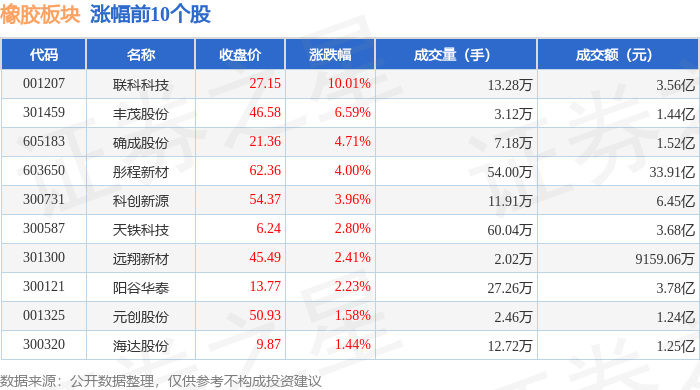
橡胶板块1月16日涨2.4%,联科科技领涨,主力资金净流出7024.96万元
Zheng Xing Xing Ye Ri Bao· 2026-01-16 08:49
Group 1 - The rubber sector experienced a 2.4% increase on January 16, with LianKe Technology leading the gains [1] - The Shanghai Composite Index closed at 4101.91, down 0.26%, while the Shenzhen Component Index closed at 14281.08, down 0.18% [1] - Key stocks in the rubber sector showed significant price increases, with LianKe Technology rising by 10.01% to a closing price of 27.15 [1] Group 2 - The rubber sector saw a net outflow of 70.25 million yuan from main funds, while retail investors contributed a net inflow of 59.69 million yuan [2] - LianKe Technology had a main fund net inflow of 65.53 million yuan, representing 18.43% of its trading volume [3] - Other notable stocks included Kexin New Energy with a main fund net inflow of 53.18 million yuan, but a net outflow from retail investors of 57.30 million yuan [3]