
金属冶炼

Search documents
宝城期货资讯早班车-20250912
Bao Cheng Qi Huo· 2025-09-12 01:57
1. Report Industry Investment Rating No relevant content provided. 2. Core Viewpoints of the Report - The report comprehensively presents macro - economic data, commodity investment information, financial news, and stock market trends, offering insights into the economic and market conditions across various sectors [1][2][14][32]. - Different institutions have diverse outlooks on the bond market. Some believe that after continuous adjustments, bond risks are released, and there may be a more optimistic outlook, while others focus on factors such as fiscal policy and inflation in relation to the bond market [28][29]. 3. Summary by Directory 3.1 Macro Data Quick View - GDP growth in Q2 2025 was 5.2% year - on - year, slightly lower than the previous quarter's 5.4% but higher than the same period last year [1]. - Manufacturing PMI in August 2025 was 49.4%, a slight increase from the previous month, while non - manufacturing PMI was 50.3%, also up from the previous month [1]. - In July 2025, the year - on - year growth rates of M0, M1, and M2 were 11.8%, 5.6%, and 8.8% respectively, with M1 showing a significant year - on - year improvement [1]. - In August 2025, CPI was - 0.4% year - on - year, and PPI was - 2.9% year - on - year [1]. 3.2 Commodity Investment Reference 3.2.1 Comprehensive - The Shanghai American Chamber of Commerce's report shows that the Chinese government's market - opening efforts have improved the business environment, with 71% of surveyed enterprises profitable in 2024, up from 66% in 2023 [2]. - The proportion of US companies choosing the US as an investment transfer destination decreased by 4 percentage points to 18% last year, indicating that the "manufacturing回流" policy had limited effect [2]. - China will take necessary measures to safeguard its legitimate rights and interests in response to Mexico's potential tariff hikes [2]. - The US canceled tariffs on most Brazilian pulp exports on September 5 [2]. - US economic data shows that the 8 - month CPI was in line with expectations, and the number of initial jobless claims reached a new high since October 2021, leading traders to expect three Fed rate cuts by the end of the year [3]. 3.2.2 Metals - International precious metal futures closed mixed. Market expectations of a Fed rate cut and a decline in confidence in US dollar assets are driving factors [4]. - Gold has become the top reserve asset for global central banks, with its proportion in reserves exceeding US Treasuries for the first time since 1996 [5]. - In September, precious metal prices reached new highs both internationally and domestically, attracting over 100 billion yuan in funds to the domestic gold futures market [5]. - Some online gold repurchase businesses have been suspended, possibly due to regulatory and risk - control reasons [5]. - Barrick Gold plans to sell a Canadian gold mine for up to $1.1 billion [5]. - In July, Chile's state - owned copper company's copper production increased by 6.4% year - on - year, while the production of the Collahuasi mine decreased by 27.2% [6]. 3.2.3 Coal, Coke, Steel, and Minerals - Heavy rain in Indonesia has affected coal production and transportation, potentially narrowing the price gap between domestic and imported coal. September's coal imports are expected to remain above 40 million tons [8]. - Vale received an operating license for a 20 - million - ton iron ore project in Brazil [8]. 3.2.4 Energy and Chemicals - Ningde Times plans to resume production at the Jiaxiaowo lithium mine, aiming for full - load production and cost - reduction measures [9]. - International oil prices fell due to increased supply and weak demand. OPEC + production increased in August, and US inventories reached a new high [9]. - The IEA expects global oil supply to grow faster than expected this year and a potential surplus in 2026 [9]. - Russia's ESPO crude oil exports from the Kozmino port will decrease from 4.2 million tons in August to 4 million tons in September [11]. - The European Central Bank predicts that the oil price in 2025 will be $69.7 per barrel [12]. 3.2.5 Agricultural Products - India's sugar production in 2025 - 26 is estimated to be 34.9 million tons [13]. - In August, US coffee imports from Brazil decreased significantly, while Germany became the largest overseas market for Brazilian coffee [13]. - Brazil's soybean production in the 2025/26 season is expected to reach 180 million tons, with 19% of the soybeans pre - sold [13]. 3.3 Financial News Compilation 3.3.1 Open Market - On September 11, the central bank conducted 292 billion yuan of 7 - day reverse repurchase operations, resulting in a net injection of 79.4 billion yuan [14]. 3.3.2 Key News - The market expects the central bank to restart treasury bond trading operations, with a more favorable view of the fourth - quarter restart [15]. - The US economic data has led traders to expect three Fed rate cuts by the end of the year [15]. - Gold has become the top reserve asset for global central banks [16]. - China will conduct a two - year factor market reform pilot in 10 regions [16]. - China will take measures to safeguard its rights and interests in response to Mexico's potential tariff hikes [16]. - The government will implement policies to stabilize foreign trade [17]. - 27 provinces plan to issue about 777.1 billion yuan of local bonds in September, with some expanding the use of special bonds to government investment funds [17]. - The North - Exchange convertible bond market opened this week, with light trading volume [17]. - Most bank wealth management companies achieved net inflows in August, with a total increase of about 285.7 billion yuan in management scale [18]. - The average 7 - day annualized yield of money market funds is approaching 1%, with 80 products having yields below 1% [18]. - The reform and restructuring of rural banks are accelerating [18]. - Bank wealth management products are attracting deposits, with 12 of the top 14 wealth management companies achieving net growth in August [19]. - The bond market has experienced a decline, mainly due to institutional behavior and low bond yields [19]. - The European Central Bank kept interest rates unchanged, indicating that the inflation - reduction process is over [20]. - The US fiscal deficit in 2025 is higher than the same period in 2024 [20]. - There are various bond - related events, including debt restructuring, cancellation of bond issuance, and changes in corporate management [20]. - Some companies' credit ratings have been adjusted [21]. 3.3.3 Bond Market Summary - The inter - bank bond market showed a mixed trend, with short - and medium - term bonds strengthening and 30 - year bonds weakening [22]. - The exchange - traded bond market had some bonds rising and others falling [22]. - The convertible bond index rose, with some bonds having significant gains and losses [22]. - Money market interest rates showed different trends, with some rising and others falling [23]. - Bond issuance and bidding results showed different yields and multiples [24]. - European and US bond yields had different changes [25]. 3.3.4 Foreign Exchange Market Express - The on - shore RMB against the US dollar closed lower, while the RMB central parity rate against the US dollar rose [27]. - The US dollar index fell, and most non - US currencies rose [27]. 3.3.5 Research Report Highlights - CITIC Securities believes that bond risks have been released, and the 10 - year treasury bond yield may return to 1.6% [28]. - CICC Fixed Income expects the low - inflation pattern to continue in the short term and suggests seizing bond trading opportunities [28]. - Huatai Fixed Income believes that the bond market adjustment is due to institutional behavior and suggests looking for opportunities after October [29]. - Changjiang Fixed Income expects the social financing growth rate to peak and the bond market to remain weakly volatile [30]. 3.4 Stock Market Key News - A - shares rose significantly, with over 4200 stocks rising, and the ChiNext Index returned to 3000 points [32]. - The Hong Kong Hang Seng Index fell, with pharmaceutical stocks weak and chip and non - ferrous sectors performing well [33]. - The continuous rise of the ChiNext Index is related to its heavy - weight stocks, especially in the AI + direction [33].
股指独领风骚,商品蓄势待发-20250912
申银万国期货研究· 2025-09-12 00:28
Core Viewpoints - The article discusses the current economic conditions in China and the U.S., highlighting the implementation of market-oriented reforms in key urban areas in China and the stable inflation rates in the U.S. [1][4][5] Economic News - The Chinese government has approved market-oriented reform pilot programs in ten urban areas, including Beijing's sub-center and the Yangtze River Delta [5] - The U.S. consumer price index (CPI) rose by 2.9% year-on-year in August, aligning with expectations, while the core CPI increased by 3.1% [4] - Initial jobless claims in the U.S. rose to 263,000, the highest in nearly four years, indicating potential labor market weakness [4] Market Performance - U.S. stock indices experienced a rebound, with significant gains in the communication sector and a total market turnover of 2.46 trillion yuan [2][9] - The financing balance in China increased by 5.774 billion yuan, indicating a continuation of liquidity support [2][9] - The market is currently in a phase characterized by a "policy bottom, liquidity bottom, and valuation bottom," suggesting potential for further growth despite short-term volatility [2][9] Commodity Insights - Oil prices fell by 1.45% in the night session, with OPEC+ countries planning to increase production by 137,000 barrels per day starting in October [11][12] - Glass and soda ash markets are experiencing slow recovery in supply and demand, with glass production inventories decreasing by 1.04 million heavy boxes [16] - The methanol market is under pressure due to high inventory levels, with coastal methanol stocks reaching a historical high of 1.508 million tons [13] Industry-Specific Data - The passenger car market in China saw retail sales of 304,000 units in early September, a 10% year-on-year decline, while wholesale figures showed a 5% decrease [6] - The domestic glass and soda ash markets are in a process of inventory digestion, with a focus on supply-side adjustments [16] - The copper market is experiencing price fluctuations due to tight supply and varying demand from different sectors [18] Shipping and Trade - The European shipping index is under pressure, with a decline of 5.28% as shipping companies adjust pricing strategies ahead of the National Day holiday [30]


五矿期货文字早评-20250911
Wu Kuang Qi Huo· 2025-09-11 01:43
1. Report Industry Investment Ratings No relevant content provided. 2. Core Views of the Report - The overall market shows a complex situation with different trends in various sectors. In the macro - financial sector, the stock index may face short - term adjustment pressure but has a long - term bullish outlook; the bond market is expected to be volatile in the short term. In the non - ferrous metals sector, most metals have their own supply - demand and price characteristics, with some expected to be strong and others to be weak. In the black building materials sector, steel prices are under pressure due to weak demand, while iron ore shows a relatively strong trend. In the energy and chemical sector, different products have different supply - demand and price trends. In the agricultural products sector, prices of various products are affected by factors such as supply, demand, and seasonality [3][6][23] - The "anti - involution" policy has an impact on the market, but its real - world implementation and effectiveness will determine whether it can drive the market to continue the upward trend similar to the supply - side structural reform. The market also needs to pay attention to the Fed's interest - rate decision and the recovery of peak - season demand [29][30] 3. Summary by Relevant Catalogs 3.1 Macro - Financial 3.1.1 Stock Index - News: In August, global hedge funds' net buying of Chinese stocks reached a new high since September 2024; Tesla is finalizing the Optimus V3 design; the US PPI in August increased by 2.6% year - on - year, lower than the expected 3.3%, and decreased by 0.1% month - on - month, lower than the expected 0.3%; Oracle's stock price soared due to a $455 billion order [2] - Transaction Logic: After the previous continuous rise, high - level hot sectors such as AI have shown differences recently. The market risk preference has decreased, and the short - term index faces adjustment pressure. However, in the long - term, the policy support for the capital market remains unchanged, and the idea is mainly to buy on dips [3] 3.1.2 Treasury Bonds - Market: On Wednesday, the main contracts of TL, T, TF, and TS all declined. In August, the CPI was flat month - on - month and decreased by 0.4% year - on - year, while the core CPI increased by 0.9% year - on - year. The PPI was flat month - on - month and decreased by 2.9% year - on - year. The Ministry of Finance will tender and re - issue 35 billion yuan of 20 - year ultra - long - term special treasury bonds on September 17. The central bank conducted 304 billion yuan of 7 - day reverse repurchase operations on Wednesday, with a net investment of 74.9 billion yuan [4] - Strategy: The manufacturing PMI in August improved but was still below the boom - bust line. The central bank is expected to maintain loose funds. The rise in market risk preference suppresses the bond market sentiment, and the bond market is expected to be volatile in the short term [5][6] 3.1.3 Precious Metals - Market: Shanghai gold rose 0.21% to 835.16 yuan/gram, and Shanghai silver rose 0.47% to 9817 yuan/kg. COMEX gold fell 0.09% to $3678.8/ounce, and COMEX silver rose 0.11% to $41.65/ounce. The US 10 - year Treasury yield was 4.04%, and the US dollar index was 97.79 [7] - Outlook: The US inflation data in August was significantly lower than expected, and the labor market weakened. It is expected that the Fed will cut interest rates more than three times in the remaining meetings of this year. It is recommended to buy on dips in the precious metals sector, especially focusing on the rise of silver prices [7][8] 3.2 Non - Ferrous Metals 3.2.1 Copper - Market: The US PPI data was weaker than expected, and copper prices rose. LME copper rose 0.96% to $10012/ton, and the Shanghai copper main contract closed at 80190 yuan/ton. The LME copper inventory decreased, and the domestic copper inventory and basis showed different trends [10] - Outlook: The market is hesitating between recession and interest - rate cut trading. Overseas copper mine supply has some disturbances, and domestic copper production has decreased marginally. Copper prices are expected to continue to be strong, with the Shanghai copper main contract running in the range of 79500 - 80800 yuan/ton and LME copper 3M in the range of 9900 - 10100 dollars/ton [10] 3.2.2 Aluminum - Market: Aluminum prices fluctuated. LME aluminum fell 0.21% to $2622/ton, and the Shanghai aluminum main contract closed at 20830 yuan/ton. The domestic aluminum inventory decreased, and the basis and market atmosphere showed different trends [11] - Outlook: Aluminum prices are oscillating between macro expectations and fundamental realities. Overseas interest - rate cut expectations and the resilience of aluminum product exports provide support, but the weak improvement in domestic terminal demand restricts the upward space. Pay attention to the peak - season demand and inventory trends. The domestic main contract is expected to run in the range of 20700 - 20960 yuan/ton, and LME aluminum 3M in the range of 2600 - 2650 dollars/ton [11] 3.2.3 Zinc - Market: The zinc market shows an over - supply situation. The zinc ore and zinc ingot inventories are increasing, the TC of zinc concentrate is rising, and the domestic supply is loose. The LME market has a low inventory of zinc warrants, and the contango is rising. The pattern of weak domestic and strong overseas is intensifying [12] - Outlook: The zinc market is expected to be in a low - level oscillating pattern with limited short - term decline space [12] 3.2.4 Lead - Market: The lead industry shows a pattern of weak supply and demand. The shortage of raw materials restricts the production of smelters, and the downstream consumption is weak. The lead ingot supply has decreased marginally, but there is still a risk of price decline if the market sentiment weakens [13] - Outlook: The lead price has certain support at the bottom, but there is a large downward risk if the commodity sentiment weakens and the smelting recovers [13] 3.2.5 Nickel - Market: The nickel price fluctuated. The profit of nickel - iron plants has improved but is still at a low level. The demand for nickel - iron from stainless steel plants provides support. The supply of intermediate products is tight, and the demand from some enterprises provides price support [14] - Outlook: The short - term macro environment is positive, and the expectation of interest - rate cuts may drive the rise of non - ferrous metals. Although the supply of refined nickel is in an over - supply situation, the long - term support from the US loose expectation and domestic anti - involution policy is strong. It is recommended to buy on dips, with the Shanghai nickel main contract running in the range of 115000 - 128000 yuan/ton and LME nickel 3M in the range of 14500 - 16500 dollars/ton [14] 3.2.6 Tin - Market: Tin prices rebounded slightly. The supply of tin mines in Myanmar is recovering slowly, and domestic smelter production is affected. The downstream demand is in the off - season, and the inventory has increased slightly [15] - Outlook: Tin prices are expected to be volatile in the short term due to the weak demand in the off - season and the significant short - term decline in supply [15] 3.2.7 Lithium Carbonate - Market: The price of lithium carbonate decreased. The resumption of production of the Jiaxiaowo mine may change the supply - demand situation. The domestic lithium carbonate is expected to be destocked in September, and the spot strength may support the bottom [16] - Outlook: Pay attention to the market atmosphere and industrial information. The Guangzhou Futures Exchange lithium carbonate 2511 contract is expected to run in the range of 68600 - 72500 yuan/ton [16] 3.2.8 Alumina - Market: The alumina index rose 0.14% to 2934 yuan/ton. The domestic and overseas prices and basis showed different trends, and the futures inventory decreased [17][18] - Outlook: Overseas ore supply is improving, and the over - capacity pattern in the smelting section is difficult to change in the short term. The Fed's interest - rate cut expectation may drive the non - ferrous metals sector to be strong. It is recommended to wait and see in the short term, with the domestic main contract AO2601 running in the range of 2850 - 3250 yuan/ton [18] 3.2.9 Stainless Steel - Market: The stainless steel main contract closed at 12915 yuan/ton, down 0.27%. The spot price was stable, and the inventory decreased [19] - Outlook: The stainless steel market shows a pattern of narrow - range oscillation, with different price trends for different products. The overall market trading atmosphere is weak, and the cold - rolled steel trading is particularly sluggish [19] 3.2.10 Cast Aluminum Alloy - Market: The AD2511 contract rose 0.22% to 20350 yuan/ton. The spot price increased, and the inventory increased slightly [20] - Outlook: The downstream of the cast aluminum alloy is gradually transitioning from the off - season to the peak season. The cost support is strong, and the market activity is increasing. The price is expected to remain high in the short term [20] 3.3 Black Building Materials 3.3.1 Steel - Market: The prices of rebar and hot - rolled coil decreased. The rebar main contract closed at 3109 yuan/ton, down 0.44%, and the hot - rolled coil main contract closed at 3342 yuan/ton, down 0.20%. The inventory increased, and the demand was weak [22][23] - Outlook: The steel market is in a weak situation. The demand is still weak in the peak season, and the steel price may decline further if the demand cannot be effectively repaired [23] 3.3.2 Iron Ore - Market: The iron ore main contract (I2601) closed at 805 yuan/ton, with no change. The supply decreased, the demand decreased, and the inventory increased [24][25] - Outlook: The iron ore price is expected to be oscillating and strong in the short term. Pay attention to the recovery of steel mill production and the peak - season demand [25] 3.3.3 Glass and Soda Ash - Glass - Market: The glass price decreased slightly. The domestic glass inventory increased, and the downstream demand was not significantly improved [26] - Outlook: The glass price is expected to be oscillating in the short term. In the long term, it will follow the macro sentiment, and the price may rise if there are substantial policies in the real estate sector [26] - Soda Ash - Market: The soda ash price was stable. The inventory increased slightly, and the downstream demand was cautious [27] - Outlook: The soda ash price is expected to be oscillating in the short term. In the long term, the price center is expected to rise, but the upward space is limited due to the weak downstream demand [27] 3.3.4 Manganese Silicon and Ferrosilicon - Market: The manganese silicon main contract (SM509) rose 0.27%, and the ferrosilicon main contract (SF511) rose 0.14%. The spot prices were stable, and the basis showed different trends [28] - Outlook: The manganese silicon and ferrosilicon prices are expected to be oscillating. It is recommended to wait and see, and pay attention to the pressure and support levels [28] 3.3.5 Industrial Silicon and Polysilicon - Industrial Silicon - Market: The industrial silicon main contract (SI2511) rose 3.03%. The spot prices were stable, and the basis showed different trends [32] - Outlook: The industrial silicon price is expected to be oscillating in the short term. Pay attention to the news drive and risk control [32][33] - Polysilicon - Market: The polysilicon main contract (PS2511) fell 1.19%. The spot prices decreased slightly, and the basis was negative [34] - Outlook: The polysilicon price is in a pattern of "weak reality, strong expectation". The price is expected to be volatile, and pay attention to the risk control [34][35] 3.4 Energy and Chemicals 3.4.1 Rubber - Market: NR and RU oscillated weakly, following the trend of industrial products such as coking coal [37] - Outlook: The rubber price may rise due to the rainy weather in Thailand. The mid - term view is bullish, and the short - term view is neutral, suggesting waiting and seeing or quick - in and quick - out operations [37][38][39] 3.4.2 Crude Oil - Market: The INE main crude oil futures rose 0.58% to 486.2 yuan/barrel. The US EIA data showed that the crude oil and refined product inventories increased [40][41] - Outlook: The oil price is currently undervalued, and the fundamental support is strong. If the geopolitical premium re - emerges, the oil price may rise further. It is recommended to be long on crude oil [41] 3.4.3 Methanol - Market: The methanol 01 contract rose 9 yuan/ton. The domestic supply increased, the overseas supply was at a high level, and the demand showed different trends [42] - Outlook: The short - term reality is weak, but the market expectation has changed. It is recommended to buy on dips and consider the 1 - 5 positive spread [42] 3.4.4 Urea - Market: The urea 01 contract fell 14 yuan/ton. The supply decreased, and the demand was weak [43] - Outlook: The urea price is expected to be in a range - bound operation. It is recommended to buy on dips [43] 3.4.5 Styrene - Market: The spot price of styrene decreased, and the futures price increased. The BZN spread is at a low level, and the cost and supply - demand sides show different trends [44][45] - Outlook: The BZN spread is expected to repair, and the styrene price may rebound after the inventory reaches the inflection point [44] 3.4.6 PVC - Market: The PVC01 contract rose 10 yuan. The cost was stable, the supply increased, and the demand was weak [46][47] - Outlook: The PVC market is in a situation of strong supply and weak demand and high valuation. It is recommended to short on rallies, but beware of the impact of anti - involution sentiment [47] 3.4.7 Ethylene Glycol - Market: The EG01 contract fell 3 yuan. The supply decreased marginally, the demand increased, and the inventory increased [48] - Outlook: The ethylene glycol inventory is expected to increase in the medium term, and the valuation may decline [48] 3.4.8 PTA - Market: The PTA01 contract rose 20 yuan. The supply decreased marginally, the demand increased, and the inventory decreased [49] - Outlook: The PTA market is in a pattern of de - stocking. It is recommended to buy on dips following PX, paying attention to the peak - season terminal performance [49] 3.4.9 p - Xylene - Market: The PX11 contract rose 44 yuan. The supply increased, the demand increased, and the inventory decreased [50] - Outlook: The PX price is expected to be oscillating. It is recommended to buy on dips following crude oil, paying attention to the peak - season demand [50][51] 3.4.10 Polyethylene (PE) - Market: The PE futures price decreased. The cost support exists, the supply is limited, and the demand is expected to increase [52] - Outlook: The PE price is expected to oscillate upward [52] 3.4.11 Polypropylene (PP) - Market: The PP futures price decreased. The supply pressure is large, and the demand is in a seasonal rebound [53] - Outlook: The PP market is in a situation of weak supply and demand, and the inventory pressure is high. It is recommended to buy on dips the LL - PP2601 contract [53] 3.5 Agricultural Products 3.5.1 Live Pigs - Market: The domestic pig price continued to decline. The supply is expected to be high in September, but there are potential support factors such as consumption and stockpiling [55] - Outlook: The pig price is expected to be in a narrow - range adjustment. It is recommended to pay attention to the low - level rebound and short - selling opportunities after the rebound, and continue the far - month reverse spread strategy [55] 3.5.2 Eggs
9月9日LME金属库存及注销仓单数据
Wen Hua Cai Jing· 2025-09-10 08:35
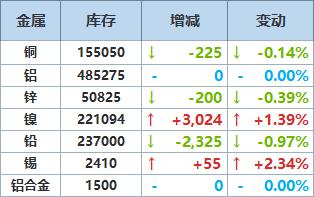
Core Insights - The report provides an overview of the changes in LME (London Metal Exchange) inventories for various metals, highlighting significant fluctuations in stock levels and the implications for market dynamics [1][3][5]. Group 1: Copper Inventory Changes - LME copper inventory decreased by 225 tons, bringing the total to 155,050 tons, with registered warrants at 133,325 tons and cancelled warrants at 21,725 tons, representing a cancellation ratio of 14.01% [3][4]. - Specific locations such as Kaohsiung and Rotterdam showed minor changes, with Kaohsiung's inventory down by 175 tons and Rotterdam remaining stable [3]. Group 2: Aluminum Inventory Changes - LME aluminum inventory remained unchanged at 485,275 tons, with registered warrants at 375,025 tons and cancelled warrants at 110,250 tons, maintaining a cancellation ratio of 22.72% [5][6]. - The inventory at Port Klang was stable at 314,400 tons, while other locations like Kaohsiung and Rotterdam also reported no changes [5]. Group 3: Zinc Inventory Changes - LME zinc inventory decreased by 200 tons to 50,825 tons, with registered warrants at 35,450 tons and cancelled warrants at 15,375 tons, resulting in a cancellation ratio of 30.25% [9][10]. - The inventory in Singapore mirrored this trend, also decreasing by 200 tons [9]. Group 4: Tin Inventory Changes - LME tin inventory increased by 55 tons to 2,410 tons, with registered warrants at 2,185 tons and cancelled warrants at 225 tons, leading to a cancellation ratio of 9.34% [11][12]. - Locations such as Port Klang and Singapore also reported increases in inventory [11]. Group 5: Nickel Inventory Changes - LME nickel inventory rose by 3,024 tons to 221,094 tons, with registered warrants at 212,502 tons and cancelled warrants at 8,592 tons, resulting in a cancellation ratio of 3.89% [13]. - Significant increases were noted in locations like Singapore and Hring, contributing to the overall rise in nickel inventory [13].
广发早知道:汇总版-20250905
Guang Fa Qi Huo· 2025-09-05 02:13
Report Industry Investment Rating No relevant content provided. Core Viewpoints of the Report - The A-share market experienced a significant correction, with major indices and most sectors declining. The consumer sector bucked the trend, while the TMT sector saw a deep correction. The four major stock index futures also declined, and the basis of the main contracts showed a neutral oscillation. Given the high volatility and the potential for the A-share market to enter a high-level oscillation pattern after a large increase, it is recommended to wait and see. [2][3][4] - The Treasury bond futures mostly closed higher, but short-term trading may remain range-bound. The market should continue to monitor the stock market trend and the release of economic data in August to assess the impact on the bond market. A range trading strategy is suggested, with attention paid to the equity market and fundamental changes. [5][6] - The precious metals market ended its consecutive gains and slightly declined due to the fading of risk aversion and profit-taking by long positions at high levels. With an increased probability of a Fed rate cut in September, the price of gold is expected to rise to over $3,600 in the short term, while silver prices may see increased volatility and are recommended for high-sell and low-buy operations. [7][9][10] - The container shipping futures (EC) showed a weak oscillation. The spot prices continued to decline, and the futures market faced pressure from the weak spot market. There may be a bottom-fishing opportunity for the December contract, and a spread arbitrage strategy between the December and October contracts is recommended. [11][12] - Most non-ferrous metals showed various trends. For example, copper prices had an upward trend but faced constraints; alumina showed a weak oscillation; aluminum prices were expected to remain range-bound; and zinc prices were likely to oscillate. The market conditions and trends of each metal were affected by factors such as supply and demand, macro policies, and inventory changes. [13][16][18] - In the black metal market, steel prices were restricted by production cuts and weak demand during the off-season. Iron ore prices followed the steel price trend, with increased shipments and arrivals. Coking coal prices were weak, and coke prices faced a situation where the seventh round of price increases had been implemented, but the eighth round was blocked. [40][41][46] - In the agricultural product market, the expected high yield of US soybeans suppressed the market, while the domestic market for meal products had a positive outlook. The pig market had limited supply-demand contradictions, and the corn market showed a weak and oscillating trend. [53][54][59] Summary by Directory Financial Derivatives - Financial Futures Stock Index Futures - Market situation: The A-share market continued to correct on Thursday, with major indices significantly declining. The consumer sector rose, while the TMT sector fell sharply. The four major stock index futures also declined, and the basis of the main contracts showed a neutral oscillation. [2][3] - News: The Ministry of Industry and Information Technology and the State Administration for Market Regulation issued a plan to stabilize the growth of the electronic information manufacturing industry from 2025 - 2026. Overseas, the Fed's Beige Book indicated little change in economic activity, and consumer spending was flat or decreased. The number of job openings in the US in July dropped to a 10 - month low. [3][4] - Funds: On September 4, the A-share trading volume increased, and the northbound capital trading volume was 332.562 billion yuan. The central bank conducted a net withdrawal of 15.08 billion yuan through reverse repurchase operations. [4] - Operation suggestion: As the impact of monetary policy in the second half of the year on the equity market is crucial, and the A-share market may enter a high-level oscillation pattern after a large increase, it is recommended to wait and see for the next - stage direction. [4] Treasury Bond Futures - Market performance: Treasury bond futures mostly closed higher, but the yields of some spot bonds rose. The short - term trading of Treasury bond futures may remain range - bound. [5] - Funds: The central bank conducted a net withdrawal of funds through reverse repurchase operations, but the inter - bank funds were still relatively loose. The central bank planned to conduct a 100 - billion - yuan 3 - month outright reverse repurchase operation. [6] - Operation suggestion: Monitor the stock market trend and the release of economic data in August. A range trading strategy is recommended, with attention paid to the equity market and fundamental changes. [6] Financial Derivatives - Precious Metals - Market review: US employment data showed signs of weakness, while the service industry PMI expanded. Fed officials had different views on interest rate cuts. The precious metals market ended its consecutive gains and slightly declined due to the fading of risk aversion and profit - taking by long positions at high levels. [7][8][9] - Future outlook: With an increased probability of a Fed rate cut in September, gold prices are expected to rise to over $3,600 in the short term. Silver prices may see increased volatility, and high - sell and low - buy operations are recommended. [9][10] - Funds: The holdings of gold and silver ETFs increased significantly in August, and the net long speculative positions showed an upward trend. [10] Financial Derivatives - Container Shipping Futures (EC) - Spot quotes: As of September 5, the spot prices of major shipping companies continued to decline slowly. [11] - Shipping indices: As of September 1, the SCFIS European line index and the US West line index declined. As of August 29, the SCFI composite index rose, but the Shanghai - Europe freight rate decreased. [11] - Fundamentals: As of September 2, the global container shipping capacity increased year - on - year. The Eurozone's composite PMI and the US manufacturing PMI showed different trends. [11] - Logic: The futures market declined, and the upward momentum was suppressed by the weak spot market. There may be a bottom - fishing opportunity for the December contract, and a spread arbitrage strategy between the December and October contracts is recommended. [12] - Operation suggestion: Expect a weak oscillation and consider a spread arbitrage strategy between the December and October contracts. [12] Commodity Futures - Non - Ferrous Metals Copper - Spot: As of September 4, copper prices rose, but the spot trading was weak. [13] - Macro: The Fed's stance became more dovish, increasing the probability of a rate cut in September. Key events in September, such as the release of economic data and the FOMC meeting, may cause market fluctuations. [13][14] - Supply: The TC of copper concentrate was at a low level. The domestic electrolytic copper production in August decreased slightly month - on - month and was expected to decline further in September due to factors such as maintenance and supply shortages. [14] - Demand: The operating rates of copper rod production decreased. The domestic demand remained resilient, but there was marginal pressure in Q3. The power and new energy sectors supported the demand. [15] - Inventory: The LME copper inventory decreased, while the domestic social inventory and COMEX copper inventory increased. [15] - Logic: The Fed's dovish stance boosted copper prices, but the upside was limited by concerns about stagflation. The fundamentals showed a "weak reality + stable expectation" state. Copper prices are expected to at least oscillate and may enter a new upward cycle when the commodity and financial attributes resonate. [16] - Operation suggestion: The main contract is expected to operate in the range of 79,000 - 81,000 yuan/ton. [16] - Short - term view: Oscillation. [16] Alumina - Spot: On September 4, the spot prices of alumina in various regions decreased, and the inventory decreased slightly from a high level, causing the spot prices to loosen. [16] - Supply: In August 2025, the production of metallurgical - grade alumina in China increased year - on - year and month - on - month. With the industry still profitable, the operating capacity is expected to continue to increase slightly in September. [17] - Inventory: As of September 4, the port inventory remained unchanged week - on - week, while the registered warehouse receipts increased. [17] - Logic: The alumina futures oscillated, and the market was dominated by fundamentals. The supply was under pressure due to new capacity, while the demand was weak. The inventory continued to accumulate, suppressing the price. The downside is limited, and the upside requires supply disruptions or sentiment catalysts. [18] - Operation suggestion: The main contract is expected to operate in the range of 2,900 - 3,200 yuan/ton. Consider short - selling on rallies in the medium term. [18][19] - View: Weak oscillation, short - selling on rallies in the medium term. [19] Aluminum - Spot: On September 4, the spot price of A00 aluminum decreased, and the premium increased. [19] - Supply: In August 2025, the domestic electrolytic aluminum production increased year - on - year and month - on - month. The proportion of molten aluminum increased, and the ingot casting volume decreased. [19] - Demand: The operating rates of downstream industries showed marginal improvement. [20] - Inventory: On September 4, the domestic electrolytic aluminum social inventory increased week - on - week, and the inventory inflection point was not clear. [20][21] - Logic: The Fed's rate - cut expectation boosted the market sentiment, but the high price suppressed downstream procurement, and the inventory increase pressured the price. Aluminum prices are expected to remain range - bound, and attention should be paid to the actual demand during the peak season, inventory changes, and macro - policy implementation. [21] - Operation suggestion: The main contract is expected to operate in the range of 20,400 - 21,000 yuan/ton. [21] - View: Wide - range oscillation. [21] Aluminum Alloy - Spot: On September 4, the spot price of ADC12 aluminum alloy remained unchanged. [21] - Supply: In July, the production of recycled aluminum alloy ingots increased, and the operating rate increased. In August, the industry was in the off - season, but some enterprises may increase production in anticipation of the peak season. [22] - Demand: In August, the demand was weak, but it showed marginal improvement at the end of the month. The demand is expected to recover moderately in September. [22] - Inventory: The social inventory increased due to the off - season. [22] - Logic: The futures price oscillated with the aluminum price. The supply of scrap aluminum was tight, and the demand was in the off - season. As the peak season approaches, the spot price is expected to remain stable, and the price difference with aluminum may converge. [23][24] - Operation suggestion: The main contract is expected to operate in the range of 20,000 - 20,600 yuan/ton. Consider a spread arbitrage strategy if the price difference is over 500. [24] - View: Strong oscillation. [24] Zinc - Spot: On September 4, the average price of 0 zinc ingots decreased, and the spot trading improved after the futures price declined. [24] - Supply: The TC of zinc concentrate remained high, and the supply of zinc ore was loose. The production of refined zinc in August was higher than expected, and it is expected to continue to increase in 1 - 9 months of 2025. [25] - Demand: The operating rates of primary processing industries were at a seasonal low but had limited room for further decline. The downstream procurement sentiment improved after the zinc price declined. [26] - Inventory: The domestic social inventory increased, while the LME inventory decreased. [26] - Logic: The supply of zinc ore was loose, and the production of refined zinc was high. The demand was about to enter the peak season, and the spot trading improved. The global inventory was low, providing support for the price. Zinc prices are expected to oscillate, and upward or downward breakthroughs require specific conditions. [27] - Operation suggestion: The main contract is expected to operate in the range of 21,500 - 23,000 yuan/ton. [27] - Short - term view: Oscillation. [27] Tin - Spot: On September 4, the price of 1 tin decreased, and the market trading was mixed. [27] - Supply: In July, the domestic tin ore import decreased, and the supply was difficult to improve in the short term. The tin ingot import increased. [28][29] - Demand and inventory: The operating rate of the soldering tin industry decreased, and the demand was weak. The LME inventory and the warehouse receipts of the Shanghai Futures Exchange increased, while the social inventory decreased. [29] - Logic: The supply of tin ore was tight, and the demand was weak. The tin price oscillated at a high level. If the supply recovers smoothly, consider short - selling on rallies; otherwise, the price is expected to continue to oscillate at a high level. [30] - Operation suggestion: The operating range is expected to be 265,000 - 285,000 yuan/ton. [30] - Recent view: Wide - range oscillation. [30] Nickel - Spot: As of September 4, the price of electrolytic nickel decreased, and the premium of imported nickel remained unchanged. [30] - Supply: In July 2025, the production of refined nickel increased year - on - year and month - on - month, and the monthly production plan is expected to increase slightly. [31] - Demand: The demand for electroplating and alloy was stable, while the demand for stainless steel was general. The demand for nickel sulfate was under pressure. [31] - Inventory: The overseas inventory remained high, the domestic social inventory decreased, and the bonded area inventory remained stable. [31] - Logic: The strengthening of the US dollar suppressed the non - ferrous metal market. The nickel price oscillated weakly, and the cost provided some support. The supply is expected to be loose in the medium term, restricting the upside. The price is expected to adjust within a range. [32] - Operation suggestion: The main contract is expected to operate in the range of 118,000 - 126,000 yuan/ton. [32][33] - Short - term view: Range adjustment. [32] Stainless Steel - Spot: As of September 4, the spot price of 304 cold - rolled stainless steel remained unchanged, and the basis increased. [33][34] - Raw materials: The price of nickel ore was stable, and the price of nickel iron was strong. The price of chrome ore was supported by cost, and the supply of chrome iron was tight. [34] - Supply: In August, the domestic stainless steel production increased, and the production is expected to continue to increase in September. [34] - Inventory: The social inventory decreased slowly, and the warehouse receipts decreased. [35] - Logic: The stainless steel futures oscillated slightly lower. The cost was supported by raw material prices, but the demand was weak. The market is cautiously optimistic about the peak season, but the demand is still weak. The price is expected to oscillate within a range. [36] - Operation suggestion: The main contract is expected to operate in the range of 12,600 - 13,400 yuan/ton. [36][37] - Short - term view: Range oscillation. [36] Lithium Carbonate - Spot: As of September 4, the spot prices of battery - grade and industrial - grade lithium carbonate decreased. The salt factories were reluctant to sell, while the traders were more willing to sell. The downstream procurement was mainly for rigid demand. [37] - Supply: In August, the production of lithium carbonate increased. The supply was affected by factors such as mine permit approval, and imports supplemented the supply. [38] - Demand: The demand was robust and optimistic, but the significant driving force was not obvious. The demand in September is expected to increase. [38] - Inventory: The overall inventory decreased last week, with the upstream inventory decreasing and the downstream inventory increasing. [39] - Logic: The lithium carbonate futures opened low and closed high, and the market sentiment improved. The fundamentals remained in a tight - balance state. The price is expected to oscillate widely around 75,000 yuan/ton and then stabilize. [39][40] - Operation suggestion: Wait and see. [40] - Short - term view: Wide - range oscillation. [40] Commodity Futures - Black Metals Steel - Spot: The steel billet price remained stable, and the spot prices of rebar and hot - rolled coil increased slightly. The January contract of rebar had a premium over the spot, while the January contract of hot - rolled coil had a discount. [40] - Cost and profit: The cost support is expected to weaken due to the limited supply recovery of coking coal and the slight increase in iron ore inventory. The steel profit decreased significantly in August. [41] - Supply: From January to August, the iron element production increased year - on - year. In August, the production increased compared with July, mainly due to the increase in scrap steel consumption. This week, the iron water production decreased due to production restrictions, but it is expected to recover next week. The production of finished steel products decreased less than that of iron water. [41] - Demand: The domestic demand and export increased in the first half of the year, but the domestic demand is expected to weaken seasonally. The steel export remained high. The apparent demand decreased seasonally in August but is expected to recover. [41] - Inventory: The inventory of five major steel products increased, mainly due to the increase in rebar inventory. The inventory increase is expected to slow down in the future. [42] - View: This week, the supply and demand
国新国证期货早报-20250905
Guo Xin Guo Zheng Qi Huo· 2025-09-05 01:38
Report Summary 1. Market Performance on September 4, 2025 - **Stock Index Futures**: A-share market had a collective pullback. The Shanghai Composite Index fell 1.25% to 3765.88, the Shenzhen Component Index dropped 2.83% to 12118.70, and the ChiNext Index declined 4.25% to 2776.25. The trading volume reached 2544.3 billion yuan, an increase of 180.2 billion yuan from the previous day. The CSI 300 Index closed at 4365.21, down 94.62 [1][2]. - **Coke and Coking Coal**: The coke weighted index closed at 1585.0, down 21.9. The coking coal weighted index closed at 1093.5 yuan, down 21.7 [3][4]. - **Zhengzhou Sugar**: Affected by the expected sufficient supply in major producing countries, the US sugar oscillated lower on Wednesday. Zhengzhou sugar 2601 contract was pressured by the decline of US sugar and the reduction of spot prices, and continued to fall at night [5]. - **Rubber**: Shanghai rubber had a narrow - range fluctuation. Natural rubber was strong while 20 - rubber was weak. Supported by the strong rainfall in the Thai production area and the firm spot price in Southeast Asia, Shanghai rubber oscillated higher at night. Indonesia's total exports of natural rubber and mixed rubber in the first 7 months were 999,000 tons, a year - on - year increase of 10% [6]. - **Soybean Meal**: The CBOT soybean futures closed higher on September 4. The US soybean harvest will start in mid - to - late September. Brazil's soybean exports in September are expected to be 6.75 million tons. In the domestic market, the soybean meal futures price oscillated, with the M2601 contract closing at 3048 yuan/ton, a decline of 0.59% [6]. - **Live Hogs**: The live hog futures price oscillated weakly, with the LH2511 contract closing at 13365 yuan/ton, a decline of 1.37%. In September, the market supply is still under pressure, but the consumption is seasonally picking up [7]. - **Palm Oil**: The palm oil futures oscillated slightly. The main contract P2601 closed at 9390, up 0.23%. Malaysia's palm oil production in August is estimated to increase by 2.07% to 1.85 million tons [8]. - **Shanghai Copper**: The main contract of Shanghai copper closed at 79770 yuan/ton. The supply of copper concentrate is tight, and the cost supports the price. The domestic demand is expected to recover, but the export demand may decline [9]. - **Iron Ore**: The iron ore 2601 contract rose 1.67% to 791.5 yuan. The global shipment of iron ore has rebounded, and the demand is slightly weak, but the terminal demand in the peak season provides support [9]. - **Asphalt**: The asphalt 2510 contract fell 2.14% to 3468 yuan. The capacity utilization rate of asphalt continues to decline, and the short - term price will oscillate [10]. - **Cotton**: The main contract of Zhengzhou cotton closed at 13960 yuan/ton at night. The cotton inventory decreased by 167 lots [10]. - **Log**: The 2511 log contract opened at 797, closed at 797, with an increase of 317 lots. The spot prices in Shandong and Jiangsu remained unchanged. The external price increase drives the internal price up, and the market is in a game between strong expectation and weak reality [10][12]. - **Steel**: The rb2601 contract closed at 3117 yuan/ton, and the hc2601 contract closed at 3313 yuan/ton. The demand for steel is unstable, and the short - term price will fluctuate slightly [12]. - **Alumina**: The ao2601 contract closed at 2980 yuan/ton. The supply is becoming more abundant, and the cost support is weakening [13]. - **Shanghai Aluminum**: The al2510 contract closed at 20605 yuan/ton. The high - level oscillation of the main contract may continue, and the market is in a state of "macro - expectation support and fundamental suppression" [13]. 2. Core Views - The A - share market had a significant pullback on September 4, with increased trading volume [1]. - The prices of coke and coking coal are under pressure. The coking coal inventory is increasing, and the coke price increase is not implemented while some areas propose price cuts [5]. - The sugar market is affected by the expected sufficient supply, and the price is under pressure [5]. - The rubber market is supported by the supply - side situation in Southeast Asia [6]. - The soybean meal price oscillates due to sufficient domestic supply and potential supply from South America [6][7]. - The live hog market has supply pressure in the short term, but the consumption is seasonally improving [7]. - The palm oil market shows a slight upward trend, and the production in Malaysia is estimated to increase [8]. - The Shanghai copper price is affected by supply, cost, demand, and external factors such as US economic data [9]. - The iron ore price oscillates due to the change in supply - demand relationship and the support from the peak - season demand [9]. - The asphalt price oscillates with the decline of capacity utilization rate and general terminal demand [10]. - The log market is in a game between strong expectation and weak reality [12]. - The steel price has limited fluctuations, and the demand recovery will determine the future trend [12]. - The alumina price is under pressure due to increased supply and weakened cost support [13]. - The Shanghai aluminum price is in a balanced state between macro - expectation support and fundamental suppression [13]. 3. Factors Affecting Different Commodities Coke and Coking Coal - **Coke**: The eighth - round price increase is not implemented, and some areas propose the first - round price cut. The iron water production is 2.4013 million tons, a decrease of 0.62 million tons. The coal mine inventory has no pressure, and the total coking coal inventory is increasing [5]. - **Coking Coal**: The price of Tangshan Mongolian 5 refined coal is 1350, equivalent to 1130 on the futures market. The power consumption in China accounts for 30% of the terminal energy consumption, and is expected to exceed 40% by 2035. The mine inventory is increasing, the capacity utilization rate of independent coal washing plants has declined for 3 consecutive weeks, and the cumulative import growth rate has declined for 3 consecutive months [5]. Zhengzhou Sugar - The expected sufficient supply in major producing countries and the decline of US sugar and spot prices affect the price of Zhengzhou sugar [5]. Rubber - The strong rainfall in the Thai production area and the firm spot price in Southeast Asia support the price of Shanghai rubber [6]. Soybean Meal - In the international market, the US soybean harvest is approaching, and Brazil's exports are expected to increase. In the domestic market, the sufficient supply of imported soybeans, the potential supply from South America, and the increase of soybean meal inventory affect the price [6][7]. Live Hogs - The supply is under pressure in September, but the consumption is seasonally picking up due to the start of the school term [7]. Palm Oil - The production increase in Malaysia affects the price of palm oil [8]. Shanghai Copper - **Supply**: The domestic copper concentrate port inventory is low, and the refined copper production is expected to decline slightly. - **Cost**: The TC fee is negative, and the raw material price increase supports the copper price. - **Demand**: The export demand may decline due to US tariffs, but the domestic demand is expected to recover. - **External Factor**: The US non - farm payroll data on September 5 will affect the copper price [9]. Iron Ore - The global shipment of iron ore has rebounded to the annual high, and the arrival volume has increased. The iron water production has decreased slightly, but the peak - season demand provides support [9]. Asphalt - The capacity utilization rate of asphalt continues to decline, and the terminal demand is general [10]. Log - The external price increase drives the internal price up, and the market is in a game between strong expectation and weak reality [12]. Steel - The demand for steel is unstable during the off - peak to peak - season transition. The cost changes little, and the production may remain high [12]. Alumina - The supply is increasing due to the resumption of production lines and the stable output of new capacity. The cost support is weakening due to the decline of bauxite price [13]. Shanghai Aluminum - The market is in a state of "macro - expectation support and fundamental suppression", and the US non - farm payroll data on September 5 will affect the market sentiment [13].
9月3日LME金属库存及注销仓单数据
Wen Hua Cai Jing· 2025-09-04 08:45
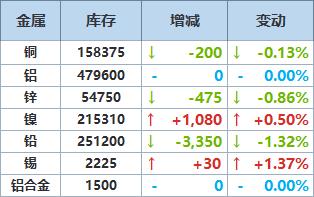
Group 1: Copper Inventory Changes - The registered warehouse inventory for copper decreased to 158,375 tons, a reduction of 1.91% from the previous day, with a cancellation of 16,100 tons, representing an increase of 19.04% in cancellations [1][3] - The cancellation ratio for copper is now at 10.17%, up from 8.53% the previous day [1] Group 2: Aluminum Inventory Changes - The aluminum inventory remains unchanged at 479,600 tons, with a cancellation of 10,850 tons, maintaining a cancellation ratio of 2.26% [1][5] - Specific locations such as Rotterdam and Singapore show significant cancellation ratios of 31.47% and 79.25% respectively [5] Group 3: Zinc Inventory Changes - Zinc inventory decreased to 54,750 tons, a drop of 9.42%, with a notable increase in cancellations to 16,300 tons, reflecting a 2759% increase in cancellations [1][9] - The cancellation ratio for zinc is now at 29.77%, up from 23.13% [1] Group 4: Tin Inventory Changes - Tin inventory increased slightly to 2,225 tons, with a cancellation of 190 tons, resulting in a cancellation ratio of 8.54% [1][11] - The inventory at specific locations like Singapore and Rotterdam shows stable levels with minimal changes [11] Group 5: Nickel Inventory Changes - Nickel inventory rose to 215,310 tons, with a cancellation of 8,352 tons, leading to a cancellation ratio of 3.88% [1][13] - The inventory levels in various locations such as Singapore and Kaohsiung indicate stable trends with minor fluctuations [13]
申银万国期货首席点评:黄金再创历史新高
Shen Yin Wan Guo Qi Huo· 2025-09-03 01:59
Report Summary 1. Report Industry Investment Rating No relevant content provided. 2. Core Views - Gold futures prices have strongly broken through, with London spot gold surpassing the $3,500 per ounce mark and COMEX gold futures hitting a new high. Multiple institutions predict that after a four - month consolidation, precious metals may start a new upward trend. Morgan Stanley has set the year - end target price of gold at $3,800 per ounce [1]. - In 2025, domestic liquidity remains loose, and it is in a policy window period. More incremental policies may be introduced in the second half of the year to boost the real economy. The external risks are gradually easing, and the probability of a Fed rate cut in September increases, enhancing the attractiveness of RMB assets. The current market is at the resonance of "policy bottom + capital bottom + valuation bottom", and the market trend is likely to continue [3][9][10]. 3. Summaries by Catalog a. Key Varieties - **Precious Metals**: Gold and silver are strengthening, and gold shows a convergent breakthrough. Trump's attempt to fire Fed governors and the USGS's proposal on silver import tariffs, along with dovish signals from the Fed and weak employment data, are positive for precious metals. However, inflation rebound, geopolitical risk reduction, and other factors limit the upside of gold. In the long - term, gold is still supported [2][18]. - **Stock Index**: The US three major indexes declined. The previous trading day saw index differentiation, with small and medium - cap stocks correcting significantly. The domestic market has a high probability of continued market trends, but one needs to adapt to accelerated sector rotation and structural differentiation. Different indexes have different characteristics in terms of risk and return [3][9][10]. - **Copper**: The copper price rose at night. The concentrate supply is tight, but the smelting output continues to grow. Multiple factors are intertwined, and the copper price may fluctuate within a range [3][19]. b. Main News on the Day - **International News**: Trump's government will request the Supreme Court to expedite the ruling on the global tariff case to overturn the federal court's decision that multiple tariffs are illegal. Market analysts believe that corporate bond issuance and budget concerns in developed countries are the main reasons for the stock market decline [4]. - **Domestic News**: China will expand the scope of visa - free countries, implementing a visa - free policy for Russian ordinary passport holders from September 15, 2025, to September 14, 2026 [5]. - **Industry News**: In August 2025, there were 2.65 million new A - share accounts, a year - on - year and month - on - month significant increase [6]. c. Daily Gains of Overseas Markets - The report provides the closing prices, price changes, and percentage changes of various overseas market varieties on September 1 and 2, 2025, including the FTSE China A50 futures, ICE Brent crude oil, London gold, etc. [7] d. Morning Comments on Major Varieties - **Financial Products** - **Stock Index**: The US three major indexes declined, and the domestic market has a high probability of continued trends, with different indexes having different risk - return characteristics [9][10]. - **Treasury Bonds**: Treasury bonds fell slightly. The market funds are loosening, and the equity market is volatile. The stock - bond seesaw effect continues, and one should pay attention to the impact of the equity market on the bond market [11]. - **Energy and Chemicals** - **Crude Oil**: SC crude oil rose at night. Geopolitical factors affect oil exports, and the OPEC and its allies will discuss production policies. One should follow up on OPEC's production increase [12]. - **Methanol**: Methanol rose at night. The domestic methanol plant operating rate and coal - to - olefin plant operating rate changed, and the coastal inventory is at a relatively high level. Methanol is expected to be bullish in the short term [13]. - **Other Energy and Chemical Products**: Rubber may continue to correct in the short term; polyolefin prices are generally weak; glass and soda ash futures are weak, and the market focuses on supply - side contraction and consumption in autumn [14][16][17]. - **Metals** - **Precious Metals**: Gold and silver are strengthening, with multiple factors influencing their trends, and the market focuses on this week's non - farm payroll data [18]. - **Copper**: The copper price rose at night, with multiple factors affecting it, and it may fluctuate within a range [19]. - **Other Metals**: Zinc may fluctuate weakly within a range; the short - term trend of lithium carbonate is affected by emotions, and one should be cautious about short - selling; iron ore is expected to be bullish in the medium - term; the steel market is in a state of weak supply and demand; double - coking products are in a high - level oscillation state; protein meal is expected to fluctuate narrowly; oils and fats are expected to continue to oscillate; sugar and cotton are expected to maintain an oscillating trend; the container shipping European line may oscillate in the short term [20][22][23].
美国财长贝森特:联储主席人选有望成为理事
Dong Zheng Qi Huo· 2025-09-02 00:44
Report Industry Investment Rating There is no relevant content provided in the report. Core Viewpoints of the Report - Market concerns about the independence of the Federal Reserve have led to increased investment in precious metals, with gold approaching its previous high and silver breaking through $40, reaching its highest level since 2011. The A - share market sentiment remains strong, and trading volume is still high. The US government's influence on the Federal Reserve is strengthening, and the US dollar maintains a weak trend. The stock index futures market is expected to remain bullish in the short term, and the US stock index is expected to fluctuate upward due to increased expectations of interest rate cuts [2][3][4]. - In the commodity market, the supply and demand of various products show different trends. For example, the production of red dates in Xinjiang is normal, and the production of polycrystalline silicon may increase in September. The price trends of different commodities also vary, with some expected to be volatile, some to decline slightly, and some to have potential upward momentum [5][56]. Summary According to the Catalog 1. Financial News and Reviews 1.1 Macro Strategy (Gold) - The US Treasury Secretary stated that the Federal Reserve should be independent but has made many mistakes. Market concerns about its independence have led to a strong rise in precious metals. The expected trend of gold is bullish but with increased volatility. Whether it can break through the previous high remains to be seen [14][15]. 1.2 Macro Strategy (Stock Index Futures) - The cross - regional traffic volume during the summer vacation increased by 7% year - on - year, and the SCO issued a statement on strengthening digital economy development. The A - share market sentiment is strong, and trading volume is high. It is recommended to allocate the stock indices evenly [16][17][19]. 1.3 Macro Strategy (Foreign Exchange Futures - US Dollar Index) - The US Treasury Secretary's statement implies that the US government's influence on the Federal Reserve is strengthening, and the US dollar is expected to remain weak [23][24]. 1.4 Macro Strategy (US Stock Index Futures) - Concerns about the Federal Reserve's independence are hard to ease, but short - term expectations of interest rate cuts support the risk appetite of the US stock market. The index is expected to fluctuate upward [25][26]. 1.5 Macro Strategy (Treasury Bond Futures) - The central bank conducted a net withdrawal of funds through reverse repurchase operations. There are opportunities to go long on treasury bonds, but the rhythm needs to be grasped [27][28][29]. 2. Commodity News and Reviews 2.1 Agricultural Products (Soybean Meal) - In August, the national soybean crushing volume increased, and the soybean meal inventory of oil mills rose slightly. The futures price is expected to be volatile, and attention should be paid to the adjustment of the US balance sheet and Sino - US relations [29][30][31]. 2.2 Agricultural Products (Soybean Oil/Rapeseed Oil/Palm Oil) - In September, the arrival of imported rapeseed is expected to decrease significantly, and the export of Malaysian palm oil in August increased by 10.22% month - on - month. It is recommended to gradually lay out long positions and pay attention to the production in August and the MPOB report [32][33][34]. 2.3 Agricultural Products (Sugar) - The net short position of raw sugar increased, and the export of Indian sugar in the 2025/26 season may reach 200,000 tons. The domestic sugar market is under pressure from imported processed sugar, but the downside space of Zhengzhou sugar is limited. It is recommended to wait for opportunities to go long on the 1 - month contract on dips [35][36][38]. 2.4 Agricultural Products (Corn Starch) - The spot price of corn starch has stabilized. The supply - demand situation is weak, and the price difference between rice and flour is at a low level. Attention should be paid to the driving factors for widening the price difference [40]. 2.5 Agricultural Products (Corn) - The inventory days of feed enterprises in August decreased month - on - month but were still higher than the same period last year. The futures and spot prices rebounded slightly, and it is recommended to pay attention to short - selling opportunities on rallies [41][42]. 2.6 Black Metals (Rebar/Hot - Rolled Coil) - The CMI index in August increased year - on - year, and the heavy - truck sales increased by 35%. The steel price is expected to continue to decline, and it is recommended to treat the steel price with a callback mindset [43][44][47]. 2.7 Black Metals (Steam Coal) - During the summer vacation, the national railway transported 2.43 billion tons of thermal coal. The price of steam coal is expected to decline slightly seasonally and maintain a range of 650 - 700 yuan [48]. 2.8 Black Metals (Iron Ore) - The CMI index in August increased year - on - year. The iron ore price is expected to be volatile, and short - selling should be cautious [49][50]. 2.9 Agricultural Products (Red Dates) - The growth of red dates in Xinjiang is normal and entering the sugar - increasing period. The futures price is in a volatile pattern. It is recommended to wait and see and pay attention to the weather in the producing areas [51][52]. 2.10 Black Metals (Coking Coal/Coke) - Some coal mines are operating normally, and the supply is affected by safety inspections. The demand side is under pressure, and the futures price is expected to be volatile [53][54]. 2.11 Non - ferrous Metals (Polycrystalline Silicon) - There are many positive news, but the production in September may increase. It is recommended to take profits on long positions in time and consider reverse arbitrage opportunities between November and December [56][58][59]. 2.12 Non - ferrous Metals (Nickel) - The nickel industry in Indonesia is operating normally. The raw material price is firm, and it is recommended to consider long positions at low levels [60][61][62]. 2.13 Non - ferrous Metals (Industrial Silicon) - The resumption of production of large factories in Xinjiang is less than expected. The short - term price is expected to be in the range of 8,200 - 9,200 yuan/ton, and attention should be paid to range - trading opportunities [63][64]. 2.14 Non - ferrous Metals (Lithium Carbonate) - The merger of Sayona and Piedmont was completed. It is recommended to pay attention to short - term long - position opportunities after de - stocking and the strengthening of the basis, as well as positive arbitrage opportunities [65][66]. 2.15 Non - ferrous Metals (Lead) - The LME lead price is weak, and the domestic supply - demand situation is expected to turn from loose to tight. It is recommended to consider long positions at low levels and pay attention to internal - external reverse arbitrage opportunities [69][70]. 2.16 Non - ferrous Metals (Copper) - Traders plan to make large - scale deliveries of copper futures. The market is paying attention to the expectation of the Federal Reserve's interest rate cut. It is recommended to take a bullish approach on a single - side basis and wait and see on an arbitrage basis [71][73][74]. 2.17 Non - ferrous Metals (Zinc) - The domestic zinc inventory has increased, and the LME zinc price is strong. It is recommended to wait and see on a single - side basis and pay attention to medium - term positive arbitrage opportunities [75][76]. 2.18 Energy Chemicals (Liquefied Petroleum Gas) - The price of LPG in East China is stable, and the 9 - month CP price remains unchanged. It is recommended to pay attention to the opportunity of upward valuation repair of CP [77][78][79]. 2.19 Energy Chemicals (Crude Oil) - The supply of Nayara refinery depends entirely on Russia. The oil price is expected to fluctuate within a narrow range [80][81]. 2.20 Energy Chemicals (PX) - The PX price is weak, and the supply - demand situation has not changed significantly. It is recommended to try long positions on dips [82][83][84]. 2.21 Energy Chemicals (PTA) - The spot price of PTA has declined, and the basis has weakened. The supply - demand situation has improved marginally. It is recommended to try long positions on dips [85][87][88]. 2.22 Energy Chemicals (Asphalt) - The asphalt inventory has decreased, mainly due to the reduction of refinery production. It is recommended to wait and see [87][88][89]. 2.23 Energy Chemicals (Urea) - The capacity utilization rate of melamine has increased. The supply of urea is under pressure, and the demand is not strong. It is recommended to pay attention to the new Indian tender [90][91]. 2.24 Energy Chemicals (Bottle Chips) - The export price of bottle chips has been slightly adjusted downward, and the demand is gradually entering the off - season. The absolute price follows the raw materials, and the processing fee is under pressure [92][93]. 2.25 Energy Chemicals (Styrene) - The port inventory of styrene has increased. The short - term inventory pressure may slow down, but the outlook in the fourth quarter is weak. It is recommended to pay attention to the policy [94][95]. 2.26 Energy Chemicals (Soda Ash) - The inventory of soda ash has decreased. The market sentiment is weak, and it is recommended to short on rallies and pay attention to supply - side disturbances [97]. 2.27 Energy Chemicals (Float Glass) - The price of float glass in the Shahe market is stable. The glass market is under pressure, and it is recommended to focus on arbitrage strategies of going long on glass and short on soda ash when the price difference widens [98]. 2.28 Shipping Index (Container Freight Rate) - The throughput of the Port of Tanjung Pelepas in Malaysia increased by 15.4% in the first half of the year. The spot freight rate is weak, and the supply pressure is high from late September to early October. The 10 - month contract has broken through the support level, and attention should be paid to the support at 1,250 [99][100].
上市公司海外收入稳健增长 凸显外贸出口韧劲
Zheng Quan Ri Bao· 2025-09-01 16:09
Core Viewpoint - China's foreign trade exports show strong resilience, with over 830 manufacturing companies in Shanghai achieving overseas revenue of 1.1 trillion yuan in the first half of the year, a year-on-year increase of 5% [1] Group 1: Export Performance - Private enterprises have surpassed 740 billion yuan in overseas revenue, marking a 6% year-on-year growth and becoming the main force in "going global" [1] - The growth in overseas revenue reflects the strong resilience and international competitiveness of China's manufacturing sector amid global economic pressures [1] Group 2: Market Expansion Strategies - Diversification into emerging markets has provided significant opportunities for foreign trade growth, with companies like Xiaogoods City focusing on regions such as the Middle East, South America, and Africa [2] - The "Belt and Road" initiative has been effectively promoted, exemplified by Ningbo-Zhoushan Port establishing over 300 container shipping routes [2] - Companies like Jinlong Automobile have accelerated their global presence, achieving a 52.4% year-on-year increase in bus exports across more than 170 countries and regions [2] Group 3: Technological Innovation - Technological innovation is identified as the core engine for companies to achieve breakthroughs in international markets, allowing them to avoid traditional low-price competition [3] - Companies are increasingly relying on high-value technology and brand strength to gain global market recognition and higher profit margins [3] Group 4: Government Support and Corporate Strategy - The Chinese government has enhanced the business environment and trade facilitation, boosting manufacturers' confidence in exploring international markets [3] - Companies are focusing on increasing R&D investment, attracting innovative talent, and achieving technological breakthroughs to support their international expansion [3] Group 5: Future Directions for Trade Development - Companies are encouraged to increase R&D investment, deepen global layouts, and enhance brand building to improve international influence and reputation [4] - Emphasis on green trade cooperation and supply chain management is suggested to address trade risks and enhance resilience against challenges such as trade friction and exchange rate fluctuations [4]