
创新药

Search documents
【早盘三分钟】2月11日ETF早知道
Xin Lang Cai Jing· 2026-02-11 01:37
Market Overview - The market temperature gauge indicates a 75% level, suggesting a strong market sentiment based on the historical P/E ratios of major indices as of February 10, 2026, with the Shanghai Composite Index at 99.59%, Shenzhen Component Index at 92.88%, and ChiNext Index at 50.6% [1]. Sector Performance - The top-performing sectors on February 10, 2026, included Media (+4.27%), Household Appliances (+2.15%), and Computer (+1.11%), while sectors like Coal (-0.84%), Social Services (-1.31%), and Real Estate (-1.40%) faced declines [2][15]. Fund Flows - The sectors with the highest net inflows were Media (¥5.341 billion), Computer (¥0.273 billion), and Social Services (¥0.209 billion). Conversely, the sectors with the largest outflows included Electric Equipment (-¥11.149 billion), Machinery (-¥4.919 billion), and Nonferrous Metals (-¥4.015 billion) [2][15]. ETF Performance - The Hong Kong Stock Connect Innovative Drug ETF (520880) rose by 2.90% on February 10, 2026, recovering above the 20-day moving average, driven by the strong performance of the innovative drug sector [5][19]. - The Sci-Tech Innovation Artificial Intelligence ETF (589520) increased by 1.81%, benefiting from the recent advancements in AI technology, particularly the release of the Seedream 5.0 model by ByteDance [7][19]. Investment Insights - Open Source Securities highlighted that China's innovative drug sector is experiencing dual breakthroughs in commercialization and internationalization, suggesting a favorable investment outlook for leading companies in this space [6][19]. - The Sci-Tech Innovation Artificial Intelligence ETF's index components have a significant collaboration with ByteDance, which holds a 29.42% weight in the index as of January 2026, indicating strong growth potential in the AI sector [7][19].


山西证券研究早观点-20260211
Shanxi Securities· 2026-02-11 01:32
Market Trends - The domestic market indices showed slight fluctuations, with the Shanghai Composite Index closing at 4,128.37, up by 0.13% [4] - During the period from February 2 to February 8, major indices experienced declines, with the Shanghai Composite Index down by 1.27% and the ChiNext Index down by 3.28% [7] Industry Insights - The non-bank financial sector is seeing a revision in underwriting regulatory guidelines, which is expected to enhance investment value in the sector [5] - The media industry is projected to continue its upward trend, driven by AI applications and IP ecosystems, with a 27.17% increase in the media index for 2025 [6] - The power equipment and new energy sector is focusing on the AIDC power revolution, with expectations for a significant increase in photovoltaic power utilization rates [8][19] - The agricultural sector is facing potential price adjustments in pig farming after a peak season, with current prices showing a downward trend [15][17] Company Analysis - Aide Technology is recognized as a leader in domestic spinal vertebral body shaping systems, benefiting from an aging population [22] - Tianfu Communication's 2025 performance forecast indicates a net profit of 1.88 to 2.15 billion yuan, driven by stable demand for optical devices [26] - Wolong Nuclear Materials anticipates a net profit of 1.1 to 1.18 billion yuan for 2025, with strong market demand across various business segments [28] Investment Recommendations - The report suggests focusing on companies that leverage AI applications and IP development, such as Kunlun Wanwei and Shanghai Film [9] - In the photovoltaic sector, companies like Aishuo and Longji Green Energy are recommended due to their technological advancements and market positioning [16][23] - For the copper connection market, companies like Wolong Nuclear Materials are highlighted for their strong growth potential in the telecommunications sector [28]
创新药企业扭亏节点或加速到来,港股通医疗ETF工银(159167)将于2月12日在深交所上市交易
Sou Hu Cai Jing· 2026-02-11 01:20
Group 1 - The core viewpoint of the news highlights the positive performance of innovative pharmaceutical companies, with many showing improved operations and reduced losses or even turning profitable in their 2025 reports, signaling a favorable outlook for the sector [1] - The ICBC Credit Suisse CSI Hong Kong Stock Connect Medical Theme ETF (code: 159167) is set to be listed on the Shenzhen Stock Exchange on February 12, 2026, aiming to track the CSI Hong Kong Stock Connect Medical Theme Index, which covers key sectors in healthcare innovation [1][2] - The CSI Hong Kong Stock Connect Medical Theme Index currently has a price-to-earnings ratio (TTM) of 32.85, which is at the 48.16% percentile since its inception, indicating that the index may not be overvalued and could still present attractive investment opportunities [1] Group 2 - In 2025, the number of new drug License-out transactions in China reached 158, with a total scale of $135.7 billion, marking a ten-year high, which significantly boosts short-term performance expectations and promotes the international development of domestic new drugs [2] - The CXO, innovative drugs, and high-value consumables sectors have shown significant growth in 2025, driven by the ongoing favorable conditions in the global innovative pharmaceutical industry and the recovery of domestic surgical demand [2] - The ICBC Credit Suisse Medical ETF (159167) aims to leverage the trends in the Hong Kong medical sector to provide beta returns for investors, capitalizing on investment opportunities within the sector [2]
港股利好因素持续积累 机构看好持股过节
Zhong Guo Zheng Quan Bao· 2026-02-10 20:22
Core Viewpoint - The Hong Kong stock market has experienced volatility recently, but the fundamental outlook and bullish logic remain unchanged, with several positive factors accumulating for the future [1][2]. Group 1: Market Performance - The Hong Kong stock market indices, including the Hang Seng Index and the Hang Seng China Enterprises Index, saw a decline of over 3% in the week from February 2 to February 6, while the Hang Seng Technology Index dropped over 6% [2]. - Following this adjustment, the market rebounded with the indices recording consecutive gains over two trading days as of February 10 [2]. Group 2: Market Drivers - Factors contributing to the recent volatility include a global software sector pullback, controversies surrounding subsidies for Hong Kong tech giants, a rebound in the US dollar, and lingering effects in the commodity market [2]. - Despite the fluctuations, the liquidity in the Hong Kong market remains relatively ample, with significant inflows from foreign and southbound capital [2]. Group 3: Investment Strategy - Investors are advised to maintain a balanced portfolio and hold stocks through the upcoming holiday, focusing on sectors such as semiconductors, innovative pharmaceuticals, leading internet technology companies benefiting from AI trends, and high-dividend stocks with solid fundamentals [1][3]. - The upcoming peak of locked-up shares set to be released from late February to early March may create potential opportunities for market positioning if the market has already adjusted for some selling pressure [2][3].
机构观点 | A股缩量盘整 Seedance概念掀涨停潮
Shang Hai Zheng Quan Bao· 2026-02-10 18:12
Group 1 - Seedance2.0 is expected to be a pivotal moment for AI in the film industry, particularly in the production of AI comics and short dramas, leading to significant cost reductions and efficiency improvements in content creation [2] - The release of Seedance2.0 has sparked widespread evaluation and discussion within the industry, showcasing impressive capabilities in multi-modal thinking and video generation from various input types [2] - The film and television sector saw a substantial increase, with the film industry index rising by 13.83%, significantly outperforming other sectors, driven by the excitement around AI applications [2] Group 2 - The innovative pharmaceutical sector is experiencing a resurgence, with notable stock price increases among companies such as Wanbangde and Guangshengtang, indicating renewed investor interest [3] - The National Medical Products Administration announced that by 2025, China's pharmaceutical industry will accelerate its internationalization, with cumulative overseas licensing transactions for innovative drugs expected to exceed $130 billion [3] - A strategic cooperation agreement between Shiyao Group and AstraZeneca could yield up to $18.5 billion, marking a significant milestone in the company's business development transactions [3] Group 3 - Emerging technologies remain a key focus for the market, with a recommendation to concentrate on sectors benefiting from AI applications and international expansion [4] - The recent volatility in the Chinese stock market is attributed to global financial tightening concerns and pre-holiday cautious sentiment, but there is optimism regarding the domestic economic outlook [4] - The semiconductor sales growth is projected to accelerate, with high demand for domestic chips and related industries expected to continue through 2026 [4][5]
A股缩量盘整 Seedance概念掀涨停潮
Shang Hai Zheng Quan Bao· 2026-02-10 18:09
Group 1: AI in Film and Media - The release of Seedance 2.0 is seen as a potential "singularity" moment for AI in the film industry, with expectations for widespread application in AI comics and short dramas, significantly reducing production costs and enhancing efficiency [2][3] - The film and cinema index surged by 13.83%, outperforming other sectors, with companies like Light Media and Happiness Blue Sea hitting the daily limit of 20% increase, while Huayi Brothers and Huace Film rose over 10% [3] - Seedance 2.0's capabilities include support for various media inputs and advanced features such as multi-modal thinking and synchronized audio-visual generation, providing users with "director-level" control precision [3] Group 2: Pharmaceutical Sector - The innovative drug sector in A-shares has shown signs of recovery, with companies like Wanbangde hitting the daily limit, and Guangsheng Tang rising by 10.44% [4] - The National Medical Products Administration announced that by 2025, China's pharmaceutical industry will accelerate its internationalization, with cumulative overseas licensing transactions for innovative drugs expected to exceed $130 billion [4] - A strategic cooperation agreement between Shiyao Group and AstraZeneca could yield up to $18.5 billion, marking it as Shiyao Group's largest business development transaction to date [4] Group 3: Emerging Technologies - Emerging technologies remain a key driver for the recovery of A-share profits, with a focus on "AI + overseas expansion" growth sectors [5] - The recent volatility in the Chinese stock market is attributed to global financial tightening concerns and pre-holiday cautious sentiment, but the shift towards domestic demand is expected to boost economic prospects [5] - The semiconductor sales growth is projected to accelerate, with high demand for domestic chips and related industries expected to continue through 2026, benefiting from the industrialization of emerging market countries [5]

资产配置日报:双牛后的冷静期-20260210
HUAXI Securities· 2026-02-10 15:30
Group 1 - The core viewpoint of the report indicates that after a dual bull market, both equity and bond markets have entered a cooling period, with major equity indices showing mixed performance and bond yields lacking downward momentum [1][6] - The report highlights that the A-share market experienced a slight increase of 0.06%, with a total trading volume of 2.12 trillion yuan, a decrease of 145.4 billion yuan compared to the previous day [1] - In the Hong Kong market, the Hang Seng Index rose by 0.58%, driven by inflows into specific stocks such as Meituan and CNOOC, while Tencent saw a net outflow [1] Group 2 - The report notes that the film and short drama gaming sectors performed well, with respective increases of 9.59% and 6.16%, attributed to the positive sentiment surrounding AI applications and pre-Spring Festival speculation [2] - The report also mentions that the market remains inactive despite favorable catalysts, with trading volumes not significantly increasing, indicating a lack of widespread enthusiasm [3][4] - The report provides statistical analysis showing that trading activity typically decreases before the Spring Festival, with a volume ratio of 0.97 during the 20 trading days prior, compared to a higher ratio of 1.20 after the festival [3][4] Group 3 - The bond market is described as being constrained by a "box effect," with the 10-year government bond yield fluctuating between 1.793% and 1.800%, indicating a lack of strong bullish sentiment [6][7] - The report highlights a shift in bond fund flows from redemption to net subscription, suggesting a renewed interest in fixed-income products as investors seek returns before the holiday [7] - The report anticipates that the bond market may experience slight adjustments due to tightening liquidity and upcoming inflation data releases, which could influence interest rates [8] Group 4 - The commodity market is characterized by increased volatility, with precious metals continuing their recovery but with diminishing gains, while industrial metals show mixed performance [9][10] - The report notes a significant capital inflow into the commodity index, particularly in precious metals, indicating a strong preference for safe-haven assets like gold [9] - Geopolitical tensions are cited as a supporting factor for gold prices, although the stabilization of the US dollar and reduced volatility may limit further price increases [10]
针对无法手术的晚期肺癌患者,强生尝试优化治疗方案;丹诺医药二次递表港交所,创新药投资真降温了?|掘金创新药
Mei Ri Jing Ji Xin Wen· 2026-02-10 13:48
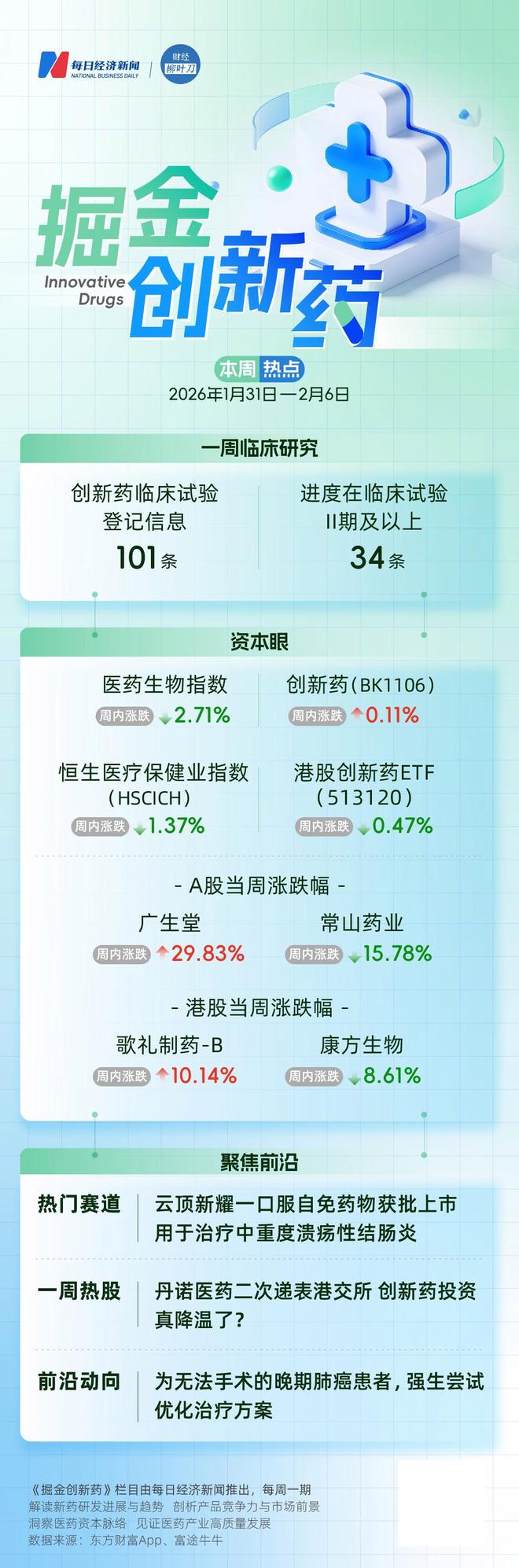
Market Overview - The pharmaceutical and biotechnology index decreased by 2.71%, underperforming the Shanghai Composite Index by 1.44 percentage points [4] - The innovative drug index (BK1106) saw a slight increase of 0.11%, while the Hang Seng Healthcare Index (HSCICH) fell by 1.37% [4] - The Hong Kong innovative drug ETF (513120) also experienced a decline of 0.47% [4] Sector Performance - The overall pharmaceutical sector weakened, lagging behind the Shanghai Composite Index, but the innovative drug sector showed relative resilience [5] - Specific stocks like Guangshentang surged due to the completion of Phase III clinical trials for hepatitis B treatments, while Changshan Pharmaceutical faced significant declines due to credit risks and expected losses [5] - In the Hong Kong market, Gilead Sciences-B received substantial investment from GIC, boosting its stock price, while Kangfang Biologics saw a notable drop due to stricter FDA approval standards [5] New Drug Developments - Danno Pharmaceuticals submitted a second listing application to the Hong Kong Stock Exchange, indicating a more rational investment environment focused on clinical viability and cash flow health [6][7] - The company has seven products in development, with TNP-2198 being the most advanced, expected to be approved in China by 2026 [6] - Three innovative drugs were approved during the week, including a treatment for type 2 diabetes and a drug for moderate to severe ulcerative colitis [12][13] Clinical Trials - From January 31 to February 6, 101 clinical trial registrations were disclosed, with 34 being in Phase II or above [8] - Notable trials include those for treatments targeting conditions such as obstructive sleep apnea and systemic lupus erythematosus [10][11] Emerging Trends - The investment landscape for innovative drugs is shifting towards a focus on clinical outcomes and commercial viability rather than merely the number of drug candidates [7] - The demand for effective treatments for ulcerative colitis is rising, with a significant increase in patient numbers expected by 2031 [14][15]

央妈今晚的讲话,信息量很大
表舅是养基大户· 2026-02-10 13:36
Core Insights - The current fiscal and monetary policies are in a "honeymoon period," with a strong emphasis on "fiscal-financial coordination" to enhance overall policy effectiveness [2] - Protecting bank net interest margins is a core goal of monetary policy, with a focus on lowering bank funding costs and maintaining favorable credit interest rates [3] - Maintaining low volatility in the bond market is a desirable market objective, with measures to balance government bond supply and demand [4] Fiscal and Monetary Policy - The report highlights the importance of fiscal and monetary policy coordination, stating that monetary policy has an "indirect incentive effect" while fiscal policy has a "direct incentive effect" [2] - The report indicates that the net investment of 5 trillion yuan through reverse repos and MLF in 2025 will effectively supplement the medium- and long-term funding gap [3] Insurance Sector - The insurance sector is expanding its balance sheet as a result of counter-cyclical policies, with premium income projected at 6.1 trillion yuan in 2025, a 7.4% year-on-year increase, while total assets are expected to grow by 15.1% [4] Industry Focus - The report emphasizes the importance of the consumer and pharmaceutical sectors, particularly the "online retail industry" and the pharmaceutical industry's core competitiveness [5] - The pharmaceutical sector is expected to enhance its international competitiveness through cross-border R&D cooperation and overseas clinical trials [5] Asset Management and Banking - The report discusses the shift of deposits from banks to non-bank financial institutions, indicating a trend where asset management products and bank deposits exhibit a "mutual exclusion" dynamic [5] - It is noted that the differentiation among banks is significant, with smaller banks facing challenges in attracting deposits due to lack of recognition from non-bank buyers [6] Market Trends - The report mentions the recent issuance of convertible bonds, with a notable 8 billion yuan issuance by Zhongke Zhuguang, reflecting changes in the supply-demand structure of the convertible bond market [8][9] - The report highlights the performance of the Hong Kong innovation drug sector, which saw a significant rebound, driven by strategic partnerships and market dynamics [24][31]

科创板已汇聚超600家企业 科创综指关注度持续提升
Zheng Quan Ri Bao Wang· 2026-02-10 12:37
本报讯 (记者毛艺融)2026年2月10日,科创板又迎来"新兵"中电科蓝天科技股份有限公司。目前,科 创板上市公司总数达到603家。作为中国"硬科技"企业的聚集地,科创板的板块产业图谱与现代化产业 体系建设同向而行,尤其在新一代信息技术、生物医药、高端装备制造等战略性新兴产业,已形成"链 主引领、上下协同"的发展格局。 科创综指为观察科创板整体情况和发展态势提供了全局性的视角。推出一年来,科创综指的市场关注度 持续提升,截至2026年2月10日,科创综指样本数量达580只,市值覆盖度超过90%,总市值高于100亿 元的科创综指成份股权重占比较发布时提升15.1%,成长效应显著。科创综指已成为与上证指数、深证 成指、创业板指并列的A股四大核心宽基指数,为境内外投资者观测和分享中国新质生产力发展红利提 供了重要工具。 已披露科创板公司 其一,集成电路产业受人工智能等新兴应用需求拉动,延续较高景气度。87家公司披露业绩情况,受益 于人工智能等新兴应用场景拓展,合计净利润同比增加约99.49亿元,57家公司业绩预增或扭亏为盈。 其二,创新药行业BD(商务拓展)交易频出、出海提速,商业化进程显著加快,招采回暖推动制药类 ...