有色

Search documents
中游分化,关注下游消费释放
Hua Tai Qi Huo· 2026-01-20 02:56
Report Summary Industry Investment Rating No industry investment rating is provided in the given content. Core View The report focuses on the differentiation in the mid - stream industries and suggests paying attention to the release of downstream consumption. It presents recent events in the production and service industries, and analyzes the price and operation status of upstream, mid - stream, and downstream industries [1]. Detailed Summary by Directory 1. Mid - view Event Overview - **Production Industry**: From January 15th to 16th, China Aero - Engine's "Taihang 7", "Taihang 15", and "Taihang 110" gas turbine innovation and development demonstration projects passed the evaluation and acceptance of the National Energy Administration, which will drive the industrialization and commercialization of China's gas turbine industry [1]. - **Service Industry**: As of January 17th, 2026, since the full - island customs closure of Hainan Free Trade Port on December 18th, 2025, Haikou Customs supervised 4.86 billion yuan in off - island duty - free shopping, a 46.8% year - on - year increase; 745,000 shopping visitors, a 30.2% increase; and 3.494 million shopping items, a 14.6% increase [1]. 2. Industry Overview - **Upstream**: Copper prices declined slightly; egg and pork prices rebounded; PTA prices dropped [2]. - **Mid - stream**: PX and urea in the chemical industry maintained high operating rates; power plant coal consumption was at a low level [3]. - **Downstream**: Second - tier city commercial housing sales increased seasonally; domestic flight frequencies decreased slightly [4]. 3. Key Industry Price Index Tracking - **Agriculture**: On January 19th, the spot price of corn was 2,262.9 yuan/ton (up 0.38% year - on - year), eggs 7.9 yuan/kg (up 8.28%), palm oil 8,620 yuan/ton (down 2.31%), cotton 15,889.3 yuan/ton (up 0.74%), and the average wholesale price of pork 18.5 yuan/kg (up 2.33%) [36]. - **Non - ferrous Metals**: On January 19th, the spot price of copper was 101,140 yuan/ton (down 2.07%), zinc 24,402 yuan/ton (up 1.16%), aluminum 23,890 yuan/ton (down 1.98%), and nickel 146,416.7 yuan/ton (up 0.46%) [36]. - **Black Metals**: On January 19th, the spot price of rebar was 3,232.3 yuan/ton (down 0.42%), iron ore 833.9 yuan/ton (down 1.03%), wire rod 3,480 yuan/ton (down 0.50%), and glass 12.9 yuan/square meter (down 0.23%) [36]. - **Non - metals**: On January 19th, the spot price of natural rubber was 15,583.3 yuan/ton (down 1.48%), and the China Plastics City price index was 775.7 (up 1.34%) [36]. - **Energy**: On January 19th, the spot price of WTI crude oil was 59.3 US dollars/barrel (up 0.37%), Brent crude oil 64.1 US dollars/barrel (up 1.25%), liquefied natural gas 3,514 yuan/ton (down 0.90%), and coal 803 yuan/ton (up 0.88%) [36]. - **Chemical Industry**: On January 19th, the spot price of PTA was 5,019.8 yuan/ton (down 2.02%), polyethylene 6,840 yuan/ton (up 2.47%), urea 1,767.5 yuan/ton (up 1.29%), and soda ash 1,214.3 yuan/ton (down 0.35%) [36]. - **Real Estate**: On January 19th, the national cement price index was 134.5 (down 0.44% year - on - year), the building materials composite index increased by 0.03%, and the national concrete price index decreased by 0.18% [36].
银河期货每日早盘观察-20260120
Yin He Qi Huo· 2026-01-20 02:41
1. Report Industry Investment Ratings No relevant content provided. 2. Core Views of the Report - The stock index is expected to continue its volatile consolidation, with the performance of the stock index futures differentiating. The market sentiment is affected by various factors such as high - level stocks and regulatory policies [20][21]. - In the agricultural product sector, the supply of protein meal still has pressure, the international sugar market is weak, the oil and fat sector maintains a volatile trend, and the prices of different agricultural products are affected by factors like supply and demand, weather, and policies [24][27][32]. - In the black metal sector, the steel price is likely to maintain a volatile trend before the Spring Festival, and the double - coke and iron ore are expected to run weakly, while the ferro - alloy has strong bottom support [55][59][61]. - In the non - ferrous metal sector, precious metals like gold and silver reach new highs due to the escalation of disputes between the US and Europe, and the prices of other non - ferrous metals are affected by factors such as geopolitics, supply and demand, and inventory [70][71][79]. - In the shipping sector, the container shipping market is in a low - season, and the freight rate is controversial. The market is waiting for new drivers [113]. - In the energy and chemical sector, the crude oil market is in a stalemate, and the prices of other chemical products are affected by factors such as raw material prices, supply and demand, and geopolitics [117][120]. 3. Summaries According to Relevant Catalogs 3.1 Financial Derivatives - **Stock Index Futures**: The stock index shows differentiation. After a slight decline in the opening, it fluctuated higher. The performance of the CSI 500 and CSI 1000 indexes was strong. The stock index futures also showed differentiation. The future market is expected to continue to fluctuate and consolidate [17][20][21]. - **Trading Strategy**: Short - term volatility, box operation, grid operation for single - side trading; IM\IC long 2606 + short ETF cash - and - carry arbitrage; double - selling strategy for options [21]. 3.2 Agricultural Products 3.2.1 Protein Meal - **Supply and Demand**: The overall supply and demand of US soybeans are relatively loose, and the domestic soybean meal cost side still has pressure. Although the short - term supply may decline and the demand is good, there is still pressure in the medium and long term [24]. - **Trading Strategy**: Short - side thinking for single - side trading; MRM spread widening for arbitrage; selling wide - straddle strategy for options [24]. 3.2.2 Sugar - **Market Condition**: The international sugar market is expected to fluctuate at the bottom in the short term, and the domestic sugar price is weakly following. The cost side provides some support, but there is also sales pressure [27]. - **Trading Strategy**: Observe for the domestic short - term main contract; observe for arbitrage; sell put options [27]. 3.2.3 Oil and Fat Sector - **Market Trend**: The market is expected to continue to fluctuate, with no obvious trend. The supply of rapeseed may increase, and the palm oil is in the production - reduction period [32]. - **Trading Strategy**: High - throw and low - suck interval operation for single - side trading; observe for arbitrage and options [32]. 3.2.4 Corn/Corn Starch - **Market Situation**: The US corn is expected to oscillate at the bottom in the short term, and the domestic corn spot price is stable in the short term but has pressure in the long term. The futures price is oscillating at a high level [35]. - **Trading Strategy**: Bullish thinking for the outer - market 03 corn after stabilization; short - term long for the 07 corn after correction; do long the 05 corn - starch spread when it is low for arbitrage [36]. 3.2.5 Live Pigs - **Supply and Demand**: The supply of live pigs is gradually increasing, and the overall price is declining. The overall inventory is high, and the supply pressure exists [37][38]. - **Trading Strategy**: Short - side thinking for single - side trading; observe for arbitrage; sell wide - straddle strategy for options [39]. 3.2.6 Peanuts - **Market Status**: The peanut spot price is stable, and the futures price is oscillating at the bottom. The import volume decreases, and the oil mill has profits [41]. - **Trading Strategy**: Go long the 05 peanut when it is low for single - side trading; observe for arbitrage; sell pk603 - C - 8200 options [41]. 3.2.7 Eggs - **Market Analysis**: The demand for eggs has improved, and the price is stable with a slight increase. The supply is in the process of capacity reduction, but the upward space of the 03 contract is limited [44]. - **Trading Strategy**: Go long the 5 - far - month contract when it is low for single - side trading; observe for arbitrage and options [45]. 3.2.8 Apples - **Market Condition**: The cold - storage inventory of apples is low, and the price is firm. The cost of warehouse receipts is high, and the demand is acceptable. The 5 - month contract price may rise if the demand remains normal [48]. - **Trading Strategy**: Partially take profits for the long position of the 5 - month contract; go short the 10 - month contract when it is high; do long the 5 - month contract and short the 10 - month contract for arbitrage [49]. 3.2.9 Cotton - Cotton Yarn - **Market Trend**: The cotton sales progress is fast, and the downstream stocking willingness increases. The cotton price is expected to oscillate in a short - term range [52]. - **Trading Strategy**: Observe for single - side trading, arbitrage, and options [52]. 3.3 Black Metals 3.3.1 Steel - **Market Situation**: The demand for steel has support, and the price is expected to continue to oscillate before the Spring Festival. The market sentiment and raw material prices affect the price [55]. - **Trading Strategy**: The steel price may be under pressure in the volatile market; short the coil - coal ratio when it is high and hold the short position of the coil - screw spread for arbitrage; observe for options [56]. 3.3.2 Double - Coking - **Market Analysis**: The supply of double - coking is relatively loose, and it is expected to run weakly with oscillations. The Mongolian coal supply and the downstream inventory - building situation affect the price [58]. - **Trading Strategy**: Oscillate weakly for single - side trading; observe for arbitrage; sell out - of - the - money call options [59]. 3.3.3 Iron Ore - **Market Condition**: The market expectation of iron ore is repeated, and the price is running weakly. The supply is loose, and the demand is expected to decline [61]. - **Trading Strategy**: Run weakly for single - side trading [62]. 3.3.4 Ferro - Alloy - **Market Status**: After adjustment, the ferro - alloy has strong bottom support. The supply of silicon - iron and manganese - silicon may decline, and the demand has support. The cost is relatively stable [64][65]. - **Trading Strategy**: Consider it as a long - position variety when it is low for single - side trading; observe for arbitrage; sell put options when it is high [68]. 3.4 Non - Ferrous Metals 3.4.1 Gold and Silver - **Market Trend**: Due to the escalation of disputes between the US and Europe, gold and silver reach new highs. The short - term performance of silver is more volatile, and gold is relatively more stable [70][71][72]. - **Trading Strategy**: Hold the long position of Shanghai gold against the 5 - day moving average; take profits for Shanghai silver conservatively or hold the long position cautiously for aggressive investors; do long the outer - market and short the inner - market for arbitrage; bullish call spread strategy for options [72][73]. 3.4.2 Platinum and Palladium - **Market Analysis**: The oscillation range of platinum and palladium converges. Platinum has stronger upward driving force, and the policy uncertainty still exists [74][75]. - **Trading Strategy**: Go long platinum when it is low for single - side trading; observe for palladium; observe for arbitrage and options [75]. 3.4.3 Copper - **Market Condition**: The short - term volatility of copper increases, and the long - term upward trend remains. The geopolitics, inventory, and consumption affect the price [77][79]. - **Trading Strategy**: Pay attention to profit protection and control positions for single - side trading; observe for arbitrage and options [80]. 3.4.4 Alumina - **Market Status**: Alumina is expected to run weakly. The increase in warehouse receipts and the downward trend of cost put pressure on the price [83]. - **Trading Strategy**: Oscillate weakly for single - side trading; observe for arbitrage and options [84]. 3.4.5 Electrolytic Aluminum - **Market Analysis**: The risk - aversion sentiment rises again, and the aluminum price stabilizes. The geopolitics, tariff policy, and inventory affect the price [86]. - **Trading Strategy**: The aluminum price stabilizes and rebounds for single - side trading; observe for arbitrage and options [87]. 3.4.6 Cast Aluminum Alloy - **Market Condition**: The market sentiment is repeated, and it stabilizes with the aluminum price. The supply of scrap aluminum is tight, which supports the price [89]. - **Trading Strategy**: No specific trading strategy provided [89]. 3.4.7 Zinc - **Market Analysis**: The price of zinc is affected by capital sentiment. The short - term price may return to the fundamental situation, with a downward pressure and then an interval oscillation [91][93]. - **Trading Strategy**: Observe the support at 17000 - 17200 and go long lightly when it is low for single - side trading; observe for arbitrage and options [93]. 3.4.8 Lead - **Market Status**: The price of lead is affected by capital sentiment. Similar to zinc, it may run weakly and then oscillate in an interval [95]. - **Trading Strategy**: Observe the support at 17000 - 17200 and go long lightly when it is low for single - side trading; observe for arbitrage and options [95]. 3.4.9 Nickel - **Market Analysis**: The nickel price adjusts with non - ferrous metals. The regulatory attitude is stable, and the long - term trend of non - ferrous metals is positive [97]. - **Trading Strategy**: Pay attention to the overall atmosphere of the non - ferrous metal sector for single - side trading; observe for arbitrage and options [98]. 3.4.10 Stainless Steel - **Market Condition**: Stainless steel follows the nickel price. The terminal demand is in the off - season, and the supply is tight. The price is expected to oscillate at a high level [100]. - **Trading Strategy**: Follow the nickel price for single - side trading; observe for arbitrage [101]. 3.4.11 Industrial Silicon - **Market Analysis**: Due to the sudden supply reduction news, the price is expected to be strong in the short term. The supply is expected to decrease, and the inventory may turn to de - stocking [102]. - **Trading Strategy**: Close the short position and go long when it is low for single - side trading; observe for arbitrage and options [103]. 3.4.12 Polysilicon - **Market Status**: The price is weakly stable. The actual transaction price may be the key to the disk. It is recommended to observe in the short term [104]. - **Trading Strategy**: Observe [104]. 3.4.13 Lithium Carbonate - **Market Analysis**: The price is running at a high level. The market may turn from inventory - building to de - stocking, and it is necessary to pay attention to the support level after the volatility decreases [107]. - **Trading Strategy**: Wait for the volatility to return to the normal level for single - side trading; observe for arbitrage; sell out - of - the - money call options [108]. 3.4.14 Tin - **Market Condition**: Due to the increasing risk of trade friction between Europe and the United States, the tin price rises with non - ferrous metals. The supply and demand situation and geopolitical risks need to be concerned [109][110]. - **Trading Strategy**: Observe the impact of trade friction on the tin price for single - side trading; observe for options [111]. 3.5 Shipping Sector - **Container Shipping**: The spot freight rate is in the process of peaking and falling. The market has different views on the strength of the upcoming peak - shipping season. The long - term recovery of the European line is still difficult. It is recommended to observe for single - side trading and do long the 6 - 10 spread when it is low for arbitrage [113][114][115]. 3.6 Energy and Chemical Sector 3.6.1 Crude Oil - **Market Situation**: The trading is light, and the market is in a stalemate. The international oil price is expected to oscillate widely. It is recommended to observe for arbitrage and options [117]. - **Trading Strategy**: Oscillate widely for single - side trading [117]. 3.6.2 Asphalt - **Market Analysis**: The raw material premium rises, and the asphalt is expected to oscillate at a high level. The supply is expected to be tight, and the demand is in the off - season. It is recommended to observe for options [120]. - **Trading Strategy**: Oscillate at a high level for single - side trading; pay attention to the BU4 - 6 positive spread for arbitrage [121]. 3.6.3 Fuel Oil - **Market Status**: The cost is oscillating, and the supply rhythm of high - and low - sulfur fuel oil needs to be concerned. The price may be volatile due to geopolitical factors. It is recommended to observe for options [122][123][124]. - **Trading Strategy**: Oscillate strongly, be vigilant about geopolitical risks for single - side trading; pay attention to the FU59 positive spread for arbitrage [124]. 3.6.4 Natural Gas - **Market Analysis**: The TTF/JKM price falls from a high level, and the HH rebounds after an over - decline. The short - term price is affected by weather and geopolitics, and the long - term price center may move down. It is recommended to observe for arbitrage [126][127][128]. - **Trading Strategy**: Continue to hold the short position of TTF and JKM in the third quarter, add positions aggressively for single - side trading; long - term roll - selling of out - of - the - money call options for TTF or JKM [128]. 3.6.5 LPG - **Market Condition**: The chemical demand is marginally weakening. The cost support weakens, and the supply increases slightly while the demand decreases slightly. The price may be under pressure [129]. - **Trading Strategy**: Oscillate weakly for single - side trading; observe for arbitrage and options [129]. 3.6.6 PX&PTA - **Market Analysis**: The polyester production cut increases, and the load decreases rapidly. The PX supply is high, and the PTA is affected by the cost and downstream demand. It is recommended to observe for arbitrage and options [132]. - **Trading Strategy**: No specific trading strategy provided [132]. 3.6.7 BZ&EB - **Market Status**: The pure benzene is expected to have a supply reduction, and the styrene has an inventory - de - stocking expectation. The price of pure benzene may be strong, and the styrene inventory is expected to decrease. It is recommended to observe for arbitrage and options [134][136]. - **Trading Strategy**: Oscillate strongly for single - side trading [136]. 3.6.8 Ethylene Glycol - **Market Analysis**: The seasonal inventory - building is obvious. The supply is stable, and the downstream demand is weak. The price is expected to oscillate weakly. It is recommended to observe for arbitrage [137]. - **Trading Strategy**: Oscillate weakly for single - side trading; sell call options [138]. 3.6.9 Short - Fiber - **Market Condition**: The supply is sufficient, and the terminal demand is weakening. The load may decrease, and the downstream is bearish. It is recommended to observe the implementation of the Spring Festival production - cut plan [140]. - **Trading Strategy**: No specific trading strategy provided [140]. 3.6.10 Bottle Chips - **Market Analysis**: The maintenance is accelerating. The production is expected to decrease, and the replenishment momentum may slow down. It is recommended to observe for arbitrage and options [142][144]. - **Trading Strategy**: Oscillate widely for single - side trading [144]. 3.6.11 Propylene - **Market Status**: The supply pressure is relieved. The supply improvement is limited, and the production enterprise has a
未知机构:陈果机构沟通小结与市场展望260118-20260120
未知机构· 2026-01-20 01:55
Summary of Conference Call on Market Trends and Investment Opportunities Industry and Company Overview - The conference focused on the dynamics of the financial markets, particularly the A-share and Hong Kong stock markets, analyzing their current status and future trends [1][2] - Emphasis was placed on the impact of AI technology advancements on market performance and investor sentiment [1][2] Core Insights and Arguments - **Market Sentiment and Risk Appetite**: A-share risk appetite is closely linked to market sentiment and liquidity, while Hong Kong stocks are driven by both domestic and foreign liquidity and company fundamentals [1][2] - **Investment Opportunities**: Key sectors highlighted for investment include technology, non-bank financials, and innovative pharmaceuticals, with a particular focus on the potential for recovery in the internet sector [1][2] - **Policy Influence**: The importance of market sentiment and policy direction in investment decisions was emphasized, suggesting that investors should monitor specific market signals to optimize their investment timing [1][2] Detailed Analysis - **Market Trends**: The discussion noted a potential shift towards a consolidation phase in the market, with a focus on the importance of the market sentiment index and the influence of incremental capital on market dynamics [3] - **Spring Market Outlook**: The second wave of the spring market is expected to involve policy-driven valuation recovery, particularly in the technology sector and among large-cap internet companies [3] - **AI Applications**: Despite a short-term cooling of risk appetite, AI applications are viewed as a significant long-term growth driver, with recommendations to hold stocks of companies with strong fundamentals [4] Hong Kong Market Insights - **Performance Discrepancies**: The Hong Kong market's performance is influenced by domestic and foreign capital flows, with a noted difference in pricing preferences between domestic and foreign investors [5][8] - **Valuation Restructuring**: The potential for valuation restructuring in internet companies due to AI applications was discussed, with the Hang Seng Internet Index showing signs of value emergence [6] - **Investment Recommendations**: Suggested sectors for investment include upstream raw materials, non-bank financials, and innovative pharmaceuticals, with a focus on companies showing improved fundamentals [6][24] Additional Considerations - **Market Signals**: Investors were advised to remain vigilant for specific market signals that could indicate optimal investment opportunities, particularly during periods of low sentiment [9][10] - **Long-term Outlook**: The long-term outlook for the technology sector, especially in AI computing and semiconductor equipment, remains positive, despite current market fluctuations [13][19] - **External Factors**: The influence of the US dollar index on Hong Kong stock liquidity was highlighted, indicating that a weaker dollar could enhance liquidity conditions for the Hong Kong market [23] Conclusion - The conference underscored the importance of understanding market sentiment, policy implications, and sector-specific dynamics in making informed investment decisions. Investors are encouraged to focus on sectors with clear fundamental improvements and to remain patient in their investment strategies, particularly in the context of the evolving AI landscape and market conditions [20][21][24]
中信证券:当前建议关注宽基产品中的创业板50、创业板指、双创50、中证1000等ETF
Jin Rong Jie· 2026-01-20 00:40
Core Insights - The ETF market has recently experienced record outflows, with broad-based ETFs seeing over 200 billion yuan in outflows in a single week, while sector and thematic ETFs in technology and cyclical sectors continue to attract inflows [1] Group 1: Market Trends - The outflow of funds from broad-based ETFs indicates a significant market adjustment, which may help temper market sentiment and promote rationality in capital markets [1] - Small-cap stocks have been less impacted by the outflows, while sectors such as banking, food and beverage, coal, and non-bank financials have faced greater challenges [1] Group 2: Investment Recommendations - The report suggests focusing on broad-based products like the ChiNext 50, ChiNext Index, Double Innovation 50, and CSI 1000 ETFs, as well as thematic products in new energy, non-ferrous metals, agriculture, pharmaceuticals, and medical devices [1]

除了140万亿元 这些突破同样值得关注
Jing Ji Guan Cha Wang· 2026-01-19 15:21
Group 1 - In 2025, China's GDP is projected to reach 140.1879 trillion yuan, reflecting a year-on-year growth of 5.0%, showcasing the resilience and adaptability of the Chinese economy in a challenging global environment [1] - The total retail sales of consumer goods in 2025 are expected to exceed 50.12 trillion yuan, with a growth rate of 3.7%, and final consumption expenditure contributing over 50% to economic growth, an increase of 5 percentage points from the previous year [2] - Research and development (R&D) expenditure intensity is anticipated to reach 2.8%, surpassing the OECD average for the first time, indicating a shift towards quality improvement and increased funding for foundational research and key technological breakthroughs [2] Group 2 - New energy vehicles (NEVs) are projected to account for over 50% of domestic new car sales in 2025, with annual production and sales exceeding 16 million units, reflecting significant growth in green energy products [2] - The share of non-fossil energy in total energy consumption is expected to increase by approximately 2 percentage points compared to the previous year, indicating progress in the green transformation of traditional industries [2] - The focus on high-quality development is evident as China moves beyond mere GDP growth, achieving effective quality improvements and structural transformations in its economy [3]
展锋:略有缓和,上下两难等方向!
Sou Hu Cai Jing· 2026-01-19 15:19
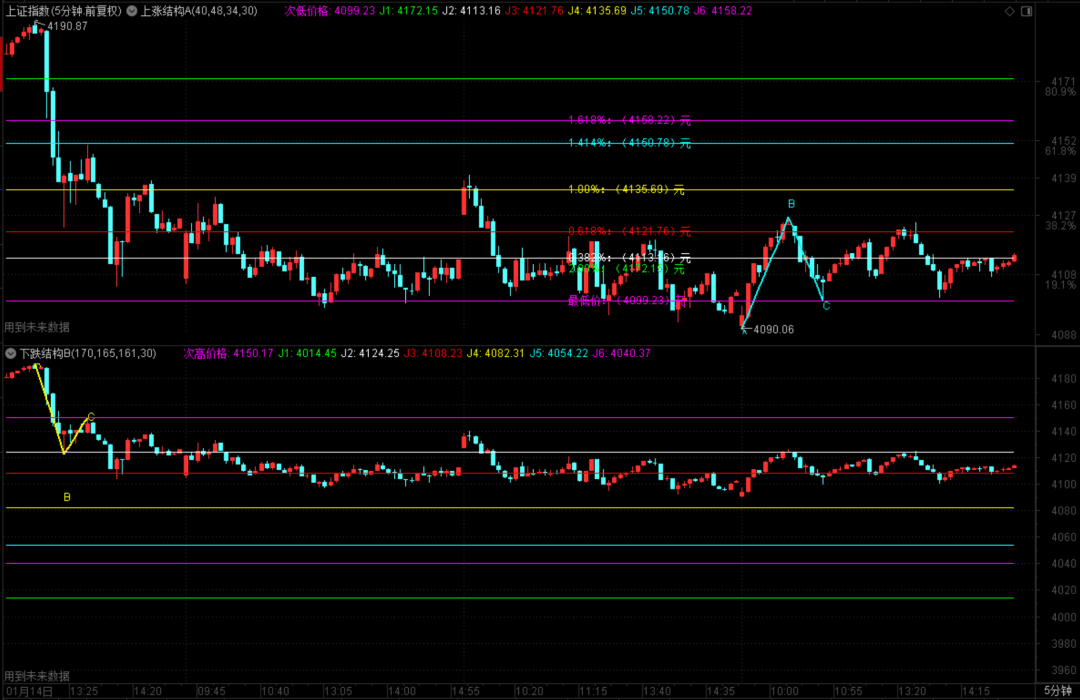
Market Overview - The market is currently in a stagnant state, with no significant upward or downward movement, resembling a bear market scenario [1] - The 5-minute structure of the market is clear, with a critical level at 4090.06; a breakthrough above 4150.17 is necessary to end the current downward structure [3] - The market is showing signs of being controlled, indicating that the current frustrating movements are unlikely to occur without external influence [3] Investment Strategy - The company has executed trades in specific stocks, including Zhonghang Jikong and Jiucai, while employing a strategy focused on selective buying [5] - The company emphasizes the importance of waiting for a clear market direction before making significant investments, advising investors to reduce positions during high points until a new trend emerges [7] - The company has identified several sectors with strong performance ratings, particularly the ultra-high voltage sector, while cautioning against potential declines in the non-ferrous sector [6] Stock Performance - The ultra-high voltage sector showed a notable increase of 4.38%, with a market capitalization of 350.15 billion [6] - The storage chip sector had a slight increase of 0.13%, with a market capitalization of 234.55 billion [6] - The chemical fiber sector experienced a rise of 3.96%, with a market capitalization of 254.35 billion [6]

(经济观察)产业结构优化彰显中国经济动能
Xin Lang Cai Jing· 2026-01-19 15:07
Group 1: Economic Growth and Structural Optimization - In 2025, China's GDP is projected to grow by 5.0% compared to the previous year, with a significant shift towards optimizing industrial structure, injecting new momentum into economic growth [1] - The "Three New" economy, focusing on new industries, new business formats, and new models, is expected to account for 18.01% of GDP in 2024, maintaining a high level in 2025 [1] - The automotive industry is projected to maintain its global leadership in production, sales, and exports, with new energy vehicles expected to account for over 50% of domestic new car sales [1] Group 2: Green Transition - By 2025, clean energy sources such as hydropower, nuclear power, wind power, and solar energy are expected to see an 8.8% increase in generation from the previous year, with non-fossil energy consumption rising by approximately 2 percentage points [2] - The green transformation of traditional industries is yielding significant results, with major energy-consuming sectors like construction materials, steel, and non-ferrous metals showing a notable decrease in energy consumption per unit of added value [2] - New energy vehicle production is anticipated to exceed 16 million units, maintaining global leadership in production and sales for 11 consecutive years [2] Group 3: Future Industries - 2025 is viewed as the year of artificial intelligence, with rapid advancements in future industries, particularly in AI, which is becoming a core driver for new productive forces and new market opportunities [3] - The integration of 5G technology is expected to cover 86 out of 97 sectors of the national economy, while industrial internet applications will comprehensively cover 41 industrial categories, enhancing value in the real economy [3] - Future industries such as advanced manufacturing, information technology, materials, energy, space, and health are identified as key areas for breakthrough developments during the 14th Five-Year Plan period [3]
【招银研究】美国经济趋势稳健,国内权益节奏放缓——宏观与策略周度前瞻(2026.01.19-01.23)
招商银行研究· 2026-01-19 12:29
Group 1: US Economic Outlook - The US economy continues to show strong overall performance with a projected real GDP annual growth rate of 5.3% by Q4 2025, driven by service consumption, intellectual property investment, and exports [2] - The CPI inflation rate for December 2025 is reported at 2.7%, aligning with market expectations, while core CPI inflation is slightly lower at 2.6%, indicating a trend towards inflation differentiation [2] - The labor market is stabilizing, with initial jobless claims at 198,000, suggesting that the unemployment cycle may have peaked [3] Group 2: Financial Markets - US Treasury yields are expected to face short-term pressure due to potential tariff increases by Trump, but the long-term trend remains downward as the interest rate cycle continues [3] - The S&P 500 and Nasdaq indices experienced declines of 0.4% and 0.7% respectively, primarily due to persistent inflation concerns impacting high-valuation tech stocks [3] - The dollar is in a mixed state, supported by resilient employment and retail data, but facing potential credit concerns due to renewed tariff threats [4] Group 3: Chinese Economic Insights - Domestic housing transactions remain low, with new home sales down 41.5% and second-hand home sales down 18.6% in major cities [7] - Export activity shows signs of recovery, with a 3.1% increase in cargo throughput and a 5.5% rebound in container throughput, indicating a positive trend in mechanical and automotive exports [7] - Corporate financing is improving, with a year-on-year increase of 580 billion in corporate loans, contributing to a stable credit growth rate of 6.4% [8] Group 4: Policy and Market Strategies - The Chinese government is focusing on boosting consumption through various initiatives, including a new round of subsidies for consumer goods [9] - The bond market is experiencing slight recovery, with the 10-year government bond yield at 1.84%, and expectations of continued support from monetary policy [10] - The A-share market is expected to slow down after a significant rally, with a focus on technology and manufacturing sectors as key growth drivers [11]
从年度数据复盘2025年经济情况
GF SECURITIES· 2026-01-19 10:26
Economic Growth - In 2025, China's real GDP is projected to grow by 5.0% year-on-year, achieving the annual growth target and maintaining a growth rate above 5% for three consecutive years[3] - The global real GDP growth forecast for 2025 is 2.7%, with developed economies and developing countries (excluding China) expected to grow by 1.7% and 3.7%, respectively[3] - China's GDP size in 2025 is estimated at 140,187.9 billion yuan, with a per capita GDP of approximately 99,786 yuan, or about 13,970 USD[3] Income and Consumption - In 2025, the per capita disposable income is expected to increase by 5.0%, slightly lower than the growth rates of 6.3% and 5.3% in 2023 and 2024, respectively[5] - The median growth rate of disposable income is projected at 4.4%, marking the lowest point since 2021[6] - The share of spending on food, clothing, and housing is declining, while spending on daily necessities, transportation, education, and entertainment is increasing[5] Industrial Growth - Key industries with rapid growth include railways, shipbuilding, aerospace (14.0%), automobiles (11.5%), and electronics (10.6%), contributing significantly to overall industrial growth[8] - The nominal GDP growth rate for 2025 is expected to be 4.0%, lower than the previous years' rates of 4.9% in 2023 and 4.2% in 2024[8] Investment Trends - Fixed asset investment is projected to decline by 3.8% year-on-year, with a notable drop in real estate investment by 36.3%[19] - The industrial capacity utilization rate is expected to be 74.4% in 2025, slightly improving but still below the 75.0% level of 2024[10] Demographic Challenges - The natural population growth rate for 2025 is projected at -2.41‰, continuing a trend of negative growth over the past three years[12] - The proportion of the population aged 60 and above is expected to reach 23.0% in 2025, indicating ongoing aging and declining birth rates[13]
【基金经理内参】引导资金流向“长牛慢牛”的核心资产;春节躁动短期平息;电力设备板块价值重估正当时
第一财经· 2026-01-19 09:38
Core Insights - The article emphasizes the importance of guiding capital towards "long bull and slow bull" core assets through targeted strategies [2] - It suggests that while short-term volatility around the Spring Festival may subside, the overall economic, policy, and liquidity environment remains optimistic for the year [2] - The undervalued "core assets" are highlighted, particularly in the power equipment sector, which is seen as ripe for value reassessment [2] - In the context of mixed signals in the non-ferrous metals sector, the stabilization of lithium carbonate prices is identified as a critical window for left-side positioning [2] - The dual value discovery in Hong Kong real estate stocks is noted, with asset reassessment and high dividend yields presenting attractive investment options [2] Summary by Sections - **Targeted Capital Flow**: The article discusses strategies to direct funds towards stable and promising core assets, indicating a shift in investment focus [2] - **Economic Outlook**: It presents a positive outlook for the year, supported by economic fundamentals, policy measures, and liquidity conditions despite short-term fluctuations [2] - **Power Equipment Sector**: The article identifies this sector as undervalued, suggesting that it is an opportune time for investors to reassess its value [2] - **Non-Ferrous Metals**: It highlights the importance of monitoring lithium carbonate prices as a key indicator for investment opportunities in this sector [2] - **Hong Kong Real Estate**: The article points out the potential for high returns through asset reassessment and dividends in this market [2]