装备制造业

Search documents
中经评论:“两新”激发中国制造新动能
Jing Ji Ri Bao· 2026-01-09 00:03
Group 1 - The "Two New" policy aims to optimize support for the manufacturing sector, enhancing investment growth in equipment manufacturing, consumer goods, and information technology, while promoting the transformation of Chinese manufacturing towards high-end, intelligent, and green development [1] - The demand for equipment updates is significant, with a 12.2% year-on-year increase in investment in equipment and tools from January to November 2025, contributing 1.8 percentage points to overall investment growth [1] - The first batch of 625 billion yuan in special bonds for consumer goods replacement has been allocated ahead of schedule, indicating strong governmental support for the initiative [1] Group 2 - The old-for-new consumption policy has opened new market opportunities for Chinese manufacturing, with sales of related products expected to exceed 2.6 trillion yuan in 2025, including over 11.5 million vehicles and 129 million home appliances [2] - The "Two New" policy not only stimulates investment and consumption but also drives quality upgrades in Chinese manufacturing, leading to improved production efficiency and profitability [2] - The shift towards smart and green products is evident, with nearly 60% of replaced vehicles being new energy vehicles and over 90% of replaced home appliances being energy-efficient [3] Group 3 - The optimization of the "Two New" policy is expected to invigorate small and medium-sized enterprises (SMEs) by lowering investment thresholds and streamlining application processes, thus enhancing their competitiveness [3] - The policy encourages a collaborative upgrade across the supply chain, fostering a virtuous cycle of demand and supply, which is essential for the sustainable growth of the manufacturing sector [3] - The dual focus on investment and consumption through the "Two New" policy is set to accelerate China's transition from a manufacturing power to a manufacturing stronghold [4]
“两新”激发中国制造新动能
Jing Ji Ri Bao· 2026-01-08 21:43
Core Viewpoint - The "Two New" policy aims to inject new momentum into Chinese manufacturing by driving investment and consumption, facilitating a transition from a manufacturing power to a manufacturing stronghold [1][4]. Investment and Consumption - The National Development and Reform Commission and the Ministry of Finance have optimized the support scope, subsidy standards, and implementation mechanisms of the "Two New" policy [1]. - A total of 625 billion yuan in special long-term bonds for the first batch of the consumption upgrade plan has been allocated ahead of schedule for 2026 [1]. - From January to November 2025, investment in equipment and tools increased by 12.2% year-on-year, contributing 1.8 percentage points to overall investment growth [1]. Market Opportunities - The "old-for-new" consumption policy has opened new market spaces for durable consumer goods, with sales expected to exceed 2.6 trillion yuan in 2025 [2]. - Specific figures include over 11.5 million vehicles, 129 million home appliances, 9.1 million digital products, and 12 million home renovation items being replaced [2]. Upgrading Manufacturing - The "Two New" policy not only stimulates investment and consumption but also drives quality upgrades in Chinese manufacturing [2]. - Companies are replacing outdated equipment with new technology, improving production efficiency and product competitiveness, which encourages further R&D investment [2]. Transition to High-End Manufacturing - There is a growing preference for smart and green products, with nearly 60% of replaced vehicles being new energy vehicles and over 90% of replaced home appliances being energy-efficient [3]. - The policy optimization is expected to invigorate more small and medium-sized enterprises (SMEs) by lowering investment thresholds and streamlining application processes [3].
2025年12月制造业市场需求回升,原材料供应端交货时间持续缩短 | 高频看宏观
Sou Hu Cai Jing· 2026-01-08 15:14
Economic Activity Index - The China High-Frequency Economic Activity Index (YHEI) as of January 6, 2026, is 1.13, an increase of 0.05 from December 30, 2025, driven by a rise in the coastal coal freight index [1][3] - The "import dry bulk freight index" remained stable at 1.15, indicating consistent shipping costs [1][3] Manufacturing Sector - The manufacturing PMI for December 2025 is 50.1%, up 0.9 percentage points from the previous month, marking a return to expansion for the first time since April 2025 [17] - High-tech manufacturing, equipment manufacturing, and consumer goods sectors saw PMIs of 52.5%, 50.4%, and 50.4%, respectively, all above the neutral line [17] - New orders index rose from 49.2% to 50.8%, and the production index increased by 1.7 percentage points to 51.7% [2][17] - The procurement volume index also returned to expansion at 51.1%, indicating increased demand for raw materials [2][17] Non-Manufacturing Sector - The non-manufacturing business activity index for December 2025 is 50.2%, up 0.7 percentage points, indicating a return to expansion [18] - The construction and service sectors reported indices of 52.8% and 49.7%, respectively, with construction rebounding after four months of contraction [18] Price Trends - The producer price index increased by 0.7 percentage points to 48.9%, while the main raw material purchase price index remains high at 53.1% [2][17] Financial Market Indicators - The central bank's net cash withdrawal through open market operations was 695.9 billion yuan, with a reverse repurchase rate of 1.4% [5] - The overnight interbank rate decreased by 1 basis point to 1.33%, while the seven-day repo rate fell by 66 basis points to 1.49% [8] Real Estate Market - In the week ending January 6, 2026, new and second-hand home transaction areas in first-tier cities fell by 48.57% and 38.95%, respectively [30] - Second-tier cities saw a decline of 59.67% and 23.04% in transaction areas for new and second-hand homes [30] Consumer Behavior - The average daily box office for movies reached 154 million yuan, an increase of 78.64 million yuan from the previous week [32]


四月国民经济延续回升向好态势
Ren Min Ri Bao· 2026-01-06 01:57
Group 1 - The core viewpoint of the articles indicates that China's national economy showed stable growth in April, with improvements in production, demand, and high-quality development [1][2] Group 2 - In April, the industrial added value of large-scale industries increased by 6.7% year-on-year, with over 80% of industries and nearly 60% of products experiencing a rebound in growth [1] - The service production index grew by 3.5% year-on-year, indicating overall stability in the service sector [1] - The total import and export volume in April increased by 8% year-on-year, with the first four months of 2023 achieving a record high for the same period [1] - Retail sales of consumer goods in April rose by 2.3% year-on-year, reflecting an expanding market demand [1] - Fixed asset investment grew by 4.2% year-on-year from January to April, with manufacturing investment increasing by 9.7% [1] - The manufacturing purchasing managers' index expanded for two consecutive months, with the production and business activity expectation index at 55.2% and the service business activity index at 50.3% [1] Group 3 - The added value of equipment manufacturing and high-tech manufacturing industries increased by 9.9% and 11.3% year-on-year in April, respectively [2] - New retail models such as instant retail and live streaming sales contributed to an 11.1% year-on-year growth in online retail sales of physical goods from January to April [2] - Investment in the livelihood sector increased significantly, with education and sports investments growing by 7.7% and 12.7% year-on-year, respectively, outpacing overall investment growth [2]
“万亿”徐州,苏北“零的突破”
Guo Ji Jin Rong Bao· 2026-01-05 04:56
Core Insights - Xuzhou is expected to join the "trillion GDP club" by 2025, becoming the sixth city in Jiangsu and the first in Northern Jiangsu to achieve this milestone [1][2] - The city's GDP is projected to reach 9,537.12 billion yuan in 2024, with a growth target of around 6% for 2025, indicating a steady economic trajectory rather than a sudden leap [1][2] Economic Growth and Development - Xuzhou's economic growth is driven by its unique geographical advantages, serving as a hub connecting four provinces, and has been recognized as the center of the Huaihai Economic Zone since 2017 [1][2] - The city has built a robust transportation network, enhancing its industrial, population, and market factor aggregation, which contributes to its economic expansion [2] Industrial Transformation - Xuzhou is transitioning from a resource-based economy to one focused on emerging industries, with 331 future industry-related enterprises and 15 recognized as high-growth by the province [2][3] - The city is experiencing significant growth in its mining and equipment manufacturing sectors, benefiting from the recovery of the coal industry and engineering machinery market [3] Future Goals and Projections - For 2026, Xuzhou aims for a GDP growth of approximately 5.5%, a public budget revenue increase of 2%, and a retail sales growth of around 6% [3] - The city's transformation journey serves as a model for similar cities in Northern Jiangsu and across the country, enhancing its role in regional collaborative development [3]

制造业PMI时隔8个月重返扩张区间
Jin Rong Shi Bao· 2026-01-05 01:27
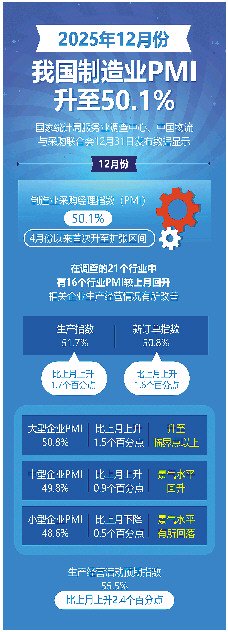
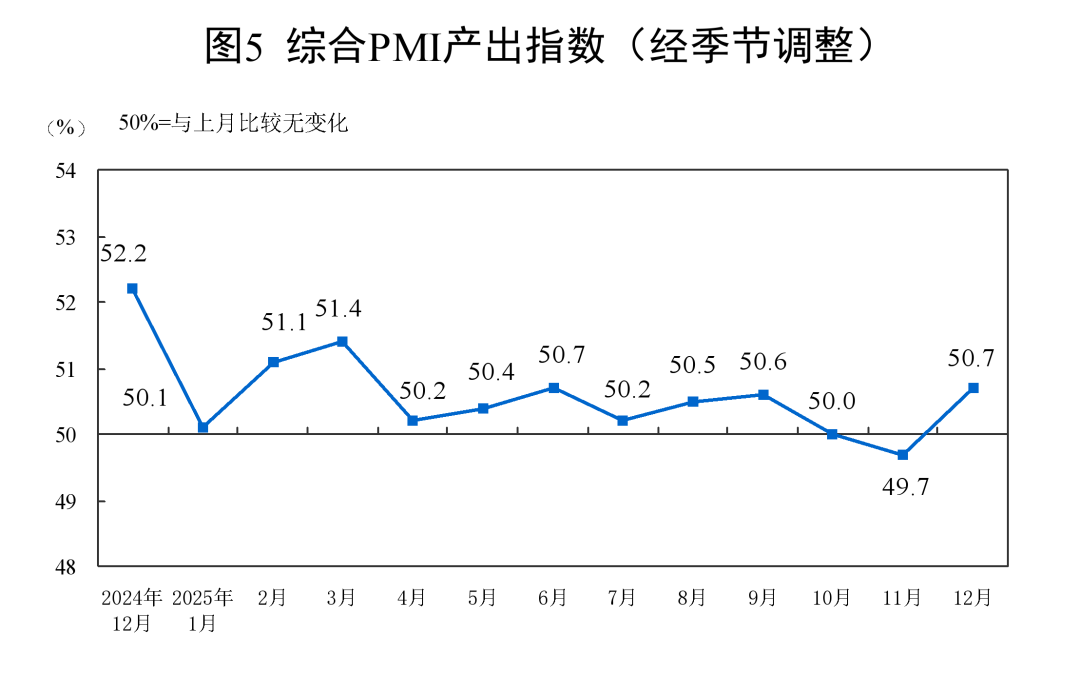
Core Viewpoint - The overall economic sentiment in China is improving as indicated by the rise in the Purchasing Managers' Index (PMI) across manufacturing and non-manufacturing sectors, suggesting a recovery in market demand and production activities [1][2][4]. Manufacturing Sector - In December 2025, the manufacturing PMI rose to 50.1%, an increase of 0.9 percentage points from the previous month, marking the first time it entered the expansion zone since April 2025 [1][2]. - The production index and new orders index were reported at 51.7% and 50.8%, respectively, with significant increases of 1.7 and 1.6 percentage points, indicating a strong recovery in market demand [2]. - The new export orders index increased by 1.4 percentage points to 49.0%, reflecting a positive shift in external trade conditions [2]. - The PMI for large enterprises reached 50.8%, up 1.5 percentage points, while medium-sized enterprises saw a rise to 49.8%. Small enterprises, however, experienced a decline to 48.6% [3]. Non-Manufacturing Sector - The non-manufacturing business activity index rose to 50.2%, an increase of 0.7 percentage points from the previous month, indicating improved sentiment in the service sector [4]. - The service sector PMI was reported at 49.7%, showing a slight recovery of 0.2 percentage points, with certain industries like telecommunications and financial services experiencing rapid growth [4]. Construction Sector - The construction PMI surged to 52.8%, a significant increase of 3.2 percentage points, returning to the expansion zone for the first time in five months, driven by new policy financial tools and favorable weather conditions [5]. - The business activity expectation index for the construction sector was reported at 57.4%, indicating optimism among construction enterprises regarding future developments [5]. Overall Economic Outlook - The comprehensive PMI output index reached 50.7%, indicating an overall expansion in production and business activities compared to the previous month [5]. - Analysts expect that the supportive measures for economic growth will continue to bolster the manufacturing sector, although consumer demand remains weak and requires further improvement [5].

三重逻辑支撑中国资产“吸金力”提升
Zheng Quan Ri Bao Zhi Sheng· 2026-01-04 17:07
Group 1: Market Performance - The Hang Seng Index surged by 2.76% and the Hang Seng Tech Index increased by 4% on January 2, 2026, indicating strong market sentiment and enhanced global attractiveness of Chinese assets [1] - The recent performance of the Hong Kong stock market reflects a significant improvement in the global appeal of Chinese assets, driven by multiple factors including policy benefits, economic fundamentals, and global liquidity [1] Group 2: Policy Support - A comprehensive policy framework has been established to enhance the attractiveness of Chinese assets, including high-level opening-up, support for technological innovation, and optimization of the foreign investment environment [1] - Specific measures such as the optimization of capital market connectivity and the reduction of the negative list for cross-border service trade have been implemented to eliminate barriers for foreign investment [1] - Policies targeting key sectors like high-end manufacturing, semiconductors, and biomedicine have been introduced, providing tax incentives, R&D subsidies, and financing support to cultivate globally competitive enterprises [1] Group 3: Economic Fundamentals - Continuous improvement in China's economic fundamentals and internal driving forces is a core support for the attractiveness of Chinese assets [2] - The manufacturing PMI reached 50.1% in December 2025, marking its first entry into the expansion zone since April of the previous year, with high-tech manufacturing PMI at 52.5% [2] - The emergence of new growth engines reinforces the logic of high-quality economic development and provides clear and lasting value anchors for the capital market [2] Group 4: Global Liquidity and Asset Allocation - The restructuring of global liquidity and adjustments in asset allocation have opened a strategic window for Chinese assets [3] - The Federal Reserve's cumulative interest rate cuts of 75 basis points last year have triggered a global capital reallocation wave, increasing the risk appetite for international capital [3] - China's assets are viewed as a "safe haven" due to their strong risk resistance and growth certainty, attracting long-term global capital allocation [3]
12月PMI反季节性回升的中观线索
GF SECURITIES· 2026-01-04 05:24
Manufacturing Sector - In December 2025, the manufacturing PMI increased by 0.9 points to 50.1, significantly above the seasonal trend where the average decline over the past 10 years was 0.3 points[3] - Only 4 out of 15 sub-sectors are in the expansion zone, a decrease of 4 from November, with specialized equipment, non-metallic mineral products, and agricultural products falling below the prosperity line[3] - High-tech manufacturing PMI rose to 52.5, up 2.4 points from the previous month, indicating strong growth in this sector[3] Industry Performance - The pharmaceutical, automotive, textile, and computer communication sectors lead in prosperity, with PMI values between 55-60, while the chemical, metal products, and non-metallic mineral sectors are between 45-50[4] - The pharmaceutical sector's production and demand may be influenced by the flu season, while the petrochemical sector stabilized with a production increase of 15 points[5] - The electrical machinery sector saw a 1.3-point increase in PMI, driven by strong demand in home appliances and new energy sectors[6] Emerging Industries - Emerging industries such as biotechnology, new energy vehicles, and next-generation information technology maintain high prosperity levels, with biotechnology PMI rising by 2.7 points[7] - Among seven emerging industries, biotechnology has the highest prosperity level at 60, while new energy vehicles and next-generation information technology are between 50-55[7] Construction Sector - The construction sector's PMI rose by 3.2 points to 52.9, marking a return to expansion after four months[9] - The real estate sector saw a slight increase of 0.5 points, with construction activities improving due to favorable policies and funding availability[8] - New orders in the construction sector increased by 1.3 points, with real estate new orders rising by 8.2 points[10] Service Sector - The service sector's business activity index increased by 0.2 points to 49.7, with online information technology services and postal services leading the growth[12] - The hospitality and catering sectors experienced the lowest prosperity levels, with indices below 45, reflecting weak consumer activity[12] - The financial services sector remains strong, with indices above 60, indicating robust performance in monetary and capital market services[12]
50.1%!重返扩张区间
Jin Rong Shi Bao· 2026-01-04 04:24
Core Viewpoint - The Purchasing Managers' Index (PMI) for December indicates a recovery in China's economic activity, with all three major indices entering the expansion zone for the first time since April [1][4]. Manufacturing Sector - The manufacturing PMI rose to 50.1%, an increase of 0.9 percentage points from the previous month, exceeding market expectations [7]. - The production index and new orders index were reported at 51.7% and 50.8%, respectively, both showing significant increases of 1.7 and 1.6 percentage points [7]. - The new export orders index increased by 1.4 percentage points to 49.0%, indicating a recovery in domestic demand [7]. - Large enterprises' PMI returned to the expansion zone at 50.8%, while medium-sized enterprises' PMI rose to 49.8%, and small enterprises' PMI fell to 48.6% [7]. Key Industries - High-tech manufacturing PMI reached 52.5%, up 2.4 percentage points, indicating positive growth trends [8]. - Equipment manufacturing and consumer goods industries both reported PMIs of 50.4%, entering the expansion zone [8]. - The construction industry PMI significantly increased to 52.8%, up 3.2 percentage points, marking a return to expansion after five months [15]. Non-Manufacturing Sector - The non-manufacturing business activity index was 50.2%, an increase of 0.7 percentage points from the previous month [12]. - The service sector PMI was reported at 49.7%, a slight increase of 0.2 percentage points, with certain sectors like telecommunications and financial services showing strong growth [12]. - The construction industry's business activity expectation index was 57.4%, indicating optimism among construction firms [16]. Overall Economic Outlook - The comprehensive PMI output index rose to 50.7%, indicating overall expansion in production and business activities compared to the previous month [16]. - The service sector's business activity expectation index increased to 56.4%, reflecting enhanced confidence in future market development [16].
经济景气水平总体回升
Xin Lang Cai Jing· 2026-01-01 16:40
Core Viewpoint - The manufacturing and non-manufacturing sectors in China showed signs of recovery in December 2025, with key indices rising above the expansion threshold, indicating improved economic conditions [1][4]. Manufacturing Sector - In December 2025, the Manufacturing Purchasing Managers' Index (PMI) reached 50.1%, marking the first time it entered the expansion zone since April [1]. - Among the 21 surveyed industries, 16 reported an increase in PMI compared to the previous month, indicating improved production and operational conditions [1]. - The production index and new orders index were 51.7% and 50.8%, respectively, both showing significant increases of 1.7 and 1.6 percentage points from the previous month [1]. - High-tech manufacturing PMI was 52.5%, up 2.4 percentage points, indicating positive growth trends [3]. - Equipment manufacturing and consumer goods industries both recorded PMIs of 50.4%, rising by 0.6 and 1.0 percentage points, respectively [3]. - The procurement activity accelerated with a procurement volume index of 51.1%, entering the expansion zone [2]. Non-Manufacturing Sector - The Non-Manufacturing Business Activity Index was 50.2%, an increase of 0.7 percentage points, indicating an improvement in the non-manufacturing sector's economic conditions [4]. - The new orders index for non-manufacturing rose to 47.3%, up 1.6 percentage points, reaching the highest level this year [4]. - The business activity expectation index for non-manufacturing was 56.5%, reflecting a continuous increase for three months, indicating rising market confidence [4]. - The construction industry saw a significant improvement, with the business activity index at 52.8%, up 3.2 percentage points from the previous month [4]. Composite Index - The Composite PMI Output Index reached 50.7%, an increase of 1.0 percentage point, indicating overall expansion in production and operational activities [5].