化工

Search documents
格林大华期货早盘提示:纯苯-20260319
Ge Lin Qi Huo· 2026-03-19 01:11
研究员:吴志桥 从业资格:F3085283 交易咨询资格:Z0019267 联系方式:15000295386 | 板块 | 品种 | 多(空) | 推荐理由 【行情复盘】 | | --- | --- | --- | --- | | | | | 周三夜盘主力合约期货 BZ2604 价格上涨 164 元至 8448 元/吨,华东主流地区现货价 格 8200 元/吨(环比-85),山东地区现货价格 7703 元/吨(环比-126)。持仓方面, 多头减少 988 手至 1.65 万手,空头减少 1412 手至 1.79 万手。 | | | | | 【重要资讯】 | | | | | 1、供应方面,2 月国内纯苯产量 185.91 万吨,较上月下降 8.73 万吨,较去年同月 | | | | | 上升 13.85 万吨。 | | | | | 2、库存方面,2026 年 3 月 16 日,江苏纯苯港口样本商业库存总量:28.8 万吨,较 | | | | | 上期库存 30.2 万吨去库 1.4 万吨,环比下降 4.6%;较去年同期库存 13.5 万吨累库 | | | | | 15.3 万吨,同比上升 113.33%。3 月 ...
能源化策略:中东更多能源基础设施损坏,原油带领化?延续强势
Zhong Xin Qi Huo· 2026-03-19 00:55
1. Report Industry Investment Rating No information provided in the report. 2. Core Viewpoints of the Report - The conflict in the Middle East has escalated, disrupting the global energy supply. China, as the world's largest crude oil importer, may release some commercial crude oil reserves to help the petrochemical industry through the current difficulties. The price of chemicals is unlikely to fall significantly due to the increase in cost [2]. - Crude oil will lead the chemical industry to continue its strong and volatile pattern. The prices of various chemical products are affected by geopolitical factors, and the market outlook varies for different products [3]. 3. Summary by Relevant Catalogs 3.1 Market Views - **Crude Oil**: The operation risk of energy facilities in the Middle East has increased, and the shortage pattern continues. The market is facing a large supply gap, and the price is expected to fluctuate strongly. The main influencing factors include the Middle East geopolitical situation, OPEC+ production policy changes, and Sino-US tariff policy adjustments [7]. - **Asphalt**: Supported by geopolitical factors, the asphalt futures price fluctuates at a high level. The refinery's profit has deteriorated, and there is an expectation of a significant reduction in refinery operations. The market is in a state of weak supply and demand, and the inventory is accumulating. The price is expected to fluctuate, and the long - term valuation is expected to decline [8]. - **High - Sulfur Fuel Oil**: Supported by geopolitical factors, it fluctuates at a high level. The high import dependence and strong geopolitical attributes are pushing up the futures price. In the long term, the demand for fuel oil power generation in the Middle East is gradually being replaced, which is a long - term negative factor. The price is expected to fluctuate, and attention should be paid to the Middle East geopolitical situation in the short term [8][9]. - **Low - Sulfur Fuel Oil**: It follows the high - level fluctuation of crude oil. It is affected by factors such as the decline in shipping demand, green energy substitution, and high - sulfur substitution. The current valuation is moderately high, and it is expected to fluctuate following crude oil [11]. - **PX**: The supply is expected to be tight due to the contraction of the total supply and structural concessions. The price is expected to fluctuate strongly in the short term, and the mid - term logic of buying on dips is maintained [13]. - **PTA**: Traders are actively selling, and the basis is rapidly weakening. The price is expected to fluctuate strongly in the short term, and the TA05 - 09 spread is expected to maintain a positive spread logic in the short term [14][15]. - **Pure Benzene**: It is mainly affected by the geopolitical situation and runs strongly in a volatile manner. The supply is expected to decrease, and the price is expected to fluctuate strongly [15][17]. - **Styrene**: Geopolitical factors bring positive effects to supply and demand, and it runs strongly in a volatile manner. The supply may be reduced, and there is an expectation of increased exports. The price is expected to fluctuate strongly [18][19]. - **MEG**: The cost side is still supported, and the price is firm under the reduction of supply. The price is expected to fluctuate strongly in the short term, and it is advisable to wait and see in the short term [20][21]. - **Short Fibers**: The market is mainly in a wait - and - see state, with mostly rigid demand transactions. The price follows the upstream and is expected to fluctuate strongly in the short term [21][22]. - **Polyester Bottle Chips**: The intraday trading has become lighter, and the transaction price difference is large. The price follows the upstream raw materials, and the processing fee has a certain support below. It is expected to fluctuate strongly [23]. - **Methanol**: Affected by the continuous geopolitical conflict, it fluctuates within a range. The market tends to trade the geopolitical premium, and it is expected to fluctuate within a range [25]. - **Urea**: The commercial reserves are concentrated and released, and the price is moderately weak. The supply is stable at a high level, and the demand side has some changes. It is expected to fluctuate moderately and may be slightly weak [26]. - **PE**: Geopolitical disturbances still exist, and it should be treated with caution. Geopolitical factors support the raw material side, but the downstream demand is affected by price increases. It is expected to fluctuate strongly [30][31]. - **PP**: Geopolitical factors boost the support of the raw material side, and it fluctuates strongly. The raw materials such as crude oil and propane still support the price, and it is expected to fluctuate strongly [31]. - **PL**: The refinery operation is decreasing, and the downstream is still under pressure. It fluctuates strongly. The operation is decreasing, but the powder profit is still under pressure. It is expected to fluctuate strongly [32]. - **PVC**: Geopolitical disturbances still exist, and it is cautiously optimistic. The reduction of chlor - alkali enterprises supports the market, but attention should be paid to the alleviation of the shortage of upstream raw material supply. It is expected to fluctuate strongly [34]. - **Caustic Soda**: The supply is decreasing, and it is cautiously optimistic. The reduction of chlor - alkali enterprises supports the market, and it is expected to fluctuate strongly [34][35]. 3.2 Variety Data Monitoring 3.2.1 Energy and Chemical Daily Index Monitoring - **Inter - period Spreads**: Different varieties have different inter - period spread values and changes, such as Brent (M1 - M2: 4.04, change: 0.01), Dubai (M1 - M2: 9.92, change: 0.72), etc. [37]. - **Basis and Warehouse Receipts**: Each variety has corresponding basis and warehouse receipt data, such as asphalt (basis: - 310, change: 9, warehouse receipt: 93980 tons), etc. [38]. - **Inter - variety Spreads**: There are also different inter - variety spread values and changes, such as 1 - month PP - 3MA (- 242, change: - 72), etc. [39]. 3.2.2 Chemical Basis and Spread Monitoring Although the report lists various varieties such as methanol, urea, etc., no specific data or analysis content is provided for this part. 3.3 Commodity Index - **Comprehensive Index**: The comprehensive index is 2581.98, with a decline of 0.38%; the commodity 20 index is 2916.20, with a decline of 0.36%; the industrial product index is 2557.35, with a decline of 0.31% [277]. - **Energy Index**: On March 18, 2026, the energy index was 1774.53, with a daily increase of 0.48%, a 5 - day increase of 2.97%, a 1 - month increase of 53.93%, and a year - to - date increase of 63.31% [279].
中东战火点燃化工行情,巴斯夫再发提价公告,化工品有望迎景气上行(附概念股)
Zhi Tong Cai Jing· 2026-03-19 00:30
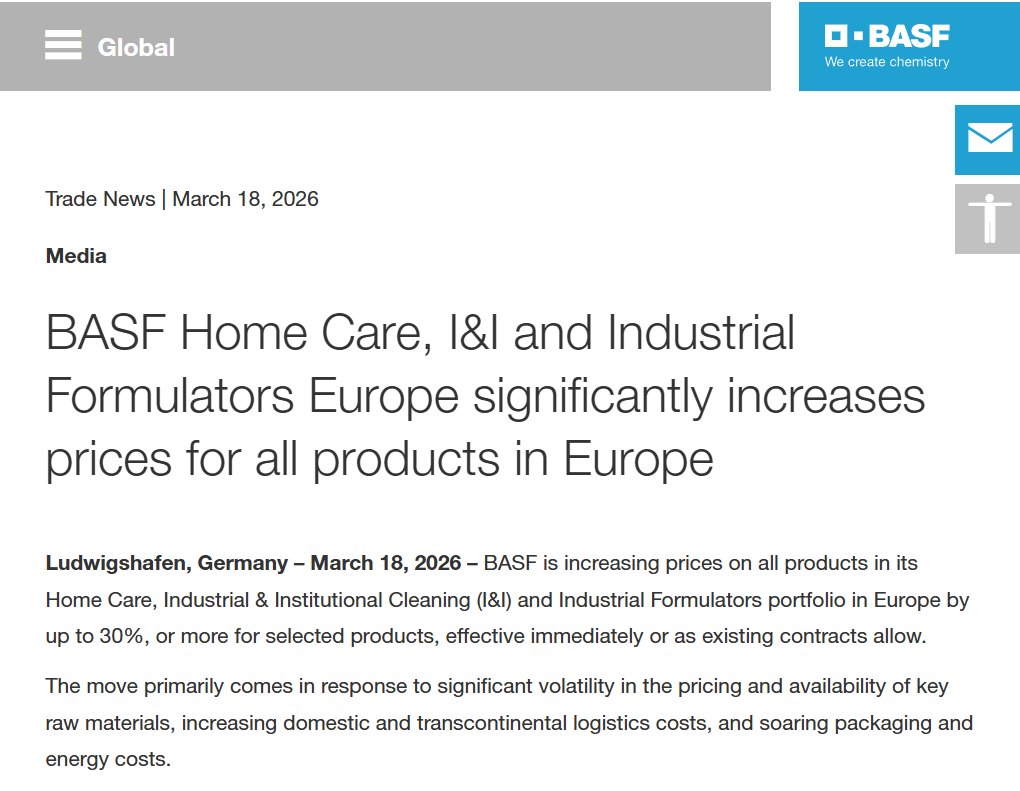
Group 1 - The ongoing escalation of the Middle East situation, particularly the conflict involving Israel and Iran, is injecting significant uncertainty into global capital markets and disrupting global prices [1] - BASF announced price increases for all products in its home care, industrial and institutional cleaning, and industrial formulation business in Europe, with increases of up to 30% for some selected products [1] - The price hikes are primarily in response to severe fluctuations in key raw material prices and supply, along with rising logistics, packaging, and energy costs [1] Group 2 - The German Chemical Industry Association (VCI) issued a warning indicating that the Iran conflict and potential closure of the Strait of Hormuz could severely impact the chemical industry, raising concerns about supply bottlenecks for ammonia, phosphate, helium, and sulfur [2] - Rising international oil prices due to geopolitical tensions may make coal chemical products a significant factor in domestic coal price transmission, especially as the Middle East is a major source of methanol imports for China [2] - Domestic chemical products maintain a global cost advantage, and with the exit of high-energy-consuming facilities in Europe and North America, along with economic growth in Asia, Africa, and Latin America, bulk chemical products are expected to see an upturn in demand by 2026 [2] Group 3 - The global energy landscape is undergoing deep adjustments, highlighting the importance of modern coal chemical technology in ensuring energy and supply chain security for China [3] - By 2025, the proportion of chemical oil consumption in China is projected to be around 24%, while coal for chemical use is expected to be about 8% [3] - China's modern coal chemical technology and scale are globally leading, with potential for high-quality exports to countries along the Belt and Road Initiative [3] Group 4 - Sinopec (00386) is constructing a globally leading refining and intelligent refining base, with a terminal network covering 30,000 gas stations and over 28,000 convenience stores [4] - Sinopec Oilfield Services (01033) is a leading integrated oil service enterprise in China, actively expanding its overseas market business [4] - Sinopec Refining and Chemical Engineering (02386) reported a 2% year-on-year increase in new contracts signed domestically, with overseas contracts accounting for 38% of total new contracts [4] Group 5 - Shanghai Petrochemical (00338) is a major integrated refining and chemical enterprise in China and the first company listed in Shanghai, Hong Kong, and New York [5] - The main business includes processing crude oil to produce synthetic fibers, resins, plastics, intermediate petrochemical products, and finished oil products [5]

中原证券晨会聚焦-20260319
Zhongyuan Securities· 2026-03-19 00:16
Core Insights - The report highlights the ongoing adjustments in various industries, particularly in the semiconductor and photovoltaic sectors, driven by geopolitical tensions and domestic policy shifts [5][9][23]. Domestic Market Performance - The Shanghai Composite Index closed at 4,062.98, with a slight increase of 0.32%, while the Shenzhen Component Index rose by 1.05% to 14,187.80 [4]. - The average price-to-earnings ratios for the Shanghai Composite and ChiNext are 16.74 and 47.98, respectively, indicating a favorable long-term investment environment [11][12]. International Market Performance - The Dow Jones Industrial Average fell by 0.67% to 30,772.79, while the S&P 500 and Nasdaq also experienced declines of 0.45% and 0.15%, respectively [5]. - The report notes that global semiconductor sales continue to grow, with a year-on-year increase of 46.1% in January 2026, indicating strong demand in the sector [18]. Industry Analysis - The semiconductor industry is experiencing a recovery, with domestic storage module manufacturers exceeding expectations in Q1 2026, driven by rising prices in the global market [17]. - The photovoltaic industry is undergoing a significant adjustment phase, with a focus on reducing internal competition and enhancing value through technological advancements [34][36]. Investment Recommendations - The report suggests focusing on sectors such as communication equipment, semiconductors, and IT services for short-term investment opportunities, given their current performance and market conditions [10][11]. - In the food and beverage sector, investment opportunities are identified in upstream raw material companies, particularly as inflationary pressures shift investment focus from oil and chemicals to agricultural products [28][30].
伊朗战争加剧欧洲成本压力,巴斯夫大幅上调产品价格
Xin Lang Cai Jing· 2026-03-18 17:02
Group 1 - BASF announced a price increase of up to 30% for multiple products in Europe due to significant fluctuations in the prices and supply of key raw materials caused by the Middle East conflict [3][7] - The price adjustments will affect BASF's home care, industrial and institutional cleaning, and industrial formulation products, with some products seeing even higher increases [3][7] - The company stated that the price hikes are necessary to address rising domestic and cross-continental logistics costs, as well as surging packaging and energy costs [3][7] Group 2 - The German Chemical Industry Association (VCI) warned that the ongoing Middle East conflict is impacting industry supply chains, with rapidly rising oil and gas prices affecting other raw materials [4][8] - Key economic indicators in Germany have significantly declined, with deteriorating confidence in the chemical, pharmaceutical, and automotive sectors [4][8] - The escalation of the Middle East situation has led to increased energy prices, exacerbating inflationary pressures in Europe [4][8] Group 3 - The conflict has resulted in supply bottlenecks for critical raw materials such as ammonia, phosphates, helium, and sulfur, with companies like Norsk Hydro reporting reduced production capacity due to limited natural gas supplies [4][8] - The European Commission President stated that fossil fuel price increases following the Gulf conflict have cost European taxpayers an additional €3 billion (approximately $3.4 billion) in import costs within the first ten days [4][8] - The new round of challenges for European industry comes after a significant production decline earlier in the year, which had already dampened hopes for recovery through fiscal stimulus [5][8]

13个标志性重大外资项目上新
第一财经· 2026-03-18 15:01
Core Viewpoint - The National Development and Reform Commission (NDRC) has launched a new batch of 13 significant foreign investment projects with a planned investment of $13.4 billion, focusing on manufacturing and increasing support for the service sector, including logistics for the first time [3][5]. Group 1: Investment Projects - The newly selected projects are primarily concentrated in manufacturing sectors such as electronics, chemicals, automotive, and electrical machinery, promoting the accelerated development of industrial clusters [5]. - The cumulative investment in significant foreign investment projects has reached $108 billion, demonstrating a notable demonstration effect in attracting foreign capital [3]. Group 2: Policy and Market Environment - The NDRC aims to expand market access and open fields with a focus on the service sector, enhancing the attractiveness of foreign investment in advanced manufacturing, modern services, high-tech, and energy-saving sectors [3][9]. - The government work report for this year emphasizes the need to deepen reforms in the foreign investment promotion system, ensuring national treatment for foreign enterprises and promoting local production [9][11]. Group 3: Foreign Investment Trends - Recent data indicates that nearly 60% of surveyed U.S. companies plan to increase their investment in China, reflecting China's long-term attractiveness as a fertile ground for foreign investment [6]. - The NDRC and the Ministry of Commerce have released the "Encouragement Directory for Foreign Investment (2025 Edition)," effective from February 1, 2026, to guide foreign investment towards advanced manufacturing and modern services [10]. Group 4: Regional Initiatives - Various regions, including Shanghai, Shandong, and Jiangsu, are actively deploying strategies to stabilize foreign investment, focusing on project implementation and enhancing service guarantees for foreign enterprises [12][13]. - Shanghai has prioritized manufacturing investment, aiming to build a modern industrial system around advanced manufacturing, with ongoing efforts to attract global resources and enhance project landing [13].
化工巨头巴斯夫上调欧洲新戊二醇及甲酸的价格
Ge Long Hui· 2026-03-18 14:09
Core Viewpoint - BASF, a chemical giant, announced a price increase for formic acid and neopentyl glycol in Europe, reflecting rising production costs and market conditions [1] Group 1: Price Increases - BASF will raise the price of formic acid by €250 per ton [1] - The price of neopentyl glycol will increase by €350 per ton [1] Group 2: Market Context - The price adjustments are effective immediately or as permitted by existing contracts, indicating a strategic response to current market dynamics [1]
行业景气观察:1-2月社零同比增幅扩大,原油价格快速上涨
CMS· 2026-03-18 14:04
Group 1: Overall Economic Trends - The total retail sales of consumer goods in January-February 2026 increased by 2.8% year-on-year, driven by the long Spring Festival holiday, which boosted dining and travel demand, along with new subsidy funds [12][20] - The retail sales excluding automobiles reached 79,827 billion yuan, growing by 3.7% year-on-year, indicating a compound annual growth rate of 3.4% over two years [12][20] Group 2: Consumer Demand Insights - The consumption structure continues to upgrade, with service and dining retail sales growing faster than goods retail sales, and online retail sales of physical goods outpacing overall retail growth [20] - Essential consumption categories showed widespread improvement, with year-on-year growth in staple food, beverages, and clothing, while tobacco sales turned positive [20][16] - The new "trade-in" subsidy program, along with platform subsidies and Spring Festival activities, led to positive growth in home appliances and furniture, while communication equipment maintained high growth [20][16] Group 3: Information Technology Sector - The Philadelphia Semiconductor Index declined, while the Taiwan Semiconductor Industry Index and DXI Index increased [7] - DRAM prices showed a mixed trend, with the DRAM Index rising by 4.13% and NAND Index also increasing, while DDR5 DRAM prices fell [7][10] Group 4: Midstream Manufacturing Sector - The prices in the new energy supply chain mostly declined, and the automotive production turned negative with a year-on-year decline of 7.52% [7][19] - The sales of major engineering machinery companies mostly turned negative in February, indicating a slowdown in the manufacturing sector [7][19] Group 5: Resource Sector Tracking - The average transaction volume of construction steel increased, while coal prices showed mixed trends with some declines in specific regions [5][22] - Brent crude oil prices rose significantly, with a week-on-week increase of 17.15%, contributing to a general rise in chemical product prices [9][24] Group 6: Financial and Real Estate Sector - The monetary market saw a net absorption, with SHIBOR rates declining, while the turnover rate and daily transaction volume in the A-share market decreased [5][29] - The transaction area of new houses and the sales area of commercial housing showed a year-on-year decline, although the decline in real estate development investment narrowed [5][31]
PP日报:PP低开后震荡运行-20260318
Guan Tong Qi Huo· 2026-03-18 11:42
Report Industry Investment Rating - Not provided in the given content Core Viewpoint - PP price is expected to oscillate strongly in the near term, and attention should be paid to the progress of downstream resumption of production after the festival and the development of the Middle East situation. The domestic supply - demand pattern of PP has improved, the chemical anti - involution is still expected, and the Middle East situation boosts energy and chemicals. However, downstream has a resistance to high prices and spot trading is weak [1]. Summary According to Related Catalogs Market Analysis - As of the week of March 13, the downstream operating rate of PP decreased by 0.16 percentage points to 45.71% week - on - week. After the Spring Festival, downstream demand recovered slowly as it has low acceptance of high - price raw materials. But the operating rate of the main downstream plastics of drawing continued to rise by 2.88 percentage points to 40.54%. On March 18, the number of shutdown devices changed little, the PP enterprise operating rate remained at about 77.5%, at a low level, and the production ratio of standard drawing decreased to about 22.5%. After the Spring Festival, petrochemical inventory has been continuously reduced, and it is currently at a neutral level in recent years. Due to the Middle East situation, the crude oil price remains high. Although the device operating rate has recovered slightly, it is still lower than that at the end of February. After the Lantern Festival, downstream rigid demand was released intensively, and the price of downstream BOPP film increased [1]. Futures and Spot Market - Futures: The PP2605 contract opened lower and then oscillated with a reduction in positions. The lowest price was 8,530 yuan/ton, the highest price was 8,895 yuan/ton, and it finally closed at 8,628 yuan/ton, above the 20 - day moving average, with a decline of 0.23%. The position decreased by 725 lots to 372,576 lots [2]. - Spot: The spot prices of PP in various regions showed mixed trends. The price of drawing was reported at 8,120 - 8,880 yuan/ton [3]. Fundamental Tracking - Supply: On March 18, the number of shutdown devices changed little, the PP enterprise operating rate remained at about 77.5%, at a low level, and the production ratio of standard drawing decreased to about 22.5% [4]. - Demand: As of the week of March 13, the downstream operating rate of PP decreased by 0.16 percentage points to 45.71% week - on - week. After the Spring Festival, downstream demand recovered slowly as it has low acceptance of high - price raw materials. But the operating rate of the main downstream plastics of drawing continued to rise by 2.88 percentage points to 40.54% [4]. - Inventory: On Wednesday, the early petrochemical inventory decreased by 15,000 tons to 850,000 tons week - on - week, 35,000 tons higher than the same period of last lunar year. Currently, petrochemical inventory is at a neutral level in recent years [4]. - Raw materials: The Brent crude oil 05 contract fell below $102 per barrel, and the CFR propylene price in China decreased by $40 per ton to $1,100 per ton week - on - week [4].
中东战火点燃化工涨价链,巴斯夫再发提价公告,部分产品涨幅达30%
Feng Huang Wang· 2026-03-18 11:34
Core Viewpoint - The ongoing conflict in the Middle East is significantly impacting global prices, prompting BASF to announce price increases of up to 30% for its household care, industrial and institutional cleaning (I&I), and industrial formulation products in Europe [1][3]. Group 1: Price Increases - BASF has stated that the price adjustments will take effect immediately and may be implemented gradually according to existing contracts [3]. - The price increase affects a wide range of products, including surfactants, enzymes, water-soluble polymers, emulsifiers, stabilizers, biocides, optical brighteners, and moisturizers, as well as customized formulations using various industrial raw materials [3]. - The reasons for the price hikes include significant fluctuations in key raw material prices and supply, rising domestic and cross-continental logistics costs, and substantial increases in packaging and energy costs [3]. Group 2: Supply Chain Concerns - The supply chain disruptions are attributed to the recent outbreak of conflict, specifically the war involving the U.S., Israel, and Iran [3]. - BASF had previously announced a price increase of up to 20% for its antioxidant, processing stabilizer, and light stabilizer products used in plastic applications due to rising costs of key raw materials and shipping [3]. - The German Chemical Industry Association (VCI) has warned of early signs of supply chain disruptions, particularly concerning the supply of ammonia, phosphate fertilizers, helium, and sulfur due to the blockade of the Strait of Hormuz [3]. Group 3: Financial Outlook - Prior to the renewed conflict, BASF had already issued a warning regarding its performance for 2026, indicating that adjusted operating profit may only see slight increases or declines in a challenging market environment [4]. - The company expects adjusted EBITDA for 2026 to be between €6.2 billion and €7 billion, compared to €6.6 billion for the fiscal year 2025 [4].