
纯碱

Search documents
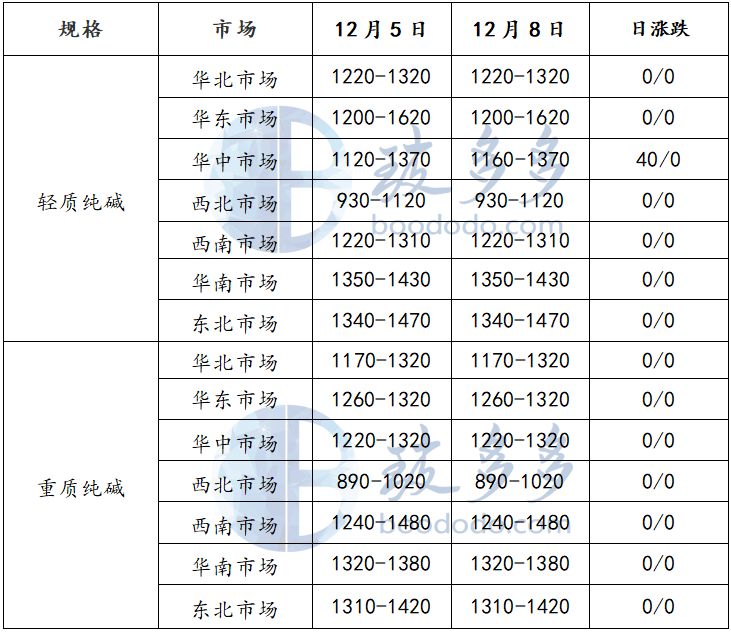
12.8纯碱日评:纯碱市场价格零星探涨
Sou Hu Cai Jing· 2025-12-09 02:38
Core Viewpoint - The domestic soda ash market is experiencing stable prices with slight upward movements in certain regions, driven by limited supply fluctuations and steady demand from downstream industries [2][6]. Price Analysis - As of December 8, 2023, the mainstream prices for light soda ash in North China are maintained at 1220-1320 CNY/ton, while heavy soda ash prices range from 1170-1320 CNY/ton [2]. - The price index for light soda ash is reported at 1202.86, reflecting an increase of 5.71, or 0.48%, from the previous working day, while the heavy soda ash index remains unchanged at 1201.43 [3]. Supply and Demand Dynamics - Supply remains stable with minor adjustments; Jiangsu Jingshen's soda ash facility is undergoing reduced maintenance, while Hubei Yingcheng's facility is set to commence production soon [2]. - Downstream demand is characterized by limited fluctuations, primarily focusing on replenishing stocks as needed, with some companies making selective purchases at lower prices [2][6]. Futures Market Insights - On December 8, the main soda ash futures contract SA2601 opened at 1133 CNY/ton and closed at the same price, marking a daily decline of 1.05% [5]. - The market sentiment is generally weak, influenced by the overall chemical sector atmosphere and a decline in downstream glass prices, alongside slight increases in supply pressure and profit disparities among companies [5]. Future Market Outlook - The soda ash market is expected to maintain a balance between supply and demand, with ample supply and a purchasing strategy focused on low-cost replenishment [6]. - Despite the current losses faced by soda ash manufacturers, there is limited room for further price reductions, suggesting that significant price fluctuations are unlikely, with the market likely to experience narrow adjustments [6].

中央政治局会议强调继续实施更加积极的财政政策和适度宽松的货币
Zhong Xin Qi Huo· 2025-12-09 00:55
Report Industry Investment Rating - The mid - term outlook for the black building materials industry is "oscillation" [7] Core Viewpoints of the Report - The central political bureau meeting emphasized the continuation of a more proactive fiscal policy and a moderately loose monetary policy, without releasing any signals beyond expectations. Recently, the profitability of steel mills has improved, and it is expected that steel production will not decline significantly in the later stage. After entering the off - season, the fundamentals still face pressure, and the steel futures market will operate weakly. There is still an expectation of a seasonal decline in hot metal production, and an expected increase in Mongolian coal imports. The futures markets of iron ore, coking coal, and coke are showing weak performance. The supply - demand surplus of glass and soda ash continues to suppress the futures prices [1]. - Overall, the fundamentals in the off - season are poor, and the central political bureau meeting did not release any signals beyond expectations. It is expected that the futures market will undergo a short - term weak adjustment. Attention should be paid to the upcoming central economic work conference and the overseas interest - rate cut rhythm [7]. Summary by Relevant Catalogs Iron Element - Hot metal production has decreased significantly, downstream demand has declined, and steel mills are undergoing annual maintenance. Although the profitability of steel mills has slightly improved, the release of restocking demand remains slow. Overseas mine shipments have increased slightly month - on - month, with Australian shipments rebounding, Brazilian shipments rising and then falling, and non - mainstream shipments increasing significantly month - on - month. The arrivals this period have decreased significantly month - on - month, but port inventories have continued to accumulate, and steel mill inventories have increased month - on - month, with overall inventory accumulation pressure remaining. The fundamental contradictions of scrap steel are limited. After the decline in spot prices, the cost - effectiveness has rebounded. The profits of electric arc furnaces are acceptable, and the demand for scrap steel from both long - and short - process steel enterprises is still supported, with limited downward space. It is expected that scrap steel prices will oscillate [2]. Carbon Element - The cost support for coke has weakened, and there is a strong expectation of further price cuts. However, there is still an expectation of winter storage and restocking of raw materials in mid - to late December, and the fundamentals still provide support. Currently, the futures valuation is too low, and there is insufficient impetus for a further significant decline. It is expected to oscillate following coking coal. It will take time to reverse the pessimistic sentiment towards coking coal. The upcoming winter storage and restocking by downstream enterprises in mid - to late December may gradually improve the fundamentals and market sentiment. Based on the expectation that the weakening of the coking coal supply - demand pattern is limited, the low - level futures valuation is expected to gradually recover at that time [2]. Alloys - The firm cost performance provides support for prices, but the market supply - demand situation remains loose, the cost transfer is not smooth, and there is insufficient impetus for the futures price to rise. It is expected that the futures price of ferromanganese silicon will mainly oscillate at a low level. The high - level cost supports the bottom of the ferrosilicon price, but the market has weak supply and demand, and there are still difficulties in destocking. Caution should be exercised regarding the upward space of the futures price. It is expected that the ferrosilicon futures price will mainly oscillate at a low level [2]. Glass and Soda Ash - There are still expectations of supply disruptions, but the inventories of middle - and downstream enterprises are moderately high. Fundamentally, the current supply - demand situation remains in surplus. If there is no more cold - repair before the end of the year, the high inventory will always suppress prices, and it is expected to oscillate weakly; otherwise, prices will rise. The soda ash industry price is approaching the cost, with obvious bottom support. Recently, the cold - repair of glass has further increased, and the overall supply - demand of soda ash remains in surplus. It is expected to oscillate in the short term. In the long run, the supply surplus pattern will further intensify, and the price center will continue to decline, promoting capacity reduction [3][7]. Specific Product Analysis - **Steel**: The spot market transactions are generally weak. As the end of the year approaches, steel mill maintenance has increased, hot metal production has continued to decline, and steel production has decreased from a high level, with a significant decline in rebar production. The funds available for domestic sample construction sites have weakened month - on - month, and the demand for building materials has declined significantly. The overall steel inventory has continued to decline, but the current inventory level is still higher year - on - year. As demand weakens, it will take time to ease the fundamental contradictions. It is expected that the futures market will operate weakly [9]. - **Iron Ore**: The spot market prices have weakened. Overseas mine shipments have increased slightly month - on - month, and the arrivals this period have decreased significantly month - on - month, but port inventories have continued to accumulate, and steel mill inventories have increased month - on - month. It is expected that hot metal production may continue to decline seasonally, the support from rigid demand will gradually weaken, and the restocking demand has not been significantly released. There is still overall inventory accumulation pressure. In the short term, iron ore prices are expected to oscillate [10]. - **Scrap Steel**: The supply of scrap steel has increased slightly this week but is still lower than the same period last year. The demand from electric arc furnaces has increased to some extent, while the demand from blast furnaces has decreased slightly. The inventories of steel enterprises have increased slightly. It is expected that scrap steel prices will oscillate [12]. - **Coke**: The futures market is pessimistic, and the spot market is weak. The supply is affected by the decline in raw material coal prices and the start of heavy - pollution weather warnings in some areas. The demand has decreased with the decline in hot metal production. The inventory of coke enterprises has increased slightly. It is expected to oscillate following coking coal [14]. - **Coking Coal**: The futures price has declined significantly. The domestic supply is at a low level, and the import is being tested for increased capacity. The demand has decreased as the downstream restocking has slowed down, and the inventory has continued to accumulate. It is expected that the low - level futures valuation will gradually recover in mid - to late December [15]. - **Glass**: The macro - environment is warm, but the supply is expected to increase slightly, the demand is weak year - on - year, the middle - stream inventory is large, and the overall restocking ability is limited. The supply - demand situation remains in surplus. If there is no further cold - repair, prices may fall [16]. - **Soda Ash**: The macro - environment is warm, the supply is expected to increase, the demand from heavy - alkali is expected to weaken, and the demand from light - alkali has not changed much. The industry is in the stage of clearing at the bottom of the cycle. It is expected to oscillate in the short term and decline in the long term [18]. - **Ferromanganese Silicon**: Affected by the decline in coking coal prices, the futures price has decreased. The cost is firm, the demand has decreased with the decline in steel production, and the supply is difficult to contract significantly. It is expected to oscillate at a low level [18]. - **Ferrosilicon**: The futures price has decreased slightly. The cost is expected to remain high, the demand from steel mills and the metal magnesium market has weakened, the supply has decreased slightly, and the destocking is difficult. It is expected to oscillate at a low level [20]. Index Information - On December 8, 2025, the comprehensive index of CITIC Futures commodities was 2267.05, down 0.18%; the commodity 20 index was 2588.87, down 0.37%; the industrial products index was 2216.09, down 0.16%. The steel industry chain index was 1946.09, with a daily decline of 1.40%, a decline of 2.53% in the past 5 days, a decline of 2.45% in the past month, and a decline of 7.69% since the beginning of the year [103][105].
黑色系周度报告-20251205
Xin Ji Yuan Qi Huo· 2025-12-05 13:50
Report Overview - The report is a weekly analysis of the black commodity sector, covering steel products, iron ore, glass, and soda ash, with data from November 28 to December 5, 2025 [1][2] 1. Report Industry Investment Rating - No industry investment rating is provided in the report 2. Report's Core View - In the medium to long - term, the steel industry's prosperity is declining, with weakening demand for rebar and downward pressure on iron ore futures prices. Glass and soda ash also face challenges, with limited upward momentum for glass and weak demand for soda ash [67][71] - In the short - term, rebar and iron ore are expected to trade in a range, while glass and soda ash are likely to show a weak and oscillating trend [68][72] 3. Summary by Related Catalogs 3.1 Black Commodities Weekly Market Review - **Rebar (RB2605)**: Futures price rose from 3117 to 3157 (up 1%), with a spot price of 3290 and a basis of 133 [2] - **Hot - rolled coil (HC2605)**: Futures price increased from 3288 to 3320 (up 1%), spot price 3300, basis - 20 [2] - **Iron ore (I2601)**: Futures price dropped from 794 to 786 (down 1%), spot price 810, basis 25 [2] - **Coke (J2601)**: Futures price rose from 1575 to 1585 (up 1%), spot price 1720, basis 135 [2] - **Coking coal (JM2605)**: Futures price decreased from 1152 to 1140 (down 1%), spot price 1510, basis 370 [2] - **Glass (FG601)**: Futures price fell from 1053 to 994 (down 6%), spot price 1130, basis 136 [2] - **Soda ash (SA601)**: Futures price declined from 1177 to 1137 (down 3%), spot price 1258, basis 121 [2] 3.2 Rebar Analysis - **Profit**: On December 4, the blast - furnace profit for rebar was 31 yuan/ton [6] - **Supply**: As of December 5, the blast - furnace operating rate was 80.16% (down 0.93 percentage points), daily hot - metal output was 232.3 tons (down 2.38 tons), and weekly rebar production was 189.31 tons (down 16.77 tons) [12] - **Demand**: In the week of December 5, the apparent consumption of rebar was 216.98 tons (down 10.96 tons). As of December 4, the trading volume of construction steel by major traders was 93,867 tons [18] - **Inventory**: In the week of December 5, social rebar inventory was 361.13 tons (down 23.62 tons), and in - plant inventory was 142.68 tons (down 4.05 tons) [23] 3.3 Iron Ore Analysis - **Supply**: In the week of November 28, global iron - ore shipments were 3323.2 tons (up 44.8 tons), and arrivals at 47 Chinese ports were 2784 tons (down 155.5 tons) [28] - **Inventory**: As of December 5, the inventory of imported iron ore at 47 ports was 15991.11 tons (up 89.89 tons), and the inventory of 247 steel enterprises was 8984.73 tons (up 42.25 tons) [33] - **Demand**: In the week of December 5, the average daily port clearance volume of imported iron ore at 47 ports was 334.23 tons (down 9.83 tons). As of December 4, the trading volume at major Chinese ports was 126.6 tons [38] 3.4 Float Glass Analysis - **Supply**: In the week of December 5, the number of operating float - glass production lines was 218 (down 2), weekly output was 1085095 tons (down 18800 tons). As of December 4, the capacity utilization rate was 77.25%, and the operating rate was 73.4% [43] - **Inventory**: In the week of December 5, in - plant float - glass inventory was 59.442 million weight - boxes (down 2.92 million tons), and the available inventory days were 26.8 days (down 0.7 days) [48] - **Demand**: In the week of December 1, the deep - processing order days of glass downstream manufacturers were 10.1 days [52] 3.5 Soda Ash Analysis - **Supply**: In the week of December 5, the capacity utilization rate of soda ash was 80.74% (down 0.66 percentage points), and production was 70.39 tons (up 0.57 tons) [55] - **Inventory**: As of December 5, in - plant soda - ash inventory was 153.86 tons (down 4.88 tons) [60] - **Sales Ratio**: As of December 5, the soda - ash sales ratio was 106.93% (down 1.23 percentage points) [64] 3.6 Strategy Recommendations - **Rebar and Iron Ore**: Medium - to long - term outlook is bearish due to weakening demand and low winter - storage willingness. Short - term trading should be based on a range - bound strategy [67][68] - **Glass and Soda Ash**: Medium - to long - term, glass has limited upward momentum, and soda - ash demand is weak. Short - term, they are expected to trade weakly and oscillate [71][72]
黑色产业链日报-20251205
Dong Ya Qi Huo· 2025-12-05 10:54
Report Industry Investment Rating No relevant content provided. Core Viewpoints - The overall finished steel is supported by raw material costs, with gradually improving profits. The market may pre - trade market expectations, and steel prices are expected to fluctuate moderately. The operating range of rebar may be between 3000 - 3300, and that of hot - rolled coil between 3200 - 3500. Attention should be paid to the destocking speed of steel and downstream consumption [3]. - Steel demand has entered the off - season, and steel mills have actively carried out maintenance and production cuts. After the reduction in steel production, steel inventory has been destocked, and the contradictions in the industrial chain have been alleviated. The price of coking coal has generally declined, benefiting steel mills, and the profits of steel mills have recently increased. Steel mills now have the space and motivation for new production increases. Steel currently has low raw material inventory and has the demand for winter storage replenishment. With the approaching of the Fed's interest - rate meeting and the Central Economic Work Conference, macro - expectations provide support, and the short - term price decline space is limited [21]. - For coking coal, the marginal change in supply is limited, but the profits of terminal steel mills are under pressure, and the production of hot metal has been continuously reduced. The supply and demand of coking coal have turned into a slight surplus. Coking enterprises are actively controlling the raw material procurement rhythm due to the expected price cuts, and the inventory pressure on upstream mines is becoming apparent. Short - term coal prices will still be under pressure. For coke, as the cost of coking coal has decreased, the immediate coking profit has recovered, and the subsequent coke supply is expected to increase. As the coking enterprises' production gradually resumes, coke may face inventory accumulation pressure. Attention should be paid to the price - cut rhythm of mainstream steel mills. Considering that the futures market has already priced in 4 - 5 rounds of price cuts in advance, the spot price of coke may face more than 2 rounds of price - cut pressure [31]. - Ferroalloys face the fundamentals of high inventory and weak demand. The cost center may decline due to the impact of coking coal supply guarantee, but the supply side maintains the trend of production cuts, so the downward space for ferroalloys is limited, and they are expected to fluctuate weakly. Recently, the price of finished steel has been relatively strong, and the market may pre - hype market expectations, driving the rebound of ferroalloys. However, due to the weak fundamentals of ferroalloys themselves, they may return to their own fundamentals after the rebound [47]. - Soda ash is mainly priced based on cost. Although the cost - side expectation is firm, the valuation has no upward elasticity without a trend - based production cut. The cold repair of glass has accelerated, and the expected rigid demand for soda ash has further weakened. The expectation of maintaining a high - level supply of soda ash in the medium and long term remains unchanged. Photovoltaic glass has started inventory accumulation at a low level, and the daily melting volume is relatively stable, and the balance of heavy soda ash continues to be in surplus. In October, the export of soda ash exceeded 210,000 tons, remaining at a high level, which continues to relieve the domestic pressure to a certain extent. The high - level inventory in the upstream and mid - stream restricts the price of soda ash [61]. - In December, the expectation of cold repair of glass production lines has resurfaced, and the implementation situation is to be determined, which will definitely affect the far - month pricing and market expectations. However, the near - month 01 contract will still follow the reality (delivery logic), and the key lies in the spot price in Hubei and the expectation of warehouse receipts. In reality, with the recent acceleration of cold repair and the expected further decline in daily melting volume, but the terminal has entered the off - season, and the inventory of futures, cash, and traders in Shahe and Hubei remains at a high level, so there is still pressure on the spot price. The degree of inventory destocking in the mid - stream should be observed [84]. Summary by Related Catalogs Steel - **Prices and Spreads** - On December 5, 2025, the closing prices of rebar 01, 05, and 10 contracts were 3137, 3157, and 3192 respectively, and those of hot - rolled coil 01, 05, and 10 contracts were 3312, 3320, and 3329 respectively [4]. - The spot prices of rebar and hot - rolled coil in different regions showed slight changes on December 5, 2025. For example, the aggregated price of rebar in China was 3326 yuan/ton, and that of hot - rolled coil in Shanghai was 3300 yuan/ton [9][11]. - The 01 - 05, 05 - 10, and 10 - 01 month - spreads of rebar and hot - rolled coil also changed compared with the previous day [4]. - The 01, 05, and 10 contract ratios of rebar to iron ore and coke remained unchanged at 4 and 2 respectively on December 5, 2025 [18]. - **Seasonal Data** - Seasonal charts of rebar and hot - rolled coil's futures prices, month - spreads, and basis were provided [5][6][7]. Iron Ore - **Prices and Spreads** - On December 5, 2025, the closing prices of iron ore 01, 05, and 09 contracts were 785.5, 769, and 744 respectively, with daily changes of - 9, - 8, and - 9 respectively [22]. - The basis of iron ore 01, 05, and 09 contracts and the prices of different iron ore varieties in Rizhao also showed certain changes [22]. - **Fundamentals** - On December 5, 2025, the daily average hot - metal production was 232.3 tons, a weekly decrease of 2.38 tons and a monthly decrease of 1.92 tons. The 45 - port desulfurization volume was 318.45 tons, a weekly decrease of 12.13 tons and a monthly decrease of 2.48 tons. Other indicators such as global shipping volume, 45 - port inventory, and 247 - steel - mill inventory also changed [25]. - **Seasonal Data** - Seasonal charts of iron ore's futures month - spreads and basis were provided [23][24]. Coking Coal and Coke - **Prices and Spreads** - The month - spreads of coking coal and coke, such as 09 - 01, 05 - 09, and 01 - 05, showed different degrees of changes on December 5, 2025. The immediate coking profit, main mine - coke ratio, main rebar - coke ratio, and main coke - coal ratio also changed [35]. - The spot prices of coking coal and coke in different regions and different types showed certain fluctuations on December 5, 2025 [38]. - **Seasonal Data** - Seasonal charts of coking coal and coke's futures month - spreads, basis, and coking profit were provided [40][41][42]. Ferroalloys - **Silicon Iron** - On December 5, 2025, the silicon - iron basis in Ningxia was - 24, with a daily increase of 72. The 01 - 05, 05 - 09, and 09 - 01 month - spreads also changed. The spot prices of silicon iron in different regions remained relatively stable, and indicators such as the price of semi - coke small materials and the price of thermal coal also showed certain changes [48]. - **Silicon Manganese** - On December 5, 2025, the silicon - manganese basis in Inner Mongolia was 122, with a daily increase of 38. The 01 - 05, 05 - 09, and 09 - 01 month - spreads changed. The spot prices of silicon manganese in different regions increased slightly, and the prices of different ores and the inventory of silicon manganese also changed [49][50]. - **Seasonal Data** - Seasonal charts of silicon - iron and silicon - manganese's production costs, profits, month - spreads, and basis were provided [51][52][53]. Soda Ash - **Prices and Spreads** - On December 5, 2025, the closing prices of soda ash 05, 09, and 01 contracts were 1213, 1275, and 1137 respectively, with daily changes of - 19, - 19, and - 25 respectively. The month - spreads (5 - 9), (9 - 1), and (1 - 5) also changed. The spot prices of heavy and light soda ash in different regions remained stable, and the difference between heavy and light soda ash also remained unchanged in most regions [62]. - **Seasonal Data** - Seasonal charts of soda ash's futures prices, month - spreads, basis, inventory, production capacity utilization, and production were provided [63][64][65]. Glass - **Prices and Spreads** - On December 5, 2025, the closing prices of glass 05, 09, and 01 contracts were 1115, 1176, and 994 respectively, with daily changes of - 16, - 12, and - 16 respectively. The month - spreads (5 - 9), (9 - 1), and (1 - 5) also changed. The basis of different contracts in Shahe and Hubei also changed [85]. - **Sales and Production** - The daily sales - to - production ratios of glass in Shahe, Hubei, East China, and South China showed different degrees of fluctuations from November 28 to December 4, 2025 [86]. - **Seasonal Data** - Seasonal charts of glass's futures prices, month - spreads, basis, inventory, daily melting volume, and sales - to - production ratio were provided [87][88][89].
基本面矛盾不足,钢价区间震荡运行
Hua Tai Qi Huo· 2025-12-05 02:30
1. Report Industry Investment Rating - No specific industry investment rating is provided in the content 2. Core Viewpoints - The steel price will oscillate within a range due to insufficient fundamental contradictions [2] - The supply - demand pattern of glass and soda ash remains unchanged, and their prices will oscillate weakly [2] - The building material consumption data of ferrosilicon and silicomanganese is fair, and their alloy futures have rebounded [4] 3. Summary by Relevant Categories Glass and Soda Ash Market Analysis - Glass: The glass futures oscillated downward with active trading and decreased positions. Regionally, the spot market was weak and stable. This week, the inventory of float glass manufacturers was 59.442 million heavy cases, a 4.68% decrease from the previous week. Although the increase in cold - repair of glass production lines improved demand slightly, the supply contraction was insufficient, and the inventory, though decreasing, was still high. Glass factories need long - term losses to clear capacity [2] - Soda Ash: The soda ash futures oscillated downward. The spot price was stable, with mainly rigid demand purchases. The production, sales, and inventory data of soda ash all declined, slightly alleviating the supply - demand contradiction, but the inventory was still high. With the expected increase in cold - repair of float glass, the demand for heavy soda ash is challenged, suppressing the price [2] Strategy - Glass: Oscillation [3] - Soda Ash: Oscillation [3] Ferrosilicon and Silicomanganese Market Analysis - Silicomanganese: The building material consumption was strong and inventory reduction was fair. The silicomanganese futures rebounded following the black market. The spot market was strong. Due to continuous losses, the production and operating rate of enterprises continued to decline, but the reduction was insufficient, and the inventory reached a new high. Port manganese ore inventory increased slightly, and the total manganese element inventory was stable, providing cost support [4] - Ferrosilicon: The ferrosilicon futures rebounded following black commodities. The Hebei Iron and Steel Group entered the market for procurement, and the market was waiting for its price guidance. Currently, ferrosilicon has high production and inventory, and demand is weakening. As the loss - time of enterprises extends, the operating rate decreases, and the inventory declines, but the high inventory still suppresses the price [4] Strategy - Silicomanganese: Oscillation [5] - Ferrosilicon: Oscillation [5]
大越期货纯碱早报-20251205
Da Yue Qi Huo· 2025-12-05 02:30
Report Industry Investment Rating No information provided. Core View of the Report The fundamentals of soda ash are weak, and it is expected to mainly fluctuate and move downward in the short term. The supply of soda ash is at a high level, terminal demand is declining, inventory is at a high level in the same period, and the pattern of supply - demand mismatch in the industry has not been effectively improved [2][5]. Summary by Relevant Catalogs 1. Daily View - The fundamentals show that the output of soda ash plants is at a high level, the second - phase of Yuangxing is expected to be put into production before the end of the year, and the overall supply is expected to be abundant; the daily melting volume of downstream float glass and photovoltaic glass continues to decline, and the inventory of soda ash plants is at a high level in the same period, which is bearish [2]. - The basis is - 32 yuan, with futures at a premium to spot, which is bearish [2]. - The national inventory of soda ash plants is 153.86 million tons, a decrease of 3.07% from the previous week, and the inventory is running above the 5 - year average, which is bearish [2]. - The price is running below the 20 - day line, and the 20 - day line is downward, which is bearish [2]. - The net position of the main force is short, and short positions are increasing, which is bearish [2]. 2. Influence Factors Summary - **Lithium**: Equipment problems lead to production reduction and maintenance of enterprises, and the recovery of soda ash supply is slow [3]. - **Negative**: Since 2023, the production capacity of soda ash has expanded significantly, and there are still large production plans this year, and the industry output is at a high level in the same period; the production of photovoltaic glass, a downstream product of heavy soda, has been reduced, and the demand for soda ash has weakened [4]. 3. Soda Ash Futures Market - The closing price of the main contract is 1162 yuan/ton, a decrease of 0.26% from the previous value; the low - end price of heavy soda ash in Shahe is 1130 yuan/ton, unchanged from the previous value; the main basis is - 32 yuan/ton, a decrease of 8.57% from the previous value [6]. 4. Soda Ash Spot Market - The low - end price of heavy soda ash in the Hebei Shahe market is 1130 yuan/ton, unchanged from the previous day [11]. - The profit of heavy soda ash in North China's ammonia - soda process is - 118.50 yuan/ton, and that in East China's co - production process is - 220 yuan/ton, at a historical low [14]. - The weekly industry operating rate of soda ash is 80.08%, and the weekly output is 69.82 million tons, including 38.31 million tons of heavy soda ash, with the output at a historical high [17][19]. - From 2023 to 2025, a large amount of new production capacity has been added or is planned to be added, with a total planned addition of 1570 million tons and an actual addition of 920 million tons [20]. 5. Fundamental Analysis - Demand - The weekly production - sales rate of soda ash is 108.16% [23]. - The daily melting volume of national float glass is 15.72 million tons, and the operating rate is 74.85% [26]. 6. Fundamental Analysis - Inventory - The national inventory of soda ash plants is 153.86 million tons, a decrease of 3.07% from the previous week, and the inventory is running above the 5 - year average [33]. 7. Fundamental Analysis - Supply - Demand Balance Sheet - From 2017 to 2024E, the supply - demand situation of soda ash has fluctuated. In 2024E, the effective production capacity is 3930 million tons, the output is 3650 million tons, the apparent supply is 3536 million tons, the total demand is 3379 million tons, and the supply - demand difference is 157 million tons [34].
黑色建材日报-20251205
Wu Kuang Qi Huo· 2025-12-05 02:28
Report Industry Investment Rating No relevant content provided. Core Viewpoints - The steel demand has officially entered the off - season, and the hot - rolled coil still faces inventory pressure, with difficulties in inventory reduction. Attention should be paid to the tone of important meetings [2]. - The overall inventory of iron ore remains high, and there is no sign of effectively resolving the inventory structural contradiction. The impact of macro - pricing will gradually strengthen in December [5]. - For the black sector, it may be more cost - effective to look for opportunities to make rebounds rather than continue to short, as macro factors are more important [9][10]. - Industrial silicon shows a short - term weak operation with a supply - demand weak pattern and limited marginal changes [13]. - Polysilicon faces challenges in reducing inventory pressure before the Chinese New Year, and there are risks in the near - month contract due to delivery games [15]. - The glass industry is still in the bottom - seeking stage, with the supply - demand contradiction not effectively resolved, and the market is expected to continue wide - range fluctuations [18]. - The soda ash market is expected to maintain a stable price in the short term, but it should still be viewed bearishly before the demand improves [20]. Summary by Category Steel Market Information - The closing price of the rebar main contract was 3175 yuan/ton, up 6 yuan/ton (0.189%) from the previous trading day. The registered warehouse receipts were 441,41 tons, unchanged. The main contract position increased by 114,799 lots to 1,411,905 lots. The Tianjin aggregated price of rebar was 3210 yuan/ton, down 10 yuan/ton, and the Shanghai aggregated price was 3300 yuan/ton, unchanged [1]. - The closing price of the hot - rolled coil main contract was 3332 yuan/ton, up 13 yuan/ton (0.391%) from the previous trading day. The registered warehouse receipts were 113,732 tons, unchanged. The main contract position increased by 492,093 lots to 1,034,595 lots. The Lecong aggregated price of hot - rolled coil was 3340 yuan/ton, unchanged, and the Shanghai aggregated price was 3300 yuan/ton, unchanged [1]. Strategy Viewpoints - This week, rebar production declined significantly, inventory continued to decrease, and the overall performance was neutral. Hot - rolled coil production decreased, apparent demand was neutral, inventory reduction was difficult, and the social inventory level was high. The steel demand has entered the off - season, and the hot - rolled coil inventory pressure remains [2]. Iron Ore Market Information - The main contract of iron ore (I2601) closed at 794.50 yuan/ton, down 0.63% (- 5.00). The position decreased by 41,114 lots to 293,700 lots. The weighted position was 949,800 lots. The spot price of PB fines at Qingdao Port was 793 yuan/wet ton, with a basis of 47.96 yuan/ton and a basis rate of 5.69% [4]. Strategy Viewpoints - In terms of supply, the overseas iron ore shipment volume remained stable. Australian shipments decreased slightly, mainly due to the decline of Rio Tinto and FMG shipments. Brazilian shipments increased significantly, and non - mainstream country shipments decreased slightly. The near - end arrival volume decreased. In terms of demand, the average daily hot metal output was 232.3 tons, down 2.38 tons. The number of blast furnace overhauls was more than that of restarts, and annual inspections increased. The steel mill profitability rate rebounded slightly after continuous decline, but less than 40% of steel mills were profitable. In the inventory aspect, port inventory continued to increase, and steel mill inventory increased slightly. Overall, the iron ore inventory is still high, and there is no sign of resolving the inventory structural contradiction [5]. Manganese Silicon and Ferrosilicon Market Information - On December 4, affected by the increase in settlement electricity prices in Qinghai and Ningxia and the sentiment of coking coal, ferroalloys rebounded significantly. The main contract of manganese silicon (SM603) closed up 0.87% at 5796 yuan/ton. The spot price of 6517 manganese silicon in Tianjin was 5720 yuan/ton, with a premium of 114 yuan/ton over the futures. The main contract of ferrosilicon (SF603) closed up 1.84% at 5546 yuan/ton. The spot price of 72 ferrosilicon in Tianjin was 5600 yuan/ton, with a premium of 54 yuan/ton over the futures [7][8]. Strategy Viewpoints - The market sentiment has improved, but there is still differentiation among commodity sectors. The black sector is weak, and ferroalloys are also affected by the weak coking coal sentiment. It is not necessary to be overly pessimistic, and the positive impact of macro - events in December on market sentiment is worth expecting. For the black sector, it may be more cost - effective to look for opportunities to make rebounds. The fundamentals of manganese silicon are not ideal, but it is difficult for its own fundamentals to drive the price down significantly. The supply - demand fundamentals of ferrosilicon have no obvious contradictions or drivers, and the operability is relatively low [9][10]. Industrial Silicon and Polysilicon Market Information - The main contract of industrial silicon (SI2601) closed at 8910 yuan/ton, down 0.11% (- 10). The weighted position increased by 12,668 lots to 413,311 lots. The spot price of 553 non - oxygenated industrial silicon in East China was 9350 yuan/ton, unchanged, and the basis of the main contract was 440 yuan/ton. The spot price of 421 was 9800 yuan/ton, unchanged, and the basis of the main contract was 90 yuan/ton [12]. - The main contract of polysilicon (PS2601) closed at 56,915 yuan/ton, down 0.90% (- 515). The weighted position decreased by 1,608 lots to 276,578 lots. The average price of N - type granular silicon was 50 yuan/kg, down 0.5 yuan/kg; the average price of N - type dense material was 51 yuan/kg, unchanged; the average price of N - type re - feeding material was 52.3 yuan/kg, down 0.05 yuan/kg. The basis of the main contract was - 4615 yuan/ton [14]. Strategy Viewpoints - Industrial silicon shows short - term weak operation. The weekly output continues to decline, and the marginal decline has slowed down significantly. The demand from polysilicon in December is weakening, the demand from organic silicon is stable in the short term, and the demand from silicon - aluminum alloy has increased, but the export has decreased significantly in October. The cost support is stable, and the supply - demand pattern has limited marginal changes [13]. - The production of polysilicon in December is expected to continue to decline, but the decline may be limited due to the capacity ramp - up in some northwest bases. The downstream silicon wafer production is expected to decrease significantly, and the inventory pressure before the Chinese New Year is difficult to relieve. The downstream prices are weak, while the upstream silicon enterprises still maintain high prices. The near - month contract has high risks due to delivery games, and attention should be paid to the final establishment of the platform company [15]. Glass and Soda Ash Market Information - The glass main contract closed at 1010 yuan/ton on Thursday afternoon, down 0.98% (- 10). The price of large - sized glass in North China was 1070 yuan, unchanged; the price in Central China was 1110 yuan, down 10 yuan. The weekly inventory of float glass sample enterprises was 59.442 million cases, down 2.92 million cases (- 4.68%). The top 20 long - position holders reduced 20,182 lots, and the top 20 short - position holders reduced 23,024 lots [17]. - The soda ash main contract closed at 1162 yuan/ton on Thursday afternoon, down 0.26% (- 3). The price of heavy soda ash in Shahe was 1132 yuan, down 3 yuan. The weekly inventory of soda ash sample enterprises was 1.5386 million tons, down 48,800 tons (- 4.68%), including 810,800 tons of heavy soda ash inventory, down 36,000 tons, and 727,800 tons of light soda ash inventory, down 12,800 tons. The top 20 long - position holders reduced 14,611 lots, and the top 20 short - position holders reduced 19,616 lots [19]. Strategy Viewpoints - The supply of glass has decreased due to the cold - repair of production lines by many enterprises last week, and the market sentiment has briefly improved, but the overall spot market trading is still light, and the manufacturers still face great pressure in shipping. The inventory has decreased slightly, and the futures price has rebounded due to short - covering. The industry is still in the bottom - seeking stage, and the market is expected to fluctuate widely in the short term. Attention should be paid to the recovery of downstream orders and the implementation of cold - repair production lines [18]. - The production capacity of soda ash has increased slightly due to the resumption of production of previously overhauled devices. The mainstream market supply meets the demand, and the inventory has decreased slightly. Light soda ash supply is locally tight, and the demand is relatively stable. Heavy soda ash demand is weak due to the decline in the glass industry. The soda ash price remains stable in the short term, but it should be viewed bearishly before the demand improves [20].
纯碱研究框架
2025-12-04 15:37
Summary of the Soda Ash Industry Conference Call Industry Overview - The soda ash market in China is characterized by significant capacity concentration, with the top ten companies holding a total capacity of 24.5 million tons, accounting for 60.8% of the national total [2][7] - Major players include Henan Jingshan, Guoyin Yinkeng, and Shandong Haohua, which significantly influence market prices [2][7] Production Capacity and Methods - As of 2025, China's total soda ash production capacity reached 44.05 million tons, with over 8 million tons added since 2020, primarily in North and Central China [2][12] - Production methods include natural soda method and synthetic soda methods (ammonia-soda method and combined soda method), with the latter being predominant in China [2][6] Price Influencing Factors - Soda ash prices are affected by supply and demand dynamics, new production capacity, macroeconomic policies, and inventory levels [4][13] - In July 2025, glass prices rebounded significantly but later fell, indicating volatility in the market [4] - The first ten months of 2025 saw a drastic reduction in soda ash imports by 97.78% and a notable increase in exports by 101.57%, driven by price advantages [4][17] Regional Production Distribution - The regional distribution of soda ash production in China is uneven, with East China and Central China accounting for the highest shares at 28% and 27%, respectively [2][16] Future Trends and Challenges - The soda ash industry is expected to continue expanding production capacity due to government support for low-cost natural gas projects and rising demand [15][21] - However, challenges include overcapacity and potential losses among manufacturers, which may limit short-term expansion [15][19] - The market may face supply-demand imbalances, particularly if downstream demand does not improve significantly [19][22] Downstream Demand Impact - Key downstream sectors include photovoltaic glass, float glass, daily glass, sodium bicarbonate, and lithium carbonate, with photovoltaic and lithium carbonate being future growth points [22] - Stable growth in downstream demand is crucial for alleviating current supply-demand conflicts and promoting industry recovery [22] Inventory and Supply Chain Management - High inventory levels are expected to persist, with peaks nearing 2 million tons in early 2025, particularly around the Spring Festival [18] - The industry may need to adjust supply chain management and enhance technological capabilities to address challenges [15][19]
中原证券晨会聚焦-20251204
Zhongyuan Securities· 2025-12-04 00:20
Core Insights - The report emphasizes the gradual recovery of the chemical industry, with profit declines slowing down and demand gradually rebounding, particularly in sub-sectors like agricultural chemicals and fluorochemicals [22][23] - The AI application in various industries is accelerating, with significant advancements in hardware and software, leading to a reshaping of the global landscape [24][25] - The food and beverage industry is experiencing a slowdown in revenue growth, with rising costs impacting profit margins, yet there are emerging opportunities in niche markets like snacks and soft drinks [27][28] Domestic Market Performance - The A-share market is showing signs of stabilization, with the Shanghai Composite Index and the ChiNext Index trading at average P/E ratios above their three-year median, indicating a suitable environment for medium to long-term investments [9][13][15] - The coal and non-ferrous metals sectors are leading the market, while sectors like internet services and software development are underperforming [9][13] Industry Analysis - The electric power and public utilities sector is rated "stronger than the market," with a focus on stable returns and shareholder value, particularly in large hydropower companies and high-dividend coal enterprises [20] - The photovoltaic industry is facing challenges with overcapacity and price stability, but there is potential for recovery as the market undergoes structural adjustments [30][33] Investment Strategies - The report suggests a balanced investment strategy, focusing on high-dividend assets like banks and utilities for defensive positioning, while also considering growth opportunities in technology and AI sectors [12][24] - Specific recommendations include monitoring companies in the chemical sector that are well-positioned to benefit from supply-demand dynamics and regulatory changes [22][23]

黑色产业链日报-20251203
Dong Ya Qi Huo· 2025-12-03 09:17
1. Report Industry Investment Rating - Not provided in the content 2. Core Views - **Steel**: The overall finished steel products are supported by raw material costs, with improving profits. The market may pre - trade market expectations, and steel prices will fluctuate moderately. The operating range of rebar is likely between 3000 - 3300 yuan/ton, and that of hot - rolled coil is between 3200 - 3500 yuan/ton. Attention should be paid to the destocking speed of steel and downstream consumption. The risk lies in the potential negative feedback from the decline in the profitability of steel enterprises [3]. - **Iron Ore**: In the short term, the fundamentals of iron ore have improved, and the valuation has been repaired. The price will maintain high - level fluctuations. The current supply - demand contradiction is not prominent, and the accumulation speed of port inventory has slowed down [22]. - **Coking Coal and Coke**: The supply of coking coal has limited marginal changes, but the profits of terminal steel mills are under pressure, and pig iron production is continuously decreasing. Coking coal supply and demand have turned into a slight surplus, and short - term coal prices will remain under pressure. For coke, due to the decline in coking coal cost, the immediate coking profit has been repaired. Subsequently, coke supply is expected to increase and may face inventory accumulation pressure [35]. - **Ferroalloys**: Ferroalloys face a fundamental situation of high self - inventory and weak demand. The cost center of gravity may shift downward, but the supply side maintains a trend of production reduction. The downside space of ferroalloys is limited, and they are expected to fluctuate weakly. Although the recent strength of finished steel prices may drive the rebound of ferroalloys, they may return to their own fundamentals after the rebound [50]. - **Soda Ash**: Soda ash is mainly priced by cost. Without trend - based production cuts, the valuation has limited upward flexibility. The rigid demand expectation of soda ash has weakened further. The medium - and long - term supply of soda ash is expected to remain high, and the upper - and middle - stream inventory is high, which restricts the price [68]. - **Glass**: In December, the expectation of cold - repair of glass production lines has resurfaced. Near - month contracts will follow the reality (delivery logic), and the key lies in the spot expectation in Hubei. In reality, with the recent acceleration of cold - repair and the expectation of further decline in daily melting, the short - term near - end of glass has strengthened, and the spot price has increased, but the sustainability remains to be observed [92]. 3. Summary by Relevant Catalogs Steel - **Futures Prices**: On December 3, 2025, the closing price of rebar 01 contract was 3137 yuan/ton, and that of hot - rolled coil 01 contract was 3319 yuan/ton [4]. - **Spot Prices**: On December 3, 2025, the aggregated price of rebar in China was 3331 yuan/ton, and the price of hot - rolled coil in Shanghai was 3310 yuan/ton [10][12]. - **Spreads**: The 01 - 05 spread of rebar was - 32 yuan/ton, and that of hot - rolled coil was - 5 yuan/ton on December 3, 2025 [4]. Iron Ore - **Futures Prices**: On December 3, 2025, the closing price of 01 contract was 799.5 yuan/ton, and the 01 - 05 spread was 22.5 yuan/ton [23]. - **Spot Prices**: On December 3, 2025, the price of Rizhao PB powder was 797 yuan/ton [23]. - **Fundamentals**: As of November 28, 2025, the daily average pig iron output was 234.68 tons, and the port inventory was 15210.12 tons [29]. Coking Coal and Coke - **Futures Spreads**: On December 3, 2025, the 09 - 01 spread of coking coal was 162.5 yuan/ton, and that of coke was 179.5 yuan/ton [39]. - **Spot Prices**: On December 3, 2025, the ex - factory price of Anze low - sulfur main coking coal was 1580 yuan/ton, and the ex - factory price of Jinzhong quasi - first - grade wet coke was 1430 yuan/ton [42]. - **Profits**: The immediate coking profit was 55 yuan/ton on December 3, 2025 [42]. Ferroalloys - **Silicon Iron**: On December 3, 2025, the spot price of silicon iron in Ningxia was 5200 yuan/ton, and the 01 - 05 spread was - 14 yuan/ton [51]. - **Silicon Manganese**: On December 3, 2025, the spot price of silicon manganese in Inner Mongolia was 5530 yuan/ton, and the 01 - 05 spread was - 48 yuan/ton [52]. Soda Ash - **Futures Prices**: On December 3, 2025, the closing price of soda ash 05 contract was 1233 yuan/ton, and the 5 - 9 spread was - 62 yuan/ton [69]. - **Spot Prices**: On December 3, 2025, the market price of heavy soda ash in North China was 1300 yuan/ton [69]. Glass - **Futures Prices**: On December 3, 2025, the closing price of glass 05 contract was 1125 yuan/ton, and the 5 - 9 spread was - 54 yuan/ton [93]. - **Spot Prices**: The 01 contract basis in Shahe was 37 yuan/ton on December 3, 2025 [93]. - **Sales and Production**: On November 28, 2025, the sales - to - production ratio of glass in Shahe was 162% [94].