
国防军工

Search documents
申万宏源:真正将“行稳致远”纳入思考框架
Xin Lang Cai Jing· 2026-01-18 09:25
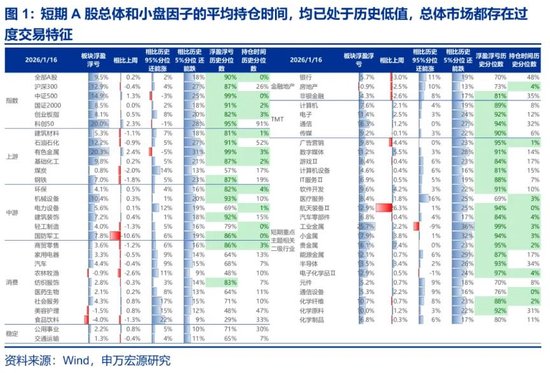
Group 1 - The 2026 market opening shows a clear characteristic of increased risk appetite driven by inflow of incremental funds, with commercial aerospace and AI application industries trending upwards [1][16] - The current market is experiencing strong momentum and excessive trading, which may lead to a short-term consolidation phase [1][16] - The average holding period for defense and military stocks is significantly lower than historical lows, indicating a decrease in stability for short-term momentum trades [1][19] Group 2 - The opening market is viewed as an extension of the strong structural technology market from 2025, which is now entering a high valuation adjustment phase [2][17] - Since September 2025, several high-momentum industries have entered a high-level consolidation phase, with notable examples including Nvidia's computing chain and Google's computing chain [2][17] - The market is expected to shift towards a consolidation phase after rapid valuation increases in new technology directions [2][17] Group 3 - The policy direction emphasizes a stable and long-term approach to avoid past investment pitfalls, such as the "deposit migration" of 2007 and the excessive trading of 2015 [10][26] - The A-share market has a mid-term upward basis, suggesting that a stable approach can balance short-term volatility with long-term goals [10][26] - The current market dynamics indicate a potential reduction in overall profit effects, with a need to wait for further economic and policy catalysts [10][28] Group 4 - The mid-term outlook for the A-share market suggests two phases of upward movement, with the first phase being driven by strong structural technology trends and the second phase potentially benefiting from cyclical improvements and increased asset allocation towards equities [12][28] - The characteristics of the two upward phases are interconnected, with the first phase led by cyclical alpha and AI computing, while the second phase may see a transition towards application-level AI trends [12][28]


单边行情纠偏,股指行稳致远
Dong Zheng Qi Huo· 2026-01-18 09:14
Report Industry Investment Rating - The rating for stock index trends is "Volatility" [4] Core View of the Report - The domestic stock market showed dramatic changes this week. With multiple trading days hitting record high trading volumes, regulatory actions to cool down the market were evident, suppressing stock performance. The stock index opened high and closed low, showing signs of a phased peak. From a capital perspective, ETFs such as the CSI 300 experienced net redemptions, which directly affected index prices. The CSRC's 2026 system work conference emphasized preventing market fluctuations and controlling the market rhythm. Therefore, the long - term slow - bull market pattern remains unchanged, but in the short term, market volatility will increase, and it still needs to accumulate upward momentum [2][10] Summary by Relevant Catalogs 1. One - Week View and Macro Key Event Overview - **Next - week view**: The regulatory measures are cooling down the market, leading to increased stock market volatility. The long - term slow - bull pattern remains, but short - term market shocks will intensify, and it needs to accumulate upward momentum [2][10] - **This - week key event focus**: - On January 12th, four departments jointly issued regulations on the operation of government investment funds, and the NDRC introduced evaluation and management methods for fund investment directions, supporting the cultivation of emerging and future industries [11] - On January 14th, the Shanghai, Shenzhen, and Beijing stock exchanges raised the margin ratio for margin trading to 100%; three departments issued tax incentives for home - buying replacement; China's December exports and imports both exceeded expectations [12][13][14] - On January 15th, the central bank implemented a 25BP structural interest rate cut, increased various re - loan quotas, and adjusted the minimum down - payment ratio for commercial real estate loans; at the end of 2025, China's social financing increased by 8.3% year - on - year [15][16] - On January 16th, the CSRC emphasized counter - cyclical adjustment to prevent market fluctuations; China and Canada reached a series of economic and trade agreements; the State Council executive meeting studied measures to promote consumption [17][18][19] 2. One - Week Market Quotes Overview - **Global stock market weekly overview**: From January 12th to 16th, global stock markets denominated in US dollars rose. The MSCI Global Index increased by 0.33%, with emerging markets (+2.25%) > frontier markets (+0.89%) > developed markets (+0.09%). The South Korean stock market rose 4.29%, outperforming the world, while the French stock market fell 1.47%, the worst - performing globally [1][21] - **Chinese stock market weekly overview**: From January 12th to 16th, most Chinese equity assets rose, with Hong Kong stocks > A - shares > Chinese concept stocks. The average daily trading volume of the Shanghai, Shenzhen, and Beijing stock exchanges was 34653 billion yuan, an increase of 6131 billion yuan compared to last week. A - share broad - based indices were divided, with the STAR 50 Index rising 2.58% and the SSE 50 Index falling 1.74% [1][24] - **Weekly overview of GICS primary industries in Chinese and foreign stock markets**: Most global GICS primary industries rose this week, with real estate leading (+3.53%) and consumer discretionary falling the most (-1.39%). In the Chinese market, information technology had the largest increase (+3.37%), and real estate lagged (-3.66%) [27] - **Weekly overview of China's A - share CITIC primary industries**: Among China's A - share CITIC primary industries this week, 10 rose (28 last week) and 20 fell (2 last week). The computer industry had the largest increase (+4.31%), and the national defense and military industry fell the most (-5.66%) [1][29] - **Weekly overview of China's A - share styles**: Small - cap growth stocks outperformed this week [33] 3. Index Valuation and Earnings Forecast Overview - **Broad - based index valuation**: The report provides PE and PB data for various broad - based indices this week, at the beginning of the year, and their changes, as well as the eight - year percentile [43] - **Primary industry valuation**: The report provides PE and PB data for various primary industries this week, at the beginning of the year, and their changes, as well as the eight - year percentile [44] - **Broad - based index equity risk premium**: The ERP of the CSI 300, CSI 500, and CSI 1000 decreased slightly this week [45][49] - **Consensus expected earnings growth rate of broad - based indices**: The expected earnings growth rate of the CSI 300 in 2025 was adjusted down to 8.64% and in 2026 to 9.32%; for the CSI 500, it was adjusted down to 26.39% in 2025 and up to 22.70% in 2026; for the CSI 1000, it was adjusted down to 28.29% in 2025 and up to 23.27% in 2026 [51] 4. Liquidity and Capital Flow Tracking - **Interest rates and exchange rates**: This week, the 10Y and 1Y interest rates declined, and the spread widened. The US dollar index was 99, and the offshore RMB exchange rate was 6.96 [60] - **Trading - type capital tracking**: This week, the average daily trading volume of northbound funds increased by 740 billion yuan compared to last week, and the margin trading balance increased by 981 billion yuan [59] - **Tracking of funds flowing in through ETFs**: There are 30 on - exchange ETFs tracking the CSI 300, 29 tracking the CSI 500, 15 tracking the CSI 1000, and 40 tracking the CSI A500. This week, the shares of ETFs tracking the CSI 300 decreased by 21.4 billion, those tracking the CSI 500 decreased by 1.7 billion, those tracking the CSI 1000 decreased by 2.7 billion, and those tracking the CSI A500 decreased by 7.7 billion [62][63][65] 5. Tracking of China's Macro High - Frequency Data - **Supply side**: Tire production rates recovered after the Spring Festival [68] - **Consumption side**: Second - hand housing transactions increased seasonally [77] - **Inflation observation**: Producer prices rebounded, while agricultural product prices adjusted [88]
量化择时周报:短期调整不改牛市格局-20260118
ZHONGTAI SECURITIES· 2026-01-18 07:26
- The report introduces a **market timing system** that uses the distance between the 20-day moving average and the 120-day moving average of the WIND All A Index to determine market trends. The system identifies an uptrend when the short-term moving average is above the long-term moving average, with a significant distance threshold of 3%[2][6][11] - The **industry trend allocation model** is highlighted, which signals opportunities in specific sectors. For the medium term, the "distressed reversal expectation model" suggests focusing on innovative healthcare. The "TWO BETA model" continues to recommend the technology sector, particularly AI applications and commercial aerospace after adjustments. In the short term, the "earnings trend model" points to opportunities in computing power (e.g., Sci-Tech Chip ETF, code 588200) and energy storage batteries (e.g., Energy Storage Battery ETF, code 159566)[2][5][7] - The **position management model** is used to determine stock allocation levels. Based on the WIND All A Index's valuation and trend, the model recommends an 80% stock allocation for absolute return products[5][7] - The **valuation indicators** for the WIND All A Index are also discussed. The PE ratio is at the 90th percentile, indicating a relatively high valuation, while the PB ratio is at the 50th percentile, representing a medium level[5][7][11]
周末五分钟全知道(1月第2期):A股“历史最大成交”后如何演绎?有何规律?
GF SECURITIES· 2026-01-18 06:06
Core Insights - The report analyzes the historical patterns of A-share market performance following significant trading volume increases, indicating that market sentiment often shifts after peak trading volumes, with only a few sectors maintaining strong momentum [3][4][5] - It highlights that sectors with robust fundamental expectations tend to sustain their strength post-volume spikes, such as construction during the Belt and Road Initiative in 2014 and AI-related sectors in 2025 [3][4][5] Historical Volume Analysis - A total of six significant volume spikes in A-shares have been identified, characterized by a trading volume increase of 1.5 times or more, with the most recent occurring on January 12, 2026, when the trading volume reached 3.6 trillion yuan [6][7] - Historical data shows that after these volume spikes, the market generally experiences a one-month period of limited risk, with an average return of 1.8% and a median return of 2.7% [26][27] - Over the subsequent three months, the market tends to enter a consolidation phase, with an average decline of 5.05% [26][27] Sector Performance Post-Volume - The report indicates that sectors leading in performance before a volume spike often do not maintain their positions in the following months, suggesting a shift in market focus [37][41] - For instance, sectors like construction and technology have shown varying degrees of performance continuity after volume spikes, with some sectors like food and beverage maintaining strength due to external factors such as foreign investment [41][42] Small vs. Large Cap Stocks - Historically, small-cap stocks tend to outperform large-cap stocks in the month following a volume spike, although this trend does not hold consistently over a three-month period [47][48] - The report emphasizes the importance of monitoring market sentiment and sector fundamentals to gauge future performance [55] Future Market Outlook - The report projects that the A-share market will likely experience a strong upward trend from late January to mid-March 2026, driven by seasonal effects and positive earnings forecasts [4][52] - Key sectors to watch include copper, energy storage, and semiconductor industries, which are expected to perform well in the upcoming months [4][55]
因子周报20260116:本周Beta和低杠杆风格显著定期报告-20260117
CMS· 2026-01-17 14:42
Group 1: Market Index and Style Performance Review - Major broad market indices mostly increased this week, with the CSI 500 rising by 2.18%, the Northbound 50 by 1.58%, and the CSI 1000 by 1.27%. However, the Shanghai Composite Index fell by 0.45% and the CSI 300 by 0.57% [2][10]. - Over the past month, all major broad market indices have risen, with the CSI 500 up by 17.59% and the CSI 1000 by 14.64% [10][11]. - In terms of industry performance, sectors such as computer, electronics, media, non-ferrous metals, and machinery performed well, while defense, agriculture, coal, real estate, and non-bank financials lagged behind [14][16]. Group 2: Factor Performance Tracking - In the CSI 300 stock pool, factors such as the 20-day volume variation coefficient, standardized unexpected earnings, and overnight momentum before earnings announcements performed well this week [3][24]. - In the CSI 500 stock pool, the 60-day specificity, 20-day specificity, and 60-day momentum factors showed strong performance [3][26]. - The overall market stock pool saw strong performance from quarterly ROA, quarterly ROE, and quarterly net profit margin factors [3][22]. Group 3: Quantitative Fund Performance - The average excess return for CSI 300 index-enhanced products was 0.58%, while the CSI 500 index-enhanced products had an average excess return of -0.26% [4][12]. - The best-performing active quantitative fund this week was Huian Quantitative Preferred A [4][12]. Group 4: Quantitative Index Enhancement Portfolio Tracking - The CSI 300 index enhancement portfolio achieved an excess return of 0.24% over the past week, while the CSI 500 index enhancement portfolio had an excess return of 0.27% [5][12]. - The CSI 800 index enhancement portfolio recorded an excess return of 0.59% [5].
ETF市场跟踪与配置周报-20260117
Xiangcai Securities· 2026-01-17 12:21
Report Industry Investment Rating No relevant content provided. Core Views - PB-ROE framework's ETF rotation strategy recommends next week to focus on the communication, agriculture, forestry, animal husbandry, and transportation industries, corresponding to their industry ETFs; the ETF redemption sentiment indicator model suggests focusing on the Science and Technology Innovation 50 ETF, SSE 50 ETF, Medical ETF, Photovoltaic ETF, and Robot ETF [9][40] - Combining PB and ROE for industry configuration may be a better choice; the third quadrant's high PB high ROE and the fifth quadrant's low PB medium ROE are key focus areas; combining the third and fifth quadrants to construct a comprehensive PB-ROE strategy has an annualized return of 11.93% and an annualized excess return of 13.22% [32][33] Summary by Directory 1. Recent Market Overview (January 12 - January 16, 2026) - Index performance: Shanghai Composite Index closed at 4101.91, down 0.45% for the week; Shenzhen Component Index closed at 14281.08, up 1.14%; ChiNext Index closed at 3361.02, up 1.00%; Beijing Stock Exchange 50 closed at 1548.33, up 1.58%; Hang Seng Index closed at 26844.96, up 2.34%. The average daily trading volume of the Shanghai and Shenzhen stock markets was 34250.96 billion yuan, and the total trading volume for the week was 17.13 trillion yuan [12] - Industry performance: Among 31 Shenwan primary industries, 13 industries rose and 18 fell. The top three gainers were computer (up 3.82%), electronics (up 3.77%), and non-ferrous metals (up 3.03%); the top three losers were national defense and military industry (down 4.92%), real estate (down 3.52%), and agriculture, forestry, animal husbandry, and fishery (down 3.27%) [5][12] - Main funds: Main funds had net outflows for 5 trading days and no net inflows, with a total net outflow of 2752.39 billion yuan for the week. The industries with more net inflows were banks, public utilities, and coal; the industries with more net outflows were national defense and military industry, power equipment, and computer [5][13] 2. Recent ETF Market Performance (January 12 - January 16, 2026) - Overall situation: As of January 16, 2026, there were 1411 ETFs in the Shanghai and Shenzhen stock markets, with a total asset management scale of 60766.01 billion yuan. There were 1101 equity ETFs (38892.41 billion yuan), 53 bond ETFs (7479.66 billion yuan), 27 money market ETFs (1529.88 billion yuan), 17 commodity ETFs (2751.84 billion yuan), 207 cross-border ETFs (10070.46 billion yuan), and 6 unlisted ETFs (41.76 billion yuan) [20] - Newly listed and established ETFs: 8 ETFs were newly listed, all equity ETFs; 7 ETFs were newly established, with a total issuance scale of 51.24 billion yuan [21] - Equity ETFs: The median weekly increase or decrease was 0.59%. Science and technology semiconductor ETFs and semiconductor equipment ETFs performed well, with the Science and Technology Semiconductor ETF Peng Hua rising the most at 12.46%; aerospace and high-end equipment ETFs performed poorly, with the Aerospace ETF falling the most at 6.88%. The average weekly share change was a decrease of 19.4716 million shares. Software ETFs and media ETFs had more share increases, while the Science and Technology Innovation 50 ETF and CSI 300 ETF had more share decreases [24] - Bond ETFs: The median weekly increase or decrease of 53 bond ETFs was 0.12%. The convertible bond ETF had the highest increase of 0.91%, while the science and technology innovation bond ETF had the highest decrease of 0.00%. As of January 16, 2026, the Haifutong CSI Short-term Financing ETF had the largest scale of 631.50 billion yuan [27] - Cross-border ETFs: The median weekly increase or decrease was 1.18%. The China-South Korea Semiconductor ETF and Hong Kong Stock Connect Internet ETF had the highest increases, with the China-South Korea Semiconductor ETF rising 6.11%; the Hong Kong Securities ETF and Nasdaq Biotechnology ETF had the highest decreases, with the Hong Kong Securities ETF falling 2.28%. Since the beginning of the year, the median increase or decrease was 3.82%, with the China-South Korea Semiconductor ETF and Hong Kong Medical ETF having higher increases, and the Nasdaq ETF and Nasdaq Technology ETF having higher decreases [29] 3. PB-ROE Framework's ETF Rotation Strategy Tracking - Factor effectiveness: PB factor and PB quantile factor show certain stratification ability, and PB quantile factor is more effective; ROE factor's effectiveness declined after 2018; using ROE factor is better than ROE quantile factor; expected ROE factor is better than expected ROE year-on-year factor. Combining PB and ROE for industry configuration may be a better choice [32] - Key quadrants: The third quadrant's high PB high ROE and the fifth quadrant's low PB medium ROE are key focus areas. From 2017 to February 2024, the compound annualized excess returns of the third and fifth quadrant portfolios were 4.27% and 1.55% respectively [32] - Strategy improvement: After supplementing the PB-ROE framework with four dimensions, the annualized excess returns of the third and fifth quadrant strategies were 4.78% and 3.94% respectively. Combining the two strategies, the annualized return was 11.93% and the annualized excess return was 13.22% [33] - Recent performance: This week, the strategy focused on the communication, agriculture, forestry, animal husbandry, and transportation industries, with a cumulative return of -0.86%, and an excess return of -0.29% compared to the CSI 300 Index [8][34] - Performance since 2023: The cumulative return was 26.03%, with an excess return of 3.81% compared to the CSI 300 Index [8][36] - Performance since 2022: The cumulative return was 7.77%, with an excess return of 11.99% compared to the CSI 300 Index [39] 4. Investment Recommendations - PB-ROE framework: Focus on the communication, agriculture, forestry, animal husbandry, and transportation industries next week, corresponding to their industry ETFs [9][40] - ETF redemption sentiment indicator model: Focus on the Science and Technology Innovation 50 ETF, SSE 50 ETF, Medical ETF, Photovoltaic ETF, and Robot ETF next week [9][40]
A股市场运行周报第76期:市场修斜率,慢牛更可期,两法可应对-20260117
ZHESHANG SECURITIES· 2026-01-17 11:40
Core Insights - The market experienced a surge followed by a pullback, with a general trend of "small strength and large weakness" observed. The major indices began to correct their upward slope, indicating a potential short-term consolidation after the spring rally initiated in mid-December last year. However, this correction does not alter the overall "systematic slow bull" nature of the market [1][4][55] - The report suggests that the technology growth sector is expected to outperform, and recommends two strategies for market participation: one is to balance mid-term positions in sectors with high prosperity and reasonable price levels, specifically in the "two electric and non-mechanical" sectors (electronics, new energy, chemicals, non-bank financials, machinery) to adopt an "offensive instead of defensive" approach; the second is to consider the relatively lower positions in the market, such as the CSI 1000 and National CSI 2000, to capture relative returns [1][5][56] Weekly Market Overview - The market saw a significant increase in trading volume followed by a decline, with the major indices showing a "small strength and large weakness" pattern. The Shanghai Composite, SSE 50, and CSI 300 indices fell by 0.45%, 1.74%, and 0.57% respectively, while growth indices like CSI 500, CSI 1000, and National CSI 2000 rose by 2.18%, 1.27%, and 1.31% respectively [2][12][54] - The technology sector is gaining momentum, with TMT sectors (Technology, Media, Telecommunications) showing strong performance, while other styles are generally weakening. The computer, electronics, media, and communication sectors rose by 3.82%, 3.77%, 2.04%, and 1.42% respectively [2][14][54] Market Sentiment and Fund Flows - The average daily trading volume in the Shanghai and Shenzhen markets increased to 3.43 trillion yuan, indicating heightened market activity. However, the financing buy-in ratio decreased to 10.85% [20][26] - The total margin financing balance rose significantly to 2.71 trillion yuan, with a notable inflow of funds into the margin financing sector, while stock ETFs experienced a net outflow of 675 million yuan [26][31] Market Attribution - Key events influencing the market included the increase in financing margin ratios by the Shanghai and Shenzhen stock exchanges, announcements from multiple listed companies urging rational decision-making, and a meeting by the China Securities Regulatory Commission emphasizing market stability [3][50][54]
宏观专题分析报告:资产定价的双主线
SINOLINK SECURITIES· 2026-01-16 15:14
Market Performance - Since the beginning of 2026, the A-share market has shown a "good start" with a cumulative increase of 5.2% in the Wind All A Index, and the average daily trading volume has exceeded 30 trillion yuan[5] - The leading sectors include media, computer, non-ferrous metals, and military industry, with year-to-date gains of 16.0%, 14.0%, 14.0%, and 9.0% respectively, reflecting the current market focus on AI and geopolitical factors[5] Economic Indicators - In December 2025, China's PPI increased by 0.2% month-on-month, marking the highest monthly increase since 2024, driven by improvements in non-ferrous and technology sector prices[12] - Prices in the non-ferrous metal mining and smelting industries rose by 3.7% and 2.8% respectively, influenced by AI-driven demand for electricity[12] Strategic Trends - The two main strategic lines for A-share pricing in 2026 are AI, reflecting the U.S. focus on technology for growth, and "anti-involution," which corresponds to China's push for reform and high-quality development[3] - The "anti-involution" strategy is entering a new phase, emphasizing "quality over price" and a shift in local government performance perspectives[15] Policy Changes - The cancellation of export tax rebates for photovoltaic products is a national-level manifestation of the "anti-involution" strategy, aimed at promoting price increases among leading companies while eliminating those relying on low prices[18] - Recent regulatory actions against monopolistic practices in the photovoltaic industry signal a commitment to fair competition and the acceleration of "anti-involution" efforts[19] Risks - Potential risks include unexpected geopolitical tensions and slower-than-expected progress in "anti-involution" reforms, which could disrupt market dynamics[4][21]
AST SpaceMobile(ASTS.US)获美国导弹防御局SHIELD项目主承包商资格 盘前跳涨逾7%
智通财经网· 2026-01-16 12:57
Core Viewpoint - AST SpaceMobile has been awarded the main contractor qualification for the MDA "SHIELD" project, marking a significant recognition of its dual-use technology and capabilities in the defense sector [1] Group 1: Company Developments - AST SpaceMobile's stock price increased by 7.5% to $108.64 following the announcement of the contract [1] - The MDA SHIELD project is part of the broader "Iron Dome" strategy aimed at creating a resilient layered defense system across various domains [1] - The selection as the main contractor is seen as a key breakthrough for AST SpaceMobile in expanding its business into the defense sector [1] Group 2: Industry Implications - The collaboration is expected to integrate AST SpaceMobile's space-ground communication technology into national missile defense systems [1] - This partnership opens up potential growth opportunities for future government contracts in the defense industry [1]

4只ST股预告2025年全年业绩
Zheng Quan Shi Bao Wang· 2026-01-16 03:36
Core Viewpoint - As of January 16, a total of 4 ST stocks have announced their annual performance forecasts, with 2 companies expecting to reduce losses and 2 companies forecasting losses [1] Group 1: Performance Forecasts - Company *ST Hua Wang (603007)* expects a reduction in losses, with a projected net profit range of -18 million to -24 million yuan, and a year-to-date price change of +3.48% [1] - Company *ST Zhang Gu (000430)* also anticipates a reduction in losses, with a projected net profit range of -45 million to -55 million yuan, and a year-to-date price change of -3.61% [1] Group 2: Loss Forecasts - Company *ST Yan Shi (600696)* is forecasting a loss, with no specific net profit figures provided, and a year-to-date price change of -5.17% [1] - Company *ST Wan Fang (000638)* is also forecasting a loss, with no specific net profit figures provided, and a year-to-date price change of -7.26% [1]


