
铜

Search documents
建信期货铜期货日报-20251120
Jian Xin Qi Huo· 2025-11-20 11:04
Group 1: Report Information - Report Name: Copper Futures Daily Report [1] - Date: November 20, 2025 [2] - Researchers: Zhang Ping, Yu Feifei, Peng Jinglin [3][4] Group 2: Investment Rating - Not provided Group 3: Core View - The short - term spot demand supports copper prices, but the macro - face has a large impact. With the continued selling of US stocks, rising Japanese bond yields, and upcoming important US data, copper prices are expected to fluctuate at the bottom [10] Group 4: Market Review and Operation Suggestions - Shanghai copper stopped falling. The selling of US stocks continued, but the A - share market stopped falling during the day, and market risk - aversion sentiment cooled. The spot price rose 110 to 86,115, and the spot premium rose 15 to 85. The decline of copper prices to 86,000 stimulated downstream purchasing sentiment. The LME0 - 3 contango structure expanded to 35, and the domestic spot import loss was around 270. With the narrowing of the import loss, the supply of imported goods is expected to increase [10] Group 5: Industry News - From January to September 2025, the production of major global copper enterprises showed differentiation. BHP's cumulative production in the first three quarters was 1.0509 million metal tons, a year - on - year increase of 6.0%; Rio Tinto's copper mine production was 0.5377 million metal tons, a year - on - year increase of 21.03%; MMG's production was 0.3455 million metal tons, a year - on - year increase of 44.84%. Freeport - McMoRan's production decreased by 8.8% year - on - year, and Glencore's production decreased by 23.54% year - on - year. Most companies maintained their annual production guidance, but Codelco lowered its annual target from 1.34 - 1.37 million tons to 1.31 - 1.34 million tons due to a safety accident [11] - Zhejiang Kefei Technology Co., Ltd. signed an EPC contract for the SHOMBERWA 60kt/a copper smelting and chemical project with LEDYA Group in the Democratic Republic of the Congo. The project will process 2 million tons of high - grade copper - cobalt sulfide ore annually, with a planned annual production of 60,000 tons of copper concentrate. The supporting blister copper and sulfuric acid production systems will be built in two phases, ultimately reaching an annual production capacity of 60,000 tons of blister copper (Cu98%) and 180,000 tons of industrial sulfuric acid (98% H₂SO₄), with expansion space reserved [11][12] - Freeport - McMoRan plans to restart the production of the Grasberg copper - gold mine in Indonesia by July next year. The mine was shut down in September this year due to a fatal accident. It is expected that the total production of copper and gold of Freeport Indonesia in 2026 will be roughly the same as in 2025, about 1 billion pounds of copper and 90 ounces of gold, and production is expected to increase from 2026 to 2027 [12]
有色金属行业周报:铜铝需求好转,关注锑市改善-20251120
East Money Securities· 2025-11-20 10:29
Investment Rating - The report maintains an "Outperform" rating for the non-ferrous metals industry, indicating expected performance above the market average [2][12]. Core Insights - Demand for copper and aluminum is showing signs of improvement, with a focus on the recovery in the antimony market [1]. - The report highlights a slight recovery in downstream demand for copper, with LME copper prices increasing by 1.2% week-on-week, while SHFE copper prices rose by 1.1% [4]. - Aluminum demand is supported by the automotive and cable sectors, with LME aluminum prices decreasing by 0.3% and SHFE aluminum prices increasing by 1.0% [4]. - The gold market is influenced by hawkish statements from the Federal Reserve, with SHFE gold prices rising by 3.5% and COMEX gold prices increasing by 1.9% [4]. - The report notes a recovery in antimony prices and a tight supply-demand situation for tungsten, with tungsten concentrate prices increasing by 1.8% [4]. Summary by Sections Copper Sector - Supply disruptions are frequent, but there is a slight recovery in downstream demand. The copper processing rate is at 66.88%, up by 4.91 percentage points week-on-week [4]. - October's copper production in China decreased by 2.94 million tons month-on-month, but year-on-year it increased by 9.63% [4]. Aluminum Sector - The aluminum processing rate is at 62.0%, with a week-on-week increase of 0.4 percentage points. The demand is bolstered by the sales of new energy vehicles, which reached approximately 1.4 million units in October, reflecting a 17% year-on-year increase [4]. Gold Sector - Investment demand for gold is slightly recovering, with SPDR Gold ETF holdings increasing by 1.9 tons week-on-week [4]. Minor Metals Sector - Antimony prices are showing signs of recovery, while tungsten supply remains tight. The report emphasizes the need to monitor export licensing and ongoing demand [4]. Steel Sector - The West Manganese project has officially commenced production, which is expected to gradually improve steel mill profitability. The report notes a decrease in total inventory of steel products by 26.23 million tons week-on-week [5].
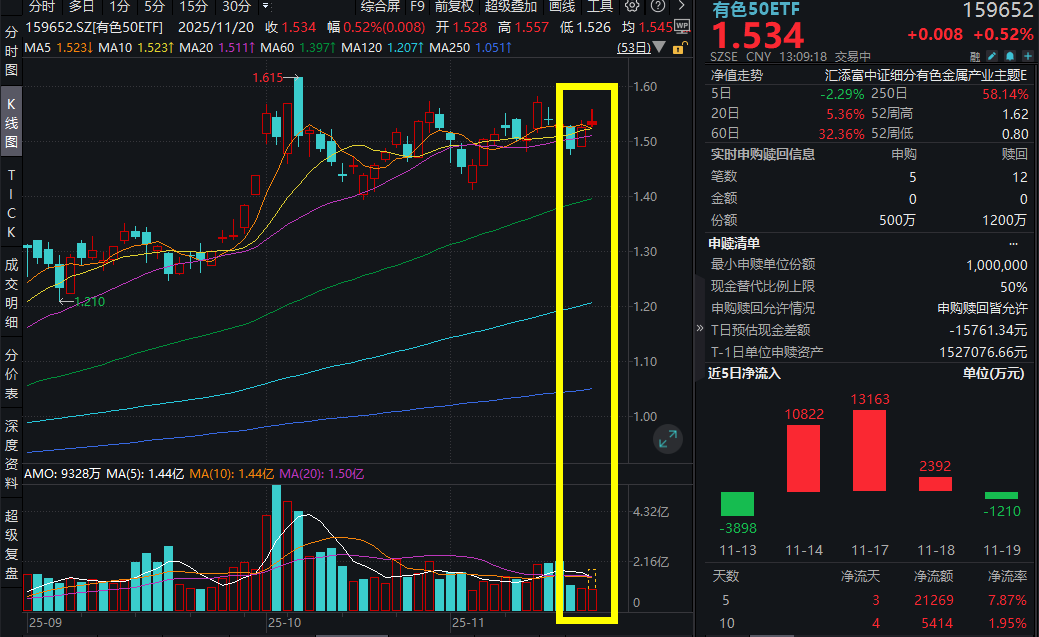
碳酸锂期货大涨超3%,盛新锂能获百亿长单!有色50ETF(159652)爆量上涨!有色年内涨幅领跑大市,2026年将如何演绎?
Xin Lang Cai Jing· 2025-11-20 05:38
Group 1: Market Overview - The A-share market showed slight recovery on November 20, with the non-ferrous sector opening high and fluctuating, as evidenced by the significant trading volume of the Non-Ferrous 50 ETF (159652) which rose by 0.52% and reached a trading volume of over 90 million yuan [1] - The Non-Ferrous 50 ETF index components mostly surged, with Zhongkuang Resources rising over 5%, while other stocks like Northern Rare Earth and Huayou Cobalt also saw gains exceeding 1% [3] Group 2: Lithium Market Dynamics - On November 19, lithium carbonate futures prices broke through 100,000 yuan/ton, indicating a clear recovery in spot lithium carbonate prices. Ganfeng Lithium's chairman stated that if demand growth exceeds 30% to 40% next year, prices could potentially exceed 150,000 yuan/ton or even 200,000 yuan/ton due to supply constraints [2] Group 3: Supply Chain and Pricing Trends - The supply chain for non-ferrous metals is facing disruptions, with several large mines experiencing operational issues, which highlights the vulnerability of global non-ferrous resource supply [6] - The copper market is expected to see average prices reach 4.55 USD per pound by 2026 due to supply concerns stemming from accidents at major mines [5] Group 4: Investment Opportunities in Non-Ferrous Metals - The non-ferrous metals sector has outperformed other industries this year, with a year-to-date increase of 79% for the CITIC non-ferrous metals index, significantly leading other sectors [5] - The Non-Ferrous 50 ETF (159652) is highlighted for its high "gold-copper content" of 46%, making it a leading choice among similar investment products [12] Group 5: Future Outlook and Strategic Considerations - The geopolitical landscape and resource security concerns are expected to drive demand for strategic commodities, with a notable increase in green demand for copper and aluminum anticipated by 2030 [8] - The ongoing industrialization in emerging economies and the reshaping of trade patterns are likely to provide new growth opportunities for commodity demand, particularly in countries involved in the Belt and Road Initiative [9]





广发期货《有色》日报-20251120
Guang Fa Qi Huo· 2025-11-20 03:22
1. Report Industry Investment Ratings No information about industry investment ratings is provided in the reports. 2. Core Views of the Reports Copper - Market sentiment is cautious, with copper prices oscillating. The long - term supply - demand contradiction supports the upward shift of the copper price bottom. The main contract is expected to range between 85,500 - 87,500 yuan/ton. Follow demand changes and overseas interest - rate cut expectations [1]. Zinc - The fundamentals offer limited support for continuous upward movement of SHFE zinc, which is likely to oscillate in the short term. The main contract is expected to range between 22,200 - 22,800 yuan/ton. Look out for demand improvement and non - recessionary interest - rate cut expectations [3]. Aluminum - The alumina market remains in a supply - demand surplus, with prices likely to remain weak. The main contract is expected to range between 2,700 - 2,900 yuan/ton. SHFE aluminum is caught between macro - level positives and weak fundamentals, with the medium - term supply expected to be tight [4]. Tin - Tin ore supply is tight, and demand shows regional differences. With positive semiconductor sentiment, long positions can be held. Monitor macro changes and Myanmar's supply recovery [6]. Aluminum Alloy - The short - term ADC12 price will stay firm, supported by costs. The main contract is expected to range between 20,400 - 21,000 yuan/ton. Track scrap aluminum supply, downstream procurement, and inventory changes [9]. Nickel - The nickel market faces macro pressure, and the fundamental improvement is limited. The medium - term supply is abundant. The main contract is expected to range between 113,000 - 118,000 yuan/ton. Pay attention to macro expectations and Indonesian policies [11]. Stainless Steel - The stainless - steel market has insufficient macro - level drivers and weak demand. The supply pressure remains. The main contract is expected to range between 12,300 - 12,600 yuan/ton. Monitor steel - mill production cuts and nickel - iron prices [13]. Lithium Carbonate - The lithium carbonate market shows strong short - term momentum. The market may continue to be strong, followed by wide - range oscillations. Be cautious when chasing long positions at current levels [15]. Polysilicon - Polysilicon prices are expected to oscillate in a high - level range. Futures may decline. Monitor inventory pressure, spot support, and demand orders [16]. Industrial Silicon - Industrial silicon prices are expected to oscillate at a low level, mainly between 8,500 - 9,500 yuan/ton. Consider short - selling or hedging at high prices [17]. 3. Summaries According to Relevant Catalogs Copper - **Price and Spread**: SMM 1 electrolytic copper price rose to 86,715 yuan/ton, with a daily increase of 0.13%. The refined - scrap spread increased by 8.98% [1]. - **Fundamentals**: In October, electrolytic copper production was 1.0916 million tons, a month - on - month decrease of 2.62%. In September, imports were 0.3343 million tons, a month - on - month increase of 26.50% [1]. Zinc - **Price and Spread**: SMM 0 zinc ingot price rose to 22,420 yuan/ton, with a daily increase of 0.45% [3]. - **Fundamentals**: In October, refined zinc production was 0.6172 million tons, a month - on - month increase of 2.85%. In September, imports were 0.0227 million tons, a month - on - month decrease of 11.61% [3]. Aluminum - **Price and Spread**: SMM A00 aluminum price rose to 21,550 yuan/ton, with a daily increase of 0.42%. Alumina prices in different regions were mostly stable [4]. - **Fundamentals**: In October, alumina production was 7.7853 million tons, a month - on - month increase of 2.39%. Electrolytic aluminum production was 3.7421 million tons, a month - on - month increase of 3.52% [4]. Tin - **Price and Spread**: SMM 1 tin price rose to 291,500 yuan/ton, with a daily increase of 0.73% [6]. - **Fundamentals**: In September, tin ore imports were 8,714 tons, a month - on - month decrease of 15.13%. In October, SMM refined tin production was 16,090 tons, a month - on - month increase of 53.09% [6]. Aluminum Alloy - **Price and Spread**: SMM aluminum alloy ADC12 price remained at 21,450 yuan/ton. The refined - scrap spread in different regions decreased [9]. - **Fundamentals**: In October, regenerated aluminum alloy ingot production was 0.645 million tons, a month - on - month decrease of 2.42%. The regenerated aluminum alloy开工率 decreased [9]. Nickel - **Price and Spread**: SMM 1 electrolytic nickel price rose to 117,600 yuan/ton, with a daily increase of 0.56%. The 8 - 12% high - nickel pig iron price decreased to 897 yuan/nickel point [11]. - **Fundamentals**: China's refined nickel production in October was 35,900 tons, a month - on - month increase of 0.84%. Imports in September were 38,164 tons, a month - on - month increase of 124.36% [11]. Stainless Steel - **Price and Spread**: 304/2B (Wuxi Hongwang 2.0 coil) price remained at 12,700 yuan/ton. The raw material prices such as nickel ore and chromium iron decreased [13]. - **Fundamentals**: In October, China's 300 - series stainless - steel crude steel production was 1.8217 million tons, a month - on - month increase of 0.38%. Indonesia's production was 0.4235 million tons, a month - on - month increase of 0.36% [13]. Lithium Carbonate - **Price and Spread**: SMM battery - grade lithium carbonate price rose to 88,900 yuan/ton, with a daily increase of 1.72%. The lithium ore price also increased [15]. - **Fundamentals**: In October, lithium carbonate production was 92,260 tons, a month - on - month increase of 5.73%. Demand was 126,961 tons, a month - on - month increase of 8.70% [15]. Polysilicon - **Price and Spread**: Polysilicon spot prices were stable, while futures prices rose to 54,625 yuan/ton. The spread between contracts increased [16]. - **Fundamentals**: Weekly polysilicon production was 26,800 tons, a week - on - week decrease of 0.74%. Monthly production was 134,000 tons, a month - on - month increase of 3.08% [16]. Industrial Silicon - **Price and Spread**: Industrial silicon spot prices were unchanged, while futures prices rose to 9,390 yuan/ton. The spread between contracts changed [17]. - **Fundamentals**: In October, national industrial silicon production was 452,200 tons, a month - on - month increase of 7.46%. The national开工率 was 68.12%, a month - on - month increase of 9.98% [17].
瑞银展望2026:卷还是不卷?洞察中国大宗周期
瑞银· 2025-11-20 02:16
Investment Rating - The report upgrades the rating for lithium carbonate due to unexpected demand from energy storage orders [5] Core Insights - The aluminum and copper sectors are fundamentally solid, driven by demand growth from the energy transition, with global copper demand expected to grow by 3% and prices potentially reaching $11,000 [4][5] - The photovoltaic (PV) industry faces severe overcapacity, with supply far exceeding demand, leading to widespread losses among companies [8][9] - The steel industry shows strong demand resilience, with no significant need for production cuts, while the cement industry struggles with low capacity utilization and regional management challenges [6][7] Summary by Sections Aluminum and Copper - The copper market is tightening, with global mine supply expected to increase by only 1% in 2026, while demand is projected to grow by 3% [4] - The aluminum sector mirrors copper's demand dynamics, with limited new capacity from Indonesia and Mozambique [4] Lithium and Energy Storage - Lithium carbonate's rating has been upgraded due to a surge in energy storage orders, with significant increases in production utilization rates for upstream materials [5][14] - The lithium battery market's demand has exceeded expectations, with total demand rising to 2,000-2,270 GWh [14] Steel and Cement - The steel industry maintains strong demand, with no immediate need for production cuts, while the cement sector faces challenges due to low utilization rates and regional management difficulties [6][7] Photovoltaic Industry - The PV industry is experiencing a critical turning point, with overcapacity issues leading to significant losses, despite expectations for gradual improvement in profitability starting in 2025 [8][13] - Government intervention is necessary to address overcapacity, as market-driven measures have proven insufficient [9][11] Future Outlook - The report anticipates that global PV demand growth may slow, with China's installation expected to stabilize between 200-250 GW in the coming years [12] - The lithium battery supply chain is expected to see a 25% increase in global production by 2026, with a corresponding rise in prices for certain materials [20]
牛市继续?明年黄金或涨至4800美元/盎司,白银铂金机会凸显 | 2025大盘点
Sou Hu Cai Jing· 2025-11-19 09:40
Core Insights - The global gold market in 2025 has experienced a significant bull market characterized by a "stair-step breakthrough and pullback" pattern, with gold prices reaching a historical peak of $4,380 per ounce in October before retreating below $4,000 in early November, and currently trading above $4,100, marking an annual increase of over 50%, the strongest performance since 1979 [1][2][3] Price Movement Analysis - Gold prices began the year at $2,800 per ounce, rising to $3,420 by the end of March, a quarterly increase of 22.1%, the best performance since Q2 2016 [1] - In Q2, gold prices fluctuated between $3,400 and $3,600, supported by an 11% drop in the US dollar index, while global gold ETF holdings increased by 187 tons [2] - Q3 saw a surge in demand, with total gold demand reaching 1,313 tons and total value at $146 billion, driven by a 47% increase in investment demand [2] - In Q4, gold prices peaked at $4,380 per ounce in mid-October but retreated to around $3,968 due to market corrections and a rebound in the dollar index [2] Driving Factors Behind Gold Prices - The current bull market in gold is driven by three core factors: geopolitical risks, central bank purchases, and global liquidity [3][4] - Geopolitical tensions, particularly the Russia-Ukraine conflict and Middle East instability, have heightened demand for gold as a safe-haven asset [3] - Central banks have significantly increased gold reserves, with net purchases of 634 tons in the first three quarters of 2025, reflecting concerns over the US dollar's credibility [4][5] Investment Demand Dynamics - Private sector investment demand has surged, with Q3 global gold investment demand reaching 537 tons, a 47% year-on-year increase, driven by ETF purchases and physical gold demand [5] - The demand for gold bars and coins reached 316 tons in Q3, with significant contributions from India and China [5] Macroeconomic Influences - Macroeconomic factors such as the Federal Reserve's policy shift, global debt pressures, and geopolitical risks are key drivers for gold prices [6] - The Federal Reserve's recent interest rate cuts and the decline in the dollar index have further supported gold's appeal [6] - Rising global debt levels and inflation concerns position gold as a valuable asset for hedging against economic instability [6] Future Outlook for Precious Metals - Analysts predict that 2026 will see a "high-level fluctuation with long-term positive trends" for precious metals, with gold potentially reaching $4,500 to $4,800 per ounce [7] - Other precious metals like silver and platinum are also expected to show significant investment value, driven by industrial demand and market dynamics [8] - The overall strategy for 2026 suggests a shift from "gold dominance" to a more balanced allocation across various precious metals [8][9]
贵金属有色金属产业日报-20251119
Dong Ya Qi Huo· 2025-11-19 09:22
1. Report Industry Investment Rating No relevant content provided. 2. Core Views of the Report - In the precious metals market, although central bank gold purchases and growing investment demand will push up the price center of precious metals in the long - term, short - term macro uncertainties about December interest rate cuts may lead to continued volatile adjustments. It is recommended to pay attention to the retracement of the 60 - day moving average [3]. - In the copper market, concerns about non - farm data affecting interest rate cuts have led to capital reduction and price drops. Inventory increases and narrowing premiums reflect fundamental pressures, with limited short - term repair space [17]. - In the aluminum market, Shanghai aluminum is expected to maintain a long - term oscillatory upward trend, but short - term weak fundamentals and a lower probability of December interest rate cuts may lead to profit - taking by previous funds, resulting in subsequent oscillatory consolidation. Alumina is in an oversupply situation, and the expiration of a large number of warehouse receipts will exacerbate the imbalance between supply and demand [36]. - In the zinc market, the cooling of interest rate cut expectations and a significant drop in November TC due to intense competition for ore in the smelting sector have increased the willingness of smelters to reduce or halt production in November. There is a possibility of inventory reduction, and there are significant differences between bulls and bears [59]. - In the nickel and stainless - steel market, nickel - iron prices have been declining due to weak downstream demand. The downside space for nickel and stainless - steel is greater than the upside space. Stainless - steel spot sales face pressure, and downstream demand remains weak [75]. - In the tin market, due to limited resumption of production in Wabang, refined tin concentrate imports have sharply decreased, and supply is weaker than demand. Shanghai tin is expected to maintain high - level oscillations, with support around 276,000 yuan [88]. - In the lithium carbonate market, strong demand from the new energy vehicle and energy storage sectors, combined with a slowdown in supply growth, may lead to a short - term strong and oscillatory trend in lithium prices, but position fluctuations should be watched out for [104]. - In the silicon industry chain, the supply - demand pattern of industrial silicon is generally weak, with wide - range oscillations. The polysilicon industry chain is experiencing production cuts and inventory accumulation, with a weak fundamental outlook and wide - range, weak oscillations [116]. 3. Summary by Relevant Catalogs Precious Metals - **Price Outlook**: In the short term, due to unclear prospects of December interest rate cuts, precious metals may continue to oscillate and adjust. In the long term, central bank gold purchases and growing investment demand will push up prices [3]. - **Price Charts**: Include SHFE gold and silver futures main - continuous prices, COMEX gold prices and gold - silver ratios, SHFE and SGX gold and silver futures - spot price differences, gold and US Treasury real interest rates, gold long - term fund holdings, and SHFE and COMEX gold and silver inventories [4][12][16]. Copper - **Price Outlook**: Market concerns about non - farm data and inventory increases have led to price drops, with limited short - term repair space [17]. - **Price Data**: Spot prices from various sources (Shanghai Non - ferrous, Shanghai Wumaoyi, etc.) have small daily increases. Futures prices of Shanghai copper and London copper show different trends, with Shanghai copper rising and London copper falling [22][23]. - **Inventory Data**: Shanghai copper warehouse receipts and LME copper inventories show different changes, with some warehouse receipts decreasing and LME copper inventories increasing [32][34]. Aluminum - **Price Outlook**: Shanghai aluminum may oscillate and consolidate in the short term, while alumina is in an oversupply situation [36]. - **Price Data**: Aluminum and alumina futures and spot prices show different trends, with some rising and some falling [38][45]. - **Inventory Data**: Shanghai aluminum and LME aluminum inventories show different changes, and alumina warehouse receipts increase slightly [53]. Zinc - **Price Outlook**: Cooling interest rate cut expectations and a drop in November TC have increased the willingness of smelters to cut production. There is a possibility of inventory reduction, and there are significant differences between bulls and bears [59]. - **Price Data**: Shanghai zinc and LME zinc prices show different trends, with Shanghai zinc rising and LME zinc falling slightly [60]. - **Inventory Data**: Shanghai zinc warehouse receipts decrease, and LME zinc inventories increase [72]. Nickel and Stainless - Steel - **Price Outlook**: Nickel - iron prices decline due to weak downstream demand, and the downside space for nickel and stainless - steel is greater than the upside space. Stainless - steel spot sales face pressure [75]. - **Price Data**: Nickel and stainless - steel futures prices show different trends, with some rising and some falling [76]. - **Inventory Data**: Nickel warehouse receipts decrease [76]. Tin - **Price Outlook**: Due to limited resumption of production in Wabang, refined tin concentrate imports have sharply decreased, and supply is weaker than demand. Shanghai tin is expected to maintain high - level oscillations [88]. - **Price Data**: Shanghai tin and London tin futures prices show different trends, with Shanghai tin rising and London tin falling slightly [89]. - **Inventory Data**: Shanghai tin warehouse receipts decrease, and LME tin inventories remain unchanged [99]. Lithium Carbonate - **Price Outlook**: Strong demand and slow supply growth may lead to a short - term strong and oscillatory trend in lithium prices, but position fluctuations should be watched out for [104]. - **Price Data**: Lithium carbonate futures and spot prices show an upward trend [105][109]. - **Inventory Data**: Guangzhou Futures Exchange warehouse receipts increase slightly, and social and downstream inventories decrease [114]. Silicon Industry Chain - **Price Outlook**: The supply - demand pattern of industrial silicon is generally weak, with wide - range oscillations. The polysilicon industry chain is experiencing production cuts and inventory accumulation, with a weak fundamental outlook [116]. - **Price Data**: Industrial silicon and polysilicon - related product prices show different trends, with some remaining stable and some changing slightly [116]. - **Inventory Data**: Industrial silicon social inventory and polysilicon total inventory show different trends [134][143].
贵金属有色金属产业日报-20251118
Dong Ya Qi Huo· 2025-11-18 11:59
1. Report Industry Investment Rating No relevant content provided. 2. Core Views of the Report - For precious metals, although central bank gold purchases and growing investment demand will push up the price center in the long - term, the unclear prospect of interest rate cuts in December and short - term technical weakness suggest a possible short - term adjustment. Attention should be paid to the retracement of the 200 - day moving average [3]. - For copper, as the delivery date approaches, the registered warrant volume has rapidly increased. The spot price of electrolytic copper has declined, the premium has strengthened, and the purchasing sentiment has increased but not significantly. The futures price has shown narrow - range fluctuations and lacks driving forces [15]. - For aluminum, the expected tightening of overseas electrolytic aluminum supply has given rise to a bullish sentiment among funds, leading to an influx of capital into Shanghai aluminum futures and an increase in prices. However, downstream demand may not support such high prices, so Shanghai aluminum is expected to fluctuate at a high level. Alumina has seen price - increasing orders due to environmental production restrictions and short - covering, but it still follows an oversupply logic. Cast aluminum alloy has strong follow - up characteristics with Shanghai aluminum and has strong downside support [33][34]. - For zinc, the expectation of interest rate cuts has cooled down, and the smelting sector's willingness to reduce or halt production in November has increased due to intense competition for ores and a significant decline in TC. The impact needs to be observed through inventory changes in November. There is a possibility of inventory reduction if demand remains stable. Currently, there are significant differences between bulls and bears, and the bottom space can be observed at the end of the month [57]. - For nickel, the expectation of interest rate cuts in December is uncertain, and the progress of Sino - US tariffs has affected risk preferences. Nickel ore prices may remain strong in the short term due to the approaching rainy season in the Philippines and the impact of typhoons on production and shipping. The prices of nickel - iron and stainless steel have declined due to weak downstream demand, and both are experiencing inventory accumulation [73]. - For tin, although there has been some resumption of production in Yunnan, the supply is still weaker than demand due to the under - expected resumption of production in Wa State and a sharp reduction in concentrate imports. Shanghai tin is expected to maintain a high - level oscillation, with support predicted around 276,000 yuan [88]. - For lithium carbonate, the price has far exceeded expectations, and downstream buyers have no intention to replenish inventory. There is an expectation of a decline in production in December. Technically, the price has broken through the 90,000 - yuan mark and reached 95,000 yuan, posing a high risk for chasing the price. There is an over - rising sentiment, and the risk of chasing the price should be vigilant [104]. - For the silicon industry chain, the supply - demand pattern of industrial silicon is generally weak, and it is expected to have wide - range fluctuations. The polysilicon industry chain is experiencing production cuts and inventory accumulation, with a weak fundamental outlook and wide - range weak fluctuations [115]. 3. Summaries by Related Catalogs Precious Metals - **Price Outlook**: Short - term adjustment possible, long - term upward trend supported by central bank purchases and investment demand [3]. - **Market Data**: Included price trends of SHFE and COMEX gold and silver, their ratios, and relationships with the US dollar index, US Treasury real interest rates, and long - term fund holdings [4][8][11]. Copper - **Spot Market**: Spot prices of copper have declined, with different degrees of decline in various regions. The premium has also decreased [18]. - **Futures Market**: Futures prices have declined, and the trading volume and open interest have shown certain trends. The registered warrant volume has increased significantly [16][19][29]. - **Import and Processing**: Copper import losses have increased, and the TC of copper concentrates has remained unchanged [24]. - **Scrap - to - Refined Spread**: The scrap - to - refined spread has decreased, indicating a reduced price advantage of scrap copper [28]. Aluminum - **Futures Prices**: The prices of Shanghai aluminum, alumina, and aluminum alloy futures have declined to varying degrees [35]. - **Price Spreads**: There are differences in price spreads between different contracts of aluminum and alumina, as well as between aluminum and alumina [38][40]. - **Spot Market**: Spot prices of aluminum in different regions have declined, and the basis has also changed [44]. - **Inventory**: The inventory of Shanghai aluminum and LME aluminum has changed, and the alumina warehouse receipt inventory has remained stable [51]. Zinc - **Futures Prices**: The prices of Shanghai zinc futures have generally declined, except for the second - consecutive contract which has increased slightly [58]. - **Spot Market**: Spot prices of zinc have declined, and the premium has changed significantly [66]. - **Inventory**: The inventory of Shanghai zinc and LME zinc has increased [70]. Nickel - **Futures Market**: The prices of Shanghai nickel and LME nickel have declined, and the trading volume has increased while the open interest has decreased. The warehouse receipt volume has increased [74]. - **Downstream Market**: The prices of nickel - iron and stainless steel have declined, and the downstream demand is weak. Both are experiencing inventory accumulation [73]. Tin - **Futures Market**: The prices of Shanghai tin and LME tin have changed slightly, with Shanghai tin showing a slight decline [89]. - **Spot Market**: The spot prices of tin and tin concentrates have declined slightly, and the prices of solder products have remained stable [93]. - **Inventory**: The inventory of Shanghai tin has increased, while the LME tin inventory has decreased [99]. Lithium Carbonate - **Futures Prices**: The prices of lithium carbonate futures have generally increased compared to the previous week, but there has been a slight decline on the day [105]. - **Spot Market**: The prices of various lithium - related products have increased, and the price differences between different grades have also changed [109]. - **Inventory**: The warehouse receipt inventory of the Guangzhou Futures Exchange and the social inventory of lithium carbonate have decreased [113]. Silicon Industry Chain - **Industrial Silicon**: The spot prices of industrial silicon in different regions have changed slightly, and the basis has increased. The futures prices have declined [115]. - **Polysilicon and Downstream Products**: The prices of polysilicon, silicon wafers, battery chips, and components have shown certain trends, and the inventory of polysilicon has increased [123][133].
云南铜业跌2.01%,成交额2.30亿元,主力资金净流出3876.66万元
Xin Lang Cai Jing· 2025-11-18 02:13
Core Viewpoint - Yunnan Copper experienced a stock price decline of 2.01% on November 18, with a current price of 17.02 CNY per share and a market capitalization of 34.102 billion CNY [1] Group 1: Stock Performance - Yunnan Copper's stock price has increased by 42.43% year-to-date, but has seen a decline of 1.45% over the last five trading days and 6.43% over the last 20 days [1] - The company has appeared on the "龙虎榜" (a stock trading list) once this year, with the most recent appearance on October 10 [1] Group 2: Financial Performance - For the period from January to September 2025, Yunnan Copper reported a revenue of 137.743 billion CNY, representing a year-on-year growth of 6.73%, and a net profit attributable to shareholders of 1.551 billion CNY, up by 1.91% year-on-year [2] - The company has distributed a total of 4.019 billion CNY in dividends since its A-share listing, with 1.944 billion CNY distributed over the last three years [3] Group 3: Shareholder Information - As of November 10, 2025, Yunnan Copper had 201,800 shareholders, a decrease of 0.39% from the previous period, with an average of 9,930 circulating shares per shareholder, an increase of 0.40% [2] - The top ten circulating shareholders include Hong Kong Central Clearing Limited as the third-largest shareholder, holding 42.9042 million shares, an increase of 9.8413 million shares from the previous period [3]

北方铜业跌2.06%,成交额1.16亿元,主力资金净流出1534.43万元
Xin Lang Cai Jing· 2025-11-18 02:02
Core Viewpoint - Northern Copper Industry's stock has experienced fluctuations, with a year-to-date increase of 85.31%, but a recent decline in the last five and twenty trading days [1] Group 1: Stock Performance - On November 18, Northern Copper's stock price fell by 2.06% to 14.25 CNY per share, with a trading volume of 116 million CNY and a turnover rate of 0.43%, resulting in a total market capitalization of 27.142 billion CNY [1] - The stock has seen a decline of 3.59% over the last five trading days and 10.49% over the last twenty trading days, while it has increased by 23.38% over the last sixty days [1] - The company has appeared on the "Dragon and Tiger List" seven times this year, with the most recent appearance on October 9, where it recorded a net buy of -44.1062 million CNY [1] Group 2: Company Overview - Northern Copper Industry Co., Ltd. was established on April 2, 1996, and listed on April 28, 1997, with its main business involving copper mining, smelting, and production of various copper products [2] - The revenue composition includes 73.68% from cathode copper, 19.74% from precious metals, 4.93% from copper strips and rolled copper foil, and smaller percentages from other products [2] - The company is classified under the non-ferrous metals industry, specifically in industrial metals and copper, and is associated with concepts such as non-ferrous copper and precious metals [2] Group 3: Financial Performance - For the period from January to September 2025, Northern Copper achieved a revenue of 19.973 billion CNY, representing a year-on-year growth of 9.89%, and a net profit attributable to shareholders of 689 million CNY, up 26.10% year-on-year [2] - The company has distributed a total of 601 million CNY in dividends since its A-share listing, with 387 million CNY distributed over the last three years [3] Group 4: Shareholder Information - As of September 30, 2025, the number of shareholders decreased by 1.23% to 186,900, with an average of 10,190 circulating shares per person, which increased by 1.24% [2] - Among the top ten circulating shareholders, Hong Kong Central Clearing Limited holds 14.9068 million shares, an increase of 3.5978 million shares from the previous period [3]
