
房地产

Search documents
2028年全球智能危机——一份来自未来的金融历史思想实验(中文版)
Xin Lang Cai Jing· 2026-02-26 05:05
Core Insights - The report by Citrini Research outlines a hypothetical scenario of an economic crisis driven by rapid advancements in artificial intelligence (AI) by June 2028, termed the "Global Intelligence Crisis" [3][4] - It emphasizes the "AI Efficiency Paradox," where AI's success leads to economic instability, including widespread white-collar unemployment and the erosion of middle-class income structures [4][10] - The concept of "Ghost GDP" is introduced, indicating that while corporate profits may rise due to AI efficiencies, the purchasing power of displaced workers declines, leading to a slowdown in money circulation and consumer spending [4][11] - The report predicts the collapse of traditional business models reliant on human labor and consumer behavior, particularly in sectors like SaaS, intermediary platforms, and private credit [4][12] Economic Impact - By February 2026, the unemployment rate is projected to reach 10.2%, with the S&P 500 index down 38% from its peak in October 2026, indicating a significant economic downturn [10] - The report notes that while corporate profits have surged due to AI, real wages for white-collar workers have stagnated, leading to a disconnect between productivity gains and consumer spending [11][12] - The economic model is described as a negative feedback loop, where increased AI adoption leads to more layoffs, further reducing consumer spending and prompting companies to invest more in AI [11][36] Industry Disruption - The report highlights that AI's capabilities are rapidly advancing, allowing companies to replace human labor with AI tools, which in turn disrupts traditional business models and revenue streams [12][17] - The software industry is particularly vulnerable, with many companies facing valuation declines and potential defaults due to the inability to sustain previous revenue growth assumptions [45][46] - The emergence of AI-driven consumer agents is changing the dynamics of various industries, including real estate and food delivery, by eliminating traditional intermediaries and reducing costs [20][25] Financial Sector Risks - The private credit market has seen significant growth, but the assumptions underpinning many leveraged buyouts are now being challenged due to AI's impact on revenue stability [45][46] - The report warns of a potential crisis in the mortgage market, as high-quality borrowers may face income instability due to white-collar job losses, raising questions about the reliability of mortgage underwriting assumptions [55][54] - The interconnectedness of financial institutions and the reliance on consumer spending from high-income earners make the economy particularly susceptible to shocks from AI-induced unemployment [43][44]






A股算力硬件概念全线走强 PCB、CPO大爆发,港股科网股普跌|股市早盘
Mei Ri Jing Ji Xin Wen· 2026-02-26 04:33
Market Overview - The three major indices showed mixed performance, with the Shenzhen Component Index rebounding while the ChiNext Index lagged [1] - As of the midday close, the Shanghai Composite Index fell by 0.08%, the Shenzhen Component Index rose by 0.28%, and the ChiNext Index decreased by 0.39% [1] - The total trading volume for the day reached 1.65 trillion yuan, with nearly 3,000 stocks declining [1] Sector Performance - AI hardware stocks, including PCB, CPO, and liquid-cooled servers, experienced significant gains, with companies like Tianfu Communication, Shenling Environment, and Huafeng Technology hitting historical highs [1] - The real estate sector saw a pullback as the market reacted to the recent favorable policies in Shanghai, with companies like Huaxia Happiness and Shilian Hang leading the decline [2] - The battery storage sector faced pressure due to concerns over rising lithium carbonate prices impacting profit margins, with companies like Sungrow Power and CATL dropping over 5% [2] Notable Company News - NVIDIA reported better-than-expected earnings for the fourth quarter of fiscal year 2026, with total revenue of $68.13 billion, surpassing analyst predictions of $66.2 billion [1] - NVIDIA's earnings per share were $1.62, exceeding the Wall Street estimate of $1.53 [1] - The company provided a positive revenue guidance for the first quarter of fiscal year 2027, projecting $78 billion, with a 2% fluctuation range, excluding revenue from data centers in China [1] Hong Kong Market - The Hang Seng Index fell by 0.39%, and the Hang Seng Tech Index dropped by 1.65%, with major tech stocks like Baidu and Alibaba declining over 2% [4]
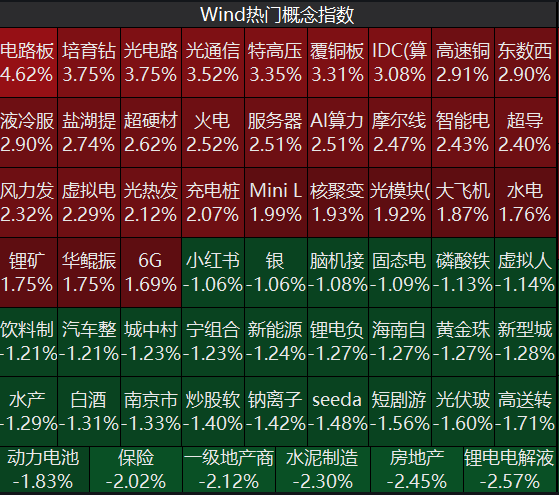
A股午评:沪指、创业板指收跌,深指飘红,近3000只个股下跌
Xin Lang Cai Jing· 2026-02-26 04:15
Market Overview - A-shares opened mixed on the 26th, with major indices fluctuating before collectively turning negative, except for the Shenzhen Composite Index which turned positive near noon [1] - By the midday close, the Shanghai Composite Index fell by 0.08%, while the Shenzhen Composite Index rose by 0.28%, and the ChiNext Index decreased by 0.39% [2] Trading Volume - The total trading volume for the half-day reached 1.65 trillion yuan, with nearly 3,000 stocks declining [1] Sector Performance - Sectors such as AI applications, lithium batteries, fintech, photovoltaic, gold, and innovative pharmaceuticals showed weakness, while real estate and insurance industries experienced significant declines [3] - Conversely, sectors like circuit boards, superhard materials, and ultra-high voltage themes were active [3]

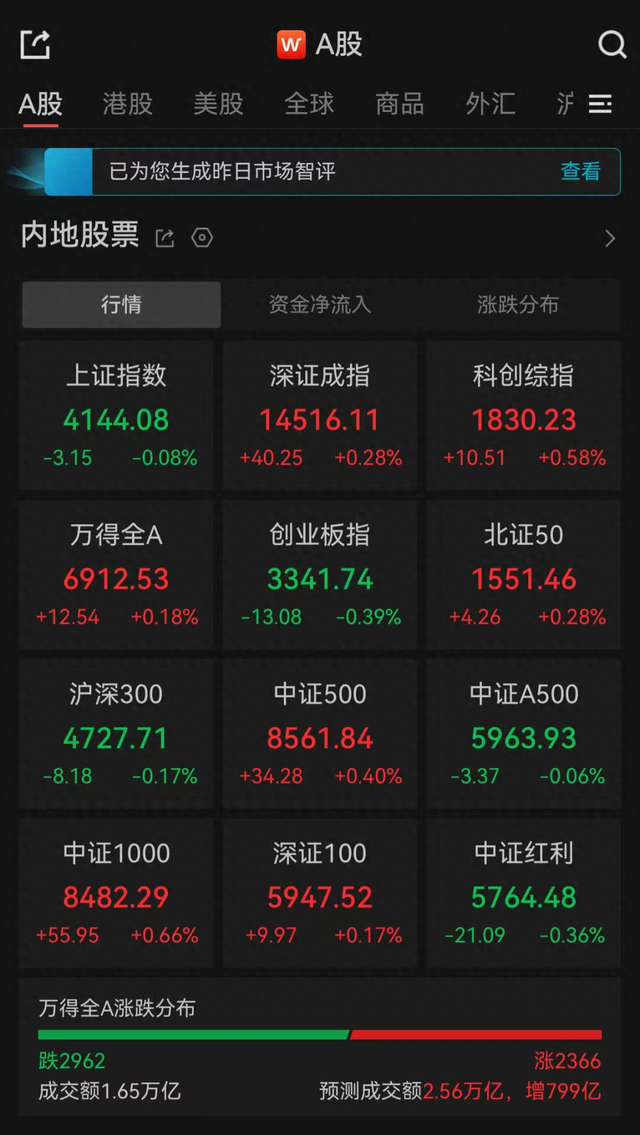
A股午评 | 创指半日跌0.39% 英伟达“交卷”缓解AI担忧 科技成长重返“C位”
智通财经网· 2026-02-26 03:47
Market Overview - The market experienced fluctuations with mixed performance among the three major indices, where the Shanghai Composite Index fell by 0.08%, the Shenzhen Component rose by 0.28%, and the ChiNext Index decreased by 0.39% [1] - The trading volume in the Shanghai and Shenzhen markets reached 1.64 trillion yuan, an increase of 117.3 billion yuan compared to the previous trading day [1] Key Sectors Computing Power Sector - The computing power sector surged following Nvidia's impressive earnings report, with significant activity in computing hardware stocks, including optical fiber, optical modules, PCBs, and liquid cooling servers [3] - Notable stocks such as Huadian Technology, Guanghe Technology, and Shenzhen Nandian hit the upper limit, while computing leasing concepts also saw strong performance with stocks like Zhongbei Communication and Aofei Data reaching their daily limit or increasing by over 10% [3] Electric Power Sector - Electric power and grid equipment stocks rallied, with companies like Shenneng Power and Huayin Power hitting the upper limit [4] - The National Energy Administration's recent report indicated that by 2025, the newly installed capacity for renewable energy generation in China is expected to reach 452 million kilowatts, a year-on-year increase of 21%, accounting for 83% of the country's new power generation capacity [4] Minor Metals Sector - The minor metals sector showed active performance, with Yunnan Zinc Industry achieving consecutive gains and Zhangyuan Tungsten reaching its upper limit [5] - The White House plans to utilize an AI model developed by the Department of Defense to establish reference prices for critical mineral trades, starting with germanium, gallium, antimony, and tungsten [5] Institutional Insights - Multiple foreign institutions express optimism, suggesting that the A-share market has entered a "slow bull" phase, with a profound shift in market driving logic [6][8] - Morgan Stanley's chief equity strategist for China, Liu Mingdi, noted that the A-share market has genuinely entered a "slow bull" phase, emphasizing that while liquidity is abundant, the market lacks earnings growth to support valuations [7] - According to Lianbo Fund, the A-share market is expected to transition from "valuation repair" to an "earnings-driven" phase by 2026, with sustainable market growth reliant on substantial improvements in corporate profitability rather than mere valuation expansion [8] Sector-Specific News - Citic Securities reported that Zimbabwe's recent ban on lithium ore exports aims to enhance mineral regulation and promote deep processing, which could lead to a significant increase in lithium prices due to supply constraints [10]
上海发布“沪七条”楼市新政,关注建材ETF(159745)投资机遇
Mei Ri Jing Ji Xin Wen· 2026-02-26 03:33
Core Viewpoint - The new housing policy "沪七条" released in Shanghai is expected to stabilize housing prices in the outer ring area by lowering purchase thresholds and increasing purchasing power for non-local families [1] Summary by Categories Policy Changes - Non-local families' social security requirement for purchasing homes in the outer ring is reduced from 3 years to 1 year [1] - Non-local families can purchase one additional property in the outer ring [1] - Families with a residence permit of 5 years can buy one property [1] - The first home provident fund loan limit is increased from 1.6 million to 2.4 million [1] - The provident fund policy shifts to "recognizing the house, not the loan" [1] Market Impact - The new policy is expected to improve the supply-demand relationship in the outer ring housing market [1] - There has been a steady decline in housing listings since Q4 2025, with high transaction volumes in the second-hand housing market [1] - New home transaction volumes during the recent Spring Festival showed significant growth compared to the same period in 2025 [1] Investor Sentiment - Market views suggest that the new policy aligns with expectations and may stimulate demand for first-time homebuyers [1] - The recovery in the housing market is anticipated to catalyze sectors such as building materials and real estate [1] - The building materials sector is expected to continue optimizing its supply-demand structure amid a trend against over-competition [1] - Investors are encouraged to consider the largest building materials ETF (159745) as a potential opportunity [1]
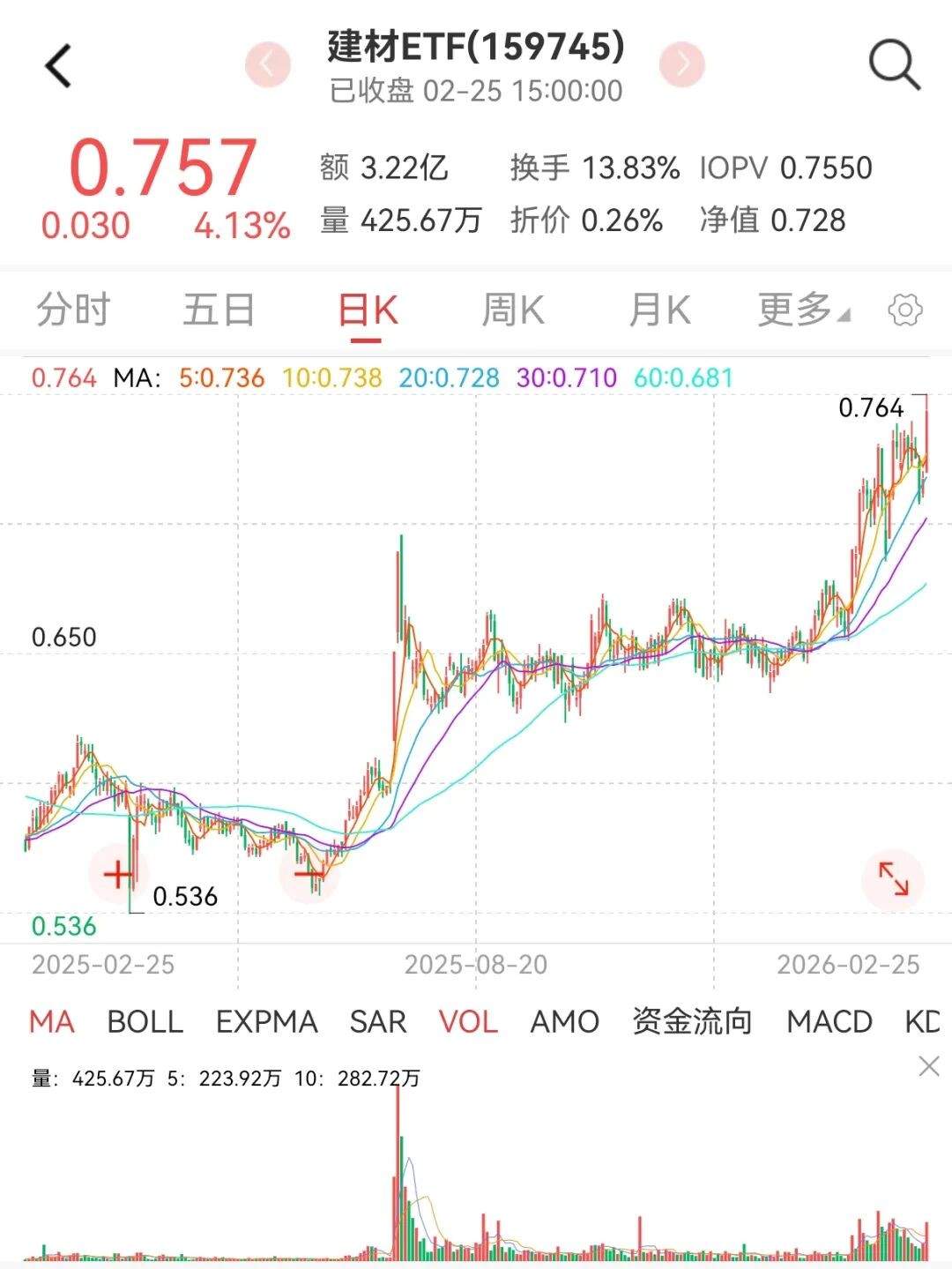
上海发布楼市“沪七条”!马年楼市新政“第一枪”释放怎样的信号?
Yang Guang Wang· 2026-02-26 03:12
Core Viewpoint - Shanghai has introduced new real estate policies aimed at lowering purchase thresholds, increasing the number of properties that can be bought, raising housing provident fund loan limits, and refining property tax policies to meet residents' housing needs and promote a stable and healthy real estate market [1][5]. Group 1: Policy Measures - The new policies include seven specific measures such as reducing housing purchase restrictions, optimizing housing provident fund loan policies, and improving personal housing property tax policies [1][5]. - The social security requirement for non-Shanghai residents to purchase homes in the outer ring has been reduced to one year, allowing eligible individuals to buy one additional property in the outer ring [2][5]. - The maximum housing provident fund loan for first-time homebuyers has increased from 1.6 million yuan to 2.4 million yuan, with potential total loans reaching up to 3.24 million yuan for families with multiple children [3][4]. Group 2: Market Impact - The introduction of these policies has led to an immediate positive response in the Shanghai real estate market, with increased inquiries from potential buyers [1][2]. - The policies are expected to stimulate demand from non-resident buyers, helping to reduce second-hand housing inventory and stabilize prices [2][6]. - The measures are designed to support various housing needs, including those of families with multiple children and residents with Shanghai residence permits, indicating a broad and targeted approach to housing demand [5][6]. Group 3: Future Outlook - The new policies are anticipated to create a peak in the real estate market in March, driven by seasonal demand, promotional activities from developers, and the supportive policy environment [6]. - The focus on lowering costs and thresholds is expected to significantly impact the upcoming "small spring" in the real estate market, enhancing overall market expectations [5][6].
高频数据跟踪:春节出游人次及花费创新高
China Post Securities· 2026-02-26 03:05
1. Report Industry Investment Rating No information provided in the given content. 2. Core Viewpoints of the Report - High - frequency economic data focuses on four aspects: production seasonally cools down; the Spring Festival movie box - office drops nearly 40% year - on - year while tourist trips and spending hit new highs due to an extra holiday day; overall prices decline with oil, coking coal, and rebar prices falling, non - ferrous prices rising slightly, and agricultural products entering a seasonal downward trend; affected by the Spring Festival, subway ridership and peak congestion index in first - tier cities are low, while flight volume is high. Short - term attention should be paid to the progress of front - loaded fiscal efforts and the recovery of the real estate market [2][31]. 3. Summary by Relevant Catalogs Production: Seasonal Obvious Cooling - Steel: In the week of February 20, the coke oven capacity utilization rate decreased by 0.11 pct, the blast furnace operating rate increased by 0.6 pct, and the rebar output increased by 1.22 tons. The inventory of rebar increased by 57.48 tons [9]. - Petroleum Asphalt: In the week of February 11, the operating rate of domestic petroleum asphalt plants decreased by 2.8 pct at a low level [9]. - Chemicals: On February 24, the PX operating rate remained flat compared with the previous week, while the PTA operating rate decreased by 3.86 pct [9]. - Automobile Tires: In the week of February 19, the full - steel tire operating rate decreased by 28.2 pct, and the semi - steel tire operating rate decreased by 45.2 pct [10]. Demand: Spring Festival Tourism and Consumption Hit New Highs, Movie Box - Office Drops Significantly Year - on - Year - Real Estate: In the week of February 22, the commercial housing transaction area decreased, the inventory - to - sales ratio increased significantly, the land supply area dropped sharply, and the residential land transaction premium rate decreased [13]. - Movie Box - Office: In 2026, the Spring Festival movie box - office was 5.752 billion yuan, a year - on - year decrease of 39.5%; the number of moviegoers was 120 million, a year - on - year decrease of 35.8% [13]. - Tourism Consumption: Due to an extra day of the Spring Festival holiday, the number of tourist trips and spending both hit new highs. During the 9 - day Spring Festival holiday, there were 596 million domestic tourist trips and the total domestic tourism spending was 803.483 billion yuan [14]. - Automobile Sales: In the week of February 8, the average daily retail sales of passenger cars decreased by 9,218 units, and the average daily wholesale sales decreased by 15,720 units [18]. - Shipping Freight Rates: In the week of February 13, the SCFI index decreased by 1.19%, and the CCFI index decreased by 3.03%. On February 24, the BDI index increased by 1.62% compared with the previous week [20]. Prices: Non - ferrous Prices Rise, Agricultural Products Enter a Seasonal Downward Trend - Energy: On February 24, the Brent crude oil price decreased by 1.38% to $70.77 per barrel [22]. - Coking Coal: On February 24, the coking coal futures price decreased by 1.74% to 1,100.5 yuan per ton [22]. - Metals: On February 24, the LME copper, aluminum, and zinc futures prices increased by 1.78%, 0.26%, and 0.15% respectively, while the domestic rebar futures price decreased by 0.98% [23]. - Agricultural Products: On February 24, the overall agricultural product price declined, with the agricultural product wholesale price 200 index decreasing by 0.81%. The prices of pork, eggs, vegetables, and fruits changed by - 0.17%, - 2.46%, - 2.33%, and + 1.50% respectively compared with before the festival [25]. Logistics: Flight Volume is High, Spring Festival Personnel Flow Hits a New High - Subway Ridership: On February 24, the seven - day moving average of subway ridership in Beijing decreased by 125.34 million person - times, a week - on - week decrease of 18.32%; in Shanghai, it decreased by 171.29 million person - times, a week - on - week decrease of 23.57% [26]. - Personnel Flow: During the 2026 Spring Festival holiday, the cross - regional personnel flow in the whole society reached 2.81 billion person - times, a new high. The daily average was 310 million person - times, an 8.2% increase compared with the same period last year [29]. - Flight Volume: On February 24, the seven - day moving average of domestic (excluding Hong Kong, Macao, and Taiwan) flight volume increased by 3.37%, that of domestic (Hong Kong, Macao, and Taiwan) increased by 1.08%, and that of international flights increased by 0.35% [29]. - Urban Traffic: On February 24, the seven - day moving average of the peak congestion index in first - tier cities decreased by 5.79% compared with the previous week [29].
平安证券(香港)港股晨报-20260226
Ping An Securities Hongkong· 2026-02-26 02:51
Market Overview - The Hong Kong stock market experienced fluctuations, with the Hang Seng Index closing at 23,831 points, down 145 points or 0.61% [1] - The market turnover decreased to 82.799 billion HKD, with net inflows of 484 million HKD recorded in the Hong Kong Stock Connect [1] - The US stock market saw all three major indices rise, with the Dow Jones up 0.63%, S&P 500 up 0.81%, and Nasdaq up 1.26%, driven by Nvidia's strong earnings report [2] Sector Performance - In Hong Kong, local real estate, software, and 5G concept sectors faced significant declines, while gold stocks performed well [1] - The technology sector showed mixed results, with the Hang Seng Technology Index slightly down by 0.19% [1] - In the US, major tech stocks like Microsoft and Facebook saw gains, while the Nasdaq China Golden Dragon Index fell by 0.47% [2] Investment Opportunities - The report emphasizes the importance of "self-reliance in technology" and AI applications as key themes for future growth in the Hong Kong stock market, suggesting that leading companies in these sectors may see long-term development opportunities [3] - The recent policies from the Ministry of Industry and Information Technology regarding national computing power and communication infrastructure are expected to boost domestic computing and communication sectors [3] - Investors are advised to focus on sectors supported by policies aimed at expanding domestic consumption, such as sports apparel and non-essential services, as well as undervalued central state-owned enterprises with high dividends [3] Key Company Highlights - Haidilao (6862.HK) led the Hang Seng Index component stocks with a gain of 6.2%, while HSBC Holdings (0005.HK) and Longfor Group (0960.HK) rose by 5.5% and 4.6%, respectively [1] - The report notes that the recent adjustments in Shanghai's real estate policies are expected to release pent-up demand, benefiting core area property companies and their supply chains, such as Longfor Group and China Resources Land [10] - The Hong Kong government announced plans to issue licenses for stablecoin issuers and establish a committee focused on AI and industry development, which could benefit sectors related to digital assets and fintech [11]
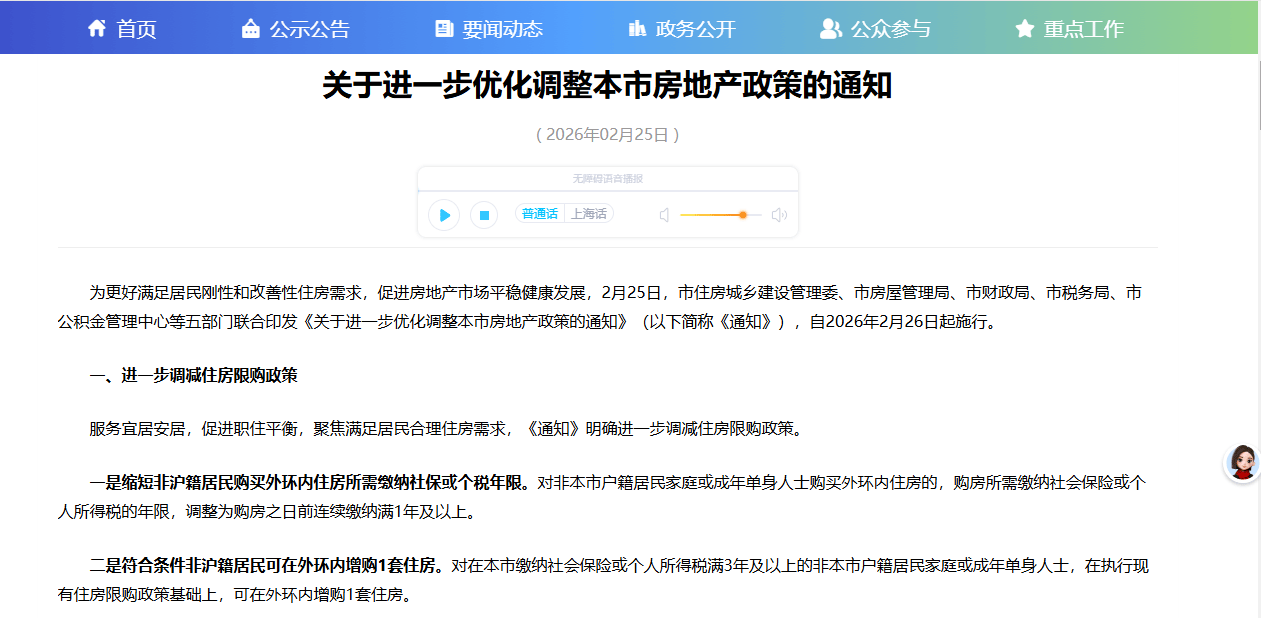
上海发布“沪七条”房地产新政:限购放宽、公积金提额,家居市场迎利好
Sou Hu Cai Jing· 2026-02-26 02:10
Group 1 - The core viewpoint of the news is the introduction of Shanghai's new real estate policy "沪七条" aimed at better meeting the housing needs of residents, effective from February 26, 2026 [1] - The policy includes adjustments in three major areas: purchase restrictions, public housing fund policies, and property tax regulations [1] - The new policy allows non-residents to purchase homes in the outer ring of Shanghai with a social security or individual tax payment period reduced from "3 years" to "1 year" [2] Group 2 - The maximum public housing fund loan for first-time homebuyers has been increased from 1.6 million yuan to 2.4 million yuan, with potential maximum loans reaching 3.24 million yuan for families with multiple children or those purchasing green buildings [2] - Families that have cleared their public housing fund loans can reapply for loans when purchasing a new home, provided they own no property or only one property in Shanghai [2] - The property tax policy will exempt adult children in household registrations from personal housing property tax if the newly purchased home is their only residence, supporting housing upgrades [2] Group 3 - Industry analysts believe the new policy will stimulate demand for both first-time and improved housing purchases, positively impacting downstream markets such as home decoration and furniture, leading to optimistic expectations for Shanghai's home furnishing industry in 2026 [2]
南华期货金融期货早评-20260226
Nan Hua Qi Huo· 2026-02-26 02:04
【南华观点】特朗普 2026 年第二任期首次国情咨文演讲,不仅是其化解执政危机、为国 会中期选举造势的核心政治动作,更是决定 2026 年全球宏观定价逻辑、大类资产走势与 跨境资本流动的核心风向标,其政策表态直接牵动美元信用、全球贸易体系与金融市场风 险偏好。本次演讲是在特朗普执政多重风险集中爆发的背景下落地,核心关税政策被美国 最高法院釜底抽薪式否决、支持率跌至第二任期谷底、政府部分停摆与两党极化加剧,叠 加中期选举的关键时间窗口,决定了本次演讲的政策表态兼具危机对冲与政治博弈的双重 属性,也为全球金融市场埋下了短期情绪波动与长期不确定性的双重伏笔。演讲核心的金 融相关政策中,最受市场关注的关税体系重构,特朗普正面回应司法危机,给出以《1974 年贸易法》为核心的替代法律框架,推出 150 天 15% 的全球临时进口关税,配套 301、 232 条款构建长期关税体系,短期对冲了财政收入缺口,却并未消除政策的长期不可预测 性,临时关税的到期风险、专项调查的边界模糊,将延后企业资本开支、扰动全球供应链 修复,加剧市场对通胀反弹的担忧,进而打乱美联储货币政策的宽松节奏,为美元指数、 美债收益率带来持续波动压力。与 ...