通信

Search documents
北交所策略专题报告:量子密钥分发网络等方向突破,富士达低温超导射频缆小批量供货
KAIYUAN SECURITIES· 2026-02-23 10:45
Investment Rating - The investment rating for the industry is "Overweight" indicating an expectation for the industry to outperform the overall market performance [74]. Core Insights - The report highlights significant breakthroughs in quantum key distribution networks, with the successful construction of the world's first large-scale quantum key distribution network based on integrated optical quantum chips, supporting 20 chip users and a networking capability of up to 3700 kilometers [13][18]. - Fujida (920640.BJ) is identified as a representative company in the quantum industry chain, having made early investments in quantum technologies and achieving key technical breakthroughs in low-temperature superconducting RF cables, which are essential for stable signal transmission in quantum computing applications [3][25]. - The report notes that Fujida's revenue for the first three quarters of 2025 reached 652 million yuan, a year-on-year increase of 16.62%, with a net profit of 55.93 million yuan, reflecting a growth of 55.38% [30][28]. Summary by Sections Quantum Key Distribution Breakthroughs - The report discusses the advancements in quantum key distribution, emphasizing the development of a scalable quantum relay module that enables long-distance quantum networks and the successful transmission of device-independent quantum key distribution (DI-QKD) over distances exceeding 100 kilometers [18][21]. Industry Performance - The information technology sector experienced an average weekly increase of 1.68%, with the median price-to-earnings (P/E) ratio dropping to 74.1X [4][31]. - The smart manufacturing sector saw its median P/E ratio rise to 42.5X, indicating positive market sentiment [47][54]. Company Announcements - Fujida's core products are being utilized in superconducting quantum computer projects across domestic research institutions, with current operations focused on small-batch supply, contributing to a growing revenue stream [3][25]. - The report also includes performance forecasts for various companies, with notable expected revenue growth for companies like JinHao Medical and North Mining Testing [68][69].
节后春季行情可能延续,科技和周期占优
Huajin Securities· 2026-02-23 03:45
Investment Rating - The report suggests a positive outlook for the A-share market post-Spring Festival, indicating a potential upward trend in the market driven by favorable policies and external factors [5][11][27]. Core Insights - The report highlights that concerns regarding economic and profit growth during the Spring Festival period did not materialize, with significant increases in travel and consumption data compared to the previous year [5][11]. - Historical data indicates that the A-share market tends to rise after the Spring Festival, particularly in years when the festival starts later, with 12 out of 16 instances showing gains in the first five trading days post-festival [11][27]. - The report emphasizes that technology growth and cyclical industries are likely to outperform in the short term following the festival, supported by favorable policies and market trends [31][32]. Summary by Sections Market Concerns and Trends - Concerns about economic performance during the Spring Festival were largely unfounded, with travel data showing a 6.1% year-on-year increase in cross-regional movement during the holiday [5][11]. - Consumption data was also positive, with the total box office for the Spring Festival exceeding 3 billion yuan, indicating strong consumer demand [5][11]. Post-Festival Market Outlook - The report anticipates a continuation of the spring market rally, with A-shares expected to show a strong upward trend due to positive policy expectations and limited external risks [11][27]. - The report notes that the macro liquidity environment is likely to remain loose, with expectations of increased capital inflow into the stock market post-festival [27][31]. Industry Configuration - The report recommends continued investment in technology growth and cyclical industries post-festival, as these sectors are expected to benefit from favorable policies and market conditions [31][32]. - Specific sectors highlighted for investment include machinery (robots), media (AI applications, gaming), computing (AI applications), electronics (semiconductors, AI hardware), military (commercial aerospace), and communications (AI hardware) [31][32].
投资策略专题:节后市场展望
KAIYUAN SECURITIES· 2026-02-23 00:55
Market Trends - After the Spring Festival, the market shows a pattern where small-cap stocks outperform large-cap stocks, with a higher probability of market gains over 5, 10, and 20 trading days[2] - The CSI 2000 index has a significant increase of 10.4% with a 91% probability of rising in the 20 trading days post-holiday[14] Sector Performance - Technology and cyclical sectors are expected to lead, with notable gains in computer, communication, environmental protection, non-ferrous metals, steel, and textile sectors[2] - Consumer staples like food and beverage, banking, and household appliances are expected to lag behind[2] Spring Rally Dynamics - Historical data from 2016 to present indicates that 6 out of 10 spring rallies have led to a second wave of gains after an initial pullback[3] - The second wave of gains is often more profitable and closely tied to the prevailing market themes, which currently favor technology[3] Investment Strategy - Investors are advised to maintain confidence in the bull market, as the core drivers remain intact, with a suggested securities ratio of over 1.1 as a bullish signal[6] - Recommended sectors include military, media (gaming), AI applications, and core AI hardware, alongside materials benefiting from PPI improvements[33] Risk Factors - Potential risks include unexpected macroeconomic policy changes, geopolitical tensions, and shifts in industrial policy[7][34][35]
或套现6692万元,海格通信前董事长拟再减持
Shen Zhen Shang Bao· 2026-02-23 00:36
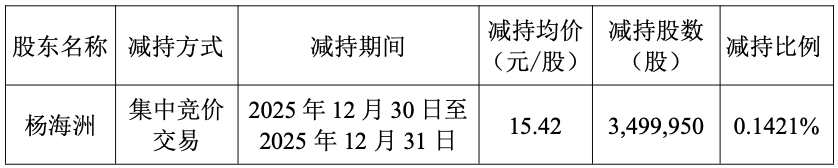
Core Viewpoint - Recently, Haige Communication (002465.SZ) announced that shareholder Yang Haizhou plans to reduce his shareholding in the company, which will not affect the company's control or governance structure [1][2]. Group 1: Shareholding Reduction - Yang Haizhou, holding 24,425,125 shares (approximately 0.9920% of the total share capital after excluding repurchased shares), plans to reduce his holdings by up to 4,000,000 shares (approximately 0.1624%) within three months from the announcement date [1]. - The reason for the reduction is personal financial planning, with shares sourced from pre-IPO holdings and capital reserve conversion [1]. - The estimated cash-out from this reduction, based on the latest share price of 16.73 yuan/share, could be around 66.92 million yuan [1]. Group 2: Completion of Shareholding Reduction - As of January 5, Yang Haizhou completed his share reduction plan, having sold a total of 3,499,950 shares, which is about 0.1421% of the total share capital [2][3]. - The average selling price during this reduction was 15.42 yuan/share [3]. Group 3: Financial Performance - Haige Communication expects a net loss attributable to shareholders of 700 million to 790 million yuan for the year 2025, with a loss of 780 million to 870 million yuan when excluding non-recurring items [5][6]. - The company reported a significant decline in net profit compared to the previous year, which was a profit of 53.14 million yuan [6]. - The losses are attributed to delayed contract signings due to industry adjustments, increased R&D investments of approximately 930 million yuan, and anticipated impairment losses of about 220 million yuan on goodwill and 250 million yuan on receivables [6]. Group 4: Market Performance - As of February 13, Haige Communication's stock price decreased by 2.28%, closing at 16.73 yuan/share, with a total market capitalization of 41.521 billion yuan [7].


财报季高ROE公司受追捧,别被表象迷惑
Sou Hu Cai Jing· 2026-02-22 14:11
Group 1 - The core argument is that many investors are misled by superficial market appearances and fail to recognize the importance of actual trading behavior, which is crucial for investment decisions [1][2][4] - Companies with high return on equity (ROE) are seen as long-term investment opportunities, but investors often overlook the underlying trading dynamics that can affect stock performance [1][12] - Quantitative data, particularly "institutional inventory," provides insights into the active participation of institutional funds, helping to distinguish between genuine market movements and mere appearances [2][4][12] Group 2 - Price fluctuations in stocks can be misleading; for instance, a stock may show volatility while institutional inventory remains active, indicating ongoing institutional interest [4][8] - Conversely, a stock may appear to recover in price without institutional support, suggesting that such recoveries are not sustainable [4][8][11] - Continuous price movements can create emotional responses among investors, leading to premature exits or misguided entries; quantitative data can clarify these situations [9][11] Group 3 - The use of quantitative thinking helps investors establish a rational investment logic, moving away from emotional reactions to market news and trends [12] - Active institutional inventory indicates that a company's value is recognized by institutions, while stagnant inventory, even in high ROE companies, may signal superficial attractiveness [12]

任正非最难学的地方是什么?对长期利益和短期利益进行分辨、取舍
Sou Hu Cai Jing· 2026-02-22 09:04
Core Insights - The article emphasizes the importance of strategic foresight in business, highlighting that successful companies balance short-term profits with long-term goals [1][4] - Huawei is presented as a case study of a company that effectively integrates strategic thinking into its operations, particularly in its entry into the automotive industry [1][2] Group 1: Strategic Decision-Making - Companies must have a clear understanding of their strategic direction and the balance between immediate financial gains and future growth [1][4] - Effective strategic decisions are based on thorough analysis rather than impulsive actions, especially for larger enterprises where mistakes can lead to significant waste [1][2] - The ability to adapt and maintain a long-term vision is crucial for companies to avoid becoming obsolete in competitive markets [3][4] Group 2: Research and Development - The article underscores the necessity of R&D investment for maintaining competitiveness, particularly in high-tech industries [2][3] - Companies that previously relied on resource integration are now recognizing the importance of R&D, influenced by Huawei's approach [2][3] - Huawei's strategy in the automotive sector includes making its technology accessible to partners, thereby establishing a competitive edge without disrupting market rules [2][3] Group 3: Market Positioning - Companies should focus not only on sales figures but also on their market share and positioning within the industry [4] - The article warns against short-sightedness, using the example of the once-popular PHS (Personal Handy-phone System) to illustrate the risks of neglecting long-term strategy [4] - Strategic leaders must navigate the complexities of balancing short-term and long-term interests, which requires a nuanced understanding of market dynamics [4][5]
A股“现金牛”显现!这家上市鲁企手握超百亿“财力”
Sou Hu Cai Jing· 2026-02-22 08:29
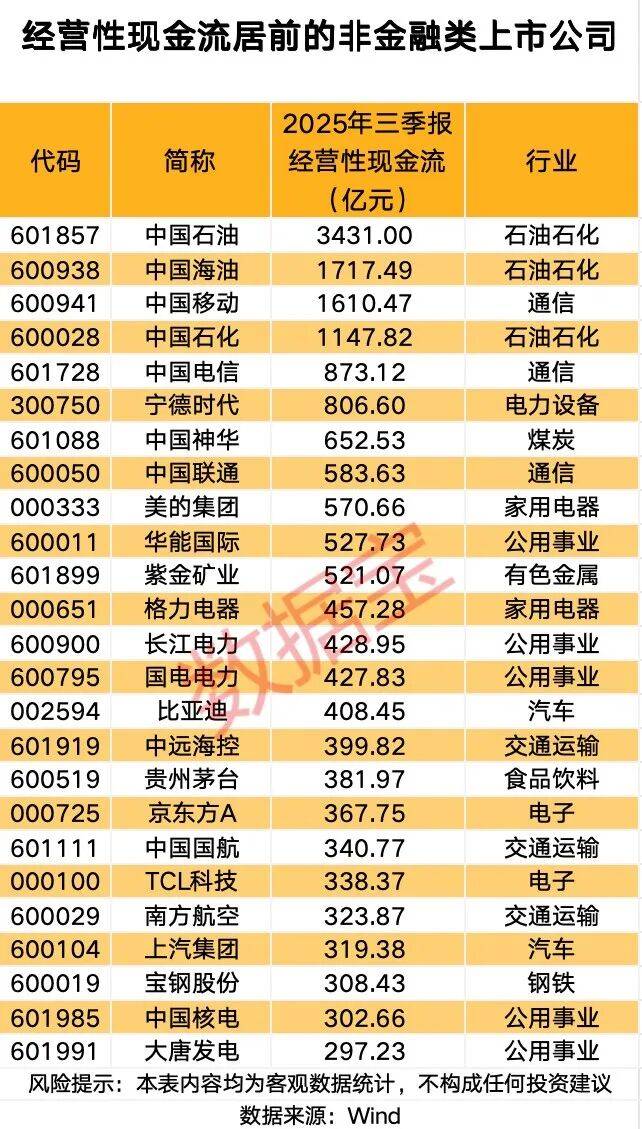
Core Insights - The A-share market emphasizes cash flow as a critical measure of a company's operational strength, with operating cash flow being particularly significant for assessing profitability quality [1] Group 1: Operating Cash Flow - In the first three quarters of 2025, A-share listed companies (excluding banks and non-bank financial sectors) generated a total net cash flow from operating activities of 3.61 trillion yuan, representing a 16.98% increase year-on-year, indicating enhanced cash generation capabilities [1] - A total of 63 listed companies reported operating cash flow exceeding 10 billion yuan, with China National Petroleum, China National Offshore Oil, China Mobile, and Sinopec leading the pack, each surpassing 100 billion yuan [1] - Industries with companies reporting over 10 billion yuan in operating cash flow include public utilities (mainly the electricity sector), oil and petrochemicals, transportation, and automotive [1] Group 2: Free Cash Flow - In the first three quarters of 2025, four industries among A-share listed companies (excluding banks and non-bank financial sectors) reported positive free cash flow, including food and beverage, real estate, agriculture, forestry, animal husbandry, and non-ferrous metals [3] - The food and beverage sector had the highest free cash flow, reflecting a significant improvement in consumer sentiment [3] - A total of 18 companies reported free cash flow exceeding 10 billion yuan, with China National Offshore Oil, Kweichow Moutai, and Zijin Mining at the forefront, reporting 70.695 billion yuan, 42.479 billion yuan, and 31.738 billion yuan respectively [5] Group 3: Company Performance - Yanzhou Coal Mining Company, established in 1997, focuses on mining, high-end chemical materials, new energy, high-end equipment manufacturing, and smart logistics, with operations in various regions including Shandong, Shaanxi, Mongolia, Xinjiang, and overseas [6] - In 2025, Yanzhou Coal reported a total coal production of 182.4 million tons, a year-on-year increase of 6.28%, and total coal sales of 170.64 million tons, up 3.39% year-on-year, showcasing its strong market control and capacity release capabilities [6]

青年早新闻|大年初四迎灶神!整年福气接回家
Xin Lang Cai Jing· 2026-02-20 02:10
Group 1 - The article discusses the celebration of the Spring Festival in China, highlighting the trend of young people sharing their festive experiences online, with 54.2% of respondents participating in "showing off" their Spring Festival celebrations [6][10][9] - A survey indicates that the most popular items to share include family dinners (60.4%) and local specialty foods (48.3%) [7][10] - The survey also reveals that 90.7% of respondents feel that sharing their Spring Festival experiences enhances the festive atmosphere [9][10] Group 2 - The article mentions the significant participation in the "2026 Year of the Horse Race Day" event in Hong Kong, attracting nearly 100,000 attendees, including over 20,000 from mainland China and overseas, setting a new record for the event [21][30] - It highlights the achievements of Chinese athletes in the 2026 Milan Winter Olympics, including Ning Zhongyan winning a gold medal in speed skating and setting a new Olympic record [14][17]

春节以来人民币汇率延续升值 大类资产怎么配?
Xin Lang Cai Jing· 2026-02-19 07:37
Core Viewpoint - The recent appreciation of the Renminbi (RMB) against the US dollar is driven by factors such as a weakening dollar index, expectations of interest rate cuts by the Federal Reserve, steady recovery of the domestic economy, and sustained high trade surpluses [1] Group 1: RMB Appreciation and Market Impact - The RMB has appreciated approximately 1.3% since early February, breaking the 6.89 mark and reaching a three-year high [1] - Analysts from Huatai Securities and Galaxy Securities predict a prolonged appreciation cycle for the RMB, with the current phase marking the beginning of this trend [1][2] - The appreciation of the RMB is expected to enhance the attractiveness of RMB-denominated assets, particularly benefiting the A-share and H-share markets [2] Group 2: Equity Market Insights - The equity market is anticipated to perform well during the RMB appreciation cycle, with Hong Kong stocks being the primary beneficiaries due to higher foreign capital participation [2][4] - A-share market performance is expected to be more differentiated, with growth-oriented sectors likely to outperform [2][3] - Key sectors benefiting from RMB appreciation include real estate, advanced manufacturing, and non-bank financials, which are expected to see improved market risk preferences [2][3] Group 3: Sector-Specific Opportunities - Industries with high foreign debt exposure, such as motorcycles, automotive parts, and photovoltaic equipment, will benefit from reduced debt pressure and exchange rate gains [2][3] - Sectors with high import dependency, like electronic chemicals and steel raw materials, will see improved profit margins due to lower costs from RMB appreciation [2][3] - The technology sector, particularly in Hong Kong, is expected to experience a rebound as foreign capital flows increase [4] Group 4: Bond Market Dynamics - The bond market is experiencing mixed influences from RMB appreciation, with downward pressure on short-term yields and upward pressure on long-term yields due to increased risk appetite in the equity market [5] - Analysts predict that the 10-year government bond yield will fluctuate within a narrow range of 1.7% to 2.1% [5] Group 5: Commodity Market Trends - The commodity market is showing significant differentiation, with industrial metals like copper being highlighted as having strong upward potential [6] - Other commodities lack clear trends, and their future performance will depend on the recovery of domestic demand [6] Group 6: Strategic Asset Allocation - Analysts recommend focusing on high-probability sectors during the current weak appreciation phase of the RMB, emphasizing growth-oriented industries such as technology and communication [7][9] - Key investment themes include sectors benefiting from foreign capital inflows, cost improvements, and holding quality RMB-denominated assets like A-shares and government bonds [9]
中国生产和制造了几乎所有的东西,为何美国经济仍比中国强大?
Sou Hu Cai Jing· 2026-02-17 09:38
Core Insights - China's manufacturing output is projected to account for nearly 30% of global production by 2025, while the U.S. will be around 13%, highlighting China's dominance in manufacturing despite a lower GDP compared to the U.S. [1][3] - By 2025, China's GDP is expected to exceed $20 trillion, while the U.S. GDP will be approximately $30 trillion, resulting in a significant gap of $9 trillion [3][5] - The disparity in GDP figures is influenced by currency exchange rates, with the nominal GDP calculation favoring the U.S. due to the stronger dollar [5][7] Group 1: Manufacturing and Economic Output - China's manufacturing sector is not just a national industry but a global manufacturing hub, producing a wide range of goods from solar panels to toys [1][3] - The purchasing power parity (PPP) method shows that China's GDP could reach approximately 40.7 trillion international dollars by 2024, surpassing the U.S. [7] - The U.S. maintains a significant advantage in controlling the value chain, with major global companies headquartered there, which impacts GDP calculations [11][19] Group 2: Currency and Financial Dynamics - The U.S. dollar serves as the primary global trade and reserve currency, allowing the U.S. to leverage its currency for economic advantages [13][15] - The U.S. has a substantial overseas direct investment of $9.7 trillion, which is three times that of China, enhancing its global economic influence [15] - The ability of the U.S. to print dollars and influence global markets creates a unique economic position that China is still working to overcome [13][15] Group 3: Innovation and Future Prospects - China is transitioning from being a manufacturing powerhouse to focusing on innovation and technology, with significant investments in R&D, particularly in sectors like electric vehicles and telecommunications [17][19] - The competitive landscape suggests that while the U.S. currently leads in nominal GDP, China's advancements in manufacturing capabilities and innovation may shift the balance in the coming years [21] - The future economic competition will hinge on technological control and the ability to influence global markets, rather than just GDP figures [21]