
大宗商品

Search documents
股债双杀阴霾散去,经典60/40投资策略“老树发新芽”?
Jin Shi Shu Ju· 2026-01-12 08:19
Group 1 - The traditional 60/40 investment strategy, which allocates 60% to stocks and 40% to bonds, is regaining attention in the market after being overlooked due to a prolonged zero-interest-rate environment and the simultaneous decline of both stock and bond markets in 2022 [2][3] - The iShares Core U.S. Aggregate Bond ETF (AGG) achieved a total return of 7.2% in 2025, marking its best performance since 2020, indicating that fixed income can contribute positively to investment portfolios [2][3] - Market experts suggest that the current bond market outlook is attractive due to the onset of a monetary easing cycle, which is expected to drive bond prices higher, while the stock market faces vulnerabilities due to high valuations and concerns over an AI bubble [4][5] Group 2 - Investment strategies may benefit from a simplified approach by allocating to representative bond market products like AGG, with a recommended duration of six to seven years for bonds, as longer-duration bonds are more sensitive to interest rate changes [4] - A suggested allocation strategy includes a 50:50 split between credit bonds and U.S. Treasuries, with the potential addition of mortgage-backed securities [4] - There is a growing interest in diversifying the 40% fixed income allocation to include alternative assets like private credit and commodities such as gold, which have gained traction among retail investors seeking protection and returns [5][6]
特朗普绑架马杜罗与泄密非农数据,市场为何无动于衷
Sou Hu Cai Jing· 2026-01-12 08:12
来源:第一财经 美欧日经济在2025年明显呈K形发展,强者愈强,弱者落伍。这种经济业态会在2026年继续。特朗普推 出的关税战,看来没有对美国经济,甚至贸易对手经济构成沉重打击,初始物价效应过后,也许没有人 再提了。美国支持以色列袭击加沙、伊朗,乃至亲自下场绑架委内瑞拉总统,这些是对联合国宪章的漠 视,并推翻了二战后的国际秩序,但在资本市场也没有卷起大的风浪。 然而,平推之中酝酿着变局。经济K形发展必然招致选民反弹,2026年最大变数就是美国中期选举。以 目前的民意,共和党可能会失去众议院多数席位,一旦成真将会冲击特朗普政府的执政能力。日本首相 高市早苗可能不久后会宣布提前大选,她的个人魅力将和选民对物价的不满直接碰撞。英国工党领袖之 争、德国地方选举,乃至法国2027年初的总统大选,均可能成为选民说NO的契机。 许多变化对经济的真实冲击需要更长时间酝酿才能看到。英国政客曾把脱欧吹得很厉害,但十年后选民 才发现,本国经济比脱欧前少了6%~8%,而且海外投资裹足不前,高收入人群逃离,财政状况每况愈 下。美国调高关税,打劫了世界,看上去对本国物价冲击有限,但其实主要涨价压力暂时被批发商、零 售商吞下,需要时间才能 ...
美股释放信号:硬资产拐点已至!大宗商品“超级周期”正在重现?
Jin Shi Shu Ju· 2026-01-12 04:08
Group 1 - The financial market is entering a long-term prosperity phase linked to hard assets and commodities, which serve as a hedge against inflation and market volatility [1] - The S&P 500 materials and energy sectors have increased by 6.4% and 4.3% respectively since the beginning of the year, while gold and silver have risen by nearly 3.7% and 12.4% in January [1] - Brent crude oil has also seen a 4.1% increase this month, driven by uncertainties surrounding U.S. involvement in Venezuela [1] Group 2 - A significant driver of this transition is the massive capital expenditure for building data centers and AI infrastructure globally [2] - The demand for industrial metals and natural gas is attributed to the construction boom related to AI and data centers, while gold benefits from the "dollar devaluation trade" [2] Group 3 - Historically, hard assets tend to outperform stocks during periods of accelerating inflation, with upcoming economic data expected to prompt a reassessment of inflation and U.S. economic strength [3] - Geopolitical tensions, particularly regarding Venezuela, have led to rebounds in oil, gold, and silver prices [3] Group 4 - Precious metals are supported by persistent inflation concerns, strong economic growth, and expectations of further interest rate cuts by the Federal Reserve [4] - Copper prices have recently surpassed $6 per pound, nearing historical highs, driven by supply disruptions and strong demand from data centers [4] Group 5 - The current environment is reminiscent of the early 2000s "supercycle" in commodities, influenced by geopolitical risks and strong global monetary supply growth [4] - Financial assets, particularly U.S. stocks, are seen as attractively priced relative to hard assets, with expectations of sustained industrial demand [5]
贵金属早报-20260108
Yong An Qi Huo· 2026-01-08 02:34
Group 1: Price Performance - London platinum's latest price is 2362.00 with a change of 116.00; London palladium's latest price is 1773.00 with a change of 51.00; LME copper's latest price is 13120.50 with a change of -251.50 [3] - The latest value of the US dollar index is 98.74 with a change of 0.14; the latest value of euro - US dollar exchange rate is 1.17 with a change of - 0.00; the latest value of pound - US dollar exchange rate is 1.35 with a change of - 0.00; the latest value of US dollar - Japanese yen exchange rate is 156.78 with a change of 0.11 [3] Group 2: Trading Data - COMEX silver's latest inventory is 13863.98 with a change of -108.05; SHFE silver's latest inventory is 553.43 with a change of -28.01 [4] - Gold ETF's latest holding is 1067.13 with no change; silver ETF's latest holding is 16099.83 with a change of -18.33 [4] - The deferred fee payment direction of SGE gold's latest data is 1 with a change of -1.00; the deferred fee payment direction of SGE silver's latest data is 2 with no change [4]
2026年,最容易赚钱的两条方向
虎嗅APP· 2026-01-05 23:57
Core Viewpoint - The article emphasizes the potential for significant investment opportunities in the commodities sector, particularly in metals like gold, silver, and copper, as they are expected to perform well in 2025 due to various economic factors and geopolitical uncertainties [5][6]. Group 1: A-shares Market - The A-share market is projected to experience a slow bull market in 2025, with the Shanghai Composite Index rising by 18.41% and the ChiNext Index increasing by 49.57% [7]. - The bull market is supported by stable policy and improving macroeconomic conditions, particularly a phase of easing in China-U.S. relations [8][9]. - The market is expected to continue its structural bull market into 2026, characterized by selective sector performance rather than broad-based gains [10][11]. Group 2: Hong Kong Stock Market - The Hong Kong stock market is anticipated to show a mixed performance, with strong IPO activity in 2025 leading to liquidity constraints [18][19]. - The Hang Seng Index's earnings per share (EPS) forecasts have been downgraded to a range of -1.4% to -2.7%, reflecting weak fundamentals [19][20]. - The market's recovery is closely tied to the improvement of the mainland Chinese economy, which significantly influences Hong Kong's market dynamics [20]. Group 3: U.S. Stock Market - The U.S. stock market faces risks from high valuations and potential corrections if growth expectations are adjusted downward [22][23]. - Despite concerns about a tech bubble, the underlying technological advancements are seen as a long-term positive for the market [22]. - Key risks include the potential for high inflation leading to "stagflation" and the effectiveness of the Federal Reserve's monetary policy in stimulating the economy [23][24]. Group 4: Gold Market - Gold prices have surged, with COMEX gold rising approximately 64% in 2025, driven by central bank demand and geopolitical tensions [26][27]. - The shift in market sentiment towards safety and the changing macroeconomic environment are expected to sustain gold's attractiveness as an investment [27][28]. - The article notes that while gold's price growth may not be as rapid as in 2025, the long-term outlook remains positive due to increasing inflation and fiscal challenges [28][29]. Group 5: Bond Market - The bond market is currently facing challenges, with the 10-year Treasury bond ETF showing minimal growth in 2025 [32][34]. - The mismatch between market expectations and actual monetary policy actions has led to a decline in bond prices despite a generally favorable interest rate environment [34][35]. - Short-term bonds are recommended for risk-averse investors, while longer-duration bonds may be more suitable for those willing to engage in market timing [37][38].


延续46年来最佳战绩!黄金26年霸气开局,高盛喊出4900美元天价
Jin Shi Shu Ju· 2026-01-02 09:44
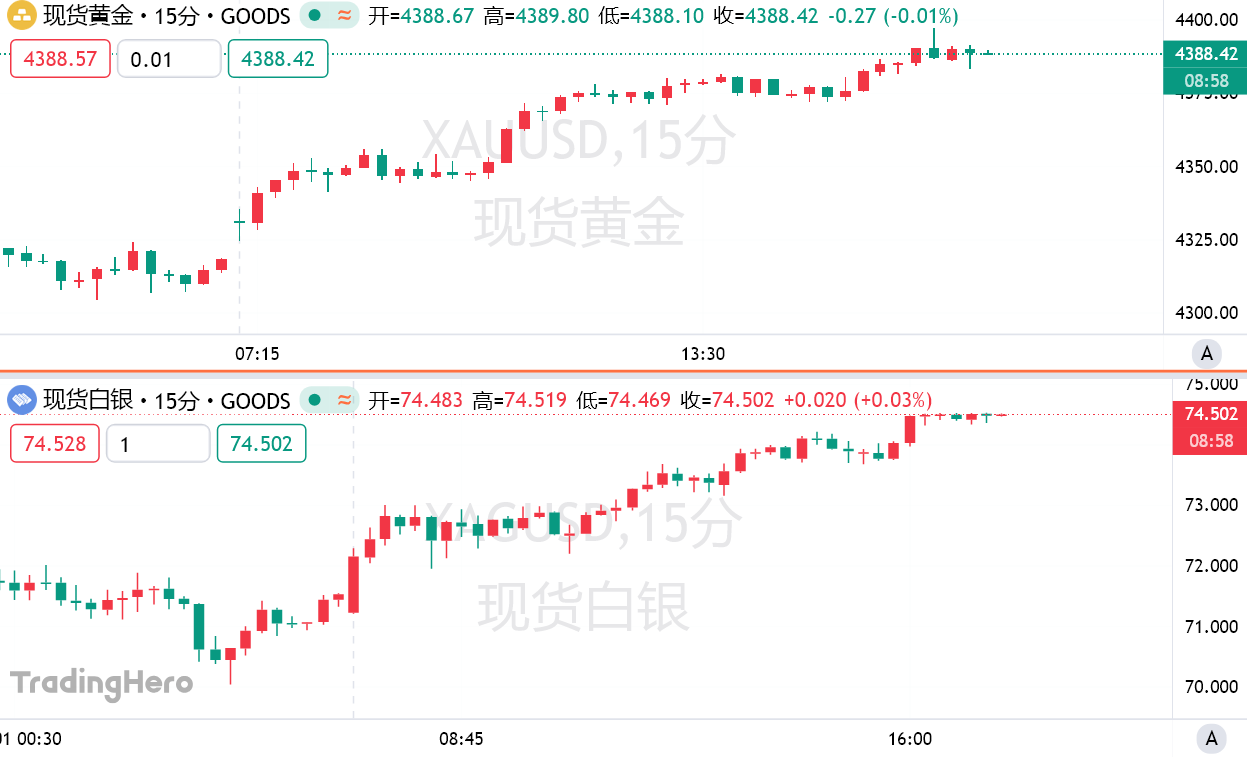
Core Viewpoint - Precious metals, including gold and silver, are expected to perform well in 2026, continuing the strong performance seen in 2025, driven by factors such as potential further interest rate cuts by the Federal Reserve and a weaker dollar [1][3]. Group 1: Market Performance - Gold prices are nearing $4,400 per ounce, while silver has surpassed $74, indicating a strong start to 2026 [1]. - The precious metals market experienced significant volatility in late December 2025 due to profit-taking by investors, but the fundamental factors are regaining focus as the year begins [3]. - In 2025, gold reached multiple historical highs, supported by central bank purchases, the Federal Reserve's easing policies, and geopolitical tensions that increased safe-haven demand [3]. Group 2: Market Dynamics - Silver's price increase in 2025 was even more pronounced than gold's, reaching levels previously deemed unattainable, influenced by concerns over potential U.S. import tariffs on refined metals [3]. - Analysts predict that up to 13% of total positions in the Comex silver market may be liquidated in the next two weeks, which could lead to a significant price reevaluation and decline [3]. - Major banks remain bullish on gold prices for 2026, with Goldman Sachs projecting a rise to $4,900 per ounce, indicating an upward risk bias [4].
【广发宏观贺骁束】高频数据下的12月经济:价格篇
郭磊宏观茶座· 2026-01-01 00:07
Group 1 - The BPI index from the business community continued to recover in December, reaching 899 points, a 2.4% increase compared to the end of November, supported by the Federal Reserve's interest rate cut cycle and ongoing narratives in the industry [1][4][5] - The energy index decreased by 4.2% month-on-month, while the non-ferrous metal index increased by 11.4% month-on-month, driven by liquidity premiums in commodities [4][5] - In December, the prices of major commodities showed mixed trends, with rebar and coking coal futures rising by 3.8% and 9.8% respectively, while the spot price of thermal coal in the Bohai Rim fell by 16.8% [9][11] Group 2 - The housing prices in the four first-tier cities continued to adjust, with the second-hand housing price index showing declines of -1.0%, -1.9%, -1.1%, and -1.2% for Beijing, Shanghai, Guangzhou, and Shenzhen respectively [11] - The photovoltaic industry composite index (SPI) rose by 6.0% month-on-month, with battery cells and polysilicon prices leading the increase, while lithium carbonate futures prices surged by 26.2% [2][12] - The export shipping sector saw stable price increases, with the China Container Freight Index (CCFI) rising by 2.2% month-on-month, and significant increases in the WCID container freight indices for routes to Los Angeles and New York [14][15] Group 3 - Food prices showed mixed trends, with the average wholesale price of pork falling by 1.4% month-on-month, while the average wholesale price of seven key monitored fruits increased by 9.7% [18] - The ICPI index, representing non-food items, showed a month-on-month increase to 100.41, indicating a rise in prices for transportation and clothing [20] - The EPMI and PMI data indicated an upward trend in factory price indices, aligning with broader price indicators like the BPI and the Nanhua Composite Index, suggesting an improving economic price trend [20]

铜价迎来十余年最猛年度涨幅,涨势续航力几何?
Jin Shi Shu Ju· 2025-12-31 02:52
受供应中断、美元走弱、中国经济增长预期改善以及人工智能领域巨额支出的推动,铜价正迎来十多年 来最大的年度涨幅。 分析师表示,这一工业金属的涨势可能延续至明年,尤其是在供应担忧加剧以及全球数据中心规模快速 扩张的背景下。 Astris Advisory Japan大宗商品策略师伊恩·罗珀(Ian Roper)特别指出,全球人工智能需求热潮是铜价 的最新驱动因素,"极度紧张"的市场格局可能意味着这一金属明年涨幅将进一步扩大。 "铜已成为可再生能源、电动汽车建设的最大受益者之一,而现在,数据中心无疑是新的增长亮点。"罗 珀在12月23日接受美国消费者新闻与商业频道(CNBC)丹·墨菲(Dan Murphy)采访时表示。机构分 歧:摩根大通看涨,高盛唱空短期但长期乐观 周二,伦敦金属交易所(LME)三个月期铜价格上涨1.5%,报12405美元/吨,在创下12960美元/吨的历 史新高后,近期涨幅有所收窄。 这一基准合约今年以来已上涨约41%,有望创下2009年以来的最佳年度表现——2009年,随着各国走出 全球金融危机,铜价涨幅超过140%。 在纽约市场,2025年初至今铜价也已飙升逾40%,同样有望创下2009年以 ...
国泰海通:2026年1月建议超配风险资产及A/H股美股
Sou Hu Cai Jing· 2025-12-30 14:34
Core Viewpoint - Guotai Junan suggests an overweight allocation to risk assets in January due to the Federal Reserve's expected interest rate cuts and balance sheet expansion, which may reduce policy uncertainty and market volatility [1] Group 1: Asset Allocation Recommendations - The recommended allocation for January is 50.00% in equities, 35.00% in bonds, and 15.00% in commodities [1] - For January 2026, the suggested equity allocation is 47.50%, with an overweight in A-shares and Hong Kong stocks (10.00%), and U.S. stocks (17.50%), while underweighting European stocks (2.50%) and Indian stocks (2.50%), and maintaining a standard allocation in Japanese stocks (5.00%) [1] Group 2: Rationale for Equity Allocation - Multiple factors support the performance of Chinese equities, with a recommendation to overweight A/H shares due to the upcoming work conference and the start of the 14th Five-Year Plan, which may lead to broader fiscal deficits and more aggressive policies [1] - The "Goldilocks" scenario is emerging, favoring U.S. stock performance, as the U.S. economy shows resilience despite cooling, with weakening inflation and corporate earnings expectations potentially supporting upward movement in U.S. stocks [1]

A股市场投资策略专题报告:A股业绩支撑:政策呵护逻辑下的价格水平
BOHAI SECURITIES· 2025-12-30 06:33
投资策略 [Table_MainInfo] A 股业绩支撑:政策呵护逻辑下的价格水平 ——A 股市场投资策略专题报告 | 究 | 分析师: | 宋亦威 | SAC NO: | 年 | 月 | 日 | S1150514080001 | 2025 | 12 | 30 | [Table_Analysis] | [Table_Summary] | | --- | --- | --- | --- | --- | --- | --- | --- | --- | --- | --- | --- | --- | | 证券分析师 | 投资要点: | 宋亦威 | | | | | | | | | | | | 就 | 年行情的业绩支撑而言,并不来自于量的超预期增长,而来自于 | ⚫ | 2026 | 022-23861608 | 价格端的有效支撑。从今年 | 月、11 | 月的情况来看,PPI | 价格已经连续 | 10 | | | | | songyw@bhzq.com | 两月出现环比转正,这种态势如能持续,将意味着明年 | 同比降幅将 | PPI | | | | | | | | | | | [Table_Author] | 严 ...