消费

Search documents
40多家企业及基金会驰援香港大埔火灾,捐款超6亿港元
Cai Jing Wang· 2025-11-28 03:13
Core Points - Over 40 companies and foundations have contributed more than 600 million HKD to support the fire disaster relief and reconstruction efforts in Tai Po, Hong Kong [1][2] - The Hong Kong government and various sectors are actively engaged in firefighting, rescue operations, and post-disaster support [1] Company Contributions - Alibaba Group has initiated a donation of 20 million HKD for disaster relief and has activated its emergency response mechanism to provide essential supplies [2] - Anta Group and Xtep Group each announced donations of 20 million HKD for disaster relief efforts [2] - Tencent, Xiaomi, and other companies have also contributed amounts ranging from 5 million HKD to 20 million HKD [2] Foundation Contributions - The Ma Yun Public Welfare Foundation donated 30 million HKD to assist affected families and support emergency personnel [3] - The Li Ka Shing Foundation allocated 80 million HKD, including 30 million HKD for immediate aid and 50 million HKD for community rebuilding [3] - The Hong Kong Red Cross received a donation of 2 million RMB for emergency rescue and humanitarian assistance [4] Insurance Sector Response - Multiple insurance companies, including China Life and Ping An, have activated emergency claims procedures to ensure rapid support for affected families [4]







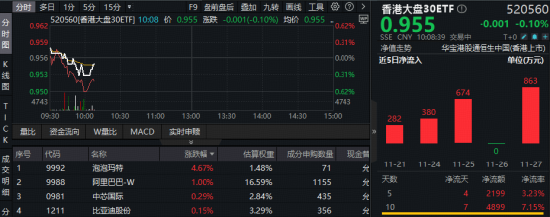
机构:港股市场呈现双主线机会!资金积极布局 自带哑铃策略的—香港大盘30ETF(520560)近10日吸金4899万元
Xin Lang Ji Jin· 2025-11-28 02:24
Core Viewpoint - The Hong Kong stock market is positioned for a new round of opportunities driven by overseas liquidity easing, moderate recovery of the Chinese economy, and the ongoing AI wave [1] Group 1: Market Opportunities - The upward trend in the AI industry cycle is expected to restore the relative advantages of leading technology stocks in Hong Kong [1] - High dividend assets are attractive due to the low interest rate environment and year-end allocation demand, with a dividend yield to 10-year government bond spread maintaining around 4% [1] - The new consumption and innovative pharmaceutical assets in Hong Kong are scarce compared to A-shares, making them worthy of attention [1] Group 2: Investment Strategies - Analysts highlight a dual opportunity in the Hong Kong market: high dividend assets and technology growth sectors, particularly AI-related companies, which may see a new round of valuation recovery [1] - The "barbell strategy" is recommended for asset allocation, focusing on stable value assets (especially H-shares with high AH premium) as a long-term base, while maintaining exposure to growth assets with solid industrial logic [1] Group 3: ETF Performance - The Hong Kong Large Cap 30 ETF (520560) has shown resilience despite market consolidation, with a slight decline of only 0.1% as of the latest report [2] - The ETF attracted significant capital inflow, with 8.63 million yuan on a single day and a total of 48.99 million yuan over the past 10 days, indicating positive sentiment towards the Hong Kong market [2] - Key constituents of the ETF include Alibaba, Tencent, and other high-dividend stocks, making it an ideal long-term investment tool for the Hong Kong market [3]
股市面面观 | A股4000点三问:震荡何因?差异何在?未来何往?
Xin Hua Cai Jing· 2025-11-28 02:17
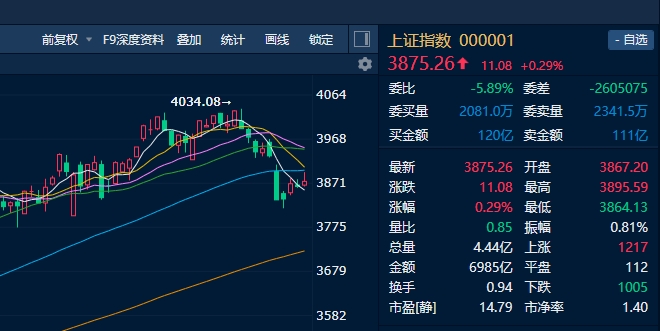
Core Viewpoint - The recent fluctuations around the 4000-point mark of the Shanghai Composite Index are attributed to a battle between bullish and bearish factors, alongside a transformation in market structure. Compared to historical instances, the current A-share market shows significant advantages in growth logic, valuation levels, and industrial foundation, suggesting a potential for a more stable mid-to-long-term market trend as multiple positive factors continue to unfold [1][2][7]. Group 1: Market Fluctuations - The 4000-point level serves as a crucial psychological barrier, leading to intense market fluctuations due to the clash of bullish and bearish sentiments. The Shanghai Composite Index briefly surpassed 4000 points on October 29, 2023, but subsequently fell below this level, indicating ongoing volatility [2][3]. - The internal structure of the market reveals that sector rotation and profit-taking demands are direct causes of the fluctuations. The recent rally has been primarily driven by AI technology stocks, which have seen rapid short-term gains, leading to adjustments as investors lock in profits [3][5]. Group 2: Market Structure Changes - The current market structure, valuation levels, and growth logic have undergone profound changes compared to previous instances of the index reaching 4000 points. The contribution of technology stocks to the index's rise has significantly increased, with their weight in the index rising from less than 5% in 2015 to 17% now [6]. - Valuation comparisons indicate that the current price-to-earnings (PE) ratio remains relatively reasonable, fluctuating between 16-17 times, compared to historical PE ratios that often exceeded 20-30 times when the index previously reached 4000 points [5][6]. Group 3: Future Outlook - Despite the current fluctuations, many institutions maintain a positive outlook for the A-share market, believing it can surpass the historical "curse" associated with the 4000-point level. Factors supporting this optimism include a low interest rate environment, ongoing industrial upgrades, and supportive policies aimed at encouraging investment and financing [7][8]. - The market is expected to transition from a previous focus on technology stocks to a more balanced structure, with an emphasis on sectors that demonstrate strong performance and growth potential. Investment strategies may include a "barbell" approach, focusing on both high-growth technology stocks and undervalued defensive sectors [8][9].
数据点评 | 利润走低的“三重拖累”(申万宏观·赵伟团队)
赵伟宏观探索· 2025-11-27 16:04
Core Viewpoint - The significant decline in industrial enterprise profits in October is primarily attributed to a high base effect, weakened profit margins, and declining revenue, collectively referred to as the "triple drag" [2][10][79]. Revenue - In October, industrial enterprise revenue showed a notable decline, with a year-on-year growth rate of 1.8%, down from 2.4% in the previous month. The actual revenue growth rate, excluding price factors, fell by 6.8 percentage points to -1.4% [1][7][81]. - All three major industrial chains—petrochemical, metallurgy, and consumer—experienced significant revenue declines, with year-on-year reductions of 6.3, 6.6, and 6.3 percentage points, respectively [2][16][81]. Profitability - Industrial enterprise profits saw a substantial year-on-year decline of 27.1 percentage points to -5.5% in October, with the operating profit margin dropping by 20.9 percentage points to -6.1% [5][44][83]. - The profit margin decline is largely driven by increased expense ratios and other loss items, which saw significant reductions compared to the previous month [2][10][79]. Industry Analysis - Industries such as non-metallic products, rubber and plastics, and general equipment faced the most significant profit declines, with respective reductions of 2, 1.4, and 1.9 percentage points [3][19][20]. - The revenue of these industries also fell sharply, with non-metallic products, rubber and plastics, and electrical machinery experiencing year-on-year declines of 19.7%, 14.2%, and 9.5% [19][20]. Cost Structure - Industrial enterprises faced increasing cost pressures, with the cost rate reaching 85.6%, a relative high compared to recent years. The cost's impact on profit remained negative at -3.2% [3][27][28]. - The metallurgy and consumer chains reported cost rates of 86.1% and 85.1%, respectively, indicating a persistent high cost environment [27][28]. Future Outlook - The "anti-involution" policy is expected to be intensified, with improvements in underutilized capacity. However, cost pressures for industrial enterprises remain significant, necessitating further monitoring of policy effects [4][42][82]. - The ongoing profitability challenges are primarily due to rigid cost pressures stemming from downstream investment behaviors, with expectations for gradual alleviation as enterprises accelerate debt repayments [4][42][82].

工业企业效益数据点评(25.10):利润走低的三重拖累
Shenwan Hongyuan Securities· 2025-11-27 13:20
Revenue Performance - In October, industrial enterprises' cumulative revenue growth year-on-year was 1.8%, down from 2.4% in the previous month[6] - The actual revenue growth rate, excluding price factors, fell significantly by 6.8 percentage points to -1.4%[14] - Revenue from the petrochemical, metallurgy, and consumer chains decreased by 6.3, 6.6, and 6.3 percentage points respectively, resulting in year-on-year growth rates of -3.4%, -1.7%, and 1.8%[14] Profitability Analysis - Industrial enterprises' profits saw a substantial year-on-year decline of 31.3 percentage points to -8.8% in October[7] - The operating profit margin dropped by 20.9 percentage points to -6.1% compared to the previous month[34] - Profitability was negatively impacted by rising costs and other losses, with the cost rate for industrial enterprises at 85.6%, remaining at a relatively high level historically[24] Cost Structure - The cost rate for the metallurgy and consumer chains was 86.1% and 85.1%, respectively, indicating a year-on-year increase of 0.6% and stable compared to the previous year[24] - The overall cost pressure on profits remained negative, contributing -3.2% to profit year-on-year[24] Industry-Specific Insights - Industries such as non-metallic products, rubber and plastics, and general equipment experienced significant profit declines, with respective profit growth rates falling by 2, 1.4, and 1.9 percentage points[16] - The automotive, electrical machinery, and computer communication sectors also saw notable profit declines, with contributions to overall profit dropping by 3, 2.7, and 1.5 percentage points[16] Inventory Trends - By the end of October, finished goods inventory increased by 3.7% year-on-year, up from 2.8% in the previous month[6] - Actual inventory growth, excluding price factors, was 8.2% year-on-year, indicating stability in mid and downstream inventories[45]
湖南证监局常态化走访助推上市公司高质量发展
Zheng Quan Ri Bao Wang· 2025-11-27 05:25
Core Points - Hunan Securities Regulatory Bureau is actively visiting listed companies to address their development challenges and enhance their quality and investment value [1][2][3][4][5] Group 1: Company Visits and Support - Hunan Securities Regulatory Bureau has visited 106 listed companies, achieving a coverage rate of 73%, creating a supportive environment for high-quality development [1] - The bureau has established a high-level coordination mechanism to conduct on-site research and provide one-on-one guidance to key companies, enhancing their market stability and investor confidence [2] Group 2: Value Management and Financial Strategies - 28 major index component companies have developed value management systems, and 86 companies have implemented annual cash dividends totaling 20.2 billion yuan, with 26 companies announcing mid-term dividends amounting to 6.889 billion yuan, a year-on-year increase of 161.34% [2] - 18 companies have repurchased shares exceeding 1.3 billion yuan, with notable actions from Hunan Hualing Steel and Lens Technology, which have positively impacted investor sentiment [2] Group 3: Mergers and Acquisitions - The bureau emphasizes compliant and efficient mergers and acquisitions, with 49 completed since 2025, including one major asset restructuring [3] - Hunan Youyi Apollo Commercial Co., Ltd. has successfully transitioned from traditional retail to a dual business model by acquiring semiconductor assets [3] Group 4: Risk Management - A dual leadership mechanism has been established to address risks in listed companies, focusing on revenue decline and negative net assets [4] - The bureau has facilitated risk resolution for several companies, including asset divestiture and financial restructuring, to mitigate delisting risks [4] Group 5: Addressing Company Challenges - The bureau is actively resolving specific challenges faced by companies, including facilitating financing for tech firms and addressing issues related to foreign trade impacts [5] - Historical issues have been addressed, such as recovering frozen shares and long-standing financial returns, enhancing the operational capacity of listed companies [5]

帮主郑重早间观察:定存退场+万亿消费红包,中长线资金该往哪去?
Sou Hu Cai Jing· 2025-11-27 03:10
Group 1: Banking Sector Changes - The five-year fixed deposit has been removed from banks, with the longest available term now being three years and interest rates significantly reduced [3] - The narrowing net interest margin is pressuring banks, leading to a shift in consumer investment strategies as traditional savings may not keep pace with inflation [3] Group 2: Consumption Market Development - Six government departments are collaborating to create three trillion-yuan consumption markets and ten billion-yuan consumption hotspots by 2027, focusing on both supply and demand [4] - The emphasis is on producing high-quality consumer goods with cultural significance, addressing supply-demand mismatches, and identifying companies that can meet new consumer needs [4] Group 3: Currency and Investment Outlook - The RMB/USD exchange rate has surpassed 7.08, the highest since October last year, indicating a positive signal for A-shares as foreign investment interest increases [5] - Morgan Asset Management predicts an annualized return of 7.7% for A-shares over the next 10 to 15 years, reflecting confidence in the long-term resilience and valuation potential of the Chinese economy [5] Group 4: Real Estate Sector Insights - Vanke is negotiating a 2 billion yuan bond extension, highlighting the slow process of risk mitigation in the real estate sector, with stable companies likely to see valuation recovery [5] Group 5: Long-term Investment Strategies - Investment strategies should align with policy directions, focusing on trillion-yuan consumption sectors such as smart home, cultural tourism, and green consumption, while selecting companies with stable cash flow and strong brand power [6] - With declining deposit rates, idle funds should be allocated to quality equity assets like index funds or stable industry leaders, emphasizing long-term compounding over short-term gains [6] - High-risk areas, such as companies with significant debt pressure and opaque operations, should be avoided to mitigate investment risks [6]

南向资金年内净买1.38万亿港元 ETF成“抄底”利器
Zheng Quan Shi Bao· 2025-11-26 18:13
近期,港股持续在高位震荡。11月26日,恒生指数冲高回落收涨0.13%,恒生科技指数涨0.11%。医药 股连续第三日反弹,恒瑞医药(600276)涨近5%,科技股走势分化。 值得注意的是,此前南向资金已经连续8日净买入港股,但在11月26日,南向资金净抛售港股39.52亿港 元。对此,基金经理认为,偶尔出现的净卖出,并不会影响资金不断涌入港股的大趋势,在低估值的吸 引之下,资金有望持续买入港股。 资金持续涌入港股ETF 对于11月26日南向资金出现的净卖出,上海一位基金经理在接受证券时报记者采访时表示:"今年来 看,南向资金也偶尔会出现单日净卖出港股的情况,但这并不意味着市场趋势的反转。近期部分提前布 局港股财报行情的资金开始止盈离场或是资金短期震荡的原因。" 实际上,今年以来,南向资金不断抄底港股,累计净买入港股1.38万亿港元,为历年之最。在南向资金 推动下,港股资产估值迎来修复,恒生指数年内涨幅接近30%,恒生科技指数年内涨幅超过25%。 相较于其他指标,ETF的资金流向能够更为精准且有力地印证资金对港股的积极买入态度。尤其是在今 年下半年港股开启震荡走势之后,ETF资金呈现越跌越买态势,加速净买入港股 ...
摩根大通:降息、减税若落地,印度股市有望在2026年底冲上30000点
Hua Er Jie Jian Wen· 2025-11-26 13:07
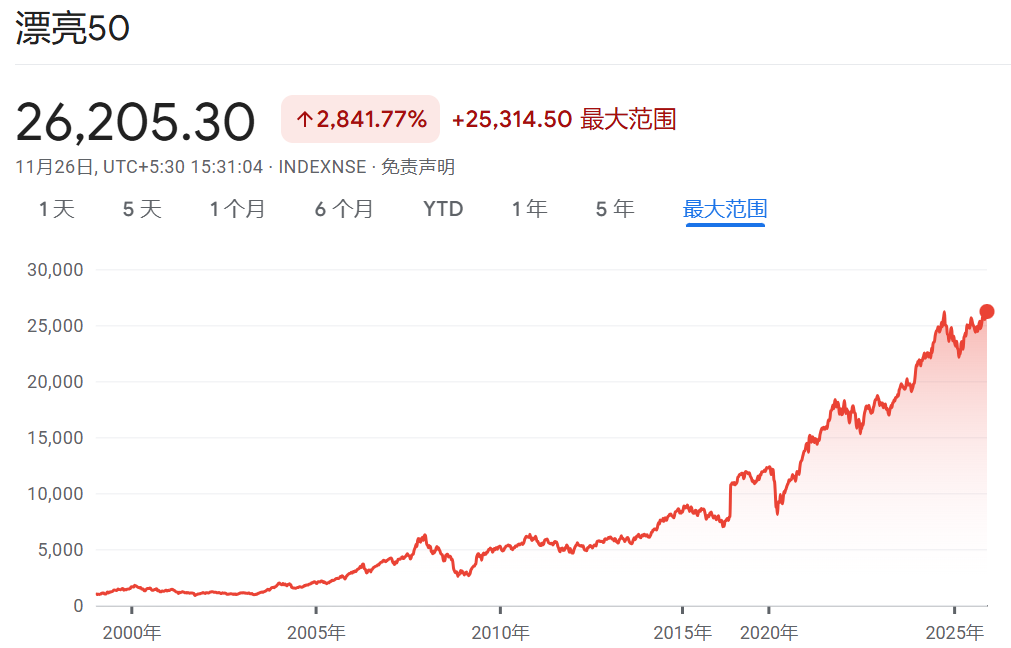
Core Viewpoint - Morgan Stanley predicts that the Indian benchmark Nifty 50 index is expected to rise to 30,000 points by the end of 2026, an increase of approximately 15% from current levels, driven by tax cuts and interest rate reductions [1] Market Performance - The Indian stock market experienced its strongest rebound in five months, with the Nifty 50 index surging 1.24% to 26,205.3 points, marking the highest closing level in 14 months [1] - The BSE Sensex index also rose 1.21% to 86,609.51 points, ending a three-day decline, with both indices recording their best single-day performance in five months [2] Economic Drivers - Morgan Stanley's report indicates that the Reserve Bank of India is expected to cut interest rates by 25 basis points in December, alongside recent tax cuts that have begun to boost consumption, corporate debt growth, and automobile sales, collectively driving domestic demand [3][4] - The report highlights that while the current valuation of the Indian stock market is at a premium compared to other emerging markets, it has fallen below long-term averages after 14 months of underperformance [4] Trade Relations - Analysts believe that the likelihood of a US-India trade agreement is high, which could lead to a short-term revaluation of the stock market. Increased oil imports from the US and reduced purchases from Russia may eliminate the possibility of punitive tariffs from the US [5] - The potential removal of the additional 25% tariff is expected to boost investor confidence, attract foreign capital, support the rupee, and benefit the IT and pharmaceutical sectors [5] Sector Preferences - Morgan Stanley maintains an "overweight" rating on sectors such as materials, financials, consumer goods, hospitals, real estate, defense, and power, while holding a "underweight" stance on IT and pharmaceutical sectors [7] - The analysis suggests that industries benefiting from domestic consumption growth and infrastructure development will perform better, with the financial sector poised to gain from the interest rate cycle and increased corporate debt demand [7]
对当前经济热点的一点思考
李迅雷金融与投资· 2025-11-25 11:53
Group 1: Real Estate Cycle - The long-term upward cycle of real estate from 2000 to 2020 led to a belief that housing prices would not decline, but this notion has been challenged as prices have started to fall [2][3] - The average rental yield in core cities of China is estimated to be around 2%, indicating a high price-to-earnings ratio of 50 times, suggesting that prices may need to adjust to a more sustainable level [3] - Real estate development investment in China has decreased by 14.7% year-on-year in the first ten months of the year, indicating a potential acceleration in the downward trend [3][6] Group 2: Economic Impact of Real Estate - The decline in the real estate sector is expected to continue affecting the overall economy, with private investment growth dropping by 4.5% year-on-year, even excluding real estate investments [3][6] - The real estate downturn is also negatively impacting financial sectors such as banking and trust, although state-owned enterprises are providing some stability [3][6] Group 3: Export Trends - China's exports have shown resilience, with a 5.3% increase in the first ten months of the year, despite concerns about negative growth earlier in the year [7][10] - However, the export growth rate is expected to slow down in the coming year due to the diminishing "import grabbing" effect from the U.S. and high base effects from previous years [10] Group 4: Consumer Spending - Consumer spending is projected to contribute more than half of GDP growth this year, as capital formation's contribution declines [11][14] - The consumption growth has shown a pattern of being high in the first half of the year and lower in the second half, influenced by previous stimulus measures [14][17] Group 5: Fiscal and Monetary Policy - The fiscal policy for 2026 is expected to be more aggressive, with a projected increase in the general deficit from approximately 11.9 trillion yuan to 13.2 trillion yuan [26][28] - Interest rates may be lowered by 10-20 basis points in 2026, but this poses challenges for banks' net interest margins [29][35] Group 6: Stock Market Dynamics - The stock market has faced resistance around the 4000-point mark, with valuation increases rather than profit growth driving recent performance [39][41] - For a sustained bull market, corporate profits must grow faster than GDP, which has not been the case recently [41][44] Group 7: Future Outlook - The GDP growth target for 2026 is estimated to remain around 5%, but achieving this will depend on various uncertain factors, including growth rates and exchange rates [24][25] - The real estate sector's ongoing challenges and the need for structural reforms in fiscal and monetary policies are critical for future economic stability [28][48]