
服务业

Search documents
以进一步深化改革融通江苏发展新动能
Xin Hua Ri Bao· 2025-12-02 05:48
Group 1 - The core viewpoint emphasizes that Jiangsu must leverage reform as a key driver for high-quality development, focusing on "integration" to break down institutional barriers and enhance the flow of critical elements such as talent, technology, capital, and data [1] - The "14th Five-Year Plan" period requires Jiangsu to address existing barriers between technology, education, and talent through reform practices, enhancing their interaction to support industrial upgrades and future development [2] - Establishing a dual-channel mechanism for industry professors and technology vice presidents aims to integrate academic and industry expertise, enhancing the practical application of research in enterprises [3] Group 2 - The emphasis on regional collaboration highlights the need for Jiangsu to create a complementary and high-quality regional economic layout, leveraging its strategic position in the Yangtze River Delta [5] - The "1+3" functional area reform is identified as a key strategy to address development imbalances and enhance overall competitiveness within Jiangsu [5] - The proposal to optimize the "flying economy" and establish a shared benefits mechanism aims to stimulate cooperation between regions and enhance innovation [6] Group 3 - The focus on market system construction aims to eliminate obstacles to the establishment of a unified national market, enhancing supply and demand dynamics through institutional reforms [8] - Jiangsu's strong supply capacity for intermediate products necessitates reforms to elevate its position in the value chain, promoting high-value-added segments [8] - The introduction of a public demand-driven technology iteration mechanism aims to address challenges in urban governance, healthcare, and environmental protection [9] Group 4 - Jiangsu's large population of 85 million presents an opportunity to convert its market potential into effective demand, driving high-quality supply [10] - The exploration of new consumption incentives linked to sustainable behaviors aims to create a circular consumption market [10] - The establishment of a skills-based compensation guideline is intended to ensure that skill enhancements directly reflect in income growth [10] Group 5 - The need for a platform-driven approach to enhance the market-oriented allocation of factors is emphasized, promoting the integration of technology, data, and governance [11] - The establishment of a data aggregation hub aims to clarify rights and responsibilities in data development and usage, ensuring equitable benefit sharing [11] - The introduction of a collaborative and efficient system for assessment will shift focus from GDP to indicators of factor integration, linking results to resource allocation [12]
2025年11月PMI数据点评:制造业景气水平小幅回升,市场预期仍保持乐观
KAIYUAN SECURITIES· 2025-12-02 03:58
Group 1: Report Summary - The report is a commentary on the November 2025 PMI data, titled "Manufacturing Sentiment Improves Slightly, Market Expectations Remain Optimistic" [1] - The analysts are Chen Xi and Wang Shuaizhong, with contact information and certificate numbers provided [2] Group 2: PMI Data Overview - In November 2025, the manufacturing PMI was 49.2%, up 0.2 pct month-on-month and down 1.1 pct year-on-year; the non-manufacturing PMI was 49.5%, down 0.6 pct month-on-month; the composite PMI was 49.7%, down 0.3 pct month-on-month [2][3] Group 3: Manufacturing PMI Analysis - The manufacturing sentiment improved slightly due to export improvement, but it remained in the contraction range for eight consecutive months. New export orders rose 1.7 pct, on-hand orders rose 1.0 pct, and the production index rose 0.3 pct month-on-month [3] Group 4: Non-manufacturing PMI Analysis - The decline in the service PMI dragged the non-manufacturing PMI into the contraction range. In November, the service PMI was 49.5%, down 0.7 pct month-on-month and 0.6 pct year-on-year, the first time in 2025 to fall into the contraction range [4] - New export orders rose, but new orders fell, indicating insufficient domestic demand. Policy measures for new consumption scenarios and promoting domestic demand and consumption may be in the works [4] Group 5: Structural Highlights - High-tech manufacturing remained in expansion, with a PMI of 50.1%. Equipment manufacturing, consumer goods, and basic raw materials industries also had PMIs above the overall manufacturing level, despite some declines [5] - Price indices improved. The purchase price of major raw materials and the ex-factory price of manufacturing rose 1.1 pct and 0.7 pct respectively, and the input price and sales price of non-manufacturing rose 1.0 pct and 1.3 pct respectively [5] Group 6: Construction PMI - The construction PMI rose to 49.6%, up 0.5 pct month-on-month. The business activity expectation index was 57.9%, up 1.9 pct month-on-month, indicating improved confidence [6] Group 7: Market Expectations - Expectations for both manufacturing and non-manufacturing improved. The manufacturing production and operation activity expectation was 53.1%, up 0.3 pct, and the non-manufacturing business activity expectation was 56.2%, up 0.1 pct [6] Group 8: Bond Market View - Bond yields are expected to rise trendily as economic expectations are revised. For stock and bond allocation, the view is that economic growth may not decline significantly in H2 2025, structural issues like prices will improve, and the stock-bond allocation will continue to shift [7]
美国 11 月 ISM 制造业 PMI 萎缩幅度创 4 个月最大,连续 9 个月收缩,对此你怎么看?
Sou Hu Cai Jing· 2025-12-02 03:52
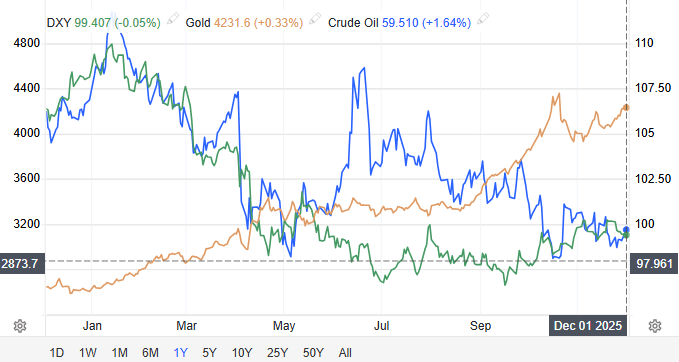
网上又都是黄金5500,白银80,美元再跌10%之类的话题了,大家又要很兴奋的高喊要做多金银铜了,美国高盛的大卫所罗门、桥水的达利 欧、还有约翰·保尔森这几个老多头联合起来,通过这轮拔网线行动,打了一次现货供需差,赚了一大票,这种走势不洗,后面就要给散户和现 货商去送钱了!而这个市场,很多人都把现货和商品混为一谈,殊不知,一旦消费端通缩,上游的供需的关系立马就失去了核心预计,人类重 回金银本位就意味着下一代的持续通缩,对于大佬是好事,对于普通人而言,别谈自己的金银储备,因为这个市场,其实并不对普通人开放。 因此,我还是这个观点,美元会降息,但按当下的几个市场上的炒作热情和流动性冻结幅度,美元后面依然会紧张(证券化市场和银行市 场)!传统意义上,降息通常对于传统金融而言意味着货币宽松,但按美债这个规模,如果也要走日本模式,同时,我们也跟进的话,估计会 让全球掀起负利率竞赛或者加息大赛,引发金融巨震,因此,2026年对于世界金融的看法请改下观念,很多事情要从流动性和债务的角度去 看! 而影响市场情绪的另一重要依据就是美国的制造业经济和就业的复苏! 2025年11月美国ISM制造业PMI指数降至48.2,较上月下降 ...

渤海证券研究所晨会纪要(2025.12.02)-20251202
BOHAI SECURITIES· 2025-12-02 01:44
Group 1 - The core viewpoint of the report indicates that the manufacturing sector is experiencing a recovery in November 2025, driven by improvements in both production and demand, with the manufacturing PMI rising to 49.2% and the production index increasing by 0.3 percentage points to 50.0% [2][3] - The new orders index also saw an increase of 0.4 percentage points to 49.2%, while new export orders rose by 1.7 percentage points to 47.6%, reflecting a positive impact from the recent US-China trade discussions [3] - The report highlights that large enterprises' manufacturing PMI fell by 0.6 percentage points to 49.3%, remaining below the threshold, while medium and small enterprises showed improvements, with medium enterprises rising by 0.2 percentage points to 48.9% and small enterprises increasing by 2.0 percentage points to 49.1%, marking the second-highest level this year [3] Group 2 - The non-manufacturing business activity index decreased by 0.6 percentage points to 49.5%, the lowest level since 2023, with the construction sector showing a slight recovery while the service sector declined due to the end of holiday effects [4] - The comprehensive PMI output index fell by 0.3 percentage points to 49.7%, indicating a contraction, primarily due to the decline in the non-manufacturing sector offsetting the manufacturing recovery [4] - Overall, the report suggests that the improvement in manufacturing sentiment is mainly attributed to a stabilizing external environment, with expectations for continued improvement in December due to forthcoming policy deployments [4]
中央财政出资优化消费供给 “发钱”之外提振消费政策还能做什么?
Zheng Quan Shi Bao· 2025-12-02 00:55
Core Viewpoint - The selection of 50 cities for the new consumption pilot program aims to address the insufficient supply of high-quality consumption and stimulate innovation in the consumption sector through targeted fiscal support policies, shifting from direct subsidies to optimizing the consumption supply structure [1][3][6] Group 1: Pilot Program Overview - The pilot program includes 50 cities, comprising 4 municipalities, 5 sub-provincial cities, and 41 other cities, focusing on creating new consumption scenarios [4] - The program emphasizes three main support directions: launching new products, diverse service consumption scenarios, and cross-industry collaborations [3][4] Group 2: Fiscal Support and Strategy - The central government will provide substantial financial support, with super-large cities receiving a total subsidy of 400 million yuan, large cities 300 million yuan, and other cities 200 million yuan over two years, totaling approximately 17 billion yuan [6][4] - This initiative represents a strategic shift in fiscal policy, focusing on enhancing the "soft environment" for consumption rather than merely providing direct financial incentives to consumers [7][10] Group 3: Consumption Upgrade and Economic Impact - The pilot program is designed to enrich high-quality service supply and leverage consumption's ripple effect, promoting related industries such as culture, tourism, and transportation [3][4] - The initiative aims to create a sustainable consumption ecosystem that enhances urban competitiveness and fosters high-growth sectors like experience economy and cultural creativity [10][11] Group 4: Challenges and Recommendations - The implementation of the pilot program may face challenges such as avoiding homogenization, attracting social capital, and transitioning from reliance on fiscal subsidies to self-sustaining models [12][13] - Recommendations include investing in consumption infrastructure, optimizing public services, and creating a favorable institutional environment to support new consumption forms [13][14]
产需修复持续性有待观察——11月PMI点评
Changjiang Securities· 2025-12-01 23:30
1. Report Industry Investment Rating No relevant content provided. 2. Core View of the Report In November 2025, the manufacturing PMI showed a marginal improvement with synchronized recovery in production and demand and accelerated destocking, but the asymmetric recovery of raw material and finished product prices may still restrict corporate profit repair, and the sustainability of external demand contribution remains to be verified. The decline in service - sector sentiment indicates that the resilience of domestic demand also needs to be observed. The bond market has adjusted, and the impact of PMI data is expected to be limited. It is recommended to allocate 10 - year Treasury bonds with a taxable coupon yield above 1.8% when there are adjustments [2]. 3. Summary by Related Catalogs Manufacturing PMI - **Overall situation**: In November 2025, the manufacturing PMI was 49.2%, up 0.2 pct from the previous month, still seasonally weak but with marginal improvement. Production, procurement, and import indices on the supply - side increased, and new order and backlog order indices on the demand - side rose. Inventory destocking accelerated, and some predictive indicators showed improved supply - demand relationships [5][9]. - **External demand contribution**: The new export order index rose 1.7 pct to 47.6%, and the new export order indices of four major manufacturing industries and large, medium, and small enterprises all increased. However, the asymmetric recovery of raw material and finished product prices may pressure corporate profit repair [9]. - **Enterprise size and industry differences**: Small and medium - sized enterprises' sentiment improved, especially small enterprises which rose 2 pct to a nearly 6 - month high of 49.1%, while large enterprises' sentiment declined 0.6 pct to 49.3%. High - tech manufacturing with a high proportion of small and medium - sized enterprises remained in expansion, while the sentiment of equipment and consumer goods manufacturing declined, and their production sides may be stronger than the demand sides [9]. Non - manufacturing PMI - **Overall situation**: The non - manufacturing business activity index was 49.5% in November 2025, down 0.6 pct from the previous month, the first time below the boom - bust line since 2023. The service - sector sentiment was dragged down by factors such as the fading holiday effect, while the construction industry's sentiment improved [5][9]. - **Sub - item structure**: The inventory and new order indices of non - manufacturing declined, while the new export order index rose. The sales price and input price indices increased for two consecutive months. In the service sector, the financial industry and some new - energy industries showed good performance. The construction industry's business activity index increased, possibly boosted by financial activities and policy support [9]. Investment Suggestion The bond market has adjusted, and the impact of PMI data is expected to be limited. It is recommended to allocate 10 - year Treasury bonds with a taxable coupon yield above 1.8% when there are adjustments [2][9].
最新报告预测 2025年欧盟实际GDP将增长1.4% 欧元区增长1.3%——欧盟经济迎来小幅回暖(国际视点)
Ren Min Ri Bao· 2025-12-01 22:07
欧盟委员会近日发布2025年秋季经济展望报告预测,2025年欧盟实际国内生产总值(GDP)将增长 1.4%,欧元区增长1.3%;2026年欧盟经济将增长1.4%,欧元区经济增长1.2%。另据最新数据,经季节 调整后,今年第三季度欧盟GDP环比增长0.3%,同比增长1.5%;欧元区环比增长0.2%,同比增长 1.3%。欧盟委员会报告认为,尽管外部环境严峻,但未来欧盟经济预计将以温和速度继续扩张。 欧盟委员会负责经济事务的委员东布罗夫斯基斯表示,鉴于外部形势严峻,欧盟必须采取果断行动,释 放内部增长潜力。这意味着要加快推进竞争力议程,简化监管、完善单一市场以及促进创新。 各经济体表现分化明显 近年来,欧盟经济整体增速偏低,阶段性停滞时有出现。今年以来,欧盟国家前三季度经济呈现微弱复 苏态势,经济整体表现略高于预期。最新数据表明,经季节调整后,欧元区和欧盟第三季度经济环比增 速较上一季度的0.1%和0.2%有所加快。其中,欧元区20个经济体中,9个国家实现环比正增长,3个国 家负增长;14个国家实现同比正增长,1个国家负增长。 欧盟各经济体的表现分化明显。环比增速中,瑞典以1.1%的增速领跑,葡萄牙与捷克分别以0. ...
【数据发布】2025年11月中国采购经理指数运行情况
中汽协会数据· 2025-12-01 12:41
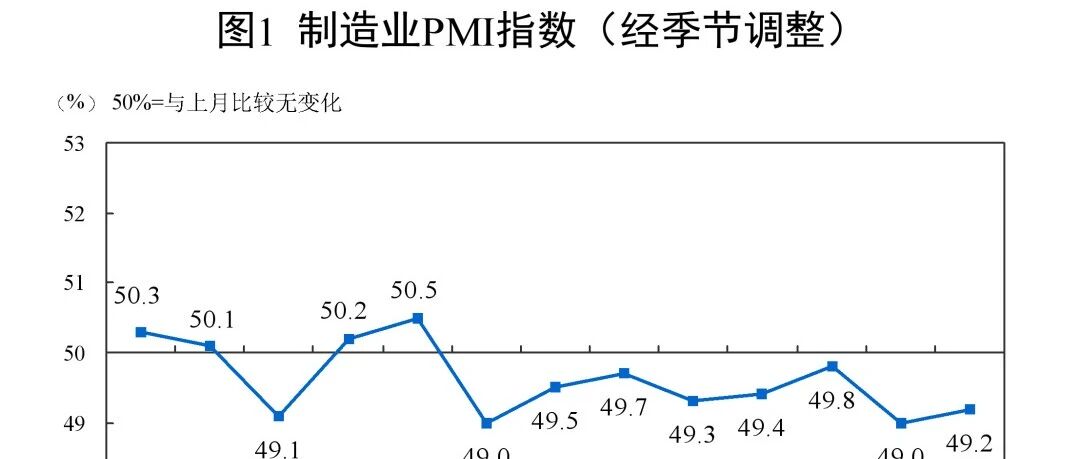
Group 1: Manufacturing PMI Overview - In November, the Manufacturing Purchasing Managers' Index (PMI) was 49.2%, an increase of 0.2 percentage points from the previous month, indicating an improvement in economic conditions [1] - The PMI for large enterprises was 49.3%, a decrease of 0.6 percentage points, while small and medium-sized enterprises had PMIs of 48.9% and 49.1%, increasing by 0.2 and 2.0 percentage points respectively, all below the critical point [4] - The production index was at 50.0%, up by 0.3 percentage points, indicating stable manufacturing production overall [4] - The new orders index rose to 49.2%, an increase of 0.4 percentage points, suggesting an improvement in market demand [4] - The raw materials inventory index remained at 47.3%, indicating a continued decrease in the inventory of major raw materials [5] Group 2: Non-Manufacturing PMI Overview - In November, the Non-Manufacturing Business Activity Index was 49.5%, a decrease of 0.6 percentage points from the previous month [9] - The construction industry business activity index was 49.6%, up by 0.5 percentage points, while the service industry index was 49.5%, down by 0.7 percentage points [12] - The new orders index for non-manufacturing was 45.7%, a decline of 0.3 percentage points, indicating a drop in market demand [14] - The input price index rose to 50.4%, an increase of 1.0 percentage point, indicating a rise in the overall price level of inputs used in business activities [14] - The business activity expectation index was 56.2%, reflecting a generally optimistic outlook among non-manufacturing enterprises [15] Group 3: Comprehensive PMI Overview - The Comprehensive PMI Output Index was 49.7% in November, a decrease of 0.3 percentage points from the previous month [21]
价格传导扭曲制约企业利润修复,非制造业景气度收缩
China Post Securities· 2025-12-01 11:02
Economic Indicators - The November manufacturing PMI is at 49.2%, showing a slight increase of 0.2 percentage points from the previous value, but still below the expansion threshold[9] - The non-manufacturing business activity index fell to 49.5%, down 0.6 percentage points, indicating a contraction in the service sector[21] - The construction sector's PMI improved to 49.6%, up 0.5 percentage points, reflecting a recovery driven by policy support[22] Price Dynamics - The PMI input price index for raw materials is at 53.6%, indicating strong price pressures, while the output price index is at 48.2%, below the expansion threshold, highlighting a disconnect in price transmission[14] - The PPI year-on-year growth is estimated to be around -2.5%, down 0.4 percentage points, indicating a divergence from the output price index[19] Profitability and Market Outlook - Industrial profits turned negative at -5.5% in October, primarily due to rising production costs and insufficient demand, which limits the ability to pass on costs to consumers[14] - The short-term economic outlook favors the bond market, with expectations of a moderate decline in interest rates due to the central bank's resumption of bond purchases[28] - Without new policy measures such as rate cuts, the equity market's recovery in industrial profits is expected to remain under pressure[28] Risks - Key risks include rising sovereign debt risks abroad, escalating geopolitical conflicts, and the potential for policy effects to fall short of expectations[3]
每日机构分析:12月1日
Xin Hua Cai Jing· 2025-12-01 10:52
Group 1 - DBS Bank expects improvement in Indonesia's economy in Q4 2025, raising the 2026 growth forecast due to potential easing policies [1] - Barclays no longer predicts a rate cut from the Reserve Bank of India in December, maintaining a neutral stance on interest rates, while suggesting that Indian economic growth may have peaked [2] - Goldman Sachs indicates a high likelihood of a 25 basis point rate cut by the Federal Reserve in December, driven by a weak labor market [4] Group 2 - UOB highlights strong GDP performance in India's second fiscal quarter, reducing the necessity for a rate cut, and raises the 2026 GDP growth forecast from 6.9% to 7.3% [1][2] - CBI criticizes the UK Chancellor's £26 billion tax increase plan, stating it burdens businesses and fails to address high energy costs, leading to a decline in the service sector's business activity index [2] - S&P Global notes that South Korea's manufacturing PMI remains below the growth threshold, reflecting domestic economic weakness and external pressures, although demand from Asian countries partially offsets declines from the US and Japan [2] Group 3 - Danske Bank predicts that Italian government bonds will continue to outperform in the Eurozone market, benefiting from potential credit rating upgrades and inclusion in more benchmark indices [3] - Moody's states that the UK's recent budget aligns with its Aa3 rating, although it warns of execution risks in fiscal consolidation efforts [3] - The European fixed income head at Invesco suggests that France may face multiple sovereign credit rating downgrades due to political instability ahead of the 2027 presidential election [3]