
原油

Search documents
中国12月钢铁出口创新高、稀土同比大增32%,全年大豆、铁矿石、原油进口齐破纪录
Hua Er Jie Jian Wen· 2026-01-14 07:58
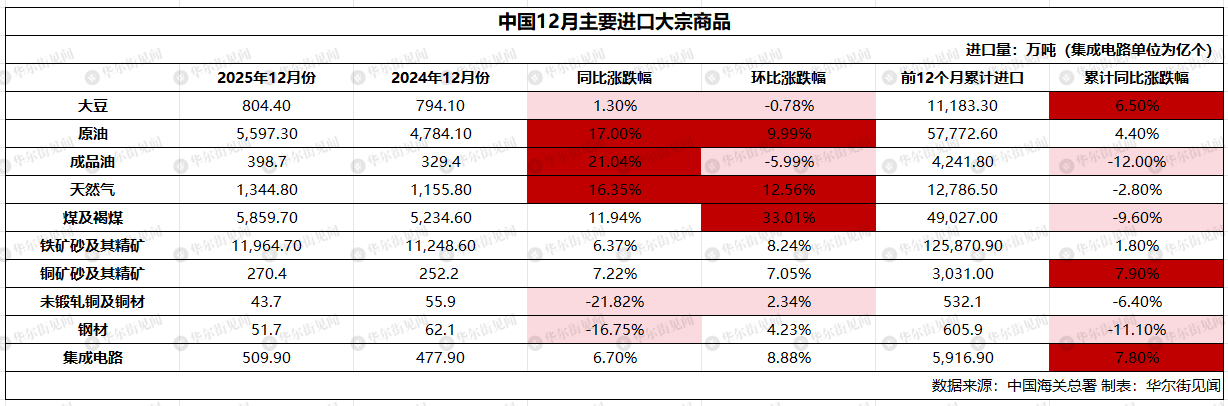
Core Insights - In 2025, China's soybean imports reached a record high of 111.8 million tons, marking the third consecutive year of growth, with a 6.5% increase from 2024 [1][3] - Iron ore imports also hit a historical peak, growing by 1.8% to 1.26 billion tons, continuing a three-year growth trend [6] - Coal imports saw the largest decline in a decade, dropping by 9.6% to 49 million tons [6][13] - December exports of rare earths surged by 32% year-on-year to 4,392 tons, while steel product exports exceeded the previous peak in 2015, reaching 11.3 million tons [2][1] Import and Export Data - December soybean imports were 8 million tons, a 1.3% increase year-on-year, while the total for the year was 111.83 million tons [3][13] - December iron ore imports were 11.96 million tons, a 6.37% increase from the previous year [9] - December crude oil imports reached 55.97 million tons, a 17% increase year-on-year, with an annual total of 57.77 million tons [4][12] - December natural gas imports rose by 16.35% to 1.34 million tons, but the total for the year fell by 2.8% to 12.79 million tons [7][13] Market Analysis - The increase in crude oil imports is attributed to stronger refining activity and robust stockpiling demand, with processing volumes expected to reach 15.38 million barrels per day in 2025 [5] - The decline in coal imports is linked to rising domestic production and the rapid adoption of clean energy, which is reducing coal demand [7] - The surge in rare earth exports indicates a solid demand foundation, despite a 20% month-on-month decline in December due to pre-holiday stockpiling by overseas buyers [2]

——2025年12月美国通胀数据点评:通胀上行压力不大
Huafu Securities· 2026-01-14 03:55
华福证券 宏 观 研 究 通胀上行压力不大 ——2025 年 12 月美国通胀数据点评 投资要点: 宏 核心 CPI 同比低位走平。12 月 CPI 同比持平至 2.7%,与预期一致; 核心 CPI 同比 2.6%,低于预期的 2.7%,继续处于 2021 年 4 月以来的最低 水平。环比 0.2%,也低于预期 0.3%。从分项同比上看,能源通胀继续走低 对冲食品项反弹,核心商品和核心服务均延续低位持平,整体分项数据也 大都保持平稳。 观 点 评 能源通胀走低。12 月 CPI 能源项同比增速继续降至 2.3%,较上月下行 1.9 个百分点。油价方面,下半年以来油价中枢延续稳步回落的趋势,逐步 向 60 美元附近靠拢,主要与目前原油市场大背景还是供给过剩有关。根据 EIA 的数据,2026 年进一步过剩至 226 万桶/日,指向 2026 年原油价格大 概率依旧承压,对应能源通胀继续在低位震荡,不会对整体 CPI 形成较大 的拉动。但需注意地缘政治局部升温(俄乌冲突、巴以冲突等)或驱动油 价短期波动率加剧。 汽车通胀继续下滑。12 月核心商品同比增速录得 1.4%,与上月持平。 本月新车和二手车同比增速均继续 ...
通胀上行压力不大——12月美国通胀数据解读
陈兴宏观研究· 2026-01-14 03:10
Core CPI and Inflation Trends - The core CPI remained flat at 2.7% year-on-year in December, aligning with expectations; the core CPI was at 2.6%, below the expected 2.7%, marking the lowest level since April 2021 [2] - Month-on-month, the CPI increased by 0.2%, also below the expected 0.3%; energy inflation continued to decline, offsetting the rebound in food prices, with core goods and services remaining low [2] Energy Inflation - In December, the year-on-year growth rate of energy CPI dropped to 2.3%, down 1.9 percentage points from the previous month; gasoline prices fell to -4.3% year-on-year, while electricity prices remained high at 6.7% [5] - The average price of Brent crude oil in December was $62.94 per barrel, down from $63.87, indicating a steady decline towards $60 due to oversupply in the oil market [5] - EIA data suggests a global oil market surplus of 2.24 million barrels per day in 2025, increasing to 2.26 million barrels per day in 2026, indicating continued pressure on oil prices [5] Automotive Inflation - Core goods year-on-year growth was recorded at 1.4%, unchanged from the previous month; new and used car prices continued to decline to 0.3% and 1.6% respectively [6] - Leading indicators suggest a potential marginal recovery in automotive inflation by Q1 2026, indicating possible improvements in durable goods consumption post Fed rate cuts in late 2025 [6] Service Inflation - Core services year-on-year growth remained flat at 3%, with housing holding steady at 3.4% and a month-on-month increase of 0.3%; high mortgage rates continue to suppress housing inflation [8] - Medical services saw a rebound of 0.2 percentage points to 3.5%, countering the decline in transportation services, which have been affected by falling oil prices [8] Long-term Inflation Expectations - In January 2026, the one-year inflation expectation from Michigan consumers remained at 4.2%, while the five-year expectation increased to 3.4% from 3.2%, indicating ongoing consumer concerns about inflation risks [10] Interest Rate Expectations - Following the inflation data release, the dollar index fluctuated, and U.S. stock indices experienced slight declines; the two-year Treasury yield decreased by about 1 basis point to 3.53% [12] - Market expectations for a Fed rate cut in June increased to 70% from 68%, with the likelihood of a rate cut in January dropping to 2.8% [12] - Overall, the continued low inflation in December suggests further potential for Fed rate cuts in the future [12]

综合晨报-20260114
Guo Tou Qi Huo· 2026-01-14 03:07
Report Industry Investment Ratings No relevant information provided. Core Views - Geopolitical risks are driving up oil prices, but short - term upside is limited due to supply surplus and the lack of confirmed conflicts. Precious metals remain bullish, and various commodities and financial products show different trends affected by factors such as supply - demand, policies, and geopolitical situations. [2][3] Summary by Categories Energy - **Crude Oil**: US December CPI data boosts market expectations for a rate cut in April. API shows a significant weekly inventory build. Geopolitical tensions in Iran drive up oil prices, but short - term upside is limited due to supply surplus in Q1 2026. [2] - **Fuel Oil & Low - Sulfur Fuel Oil**: Fuel oil follows crude oil price movements. High - sulfur fuel oil may see increased demand as a substitute for asphalt if Venezuelan heavy - oil supply is disrupted. Low - sulfur fuel oil supply is expected to increase, with a weakening fundamental outlook. [22] - **Asphalt**: Iranian geopolitical tensions lead to a rebound in crude oil prices, but asphalt's price increase is limited. Attention should be paid to the arrival of Venezuelan crude oil. [23] Metals - **Precious Metals**: US December CPI data and Iranian tensions make precious metals bullish. [3] - **Base Metals** - **Copper**: LME copper shows signs that support domestic refined copper exports. Chile raises its copper production target. [4] - **Aluminum**:沪铝 tests historical highs, but the break - through is unconfirmed. High profits prompt aluminum plants to consider selling - hedging. [5] - **Zinc**: Zinc prices rise, but high prices may have a negative impact on downstream consumption. [8] - **Nickel & Stainless Steel**:沪镍 falls, while stainless - steel market activity is high. Inventory changes show different trends for pure nickel, nickel - iron, and stainless steel. [10] - **Tin**:沪锡 trading is driven by increased funds. Indonesian tin exports are significant, and option trading amplifies price fluctuations. [11] - **Carbonate Lithium**: The market is active. Upstream sales strategies change, and demand remains strong. Inventory changes vary among different sectors. [12] - **Industrial Silicon**: It has a weak supply - demand situation. Reduced production in the north is not enough to offset weak demand from downstream industries. [13] - **Polysilicon**: Prices continue to decline. The market trading logic has changed, and caution is advised. [14] Steel - **Iron Ore**: The supply is relatively abundant, and the demand is weak. It is expected to fluctuate in the short - term. [16] - **Coke & Coking Coal**: Both are expected to have a bullish - oscillating trend. Carbon element supply is abundant, and downstream iron - water production may bottom - out and rebound. [17][18] - **Silicon Manganese & Silicon Ferrosilicon**: Both suggest a strategy of buying on dips. They are affected by factors such as raw material prices, inventory, and demand from the iron - making industry. [19][20] - **Rebar & Hot - Rolled Coil**: Steel prices are in a range - bound pattern. Demand is weak, and supply is gradually recovering. [15] Chemicals - **Urea**: The market is in a stalemate. Production increases, and downstream demand shows mixed trends. Short - term prices may decline slightly, but the downward space is limited. [24] - **Methanol**: Geopolitical factors cause significant price fluctuations. Overseas supply is low, but domestic demand is weakening, and the driving force for price increases is weakening. [25] - **Pure Benzene**: Cost - driven short - term price increases, but the fundamental situation is weak, and long - term de - stocking is difficult. [26] - **Styrene**: Cost - support is strengthened, and the supply - demand is in a tight balance. [27] - **Polypropylene, Plastic, & Propylene**: Rising oil prices are beneficial to the market. Supply and demand show different trends for each product. [28] - **PVC & Caustic Soda**: PVC may strengthen in the long - term with potential de - capacity. Caustic soda is in a weak state, and the profit of chlor - alkali integration may be compressed. [29] - **PX & PTA**: Geopolitical risks drive up prices, but downstream demand is weakening. [30] - **Ethylene Glycol**: Supply is expected to increase domestically and decrease overseas. Short - term attention should be paid to oil price fluctuations, and the long - term outlook is still under pressure. [31] - **Short - Fiber & Bottle - Chip**: Demand for both is weakening in the short - term. Cost is the main driving factor, and long - term over - capacity is a pressure. [32] Agricultural Products - **Soybean & Soybean Meal**: The USDA report is bearish. South American weather and US soybean exports are important factors to watch. [36] - **Soybean Oil & Palm Oil**: The market is affected by bio - diesel expectations and supply - side factors. It is expected to be range - bound. [37] - **Rapeseed Meal & Rapeseed Oil**: The US Department of Agriculture report indicates a loose supply - demand situation. The market is affected by Sino - Canadian relations and inventory levels. [38] - **Soybean No. 1**: Domestic soybean prices are回调. Supply is tight at the grassroots level, but demand is cautious. [39] - **Corn**: The US corn harvest is large, and the domestic market is affected by supply and demand factors. It is expected to fluctuate widely. [40] - **Livestock & Poultry Products** - **Pig**: The futures market is oscillating. Short - term supply pressure is high, and long - term prices may form a double - bottom pattern. [41] - **Egg**: Egg prices are expected to strengthen in the first half of 2026 due to reduced supply and increased demand. [42] - **Cotton**: The US cotton report is bullish, but the domestic market is in the off - season. Demand is stable, and the planting area policy in Xinjiang is uncertain. [43] - **Sugar**: International sugar production shows different trends in different countries. Domestic sugar production in Guangxi is expected to increase, and the rebound of Zhengzhou sugar is limited. [44] - **Apple**: Apple futures prices rise. The market focus shifts to demand, and the high - quality fruit supply is tight. [45] - **Wood & Pulp** - **Wood**: Wood prices are at a low level. Supply is expected to decrease, and demand is in the off - season. Low inventory provides some support. [46] - **Pulp**: Pulp prices are stable. Downstream demand is weak, and inventory is increasing. [47] Financial Products - **Stock Index**: A - share markets are expected to be range - bound and strong. Geopolitical situations need to be closely monitored. [48] - **Treasury Bond**: Treasury bond futures show a bullish - flattening trend. The strategy of flattening the yield curve is recommended. [49] Shipping - **Container Shipping Index (European Route)**: Maersk's price cuts indicate a weakening market. The 04 - contract valuation lacks a clear anchor, and far - month contracts are under pressure due to the expected resumption of Red Sea shipping. [21]
贵金属早报-20260114
Yong An Qi Huo· 2026-01-14 02:06
Price Performance - London Gold latest price is 4623.05, with a change of 10.10 [1] - London Silver latest price is 85.82, with a change of 1.75 [1] - London Platinum latest price is 2374.00, with a change of 92.00 [1] - London Palladium latest price is 1865.00, with a change of 32.00 [1] - WTI Crude latest price is 61.15, with a change of 1.65 [1] - LME Copper latest price is 13067.50, with a change of -125.50 [1] - US Dollar Index latest is 99.18, with a change of 0.29 [1] - Euro to US Dollar latest is 1.16, with a change of -0.00 [1] - British Pound to US Dollar latest is 1.34, with a change of -0.00 [1] - US Dollar to Japanese Yen latest is 159.17, with a change of 1.00 [1] Trading Data - COMEX Silver inventory latest is 13550.90, with a change of -56.41 [1] - SHFE Silver inventory latest is 630.07, with a change of -19.57 [1] - Gold ETF holdings latest is 1074.23, with a change of 3.43 [1] - Silver ETF holdings latest is 16321.16, with a change of -26.79 [1] - SGE Gold deferred fee payment direction latest is 2, with a change of 0.00 [1] - SGE Silver deferred fee payment direction latest is 2, with a change of 0.00 [1]
中信期货晨报:贵金属波动率仍高,股指商品大部回调-20260114
Zhong Xin Qi Huo· 2026-01-14 02:05
1. Report Industry Investment Rating - No information provided in the report 2. Core Views of the Report - Overseas macro: US economic data shows a cooling trend, and the Fed's independence is under concern. Key events to watch include the Supreme Court's ruling on Trump's tariffs, US CPI data, the nomination of the new Fed chair, and Q4 GDP data [8]. - Domestic macro: The domestic macro - environment is expected to improve moderately, with a focus on investment. The 12 - month PMI and price data have shown mild improvements. The "price commitment" for Chinese EV exports to the EU is a positive for new - energy vehicle manufacturers [8]. - Asset views: Recommend long positions in stock indices, non - ferrous metals (copper, aluminum, tin), and gold on a monthly basis. Silver should be treated as a standard allocation in the short - term and overweighted when volatility stabilizes [8]. 3. Summary by Relevant Catalogs 3.1 Index and Bond Market - **Stock Index Futures**: Double - factor boost to the market, but continuous upward movement requires waiting for incremental funds. Short - term outlook is oscillatory upward [9]. - **Stock Index Options**: Use option covered strategies to increase returns. Short - term outlook is oscillatory [9]. - **Treasury Bond Futures**: Long - end sentiment remains weak. Short - term outlook is oscillatory, depending on the implementation of monetary policy [9]. 3.2 Precious Metals - **Gold**: With smooth expectations of liquidity easing and resurgent geopolitical conflicts, short - term outlook is oscillatory upward, depending on US fundamentals, Fed policy, and geopolitical trends [9]. - **Silver**: Tight spot supply structure, sensitive to liquidity and driven by the pro - cyclical trend. Short - term outlook is oscillatory upward, depending on US fundamentals, Fed policy, and geopolitical trends [9]. 3.3 Shipping - **Container Shipping to Europe**: Near - term support from pre - Spring Festival shipments, long - term focus on the risk of shipping line resumptions. Short - term outlook is oscillatory, depending on shipping line resumption plans, long - term contract freight rates, and pre - Spring Festival cargo volume [9]. 3.4 Black Building Materials - **Steel**: Inventory is starting to accumulate, and the price has fallen after a rise. Short - term outlook is oscillatory, depending on special bond issuance, steel exports, and iron - water production [9]. - **Iron Ore**: Market sentiment is strong, but inventory pressure is building. Short - term outlook is oscillatory, depending on overseas mine production and shipments, domestic iron - water production, weather, port inventory, and policy [9]. - **Coke**: Rigid demand has increased significantly, but the fifth price increase has failed. Short - term outlook is oscillatory, depending on steel production, coking costs, and macro - sentiment [9]. - **Coking Coal**: Supply - demand structure has improved, and prices have rebounded. Short - term outlook is oscillatory, depending on steel production, coal mine safety inspections, and macro - sentiment [9]. - **Silicon Iron**: Market supply and demand are both weak. Short - term outlook is oscillatory, depending on raw material costs and steel procurement [9]. - **Manganese Silicon**: Cost bottom has risen, but de - stocking pressure remains. Short - term outlook is oscillatory, depending on cost prices and overseas quotes [9]. - **Glass**: Production has decreased, and demand is weak. Short - term outlook is oscillatory, depending on spot sales [9]. - **Soda Ash**: Supply has increased significantly, and supply exceeds demand. Short - term outlook is oscillatory, depending on soda ash inventory [9]. 3.5 Non - ferrous Metals and New Materials - **Copper**: Inventory is continuously accumulating, and the price is oscillating at a high level. Short - term outlook is oscillatory upward, depending on supply disruptions, domestic policy surprises, Fed policy, domestic demand recovery, and economic recession [9]. - **Alumina**: The oversupply situation has not improved significantly, and prices are under pressure. Short - term outlook is oscillatory, depending on ore production resumption, electrolytic aluminum production resumption, and extreme market trends [9]. - **Aluminum**: Mozal aluminum plant faces shutdown, and the price is oscillating at a high level. Short - term outlook is oscillatory upward, depending on macro risks, supply disruptions, and demand [9]. - **Zinc**: LME zinc inventory continues to increase, and the price rebound is limited. Short - term outlook is oscillatory, depending on macro - risk and zinc ore supply [9]. - **Lead**: Downstream purchasing willingness has improved, and the price may stop falling and stabilize. Short - term outlook is oscillatory, depending on supply disruptions and battery exports [9]. - **Nickel**: Indonesia plans to significantly reduce nickel ore RKAB, and the price has rebounded. Short - term outlook is oscillatory, depending on macro and geopolitical changes, Indonesian policy risks, and supply [9]. - **Stainless Steel**: Driven by the nickel price rebound, the stainless - steel price has recovered. Short - term outlook is oscillatory, depending on Indonesian policy risks and demand growth [9]. - **Tin**: Downstream rigid demand is resilient, and the price is oscillating upward. Short - term outlook is oscillatory upward, depending on the resumption of production in Wa State and demand improvement [9]. - **Industrial Silicon**: Market sentiment is volatile, and the price has recovered. Short - term outlook is oscillatory, depending on supply - side production resumption and policy changes [9]. - **Polysilicon**: The expectation of state - reserve purchase is still fermenting, and the price is highly volatile. Short - term outlook is oscillatory, depending on supply - side production resumption and domestic photovoltaic policy [9]. - **Lithium Carbonate**: Inventory de - stocking has slowed down, and the price is under pressure. Short - term outlook is oscillatory, depending on demand, supply disruptions, and technological breakthroughs [9]. 3.6 Energy and Chemicals - **Crude Oil**: Geopolitical factors continue to disrupt, and attention should be paid to the Iranian risk. Short - term outlook is oscillatory, depending on OPEC+ production policy and geopolitical situation [11]. - **LPG**: The strong - reality situation is weakening. Short - term outlook is oscillatory, depending on the cost of crude oil and overseas propane [11]. - **Asphalt**: The asphalt futures price is oscillating in an over - valued range. Short - term outlook is downward, depending on sanctions and supply disruptions [11]. - **High - Sulfur Fuel Oil**: Pressured by Venezuelan heavy oil, the fuel oil futures price has fallen. Short - term outlook is oscillatory, depending on geopolitics and crude oil prices [11]. - **Low - Sulfur Fuel Oil**: The low - sulfur fuel oil futures price is oscillating upward. Short - term outlook is oscillatory, depending on crude oil prices [11]. - **Methanol**: Inventory pressure is significant, and MTO demand is weak. Short - term outlook is oscillatory downward, depending on macro - energy, Middle - East situation, and overseas production shutdown [11]. - **Urea**: Actual transactions have slowed down. Short - term outlook is oscillatory, depending on coal prices, downstream replenishment, and enterprise inventory [11]. - **Ethylene Glycol**: Overseas arrivals are concentrated, and inventory capacity is tight. Short - term outlook is oscillatory, depending on coal and oil prices and port inventory [11]. - **PX**: Polyester demand weakness puts pressure on upstream raw materials. Short - term outlook is oscillatory, depending on crude oil price fluctuations, macro - changes, and polyester production cuts [11]. - **PTA**: Polyester production cuts are concentrated, and basis and processing fees are under pressure. Short - term outlook is oscillatory, depending on crude oil price fluctuations, macro - changes, and polyester load [11]. - **Short - Fiber**: Fluctuations have narrowed, and sales are stable. Short - term outlook is oscillatory, depending on downstream yarn - mill purchasing and demand around the Spring Festival [11]. - **Bottle Chip**: More plant overhauls in January, and profit support has increased. Short - term outlook is oscillatory, depending on bottle - chip enterprise production cut targets and shipping costs [11]. - **Propylene**: Some downstream industries have resumed production. Short - term outlook is oscillatory, depending on oil prices and domestic macro - situation [11]. - **PP**: Commodity sentiment is positive, and overhauls have decreased slightly. Short - term outlook is oscillatory, depending on oil prices and domestic and overseas macro - situations [11]. - **Plastic**: Macro - factors boost, but downstream transactions have decreased. Short - term outlook is oscillatory, depending on oil prices and domestic and overseas macro - situations [11]. - **Styrene**: Driven by exports and positive commodity sentiment, the price is oscillating upward. Short - term outlook is oscillatory, depending on oil prices, macro - policy, and plant operations [11]. - **PVC**: Supported by short - term "export rush". Short - term outlook is oscillatory, depending on expectations, costs, and supply [11]. - **Caustic Soda**: Low - valued and with weak expectations, the price is running weakly. Short - term outlook is oscillatory, depending on market sentiment, production, and demand [11]. 3.7 Agriculture - **Oils and Fats**: The USDA report is relatively bearish. Short - term outlook is oscillatory, depending on South American weather and Malaysian palm oil production and demand [11]. - **Protein Meal**: There are both bullish and bearish factors. Short - term outlook is oscillatory, depending on customs policies, South American weather, macro - situation, and trade wars [11]. - **Corn/Starch**: The price is oscillating at a high level. Short - term outlook is oscillatory upward, depending on demand, macro - situation, and weather [11]. - **Pig**: Supply and demand are both increasing. Short - term outlook is oscillatory, depending on farming sentiment, epidemics, and policies [11]. - **Natural Rubber**: Follows the macro - trading logic. Short - term outlook is oscillatory upward, depending on产区 weather, raw material prices, and macro - changes [11]. - **Synthetic Rubber**: Oscillating at a high level. Short - term outlook is oscillatory upward, depending on crude oil price fluctuations [11]. - **Cotton**: The cotton price is in an oscillatory adjustment period. Short - term outlook is oscillatory upward, depending on production and demand [11]. - **Sugar**: The sugar price is oscillating horizontally, and supply pressure is increasing. Short - term outlook is oscillatory downward, depending on imports and Northern Hemisphere production [11].
能源化策略:地缘政治持续扰动原油市场,化?趋势不明延续震荡
Zhong Xin Qi Huo· 2026-01-14 02:04
原油价格于1月13日晚间大幅走高,此前美国加大对伊朗施压,同时 在俄罗斯黑海沿岸一个对于哈萨克斯坦原油至关重要的装运码头附近有油 轮遭到袭击。美国总统特朗普宣布,对与伊朗"做生意"的国家的商品加 征25%关税,并且不排除对这个波斯湾国家实施军事打击。期权市场也显 示出油价可能飙升的风险,交易员对看涨合约要求的溢价,已达到自以色 列和美国2025年对伊朗发动空袭以来的最高水平。伊朗和俄罗斯的地缘因 素是近期原油市场的主要关注点。 板块逻辑: 化工与原油的节奏略有不同,估值修复导致此轮化工反弹先于原油。 随着化工品利润的修复,后期需要关注装置开工率的提升情况,以PTA和 苯乙烯为例,当前产业中大部分装置都实现盈利。塑料期价持续反弹,本 周以来塑料的基差也由负转正,产业链的下游和终端都在积极补库;进口 套利窗口打开后,美金货源也报价走高,而当前美金低价货源有限。下游 需求淡季逐步来临,但并没有超越季节性的利空,塑料可能会延续震荡格 局。 投资咨询业务资格:证监许可【2012】669号 原油:地缘持续扰动,关注伊朗风险 沥青:沥青期价处于高估区间震荡 高硫燃油:委内瑞拉重油施压,燃油期价震荡 低硫燃油:低硫燃油期价震 ...
宝城期货原油早报-2026-01-14-20260114
Bao Cheng Qi Huo· 2026-01-14 01:49
Report Summary 1) Report Industry Investment Rating No relevant information provided. 2) Report's Core View - The crude oil 2603 contract is expected to be volatile in the short - and medium - term, and show a stronger trend intraday, with an overall view of stronger operation. The core reason is the escalation of the US - Iran conflict, which has led to an increase in geopolitical risks and supported the crude oil price [1][5]. 3) Summary by Related Information Time - cycle Views - Short - term (within a week): The crude oil 2603 contract is expected to be volatile [1]. - Medium - term (two weeks to one month): The crude oil 2603 contract is expected to be volatile [1]. - Intraday: The crude oil 2603 contract is expected to be stronger [1]. Price Movement Reference - The reference view is that the crude oil price will run stronger [1][5]. Core Logic - The US President Trump has frequently released geopolitical risk signals, and the US may target Greenland and Mexico. Also, the US has threatened a new round of military strikes against Iran, intensifying the Middle East geopolitical risks. The strengthening of the crude oil risk premium has weakened the dominance of the weak supply - demand pattern in the oil market, supporting the stronger operation of domestic and foreign crude oil futures prices on Tuesday night. It is expected that domestic crude oil futures prices may maintain a volatile and stronger trend on Wednesday [5]. Calculation Notes - For varieties with night trading, the starting price is the night - trading closing price; for those without night trading, it is the previous day's closing price. The ending price is the day - trading closing price for calculating the price change [2]. - A decline of more than 1% is considered weak, a decline of 0 - 1% is considered weakish, an increase of 0 - 1% is considered strongish, and an increase of more than 1% is considered strong. The strongish/weakish description only applies to intraday views, not short - and medium - term views [3][4].
光大期货:1月14日能源化工日报
Xin Lang Cai Jing· 2026-01-14 01:25
Oil Market - Oil prices have experienced five consecutive increases, with WTI February contract closing up by $1.65 to $61.15 per barrel, a rise of 2.77% [2][16] - Brent March contract closed up by $1.60 to $65.47 per barrel, a rise of 2.51% [2][16] - Concerns over supply disruptions due to geopolitical tensions in Iran and issues with the Caspian Pipeline Consortium have heightened bullish sentiment in the market [2][16] - API data indicates a significant increase in U.S. crude oil inventories by 5.278 million barrels last week, compared to a decrease of 2.766 million barrels the previous week [2][16] Fuel Oil - The main fuel oil contract FU2603 on the Shanghai Futures Exchange rose by 0.53% to 2461 yuan/ton, while low-sulfur fuel oil contract LU2603 increased by 1.66% to 3066 yuan/ton [17][18] - The low-sulfur fuel oil market structure remains stable, with moderate support for high-sulfur fuel oil due to recovering demand from the shipping sector [17][18] Asphalt - The main asphalt contract BU2602 on the Shanghai Futures Exchange fell by 0.66% to 3140 yuan/ton [19] - The market is influenced by tightening raw material supply and declining refinery output, leading to a significant price increase [19] Rubber - The main rubber contract RU2605 fell by 155 yuan/ton to 15975 yuan/ton, while NR and BR contracts also saw declines [20] - The export volume of natural rubber in November 2025 decreased by 14.7% year-on-year to 37,150 tons, with 50.8% exported to China [20] PX, PTA, and MEG - TA605 closed at 5140 yuan/ton, down 0.04%, while EG2605 closed at 3815 yuan/ton, down 1.68% [21] - The polyester market is expected to experience short-term fluctuations due to geopolitical risks affecting oil prices [21] Methanol - Methanol prices in Taicang were reported at 2257 yuan/ton, with CFR China prices ranging from $265 to $269 per ton [22] - The market is expected to maintain a bottom range due to declining port inventory pressure [22] Polyolefins - Mainstream prices for polyolefins in East China range from 6370 to 6500 yuan/ton, with various production margins reported [23][24] - Supply is expected to decrease slightly due to temporary maintenance, while demand is anticipated to recover as the Lunar New Year approaches [24] PVC - PVC prices in East China have been adjusted upwards, with various grades priced between 4660 and 4850 yuan/ton [25] - The market is expected to maintain a bottom range due to high supply levels and slowing domestic demand [25] Urea - Urea futures prices showed a slight decline, with the main contract closing at 1774 yuan/ton [26] - The market is entering a phase of consolidation as demand remains supported by winter storage [26] Soda Ash - Soda ash futures prices fell by 1.3%, with the main contract closing at 1212 yuan/ton [27] - The market outlook remains weak due to low demand and inventory pressures as the Lunar New Year approaches [27] Glass - Glass futures prices showed a decline, with the main contract closing at 1096 yuan/ton, down 3.09% [28] - The market is supported by high transaction volumes in the spot market, but seasonal demand is expected to decrease as the holiday approaches [28]

美国对伊朗持续施压,“断供”风险推涨油价,利好油服行业
Sou Hu Cai Jing· 2026-01-14 00:45
Group 1 - The U.S. government announced a 25% tariff on any country doing business with Iran, indicating heightened geopolitical tensions [1] - The International Energy Agency predicts a global oil supply surplus of 3.84 million barrels per day by 2026, leading to a systemic decline in oil prices [1] - If U.S.-Iran conflict escalates, Iranian oil exports may be disrupted, exacerbating global supply tightness [1] Group 2 - Approximately 13 million barrels of oil are transported daily through the Strait of Hormuz, accounting for about 31% of global maritime oil transport [2] - Concerns over the closure of the Strait of Hormuz could increase oil prices by several dollars, with a complete closure potentially raising prices by $10 to $20 per barrel [2] - If the conflict leads to a complete halt of Iranian oil exports, a global supply gap of over 2 million barrels per day could occur, potentially driving Brent crude prices to $90-100 per barrel if sustained for six months [2] Group 3 - The geopolitical conflict is expected to boost oil price expectations, leading to increased exploration and development spending by oil and gas companies, which directly benefits oil service equipment demand [2]