
纯碱

Search documents
广发期货日评-20251031
Guang Fa Qi Huo· 2025-10-31 05:33
Report Summary 1. Investment Ratings The report does not explicitly provide an overall industry investment rating. However, it offers specific trading suggestions for different sectors and varieties: - **Financial Sector** - **Equity Index Futures**: Try to lightly sell put options at the support level or construct a bull call spread for follow - up upside potential [3]. - **Treasury Bond Futures**: Go long on pullbacks for the unilateral strategy and pay attention to the positive arbitrage strategy for the cash - futures strategy [3]. - **Precious Metals**: For gold, there is pressure for a further decline; for silver, it is in a volatile consolidation. Trading suggestions are based on price trends [3]. - **Black Metals Sector** - **Steel**: Reduce long positions appropriately and hold the long - coking coal and short - hot - rolled coil arbitrage [3]. - **Iron Ore**: Close long positions and observe, and consider the 1 - 5 positive arbitrage [3]. - **Coking Coal and Coke**: Go long on pullbacks and hold the long - coking coal and short - coke arbitrage [3]. - **Non - ferrous Metals Sector** - **Copper**: Pay attention to the support around 87,000 [3]. - **Tin**: Adopt a low - buying strategy on pullbacks [3]. - **Energy and Chemical Sector** - **Crude Oil**: Go short in the short term [3]. - **Urea, PX, PTA, etc.**: Adopt different strategies such as reducing long positions, short - selling on rallies, and spread trading according to different varieties [3]. - **Agricultural Products Sector** - **Soybeans**: Hold long positions in the 2601 contract [3]. - **Palm Oil**: The main contract may test the support at 8,800 yuan [3]. - **Sugar**: It is in a bottom - oscillating state around 5,400 [3]. - **Cotton**: It is in a range - bound and upward - trending state, paying attention to the pressure around 13,800 [3]. - **Special and New Energy Sectors** - **Glass**: Look for short - term long opportunities based on the spot market [3]. - **Carbonate Lithium**: It is in a relatively strong state, with the main contract reference range of 83,000 - 87,000 [3]. 2. Core Views - **Market Environment**: Key factors such as the meeting between Chinese and US leaders, the release of the 15th Five - Year Plan draft, and the clarification of bond - fund redemption fees have an impact on the market. Risk - preference - enhancing factors are gradually materializing, and uncertainties in the market are decreasing [3]. - **Sector - specific Views** - **Financial Sector**: Stock index futures are affected by market sentiment and policy expectations; treasury bond futures are on an upward trend as negative factors are gradually digested; precious metals are affected by geopolitical and trade factors [3]. - **Black Metals Sector**: Supply and demand factors such as production, transportation, and inventory levels affect the price trends of steel, iron ore, coking coal, and coke [3]. - **Non - ferrous Metals Sector**: Prices are affected by factors such as macro - environment, supply - demand relationship, and technical levels [3]. - **Energy and Chemical Sector**: Supply - demand expectations, cost support, and inventory levels are the main factors affecting prices [3]. - **Agricultural Products Sector**: Factors such as procurement, supply pressure, and seasonal characteristics affect the price trends of various agricultural products [3]. - **Special and New Energy Sectors**: Macro - events and fundamental factors affect the price trends of glass, rubber, and new - energy products [3]. 3. Summary by Related Catalogs - **Financial Sector** - **Equity Index Futures**: After the meeting between Chinese and US leaders and the release of the 15th Five - Year Plan draft, the market has a short - term pullback after reaching a high. It is recommended to try light - selling put options or constructing a bull call spread [3]. - **Treasury Bond Futures**: As negative factors such as bond - fund redemption fees and central - bank bond - buying uncertainties are gradually digested, the bond market sentiment is improving. It is recommended to go long on pullbacks and consider the positive arbitrage strategy [3]. - **Precious Metals**: Gold is under pressure to decline due to factors such as the meeting between Chinese and US leaders and geopolitical concerns; silver is in a volatile consolidation [3]. - **Black Metals Sector** - **Steel**: The increase in apparent demand and the alleviation of inventory pressure lead to suggestions of reducing long positions and holding arbitrage positions [3]. - **Iron Ore**: The decline in shipping and arrivals, the increase in port inventory, and the sharp drop in molten - iron production lead to suggestions of closing long positions and considering arbitrage [3]. - **Coking Coal and Coke**: The strength of coking - coal prices and the cost support provided by coking coal lead to suggestions of going long on pullbacks and holding arbitrage positions [3]. - **Non - ferrous Metals Sector** - **Copper**: After the realization of positive expectations, the price is in a high - level oscillation. Pay attention to the support level [3]. - **Tin**: Affected by the Fed's interest - rate outlook, it is recommended to buy on pullbacks [3]. - **Energy and Chemical Sector** - **Crude Oil**: Although the macro - sentiment has eased and inventory has decreased, the increase in OPEC production limits the rebound height. It is recommended to go short in the short term [3]. - **Urea, PX, PTA, etc.**: Due to weak supply - demand expectations and limited cost support, different trading strategies are recommended for different varieties [3]. - **Agricultural Products Sector** - **Soybeans**: Supported by China's increased confidence in purchasing US soybeans, hold long positions [3]. - **Palm Oil**: The main contract may test the support level [3]. - **Sugar**: It is in a bottom - oscillating state due to abundant overseas supply [3]. - **Cotton**: With the solidification of new - cotton costs, it is in a range - bound and upward - trending state [3]. - **Special and New Energy Sectors** - **Glass**: Affected by macro - events, pay attention to short - term long opportunities based on the spot market [3]. - **Carbonate Lithium**: With the upward shift of the price center and the realization of demand benefits, it is in a relatively strong state [3].
宏观继续提振市场情绪,基本?分化主导价格表现各异
Zhong Xin Qi Huo· 2025-10-31 03:49
Report Industry Investment Rating - The mid - term outlook for the industry is "Oscillation" [6] Core Viewpoints - The Fed's interest rate cut and the easing of Sino - US trade frictions continue to boost market sentiment, but the differentiation of fundamentals leads to different price performances of sector varieties. The supply - demand of coal and coke remains balanced with high - level price oscillation, while high inventories of steel and continuous inventory accumulation of iron ore lead to price declines [1][2]. - The marginal weakening of the supply - demand pattern is the main feature of the later fundamental situation, which still poses upward resistance to the prices of some sector varieties. At the same time, there is still a possibility of positive news from the macro and policy levels. It is recommended to seize the upward opportunities under favorable macro and policy conditions [6]. Summary by Relevant Catalogs Iron Element - Iron ore: The weekly molten iron output has decreased as expected. The weakening of steel mill profitability and the start of the off - season will limit the recovery space of molten iron after the end of environmental protection restrictions. Iron ore arrivals are expected to recover, and inventory is expected to increase marginally. The fundamentals are marginally weakening, but overall contradictions are not prominent. Macro expectations and market sentiment dominate, and short - term prices are expected to oscillate [2]. - Scrap steel: The supply and demand of scrap steel both decline, and the fundamental contradictions are not prominent. Recently, the finished product data has slightly improved, and the downward driving force of scrap steel is limited. It is expected that the short - term scrap steel price will mainly follow the finished products [2][10]. Carbon Element - Coke: Under environmental protection restrictions, the demand for coke is temporarily tightened, but the overall supply - demand contradiction is not large. With the continuous increase in raw coal prices, coke has started three rounds of price increases. However, although the finished product prices have slightly recovered recently, steel mill profits are still under pressure, and the game between steel and coke continues. It is expected that the coke price will oscillate [2][12]. - Coking coal: The supply of coking coal is difficult to improve. With continuous procurement from the middle and lower reaches, the coal mine inventory has dropped to a recent low. The short - term fundamentals are healthy. It is expected that the short - term coking coal price will oscillate, waiting for further macro and policy boosts [2][13]. Alloys - Manganese silicon: The short - term cost is stable, and the high output of steel supports the price. However, the market supply - demand expectation is pessimistic, and the driving force for the price increase of manganese silicon is insufficient [3]. - Ferrosilicon: The high output of finished products and the firm cost support the ferrosilicon price in the short term. However, the market supply - demand relationship is relatively loose, and the upward price space is limited [3]. Glass and Soda Ash - Glass: Some manufacturers are trying to support the price by raising the spot price. Attention should be paid to whether the price increase is implemented and the sales situation after implementation. If the sales remain weak, the price will return to a weak oscillation. In the medium and long term, market - oriented capacity reduction is still needed, and the price may continue to oscillate downward [3][14]. - Soda ash: The supply - surplus pattern remains unchanged. It is expected that the price will follow the macro fluctuations and oscillate widely in the future. In the long term, the price center of gravity will still move down to promote capacity reduction [3][16]. Specific Varieties - Steel: The macro sentiment is volatile, and the futures price is under pressure to decline. The spot market trading is generally weak, and the market sentiment has deteriorated. The fundamentals are improving, but the inventory level is still higher than the same period last year. It is expected that the short - term futures price will be under pressure, and attention should be paid to macro policy disturbances [8]. - Iron ore: The molten iron output has decreased significantly, and the inventory has increased month - on - month. The spot price has weakened. The fundamentals are marginally weakening, but overall contradictions are not large. Macro expectations and market sentiment dominate, and short - term prices are expected to oscillate [8][9]. - Scrap steel: The arrival volume has decreased slightly, and the price is oscillating. The supply and demand of scrap steel both decline, and the fundamentals have no prominent contradictions. It is expected that the short - term price will follow the finished products [10]. - Coke: The supply has slightly increased, and the demand is temporarily tightened. The overall supply - demand contradiction is not large, and the price is expected to oscillate [11][12]. - Coking coal: The supply is difficult to increase, and coal mines continue to reduce inventory. The short - term fundamentals are healthy, and the price is expected to oscillate [13]. - Glass: Manufacturers are trying to support the price by raising the spot price. Attention should be paid to the implementation of the price increase and the sales situation. If the sales are weak, the price will return to a weak oscillation. In the long term, the price is expected to oscillate downward [14]. - Soda ash: After the supply recovery, manufacturers have returned to the inventory accumulation state. The supply - surplus pattern remains unchanged. It is expected that the price will follow the macro fluctuations and oscillate widely, and the long - term price center of gravity will move down [16]. - Manganese silicon: The driving force for price increase is insufficient, and the futures price is oscillating. The short - term cost is stable, and the high steel output supports the price, but the market supply - demand expectation is pessimistic [17]. - Ferrosilicon: The supply - demand relationship is still loose, and there is pressure above the futures price. The high output of finished products and the firm cost support the price in the short term, but the supply - demand relationship is relatively loose [18]. Related Indexes - On October 30, 2025, the comprehensive index of CITICS Futures commodities decreased by 0.57% to 2250.38, the commodity 20 index decreased by 0.52% to 2544.78, and the industrial products index decreased by 0.87% to 2246.75 [99]. - The steel industry chain index on October 30, 2025, had a daily decline of 0.68%, a 5 - day increase of 2.52%, a 1 - month decline of 0.05%, and a year - to - date decline of 2.96% [101].
新世纪期货交易提示(2025-10-31)-20251031
Xin Shi Ji Qi Huo· 2025-10-31 03:39
Report Industry Investment Ratings - Iron ore: Rebound [2] - Coking coal and coke: Rebound [2] - Rolled steel: Oscillation [2] - Glass: Oscillation [2] - Soda ash: Oscillation [2] - CSI 500: Rebound [4] - CSI 1000: Rebound [4] - 2-year Treasury bond: Oscillation [4] - 5-year Treasury bond: Oscillation [4] - 10-year Treasury bond: Upward [4] - Gold: High-level oscillation [4] - Silver: High-level oscillation [4] - Logs: Weak oscillation [6] - Pulp: Bottom consolidation [6] - Offset paper: Weak oscillation [6] - Soybean oil: Range operation [6] - Palm oil: Range operation [6] - Rapeseed oil: Range operation [6] - Soybean meal: Rebound [6] - Rapeseed meal: Rebound [6] - Soybean No. 2: Rebound [8] - Soybean No. 1: Rebound [8] - Live pigs: Oscillation with a slight upward trend [8] - Rubber: Oscillation [10] - PX: On the sidelines [10] - PTA: Oscillation [10] - MEG: On the sidelines [10] - PR: On the sidelines [10] - PF: On the sidelines [10] Report's Core Views - The macro利好 has landed, and black prices are returning to fundamentals. The iron ore market has an oversupply situation, and the coal and coke market is affected by policies and supply concerns. The steel market's price stop depends on production cuts and anti-"involution" policies. The glass market has inventory pressure and weak demand. The financial market has different trends for various indexes, and the precious metal market is affected by multiple factors such as central bank purchases and geopolitical risks. The light industry and agricultural product markets have their own supply and demand characteristics, and the soft commodity and polyester markets also face different situations [2][4][6][8][10] Summary by Related Catalogs Black Industry - Iron ore: The main line is "loose supply, low demand, and port inventory accumulation." The supply has room for impulse, and the demand is weak due to the low level of real estate new construction. Follow-up attention should be paid to four main lines that may trigger price revaluation [2] - Coking coal and coke: Driven by multiple news, the price has risen. The market is concerned about demand-side policies, and the core contradiction lies in the low profit level of steel mills [2] - Rolled steel: The price is affected by the demand for steel, and the stop of the decline depends on production cuts and policy implementation [2] - Glass: There are contradictions in the market, with weak demand and increasing inventory pressure. The solution depends on reducing the daily melting volume and the support of policies [2] Financial Market - Stock index futures/options: Different indexes have different trends, and the market is short-term consolidated with increasing bullish sentiment [4] - Treasury bonds: The yield of 10-year Treasury bonds has declined, and the market has a slight upward trend. It is recommended to hold long positions lightly [4] - Gold: The pricing mechanism is changing, and it is affected by multiple factors such as central bank purchases, geopolitical risks, and interest rate policies. It is expected to oscillate at a high level in the short term [4] Light Industry - Logs: The supply is increasing seasonally, while the demand is weakening. The price is expected to oscillate weakly [6] - Pulp: The cost support is weakening, and the demand is poor. The price is expected to consolidate at the bottom [6] - Offset paper: There is supply pressure, and the demand has not improved. The price is expected to oscillate weakly [6] Oil and Fat - Oils: The supply is abundant, and the demand is weak. The overall is expected to continue range operation [6] - Meal: Supported by trade optimism and the rise of US soybean futures, it is expected to rebound in the short term [6] Agricultural Products - Live pigs: The trading average weight may increase slightly, and the settlement price may rise. The market is expected to oscillate with a slight upward trend [8] Soft Commodities and Polyester - Rubber: The supply is affected by weather, and the demand is improving. The inventory is decreasing. The price is expected to oscillate widely [10] - PX: The trade dispute risk is weakening, and the price follows the oil price [10] - PTA: The cost support is weakened, and the supply and demand are marginally improved. The price follows the cost [10] - MEG: The supply is at a high level, and the demand is worrying. The price is suppressed by the inventory pressure [10] - PR: The market may oscillate weakly [10] - PF: The market may be sorted narrowly [10]
黑色建材日报:宏观预期兑现,盘面短期承压-20251031
Hua Tai Qi Huo· 2025-10-31 02:50
Report Summary 1. Investment Ratings - Glass: Oscillating weakly [2] - Soda Ash: Oscillating weakly [2] - Silicomanganese: Oscillating [4] - Ferrosilicon: Oscillating [4] 2. Core Views - The macro - expected situation has been realized, and the market is under short - term pressure. The supply - demand contradictions in glass, soda ash, and double - silicon sectors continue to affect the prices of related products [1][3] 3. Market Analysis and Strategy by Product Glass - **Market Analysis**: The glass futures market dropped significantly yesterday. Downstream procurement is cautious, mainly for刚需. The开工 rate of float glass enterprises this week was 80.63%, unchanged from last week, and the factory inventory was 65.79 million heavy boxes, a 1.24% decrease from last week, showing obvious inventory reduction. However, the supply - demand contradiction is still large, the inventory pressure is still at a historically high level, and the futures - cash merchants are squeezing the market share of glass factories. With the end of the consumption peak season and the potential for some production lines to resume production, the glass price is expected to remain under pressure [1] - **Strategy**: Oscillating weakly [2] Soda Ash - **Market Analysis**: The soda ash futures market showed a weak oscillating trend yesterday. Downstream procurement is mainly for刚需 replenishment. This week, the soda ash production was 757,600 tons, a 2.29% increase from last week, and the inventory was 1.702 million tons, a 0.01% decrease from last week. The supply - demand contradiction remains, with the supply expected to increase further, the刚需 showing resilience, and the speculative demand weakening. The inventory reduction pressure will persist throughout the year [1] - **Strategy**: Oscillating weakly [2] Silicomanganese - **Market Analysis**: The main contract of silicomanganese futures first rose and then fell, closing at 5,842 yuan/ton yesterday. The spot market was stable, and the alloy cost support was fair. The price of 6517 in the northern market was 5,600 - 5,680 yuan/ton, and in the southern market was 5,650 - 5,700 yuan/ton. Although silicomanganese enterprises are facing increasing losses, the production remains high, and the inventory reduction pressure is large. Recently, coking coal has driven the upward movement of the black sector, strengthening the bottom support of silicomanganese. It is expected that the silicomanganese price will continue to fluctuate with the sector [3] - **Strategy**: Oscillating [4] Ferrosilicon - **Market Analysis**: The main contract of ferrosilicon futures tried to rise in the morning but faced pressure and then declined in the afternoon under the influence of the black sector. The spot market sentiment was flat, and most operations were cautious. The cash - inclusive ex - factory price of 72 - grade ferrosilicon in the main production areas was 5,150 - 5,200 yuan/ton, and the price of 75 - grade ferrosilicon was 5,700 - 5,800 yuan/ton. Currently, ferrosilicon enterprises have high production and high inventory, and the demand is expected to weaken. Although enterprises are continuously losing money, it has not effectively curbed production, and the weak fundamental situation is difficult to reverse. It is expected that the short - term ferrosilicon price will follow the sector [3] - **Strategy**: Oscillating [4]
《特殊商品》日报-20251031
Guang Fa Qi Huo· 2025-10-31 02:32
Group 1: Natural Rubber Industry Report Industry Investment Rating No information provided. Core Viewpoint Supply -产区雨水偏多至月底,原料价格上涨,短时成本端支撑胶价,中长线供应放量预期仍在;需求 - 半钢胎企业排产稳定,全钢胎企业出货平稳但部分库存攀升;隔夜美联储对12月降息前景偏鹰,胶价短期承压,后续关注主产区旺产期原料产出及宏观变化,若原料上量顺利胶价有下行空间,若不畅预计胶价在15000 - 15500附近运行 [1] Summary by Directory - **Spot Price and Basis**: 云南国富手机胶等部分现货价格有涨跌,如云南国富手机胶涨0.34%,泰标混合胶跌1.32% [1] - **Inter - monthly Spread**: 9 - 1价差等有变动,如9 - 1价差涨3.45%,1 - 5价差跌12.50% [1] - **Fundamental Data**: 8月部分国家产量有变化,如泰国产量降0.43%,印度产量涨11.11%;轮胎开工率、产量、出口量及橡胶进口量等有不同表现,如8月国内轮胎产量涨9.10%,9月轮胎出口量降10.65% [1] - **Inventory Change**: 保税区库存等有增减,如保税区库存降1.20%,上期所厂库期货库存涨6.28% [1] Group 2: Log Industry Report Industry Investment Rating No information provided. Core Viewpoint 本周供应端到港量大增,但下游订单不足,周边港口价格下行,市场承压;盘面价格处相对低位,内外盘价格倒挂形成进口成本支撑,限制下方空间,供需双弱格局下,原木期货盘面预计仍将维持偏弱震荡运行 [3] Summary by Directory - **Futures and Spot Prices**: 原木期货部分合约价格下跌,如主力LG2601跌1元/立方米;部分现货价格下降,如江苏4米中A辐射松价格降10元/方 [3] - **Cost**: 人民币兑美元汇率及进口理论成本变化小,分别涨0%和0% [3] - **Supply**: 港口发运量和离港船数增加,如新西兰→中日韩港口发运量涨6.00%,离港船数涨4.55% [3] - **Inventory**: 全国针叶原木总库存减少,日均出库量增加,如库存降2.74%,出库量增2% [3] Group 3: Glass and Soda Ash Industry Report Industry Investment Rating No information provided. Core Viewpoint - **Soda Ash**: 宏观因素使商品盘面利空,前期反弹停止;周产高位,刚需过剩,厂家库存转移至中下游;中期下游产能无大幅增量,需求延续刚需格局,供需承压;阶段性利空基本出尽,建议前期空单止盈离场,短期观望,等待反弹空机会 [4] - **Glass**: 宏观因素使商品盘面利空,前期反弹停止;前几日玻璃现货产销转暖带动盘面反弹,中下游补库,期现商采购积极;深加工订单季节性好转但仍弱,地产周期底部竣工缩量,行业需产能出清;前期盘面下跌利空基本兑现,建议前期空单离场,关注现货捕捉短多机会 [4] Summary by Directory - **Glass - related Prices and Spreads**: 玻璃部分合约价格下跌,如玻璃2505跌2.81%,玻璃2509跌2.21% [4] - **Soda Ash - related Prices and Spreads**: 纯碱部分合约价格下跌,如纯碱2505跌1.71%,纯碱2509跌1.34% [4] - **Supply**: 纯碱开工率和周产量下降,光伏日熔量下降,如纯碱开工率降1.72%,周产量降1.71%,光伏日熔量降0.84% [4] - **Inventory**: 玻璃厂库和纯碱厂库库存增加,纯碱交割库库存减少,如玻璃厂库增4.72%,纯碱厂库增2.54%,纯碱交割库降3.18% [4] - **Real Estate Data**: 新开工面积等有变化,如新开工面积涨幅0.09%,施工面积降2.43% [4] Group 4: Industrial Silicone Industry Report Industry Investment Rating No information provided. Core Viewpoint 工业硅现货价格上涨,期货价格先涨后回落;周度供应端产量增加,需求端产量下降或致累库施压价格;华东套利窗口打开或带来套保机会;焦煤价格上涨或带动期价;工业硅供应增加使价格承压,但有成本支撑,预计低位震荡,价格波动区间8500 - 9500元/吨 [5] Summary by Directory - **Spot Price and Main Contract Basis**: 华东通氧SI5530等现货价格上涨,如华东通氧SI5530涨1.07%,华东SI4210涨0.52% [5] - **Inter - monthly Spread**: 部分合约价差有变动,如2512 - 2601价差涨200.00%,2601 - 2602价差跌66.67% [5] - **Fundamental Data**: 全国和部分地区工业硅产量、开工率有变化,如全国工业硅产量涨9.10%,新疆开工率涨22.09%;有机硅DMC等产量有增减,如有机硅DMC产量降5.78%,再生铝合金产量涨7.48% [5] - **Inventory Change**: 新疆厂库等库存有增减,如新疆厂库库存降0.28%,云南厂库库存涨1.47% [5] Group 5: Polysilicon Industry Report Industry Investment Rating No information provided. Core Viewpoint 多晶硅现货价格小幅下跌,期货价格震荡下跌;供应端11月产量有望下降,周度产量和硅片产量均有3 - 4%降幅;需求端硅片排产增加但下游采购减少,库存增加;多晶硅高位震荡,关注平台公司成立、产量控制及需求端订单情况;期货升水现货均价,继续大幅上涨需关注上游套保套利空间 [7] Summary by Directory - **Spot Price and Basis**: N型复投料平均价等有涨跌,如N型复投料平均价跌0.10%,N型颗粒硅平均价持平 [7] - **Futures Price and Inter - monthly Spread**: 主力合约等价格和价差有变动,如主力合约跌0.07%,景月 - 连一价差跌16.06% [7] - **Fundamental Data**: 周度和月度多晶硅、硅片产量等有变化,如周度多晶硅产量降4.41%,月度硅片产量涨5.37% [7] - **Inventory Change**: 多晶硅和硅片库存增加,如多晶硅库存涨1.16%,硅片库存涨2.49% [7]
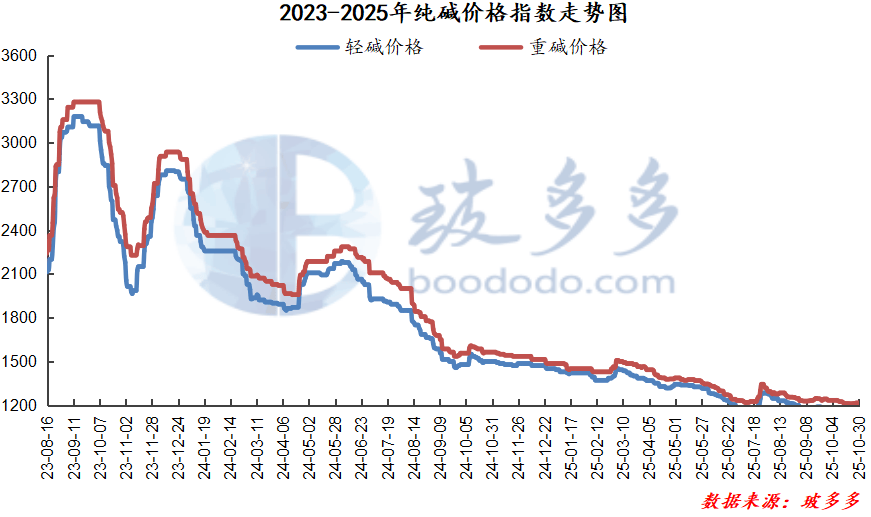
纯碱周刊:供需僵局暂难破 窄幅震荡仍延续(20251030期)
Sou Hu Cai Jing· 2025-10-31 01:55
Group 1: Project Update - The Sanyou Soda Ash Carbon Filter System Optimization Project has successfully completed trial production, focusing on cost reduction and efficiency improvement through an "one replaces two" upgrade plan, which includes the addition of one vacuum filter to replace two existing units, effectively reducing steam consumption [1] Group 2: Federal Reserve Interest Rate Decision - The Federal Reserve announced a 25 basis point reduction in the federal funds rate target range to between 3.75% and 4%, marking the second rate cut of the year [2] - The Fed's statement indicated that the U.S. economy is expanding at a moderate pace, with employment growth slowing and a slight increase in the unemployment rate, although it remains low [2] - The Fed is closely monitoring risks to its dual mandate of maximum employment and 2% inflation, noting an increase in downside risks to employment [2] Group 3: Market Reactions - Following Fed Chair Powell's remarks, U.S. stock indices experienced initial declines but stabilized by the close, with the Dow Jones and S&P 500 slightly down while the Nasdaq Composite rose slightly to a new closing high [3] - Powell's comments about the uncertainty of a December rate cut led to brief market volatility, highlighting divisions among Fed officials regarding the rate decision [3] Group 4: Soda Ash Market Analysis - The domestic soda ash market is experiencing a narrow fluctuation under a backdrop of supply-demand balance, with prices running weakly; light soda ash prices range from 930 to 1600 yuan/ton, and heavy soda ash prices range from 930 to 1480 yuan/ton [4] - The market is characterized by high supply and weak demand, leading to price suppression, while rising coal prices and industry losses are providing some support for price stability [5] Group 5: Future Market Predictions - There are currently no significant demand growth points in the soda ash market, with high inventory levels allowing for negotiation space in transactions [6] - Companies are operating at low profit margins, limiting the potential for further price declines, and the market is expected to maintain a stable yet slightly adjusted trend [6] Group 6: Production and Profitability - The soda ash industry is operating at approximately 84.30% capacity, with production estimated at around 746,000 tons, reflecting a slight increase from the previous week [12] - The total inventory of soda ash manufacturers is reported at 1.522 million tons, a slight increase from the previous week [14] - Profit margins for soda ash production methods are negative, with the soda ash production using the ammonia-soda process showing a loss of 41.70 yuan/ton, indicating continued financial pressure on producers [16]

产业边际弱化程度有限,宏观继续释放利好
Zhong Xin Qi Huo· 2025-10-30 06:31
Report Industry Investment Rating - The mid - term outlook for the entire industry is "Swing" [8][9][10][11][14][16][17][18][19] Core Viewpoints of the Report - Although the industry has marginal weakening, the contradictions are limited. Recently, the macro has continuously released positive news, strengthening the lower support for the prices of sector varieties, which is consistent with the previous judgment of weakened industrial chain logic and strengthened macro - expectations. As long as the hot metal output does not decline more than expected, the macro level will continue to support the prices of sector varieties [8] Summary by Related Catalogs 1. Overall Industry Situation - The daily consumption of sintered powder ore by steel enterprises decreased, indicating a short - term downward expectation of hot metal. But the strengthening of the macro - atmosphere continued to push up the prices of sector varieties. The macro - positives included the release of the "Urban Business Quality Improvement Action Plan" and the upcoming meeting between Chinese and US leaders [2] 2. Different Element and Product Analyses Iron Element - For iron ore, the fundamentals have marginal weakening, but the overall contradictions are not prominent. The macro - expectation dominates in the short - term, and the price is expected to oscillate with support. For scrap steel, the fundamentals have no obvious contradictions, and the price is expected to follow the finished products due to warming macro - sentiment and slightly improved finished product data [3] Carbon Element - For coke, environmental protection restrictions have limited impact, and the short - term fundamentals have few contradictions. With rising costs, coke has started a third round of price increases, but steel mills' profits are under pressure, so the price is expected to oscillate. For coking coal, supply is hard to improve, and the short - term fundamentals are healthy due to low upstream inventory. The third - round price increase boosts the market, and the price is expected to oscillate with an upward trend [3] Alloys - For manganese silicon, short - term cost stability and high steel output support the price, but the supply - demand expectation is pessimistic, and the upward driving force is insufficient. For ferrosilicon, high finished product output and stable costs support the price, but the supply - demand relationship is loose, and the upward space is limited [3] Glass and Soda Ash - For glass, the recent strengthening of the futures price has driven a positive futures - spot feedback, but the replenishment space is limited, and the rebound space is expected to be limited. In the long - term, capacity reduction through marketization is needed, and the price may continue to oscillate downward. For soda ash, the oversupply pattern remains unchanged, and it is expected to fluctuate widely following the macro, with the long - term price center moving down to promote capacity reduction [3][8] 3. Individual Product Analyses Steel - Spot market transactions are average, but speculative sentiment has improved. Steel production shows a downward sign, while demand continues to recover, and inventory is decreasing. Short - term the futures price has a rebound drive, but the upward space is limited due to high inventory [9] Iron Ore - Port transactions increased, and the spot price was strong. Fundamentally, overseas mine shipments increased slightly, and the arrival volume has a rebound expectation. Demand - side iron water output declined marginally, and inventory is expected to accumulate slightly. The price is expected to oscillate in the short - term with macro - expectations dominant [9][10] Scrap Steel - Supply has decreased slightly, and electric furnace profits have increased. The fundamentals have few contradictions, and the price is expected to follow the finished products [11] Coke - The futures price oscillated strongly. Supply is hard to increase due to cost and environmental factors. Demand may decline slightly, and inventory is low. The price is expected to oscillate with continued game between steel and coke enterprises [12] Coking Coal - The futures price oscillated strongly. Supply is hard to improve due to production disturbances in mines. Import resources are tight, and inventory is low. The price is expected to oscillate with an upward trend [13] Glass - The price oscillated. Supply may be affected by gas - related changes, but short - term output decline is limited. Demand is weakening, and the replenishment ability is limited. The price rebound space is limited, and it may oscillate downward in the long - term [14] Soda Ash - The price is expected to oscillate at a low level. Supply is stable, and demand is okay. The industry is at the bottom of the cycle, and the price has strong bottom support but lacks upward driving force in the short - term. In the long - term, the price center will move down [16] Manganese Silicon - The futures price oscillated strongly following the upward trend of the black sector. Cost increases are limited, and demand support is weakening due to expected steel production decline. Supply is at a high level, and the price increase driving force is insufficient [17] Ferrosilicon - The futures price rebounded after a decline. Cost has increased, and supply pressure is accumulating. Demand may decline due to expected steel production decline. The price has support but limited upward space [18] 4. Index Information Comprehensive Index - The commodity index was 2263.37, up 0.93%; the commodity 20 index was 2558.20, up 1.02%; the industrial product index was 2266.37, up 1.23% [98] Section Index - The steel industry chain index was 2059.83 on October 29, 2025, with a daily increase of 1.85%, a 5 - day increase of 2.55%, a 1 - month increase of 1.03%, and a year - to - date decrease of 2.30% [100]
黑色建材日报-20251030
Wu Kuang Qi Huo· 2025-10-30 03:12
Report Summary 1. Industry Investment Rating There is no information provided regarding the industry investment rating in the given reports. 2. Core Viewpoints - For the steel industry, in the long - term, steel prices' upward logic remains unchanged under the increasingly loose macro - environment. However, in the short - term, the actual demand for steel is still weak and unlikely to improve substantially. Attention should be paid to the impact of Sino - US talks and overseas macro - environment changes on market sentiment [2]. - For the iron ore market, the price is expected to fluctuate. Although the supply is increasing and the demand is weakening with the decline of iron - making water production, the positive signals from Sino - US economic and trade consultations and the expected interest - rate cut by the Federal Reserve have an impact on the market [5]. - For the black metal sector, the outlook is not pessimistic. It is considered more cost - effective to look for rebound opportunities after price corrections rather than short - selling. The downward momentum of the black metal sector has significantly weakened after nearly four years of decline [10]. - For industrial silicon, the supply pressure persists, and the demand support is weakening. The price is expected to fluctuate with market sentiment in the short - term, and the cost provides some support [14]. - For polysilicon, the supply pressure may be marginally relieved, and the supply - demand pattern may improve. The price is affected by policy expectations and industry news, and attention should be paid to the actual implementation [16]. - For glass, the futures price rebounded due to short - position exits, and the market's bearish sentiment eased. Attention should be paid to macro - policy trends and the operation of production lines in the Shahe area [19]. - For soda ash, the price is expected to continue narrow - range fluctuations in the short - term due to the combination of cost support and high inventory [21]. 3. Summary by Category Steel - **Market Quotes** - The closing price of the rebar main contract was 3133 yuan/ton, up 42 yuan/ton (1.358%) from the previous trading day. The registered warehouse receipts decreased by 1221 tons to 124,540 tons, and the main contract's open interest decreased by 36,350 lots to 1.894 million lots. The Tianjin and Shanghai aggregated prices increased by 30 yuan/ton and 20 yuan/ton respectively [1]. - The closing price of the hot - rolled coil main contract was 3345 yuan/ton, up 40 yuan/ton (1.210%) from the previous trading day. The registered warehouse receipts increased by 3402 tons to 104,773 tons, and the main contract's open interest decreased by 12,738 lots to 1.461 million lots. The Lecong and Shanghai aggregated prices increased by 30 yuan/ton and 20 yuan/ton respectively [1]. - **Strategic Views** - Macroscopically, real - estate investment will shift from "scale expansion" to "quality improvement", and the new construction area is unlikely to increase significantly. Fundamentally, rebar's supply and demand both increased, and inventory continued to decline; the output of hot - rolled coils decreased slightly, demand improved marginally, and inventory reduction accelerated [2]. Iron Ore - **Market Quotes** - The main contract of iron ore (I2601) closed at 804.50 yuan/ton, up 1.51% (+12.00). The open interest decreased by 6094 lots to 542,900 lots, and the weighted open interest was 916,500 lots. The spot price of PB powder at Qingdao Port was 805 yuan/wet ton, with a basis of 52.06 yuan/ton and a basis rate of 6.08% [4]. - **Strategic Views** - The supply of iron ore is increasing, with the overseas shipment volume at a high level. The demand is weakening as the daily average iron - making water production has dropped below 240,000 tons. The port inventory is increasing, and the price is under pressure. However, positive macro - signals may affect the market [5]. Ferrosilicon and Manganese Silicon - **Market Quotes** - On October 29, affected by the market atmosphere and other factors, the price of ferrosilicon and manganese silicon rebounded. The main contract of manganese silicon (SM601) closed up 1.07% at 5852 yuan/ton, and the Tianjin spot price was 5720 yuan/ton, with a basis of 58 yuan/ton. The main contract of ferrosilicon (SF601) closed up 0.54% at 5594 yuan/ton, and the Tianjin spot price was 5650 yuan/ton, with a basis of 56 yuan/ton [8]. - **Strategic Views** - The supply of ferrosilicon and manganese silicon may be restricted in the future. Currently, steel mills are facing difficulties due to high supply and low demand, and there is a risk of "negative feedback". The outlook for the black metal sector is not pessimistic, and it is more cost - effective to look for rebound opportunities. Manganese silicon and ferrosilicon are likely to follow the black metal sector's trend [9][10]. Industrial Silicon and Polysilicon - **Market Quotes** - The main contract of industrial silicon (SI2601) closed at 9170 yuan/ton, up 2.40% (+215). The weighted open interest decreased by 693 lots to 432,693 lots. The spot price of 553 non - oxygen - permeable industrial silicon in East China was 9300 yuan/ton, with a basis of 130 yuan/ton for the main contract [12]. - The main contract of polysilicon (PS2601) closed at 54,990 yuan/ton, up 1.17% (+635). The weighted open interest decreased by 5722 lots to 250,114 lots. The average price of N - type granular silicon was 50.5 yuan/kg, and the average price of N - type dense material decreased by 0.5 yuan/kg to 51 yuan/kg [15]. - **Strategic Views** - For industrial silicon, the supply pressure persists, and the demand support is weakening. The price is expected to fluctuate with market sentiment in the short - term, and the cost provides some support [14]. - For polysilicon, the supply pressure may be marginally relieved, and the supply - demand pattern may improve. The price is affected by policy expectations and industry news, and attention should be paid to the actual implementation [16]. Glass and Soda Ash - **Market Quotes** - The glass main contract closed at 1113 yuan/ton on Wednesday, up 1.64% (+18). The inventory of float glass sample enterprises increased by 233.74 million cases (3.64%) to 66.613 million cases. The top 20 long - position holders reduced 4570 long positions, and the top 20 short - position holders reduced 19,408 short positions [18]. - The soda ash main contract closed at 1239 yuan/ton on Wednesday, down 0.56% (-7). The inventory of soda ash sample enterprises increased by 0.16 million tons (3.64%) to 1.7021 million tons, with the heavy - soda inventory decreasing by 0.62 million tons and the light - soda inventory increasing by 0.78 million tons. The top 20 long - position holders reduced 6034 long positions, and the top 20 short - position holders reduced 36,087 short positions [20]. - **Strategic Views** - The glass futures price rebounded due to short - position exits, and the market's bearish sentiment eased. Attention should be paid to macro - policy trends and the operation of production lines in the Shahe area [19]. - The soda ash price is expected to continue narrow - range fluctuations in the short - term due to the combination of cost support and high inventory [21].
产能持续增长 纯碱易跌难涨
Qi Huo Ri Bao· 2025-10-29 23:46
纯碱期货价格自7月底创出新高后,重回下跌趋势,至今已有3个月。其中,2601合约价格从最高1530元 /吨,下跌至最低1194元/吨,跌幅22%。近期,纯碱期货价格跟随宏观情绪回暖略有反弹,这是否预 示行情将要触底呢?从供应端来看,随着新建产能陆续投放,纯碱产能持续增长,但需求端没有太大的 改善,甚至出口还有下滑的迹象。纯碱供应过剩局势加剧,未来价格预计易跌难涨。 供应过剩加剧 今年"金九银十"旺季成色不足,玻璃库存持续大幅累积,下游开工萎靡不振。据钢联数据,截至10月28 日,浮法玻璃日产量为161275吨,近一个月维持稳定;光伏玻璃日产量为88680吨,相比上周的89980吨 下降1300吨。浮法与光伏玻璃日产总量略有下降,重碱国内需求仍无起色。 从厂内库存细分数据来看,截至10月24日当周,重碱厂内库存为93.45万吨,基本维持稳定;但轻碱连 续3周累库,库存从69.67万吨增加至76.76万吨,创历史同期新高,表明轻碱下游需求也没有太大的改 善。重碱和轻碱库存均没有好转,出口也在下降,导致纯碱总库存继续累积。 碱厂减产动力不足 目前,碱厂虽然陷入亏损,但亏损幅度较小,远远未到促使碱厂主动减产的幅度,仍 ...
黑色产业链日报-20251029
Dong Ya Qi Huo· 2025-10-29 09:52
1. Report Industry Investment Rating No relevant content provided. 2. Core Viewpoints - Steel prices are expected to rebound slightly. Although there is no substantial improvement in downstream consumption, there is an expectation of crude steel production cuts, and steel prices will fluctuate subsequently [3]. - The current iron ore market has a loose supply - demand balance, and prices are supported by macro - expectations. After the impact of macro events subsides, iron ore prices are expected to continue to be under pressure [23]. - Recently, due to downstream replenishment and reduced mine production in some areas, coking coal inventory has improved, and the spot market is tight. Coke prices may be strong in the short term, but potential negative feedback risks from the steel industry will limit the rebound height of coking coal and coke prices [35]. - Ferroalloys face a contradiction between high inventory and weak demand. There is a large de - stocking pressure, and the black negative feedback risk is increasing [52]. - Soda ash is mainly priced by cost. With high - level supply expectations and high inventories, the upside potential is limited, but there is cost support at the bottom [62]. - After the price cut of glass, sales have improved, but the high inventory of the middle - stream is being depleted slowly. If there is no real production cut, the price of the 01 contract may decline towards the delivery date, while there is cost support and policy expectations in the long - term [90]. 3. Summary by Relevant Catalogs Steel - **Futures prices and spreads**: On October 29, 2025, compared with the previous day, most steel futures contract prices increased, and some spreads changed. For example, the closing price of the rebar 01 contract was 3133 yuan/ton, up from 3091 yuan/ton on October 28 [4]. - **Spot prices and basis**: Rebar and hot - rolled coil spot prices in different regions showed slight changes. The basis of some contracts decreased, such as the 01 rebar basis in Shanghai, which decreased from 129 yuan/ton on October 28 to 107 yuan/ton on October 29 [9]. - **Other ratios**: Ratios such as the volume - rebar difference, rebar - iron ore ratio, and rebar - coke ratio remained relatively stable [16][20]. Iron Ore - **Price data**: On October 29, 2025, iron ore futures contract prices increased compared with the previous day, while the basis of some contracts decreased. For example, the 01 contract closing price was 804.5 yuan/ton, up 12 yuan/ton from the previous day, and the 01 basis decreased by 3 yuan/ton [24]. - **Fundamental data**: The average daily hot - metal production decreased slightly, the 45 - port inventory continued to accumulate, reaching 14423.59 tons, and the global shipping volume increased slightly [29]. Coking Coal and Coke - **Disk prices and spreads**: Coking coal and coke contract prices, basis, and spreads changed. For example, the coking coal 09 - 01 spread increased by 9.5 yuan/ton on October 29 compared with the previous day [40]. - **Spot prices and profits**: Coking coal and coke spot prices in different regions increased, and some import and production profits changed. The immediate coking profit increased from - 55 yuan/ton on October 28 to - 10 yuan/ton on October 29 [41]. Ferroalloys - **Silicon - iron data**: Silicon - iron basis, spreads, and spot prices changed. The silicon - iron basis in Ningxia decreased by 30 yuan/ton on October 29 compared with the previous day [53]. - **Silicon - manganese data**: Silicon - manganese basis, spreads, and spot prices also changed. The silicon - manganese basis in Inner Mongolia decreased by 62 yuan/ton on October 29 compared with the previous day [55]. Soda Ash - **Disk prices and spreads**: Soda ash contract prices increased on October 29, 2025, and some spreads changed. The soda ash 01 contract increased by 20 yuan/ton compared with the previous day, with a daily increase rate of 1.61% [63]. - **Spot prices**: Soda ash spot prices in different regions remained stable on October 29, and the difference between heavy and light soda ash varied by region [66]. Glass - **Disk prices and spreads**: Glass contract prices increased on October 29, 2025, and some spreads and basis changed. The glass 01 contract increased by 14 yuan/ton compared with the previous day, with a daily increase rate of 1.26% [91]. - **Sales data**: The sales in different regions showed fluctuations. For example, the sales in Shahe on October 28 were 159 [92].