
纺织服装

Search documents
定力广东 向新而行
Sou Hu Cai Jing· 2025-12-30 01:17
Core Insights - Guangdong's economy is projected to reach 14.16 trillion yuan in 2024, maintaining its position as the largest in China for 36 consecutive years, with significant advancements in innovation and regional coordination [2][12] - The province has crossed three trillion yuan milestones during the 14th Five-Year Plan, showcasing its economic resilience and contribution to national growth [3][12] Economic Stability - Guangdong's economic output has surpassed 12 trillion, 13 trillion, and 14 trillion yuan, contributing one-tenth of the national GDP, with public budget revenues leading the country for 34 years [3][13] - The province leads in key sectors such as electronic information manufacturing, automotive, and electrical machinery, with manufacturing value added accounting for 32% of GDP [3][13] - Guangdong's foreign trade has been the highest in the country for 39 years, with general trade accounting for 58.2% of total trade, indicating a robust internal and external market [3][13] Talent Activation - The "Million Talents Gather in South Guangdong" initiative has been launched to stabilize employment and support high-quality development through targeted recruitment efforts [4][15] Innovation Drive - Guangdong is building a comprehensive innovation chain that includes basic research, technology breakthroughs, and talent support, with significant advancements in semiconductor and AI industries [6][16] - The province's industrial robot production accounts for over 40% of the national total, maintaining its leadership in the robotics sector for five consecutive years [6][16] Reform and Governance - Guangdong has pioneered local legislation for modern enterprise systems and has over 20 million business entities, indicating a vibrant entrepreneurial environment [8][18] - The province is enhancing governance through digital government initiatives and empowering local authorities, aiming to stimulate internal growth [8][18] Open Economy - Guangdong's openness is evolving from traditional trade to deeper institutional reforms, with the Guangdong-Hong Kong-Macau Greater Bay Area serving as a key driver for this transformation [9][19] - The province has achieved 772 institutional innovation results in its free trade zone, promoting a higher quality of open economy [9][19] Development Initiatives - The "Hundred Counties, Thousand Towns, and Ten Thousand Villages High-Quality Development Project" aims to enhance regional coordination and economic growth across the province [10][21] - Guangdong plans to achieve modernization by 2035, focusing on balanced and inclusive development [10][21]

开润股份拟全资控股上海嘉乐 加速业务整合及产业协同
Zheng Quan Shi Bao Wang· 2025-12-29 13:48
Core Viewpoint - Kairun Co., Ltd. is acquiring the remaining 28.15% stake in Shanghai Jiale Co., Ltd. for 394 million yuan, aiming to enhance operational efficiency and resource optimization, establishing a solid foundation for its "fabric + garment" growth strategy [1] Group 1: Acquisition Details - Kairun's wholly-owned subsidiary, Chuzhou Mirun Technology Co., Ltd., will hold 100% of Shanghai Jiale after the acquisition [1] - The transaction price for the 28.15% stake is 394 million yuan [1] Group 2: Business Integration and Performance - Since gaining control of Shanghai Jiale, Kairun has focused on business integration and synergy, leading to improved operational efficiency and performance [2] - In 2024, Shanghai Jiale achieved revenue of 1.489 billion yuan, a year-on-year increase of 15.81%, and net profit of 48.92 million yuan, marking a turnaround [2] - From January to September 2025, Shanghai Jiale reported revenue of 1.1 billion yuan and net profit of 64.61 million yuan, with a net profit margin of 5.88% [2] Group 3: R&D and Product Innovation - Kairun is enhancing Shanghai Jiale's management and technology capabilities, accelerating digital upgrades and refined management [2] - Shanghai Jiale's R&D efforts have led to several awards in 2024, including recognition for innovative and sustainable fabric products [2] Group 4: Financial Performance - In the first three quarters of the year, Kairun reported revenue of 3.719 billion yuan, a year-on-year growth of 22.94%, and a net profit of 256 million yuan, up 13.81% [3] - The operating cash flow reached 430 million yuan, a significant increase of 258.66% [3] - The gross margin for the third quarter was 23.8%, an increase of 1.84 percentage points year-on-year [3]
开润股份拟收购上海嘉乐28.15%股份
Zheng Quan Ri Bao Wang· 2025-12-29 13:16
Core Viewpoint - The acquisition of 28.15% of Shanghai Jiale by Anhui Kairun Co., Ltd. will result in Kairun achieving 100% ownership of Jiale, enhancing its operational efficiency and strategic integration in the apparel sector [1][2] Group 1 - Kairun's subsidiary, Chuzhou Mirun Technology Co., Ltd., will pay 394 million yuan for the acquisition, funded through its own or raised capital [1] - Following the acquisition, Kairun will fully integrate Shanghai Jiale, marking a significant step in consolidating its control and operational capabilities [1] - The integration aims to create a "fabric + garment" growth strategy, enhancing collaboration between Jiale's apparel business and Kairun's existing bag business, leading to improved operational efficiency and performance [1] Group 2 - The full control of Shanghai Jiale is expected to significantly enhance Kairun's strategic synergy and resource integration capabilities, improving operational and decision-making efficiency [2] - This move aligns with Kairun's long-term development strategy and is anticipated to optimize internal resource allocation and collaboration [2] - The acquisition is projected to strengthen Kairun's vertical integration capabilities in the apparel sector, potentially delivering sustainable and substantial value returns for investors [2]
乌苏市工业经济活力四射
Zhong Guo Xin Wen Wang· 2025-12-29 10:58
Core Viewpoint - Uusu City is strategically positioning itself as an "Industrial Strong City" by leveraging its advantages in the Silk Road Economic Belt and developing a modern industrial system that includes synthetic biology manufacturing, intelligent equipment manufacturing, and cotton textile and apparel industries [1][2]. Synthetic Biology Manufacturing - Uusu has established a synthetic biology manufacturing industrial cluster covering 9,439 acres, with the Uusu Industrial Park as the core [3]. - Key player in this sector is Kasei Biotech (Uusu) Co., Ltd., which has developed production lines for long-chain dicarboxylic acids and bio-based polyamides, achieving an output value of 1.097 billion yuan in 2024 [3]. - The goal is to reach a synthetic biology manufacturing output value of 10 billion yuan during the 14th Five-Year Plan period, establishing Uusu as a future demonstration zone for synthetic biology manufacturing in Western China [3]. Intelligent Equipment Manufacturing - Uusu's intelligent equipment manufacturing sector is gaining recognition, with products like large cotton-picking machines being exported to multiple international markets [4]. - The North New Science and Technology Co., Ltd. has transitioned from providing a few products to covering over ten sectors, achieving a production value of 20 million yuan and tax contributions of 2.02 million yuan in 2025 [5]. - The Uusu Industrial Park has been recognized as a high-tech industrial development zone, with plans to add 21 new high-tech enterprises by 2025, bringing the total to 36 [5][6]. Textile and Apparel Industry - Uusu is enhancing its textile and apparel industry by upgrading to high-end, intelligent, and full-industry chain production [6][7]. - The introduction of advanced production lines has increased yarn spinning efficiency by nearly 50%, and the company has initiated a project to produce high-end blended yarns [6]. - The establishment of a complete silk production chain has diversified the industry, transitioning from cotton to silk, thus increasing the added value of products [7]. Logistics Hub Development - Uusu is evolving from a geographical transportation node to a modern logistics hub, supported by a comprehensive transportation network [8]. - The city has been integrated into the international railway transport system, significantly reducing transportation costs and time for goods to Central Asia [8][9]. - A planned 13.67 square kilometer commercial logistics park aims to enhance trade and logistics capabilities, facilitating a dual open pattern of foreign and domestic trade [9].

鲁泰A:12月29日召开董事会会议
Mei Ri Jing Ji Xin Wen· 2025-12-29 10:28
Group 1 - The core point of the article is that Lutai A held its 11th sixth board meeting on December 29, 2025, to review proposals including daily related transactions [1] - For the first half of 2025, Lutai A's revenue composition is as follows: textiles and apparel account for 92.77%, thermal power (electricity and steam) accounts for 4.92%, and other businesses account for 2.32% [1] Group 2 - As of the report, Lutai A has a market capitalization of 5.8 billion yuan [2]
中银量化大类资产跟踪:有色与贵金属领涨权益与大宗商品市场
Bank of China Securities· 2025-12-28 08:11
- The report tracks the performance of various stock market indices, including A-shares, Hong Kong stocks, and US stocks, highlighting their weekly, monthly, and year-to-date performance[1][16][17] - The report provides a detailed analysis of the performance of different stock market styles, such as growth vs. dividend, small-cap vs. large-cap, and micro-cap vs. CSI 800, including their relative crowding and excess net value[2][60][71] - The report includes a comprehensive analysis of the valuation and equity-bond cost-effectiveness of A-shares, with specific focus on PE_TTM and ERP metrics for various indices and sectors[3][41][49][51] - The report tracks the performance and crowding of different investment styles, such as momentum vs. reversal, and their relative excess returns[2][60][71] - The report provides insights into the impact of US bond yields on the performance of different stock market styles, such as large-cap vs. small-cap and growth vs. dividend[3][82][84] - The report includes a detailed analysis of the main fund indices, including their absolute and relative returns, and tracks the scale of public funds and their impact on the market[3][88][90][94] - The report provides a comprehensive overview of the commodity market, including the performance of various commodity indices in China and the US[3][123][125]

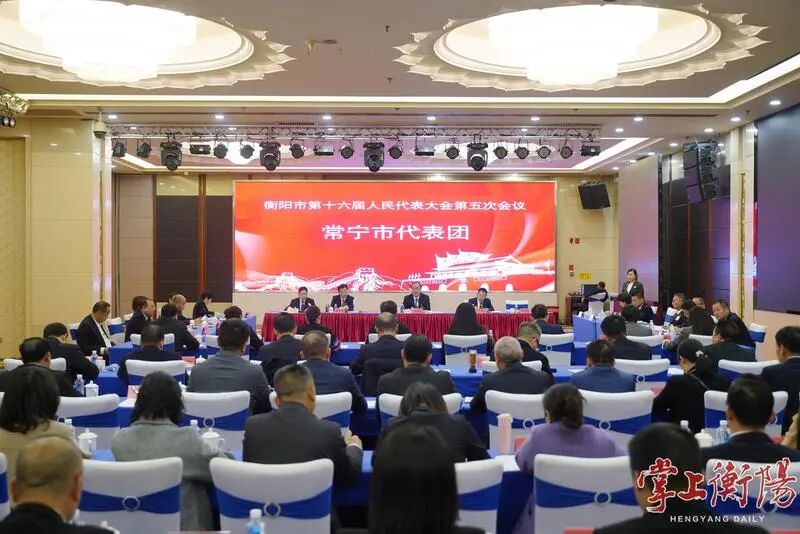
朱健参加常宁市代表团分团审议时强调:常宁要争当全市经济高质量发展的“领头雁”
Xin Lang Cai Jing· 2025-12-28 02:56
Group 1 - The core message emphasizes that Changning aims to be a leader in high-quality economic development within the city, contributing to the establishment of a higher-level national regional key city and provincial sub-center city [1][3]. - Nine representatives discussed the highlights of the "Government Work Report" and the draft outline of the "14th Five-Year Plan," focusing on aspects such as strengthening industrial chains, supporting youth entrepreneurship, and attracting technology talent [3][5]. - The past year has seen positive changes in various aspects of Changning's development, with core indicators maintaining a good trend, and the Shuikoushan copper-lead-zinc industrial cluster being recognized as a national characteristic industrial cluster for small and medium-sized enterprises [3][5]. Group 2 - The "14th Five-Year Plan" outlines systematic planning and strategic deployment for the city's economic and social development, aiming to establish Changning as a key growth pole for high-quality development in the province and a bridgehead for integration into the Guangdong-Hong Kong-Macao Greater Bay Area [5][6]. - Key focus areas include stabilizing the economy, boosting industrial growth, accelerating project investments, promoting private investments, and expanding foreign investment, particularly in the non-ferrous metals and textile industries [5][6]. - Emphasis is placed on practical and effective governance, ensuring employment stability for key groups such as college graduates and returning migrant workers, and fostering a vibrant and orderly cadre system to enhance productivity [6].
2025年1-11月全国纺织服装、服饰业出口货值为2537.6亿元,累计下滑4.6%
Chan Ye Xin Xi Wang· 2025-12-28 02:00
2019年-2025年1-11月全国纺织服装、服饰业出口货值统计图 数据来源:国家统计局,智研咨询整理 知前沿,问智研。智研咨询是中国一流产业咨询机构,十数年持续深耕产业研究领域,提供深度产业研 究报告、商业计划书、可行性研究报告及定制服务等一站式产业咨询服务。专业的角度、品质化的服 务、敏锐的市场洞察力,专注于提供完善的产业解决方案,为您的投资决策赋能。 上市公司:凤竹纺织(600493),江南高纤(600527),航民股份(600987),百隆东方(601339), 浙文影业(601599),台华新材(603055),健盛集团(603558),新澳股份(603889),迎丰股份 (605055),华生科技(605180),富春染织(605189),夜光明(873527),云中马(603130) 相关报告:智研咨询发布的《2026-2032年中国纺织服装行业市场行情动态及投资潜力研究报告》 根据国家统计局数据可知:2025年11月全国纺织服装、服饰业出口货值为224.4亿元,同比下降12.2%; 2025年1-11月全国纺织服装、服饰业累计出口货值为2537.6亿元,累计同比下降4.6%。 ...

杭州宏华数码科技股份有限公司关于为参股公司提供担保的公告
Shang Hai Zheng Quan Bao· 2025-12-26 19:15
Core Viewpoint - The company, Hangzhou Honghua Digital Technology Co., Ltd., has provided a guarantee for its associate company, Zhejiang Honghua Baijin Qianyin Home Textile Technology Co., Ltd., to support its financing needs, which is expected to enhance operational efficiency and align with the company's strategic interests [1][9]. Group 1: Guarantee Details - The company signed a syndicate loan guarantee contract on April 15, 2024, to provide a guarantee of up to RMB 140 million for Baijin Qianyin [1]. - The total loan amount has been reduced from RMB 400 million to RMB 385 million due to the repayment of RMB 15 million by Baijin Qianyin [2]. - The company plans to provide a guarantee amount not exceeding RMB 134.75 million, with the guarantee being a joint responsibility with other shareholders based on their shareholding ratios [2][8]. Group 2: Internal Decision-Making Process - The board of directors approved the guarantee proposal during the fifth meeting of the eighth board on December 25, 2025, and this decision does not require shareholder approval [3][9]. Group 3: Financial and Operational Status of the Guaranteed Entity - Baijin Qianyin is not classified as a dishonest entity, has clear ownership, and is free from any significant litigation or arbitration issues [6]. - The financial condition of Baijin Qianyin is reported to be good, and the associated financial risks are considered manageable [8]. Group 4: Board and Sponsor Opinions - The board believes that providing the guarantee is beneficial for the operational development of Baijin Qianyin and aligns with the company's overall interests, with controllable risks [9]. - The sponsor has confirmed that the guarantee complies with relevant regulations and does not harm the interests of the company or its shareholders [10].

天创时尚:拟使用不超过4.50亿自有资金委托理财
2 1 Shi Ji Jing Ji Bao Dao· 2025-12-26 12:00
Core Viewpoint - The company plans to use its own funds for entrusted wealth management, with a maximum daily balance of up to 450 million yuan [1] Group 1 - The company will invest in various financial products, including structured deposits, bank wealth management products, and wealth management products issued by securities firms [1] - The funding source for this investment will be the company's own funds [1] - The decision was approved at the 19th meeting of the fifth board of directors on December 26, 2025, and does not require shareholder approval [1]
