
农业等

Search documents
广东省党政代表团来我省考察并举行粤黔东西部协作联席会议
Zheng Quan Shi Bao Wang· 2025-09-08 01:12
Core Viewpoint - The Guangdong provincial government is strengthening cooperation with Guizhou province to promote high-quality development and achieve mutual benefits in the context of China's modernization process [2][4][5]. Group 1: Cooperation Initiatives - The Guangdong delegation expressed gratitude for Guizhou's support and emphasized the importance of deepening collaboration in various sectors, including poverty alleviation and rural revitalization [4][5]. - Key areas of focus include enhancing internal development momentum, attracting resources, and promoting industrial cooperation, particularly in agriculture and digital economy [4][5]. - The two provinces aim to leverage their respective strengths to create a new model of cooperation, particularly in energy, tourism, and digital industries [4][5]. Group 2: Economic Development - Guizhou is committed to high-quality development and aims to prevent large-scale poverty while promoting comprehensive rural revitalization [5]. - The cooperation will also involve deepening collaboration in various industries such as agriculture, tourism, and technology, as well as enhancing human resource exchanges [5]. - The Guangdong delegation visited several key projects in Guizhou, including data centers and agricultural industry parks, to assess the progress of cooperation [6].


长江期货市场交易指引-20250903
Chang Jiang Qi Huo· 2025-09-03 02:14
Report Industry Investment Ratings - Macro finance: The stock index is recommended to be moderately long at low levels in the medium and long term, and government bonds are recommended to be on the sidelines [1][5] - Black building materials: Coking coal and rebar are recommended for range trading, and glass is recommended to be long at low levels [1][7][9] - Non - ferrous metals: Copper is recommended to be moderately long at low levels, aluminum is recommended to be long at low levels after a pullback, nickel is recommended to be on the sidelines or short at high levels, tin is recommended for range trading, and gold and silver are recommended for range trading [1][10][11][16][18] - Energy and chemicals: PVC and styrene are expected to be weakly volatile, caustic soda and rubber are expected to be strongly volatile, soda ash is recommended for shorting 01 and going long 05 arbitrage, urea and methanol are expected to be volatile, and polyolefins are expected to be widely volatile [1][20][21][24][26][27][28][32] - Cotton textile industry chain: Cotton, cotton yarn, PTA, and jujube are expected to be volatile, and apples are expected to be strongly volatile [1][33][34][35][36] - Agricultural and livestock products: Pigs and eggs are recommended to be short at high levels, corn is expected to be widely volatile, soybean meal is expected to have limited upside, and oils are expected to be adjusted at high levels [1][37][39][40][43][46] Core Views - The A - share market has short - term fluctuations but the medium - term repair trend remains unchanged, and it is recommended to go long during corrections. The bond market lacks short - term positive drivers and is recommended to be on the sidelines [5] - The coal market price is in a stalemate, and the rebar price is expected to fall first and then rise in September. The glass market may have a phased recovery in demand and is recommended to be long at low levels [7][9] - The copper price is expected to be strong in the later stage due to the shift from the off - season to the peak season. The aluminum market is recommended to be long at low levels considering the peak season demand. The nickel market is expected to be weakly volatile in the medium and long term, and the tin market is recommended for range trading [10][11][16] - The PVC market is expected to be weakly volatile due to high inventory and uncertain export sustainability. The caustic soda market is expected to have low - long opportunities during the peak season. The styrene market is expected to be weakly volatile, and the rubber market is expected to be strongly volatile [20][23][24][26] - The urea price is expected to be weak first and then strong in the short term. The methanol market has a supply - demand balance with increased demand from methanol - to - olefins. The polyolefin market is expected to have support at the bottom, and the L - PP spread is expected to widen [27][28][30] - The cotton price is expected to be strong in the short term but may face downward pressure in the future. The PTA market is expected to be volatile and is currently in a de - stocking stage. The apple market is expected to be strongly volatile, and the jujube market is expected to be stable [33][34][35][36] - The pig market has limited upside due to large supply, and the egg market is recommended to be short at high levels. The corn market is expected to be range - bound, the soybean meal price has limited upside, and the oil market is expected to be adjusted at high levels [37][39][40][41][43][46] Summary by Category Macro Finance - Stock Index: On Tuesday, the A - share market was volatile and adjusted. There is a possibility of a technical correction in the short term, but the medium - term repair trend remains unchanged. It is recommended to go long during corrections [5] - Government Bonds: The bond market continued to be volatile on Tuesday. In the short term, there is a lack of positive drivers, and the downward space for interest rates is limited. It is recommended to be on the sidelines [5] Black Building Materials - Coking Coal: The coal market price is in a stalemate. The downstream demand is weak, and the number of coal mines on training leave has increased, intensifying market caution [7] - Rebar: On Tuesday, the rebar futures price was narrowly volatile. The fundamentals show an increase in demand, production, and inventory. The static valuation is neutral to low. It is expected that the price will fall first and then rise in September, and range trading is recommended [7] - Glass: The supply is stable, and the inventory has decreased slightly in some regions. The demand has improved at the end of the month. Considering the peak season and macro - sentiment, it is recommended to be long at low levels [9] Non - ferrous Metals - Copper: The copper price is mainly affected by macro factors and is in a high - level range. The demand is expected to increase in the peak season, and it is recommended to be moderately long at low levels [10] - Aluminum: The supply of bauxite is affected by the rainy season in Guinea. The production capacity of electrolytic aluminum is increasing steadily, and the demand is warming up in the peak season. It is recommended to be long at low levels [11] - Nickel: The nickel market is in a state of over - supply in the medium and long term, and the price is expected to be weakly volatile [16] - Tin: The supply of tin ore is tight, and the demand from the semiconductor industry is expected to recover. It is recommended for range trading [16] - Gold and Silver: The market's expectation of a Fed rate cut in September is rising, and the prices of precious metals are expected to have support below. It is recommended to be long at low levels after a pullback [18] Energy and Chemicals - PVC: The cost is at a low level, the supply is high, and the demand is weak. The export support is uncertain, and it is expected to be weakly volatile [20] - Caustic Soda: Affected by rumors and warehouse receipts, the price has fallen. The demand is expected to increase in the peak season, and there are low - long opportunities [23] - Styrene: The cost is under pressure, the supply is abundant, and the demand is limited. It is expected to be weakly volatile [24] - Rubber: The cost is rising, the inventory is decreasing, and it is expected to be strongly volatile [26] - Urea: The supply is increasing, the demand is scattered, and the inventory is accumulating. The price is expected to be weak first and then strong [27] - Methanol: The supply is increasing, the demand from methanol - to - olefins is expected to increase, and the market is expected to be volatile [28] - Polyolefins: The traditional peak season is coming, the demand is expected to be boosted, and the supply pressure is relieved for polyethylene. It is expected to have support at the bottom, and the L - PP spread is expected to widen [30] - Soda Ash: The spot market is sluggish, the supply is expected to increase, and the downstream demand is improving. It is recommended for shorting 01 and going long 05 arbitrage [32] Cotton Textile Industry Chain - Cotton and Cotton Yarn: The global cotton supply and demand are improving, but the new cotton output is expected to increase, and the price may face downward pressure. Hedging is recommended [33] - PTA: The device is under maintenance, the supply is decreasing, and the demand is stable. It is in a de - stocking stage and is expected to be volatile [34] - Apple: The price of early - maturing apples is polarized, and the inventory apple market is stable. The price is expected to be strongly volatile [35] - Jujube: The Xinjiang jujube is in the sugar - increasing stage, and the price is expected to be stable [36] Agricultural and Livestock Products - Pigs: The short - term price has a limited upside due to large supply, and the medium - and long - term price is under pressure. It is recommended to short at high levels and consider arbitrage [37][39] - Eggs: The short - term price may rebound slightly, but the supply is sufficient. It is recommended to be short at high levels for near - term contracts and wait and see for far - term contracts [39][40] - Corn: The supply is sufficient during the transition period between old and new crops, and the cost support is weakening. It is recommended for range trading and arbitrage [41][42] - Soybean Meal: The domestic supply is abundant from September to October, and the price is under pressure, but there is cost support. It is recommended to pay attention to the support level [44][45] - Oils: The short - term price is under pressure from multiple negative factors, but there is also support. It is recommended to wait and see during the correction and then go long [46][52]
南向资金持续加仓中信股份(00267):低估值+高分红,双轮驱动彰显龙头韧性
智通财经网· 2025-09-02 07:41
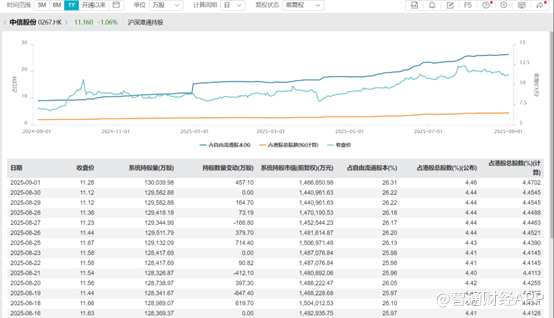
Core Viewpoint - The continuous inflow of southbound funds into Hong Kong stocks, particularly high-dividend stocks like CITIC Limited, reflects a strong market recognition of the company's low valuation and high dividend policy, indicating a reassessment of its profitability and growth potential [1][3][17] Group 1: Southbound Fund Inflows - Southbound funds have significantly increased their holdings in CITIC Limited, with a total inflow of approximately HKD 990.9 billion year-to-date as of September 1 [1] - The number of shares held by southbound funds in CITIC Limited reached 1.295 billion, accounting for 26.31% of the free float and 4.46% of the total share capital, a substantial increase from 760 million shares at the beginning of the year [1][3] Group 2: Dividend Policy and Valuation - CITIC Limited has a benchmark dividend policy, with cumulative dividends exceeding RMB 140 billion over ten years and a rolling dividend yield of 5.44%, significantly above the market average [4] - The actual dividend payout ratio for 2024 is set to increase to 27.5%, with plans to exceed 30% by 2026, demonstrating a strong commitment to returning cash to shareholders [6] Group 3: Financial Performance - For the first half of the year, CITIC Limited reported revenue of RMB 368.8 billion and a net profit attributable to shareholders of RMB 31.2 billion, reflecting a stable operational performance despite a challenging environment [6] - The company's price-to-book ratio is only 0.39 and the price-to-earnings ratio (TTM) is 5.2, both significantly lower than the industry median, indicating substantial room for valuation recovery [6] Group 4: Business Structure and Growth - The comprehensive financial services segment remains a cornerstone for CITIC Limited, contributing RMB 139.8 billion in revenue, which is 37.9% of total revenue, and 90.97% of net profit [8] - CITIC Bank has shown resilience with a net profit of RMB 36.5 billion, growing 2.8% year-on-year, supported by fee income growth and effective cost management [8] Group 5: Internationalization and Global Strategy - CITIC Limited's international revenue reached RMB 65.8 billion, a 15% increase year-on-year, with overseas income accounting for 17.9% of total revenue [13] - The company has actively engaged in cross-border financial services, achieving significant growth in bond underwriting and cross-border loans, contributing to the internationalization of the Renminbi [13][14] Group 6: Innovation and Technology - The company has invested heavily in technology innovation, establishing a "2+4+N" innovation matrix to enhance its research and development capabilities [12] - CITIC Limited's focus on new industries, including digital technology and intelligent manufacturing, has opened new growth avenues, showcasing its strategic adaptability [11][12]

乌副总理:共建“一带一路”倡议是最重要的国际合作倡议之一
2 1 Shi Ji Jing Ji Bao Dao· 2025-08-30 23:49
Core Viewpoint - The Uzbekistan-China Economic and Trade Investment Forum highlights the strengthening of bilateral relations, with Uzbekistan viewing China as a key strategic partner and emphasizing the importance of the Belt and Road Initiative for mutual development and friendship [1][2]. Group 1: Bilateral Trade and Investment - The bilateral trade volume between Uzbekistan and China is projected to exceed $13 billion in 2024 [1]. - Direct investments from China to Uzbekistan have increased several times since 2017, covering critical sectors such as energy, geology, chemicals, agriculture, transportation, tourism, pharmaceuticals, and green economy [1]. Group 2: Economic Reforms and Opportunities - Uzbekistan is actively pursuing economic reforms and improving its business environment, creating vast market opportunities for Chinese investors [2]. - Key areas for potential collaboration between Chinese and Uzbek enterprises include green energy and climate investment, digital technology, strategic mineral resources, transportation logistics, and tourism development [2]. Group 3: Institutional Support - The China Council for the Promotion of International Trade (CCPIT) emphasizes the strong economic complementarity and significant cooperation potential between China and Uzbekistan [2]. - The forum was co-hosted by the Uzbekistan Ministry of Investment, Industry and Trade, the Uzbekistan Embassy in China, and the Uzbekistan Chamber of Commerce [2].
莫高股份:8月27日召开董事会会议
Mei Ri Jing Ji Xin Wen· 2025-08-28 14:38
Group 1 - The core point of the article is that Mogao Co., Ltd. held its 11th fourth board meeting on August 27, 2025, to review various proposals, including the revision of the annual work report management measures [1] - For the fiscal year 2024, the revenue composition of Mogao Co., Ltd. is as follows: biodegradable materials and products account for 33.76%, plastic products for 22.46%, pharmaceuticals for 20.45%, agriculture for 18.45%, and other businesses for 4.89% [1] - As of the report date, the market capitalization of Mogao Co., Ltd. is 2 billion yuan [1]

中信期货晨报:国内商品期货多数下跌,黑色系普遍收跌-20250814
Zhong Xin Qi Huo· 2025-08-14 02:53
Group 1: Report Overview - The report is titled "Domestic Commodity Futures Mostly Decline, Black Series Generally Close Lower - CITIC Futures Morning Report 20250814" [1] Group 2: Market Performance Domestic Main Commodities - Index futures generally showed an upward trend. For example, the CSI 300 futures had a daily increase of 0.96%, a weekly increase of 2.15%, a monthly increase of 2.81%, a quarterly increase of 7.33%, and a year - to - date increase of 6.37% [4] - Treasury futures mostly had minor fluctuations. The 2 - year Treasury futures had a daily increase of 0.03%, a weekly decrease of 0.02%, a monthly increase of 0.02%, a quarterly decrease of 0.13%, and a year - to - date decrease of 0.59% [4] - In the foreign exchange market, the US dollar index decreased by 0.20% weekly, 21.98% monthly, 13.4% quarterly, and 9.60% year - to - date [4] - Interest rates showed different trends. The 10Y Chinese bond yield increased by 7.9bp quarterly and 0.1bp year - to - date, while the 10Y US Treasury yield increased by 5bp quarterly and decreased by 26bp year - to - date [4] Popular Industries - Some industries like the grass - colored gold industry had good performance, with a daily increase of 1.28%, a weekly increase of 4.59%, a monthly increase of 4.37%, a quarterly increase of 11.54%, and a year - to - date increase of 31.85%. While some industries like the pharmaceutical industry had a daily decrease of 0.86%, a weekly decrease of 0.88%, a monthly decrease of 0.88%, a quarterly increase of 12.63%, and a year - to - date increase of 21.76% [4] Overseas Commodities - In the energy sector, NYMEX WTI crude oil decreased by 1.44% daily, 0.43% weekly, 9.03% monthly, 2.91% quarterly, and 12.23% year - to - date [4] - Precious metals such as COMEX gold increased by 0.17% daily, decreased by 1.69% weekly, increased by 1.71% monthly, increased by 2.55% quarterly, and increased by 28.81% year - to - date [4] - In the non - ferrous metals sector, LME copper increased by 1.17% daily, 0.74% weekly, 2.43% monthly, decreased by 0.38% quarterly, and increased by 12.05% year - to - date [4] - In the agricultural products sector, CBOT soybeans increased by 2.18% daily, 4.64% weekly, 4.24% monthly, 0.46% quarterly, and 2.20% year - to - date [4] Other Domestic Commodities - Many commodities showed various trends. For example, the shipping container freight rate to Europe (ECSA) increased by 5.96% daily, decreased by 7.17% weekly, decreased by 6.46% monthly, decreased by 0.44% quarterly, and decreased by 40.93% year - to - date [5] Group 3: Macroeconomic Analysis Overseas Macro - The overseas market is facing a situation where the US economic fundamentals are weak. The China - US tariff negotiation period is postponed to November 12. The US CPI in July met expectations. The upcoming tariff implementation in August may test market sentiment. The internal personnel change in the Fed and the US CPI data next week will guide market expectations for interest rate cuts and risk appetite [9] Domestic Macro - China's exports in July increased by 7.2% year - on - year, mainly relying on the strong demand from non - US markets to offset the decline in exports to the US. However, this may be due to pre - tariff rush shipments, and future exports face the risk of decline and restricted re - export trade [9] Asset Views - Domestically, reduce the allocation of domestic equities and wait for the policy and profit repair window in the second half of the month. Maintain the allocation of commodities with a focus on the infrastructure and export chain, and maintain the allocation of gold. Overseas, reduce the allocation of US stocks due to high valuations and maintain the allocation of US bonds. Slightly increase the allocation of RMB funds to relieve pressure from the weak US dollar and reduce the allocation of US dollar money market funds to be cautious about interest rate cut games. Overall, maintain a defensive layout and focus on the policy and data inflection points in late August [9] Group 4: Viewpoints on Different Sectors Finance - Stock index futures: Growth opportunities are spreading, and the short - term outlook is a fluctuating upward trend. Stock index options: Layout offensive strategies, with a short - term fluctuating upward trend. Treasury futures: The bond market is still under pressure, with a short - term fluctuating trend [10] Precious Metals - Gold and silver are expected to fluctuate upwards as the market returns to the logic of the restart of the interest rate cut cycle, with the US economic fundamentals weakening [10] Shipping - The shipping container freight rate to Europe is expected to fluctuate as the market focuses on the game between peak - season expectations and the implementation of price increases [10] Black Building Materials - Most products in this sector, such as steel, iron ore, coke, and coking coal, are expected to fluctuate. For example, steel has strong cost support, and iron ore has a healthy fundamental situation [10] Non - ferrous Metals and New Materials - Copper, aluminum, zinc, etc. have different short - term trends. Copper is expected to fluctuate downward, while aluminum is expected to continue to recover, but the overall demand weakness needs to be noted [10] Energy and Chemicals - Most products in this sector are expected to fluctuate. For example, crude oil is expected to fluctuate downward due to geopolitical concerns easing and supply pressure remaining. Some chemicals like LPG are expected to fluctuate due to cost and demand factors [12] Agriculture - Oils, fats, and protein meals are expected to continue to be strong, while corn/starch is expected to continue to fluctuate weakly [12]
短期市场或进入调整震荡期,利用调整优化持仓结构
British Securities· 2025-08-04 01:41
Market Overview - The market experienced a pullback after reaching a high, primarily due to the Federal Reserve's decision to maintain the benchmark interest rate between 4.25% and 4.50%, and the lack of strong stimulus signals from recent policy meetings [2][17][20] - Economic data showed weakness, with the manufacturing PMI falling to 49.3%, leading to a decline in market sentiment and a decrease in risk appetite among investors [2][17][20] - The market is expected to enter a consolidation phase with limited downward space, although individual stock differentiation may increase [3][18][19] Sector Performance - The pharmaceutical sector, particularly innovative drugs, showed strength, driven by favorable policy changes and a recovering market environment [9][10] - The renewable energy sector, including solar and wind energy, is anticipated to remain active due to ongoing global efforts to achieve carbon neutrality and supportive government policies [9][10] - The semiconductor sector is projected to grow significantly, with a forecasted increase of over 15% in the global semiconductor market by 2025, driven by rising demand for AI and high-performance computing [12] - The military industry is expected to receive continued policy support, with a stable increase in defense budgets and potential catalysts from geopolitical tensions [14] Investment Strategy - Investors are advised to focus on high-quality sectors and select stocks with solid fundamentals and reasonable valuations, especially during the earnings verification period in August [3][19] - Caution is recommended for stocks that have risen significantly but have uncertain earnings prospects, as they may face substantial pullback pressure [3][19] - For aggressive investors, attention should be given to technology growth stocks that have corrected to attractive levels, while conservative investors should wait for market stabilization [3][19]
江苏亮出科创成绩单 多项指标全国居前
Huan Qiu Wang Zi Xun· 2025-08-03 09:42
Group 1 - Jiangsu Province ranks second in national regional innovation capability and has a research and development (R&D) investment intensity of 3.33%, achieving a medium level among innovative regions [1] - The province's contribution to national R&D investment exceeds 1/8 over the past three years, with high-tech industry output value surpassing 50% for the first time, reaching 50.7% [1] - Jiangsu's invention patent ownership per ten thousand people is 74.5, maintaining the top position among provinces for nine consecutive years [1] Group 2 - The "Future" ship, China's first "offshore mobile laboratory," was successfully delivered, showcasing Jiangsu's strength in cutting-edge fields [2] - Jiangsu has established a multi-dimensional innovation matrix with major laboratories focusing on key areas such as 6G, deep-sea, deep-earth, and agriculture [2] - The province has implemented a talent evaluation mechanism to promote high-level scientific and technological self-reliance, with nearly 3,000 individuals awarded senior titles through a green channel [2]
洞悉十五五系列报告之一:战略资源、海洋、城市更新
Shenwan Hongyuan Securities· 2025-07-17 11:11
Group 1: Policy Insights - The "14th Five-Year Plan" (2021-2025) is transitioning into the "15th Five-Year Plan" (2026-2030), with a focus on strategic resources and urban renewal[2] - The management of strategic resources, particularly rare earths and lithium, will become stricter during the "15th Five-Year Plan" period[2] - The development of the marine economy is emphasized, with a focus on enhancing marine technology and fostering leading enterprises in marine science[2] Group 2: Economic Development Strategies - The planning process for the "15th Five-Year Plan" has increased its focus on the global political and economic landscape, highlighting the need for strategic adjustments[2] - Urban renewal policies will be advanced, aiming to establish sustainable urban renewal models and financing mechanisms[2] - The report indicates a significant increase in the focus on labor income distribution and its impact on consumption capacity, reflecting the importance of residents' income levels[29] Group 3: Research and Development Focus - The report outlines the need for innovative policies to support the cultivation of unicorn enterprises and future industries during the "15th Five-Year Plan" period[26] - There is a notable emphasis on the integration of technology and capital markets to enhance investment and financing coordination[32] - The report suggests that the international situation will be a critical factor in shaping the "15th Five-Year Plan" policies[7]
中信期货晨报:市场情绪延续回暖,玻璃、焦煤、纯苯涨幅靠前-20250711
Zhong Xin Qi Huo· 2025-07-11 00:24
1. Report Industry Investment Rating - The report does not provide an overall industry investment rating. 2. Core Viewpoints of the Report - Market sentiment continues to warm up, with glass, coking coal, and pure benzene leading the gains [1]. - Overseas macro: The better - than - expected June non - farm payrolls in the US postponed market bets on Fed rate cuts, and the "Big and Beautiful" bill will increase the US deficit. There are concerns in the US employment market. - Domestic macro: The economic fundamentals are improving. The "anti - involution" policy has a significant impact on domestic commodities. - Asset view: Domestic assets present mainly structural opportunities, and the policy - driven logic is strengthened. Long - term, the weak - dollar pattern persists, and strategic allocation to resources like gold should be maintained [6]. 3. Summary by Relevant Catalogs 3.1 Macro Highlights - **Overseas Macro**: The better - than - expected June non - farm payrolls in the US led to a small rebound in the US dollar index. The "Big and Beautiful" bill will increase the US deficit by $3.3 trillion in the next 10 years. There are hidden concerns in the US employment market such as rising permanent unemployment and continued increase in continued jobless claims, along with slower wage growth [6]. - **Domestic Macro**: China's economic fundamentals are improving. The "anti - involution" policy has affected commodities like coking coal, rebar, glass, and polysilicon. The June manufacturing PMI and non - manufacturing business activities improved [6]. - **Asset Views**: Domestic assets offer mainly structural opportunities, and the policy - driven logic is strengthened. In the fourth quarter, there is a higher probability of incremental domestic policies. Overseas, pay attention to tariff frictions and geopolitical risks. The long - term weak - dollar pattern persists, and strategic allocation to resources like gold is recommended [6]. 3.2 Viewpoint Highlights 3.2.1 Macro - **Domestic**: Moderate reserve requirement ratio cuts and interest rate cuts are expected, and fiscal policies will be implemented as planned. - **Overseas**: The inflation - expectation structure is flattening, economic growth expectations are improving, and stagflation trading is cooling down [7]. 3.2.2 Finance - **Stock Index Futures**: The Shanghai Composite Index approaches the 3500 mark, with insufficient incremental funds, and the short - term outlook is volatile. - **Stock Index Options**: The probability of volatility decline is high, with deteriorating option liquidity, and the short - term outlook is volatile. - **Treasury Bond Futures**: The bond market remains volatile, and attention should be paid to factors such as unexpected tariffs, supply, and monetary easing, with a short - term volatile outlook [7]. 3.2.3 Precious Metals - Gold and silver continue to adjust. Pay attention to Trump's tariff policy and the Fed's monetary policy, with a short - term volatile outlook [7]. 3.2.4 Shipping - For the container shipping route to Europe, pay attention to the game between peak - season expectations and price - increase implementation, as well as tariff policies and shipping - company pricing strategies, with a short - term volatile outlook [7]. 3.2.5 Black Building Materials - For steel products, the macro sentiment fluctuates, and the futures prices are volatile. Pay attention to the progress of special - bond issuance, steel exports, and molten - iron production. - For iron ore, the small - sample molten - iron production decreases, and the price fluctuates upward. Pay attention to overseas mine production and shipping, domestic molten - iron production, weather, port ore inventory, and policy dynamics. - For other products such as coke, coking coal, silicon ferroalloy, manganese silicon, glass, and soda ash, various factors affect their prices, and the short - term outlook is mainly volatile [7]. 3.2.6 Non - ferrous Metals and New Materials - For most non - ferrous metals like copper, aluminum, zinc, lead, nickel, etc., the prices are affected by various factors such as tariffs, supply, and demand. The short - term outlook is mainly volatile, with some showing a downward trend [7]. 3.2.7 Energy and Chemicals - Crude oil: The rebound is limited, and attention should be paid to geopolitical disturbances, with a short - term downward - volatile outlook. - Other energy - chemical products such as LPG, asphalt, and high - sulfur fuel oil are affected by different factors, and their short - term outlooks vary from volatile to downward [9]. 3.2.8 Agriculture - For most agricultural products such as grains, oils, and livestock, the prices are affected by factors such as supply, demand, weather, and policies, and the short - term outlook is mainly volatile. Some products like rubber and synthetic rubber are expected to rise with volatile trends [9].