
货币

Search documents
全球风险资产
Sou Hu Cai Jing· 2025-11-12 07:59
Core Viewpoint - The expectation of a Federal Reserve interest rate cut has diminished, leading to pressure on global risk assets through two main channels [1] Group 1: Impact on Currency and Commodities - A decline in interest rate cut expectations supports the US dollar index in the short term, which, as a core global pricing currency, makes dollar-denominated commodities and emerging market assets less attractive, potentially causing capital to flow back to dollar assets [1] - The continued restrictive monetary policy will elevate real interest rates, negatively impacting the valuation logic of risk assets, particularly high-valuation growth assets, as rising discount rates compress their valuation space [1] Group 2: Market Performance - Recent market performance indicates a pullback in the US Nasdaq index, emerging market equities, and cyclical commodities like oil, reflecting the pressure on risk assets [1]
美股又创新高!全因中美贸易要签协议?分析师:贸易局势没根本好转
Sou Hu Cai Jing· 2025-10-27 06:41
Group 1 - US stock index futures rose in early Asian trading due to positive news regarding a comprehensive trade agreement between the US and China [1][3] - S&P 500 futures and Nasdaq 100 futures increased by 0.7% and 0.9% respectively, while major Asia-Pacific markets also saw gains [3] - On October 24, US stock markets continued their upward trend, with the S&P 500 closing up 0.8% and the Nasdaq rising 1%, both reaching new closing highs [3] Group 2 - Currency markets showed mixed results, with Australian and New Zealand dollars slightly rising, while the US dollar's performance varied against other major currencies [3] - Analysts remain cautious despite the optimistic market sentiment, with some suggesting that the current situation reflects a cooling rather than a fundamental improvement [3][4] - This week is critical for the market as central bank policies and US corporate earnings season converge, potentially leading to market volatility [4]

刷屏大涨!这一板块爆发
Zhong Guo Zheng Quan Bao· 2025-10-24 11:48
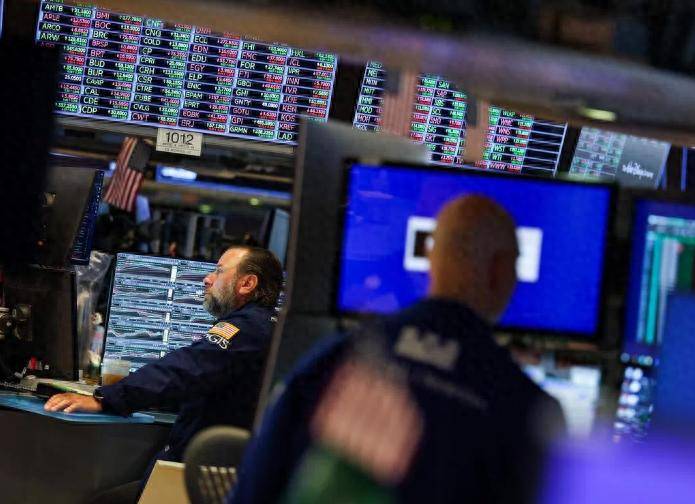
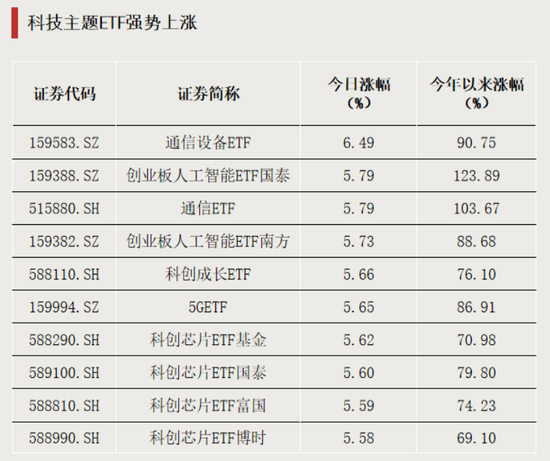
Market Overview - On October 24, A-shares saw all three major indices rise, with total trading volume approaching 2 trillion yuan, an increase of over 330 billion yuan compared to the previous trading day [1] - The Shanghai Composite Index closed at its intraday high of 3950.31 points, with over 1000 of the 1300+ ETFs in the market rising, and more than 130 products gaining over 4% [1] ETF Performance - Technology-themed ETFs performed exceptionally well, with all top ten ETFs by daily gain being technology-focused, each rising over 5% [2] - Some technology-themed ETFs have achieved over 100% returns year-to-date [2] - The Communication Equipment ETF (159583) led the market with a 6.49% increase and a trading volume of 190 million yuan, doubling from the previous day [2][3] - The top-performing stocks within the Communication Equipment ETF included Aerospace Science and Technology, which hit the daily limit, and several others that rose over 10% [2] Sector Analysis - The communication and electronics sectors were the top performers among over 30 industry sectors, with a combined trading volume exceeding 540 billion yuan [2] - Four ETFs linked to the Shanghai Stock Exchange Science and Technology Innovation Board Chip Index also made it to the top ten gainers, with significant increases in stocks related to storage chips [3][4] Fund Flows - On October 23, the ETF market saw a net inflow of approximately 6 billion yuan, with defensive ETFs continuing to attract funds, while some aggressive ETFs also gained interest [7][8] - Defensive ETFs focused on currencies, bonds, banks, and gold saw significant net inflows, with the Hua Bao Tian Yi ETF (511990) leading with a net inflow of 717 million yuan [7][8] - Conversely, some large-cap broad-based products experienced net outflows, with the Coal ETF (515220) seeing a net outflow of 601 million yuan on the same day [9][10] Earnings Outlook - Analysts suggest that the technology growth sector remains a favored investment theme, particularly with the acceleration of AI industry trends [11] - The upcoming third-quarter earnings reports are expected to show strong performance in the electronics and AI sectors, with many companies likely to exceed expectations [11][12] - The overall return on equity (ROE) for A-share listed companies (excluding financials and oil) is expected to rise, indicating improving profitability and market fundamentals [12]
加纳塞地升值
Shang Wu Bu Wang Zhan· 2025-10-18 15:55
Core Insights - The Ghanaian currency, the Cedi, has continued its upward trend in the interbank market, particularly against major currencies like the US Dollar [1] - As of October 16, 2023, the exchange rate of the Ghanaian Cedi to the US Dollar is approximately 10.62 Cedis, a significant appreciation from earlier in the month when it surpassed 12 Cedis [1] Currency Performance - The Cedi has shown strong performance against the US Dollar, indicating a recovery in the currency's value [1] - The appreciation of the Cedi reflects a positive shift in the currency's market dynamics, which could influence investor sentiment and economic stability in Ghana [1]
一文说清指数基金
Jing Ji Wang· 2025-10-16 08:27
Group 1 - The core idea of the article emphasizes the advantages of index funds, allowing investors to profit from market trends without the need for stock selection [2][3] - Year-to-date returns for major index funds such as the CSI 300 and A500 are reported at 20% and 28% respectively, outperforming underperforming stocks [2] - The semiconductor sector has been highlighted as a leading performer in the A-share market, with an average increase of 69.62% for stocks in the STAR Market, although some individual stocks underperformed significantly [2][3] Group 2 - Investing in index funds simplifies the investment process, as fund managers handle stock selection and tracking, ensuring returns closely match the index performance [3] - The performance of the STAR Market semiconductor index funds has been consistent, with returns ranging from 68.56% to 69.31%, closely aligning with the sector's overall growth [3] - As of October 10, over 3,000 index funds exist in the A-share market, with a total scale exceeding 7 trillion yuan, covering various investment categories [5] Group 3 - For investors interested in international markets, ETFs provide a means to invest in overseas assets, with notable returns in the Hong Kong innovation drug sector exceeding 100% this year [6] - Gold ETFs have shown a return of approximately 45% this year, reflecting the performance of physical gold prices [6] - Investors with a lower risk appetite can consider bond index funds, which have yielded returns between 11% and 17% this year [6]
Ultima Markets金价预测:黄金/美元仍然准备进行获利回吐;还不行吗?
Sou Hu Cai Jing· 2025-10-15 09:22
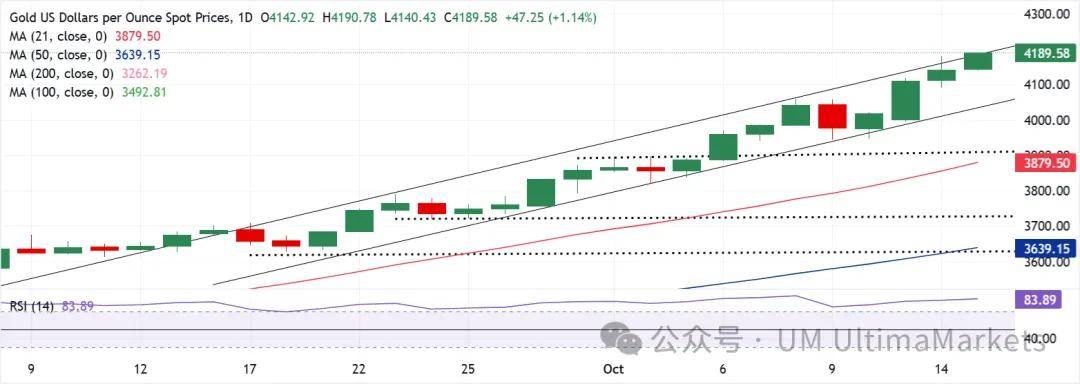
Core Insights - Gold prices are moving away from historical highs, but buyers maintain control amid a weakening dollar [1] - Renewed trade tensions between the US and China, along with bets on two more rate cuts by the Federal Reserve, offset the IMF's optimistic outlook on global economic growth [1] Market Dynamics - Gold is experiencing a "buy on dips" trading strategy, with buyers remaining optimistic despite global stock market trends [3] - The recent rise in gold prices is attributed to President Trump's consideration of terminating trade relations with China, which has escalated trade tensions [3] - The US and China have begun imposing reciprocal port fees, further intensifying the trade war backdrop [3] Federal Reserve and Currency Impact - Ongoing concerns about US-China trade, coupled with expectations of two more rate cuts by the Federal Reserve, negatively impact the dollar, benefiting non-yielding precious metals [4] - Market expectations for rate cuts in October and December exceed 90%, despite cautious remarks from Fed Chair Jerome Powell [4] - The People's Bank of China set the USD/CNY midpoint at 7.0995, stronger than the previous day's rate, surprising the market [5] Technical Analysis - The daily chart shows gold challenging the upper boundary of an ascending channel, with the RSI nearing extreme overbought levels at approximately 84 [10] - Buyers are attempting to break through the upper resistance of the channel, currently at $4,184, to sustain a record rise above the $4,200 mark [11][12] - The next psychological target for bullish investors is $4,250, while a rejection at resistance could lead to a drop to the $4,100 level [13][14] - Key support is located at the lower boundary of the ascending channel, around $4,036, with a potential breakdown confirming a pattern failure and further correction to the $3,950 psychological level [15][16]
日法政治担忧缓解 美元复苏态势受阻
Jin Tou Wang· 2025-10-10 11:32
Group 1 - The US dollar index fell below 99.50, showing a slight decline after reaching a two-month high of 99.55, indicating a pause in its recent recovery trend [1][2] - The US government shutdown has entered its ninth day with no significant progress, as the Republican proposal to fund the government failed to secure enough votes in the Senate [1] - Trump's administration plans to use the government shutdown to permanently cut what he refers to as "Democratic projects," signaling a shift in focus towards reducing federal spending [1] Group 2 - The dollar index has shown strong performance this week, up 1.7% and on track for its best weekly performance in a year, despite the ongoing government shutdown [2] - The dollar index is expected to maintain a range between 99 and 99.5 ahead of employment data, with potential volatility depending on signals from Powell at the upcoming community bank meeting [2] - If Powell emphasizes "sticky inflation," it could push the index to break through the resistance level of 99.5 [2]
信心一日还魂记
虎嗅APP· 2025-10-03 11:48
Core Viewpoint - The article discusses the importance of "confidence" in the Chinese economy, likening it to a theatrical play titled "Waiting for Confidence," where confidence is a crucial yet elusive element for economic recovery [4][6]. Group 1: Importance of Confidence - Confidence is described as a "metaphysical" element that drives economic actions and decisions, transforming uncertainty into actionable expectations [6][8]. - The article emphasizes that confidence cannot be artificially created through policies or data alone; it exists in the collective consciousness of individuals [8][22]. Group 2: Case Study of Argentina - Argentina serves as a case study where confidence was temporarily restored through external intervention, specifically a $200 billion currency swap line from the U.S. Treasury, which provided a significant credit backing to the Argentine central bank [12][14]. - Historical parallels are drawn to past crises, such as the 1994-1995 Mexican Tequila Crisis, where similar confidence-boosting measures were effective [14][15]. Group 3: Challenges in Restoring Confidence - Despite temporary boosts in confidence, the article questions whether it can be sustained, highlighting that market participants remain skeptical and risk premiums are still high [21][22]. - The political landscape in Argentina poses a significant challenge, as any signs of failure in reforms can lead to a rapid loss of confidence among investors [21][22].

美国靠美元当 “世界霸王”,印钱想让中国百姓买单?42国联手破局
Sou Hu Cai Jing· 2025-09-30 12:56
Core Viewpoint - The trend of de-dollarization is accelerating as emerging economies like China and Russia rise, with 42 countries working to reduce their dependence on the US dollar and promote their own digital currencies [1][19][27] Group 1: Historical Context of the Dollar's Dominance - The US dollar became the dominant global currency due to historical events, particularly during the two World Wars, which shifted the economic center to the US [3] - The Bretton Woods system established the dollar's link to gold, making it the sole reserve currency and embedding it in global trade and finance [5] - The dollar's detachment from gold in 1971 did not diminish its dominance, as the US established the petrodollar system through strategic agreements with Saudi Arabia [7][9] Group 2: Economic Policies and Global Impact - The US has leveraged its dollar dominance to attract global capital and implement quantitative easing, which stimulates its economy but can create asset bubbles in other countries [11][14] - The influx of "hot money" into emerging markets can lead to economic volatility when these funds withdraw, particularly during US economic recoveries [14][16] - Historical financial crises have shown how the US benefits from its dollar dominance while other nations suffer economic downturns [16][17] Group 3: The Shift Towards De-dollarization - Increasing awareness of the risks associated with dollar dependence has led many countries to pursue de-dollarization, exploring alternative currency systems and digital currencies [19][21][25] - Countries like Russia, Iran, and Brazil are accelerating the development of their digital currencies to reduce reliance on the dollar [21] - Efforts to establish non-dollar trade mechanisms, such as the trade settlement system between European countries and Iran, challenge US sanctions and promote alternative trade routes [21][23] Group 4: Future Implications - The move towards de-dollarization signifies a potential shift in global economic power and may lead to significant changes in the international financial system [25] - The increasing use of currencies other than the dollar in global trade, particularly in oil transactions, indicates a challenge to the dollar's status as the sole reserve currency [23][25] - The collaboration of 42 countries to develop digital currencies reflects a growing trend towards financial independence from the US dollar [27]
香港2025施政报告:锚定国家战略,擘画发展蓝图
Guotai Junan Securities· 2025-09-17 12:51
Economic Development - The 2025 Policy Address emphasizes "improving people's livelihoods" and "economic development" as its main themes, proposing several breakthrough policies to consolidate Hong Kong's status as an international financial center[6] - The government aims to foster emerging industries such as advanced manufacturing, life sciences, new energy, artificial intelligence, and data science to create high-quality jobs and enhance overall economic efficiency[5][7] Capital Market Initiatives - The government plans to assist mainland tech companies in financing through the "Tech Enterprise Channel" and improve the main board listing system and issuance mechanisms for structured products[8] - Initiatives include optimizing regulations for "same share, different rights" listings and exploring a T+1 settlement cycle to attract more overseas companies to list in Hong Kong[8] Currency and Bond Market Development - The Hong Kong Monetary Authority (HKMA) will introduce a new "Renminbi Business Funding Arrangement" to enhance liquidity in the offshore RMB market, supported by a currency swap agreement with the People's Bank of China[11] - Plans to upgrade financial infrastructure and promote offshore Chinese government bonds as collateral to expand the application of RMB assets in the bond market[9] Financial Technology Advancements - The HKMA will continue to advance the Ensemble project, promoting tokenized deposit products and facilitating the issuance of tokenized bonds[13] - The report highlights the importance of regulatory sandboxes to encourage banks to strengthen risk management capabilities and the establishment of a risk prevention system in the digital asset sector[13]