
电子

Search documents
APEC会议最后一天,王毅压轴出席,只字不提美国,新的危机降临
Sou Hu Cai Jing· 2026-02-14 03:44
Core Viewpoint - The article discusses China's strategic positioning in the APEC meeting, highlighting its indifference towards the U.S. and the ineffectiveness of U.S. tariffs, which have backfired and strengthened China's economic stance [1][6][12]. Group 1: U.S.-China Trade Relations - From April to September last year, China's trade surplus with the U.S. increased, heading towards a record $1.2 trillion, as U.S. tariffs ultimately burden American consumers and businesses [5][22]. - The U.S. tariffs intended to pressure China have inadvertently led to a more flexible Chinese supply chain, minimizing the impact of these tariffs [5][6]. - China's silence at APEC is a strategic move, indicating that the U.S. strategy has failed and does not warrant a response [6][16]. Group 2: Regional Economic Dynamics - Japan and South Korea are benefiting economically from the RCEP framework, with Japan expected to gain over $48 billion by 2030, while also reducing production costs through lower tariffs on China and South Korea [17][19]. - Southeast Asian countries, previously reliant on the U.S. market, are experiencing negative growth due to U.S. tariffs, leading them to recognize the benefits of cooperating with China [22][25]. - Samsung is increasing investments in China, reflecting a shift in economic focus among U.S. allies towards China, undermining the U.S. Indo-Pacific strategy [25][26]. Group 3: Future Implications for the U.S. - The U.S. is facing a crisis of being forgotten rather than defeated, as its influence in the Asia-Pacific region diminishes with China's proactive initiatives [26][28]. - If the Asia-Pacific countries form a tight internal cooperation, U.S. companies may face increased market access costs by 15% to 20% in the coming years [30][32]. - The U.S. is caught in a dilemma of wanting to engage in trade wars while struggling with domestic inflation and lacking a coherent strategy for re-engagement in the Asia-Pacific [32][33].


清越科技因涉嫌财务造假被立案调查,股价波动加剧
Jing Ji Guan Cha Wang· 2026-02-14 02:15
Core Viewpoint - Qingyue Technology (688496.SH) is under investigation by the China Securities Regulatory Commission for suspected false reporting of financial data, which has led to significant regulatory risks and market concerns [1] Group 1: Investigation and Regulatory Impact - The company announced that three securities accounts, totaling 1.6313 million shares of repurchased stock, and seven fundraising accounts, with a total principal of approximately 134 million yuan, have been frozen [1] - If the investigation results in a finding of major violations, the company’s stock may face forced delisting [1] Group 2: Stock Performance - As of February 13, 2026, Qingyue Technology's stock closed at 6.46 yuan, with a cumulative increase of 2.22% over the past five days, although it experienced significant volatility with a range of 5.22% [1] - On February 10, there was a net outflow of 1.3693 million yuan in principal funds, but on February 13, there was a net inflow of 833,800 yuan, indicating high market trading activity with a turnover rate of 1.80% [1] Group 3: Financial Performance - For the first three quarters of 2025, the company reported revenue of 476 million yuan, a year-on-year decrease of 13.64%, and a net loss attributable to shareholders of 43.3534 million yuan [1] - The full-year performance forecast for 2025 indicates an expected loss range of 74 million to 110 million yuan, primarily due to declining revenue from the electronic paper business and increased asset impairment provisions [1] - The combination of weak financial performance and the investigation has further eroded investor confidence [1]

新华财经早报:2月14日
Xin Hua Cai Jing· 2026-02-14 00:10
Group 1: Industry Developments - The "Modern Capital Urban Circle Spatial Collaborative Planning (2023-2035)" has been released, aiming to enhance the capital's functions and create a high-quality development growth pole [1] - The Ministry of Industry and Information Technology has called for accelerated development of the low-altitude industry, emphasizing top-level planning and the establishment of a standard system [1] - The State Council has approved the upgrade of the Xiong'an High-tech Industrial Development Zone to a national high-tech industrial development zone, covering an area of 20.84 square kilometers [1] Group 2: Financial Data - As of the end of January, the broad money supply (M2) reached 347.19 trillion yuan, a year-on-year increase of 9% [1] - The social financing scale stood at 449.11 trillion yuan at the end of January, with a year-on-year growth of 8.2% [1] - The January consumer price index (CPI) in the U.S. rose by 2.4% year-on-year, a decrease from 2.7% in December [2] Group 3: Company Announcements - China Shenhua reported that its second phase unit 4 has officially commenced commercial operations, with coal sales in January increasing by 9.9% year-on-year [4] - Gaode Infrared has signed a product order contract worth approximately 1.851 billion yuan [4] - Haiyou Engineering has won overseas project bids, with the company's share exceeding 800 million USD [4]
估值驱动行情延续 节后把握结构性机会
Zhong Guo Zheng Quan Bao· 2026-02-13 22:45
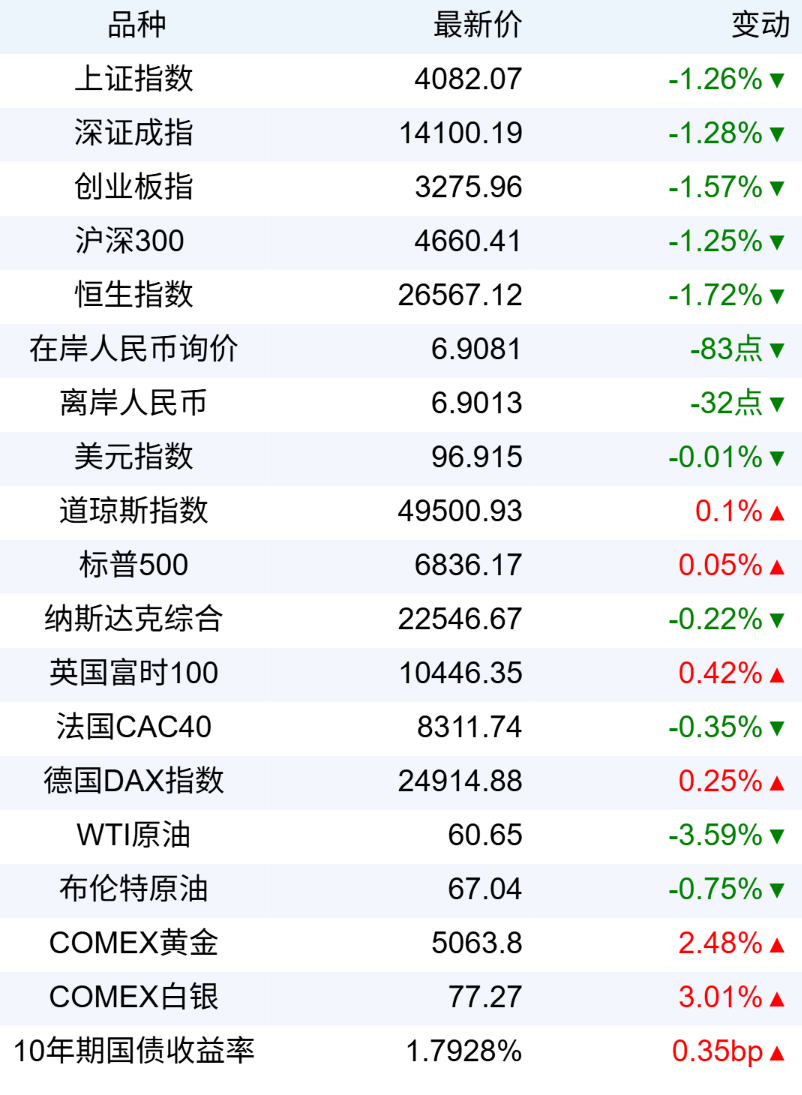
Group 1 - The A-share market is influenced by multiple factors, showing characteristics of valuation-driven and structural differentiation, with a clear upward trend expected to continue post-Spring Festival [2][4] - The core support for the market's upward trend includes improving corporate earnings prospects, increased willingness of residents to invest, and ongoing policies to optimize industry competition [2][4] - The market is expected to experience a "red envelope market" post-Spring Festival, driven by the current market's duration and upward amplitude being significantly lower than the average of previous uptrends [4][7] Group 2 - The investment logic post-Spring Festival will focus on "value supporting growth," with a shift from low-risk to high-risk preferences, emphasizing technology and cyclical price increases [7] - Five key investment themes are suggested: 1. The artificial intelligence industry chain, focusing on application rather than hardware [7][8] 2. High dividend assets, particularly in stable cash flow sectors like white goods and banking [7][8] 3. Anti-involution sectors benefiting from improved competition, such as coal and steel [7][8] 4. Core areas of domestic demand recovery, including health and tourism sectors [7][8] 5. Investment opportunities in strategic and industrial metals, expected to see a rebound in 2026 [7][8] Group 3 - The market structure shows significant calendar effects and valuation-driven characteristics, with the average increase of the Wind All A Index being over 20% during the spring market since 2009 [3] - The equity market is currently in a bullish window until early March 2026, with a strategy of "rapid gains and risk control" [3][4] - The bond market is experiencing downward pressure on yields, with the 10-year government bond yield expected to fluctuate between 1.80% and 1.85% [3]
戴康工业获多家机构看好,股价近期表现活跃
Jing Ji Guan Cha Wang· 2026-02-13 20:47
Group 1 - The core viewpoint of the news is that DaiKang Industrial (DY.N) has received positive ratings from 12 institutions, with a target average price of $407.82 and a maximum target price of $510.00, reflecting optimism about its growth prospects in AI data centers and fiber broadband business [1] Group 2 - The company's Q3 2026 financial report shows revenue of $1.452 billion, a year-on-year increase of 14.13%, exceeding market expectations; net profit reached $106 million, up 52.41%, also surpassing forecasts, driven by increased demand in the electronics sector [2] Group 3 - In the past week, DaiKang Industrial's stock price has risen by 6.37%, with a price fluctuation range of 11.87%; specific movements include a rise of 3.70% to $415.28 on February 9, a decline of 1.18% on February 10, a significant increase of 4.70% to $429.68 on February 11, a drop of 2.87% on February 12, and closing at $425.97 on February 13 with a daily increase of 2.07%; trading volume reached $236 million on February 12, indicating active trading [3]
1月份越南贸易逆差近18亿美元
Shang Wu Bu Wang Zhan· 2026-02-13 17:10
Core Insights - In January 2026, Vietnam experienced a trade deficit of nearly $1.8 billion despite a significant increase in exports and imports [1][2] Export Summary - Vietnam's total exports reached $43.19 billion in January 2026, marking a year-on-year increase of 30.13% [1] - Key export categories included computers, electronic products, and components, as well as machinery and tools, both exceeding $1 billion in exports, with growth rates of 57.92% and 40.52% respectively [1] - Foreign Direct Investment (FDI) enterprises accounted for nearly 78% of total exports, amounting to $33.64 billion, which is a 43.32% increase year-on-year [1] - In the electronics, computers, and mobile phone sectors, FDI enterprises contributed to 99% of the export value [1] Import Summary - Vietnam's total imports in January 2026 reached $44.97 billion, reflecting a year-on-year increase of 49.61% [1] - Major import categories included computers, electronic products, and components, with imports growing by 70.82%, and machinery and tools, which increased by 47.11% [1] - FDI enterprises dominated the import structure, accounting for approximately 71.3% of total imports, totaling $32.06 billion, a year-on-year increase of 67.27% [1] - The current value chain structure in Vietnam indicates that domestic companies primarily engage in low-value-added activities such as processing and assembly [1] Trade Balance Summary - In the first half of January, Vietnam faced a significant trade deficit, but a recovery in exports in the latter half led to a surplus of $1.58 billion, resulting in an overall trade deficit of $1.78 billion for the month [2] - The trade balance pressure is attributed to a substantial increase in imports of raw materials and components necessary for manufacturing [2]
数说蛇年A股,多个纪录!
Zhong Guo Zheng Quan Bao· 2026-02-13 14:05
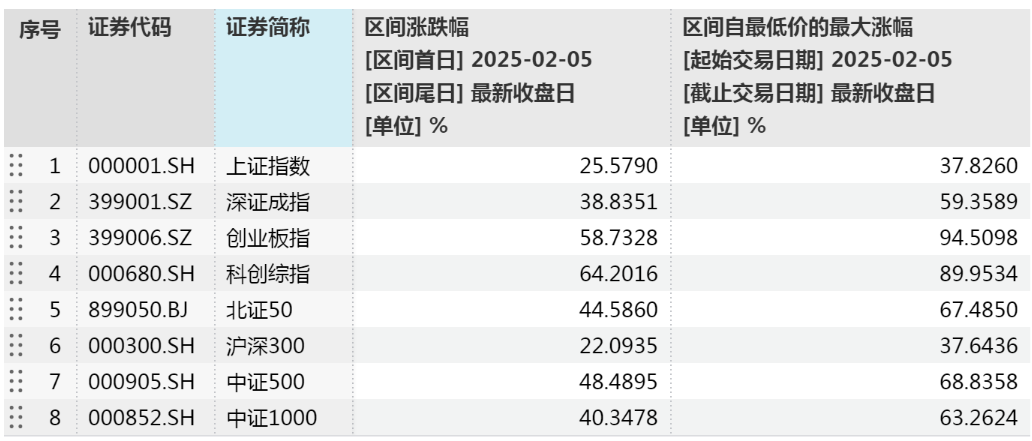
Core Insights - The A-share market experienced significant fluctuations and growth during the Year of the Snake, with major indices showing substantial increases in value [2][3]. Market Performance - The Shanghai Composite Index, Shenzhen Component Index, ChiNext Index, and Sci-Tech Innovation Board Index recorded cumulative increases of 25.58%, 38.84%, 58.73%, and 64.20% respectively [3][4]. - The total market capitalization of A-shares reached a record high of 124.45 trillion yuan, an increase of 32.87 trillion yuan since the beginning of the Year of the Snake [3][5]. Trading Volume - The total trading volume for A-shares exceeded 482 trillion yuan, with an average daily trading volume of 1.89 trillion yuan, both figures marking historical highs [5][6]. Sector Performance - The non-ferrous metals and technology sectors led the market, with respective increases of 112.63% and 90.83% [12][13]. - A total of 776 stocks saw their prices rise by over 100%, with 198 stocks increasing by more than 200% [14][15]. Notable Stocks - The top-performing stocks included Shangwei New Materials, which surged by 1836.53%, and Tianpu Co., which rose by 942.69% [15][16]. - The number of stocks with a market capitalization exceeding 100 billion yuan increased from 128 to 185 during the Year of the Snake, indicating a significant expansion of the large-cap segment [17]. Financing and Investment Trends - The margin financing balance reached a record high of 26,293.37 billion yuan, with an increase of 8,640 billion yuan since the beginning of the year [9][10]. - The electronic, power equipment, non-ferrous metals, and communication sectors attracted net buying amounts exceeding 700 billion yuan [9].
由创新高个股看市场投资热点(第 231 期):热点追踪周报-20260213
Guoxin Securities· 2026-02-13 12:41
Quantitative Models and Construction Methods 1. Model Name: 250-Day New High Distance Model - **Model Construction Idea**: This model tracks the distance of stock prices or indices from their 250-day high to identify market trends and hotspots. It is based on the momentum and trend-following strategy, which has been proven effective in various studies[11][18]. - **Model Construction Process**: The 250-day new high distance is calculated as follows: $ 250\text{-day new high distance} = 1 - \frac{Close_t}{ts\_max(Close, 250)} $ Where: - $ Close_t $ is the latest closing price - $ ts\_max(Close, 250) $ is the maximum closing price over the past 250 trading days If the latest closing price reaches a new high, the distance is 0. If the price falls from the high, the distance is a positive value, representing the degree of decline[11]. - **Model Evaluation**: The model effectively identifies stocks and indices with strong momentum and highlights market leaders, aligning with the principles of momentum investing[11][18]. 2. Model Name: Stable New High Stock Selection Model - **Model Construction Idea**: This model focuses on selecting stocks that exhibit stable price paths and consistent momentum, as smoother price trajectories tend to yield stronger momentum effects[24]. - **Model Construction Process**: Stocks are filtered from the pool of those that hit a 250-day high in the past 20 trading days. The selection criteria include: - Analyst attention: At least 5 buy or overweight ratings in the past 3 months - Relative strength: Top 20% in 250-day price performance - Price stability: Evaluated using the following metrics: - Absolute value of price changes over the past 120 days - Sum of absolute daily price changes over the past 120 days - Momentum continuity: - Average 250-day new high distance over the past 120 days - Average 250-day new high distance over the past 5 days The top 50 stocks based on these criteria are selected[24][26]. - **Model Evaluation**: The model emphasizes smooth price trajectories and consistent momentum, which are less likely to attract excessive attention, thereby enhancing the momentum effect[24]. --- Model Backtesting Results 1. 250-Day New High Distance Model - **Indices' 250-Day New High Distance (as of February 13, 2026)**: - Shanghai Composite Index: 2.00% - Shenzhen Component Index: 2.35% - CSI 300: 2.72% - CSI 500: 3.51% - CSI 1000: 3.14% - CSI 2000: 2.54% - ChiNext Index: 3.32% - STAR 50 Index: 5.50%[12][13]. 2. Stable New High Stock Selection Model - **Selected Stocks**: 50 stocks were identified, including Zhongtung High-tech, Dike Co., and Xiechuang Data. - **Sector Distribution**: - Technology: 21 stocks (most from the electronics industry) - Manufacturing: 16 stocks (most from the machinery industry)[27][32]. --- Quantitative Factors and Construction Methods 1. Factor Name: 250-Day New High Distance - **Factor Construction Idea**: Measures the relative position of a stock's price to its 250-day high, capturing momentum and trend-following characteristics[11]. - **Factor Construction Process**: $ 250\text{-day new high distance} = 1 - \frac{Close_t}{ts\_max(Close, 250)} $ Where: - $ Close_t $ is the latest closing price - $ ts\_max(Close, 250) $ is the maximum closing price over the past 250 trading days[11]. - **Factor Evaluation**: The factor effectively identifies stocks with strong momentum and aligns with established momentum strategies[11][18]. 2. Factor Name: Price Stability - **Factor Construction Idea**: Evaluates the smoothness of a stock's price trajectory, as smoother paths are associated with stronger momentum effects[24]. - **Factor Construction Process**: - Absolute value of price changes over the past 120 days - Sum of absolute daily price changes over the past 120 days[24]. - **Factor Evaluation**: The factor highlights stocks with stable price movements, which are less likely to attract excessive attention, enhancing the momentum effect[24]. --- Factor Backtesting Results 1. 250-Day New High Distance Factor - **Indices' 250-Day New High Distance (as of February 13, 2026)**: - Shanghai Composite Index: 2.00% - Shenzhen Component Index: 2.35% - CSI 300: 2.72% - CSI 500: 3.51% - CSI 1000: 3.14% - CSI 2000: 2.54% - ChiNext Index: 3.32% - STAR 50 Index: 5.50%[12][13]. 2. Price Stability Factor - **Selected Stocks**: 50 stocks were identified, including Zhongtung High-tech, Dike Co., and Xiechuang Data. - **Sector Distribution**: - Technology: 21 stocks (most from the electronics industry) - Manufacturing: 16 stocks (most from the machinery industry)[27][32].



热点追踪周报:由创新高个股看市场投资热点(第231期)-20260213
Guoxin Securities· 2026-02-13 12:16
- The report introduces a quantitative model called "250-day new high distance" to track market trends and identify market hotspots. The model is based on momentum and trend-following strategies, emphasizing the effectiveness of stocks reaching new highs as market indicators. The formula for calculating the 250-day new high distance is: $ 250\text{-day new high distance} = 1 - \frac{Close_t}{ts\_max(Close, 250)} $ where $ Close_t $ represents the latest closing price, and $ ts\_max(Close, 250) $ is the maximum closing price over the past 250 trading days. If the latest closing price reaches a new high, the distance is 0; otherwise, it is a positive value indicating the degree of fallback from the new high[11][12][13] - The report evaluates the model positively, citing its ability to capture market trends and identify leading stocks that perform well during market uptrends. It references studies by [George@2004], William O'Neil, and Mark Minervini, which support the idea that stocks near their 52-week highs tend to outperform those far from their highs[11][18][21] - The report provides backtesting results for the 250-day new high distance model. As of February 13, 2026, major indices such as the Shanghai Composite Index, Shenzhen Component Index, CSI 300, CSI 500, CSI 1000, CSI 2000, ChiNext Index, and STAR 50 Index have respective 250-day new high distances of 2.00%, 2.35%, 2.72%, 3.51%, 3.14%, 2.54%, 3.32%, and 5.50%[12][31] - The report introduces a quantitative factor called "Stable New High Stocks" to identify stocks with smooth price paths and consistent momentum. The factor construction involves screening stocks that have reached a 250-day new high in the past 20 trading days and applying criteria such as analyst attention (at least five buy or overweight ratings in the past three months), relative price strength (top 20% in 250-day returns), price path smoothness (measured by price displacement ratio), and sustained new high performance (average 250-day new high distance over the past 120 days and past 5 days)[24][26][27] - The report evaluates the factor positively, citing research by [Turan G Bali, Nusret et al@2011] and [Da, Gurun et al@2012], which highlight the superior performance of stocks with smooth price paths and strong momentum. The factor is designed to capture these characteristics effectively[24][26][27] - Backtesting results for the "Stable New High Stocks" factor show that 50 stocks were selected based on the criteria, with the highest representation in the technology and manufacturing sectors. Specifically, 21 stocks from the technology sector (dominated by the electronics industry) and 16 stocks from the manufacturing sector (dominated by the machinery industry) were included[27][32][30]
由创新高个股看市场投资热点(第 231 期)
Guoxin Securities· 2026-02-13 11:57
- The report introduces a quantitative model based on tracking the 250-day high distance of stocks and indices, which serves as a momentum and trend-following strategy. The calculation formula is: $ 250\ Day\ High\ Distance = 1 - \frac{Close_t}{ts\_max(Close, 250)} $ where $ Close_t $ represents the latest closing price, and $ ts\_max(Close, 250) $ is the maximum closing price over the past 250 trading days. If the latest closing price hits a new high, the distance is 0; otherwise, it is a positive value indicating the degree of pullback. [11][12][13] - The model evaluates the relative proximity of major indices to their 250-day highs. As of February 13, 2026, the 250-day high distances for indices such as the Shanghai Composite Index, Shenzhen Component Index, CSI 300, CSI 500, CSI 1000, CSI 2000, ChiNext Index, and STAR 50 Index are 2.00%, 2.35%, 2.72%, 3.51%, 3.14%, 2.54%, 3.32%, and 5.50%, respectively. [12][13][31] - The report also tracks the proximity of industry indices and concept indices to their 250-day highs. For example, industries like building materials, machinery, light manufacturing, petrochemicals, and media are closer to their 250-day highs, while industries such as food & beverage, banking, comprehensive finance, pharmaceuticals, and agriculture are farther away. Concept indices such as paper, internet, cloud computing, energy storage, and engineering machinery are also closer to their 250-day highs. [13][15][31] - A separate quantitative factor is introduced to monitor stocks that have hit new highs in the past 20 trading days. A total of 1,390 stocks achieved 250-day highs during this period, with the highest numbers in industries like machinery, electronics, and basic chemicals. The highest proportions of new-high stocks are found in sectors such as non-ferrous metals, petrochemicals, and steel. [19][20][32] - The report further refines the analysis by introducing a "Stable New High Stock" factor, which selects stocks based on criteria such as analyst attention, relative price strength, price path smoothness, and sustained new highs. Specific metrics include: - Analyst attention: At least 5 buy or overweight ratings in the past 3 months - Relative price strength: Top 20% in market-wide 250-day returns - Price path smoothness: Evaluated using metrics like price displacement ratio - Sustained new highs: Average 250-day high distance over the past 120 days - Trend continuation: Average 250-day high distance over the past 5 days Fifty stocks were selected based on these criteria, including names like Zhong Tung High-tech, Dike Co., and Xiechuang Data. [24][26][27] - The report highlights the distribution of stable new-high stocks across sectors, with the technology and manufacturing sectors having the highest numbers (21 and 16 stocks, respectively). Within technology, electronics dominate, while machinery leads in manufacturing. [27][28][32]