大宗商品

Search documents
国金证券:迎接2026,告别单一叙事
Xin Lang Cai Jing· 2025-12-21 09:36
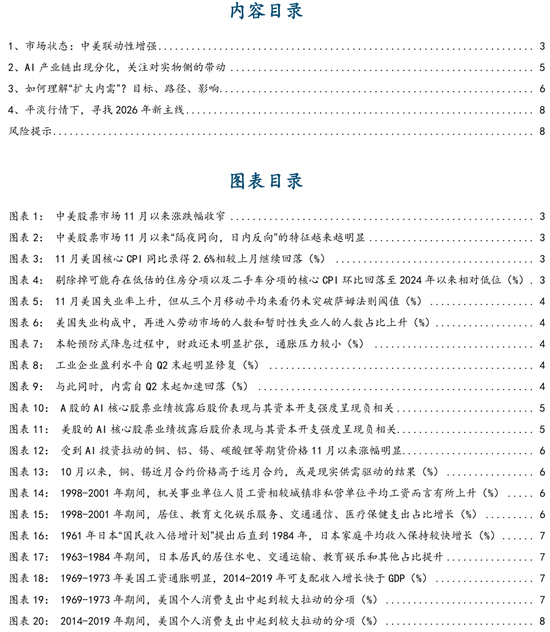
Group 1: Market Status - The correlation between A-shares and U.S. stocks has increased, with the 20-day rolling correlation of the CSI 300 and S&P 500 rising to over 90% since November, indicating a new norm of "overnight same direction, intraday reverse" [2][11][45] - Both the U.S. and Chinese economies are in a phase of "limited upward elasticity and reduced downward risk," with the U.S. core CPI falling to 2.6%, the lowest in three and a half years, and the unemployment rate rising to 4.6% primarily due to increased labor participation and temporary unemployment [2][13][47] - The Chinese economy shows signs of a bottom in corporate profits, while domestic demand is weakening, creating a favorable environment for subsequent policy support [2][13][47] Group 2: AI Industry Chain - The investment in the AI industry chain is showing two notable characteristics: first, "pan-AI" assets (copper, lithium, aluminum, energy storage, and electrical equipment) are performing better than core AI assets (computing chips, optical modules, PCB) [2][18][52] - Investors are becoming less tolerant of the contradiction between aggressive capital expenditures and the lack of revenue growth in companies within the AI industry chain, as evidenced by the negative correlation between stock performance and capital expenditure as a percentage of revenue [2][18][52] - Commodity prices for copper, aluminum, tin, and lithium carbonate have been rising since late October, driven by supply-demand dynamics, with near-term contracts for copper and tin outperforming longer-term contracts [2][19][53] Group 3: Understanding "Expanding Domestic Demand" - The articles published in "Qiushi" magazine emphasize the importance of consumer demand as a primary focus for expanding domestic demand, highlighting the need for a complete domestic demand system [3][24][58] - The strategy includes enhancing secondary distribution to increase residents' net transfer income and optimizing primary distribution to improve labor income, with potential reforms in state-owned enterprises to guide wage adjustments [3][25][58] - Historical examples from Japan and the U.S. show that periods of rising resident income lead to increased service and new-type consumption, indicating that the current "income increase plan" may boost demand for service consumption and technology-driven durable goods [3][27][58] Group 4: Preparing for 2026 - The current market conditions, characterized by limited macro elasticity and increased industry differentiation, suggest a shift in investment strategy towards "physical demand-driven" and "domestic demand policy dividends" as more certain avenues for growth [2][39][40] - Recommendations include focusing on industrial resource products (copper, aluminum, tin, lithium, crude oil, and oil transportation) that benefit from AI investment and global manufacturing recovery, as well as sectors like aviation, hotels, duty-free, and food and beverage that will benefit from increased consumer spending [2][32][39] - The non-bank financial sector (insurance, brokerage) is expected to benefit from capital market expansion and a bottoming out of long-term asset returns, alongside opportunities in China's equipment export chain and domestic manufacturing sectors [2][32][39]


同比增长26.1%!
Sou Hu Cai Jing· 2025-12-20 05:23
Group 1 - In the first 11 months of the year, China's e-commerce has continuously stimulated consumer vitality, with digital consumption and online services being the main growth drivers [2] - The growth of digital products monitored by the Ministry of Commerce increased by 8.2%, with smart wearables and smart robots maintaining double-digit growth [2] - Online service consumption saw a significant increase of 21.7% [2] Group 2 - The average price index for China's bulk commodities is expected to be 112.1 points in 2025, showing a trend of stabilization and recovery, with clear characteristics of new and old kinetic energy conversion [3] - In November, actual foreign investment used in China increased by 26.1% year-on-year, with 61,207 new foreign-invested enterprises established in the first 11 months, a 16.9% increase [3] - In November alone, 7,425 new foreign-invested enterprises were established, marking a year-on-year growth of 35.3% [3] Group 3 - The 2025 China International Tourism Trade Fair opened in Haikou, attracting over 1,000 travel merchants and representatives from 101 countries and regions, with a total exhibition area of 65,000 square meters [3] Group 4 - Beijing has enhanced public services related to Taiwan, focusing on eight areas including entry, residence, travel, education, employment, medical care, social security, and assistance, resulting in a streamlined service process [4] - A total of 13 "process testing" sessions have been conducted to address specific issues in areas such as medical care and social security, improving the experience for Taiwanese residents [4] Group 5 - The second "Tongqi Zhi Guang" Cross-Strait Animation Fashion Design Week was held in Shanghai, promoting cultural exchange and collaboration between the two sides through various activities [5] - The event serves as a significant platform for youth cultural exchange, fostering substantial interaction among young talents in the creative and cultural sectors [5]

商品宏观全景图:2026能否孕育新一轮大宗商品牛市?
对冲研投· 2025-12-19 08:04
Group 1 - The core viewpoint of the article emphasizes that the main driving force for future commodities will be overseas, particularly the "big fiscal" cycle in the United States and AI capital expenditure, which is unprecedented since World War II [4][25] - The report quantifies the demand for copper and aluminum driven by AI data centers, highlighting it as a significant growth driver for the coming years [4][31] - The consensus ranking for commodities is established as non-ferrous metals > precious metals > agricultural products > energy > ferrous metals, reflecting the current market pricing consensus [4][15][66] Group 2 - The analysis delves into the vulnerabilities behind the consensus, noting that the market may underestimate the complexity of domestic capacity clearance, which has been disrupted by traditional paradigms [5] - The report warns against over-reliance on the current supply-demand balance, suggesting that structural changes may not be fully priced in [5] - The retreat from global decarbonization consensus is particularly evident in Asia, where energy security and economic considerations are overshadowing climate agendas, potentially impacting commodity pricing [5] Group 3 - Several coherent themes for trading opportunities are proposed, including the re-inventorying and competition for key minerals driven by geopolitical tensions [6][7] - The rise of the renminbi is highlighted, with expectations that its internationalization will gradually weaken the traditional pricing power of LME compared to SHFE [7] - The report advocates for an "odds thinking" approach, suggesting that when market consensus is overly optimistic, investors should seek undervalued opportunities [7] Group 4 - The article draws historical parallels between current fiscal, technological, and geopolitical characteristics and the "stagflation" commodity bull market of the 1970s, indicating a potential for another "high-light year" in the commodity market [8][9] - The U.S. fiscal deficit is projected to remain historically high, with significant implications for economic resilience and corporate capital expenditure, particularly in AI-related infrastructure [25][24] - The report notes that AI capital expenditure is expected to account for over 60% of U.S. GDP growth, underscoring its critical role in the economy [25]

高质量对话 | 中银基金郭昀松:聚焦时代的周期
点拾投资· 2025-12-19 06:05
Core Viewpoint - The article emphasizes the importance of macroeconomic trends and industry cycles over individual stock selection in investment strategies, highlighting the significant performance of gold and cyclical stocks in 2025 [3][4][5]. Group 1: Investment Performance - Gold has seen a price increase of over 60% year-to-date, marking the highest rise since 1979 [3]. - The two funds managed by Guo Yunsong, Zhongyin Stable Strategy Mixed A and Zhongyin Cycle Preferred Mixed A, achieved net value growth rates of 28.39% and 41.38% respectively over the past year, significantly outperforming their benchmarks [4]. - The macroeconomic environment, particularly the high leverage ratio of the U.S. government, has led to a decline in the value of U.S. Treasury bonds, prompting investors to turn to gold as an alternative [5][21]. Group 2: Investment Framework - Guo Yunsong's investment framework prioritizes understanding macroeconomic cycles and industry trends, likening them to seasonal changes [4][5]. - The concept of "area" (time x price) is introduced, suggesting that the duration of high prices is crucial for commodity investments [5][9]. - The focus is on structural demand growth in commodities like copper and aluminum, driven by supply constraints and increasing demand [5][24]. Group 3: Market Trends and Predictions - The article discusses the shift in commodity pricing power towards supply-side factors, indicating that even in low-demand environments, commodities can maintain pricing strength due to supply constraints [22]. - A structural differentiation within the commodity market is anticipated, with high-end manufacturing and energy-related commodities expected to perform well, while others like steel may lag [24]. - The macroeconomic outlook for 2026 suggests that the Federal Reserve's continued easing will significantly impact asset prices, with a focus on microstructural changes in demand being more critical than macro totals [25].

中物联何辉:2025年全社会物流总额预计达380万亿元 亟待加快可信贸易规则建设
Xin Hua Cai Jing· 2025-12-19 05:49
Core Insights - The total logistics volume in China is expected to reach approximately 380 trillion yuan by 2025, with the sales of bulk commodity production materials projected to exceed 1 trillion yuan for the first time, highlighting the resilience and potential of China's economy amidst global uncertainties [1][2] - From January to October this year, China's total social logistics volume reached 293.7 trillion yuan, a year-on-year increase of 5.1%, indicating steady expansion in logistics demand and continuous optimization of structure [1] - The China Bulk Commodity Price Index (CBPI) stood at 114.1 points in November 2025, reflecting a month-on-month increase of 0.8% and a year-on-year increase of 1.6%, demonstrating improved supply-demand relationships in the domestic industry [1] Industry Development Strategies - Accelerate the cultivation of new productive forces in bulk commodities, integrating trustworthy trade concepts throughout the global resource allocation process, and fostering high-quality development through the use of digital technologies [3] - Enhance global resource allocation capabilities in bulk commodities by leveraging China's large market advantages and promoting international capacity cooperation, aiming to strengthen the competitiveness of bulk commodity circulation enterprises [3][4] - Create a fair, stable, and sustainable global supply chain by utilizing digital technologies to establish new mechanisms for shared interests and risk-sharing, while promoting green and low-carbon development in various sectors [4]
洪灝:大宗商品未来会继续有所表现,人民币被严重低估,AI谈泡沫破裂还是过早
对冲研投· 2025-12-17 12:01
Core Viewpoint - The focus of policies is expected to shift from external trade competition to domestic economic development in 2026, which could positively impact the stock market if economic performance is stable [4][8][9]. Policy Shift - The upcoming year is the first year of the five-year plan, indicating a high probability of significant policy announcements and support for economic growth [8]. - Monetary policy is expected to remain moderately loose, with increased fiscal efforts to support domestic economic construction [8]. AI Market Analysis - Current valuations in the U.S. AI market are at historical highs, but conditions for a bubble burst, such as weakened liquidity and high leverage, have not yet been observed, making it premature to discuss a bubble collapse [10][12]. - Despite high valuations, major tech companies continue to show strong cash flow and growth rates, indicating that while a bubble exists, its timing for a potential burst is uncertain [11][12]. Investment Strategy - Investors are advised to allocate 50% of their portfolio to non-U.S. markets due to the peak performance of U.S. stocks and anticipated depreciation of the U.S. dollar [13][15]. - The upcoming change in the U.S. Federal Reserve leadership may lead to more accommodative monetary policies, increasing pressure on the dollar's value [15]. Currency Outlook - The Chinese yuan is considered severely undervalued, with recent strengthening indicating the beginning of an appreciation trend, potentially reaching 7.05 against the dollar [16][17]. - The actual exchange rate of the yuan has depreciated by over 25% in recent years, despite strong export performance, suggesting significant room for appreciation [17]. AI Sector Investment - Continued investment in leading Chinese AI companies is recommended, as the technological gap between China and the U.S. is narrowing [18][19]. - The trend of large tech companies transitioning to AI-focused operations is expected to become more pronounced [19]. Commodity Market Outlook - The demand for commodities is anticipated to remain strong due to the resource needs driven by AI development and the economic cycle entering its mid-to-late phase [21][23]. - The performance of precious metals and industrial metals is expected to continue to strengthen, supported by the capital-intensive nature of AI technologies [22][23].

NCE外汇:解读金属牛市 就业超预期但内需疲软
Xin Lang Cai Jing· 2025-12-17 10:28
Economic Overview - The current economic fundamentals are at a delicate turning point, with the latest non-farm payroll data showing an increase of 64,000, surpassing the market expectation of 51,000, but underlying signals indicate a cooling trend [1][3] - The unemployment rate unexpectedly rose to 4.6%, suggesting a loosening of the previously tight labor market, adding significant uncertainty to future monetary policy directions [1][3] Employment Structure Analysis - Recent revisions of employment data indicate that growth momentum has been overestimated, with August's figures revised down to -26,000 and September's to 108,000 [4] - The average hourly wage growth in November was only 0.1%, falling short of expectations, which may erode residents' real purchasing power amid inflation [4][5] Business Activity and PMI - The S&P Global Composite PMI index fell from 54.2 to 53, with the services PMI dropping to 52.9, reflecting a loss of momentum in business activity expansion [5] - Although all sectors remain above the 50 mark, the downward trajectory raises widespread concerns about the sustainability of growth [5] Commodity Market Insights - The commodity market is experiencing significant structural differentiation, with platinum emerging as a leading asset, surging 3.22% to $1,874.30, indicating its safe-haven asset characteristics and expectations of supply-demand gaps in industrial manufacturing [5] - Silver has slightly retreated to $63.795, but its substantial gains since August suggest that the current consolidation may represent a high-level bottoming process [5] Gold Market Dynamics - Gold prices are hovering around $4,331.20, reflecting a cautious investor sentiment as they digest conflicting information [6] - The rise in unemployment provides support for safe-haven assets, while the better-than-expected job growth suppresses bullish momentum [6] - The strong breakout of platinum and the high-level consolidation of gold create a market landscape driven by both safe-haven and industrial demand, with the metal sector's independent trends likely to be a focus in the near term [6]

标普-中国企业违约债券回收率 研究2025
2025-12-16 03:26
中国企业违约债券回收率 研究2025 现金更少、待时更长 张积豪 大中华区企业信用研究首席 自2020年违约境内人民币债券: 2 • 非房地产境内债券违约率在2019年达到峰值(1.2%),房地产境内债券违约率在2022年见顶(9.9%),2025年分别回落至0.04%和0.6%。 • 仅21%案例仍未处置。高达61%的庭外处置比例可能是由于境内对违约方资产的索赔力度更大所致。 • 由于境内违约未处置比例(21%)低于境外违约未处置(42%),今年已处置案例降至不及峰值的一半。下降趋势将持续。 • 庭外处置进展更快,但剩余案例进入法庭的时间更长(14个月对6个月),庭内处置时间也更长(13个月对9个月)。 • 房地产危机使得前景较好的违约方能够更快地处置,而前景较弱的违约方则费时更久。 • 庭外处置中,现金及/或股权偿付的占比从19%下降至9%,而纯展期从81%上升至91%。 • 近期所有庭内处置都需偿付现金,包括纯现金(56%)、或加上股权(35%)或资产(9%)。不偿付现金,已不再被债权人接受。 • 庭外处置的现金回收率减少2/3至票面价值的20%,与庭内重组相仿(19%),这反映两种情况下的现金水平都较 ...
刚刚,中国资产大利好!瞄准A股四大方向!
天天基金网· 2025-12-12 01:03
上天天基金APP搜索777注册即可领500元券包,优选基金10元起投!限量发放!先到先得! 美联储年内三次降息,中国资产正迎来全球资金的青睐。摩根士丹利披露的数据显示,截至今年11 月,境外长线资金今年以来通过沪深港通等渠道净买入约100亿美元的中国内地及香港股票。 多家外资机构表示,中国经济展现出韧性,市场估值具备吸引力,且政策环境持续优化,推动海外 长线资金加速回流中国股市。从配置方向看,外资重点关注科技成长、资源品、基本面改善行业及 高股息板块。 海外资金回流中国市场 伴随美联储年内三次降息,海外资金呈现出积极流入中国资产的态势。 摩根士丹利披露的数据显示,截至今年11月,境外长线资金今年以来通过沪深港通等渠道净买入约 100亿美元的中国内地及香港股票,与2024年约170亿美元的资金流出形成鲜明对比。 高盛最新发布的全球资金流向报告显示,在截至12月3日的一个月中,中国内地股票基金获得 58.46亿美元净流入,规模超过韩国、印度等市场。 海外中国ETF今年以来也持续"吸金"。富途数据显示,截至12月9日,中国海外互联网ETF- KraneShares资产规模为89.14亿美元,相较于去年年底的54.1 ...

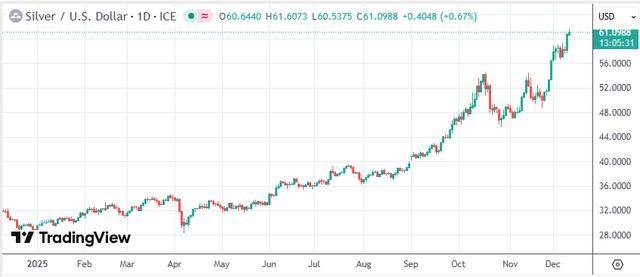
现货银价升破60美元后势头不减 ETF资金狂涌、投机客集结
Sou Hu Cai Jing· 2025-12-10 09:17
Core Viewpoint - The price of spot silver has surged, breaking the $60 per ounce mark and reaching $61.62, with a monthly increase of nearly 9% and an annual increase of over 112% [1][3]. Group 1: Price Movement - Spot silver prices rose significantly, with a peak increase of over 1.3% during the European session on December 10 [1]. - The price has shown a consistent upward trend, potentially marking the eighth consecutive month of gains [1]. Group 2: Market Drivers - The recent surge in silver prices is attributed to supply tightness and speculative investments, driven by expectations of further monetary easing by the Federal Reserve [3]. - Market expectations indicate an 87.6% probability of a 25 basis point rate cut by the Federal Reserve, which typically benefits non-yielding precious metals like silver [3]. Group 3: Investor Sentiment - There is a strong retail and speculative investor base in silver, which tends to attract more funds when upward momentum is established [3]. - Despite a significant 20% increase over the past three weeks, market sentiment remains strong, with discussions of silver potentially reaching $100 [3]. Group 4: Supply Dynamics - Silver inventory has been steadily decreasing, with mining output failing to meet demand from investors and industrial applications, leading to ongoing supply shortages [4]. - The U.S. Geological Survey has added silver to its list of critical minerals, which may face tariffs or trade restrictions, further tightening supply [4]. - Concerns over tariffs have led traders to move silver to the U.S., exacerbating supply issues in other regions [4].