房地产业

Search documents
谈论休息权之前,请让我准时下班
Hu Xiu· 2025-05-14 12:24
Core Viewpoint - The article discusses the gap between the ideal of "rest rights" as a legal entitlement and the reality faced by workers in China, highlighting the challenges in achieving a balanced work-life dynamic in the context of evolving labor relations and economic conditions [3][4][16]. Group 1: Historical Context and Current Trends - John Maynard Keynes envisioned a future where people would only need to work 15 hours a week by the 21st century due to technological advancements [2]. - The implementation of the "8-hour workday" in China's Labor Law in 1995 has not led to the expected reduction in working hours, with average weekly hours rising to 49 in 2023 [3]. - Despite a slight decrease to 48.6 hours projected for 2024, the average workday still exceeds 8 hours, reflecting a stagnation in labor rights progress [3]. Group 2: The Concept of Rest Rights - The concept of "rest rights" is evolving, with traditional definitions becoming obsolete due to changes in labor dynamics brought about by technology and the gig economy [4][5]. - Rest rights are defined legally as a means to balance the interests of labor and capital regarding time allocation, but current practices show a significant gap between legal entitlements and actual worker experiences [6][8]. Group 3: Labor Relations and Legal Challenges - The rise of gig economy jobs complicates the recognition of labor relationships, making it difficult for workers to claim their rights under existing labor laws [10][11]. - Current legal frameworks struggle to protect flexible workers, as many platforms exploit complex employment models to evade obligations [11][12]. - The lack of clear legal recognition for new employment forms leads to inadequate protections for workers, relying instead on lower-tier guidelines from government agencies [11][12]. Group 4: Future Considerations and Cultural Shifts - The article suggests that to effectively promote rest rights, there needs to be a cultural shift towards integrating leisure and work, emphasizing the importance of both financial and time resources for consumers [17]. - The impact of AI on labor dynamics is discussed, with potential for both increased productivity and further alienation of workers, raising questions about the distribution of resources generated by AI [18][19].
中国经济观测点丨4月新注册经营主体数量小幅下降 融资规模缩小
Xin Hua Cai Jing· 2025-05-14 10:06
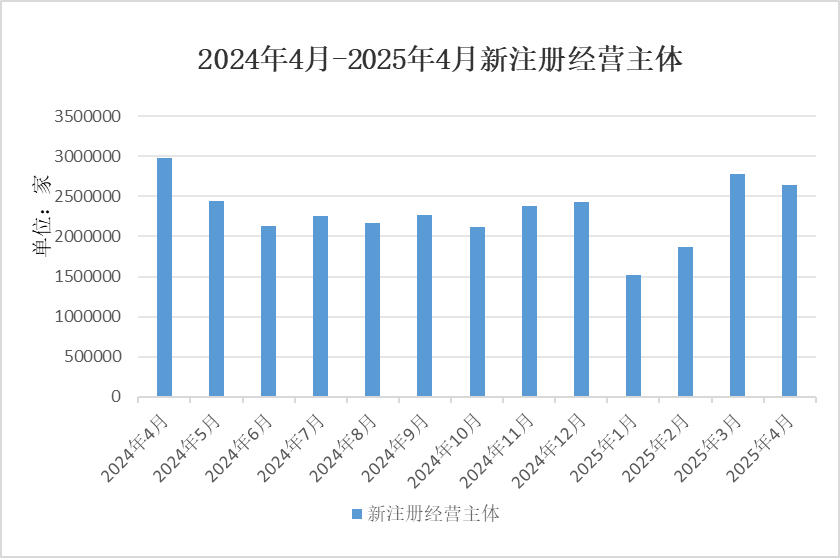
Group 1 - In April 2025, the number of newly registered business entities in China was 2.643 million, a year-on-year decrease of 11.2% and a month-on-month decrease of 5% [1] - The top ten provinces for new registrations in April remained largely consistent with the previous month, with Guangdong leading at 322,194 new entities, a year-on-year increase of 7.77% [3] - The top ten provinces accounted for over 60% of the total new registrations in April [4] Group 2 - In April, nine provinces and municipalities showed positive growth rates, with Hubei achieving the highest year-on-year growth rate of 26.10%, while Hainan had the lowest at -83.13% [6] - The retail sector had the highest number of new registrations in April, totaling 212,500, with a year-on-year growth of 12.39%, followed by wholesale and business services [8] Group 3 - The total financing scale in April 2025 was 36.367 billion yuan, with 306 financing events reported, a decrease from previous months [10] - The manufacturing sector had the highest financing scale, accounting for 283.31 billion yuan or 77.9% of the total, followed by real estate and information technology sectors [10] - In terms of financing rounds, public equity financing through private placements accounted for 15.609 billion yuan, representing 42.92% of the total financing [11]

深康佳A“离场”背后:华侨城聚焦核心主业
Hua Xia Shi Bao· 2025-05-13 02:38
Core Viewpoint - China Overseas Chinese Town Group is restructuring its development strategy to focus on core businesses and improve overall quality amidst complex internal and external environments [2][6] Group 1: Shareholding Changes - On April 29, 2023, Shenzhen Konka Group announced a change in its controlling shareholder from China Overseas Chinese Town Group to Panshi Runchuang (Shenzhen) Information Management Co., Ltd [3] - The shareholding transfer was part of a broader initiative to promote professional integration among state-owned enterprises and optimize resource allocation [3][4] - Following the transfer, the actual controller remains the State-owned Assets Supervision and Administration Commission of the State Council [3] Group 2: Financial Performance - From 2022 to 2024, Shenzhen Konka Group reported negative net profits, with a net profit of 94.81 million yuan in Q1 2025, but a non-recurring net profit loss of 441 million yuan [4] - The company is involved in consumer electronics, semiconductors, and storage chips, indicating a focus on high-tech sectors despite recent financial struggles [4] Group 3: Strategic Focus of China Overseas Chinese Town Group - China Overseas Chinese Town Group's main businesses include culture, tourism, real estate, and electronic technology, with a strategic shift away from consumer electronics to concentrate on its core competencies [6][7] - The company aims to enhance its competitive edge in tourism and real estate by divesting from non-core assets, thereby optimizing its asset structure and improving financial stability [7] - Future plans include independent operations for tourism and real estate segments, allowing for specialized development paths [6][7]



海外周报第89期:关税战下的美国库存“倒计时”-20250512
Huachuang Securities· 2025-05-12 11:42
Inventory Analysis - As of February, the overall actual inventory-to-sales ratio in the U.S. manufacturing and trade sectors is approximately 1.5 months, with manufacturers at 1.9 months, wholesalers at 1.3 months, and retailers at 1.4 months, all at low percentiles since the pandemic[2] - If assuming that the inventory of manufacturers, wholesalers, and retailers only serves domestic retail sales, the overall inventory could cover about 4.2 months of sales[2] - The low inventory-to-sales ratio may indicate limited buffer space against supply-demand imbalances, potentially leading to upward pressure on inflation[2] Industry-Specific Insights - In the retail sector, the actual inventory-to-sales ratio for furniture, appliances, and consumer electronics is low at only 1 month, placing it in the 6.5% percentile since the pandemic[3] - Conversely, the inventory-to-sales ratio for motor vehicles and parts, as well as building materials, exceeds 2 months, with motor vehicles at approximately 2.5 months (88.5% percentile) and building materials at about 2 months (85.2% percentile)[3] - In manufacturing and wholesale, machinery, textile raw materials, and related products have higher inventory-to-sales ratios, all exceeding 2 months, with machinery at 2.9 months (83.6% percentile) and textile raw materials at 2.8 months (70.4% percentile)[3] PMI and Inventory Trends - As of April, the ISM manufacturing PMI inventory index decreased to 50.8% from 53.4% in March, indicating a cooling in pre-tariff stockpiling behavior[4] - The customer inventory index remains low at 46.2%, suggesting concerns about the sustainability of overall manufacturing inventory levels[4] - Among 18 manufacturing sectors, 5 reported increased inventory in April, while 8 sectors, including textiles and transportation equipment, saw declines[4]
宏观策略周报:美国关税谈判有所进展,全球风险偏好整体升温-20250512
Dong Hai Qi Huo· 2025-05-12 09:50
1. Report Industry Investment Rating - Short - term, maintain a cautious long position for the four major stock index futures (IH/IF/IC/IM) in A - shares; maintain a cautious wait - and - see attitude for commodities and government bonds. The ranking is: stock index > government bonds > commodities. Among commodities, the ranking is: precious metals > non - ferrous metals > energy > black metals [2] 2. Core Viewpoints - Domestically, in April, China's exports increased by 8.1% year - on - year, far exceeding expectations, and the trade surplus was 96.81 billion US dollars, a year - on - year increase of 34%. China and the US will hold trade talks, and the central bank has unexpectedly cut the reserve requirement ratio by 0.5% and interest rates by 10BP, which will boost domestic risk appetite in the short term. Internationally, the US economic activities are still expanding steadily, the US - UK has reached a limited trade agreement, and the US - China trade negotiation has made progress. The Fed maintains the federal funds rate target range at 4.25% - 4.5%, and the dollar rebounds in the short term, leading to an overall increase in global risk appetite [2] 3. Summary by Directory 3.1 Last Week's Important News and Events - On May 5th, the US President announced to impose a 100% tariff on all foreign - made movies entering the US and will announce tariff measures on pharmaceutical products in the next two weeks. On May 6th, the US March trade deficit widened to a record 140.5 billion US dollars, and the US refused to cancel some tariffs on Japan. On May 7th, the Fed kept interest rates unchanged, and the US and the EU are in trade negotiations. On May 8th, the UK and the US reached a tariff trade agreement, and the EU announced a retaliatory list of 95 billion euros of US goods. On May 9th, the US President said that the US and China will conduct substantial trade negotiations this weekend, and the current 145% tariff on China will be lowered [3][4][5][6][10] 3.2 This Week's Important Events and Economic Data Reminders - From May 12th to May 16th, there will be a series of industrial data releases, including electrolytic aluminum inventory, iron ore shipping and arrival volume, etc., as well as important economic data such as the US CPI, PPI, and GDP data of various countries [11] 3.3 Global Asset Price Trends - Stock markets: Different stock indices in various countries have different price trends and changes. Bond markets: Yields of 10 - year bonds in different countries have different fluctuations. Commodity markets: Prices of various commodities such as steel, non - ferrous metals, and energy have different changes. Exchange rate markets: Exchange rates of major currencies have different degrees of fluctuations [12] 3.4 Domestic High - Frequency Macroeconomic Data - Upstream: Includes data on commodity price indices, energy prices, coal inventories, and iron ore prices. Mid - stream: Covers data on steel prices, production, and inventory, non - ferrous metal prices and inventory, building material prices and inventory, and chemical product prices and inventory. Downstream: Involves data on real estate transaction area, automobile sales, and agricultural product prices [13][42][71] 3.5 Domestic and Foreign Liquidity - Global liquidity: Shown by the US Treasury yield curve. Domestic liquidity: Reflected by central bank open - market operations, inter - bank lending rates, and bond yields [82][84] 3.6 Global Financial Calendar - From May 13th to May 16th, there are important economic data releases in the EU, the US, Germany, Japan, etc., including CPI, PPI, GDP, and other data [105]
出售矿业资产加速新能源转型 ,“卧龙地产”证券简称即将更改为“卧龙新能”
Shen Zhen Shang Bao· 2025-05-09 13:58
Core Viewpoint - The company is undergoing a significant transformation from a traditional mineral trading business to a focus on renewable energy, as evidenced by the change of its stock abbreviation to "卧龙新能" (Wolong New Energy) and the divestiture of its mining assets [1][3][5] Group 1: Company Name and Stock Abbreviation Change - The company will officially change its stock abbreviation from "卧龙地产" (Wolong Real Estate) to "卧龙新能" (Wolong New Energy) on May 15, 2025, following approval from the Shanghai Stock Exchange [1][3] - The name change reflects the company's strategic shift towards renewable energy, with the management team having extensive experience in the industry [3] Group 2: Asset Divestiture - The company is in the process of selling its core mineral trading platform, Shanghai Mining, with preliminary valuation agreements reached between the parties involved [1][4] - The sale of Shanghai Mining, which accounted for nearly 70% of the company's revenue, aims to eliminate competition with its controlling shareholder, Wolong Holdings [4][5] Group 3: Strategic Focus on Renewable Energy - The company plans to actively respond to the national "dual carbon" policy by developing its renewable energy business, which includes wind, solar, energy storage, and hydrogen energy sectors [2] - Specific initiatives include the construction of a wind energy project in Baotou and the acquisition of distributed solar power station orders to enhance market share [2] - The company has made significant acquisitions in 2025, including stakes in four companies related to power and energy storage, establishing a comprehensive business matrix in the renewable energy sector [5]

董希淼解析金融增量政策:房地产新模式转向“租购双轨”,险资入市或催生蓝筹红利
Sou Hu Cai Jing· 2025-05-09 11:51
Core Viewpoint - The newly introduced financial policies can be seen as an upgraded version of last year's 924 policy, aimed at stabilizing market confidence and promoting high-quality economic development in the face of increasing global uncertainties [2]. Group 1: Financial Policies and Market Impact - The financial policies include eight incremental measures targeting real estate, stock markets, and technology finance, such as new financing systems for real estate and expanded insurance fund investments [1][2]. - The "white list" loan mechanism for real estate financing has increased to 6.7 trillion yuan, allowing banks to selectively support qualified enterprises while managing risk [3][4]. Group 2: Real Estate Development Model - The new real estate development model shifts from a "single sale" approach to a "rental and purchase" model, necessitating innovative financing systems to support rental housing construction and loans [3]. - The financing system will need to adapt to support both rental housing and general commodity housing loans, reflecting a dual-track system of affordable and commercial housing [3]. Group 3: Insurance Fund Investments - Insurance funds, characterized by their large scale and long duration, are expected to increase their investments in the stock market, with over 4.4 trillion yuan currently allocated to equity assets [6]. - Policies are set to direct 30% of new premiums from large state-owned insurance companies into the A-share market annually, providing a stable influx of capital [6]. Group 4: Support for Technology Enterprises - The establishment of financial asset investment companies aims to enhance support for technology enterprises through a "dual investment and loan" model, allowing banks to provide both credit support and equity investment [9][10]. - The development of specialized technology insurance is anticipated to provide risk coverage for early-stage technology companies, facilitating their access to financing [10][11].
“增量政策”序幕拉开——稳市场稳预期新闻发布会学习理解
赵伟宏观探索· 2025-05-08 22:44
Core Viewpoint - The article discusses the recent press conference held by the State Council Information Office on May 7, 2025, which introduced a comprehensive financial policy package aimed at stabilizing the market and expectations. The focus is on the implementation of monetary policies and measures to support various sectors, including real estate, capital markets, and private enterprises [1][10]. Summary by Sections Monetary Policy Measures - The central bank introduced three types of monetary policy measures: quantity-based policies, price-based policies, and structural policies. Quantity-based policies include reserve requirement ratio (RRR) cuts to increase long-term liquidity supply. Price-based policies involve lowering policy interest rates and structural monetary policy tool rates, including public housing loan rates. Structural policies aim to improve existing tools and create new ones to support innovation, consumption, and inclusive finance [2][11]. - A comprehensive RRR cut of 0.5 percentage points is expected to provide approximately 1 trillion yuan in long-term liquidity to the market [7]. - The central bank also lowered the interest rates on structural monetary policy tools by 0.25 percentage points, which is projected to save banks approximately 150-200 million yuan annually in funding costs [4][12]. Financial Support for Real Estate and Capital Markets - The Financial Regulatory Bureau announced eight incremental policies to support real estate, capital markets, and private enterprises. These include accelerating the introduction of financing systems compatible with new real estate development models and expanding the scope of long-term investment trials for insurance funds [3][11]. - The demand side of the real estate market will benefit from a 0.25 percentage point reduction in personal housing provident fund loan rates, which is expected to save residents over 200 million yuan in interest payments annually [6][15]. Support for Private Enterprises and Innovation - The conference emphasized strong financial support for private enterprises and technological innovation. The central bank plans to use tools like innovation re-loans to increase credit support for private enterprises in technology sectors [5][14]. - The Financial Regulatory Bureau proposed a comprehensive policy package to support private enterprise financing and provide precise financial services to entities significantly affected by tariffs [3][14]. Market Stability Initiatives - The policies aim to stabilize and activate capital markets through various measures, including enhancing the collaboration between the central bank and the China Investment Corporation to support stock market index funds and providing sufficient re-loan support [5][14]. - The introduction of a new merger and acquisition loan management approach is intended to facilitate industrial transformation and upgrading [8][14]. Overall Economic Context - The recent monetary policy actions are seen as a response to the stable performance of the real estate and stock markets, with the economy showing resilience, as indicated by a 5.4% year-on-year GDP growth in the first quarter [12][13].
5月信用债策略月报:回归基本面,信用债如何配置?-20250508
Huachuang Securities· 2025-05-08 10:43
Group 1 - The report emphasizes the importance of fundamental research on issuers in a weak economic environment, highlighting the recent incident involving China Aviation Industry Corporation as a case in point [1][15][22] - It notes that the probability of credit spread compression is high in May, driven by favorable monetary conditions and the need for institutional investors to adjust their preferences in a low-interest-rate environment [1][15][19] - The report suggests that the current market conditions favor short-term credit products, while the demand for medium to long-term credit bonds may be constrained due to regulatory impacts on wealth management products [1][15][23] Group 2 - The strategy for credit bonds includes focusing on high-yielding products and extending duration where possible, particularly in the 4-5 year range, while being cautious about liquidity [2][3][23] - It highlights that the current yield spreads for various credit products are at historically high levels, indicating potential for further compression, especially in the 2-3 year and 4-5 year categories [2][24][26] - The report identifies specific sectors for investment, such as local government bonds and high-rated real estate bonds, while advising caution in lower-rated sectors due to ongoing credit risks [4][5][19]
这次降准降息,一点都不简单
虎嗅APP· 2025-05-08 10:03
Core Viewpoint - The recent reduction in the reserve requirement ratio (RRR) by 0.5% and the expected decrease in mortgage rates by 0.1% are seen as measures to stabilize the economy and the real estate market, rather than aggressive stimulus actions [4][34][40]. Group 1: Monetary Policy Changes - The RRR cut aims to increase the liquidity in the market, allowing banks to lend more, which can stimulate economic activity [14][15]. - This RRR adjustment is notable as it is the longest interval since the last cut, indicating a careful approach to monetary policy [19][22]. - The reduction in mortgage rates is a reflection of the broader monetary policy aimed at maintaining stability in the housing market [34][40]. Group 2: Real Estate Market Implications - The announcement includes support for a new financial development strategy aligned with the evolving real estate market [33]. - The reduction in the public housing loan interest rate from 2.85% to 2.6% is expected to lower the cost of home purchases for borrowers [35]. - The current mortgage rate of 3.6% and the reduced public loan rate suggest potential for further decreases in housing loan rates, which could stimulate the market [36][40]. Group 3: Structural Financial Support - The introduction of 300 billion yuan for technological innovation and 500 billion yuan for service consumption and elderly care loans indicates a shift towards supporting emerging sectors [54][57]. - An increase of 300 billion yuan in loans for agriculture and small businesses highlights the focus on strengthening the domestic economy [63]. - The reduction of reserve requirements for auto finance companies to 0% demonstrates targeted support for the automotive industry, which is seen as a key growth area [66][69]. Group 4: Broader Economic Context - The overall monetary policy is designed to ensure economic growth and stability, with a focus on gradual adjustments rather than abrupt changes [30][78]. - The measures taken are part of a larger strategy to adapt financial support to the needs of the economy, particularly in light of recent recovery signs [25][60]. - The emphasis on maintaining stability in the real estate market reflects a cautious approach to avoid overheating while still encouraging growth [41][42].