
贵金属

Search documents
贵属策略报:?银再度下跌,?银波动剧烈
Zhong Xin Qi Huo· 2026-02-06 01:32
万得数据显⽰,⽇内⾦银价格再度下⾏,其中⽩银板块跌势更⼤、跌幅逾 9%;主要受投资者获利抛售、美元指数⾛强及地缘紧张局势趋缓等多重 因素压制。据央视新闻报道,当地时间2⽉4⽇,经多位中东领导⼈紧急游 说,原定于2⽉6⽇举⾏的美伊核谈判计划得以恢复,地缘紧张局势有所缓 和。此外,中国⻩⾦协会指出,2025年我国⻩⾦消费量同⽐下降3. 57%、⽽⻩⾦产量同⽐上升1.09%,对短期⾦价上涨空间形成抑制。近期 亚太股市受美股冲击,市场情绪反复,叠加2⽉5⽇上期所再次宣布上调⾦ 银等期货品种保证⾦并扩⼤涨跌停板,短期⾦银波动⻛险仍较⼤;预计短 线⻩⾦维持宽幅震荡,⽩银波动⻛险尤为突出。 投资咨询业务资格:证监许可【2012】669号 中信期货研究|贵⾦属策略⽇报 2026-2-6 ⾦银再度下跌,⽩银波动剧烈 黄金观点:短线维持宽幅震荡走势。 逻辑:万得数据显示,日内海内外金价均下跌超1%,受投资者止盈 抛售、美元指数走强、美伊地缘紧张局势边际缓和等因素压制;中国 黄金协会指出2025年黄金消费量有所下降、而产量增加,亦对短期 上涨空间形成一定压制。2月5日中国黄金协会数据显示,2025年我国 黄金产量381.339吨、 ...
黄金早参丨交易所上调保证金及涨跌停限制,金价承压回落,短期或维持宽幅震荡
Sou Hu Cai Jing· 2026-02-06 01:29
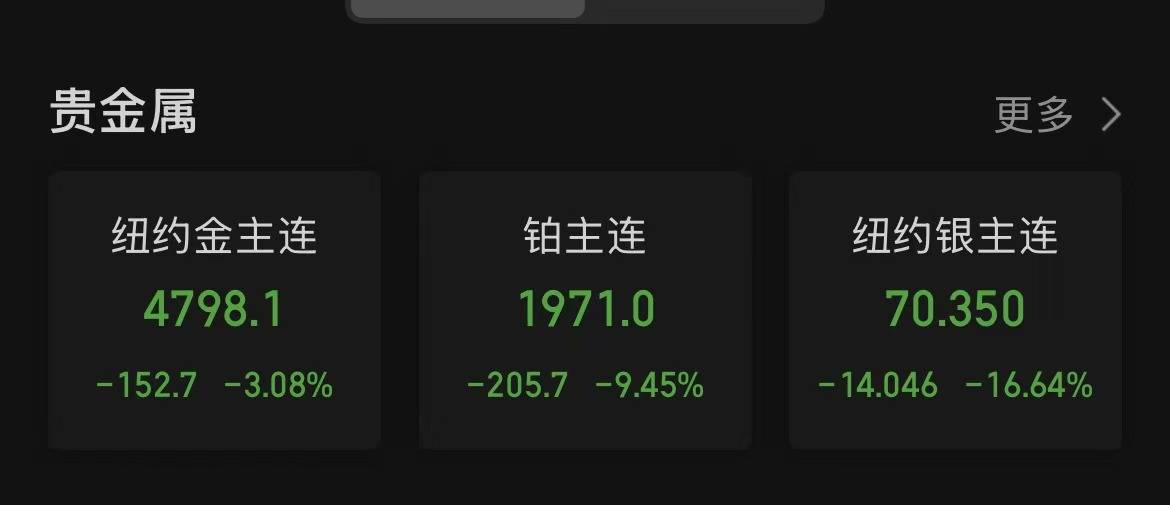
Core Viewpoint - The gold and silver prices experienced a significant decline due to increased margin requirements set by exchanges and the Federal Reserve's commitment to maintaining a tight monetary policy [1] Group 1: Market Reactions - As of the market close, COMEX gold futures fell by 3.08% to $4,798.10 per ounce, while the China Gold ETF (518850) also dropped by 3.08% [1] - The gold stock ETF (159562) decreased by 5.13%, and the non-ferrous metals ETF (516650) fell by 4.89% [1] Group 2: Margin Requirements - The CME raised the initial margin for COMEX 100 gold futures from 8% to 9% and for COMEX 5000 silver futures from 15% to 18% [1] - The Shanghai Futures Exchange announced that starting from February 9, the price fluctuation limits for gold and silver futures will be adjusted to 17% and 20%, respectively [1] - The margin requirements for maintaining positions will be adjusted to 18% and 21%, while general position trading margins will be set at 19% and 22% [1] Group 3: Market Analysis - Analysts noted that the recent strength of the US dollar and a broad market decline prompted investors to sell off their precious metal holdings [1] - A calming of geopolitical tensions has also reduced the safe-haven demand for gold, contributing to the ongoing price decline [1] - Short-term expectations indicate that gold prices will continue to experience wide fluctuations, with key attention on the progress of US-Iran nuclear negotiations and changes in US monetary policy expectations [1]
道指跌近600点,原油下跌,白银重挫,比特币跌破65000美元/枚
Zhong Guo Ji Jin Bao· 2026-02-06 01:20
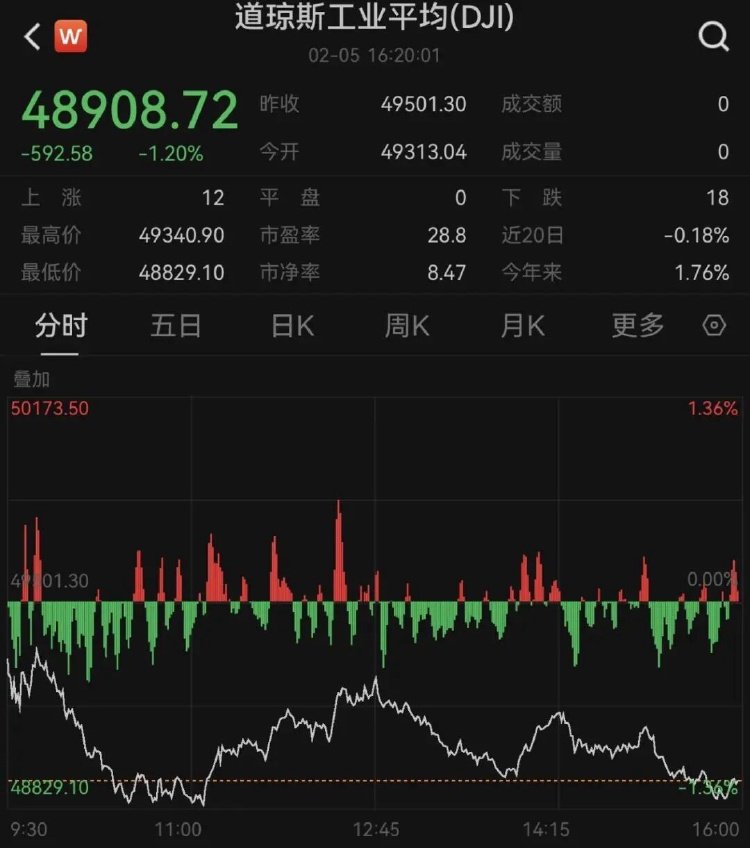
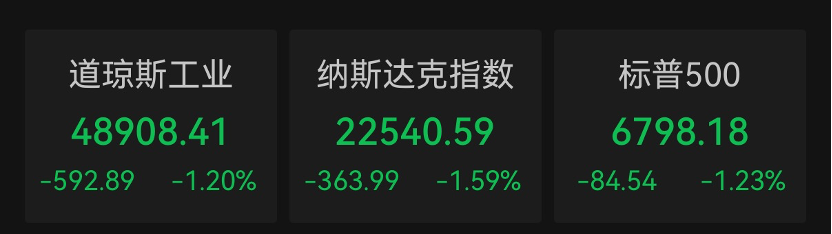
Market Overview - The Dow Jones Industrial Average fell by 592.58 points, a decline of 1.20%, closing at 48,908.72 points [2] - The Nasdaq Composite dropped by 363.99 points, down 1.59%, ending at 22,540.59 points [2] - The S&P 500 index decreased by 84.32 points, a 1.23% drop, closing at 6,798.40 points [2] Technology Sector Performance - Major tech stocks experienced significant declines, with Microsoft down nearly 5%, Amazon falling over 4%, and Tesla dropping more than 2% [6] - The performance of the "Tech Seven" index showed a decrease of 1.75% [7] - Amazon plans to invest $200 billion in data centers and chips, raising concerns among investors about profit pressures before returns materialize [7] Commodity Market Movements - Crude oil prices fell after a previous increase, with WTI settling at $63.29 per barrel and Brent crude down 2.8% to $67.55 per barrel [9] - Silver prices saw a significant drop, with a decline of 18% on Thursday, closing at $72.12 per ounce [10] - Bitcoin fell below $65,000, erasing all gains since Trump's election, marking a significant downturn in the cryptocurrency market [12][15] Economic Indicators - The number of planned layoffs in January reached the highest level for that month since the global financial crisis, while hiring intentions hit a record low [5] - Initial jobless claims in the U.S. rose significantly, reaching the highest level since early December, reversing a recent downward trend [5]






帮主郑重:昨夜全球资产大洗牌,你的钱袋子还好吗?
Sou Hu Cai Jing· 2026-02-06 01:11
Group 1: Market Overview - The recent decline in various asset classes, including U.S. stocks, gold, and Bitcoin, is attributed to a clear logic of deleveraging and market corrections [3][4][6] - Bitcoin's sharp drop is primarily due to investors using leverage, leading to forced liquidations as prices fell, creating a domino effect [3] - Gold and silver prices have also decreased, influenced by reduced geopolitical tensions and a stronger U.S. dollar, alongside selling pressure from investors needing to cover margin calls [3][4] Group 2: U.S. Stock Market Dynamics - The Dow Jones Industrial Average fell nearly 600 points, with the S&P 500 erasing its gains for the year, driven by concerns over weak employment data and a potential shift in Federal Reserve interest rate expectations [4] - The market is undergoing a repricing phase, reflecting uncertainty about economic conditions and interest rate policies [4] Group 3: Technology Sector Insights - The technology sector is experiencing a divergence, with companies like OpenAI advancing AI applications while others, such as those involved in traditional finance, face challenges [4][6] - The release of AI models capable of financial research has raised concerns about the impact on traditional financial services, indicating a potential industry transformation [6] Group 4: Investment Strategies - Investors are advised to avoid leverage, particularly in volatile assets like cryptocurrencies, and to focus on long-term, stable investment strategies [5] - It is recommended to refrain from chasing market trends or attempting to time the market during periods of panic, instead waiting for clearer signals before making investment decisions [5] - Diversification across asset classes, including U.S. stocks and precious metals, is emphasized to mitigate risks associated with market fluctuations [5] Group 5: Macro Trends and Policy Implications - Global uncertainties are increasing, influenced by geopolitical developments and policy changes, which can subtly affect market dynamics [5] - Investors should align their strategies with broader policy trends and industry developments rather than acting against prevailing market sentiments [5]

券商晨会精华:继续坚定看好中国资产重估进程
Xin Lang Cai Jing· 2026-02-06 00:17
Group 1 - The three major indices narrowed their declines after initially dropping over 1%, with the North Stock 50 Index falling over 2% [1] - The total trading volume in the Shanghai and Shenzhen markets was 2.18 trillion, a decrease of 304.8 billion compared to the previous trading day [1] - Over 3,700 stocks in the market declined, while the consumer sector saw significant gains, particularly in food and beverage, retail, film and television, and tourism [1] Group 2 - CITIC Securities predicts faster profit growth in sectors such as aerospace, electricity, and non-ferrous metals based on industrial indicators [2] - The Industrial Prosperity Index, constructed using six industrial indicators, shows a strong correlation with profit growth in manufacturing companies [2] - The index indicates that over 60% of industry prosperity indices correlate with corresponding profit growth rates above 50% [2] Group 3 - Huatai Securities reports that the ongoing negotiations regarding Indonesia's coal production quotas for 2026 are impacting spot coal exports [3] - The reduction in Indonesian coal spot exports is estimated to affect China's monthly average thermal coal consumption and import volumes by 0.5% and 4.2%, respectively [3] - The timing of the quota negotiations coincides with the Lunar New Year, which may amplify the emotional impact on coal consumption beyond the fundamental effects [3]
美股全线下跌,金银暴跌!“中国金龙”,逆势走强
Zhong Guo Zheng Quan Bao· 2026-02-05 23:36
Market Overview - On February 5, U.S. stock indices closed lower, with the Dow Jones down 1.2%, S&P 500 down 1.23%, and Nasdaq down 1.59% [2][4] - Large technology stocks mostly declined, with the U.S. tech giants index falling 1.76% [4] Amazon's Financial Performance - Amazon reported Q4 sales of $213.39 billion, slightly above market expectations of $211.49 billion, but earnings per share were $1.95, just below the forecast of $1.96 [4] - The company anticipates capital expenditures of approximately $200 billion by 2026, significantly higher than the market estimate of $146.11 billion, representing a 37% increase [4] Chinese Stocks Performance - The Nasdaq Golden Dragon China Index rose by 0.9%, while the Chinese tech leaders index fell by 0.45% [4] - Notable movements included NIO rising over 6%, while Tencent Holdings dropped over 1% [4] Precious Metals Market - Precious metals prices fell sharply, with London gold spot prices dropping over 4% to $4,760.25 per ounce, and COMEX gold futures down over 2% to $4,825.50 per ounce [5][6] - London silver spot prices plummeted by 19% to $71.841 per ounce, with COMEX silver futures down over 14% to $72.565 per ounce [5][6] Electric Vehicle Strategy in Canada - Canada announced a new electric vehicle strategy, including the revival of purchase subsidies and collaboration with China to boost domestic production and export of electric vehicles [7] - The strategy aims to leverage existing and new trade agreements to promote large-scale investments in the electric vehicle sector [7]
凌晨!全线暴跌,超43万人爆仓!美股、黄金、白银、比特币、石油全崩了
券商中国· 2026-02-05 23:33
Market Overview - The financial markets experienced a comprehensive sell-off, with the cryptocurrency market facing a "crash-like" decline, where Bitcoin fell over 12% and Ethereum dropped over 13% [1][3]. - Over 430,000 traders were liquidated in the cryptocurrency market within 24 hours, with a total liquidation amount reaching approximately $2.069 billion (around 144 million RMB) [4][5]. Cryptocurrency Market - Bitcoin's price fell to around $63,860.8, marking a 12.81% decrease, while Ethereum's price dropped to $1,867.6, down 13.10% [4]. - Other cryptocurrencies also saw significant declines, with XRP plummeting over 22% and SOL and Dogecoin both dropping over 14% [3][4]. - Since reaching its peak in October of the previous year, Bitcoin's price has fallen over 48%, with its market capitalization shrinking from $2.48 trillion to $1.27 trillion [4]. Stock Market - The U.S. stock market also faced severe declines, with all three major indices closing down over 1%. The Nasdaq experienced its worst three-day sell-off since April of the previous year, dropping 1.59% [8]. - Major tech stocks such as Amazon and Microsoft fell over 4%, while Tesla dropped over 2% [9]. Employment Data Impact - Weak employment data contributed to the market's bearish sentiment, with U.S. employers announcing 108,435 layoffs in January, the highest for that month since the global financial crisis [9]. - Initial jobless claims also exceeded expectations, indicating a potential decoupling of employment from economic growth [9]. Precious Metals Market - The precious metals market was similarly affected, with silver prices plummeting over 19% and gold dropping over 3% [10]. - Following the recent declines, the Chicago Mercantile Exchange (CME) announced adjustments to margin requirements for certain futures contracts, increasing the margin for gold to 9% and for silver to 18% [11].

英皇娱乐酒店卖金砖豪赚9020万港元!贵金属巨震下的套现和豪赌
2 1 Shi Ji Jing Ji Bao Dao· 2026-02-05 23:08
Core Viewpoint - The precious metals market remains unstable, with significant price fluctuations in gold and silver, leading to varied strategies among companies and investors [1][9]. Group 1: Company Actions - Aok Holdings plans to sell up to 10,000 kilograms of silver based on market conditions, which was acquired in 2020, to improve its financial performance, expecting a profit contribution of approximately 52 million yuan from this sale [2]. - Emperor Entertainment Hotel confirmed the sale of its "gold bricks" for 99.7 million HKD, anticipating a profit of 90.2 million HKD, as part of a strategy to enhance its service offerings following the cessation of its gaming operations [3]. - The Secretary of the Board of Directors of Xinyi Silver Tin made headlines by purchasing 2 million yuan worth of shares at a limit-down price, indicating confidence in the company's future despite recent price drops [5][6]. Group 2: Market Dynamics - The precious metals market has experienced a significant pullback, with London gold and silver seeing maximum declines of 21.37% and over 41% respectively since January 29 [9]. - Financing funds have aggressively bought shares of Hunan Gold, with net purchases reaching 1.8 billion yuan over two days, reflecting a strong interest in bottom-fishing during the price decline [8]. - The volatility of gold and silver remains high, with recent trading days showing fluctuations exceeding 10%, indicating ongoing market instability and potential for further price movements [10][11].
一天抹去三天弱反“成果”,国际白银现货价格再创新低
Sou Hu Cai Jing· 2026-02-05 22:41
Group 1 - The international silver spot price hit a new low, with COMEX gold futures down 3.08% at $4798.1 per ounce and COMEX silver futures down 16.64% at $70.35 per ounce [1] - The significant drop in COMEX silver futures erased the gains accumulated over the previous three days, indicating a volatile market reaction [2] - The market's initial reaction was triggered by Trump's nomination of Kevin Warsh as the next Federal Reserve Chairman, which alleviated concerns about the Fed's independence and strengthened the dollar, negatively impacting gold and silver prices [3] Group 2 - On January 30, the international precious metals market experienced its largest single-day drop since 1980, with silver falling over 36% and gold dropping more than 12% [3] - Following a brief rebound from February 2 to February 4, where COMEX silver futures increased by 0.98%, 10.27%, and 5.36%, the subsequent drop on February 5 negated these gains [2] - The CME's "FedWatch" indicated a 22.7% probability of a 25 basis point rate cut by March, with a 77.3% chance of maintaining current rates, reflecting market expectations for monetary policy [4] Group 3 - The A-share non-ferrous metal sector faced continued pressure, with companies like Hunan Silver and Sichuan Gold experiencing significant declines, including trading halts [4] - Experts suggest that the adjustment in gold and silver prices is not over, advising investors against blindly trying to buy the dip and emphasizing the importance of market conditions and geopolitical factors [5] - The relationship between gold prices and the dollar is highlighted, with a strong dollar typically leading to weaker gold prices, indicating a complex interplay of economic factors affecting precious metals [5]
刚刚!黄金、白银再跳水!史诗级震荡搅动三大市场,后市两大变量
Sou Hu Cai Jing· 2026-02-05 15:46
Core Viewpoint - The recent epic volatility in metal prices, particularly gold and silver, has had a significant impact on various financial markets, including stocks, futures, and funds [1][3]. Group 1: Metal Price Volatility - On February 5, international gold and silver prices dropped sharply, with spot gold falling over 3% and spot silver dropping more than 17%, breaking below $74 per ounce [1]. - Since reaching historical highs on January 29, the precious metals market has experienced unprecedented fluctuations, affecting not only metal prices but also broader financial markets [1][3]. - The volatility has led to a dramatic decline in futures market positions, with total open interest in Shanghai gold futures decreasing by over 47,000 contracts since January 30 [3][4]. Group 2: Impact on Futures and Stock Markets - The fluctuations in metal prices have caused significant changes in the total open interest of various metal futures, including platinum, palladium, copper, aluminum, and tin, reflecting a downward trend [4]. - In the A-share market, financing balances for metal-related stocks have also experienced extreme fluctuations, mirroring the volatility in metal prices [4]. - For example, Hunan Silver's financing balance surged from approximately 1 billion yuan to 1.4 billion yuan during the rise in silver prices, only to drop back to just over 1 billion yuan as prices plummeted [4]. Group 3: Fund Market Reactions - The volatility in metal prices has also affected the fund market, with several commodity funds, particularly gold ETFs, experiencing significant fluctuations in scale [6][7]. - From January 30 to February 2, 14 commodity gold ETFs collectively shrank by over 60 billion yuan due to the sharp drop in metal prices [6]. - The scale of the Huazhong Gold ETF, for instance, decreased by approximately 7.9 billion yuan on January 30 and further by about 16.5 billion yuan on February 2, totaling a reduction of over 20 billion yuan in just two trading days [7]. Group 4: Future Price Dynamics - Analysts suggest that the core foundation of the current precious metals bull market is the contraction of dollar credit, indicating that the long-term narrative has not reversed [9][10]. - The future price dynamics of platinum, palladium, and base metals will be primarily driven by macroeconomic expectations and supply-side disruptions [10]. - The market will continue to focus on the marginal changes in the Federal Reserve's monetary policy, with expectations of a weak dollar providing support for precious and base metals [10].