债券

Search documents
政策助力下,中长期有望“稳中有进”
Datong Securities· 2025-12-16 07:55
Group 1 - The overall asset performance indicates that various asset classes have entered a period of fluctuation, with the equity market experiencing a high-level consolidation phase, primarily driven by the technology sector, while consumer and cyclical sectors remain weak [1][6]. - The Federal Reserve's recent interest rate cut was weaker than expected, limiting its positive impact on the U.S. and global economies, which in turn affects the capital markets [1][6]. - The Central Economic Work Conference in China reiterated a stable growth approach, with a focus on expanding domestic demand and improving investment, although the implementation of these policies may take time to materialize [2][10]. Group 2 - The A-share market is currently in a high-level consolidation phase, with limited substantial positive news and a preference for stability as the new year approaches [2][10]. - The report suggests a "barbell strategy" for asset allocation, recommending maintaining positions in the technology sector while cautiously considering opportunities in the consumer sector due to recent positive macro data [2][11]. - The technology sector is expected to remain a core driver of market performance, with significant opportunities arising from national competition and domestic innovation [10][11]. Group 3 - The bond market is following the trends of the equity market, showing a clear negative correlation, and is expected to remain under pressure without significant positive catalysts [3][32]. - The bond market's configuration suggests limited upward potential in the short term, but it may serve as a stabilizing option against equity market volatility [32]. Group 4 - The commodity market is experiencing a return to a fluctuating trend, with precious metals like silver supporting the upward movement of the precious metals index, while energy and chemical commodities are underperforming [4][41]. - The report anticipates that gold may continue to rise in the long term, driven by a decoupling from the U.S. dollar, although the overall strength of the commodity market will depend on the performance of metals and agricultural products [41][45].
政府债周报(12/14):下周新增债披露发行352亿-20251216
Changjiang Securities· 2025-12-16 05:47
Report Investment Rating - No investment rating information provided in the report Core Viewpoints - From December 15 - 21, local government bonds are scheduled to be issued worth 400.4 billion yuan, including 352.2 billion yuan of new bonds (59.6 billion yuan of new general bonds and 292.6 billion yuan of new special bonds) and 48.2 billion yuan of refinancing bonds (39.2 billion yuan of refinancing general bonds and 9.0 billion yuan of refinancing special bonds) [1][5] - From December 8 - 14, local government bonds worth 1069.6 billion yuan were issued, including 710.5 billion yuan of new bonds (210.0 billion yuan of new general bonds and 500.5 billion yuan of new special bonds) and 359.0 billion yuan of refinancing bonds (187.4 billion yuan of refinancing general bonds and 171.6 billion yuan of refinancing special bonds) [1][5] - As of December 14, the fifth - round second - batch special refinancing bonds totaled 20,000.00 billion yuan, the sixth - round totaled 2881.00 billion yuan, and no new disclosure was made this week. The top three provinces or municipalities with separately - planned status in the fifth - round second - batch disclosure were Jiangsu (2511.00 billion yuan), Hunan (1288.00 billion yuan), and Henan (1227.00 billion yuan) [5] - As of December 14, the special new special bonds in 2025 totaled 13656.08 billion yuan, and since 2023, a total of 25534.72 billion yuan has been disclosed. The top three in terms of disclosure scale are Jiangsu (2440.35 billion yuan), Hubei (1377.69 billion yuan), and Henan (1325.34 billion yuan). The top three provinces or municipalities with separately - planned status in 2025 disclosure are Jiangsu (1289.00 billion yuan), Guangdong (1239.28 billion yuan), and Henan (759.60 billion yuan) [6] Summary by Directory Local Bond Actual Issuance and Forecast Issuance - Actual Issuance and Pre - issuance Disclosure: From December 8 - 14, the net supply of local government bonds was 623 billion yuan; from December 15 - 21, the forecast net supply of local government bonds is 281 billion yuan [12] - Comparison of Planned and Actual Issuance: Data shows the comparison between planned and actual issuance of local government bonds in November and December, as well as the comparison of monthly issuance and net financing in recent months [15][18][21] Local Bond Net Supply - New Bond Issuance Progress: As of December 14, the issuance progress of new general bonds was 95.06%, and that of new special bonds was 99.32%. The calculation denominator of the issuance progress includes the 200 billion yuan of used carry - over quota, so there is a certain difference in the caliber compared with the previous progress (before November) [25] - Refinancing Bond Net Supply: As of December 14, the cumulative scale of refinancing bonds minus local government bond maturities for the year is shown in the figure, and the statistical caliber includes both issued and disclosed but not yet issued bonds [27][28] Special Bond Issuance Details - Special Refinancing Bond Issuance Statistics: As of December 14, the special refinancing bond statistics are presented in the figure, including different rounds of issuance in various regions, and the statistical caliber includes both issued and disclosed but not yet issued bonds [31][32] - Special New Special Bond Issuance Statistics: As of December 14, the special new special bond statistics are presented in the figure, showing the issuance in 2023, 2024, and 2025 in various regions, and the statistical caliber includes both issued and disclosed but not yet issued bonds [34][35] Local Bond Investment and Trading - Primary - Secondary Spread: The primary and secondary spreads of local government bonds are presented in the figure, showing the spreads of different maturities on December 7 and December 14, 2025, and the changes [38] - Regional Secondary Spread: The regional secondary spreads of local government bonds from September 5, 2025, to December 12, 2025, in different regions are presented in the figure [39] New Special Bond Investment Directions - Project Investment Direction Monthly Statistics: The latest month's statistics only consider the investment directions of issued new bonds, and do not consider the pre - issuance disclosure of new bond investment directions [41]
债市早报:11月宏观经济数据出炉;资金面依然宽松,债市延续调整
Jin Rong Jie· 2025-12-16 03:23
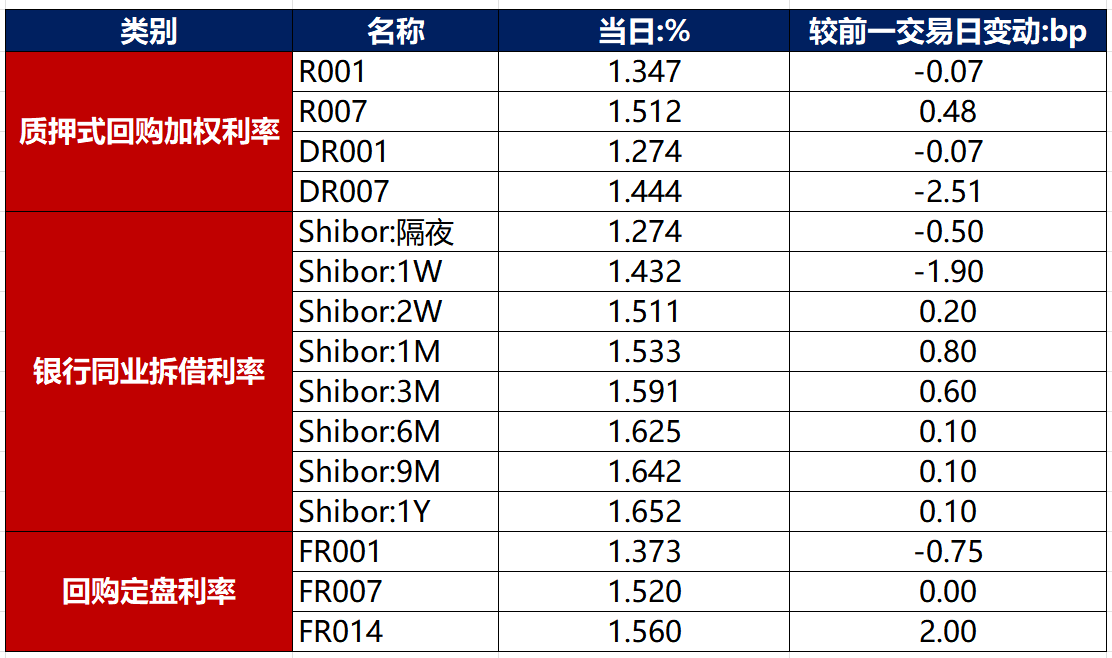
Group 1: Domestic News - Xi Jinping's article emphasizes that expanding domestic demand is a strategic move essential for economic stability and security, aiming to make it the main driver of economic growth [2] - The China Securities Regulatory Commission (CSRC) is committed to deepening reforms in the capital market to support stable employment and economic development [2] - The November macroeconomic data shows a 4.8% year-on-year increase in industrial added value, while retail sales grew by 1.3%, indicating a slowdown in consumption [3] Group 2: Monetary Policy and Market Operations - The People's Bank of China conducted a 130.9 billion yuan reverse repurchase operation at a fixed rate of 1.40%, resulting in a net cash injection of 8.6 billion yuan for the day [7] - The money market remains loose, with the DR001 and DR007 rates declining to 1.274% and 1.444%, respectively [8] Group 3: Bond Market Dynamics - The bond market continues to adjust, with long-term bonds experiencing greater volatility; the yield on the 10-year government bond rose by 1.65 basis points to 1.8590% [11] - The secondary market for credit bonds showed significant price deviations, with some bonds experiencing drastic declines [13] - Several companies, including R&F Properties and Times China Holdings, announced bondholder meetings to discuss repayment arrangements amid market fluctuations [14][16] Group 4: International Market Insights - The New York Fed reported a significant drop in the manufacturing activity index, indicating a contraction in the sector, although future outlook indicators improved [5] - U.S. Treasury yields generally declined, with the 10-year yield falling to 4.18% [21] - Major European economies saw a decrease in 10-year government bond yields, with Germany's yield down to 2.85% [24]


新西兰国债涨幅扩大 债券发行计划规模缩小
Xin Lang Cai Jing· 2025-12-16 00:54
Core Viewpoint - New Zealand has reduced its bond issuance forecast, leading to an increase in bond prices and a decline in yields across various maturities [1] Group 1: Bond Market Reaction - The 5-year government bond yield in New Zealand decreased by 11 basis points to 3.70% [1] - The 10-year government bond yield fell by 10 basis points to 4.40% [1] - The 2-year government bond yield dropped by 4 basis points to 2.73% [1] Group 2: Issuance Forecast - The updated government bond issuance plan anticipates a total issuance of NZD 35 billion by the fiscal year ending June 2026 [1] - This figure represents a reduction of NZD 3 billion from previous estimates [1]
美国国债:12月15日收益率多有变动,呈现不同走势
Sou Hu Cai Jing· 2025-12-15 22:50
Core Viewpoint - The article discusses the recent movements in U.S. Treasury yields, highlighting a decline in the 10-year yield and variations in other maturities, indicating market reactions to economic conditions and inflation expectations [1]. Group 1: Treasury Yield Movements - The 10-year U.S. Treasury yield decreased by 0.78 basis points, closing at 4.1763% [1] - The 2-year Treasury yield fell by 2.07 basis points, settling at 3.5015% [1] - The 30-year Treasury yield increased by 0.31 basis points, reaching 4.8476% [1] Group 2: Yield Spread and Inflation-Linked Securities - The yield spread between the 2-year and 10-year Treasuries widened by 1.278 basis points, now at +67.257 basis points [1] - The 10-year Treasury Inflation-Protected Securities (TIPS) yield rose by 1.08 basis points, to just below 1.8965% [1] - The 2-year TIPS yield increased by 1.64 basis points, reaching 1.1272% [1] - The 30-year TIPS yield saw a rise of 1.47 basis points, now at 2.6180% [1]
西班牙10年期国债收益率跌0.7个基点,报3.297%
Mei Ri Jing Ji Xin Wen· 2025-12-15 21:54
Group 1 - The yield on Spain's 10-year government bonds decreased by 0.7 basis points, reaching 3.297% on December 15 [1]
债市日报:12月15日
Xin Hua Cai Jing· 2025-12-15 15:12
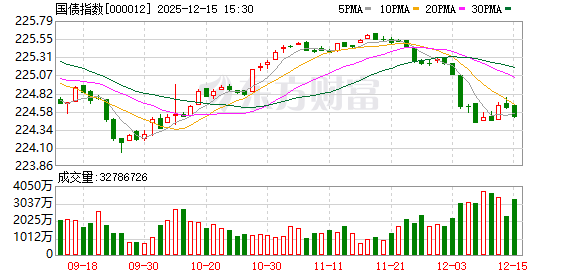
新华财经北京12月15日电(王菁)债市周一(12月15日)延续调整,随着近期重要会议内容落地,机构 止盈情绪更加突出,日内超长债领跌主要利率债,国债期货主力全线收跌;公开市场单日净投放86亿 元,资金利率月中走势分化。 机构认为,阶段性反弹行情基本结束,调整行情或仍在持续。近期30年等超长债波动加剧,与该期限聚 集了大量交易盘、而配置力量不足有关,目前后续方向不算明朗。 【行情跟踪】 国债期货收盘全线下跌,30年期主力合约跌0.99%报111.53,10年期主力合约跌0.12%报107.87,5年期 主力合约跌0.03%报105.785,2年期主力合约跌0.01%报102.454。 【一级市场】 农发行1.074年、3年、5年期金融债中标收益率分别为1.4518%、1.6228%、1.7640%,全场倍数分别为 2.95、5.08、3.77,边际倍数分别为3.64、1.05、3.49。 【资金面】 公开市场方面,央行公告称,12月15日以固定利率、数量招标方式开展了1309亿元7天期逆回购操作, 操作利率1.40%,投标量1309亿元,中标量1309亿元。数据显示,当日1223亿元逆回购到期,据此计 算,单日 ...
美国长久期国债收益率为何居高不下
集思录· 2025-12-15 13:57
1.节衣缩食慢慢减少国债规模,会带来大萧条,且政客选票制度不允许 我查了下2020年,才0.6%年化,为啥现在4.18%降不下来呢,美国都降息4次了, 请指教! 2. 长期大幅通货膨胀减少实际国债价值 西楼 3. 政府总破产,耍赖不归还国债了 现在美国连支付国债利息都要再发国债支付,连本带利总金额已经突破38万亿美元了,将来 只有三条路可选: 韦168 美国多次降息只有短期国债利息下降,长期和超长期国债收益率并没有下降。也就是资金认 为长期美国还会通胀,长期国债无法低利率发行。换种说法就是:降低利率长期国债卖不出 去。如果美联储强行买入长债企图压低长期利率,结果市场美元会变得更多,助推通胀.... nirvana1982 我买了近40%仓位美债,国内美债QDII收益也就1.2%,跟火鸡差不多,搞不清楚发生啥了, 但反正跟国内债基也差不多,也没啥懊悔的 猫消灭人类 我认为和汇率有关系,国债收益率上升,是看空本币汇率。 长期国债的最大风险,是汇率。 量化投资先锋 美国国债问题源于美国联邦政府的收入长期低于支出,产生大量赤字,被迫借债。 2024年,美国联邦政府的财政收入总金额为4.918万亿美元,财政支出总金额为 ...

12月15日大盘简评
Mei Ri Jing Ji Xin Wen· 2025-12-15 10:16
Group 1 - A-shares experienced a downward trend today, with the Shanghai Composite Index closing at 3867.92 points, down 0.55%, and the Shenzhen Component Index at 13112.09 points, down 1.10% [1] - The total trading volume in the two markets was less than 1.8 trillion yuan, a decrease from the previous trading day, indicating a market environment where declines outnumbered gains, particularly in the electronic communication sector [1] - The overall economic and policy environment for A-shares remains positive, with expectations for fiscal spending to support economic demand recovery, leading to a potential return to an upward cycle for A-shares in the medium term [1] Group 2 - The gold sector performed well today, with the Gold Fund ETF (518800) rising by 1.37% and the Gold Stock ETF (517400) increasing by 1.28% [2] - Short-term expectations include a 25 basis point rate cut by the Federal Open Market Committee (FOMC) in December, alongside ongoing geopolitical tensions and a global trend towards de-dollarization, which are expected to support gold prices [2] - The defensive demand in the market is increasing, with dividend stocks benefiting as a "safe haven," and the resource-heavy dividend index is sensitive to fluctuations in coal and oil prices [2]
债市承压!30年期国债期货大跌 后续怎么看?
Zheng Quan Shi Bao· 2025-12-15 09:37
Core Viewpoint - The bond market is under pressure, with a significant decline in long-term treasury futures and rising yields, indicating a shift in market expectations and trading dynamics [2][3][5]. Group 1: Market Performance - On December 12, the 30-year treasury futures fell by 0.71%, continuing to decline on December 15, reaching a low of 111.43 yuan, marking a new low in the current adjustment cycle [3]. - The yield on the 30-year treasury bond has increased to 2.277%, while the 10-year treasury bond yield rose by 1.5 basis points to 1.8575% [5][7]. Group 2: Market Dynamics - The widening of the yield spread between different maturities, particularly the 30-year and 10-year bonds, has exceeded 40 basis points, reflecting increased volatility in the bond market [7]. - Analysts suggest that the recent bond market decline is not primarily due to central bank tightening or liquidity issues, but rather a change in market environment leading to reduced long-term bond allocation by institutions [2][8]. Group 3: Future Outlook - Most institutions maintain a cautious short-term outlook for the bond market, while remaining optimistic about the long-term trend [9]. - The bond market is expected to face constraints from various factors, including supply dynamics of long-term bonds and expectations of economic recovery, which may limit upward momentum [8][11].