汽车等

Search documents
【盘前三分钟】10月14日ETF早知道
Xin Lang Ji Jin· 2025-10-14 01:07
Core Insights - The article highlights the strong performance of the non-ferrous metals sector, driven by multiple factors, including rising international gold prices and robust demand for industrial metals, particularly rare earths due to tightened export controls [4]. Market Overview - As of October 13, 2025, the Shanghai Composite Index and Shenzhen Component Index showed significant percentile rankings of 98.68% and 86.26% respectively, indicating a high valuation level compared to the past decade [1]. - The non-ferrous metals index surged over 3%, with several constituent stocks hitting their daily limit up, reflecting strong market sentiment [3]. Sector Performance - The non-ferrous metals sector is experiencing a favorable environment with both volume and price increases, maintaining high profit growth rates [4]. - The banking sector showed resilience amidst market volatility, with the banking index rising nearly 1% on the same day, attracting defensive capital due to stable dividends and improved yield ratios [4]. Fund Flows - The top three sectors for capital inflows included steel (¥8.92 billion), environmental protection (¥2.49 billion), and agriculture (¥2.46 billion) [2]. - Conversely, the sectors with the highest capital outflows were electronics (¥94.39 billion), electric equipment (¥66.15 billion), and automotive (¥43.09 billion) [2]. ETF Performance - The non-ferrous metals leading ETF (code: 159876) has shown a remarkable increase of 73.41% over the past six months, indicating strong investor interest [3]. - The banking ETF (code: 512800) also demonstrated a solid performance with a 5.71% increase, reflecting its attractiveness in the current market environment [3].


天风证券:赛点2.0第三阶段攻坚不易 重视恒生互联网 把投资主线降维为这三个方向
智通财经网· 2025-10-13 23:53
Core Viewpoint - The report from Tianfeng Securities emphasizes the challenges in the third phase of the "Saidian 2.0" initiative, highlighting the importance of Hang Seng Internet amidst economic recovery and market liquidity [1][7]. Industry Trends - Overall industry sentiment shows an upward trend in sectors such as electric equipment, machinery, electronics, food and beverage, light manufacturing, real estate, and retail, while sectors like oil and petrochemicals, construction materials, pharmaceuticals, textiles, automotive, public utilities, and environmental protection are experiencing a downward trend [2]. - The report predicts strong performance in specific sub-industries over the next four weeks, including automotive services, commercial vehicles, automotive parts, rail transit equipment, lighting equipment, household appliance parts, chemical pharmaceuticals, non-metallic materials, plastics, consumer electronics, chemical fibers, electronic chemicals, and motors [2]. Key Data Points - In the automotive sector, the operating rate for semi-steel tires in China is reported at 46.51%, reflecting a week-on-week decrease of 27.07 percentage points [3]. - In the machinery sector, the factory price for liquid oxygen in Shandong is reported at 270.0 CNY per ton, with a week-on-week increase of 3.85% [4]. - In the transportation sector, the weekly subway passenger volume in Beijing is 10.5665 million, showing a week-on-week increase of 52.78%, while in Suzhou, the volume is 1.896 million, reflecting a week-on-week decrease of 21.94% [4]. - In the pharmaceutical sector, the market price for domestic vitamin E (50%) is reported at 47.5 CNY per kilogram, with a week-on-week decrease of 5.94% [5]. - In the basic chemical sector, the spot price for acetic acid is 2500.0 CNY per ton, with a week-on-week increase of 1.63% [5]. - In the electronics sector, the average spot price for DRAM DDR3 (4Gb) is reported at 2.58 USD, with a week-on-week increase of 6.71% [6]. - In the electric equipment sector, the price for lithium hexafluorophosphate is reported at 67,500 CNY per ton, with a week-on-week increase of 10.66%, while the average price for lithium iron phosphate is 33,700 CNY per ton, reflecting a week-on-week decrease of 0.3% [6]. Investment Strategy - The investment focus is categorized into three main directions: 1) breakthroughs in Deepseek and leadership in open-source technology AI, 2) internal and external resonance with gradual economic recovery, favoring a "stronger gets stronger" bull market style, though cyclical stocks may perform better in the latter half, and 3) the continued rise of undervalued dividends [1][7]. - The report suggests that during the early stages of a bull market, funds tend to favor a few high-sentiment sectors, while in later stages, funds concentrate on main lines, making it harder for new funds to profit [7].

A股市场大势研判:三大指数低开高走,大盘震荡回升
Dongguan Securities· 2025-10-13 23:31
Market Overview - The three major indices opened lower but rebounded throughout the day, with the Shanghai Composite Index closing at 3889.50, down 0.19% [2] - The Shenzhen Component Index closed at 13231.47, down 0.93%, while the CSI 300 Index closed at 4593.98, down 0.50% [2] - The ChiNext Index closed at 3078.76, down 1.11%, but the STAR 50 Index rose by 1.40% to 1473.02 [2] Sector Performance - The top-performing sectors included Nonferrous Metals (up 3.35%), Environmental Protection (up 1.65%), and Steel (up 1.49%) [3] - The underperforming sectors were Automotive (down 2.33%), Household Appliances (down 1.74%), and Beauty Care (down 1.58%) [3] - Concept sectors that performed well included Rare Earth Permanent Magnet (up 6.92%) and Military Restructuring Concept (up 3.51%) [3] Future Outlook - The market showed resilience despite initial declines due to U.S. tariff threats, with a notable recovery in the afternoon [4] - The trading volume in the Shanghai and Shenzhen markets was 2.35 trillion, a decrease of 160.9 billion from the previous trading day [6] - The report suggests that the market's risk appetite may remain resilient due to accumulated experience and policy support, with potential sector rotation favoring anti-tariff and stable assets like rare earths and military [6] Economic Indicators - China's goods trade for the first three quarters reached 33.61 trillion yuan, a year-on-year increase of 4%, with exports at 19.95 trillion yuan (up 7.1%) and imports at 13.66 trillion yuan (down 0.2%) [5] - In September, trade volume was 4.04 trillion yuan, reflecting an 8% year-on-year growth [5]
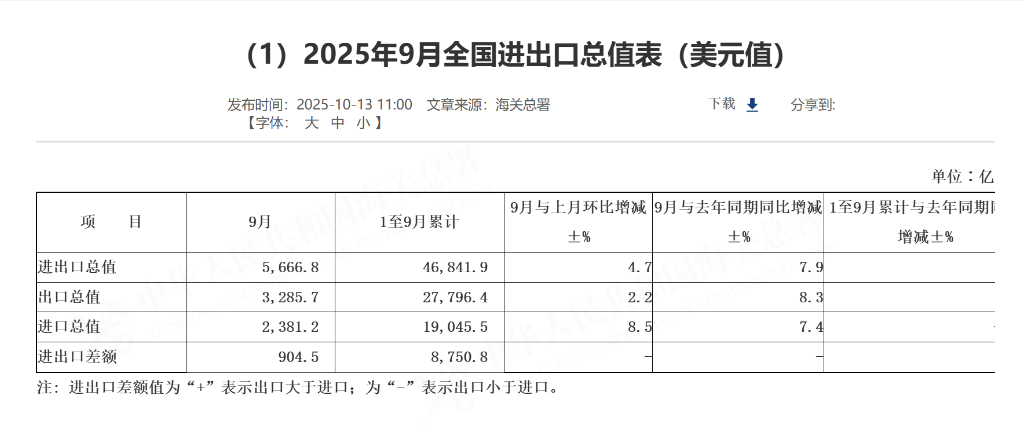
超预期:中国9月以美元计价出口同比增长8.3%,进口同比增7.4%
Hua Er Jie Jian Wen· 2025-10-13 03:52
中国9月以美元计价出口同比增长8.3%,预期+6.6%,前值+4.4%。 面对严峻复杂的外部环境,我国货物贸易实现平稳增长。 10月13日周一,海关总署公布数据显示,按美元计,中国9月以美元计价出口同比增长8.3%,进口同比增长7.4%,均超预期。 中国9月以美元计价进口同比增长7.4%,预期+1.8%,前值+1.3%。 | 项 | H | ਰੇ H | 1至9月累计 | | 9月与上月环比增减 9月与去年同期同比增减 1至9月累计与去年同期 | | | --- | --- | --- | --- | --- | --- | --- | | | | | | +% | +% | 增减土% | | 进出口总值 | | 5, 666. 8 | 46,841.9 | 4.7 | 7.9 | | | 出口总值 | | 3, 285. 7 | 27,796.4 | 2.2 | 8. 3 | | | 进口总值 | | 2,381.2 | 19, 045. 5 | 8.5 | 7.4 | | | 进出口差额 | | 904. 5 | 8, 750. 8 | | | | 按人民币计,中国9月进口同比(按人民币计) 7.5%,前 ...
量化点评报告:十月配置建议:价值股的左侧信号
GOLDEN SUN SECURITIES· 2025-10-09 06:10
- The "ERP and DRP standardized equal-weight calculation model" is used to compute A-share odds, which as of September end, declined to 0.2 standard deviations, indicating a neutral level[10] - The "macro victory rate scoring card model" synthesizes asset victory rates based on factors like credit and PMI pulses, which recently bottomed out, pushing A-share victory rates to 19%[10] - The "bond odds model" is constructed using the expected yield difference between long and short bonds, with recent bond odds retreating to -0.9 standard deviations, reflecting valuation risks for long bonds[11] - The "bond victory rate model" integrates credit and growth expansion data, showing a decline to -6%, indicating low victory rates[11] - The "AIAE indicator model" for US stocks is at 54%, its historical peak, corresponding to 2.4 standard deviations, signaling high pullback risks[15] - The "Federal Reserve liquidity index model" combines quantity and price dimensions, showing a tightening liquidity index at 20%, a medium-high level[15] Model Backtesting Results - ERP and DRP model: A-share odds at 0.2 standard deviations, victory rate at 19%[10] - Bond odds model: -0.9 standard deviations, victory rate at -6%[11] - AIAE indicator model: 54% historical peak, 2.4 standard deviations[15] - Federal Reserve liquidity index: 20% medium-high level[15] Factor Construction and Evaluation - Value factor: High odds (0.9 SD), medium trend (-0.3 SD), low crowding (-1.4 SD), comprehensive score 3, recommended for focus[19][22] - Small-cap factor: Medium odds (-0.2 SD), strong trend (1.6 SD), medium-low crowding (-0.5 SD), comprehensive score 2.2, configuration value improved[20][23] - Quality factor: High odds (1.4 SD), weak trend (-1.2 SD), medium-low crowding (-0.5 SD), comprehensive score 0.6, recommended for long-term attention[24][26] - Growth factor: Medium-high odds (0.8 SD), medium trend (0.1 SD), high crowding (1.0 SD), comprehensive score 0.1, recommended for standard allocation[27][28] Factor Backtesting Results - Value factor: Odds 0.9 SD, trend -0.3 SD, crowding -1.4 SD, score 3[19][22] - Small-cap factor: Odds -0.2 SD, trend 1.6 SD, crowding -0.5 SD, score 2.2[20][23] - Quality factor: Odds 1.4 SD, trend -1.2 SD, crowding -0.5 SD, score 0.6[24][26] - Growth factor: Odds 0.8 SD, trend 0.1 SD, crowding 1.0 SD, score 0.1[27][28] Strategy Construction and Evaluation - "Odds-enhanced strategy" allocates assets based on odds indicators under volatility constraints, achieving annualized returns of 6.6%-7.5% and maximum drawdowns of 2.4%-3.0% since 2011[39][41] - "Victory rate-enhanced strategy" uses macro victory rate scoring to allocate assets, achieving annualized returns of 6.3%-7.7% and maximum drawdowns of 2.3%-2.8% since 2011[42][44] - "Odds + victory rate strategy" combines risk budgets from both strategies, achieving annualized returns of 7.0%-7.6% and maximum drawdowns of 2.7%-2.8% since 2011[45][47] Strategy Backtesting Results - Odds-enhanced strategy: Annualized returns 6.6%-7.5%, max drawdowns 2.4%-3.0%[39][41] - Victory rate-enhanced strategy: Annualized returns 6.3%-7.7%, max drawdowns 2.3%-2.8%[42][44] - Odds + victory rate strategy: Annualized returns 7.0%-7.6%, max drawdowns 2.7%-2.8%[45][47]
日股历史新高,日元却走低
Zheng Quan Shi Bao· 2025-10-07 05:15
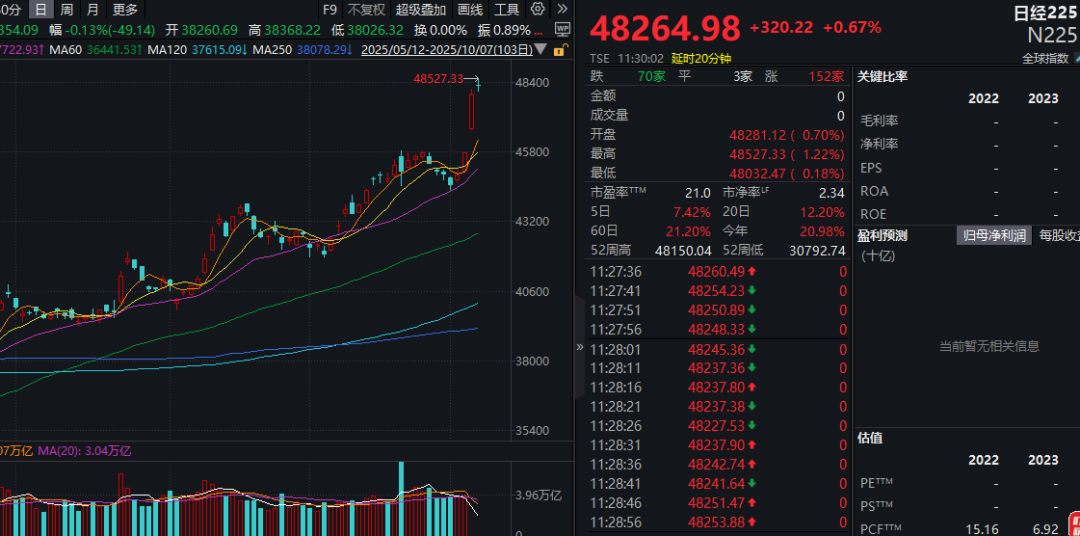
Group 1 - The Japanese stock market is experiencing an upward trend, with the Nikkei 225 index reaching a historical high, while the yen is depreciating [1][2][3] - On October 7, the Nikkei 225 index closed up by 0.67% at 48,264.98 points, with the Topix index rising by 0.28% to 3,235.13 points [3] - Fujikura, a component of the Nikkei 225 index, led the gains with a rise of over 7%, and at one point, it increased by over 10% [5] Group 2 - Fujikura's stock has surged over 100% since 2025 and over 500% in 2024, indicating a tenfold increase from its low in the past two years [5] - The significant rise in Fujikura's stock price is attributed to increased demand driven by AI and other sectors [5] - Other notable stocks in the Nikkei 225 index include Sumitomo Electric, Tokyo Electric Power, Renesas Electronics, and Panasonic, which also saw gains [6]
苏州市聚焦“安全放心、质量放心、价格放心、服务放心、维权放心”开展专项行动
Su Zhou Ri Bao· 2025-10-02 00:07
Core Points - Suzhou has launched a "100-Day Assurance" special action plan to enhance consumer confidence and safety in the market, focusing on quality, pricing, service, and rights protection [1][2][3] Group 1: Consumer Environment Improvement - The action plan aims to create a trustworthy consumption environment by implementing 12 measures that enhance service quality, optimize market order, improve rights protection efficiency, and foster a collaborative social atmosphere [1] - Key commercial areas in Suzhou will see initiatives to elevate the consumer environment, with a goal to establish a number of "assured consumption" zones across various types of markets and shopping areas [1] - The plan includes a commitment to add 5,000 offline retailers offering a "no-reason return" policy throughout the year [1] Group 2: Quality Regulation and Brand Development - Suzhou will enhance the cultivation and protection of time-honored brands and promote "Jiangsu Quality" and "Suzhou Manufacturing" in categories such as food, home appliances, and daily consumer goods [2] - The initiative emphasizes quality supervision of consumer goods closely related to daily life, particularly focusing on food safety and the safety of pharmaceuticals and cosmetics [2] Group 3: Consumer Order Optimization - The city will implement the "Guarding Consumption" initiative to create a trustworthy and satisfactory consumption ecosystem, promoting a multi-faceted dispute resolution model [3] - A commitment to "one-click resolution" for consumer rights will be promoted, encouraging e-commerce platforms and businesses to adopt online dispute resolution mechanisms [3] - Educational efforts will be made to enhance legal awareness and consumer rights, alongside initiatives to foster industry self-discipline and a culture of honesty in consumption [3]
特朗普:对美国境外制作电影征100%关税|首席资讯日报
首席商业评论· 2025-10-01 04:02
Group 1 - Trump announced a 100% tariff on movies produced outside the U.S. [2] - "Yidui" parent company, Miliang Technology, plans to go public in Hong Kong with a net profit exceeding 200 million yuan in the first half of the year, but faces complaints regarding "induced consumption" [3] - Wuhan's new housing policy increases housing provident fund loan limits to 1.5 million yuan for dual contributors and 1.2 million yuan for single contributors, aiming to boost housing demand [4] Group 2 - Meta is facing an antitrust lawsuit alleging that its Instagram Shopping plan stole ideas from a now-defunct startup [5][6] - Alibaba is reportedly negotiating to purchase a 70 billion HKD office building in Hong Kong, which is part of its strategy to expand its real estate footprint [7] - Huatai Securities reports that the petrochemical industry is expected to see a recovery in growth due to new policies aimed at enhancing high-end supply and regulating capacity [8] Group 3 - Poland's defense budget is set to increase to 200 billion zloty (approximately 54.9 billion USD) by 2026, representing 4.8% of GDP, focusing on airspace security [9] - iFlytek has completed optimization of algorithms on Ascend computing power, ensuring robust support for its ongoing model iterations [10] - Pop Mart's new "Starry People" blind box sold out quickly, with resale prices reaching up to 1188 yuan for a set, indicating strong market demand [11][12] Group 4 - Evergrande Property reported a net profit of approximately 491 million yuan in the first half of 2025, a slight decline of 0.6% year-on-year [13] - Seres has completed payment for a 10% stake in Shenzhen Yingwang Intelligent Technology from Huawei, totaling 11.5 billion yuan [14][15]

今日130.46亿元主力资金潜入电子业
Zheng Quan Shi Bao Wang· 2025-09-24 13:50
(原标题:今日130.46亿元主力资金潜入电子业) 证券时报•数据宝统计,今日有14个行业主力资金净流入,17个行业主力资金净流出。资金净流入金额 最大的行业为电子,涨跌幅2.76%,整体换手率5.01%,成交量较前一个交易日变动-2.82%,主力资金 净流量130.46亿元;今日资金净流出最大的行业为汽车,涨跌幅0.36%,整体换手率3.79%,成交量较前 一个交易日变动-19.48%,主力资金净流量-20.64亿元。(数据宝) 今日各行业主力资金流向一览 | 行业名称 | 成交量 | 成交量 较昨日 | 换手率 | 涨跌幅 | 今日 | | --- | --- | --- | --- | --- | --- | | | (亿股) | 增减 | (%) | (%) | 主力资金 净流入(亿元) | | | | (%) | | | | | 电子 | 139.65 | -2.82 | 5.01 | 2.76 | 130.46 | | 计算机 | 79.89 | -11.43 | 4.47 | 2.52 | 50.21 | | 电力设备 | 105.96 | 0.52 | 4.23 | 2.88 | 45.30 ...
国新办9月22日将举行发布会!三分钟看完周末发生了什么
Sou Hu Cai Jing· 2025-09-22 01:05
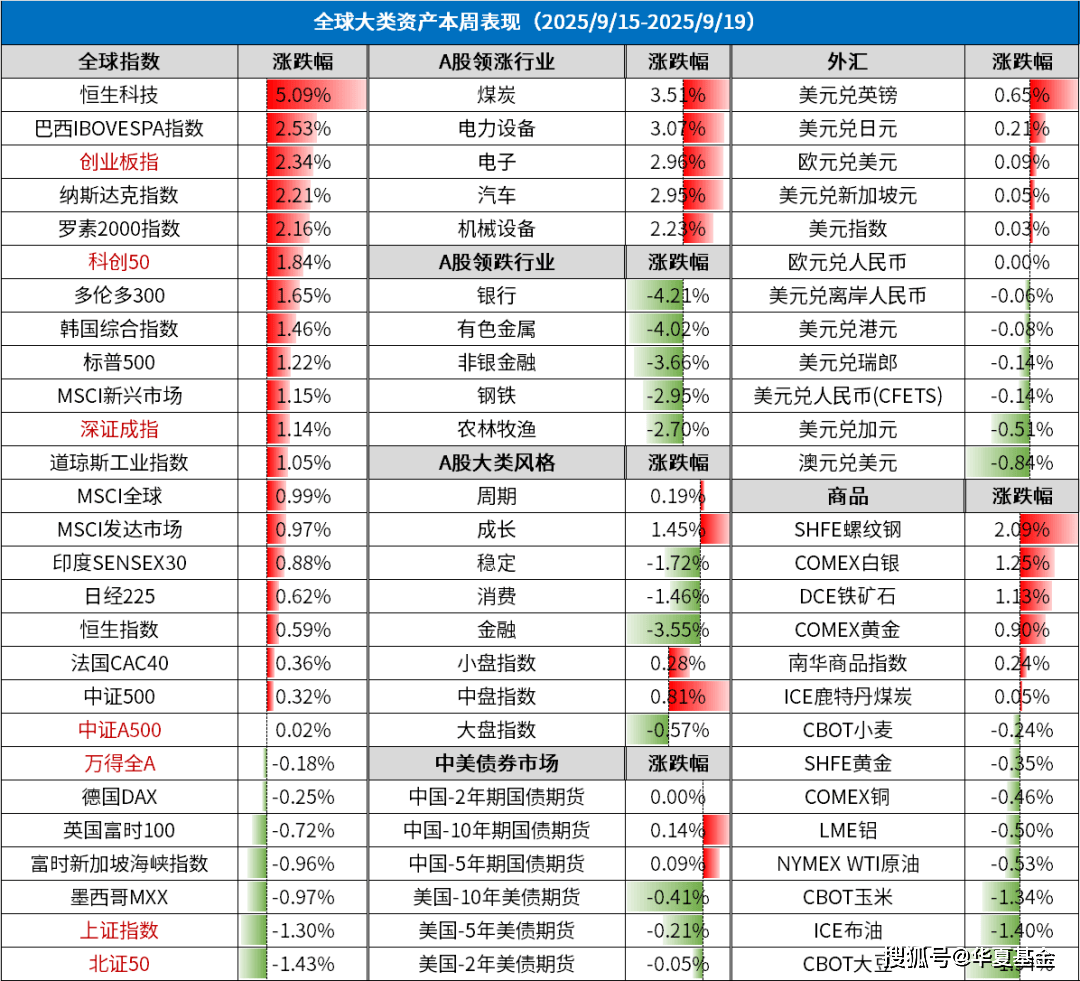
Market Performance - Global indices showed mixed performance, with the Hang Seng Tech Index leading with a gain of 5.09% [1] - The A-share market experienced a downward trend, particularly in the banking and non-bank financial sectors, which saw declines of 4.21% and 3.66% respectively [2][3] - The overall equity market in China faced volatility, with the Shanghai Composite Index dropping by 1.30% [2] Industry Performance - The coal industry led the weekly gains with a rise of 3.5%, followed closely by electric power equipment at 3.1% and electronics at 3.0% [3] - Conversely, the banking sector faced significant losses, declining by 4.2%, while non-bank financials and non-ferrous metals also saw declines of 3.7% and 4.0% respectively [3] - Year-to-date performance highlights include the electronics sector up 44.3% and electric power equipment up 32.0% [3] Investment Strategies - The upcoming "14th Five-Year Plan" is expected to create investment opportunities, with significant trading activity anticipated around key announcements [5][6] - Historical data suggests that the market tends to react positively during the trading periods surrounding the release of the "Five-Year Plan" documents, with an average increase of 7.02% [6] Sector Highlights - The robotics sector is gaining traction, driven by expectations of recovering T-chain orders and recent positive developments from key industry players [4] - The banking sector has been under pressure due to a shift in market sentiment and capital flow towards higher-risk sectors, leading to a notable decline in stock prices [4]