
家具

Search documents
周周芝道 模型跟踪:关税对美国通胀影响
2025-07-21 00:32
Summary of Key Points from Conference Call Industry and Company Involved - The analysis focuses on the impact of tariffs on inflation in the United States, particularly in relation to various industries and consumer behavior. Core Insights and Arguments - **Tariff Rate Increase**: The effective tariff rate in the U.S. rose significantly from 2.5% at the beginning of 2025 to 8.8% by mid-year, with tariffs on imports from China increasing from 10% to nearly 40% [1][5] - **Impact on Different Industries**: The metal industry saw a 50% increase in tariffs, while small appliances, furniture, and toys experienced a 20% increase [1][5] - **Cost Burden Distribution**: Tariff costs are primarily borne by exporters, U.S. companies, and consumers, with historical data indicating that consumers ultimately shoulder most of the burden [1][3][11] - **Inflation Transmission**: As of June 2025, approximately 40% of tariff costs have been passed on to the Consumer Price Index (CPI), with the remaining 60% potentially absorbed by businesses [1][9][11] - **Correlation Between Actual and Theoretical Inflation**: There is a positive correlation between actual inflation and theoretical predictions, with a correlation coefficient of about 0.4 [1][9] - **Modeling Approach**: A comprehensive panel regression model was developed to track the impact of tariffs across 212 industries, allowing for detailed analysis of long-term effects on inflation [2][5] Additional Important Content - **Consumer Price Index (CPI) and Federal Reserve Policy**: The CPI is crucial for determining the Federal Reserve's interest rate decisions, with expectations of potential rate cuts in late 2025 [3][12] - **Differential Impact on Product Categories**: Certain product categories, such as small appliances and audio equipment, are experiencing significant inflation, while the automotive sector shows no notable price increases [10] - **Weak Dollar Effects**: A weaker dollar limits exporters' ability to absorb tariff costs, leading to increased pressure on importers [13][14] - **Future Economic Indicators**: The future path of interest rate cuts by the Federal Reserve will depend on economic data and the observed effects of tariffs on inflation [7][12] - **Monitoring Future Trends**: Continuous tracking of CPI data from July to September will help assess the transmission of tariff costs between businesses and consumers [16]
轻工业活力充沛展新质
Jing Ji Ri Bao· 2025-07-20 21:55
Group 1: Industry Performance - In the first five months of this year, retail sales of major light industry products increased by 11.9%, surpassing the national average of 6.9 percentage points [1] - The light industry achieved operating income of 9.3 trillion yuan, a year-on-year increase of 4.7%, and profits of 531.5 billion yuan, up 2.8% [1] - The development goal for the light industry by 2030 is to establish a strong global presence, enhancing domestic demand, promoting consumption, and stabilizing growth [1] Group 2: Leading Enterprises and Innovation - The top 200 light industry enterprises reported operating income of 3.95 trillion yuan and profits of 344.8 billion yuan, accounting for 17.2% and 23% of the industry, respectively [2] - The average R&D intensity among the top light industry technology enterprises is 2.9%, with specific sectors like light machinery and cosmetics showing higher averages [2] Group 3: International Expansion and Competitive Advantage - China's light industry has become the largest producer and exporter of light industrial products globally, with significant manufacturing capabilities in textiles, appliances, and food [5] - The international market presents opportunities for Chinese light industry enterprises to optimize their global layout and reduce risks, particularly in regions like Southeast Asia and Africa [5][6] Group 4: Digital Transformation - The digitalization level in the light industry is leading in the industrial sector, with a digital R&D design tool penetration rate of 78.2% and a key process CNC rate of 62.4% [7] - By 2027, the goal is to achieve a digital R&D design tool penetration rate of around 90% among key light industry enterprises [8] Group 5: Future Development Plans - The light industry aims to integrate technological innovation with industrial innovation, enhancing supply-demand adaptability and leading consumption markets with high-quality supply [4] - The implementation of the "Light Industry Digital Transformation Implementation Plan" aims to foster smart factories and intelligent consumer products by 2030 [8]
中经评论:从供需两端激活消费“主引擎”
Zhong Guo Jing Ji Wang· 2025-07-19 07:10
Group 1 - The core viewpoint of the articles highlights the robust growth of consumer spending in China, which significantly contributes to GDP growth, with domestic demand accounting for 68.8% of GDP growth in the first half of the year, and final consumption expenditure contributing 52% [1][3] - The increase in consumer spending is attributed to a series of incremental policies that have effectively stimulated the market, showcasing the potential of China's large-scale economy [1][3] - Consumer preferences are shifting from basic needs to quality and experience, as evidenced by the strong sales of home appliances and cultural products, with retail sales in these categories growing by 30.7%, 25.4%, 24.1%, and 22.9% respectively [1][2] Group 2 - The emergence of new consumer demands is driving growth in niche markets, with initiatives like the "cool economy" and various local events aimed at enhancing consumer experience [2] - Local governments are actively promoting diverse and personalized consumption, with initiatives such as fashion consumption expansion plans and unique local events to stimulate market dynamics [2] - The government has prioritized boosting consumption and investment efficiency as a key task for 2025, with specific action plans to address barriers to consumer spending [3]
精一家具朱政臣:坚持“设计为人”,推动人文经济融合发展
Nan Fang Du Shi Bao· 2025-07-18 13:52
Core Insights - The company emphasizes the integration of "design for people" with cultural and economic development, showcasing its commitment to innovation and community engagement [1][4]. Group 1: Company Achievements - The company holds over 600 patents and has received more than 30 domestic and international design awards, with products sold in 127 countries and regions [1]. - The headquarters, designed by the renowned architectural firm M Moser, embodies principles of openness, sharing, and ecology, serving as a platform for industry exchange and creative collaboration [3]. Group 2: Community Engagement - The company has initiated a "wall-breaking" collaboration, offering 4,000 square meters of space for a public square and transforming the area in front of its headquarters to enhance community interaction [4]. - In partnership with local government, the company is developing a 5,000 square meter eco-park, improving community environment and quality of life [4]. Group 3: Sustainability Initiatives - The company is committed to ESG principles, establishing "green beauty factories" powered by solar energy with a total installed capacity of 5,530 kilowatts [5]. - It focuses on creating environmentally friendly products, achieving multiple certifications including international green awards and integrating sustainability throughout the product lifecycle [5].


我投的十月稻田、植护、源氏木语,年销售额均超50亿
创业家· 2025-07-18 09:56
Core Viewpoint - The article discusses the emergence of a new generation of national brands in mature industries, highlighting their rapid growth and innovative approaches to product and channel development [4][5][7]. Group 1: New Generation National Brands - New generation national brands are identified as those that leverage existing categories to create impactful new brands through innovative products and models [4]. - Three companies backed by Qicheng Capital have achieved annual sales of over 5 billion, exemplifying this trend: October Rice Field, Zhihui, and Genji Wood Language [5]. - These brands can quickly establish significant market positions in mature industries, continuously refining their product models to create new products with a scale of 1 billion [7]. Group 2: Online and Offline Integration - The new generation of national brands excels in becoming omnichannel champions by effectively utilizing online platforms like JD.com, Tmall, and Douyin to achieve rapid growth [8]. - By leveraging online success, these brands can transition into offline channels, aiming for sales scales between 5 billion and 10 billion [8]. Group 3: Case Studies of Successful Brands - October Rice Field has become the leading online brand in the rice category, achieving nearly 5 billion in sales last year and listing on the Hong Kong Stock Exchange [9]. - The brand's success is attributed to its high-quality sourcing, efficient supply chain management, and strong market share [10][11]. - Genji Wood Language has focused on health-conscious materials and aesthetic appeal, achieving significant sales growth by starting online and expanding to offline stores [12][14]. - The brand has capitalized on local supply chain advantages and competitive pricing to attract consumers [13][14]. - Zhihui has disrupted the paper towel market by offering affordable products directly to consumers, gaining a large user base in lower-tier cities [17][18]. - The brand's innovative packaging and marketing strategies have led to explosive sales growth, particularly through platforms like Douyin [20][21].

成都市制造业特色产业园发展规划出台 2030年底特色产业营收破1.5万亿元
Si Chuan Ri Bao· 2025-07-18 07:56
Core Viewpoint - Chengdu's Economic and Information Bureau has issued the "Chengdu Manufacturing Industry Characteristic Industrial Park Development Plan (2025-2030)", aiming for significant growth in characteristic industries by 2030, with a target revenue exceeding 1.5 trillion yuan and an industrial concentration rate of over 80% [1][5]. Group 1: Development Goals - By the end of 2030, the plan aims for characteristic industrial revenue to surpass 1.5 trillion yuan, with over 80% concentration in characteristic industries and 60% of the city's industrial revenue coming from large-scale enterprises in characteristic industrial parks [1][5]. - The plan outlines the establishment of over 12 nationally influential characteristic manufacturing industrial parks, over 16 emerging industry parks, and over 2 future industry parks by 2030 [1]. Group 2: Key Tasks - The plan identifies five key tasks: guiding specialized development, enhancing operational management, promoting modern and green development, improving innovation capabilities, and focusing on quality development [2]. - To enhance park visibility and recognition, a gradient cultivation approach will be adopted, with 30 characteristic industrial parks to be selected by 2025 [2]. - The operational management level will be improved by transforming state-owned platform companies into industrial investment operators and attracting quality operators [2]. Group 3: Innovation and Development - The plan supports characteristic industrial parks in hosting high-level national manufacturing innovation platforms and aims to cultivate "unicorn" companies and "specialized and innovative" enterprises [3]. - It emphasizes the need for parks to focus on specific industrial demands and develop service scenarios, including autonomous driving and drone delivery [3]. Group 4: Differentiated Layout - The plan outlines a differentiated layout for various urban areas, focusing on innovation in new products and technologies in urban new areas, modern urban industry in central urban areas, and traditional industry upgrades in county-level cities [5]. - Urban new areas will focus on strategic emerging industries, while central urban areas will enhance project capacity and promote collaboration between R&D and manufacturing [5].
临沂商城周价格总指数为102.49点,环比下跌0.04点(7月10日—7月16日)
Zhong Guo Fa Zhan Wang· 2025-07-18 04:20
Core Viewpoint - The overall price index in Linyi Mall has decreased slightly, indicating a mixed trend in various product categories with some experiencing price increases while others face declines [1] Group 1: Price Index Overview - The total weekly price index for Linyi Mall is 102.49 points, down 0.04 points or 0.04% from the previous week [1] - Among 14 categories, 3 categories saw price increases, 4 remained stable, and 7 experienced price declines [1] Group 2: Price Increases - Steel category index rose to 96.57 points, up 0.06 points; medium materials, pipes, and boards increased, while construction steel decreased [1] - Home appliances and audio-visual equipment index reached 103.17 points, up 0.01 points; kitchen appliances saw increased demand due to summer activities [2] - Lighting category index increased to 104.31 points, up 0.01 points; demand for ceiling lights and related accessories has risen [3] Group 3: Price Decreases - Building decoration materials index fell to 105.37 points, down 0.36 points; prices decreased due to lower raw material costs and seasonal demand [4] - Board category index decreased to 96.93 points, down 0.16 points; demand weakened due to high temperatures affecting construction [5] - Furniture category index dropped to 88.98 points, down 0.05 points; sales primarily driven by essential purchases, leading to slight price reductions [6]

外媒热评中国经济“半年报”:“向好态势有望在下半年延续”
Zhong Guo Xin Wen Wang· 2025-07-18 03:25
Group 1 - China's GDP growth for the first half of 2025 reached 5.3%, an increase of 0.3 percentage points compared to the same period in 2024 [2] - The retail sales of consumer goods in China grew by 5.0% year-on-year, with online retail sales increasing by 8.5% [2] - The contribution of final consumption expenditure to economic growth exceeded 52% in the second quarter, indicating strong consumer demand [2][3] Group 2 - Foreign institutions, including Citibank and Goldman Sachs, have raised their forecasts for China's economic growth in 2025, reflecting sustained economic momentum [3] - The manufacturing Purchasing Managers' Index (PMI) rose by 0.2 percentage points in June, indicating a recovery in manufacturing activity [3] - Despite external uncertainties, the Chinese economy is expected to maintain stable growth in the second half of the year, supported by structural adjustments and high-quality development practices [4]
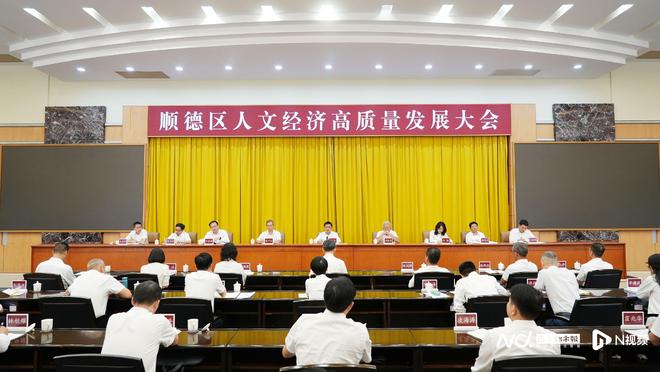
顺德起笔:三个关键词解码人文经济新思路
Nan Fang Du Shi Bao· 2025-07-18 01:44
Core Insights - The conference focused on the high-quality development of the "cultural economy" in Shunde, emphasizing the need for modern industrial forms, coordinated urban-rural development, and enhanced cultural values [1][18] - The new district secretary, Chen Xinwen, highlighted the importance of building two world-class intellectual properties: a world-class tourism destination and a world-class intelligent manufacturing hub [1][11] Group 1: Development Strategies - Shunde is integrating into the "Ring Two Rivers" initiative, aiming to create a refined Lingnan cultural city through the "Hundred Thousand Million Project" [3][4] - The focus is on enhancing collective economies in villages, promoting cultural integration into industrial upgrades, and fostering a dual development path of culture and economy [6][4] Group 2: Cultural and Economic Integration - The concept of "humanistic economics" is being promoted, which emphasizes the mutual empowerment of culture and economy, aiming for a harmonious coexistence [9][18] - The district is leveraging its cultural heritage to enhance tourism and economic growth, with initiatives like the revitalization of traditional cultural sites and the development of new cultural tourism projects [15][17] Group 3: Future Vision - Shunde aims to transform its image from a manufacturing hub to a culturally rich and innovative city, focusing on unique cultural characteristics and historical heritage [8][18] - The district is committed to creating world-class tourism attractions, such as the Bruce Lee theme park, to enhance its global appeal [17][18] Group 4: Business Engagement - Local enterprises are encouraged to adopt innovative strategies and expand globally, with a focus on sustainable development and cultural integration [13][14] - The district's leadership is actively engaging with businesses to understand their needs and promote a collaborative environment for growth [11][13]
顾家家居: 顾家家居2024年限制性股票激励计划部分限制性股票回购注销实施之法律意见书
Zheng Quan Zhi Xing· 2025-07-17 16:25
Core Viewpoint - The legal opinion letter from Grandall Law Firm (Hangzhou) confirms that the stock repurchase and cancellation plan by Kuka Home Co., Ltd. has received the necessary approvals and complies with relevant laws and regulations [1][5][6] Group 1: Approval and Authorization of Repurchase - On September 20, 2024, the fifth board of directors of the company approved the stock incentive plan and submitted it for shareholder meeting review [3] - The fourth temporary shareholder meeting on October 14, 2024, approved the stock incentive plan and authorized the board to handle related matters [4] - On April 27, 2025, the board approved the repurchase and cancellation of 120,000 shares of restricted stock held by a departing incentive object, which was later approved in the annual shareholder meeting on May 19, 2025 [4][5] Group 2: Details of the Repurchase - The repurchase is based on the provisions of the incentive plan regarding changes in the personal situation of incentive objects, specifically for those who have left the company [5] - The repurchase involves 120,000 shares, representing 1.2339% of the incentive plan's total stock and 0.0146% of the company's total share capital, at a price of 10.46 yuan per share, totaling 1,255,200 yuan funded by the company's own resources [5][6] Group 3: Compliance and Conclusion - The legal opinion confirms that the reasons, quantity, price, and funding source for the stock repurchase comply with relevant laws and regulations [6] - The company has opened a dedicated securities account for the repurchase and submitted the necessary application for the cancellation of the shares [6] - The legal opinion concludes that the repurchase plan has obtained the necessary approvals and must still complete the registration for capital reduction [6]
