电力设备

Search documents
华泰A股策略:转向胜率思维
Xin Lang Cai Jing· 2026-02-01 23:20
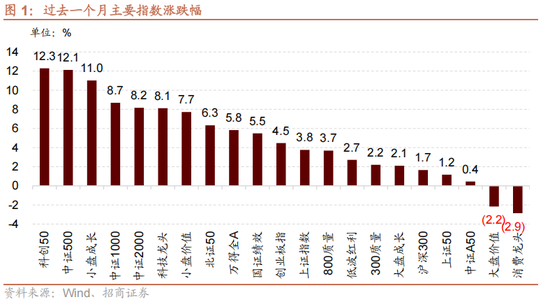
Core Viewpoint - The A-share market is experiencing high volatility at elevated levels, with external and internal factors limiting risk appetite ahead of the holiday season. The core drivers of the current spring market rally remain unchanged, suggesting potential opportunities for investment after adjustments [1][17]. Group 1: Market Analysis - The A-share market has shown a preference for value stocks, with a notable shift towards lower valuation sectors such as liquor and consumer goods, increasing the difficulty of capturing excess returns [1][17]. - Historical spring market adjustments are often driven by profit-taking pressures, policy and fundamental validations, and external environmental shocks. If adjustments are primarily due to fund behavior, they may provide space for subsequent increases [2][18][20]. Group 2: Economic Indicators - As of now, over 50% of annual performance forecasts have been disclosed across all A-shares, with a higher than average positive forecast rate in sectors such as non-bank financials, materials, and consumer goods. The sectors with the highest projected net profit growth include military, machinery, and consumer products [3][21]. - The overall industry prosperity index has risen for two consecutive months, indicating improvements in various sectors, including power equipment, semiconductors, and consumer goods [3][21]. Group 3: Valuation Observations - Current valuation and trading conditions indicate that sectors like computing power and materials are experiencing high levels of crowding, while consumer and export chains, as well as AI applications, are less crowded, presenting potential investment opportunities [4][22]. - The trading crowding in sectors such as semiconductors and aerospace equipment shows signs of decline, while consumer goods and financial sectors are beginning to recover from low trading crowding [4][22]. Group 4: Investment Recommendations - The market is expected to maintain volatility in the short term, with a potential continuation of the spring rally post-holiday. It is recommended to focus on high-quality, low-valuation sectors such as power equipment, semiconductors, and consumer goods [5][23]. - The investment strategy should include a shift towards sectors with high growth potential and favorable valuations, while also considering thematic investments in AI applications and consumer travel chains benefiting from the holiday season [5][23].

机构研究周报:风格转换成长“轮休”,黄金短空长多
Wind万得· 2026-02-01 22:37
Core Viewpoint - The article discusses the recent volatility in the gold and silver markets, the transition of the equity market from a "structural bull" to a "comprehensive bull," and the implications for various sectors, particularly technology and real estate [1][3][4]. Group 1: Precious Metals - On January 30, gold and silver experienced significant declines, with silver dropping 36% and gold falling over 12%, marking the largest daily declines in history [3]. - Short-term market dynamics indicate that the momentum for gold's correction is still accumulating, while the long-term fundamentals for gold remain solid, suggesting a continued bull market trend [3]. Group 2: Equity Market - According to Franklin Templeton, the domestic asset allocation for 2026 will be driven by three core logic points: a weak dollar benefiting RMB assets, low domestic interest rates leading to increased equity investments, and policy support impacting inflation [4]. - Zhejiang Securities notes that the technology growth sector has entered a phase of high-level consolidation after a strong three-week performance, while the resource sector is experiencing volatility amid global resource price fluctuations [6]. - CICC highlights that the willingness of residents to invest in the stock market remains weak, with the correlation between available funds and stock market performance being low [7]. Group 3: Industry Research - Huatai Securities indicates that the real estate sector is entering a "policy + small spring" window, with improved transaction volumes in core cities and relaxed financing conditions [10]. - China Europe Fund emphasizes a moderate bull market for A-shares in 2026, focusing on structural opportunities in overseas computing power and industrial metals [11]. - China Asset Management points out that the demand for electrical equipment exports is rising due to the urgent need for upgrades in North America's aging power grid [12].



乐观看待权益市场表现 公募踊跃布局科技创新赛道
Shang Hai Zheng Quan Bao· 2026-02-01 18:37
Core Insights - The public fund industry is actively launching new products, with technology themes becoming a popular investment focus due to improving macroeconomic conditions and ongoing technological advancements, leading to a positive outlook for the A-share market through 2026 [1][2] Group 1: Market Trends - Multiple public funds have recently launched technology-themed products, with significant fundraising success, such as the Morgan Stanley Hong Kong-Shanghai Technology Mixed Fund raising 4.424 billion yuan [1] - The overall market sentiment is expected to remain positive, with sectors like innovative pharmaceuticals, artificial intelligence, and robotics showing strong performance [1][2] Group 2: Economic Outlook - The gradual recovery of the economy, driven by the "anti-involution" policy and strong demand in various sectors, is anticipated to lead to a stable economic environment through 2026 [2] - The new wave of technological revolution is expected to reshape the global economic landscape, providing strong momentum for China's economic development [2] Group 3: Investment Directions - Five key investment areas are highlighted: 1. Domestic semiconductor industry growth driven by increased production and technological upgrades [3] 2. Non-ferrous metals benefiting from global resource adjustments and domestic policy, with structural demand from AI and new energy sectors [3] 3. Power equipment sector gaining opportunities from global AI infrastructure development [3][4] 4. AI computing power infrastructure growth supported by increased capital expenditure from major internet companies [4] 5. Humanoid robots entering the industrialization phase, showcasing significant market potential [5]
数读IPO系列:2025年沪深新股总结-华金证券
Sou Hu Cai Jing· 2026-02-01 16:32
Group 1 - In 2025, the new "National Nine Articles" and the "1+6" reform of the Sci-Tech Innovation Board drove a moderate development of the Shanghai and Shenzhen new stock market, with a total of 90 new stocks listed, an increase of 13 from 2024 [1][7] - The fundraising scale significantly increased, with total funds raised reaching 124.24 billion yuan, a year-on-year growth of 98.25%, and large IPOs in the second half contributed 72% of the total fundraising [1][18] - The average fundraising amount per new stock was 13.80 million yuan, up 69.62% year-on-year, with the Sci-Tech Innovation Board leading at an average of 20.03 million yuan [1][24] Group 2 - In the primary market, the offline subscription yield remained stable compared to 2024, but accounts with a scale of 5 billion yuan and above saw a significant increase in yield [2][31] - The average first-day closing price increase was 227.90%, maintaining a high level, with no stocks experiencing a loss on the first day [2][41] - The Sci-Tech Innovation Board had the highest average first-day closing price increase, while industries such as non-ferrous metals and social services performed notably well [2][50] Group 3 - In the secondary market, timing remained a key factor for improving investment returns and success rates, with new stocks listed during market sentiment lows or upward cycles performing better [2][8] - The average investment return in the secondary market was 14.53%, a slight decrease from 2024, but the investment success rate increased to 33.33% [2][8] - The ChiNext Board outperformed in both investment returns and success rates, with industries like electronics and social services leading [2][8]

【十大券商一周策略】市场调整或提供新的布局窗口!大炼化,下一个有色?
券商中国· 2026-02-01 15:28
Group 1 - The current ETF redemption wave is likely ending, providing a recovery window for large-cap stocks, indicating a style shift from small-cap to large-cap and from themes to quality [2] - The nomination of Kevin Walsh as the Federal Reserve Chair represents a policy shift towards "real economy" in the U.S., which could significantly impact global risk assets [2] - The focus on price increases across various sectors, particularly in cyclical industries, is expected to continue throughout the first quarter, driven by China's policy shift from scale expansion to quality improvement [2] Group 2 - A high-level market adjustment is anticipated before a new upward phase, with a focus on clarifying industrial trends and digesting valuations [5] - The spring market is expected to maintain a bullish outlook, with potential for new opportunities post-adjustment, particularly in sectors with strong fundamentals [9] - The cyclical recovery in sectors like power equipment, storage, and semiconductor equipment is highlighted, alongside themes such as AI applications and robotics [3][9] Group 3 - The market is experiencing structural fluctuations, with a focus on sectors with strong fundamental support, such as technology innovation and manufacturing [6] - The adjustment in the metals sector is attributed to a shift in narrative from liquidity and dollar credit to industrial demand and low inventory [7] - The outlook for the commodities market remains positive, driven by geopolitical factors and structural supply-demand gaps, with a recommendation to focus on sectors like precious metals and energy [11] Group 4 - The market is witnessing a rotation towards low-weight stocks, with a potential for significant gains in sectors like chemicals and advanced manufacturing [8] - The upcoming period is characterized by a focus on consumer recovery and the impact of policies aimed at boosting domestic demand [7] - The expectation of a new phase in the commodities supercycle, particularly in the refining sector, is noted, with a recommendation to invest in related industries [10]

核心逻辑未变!关于A股和黄金走势,机构最新研判
Xin Lang Cai Jing· 2026-02-01 15:13
Core Viewpoint - The A-share market is experiencing a weak and volatile trend, with the core logic supporting the spring market remaining unchanged, and the precious metals sector expected to enter a wide fluctuation phase in the short term [1][6] Market Trends - The non-manufacturing business activity index for January is reported at 49.4%, a decrease of 0.8 percentage points from the previous month, indicating a decline in overall non-manufacturing sector activity [1] - The capital market service index is above 65%, reflecting high market activity in sectors such as monetary financial services and insurance [1] Investment Recommendations - Focus on sectors with lower price increases but strong logical support, including storage chips, embodied intelligence, AI edge computing, energy storage, and the lithium battery supply chain [1][5] - Emphasize sectors mentioned in the "14th Five-Year Plan," such as commercial aerospace, 6G, nuclear power, hydrogen energy, quantum communication, and brain-computer interfaces [5] Precious Metals Sector - Banks have issued risk warnings regarding precious metals business, citing increased market uncertainty and price volatility, while still recognizing the medium to long-term investment value of gold and similar assets [2] - The precious metals sector is currently in a high congestion state after rapid previous gains, expected to enter a wide fluctuation phase, but the fundamental outlook remains positive due to unresolved supply-demand gaps [6] Sector-Specific Insights - The AI industry is expected to significantly drive electricity demand, creating investment opportunities in the energy storage and power equipment sectors [6] - The pharmaceutical industry is anticipated to continue its upgrade trend driven by innovation, with a long-term positive outlook for globally competitive drugs and devices [7] - The technology growth sector is favored due to abundant liquidity and industry theme catalysts, with a focus on sectors supported by industry trends [8]
固定收益周报:看多2月,风格均衡-20260201
Huaxin Securities· 2026-02-01 14:41
1. Report Industry Investment Rating The report does not explicitly mention the overall industry investment rating. 2. Core Viewpoints - The analysts are optimistic about the equity market in February with a balanced style, while the bond market has an increased risk of adjustment [2][7]. - The marginal expansion of the real - sector balance sheet in February is highly certain, and the probability of a significant tightening of the capital market is low [2]. - In the context of the marginal convergence of the national balance sheet, the top - down subjective allocation strategy focusing on position selection and style analysis will gain more attention and favor from the market [22]. 3. Summary by Directory 3.1 National Asset - Liability Sheet Analysis - **Liability Side**: In December 2025, the real - sector liability growth rate was 8.4% (previous value 8.6%). It is expected to drop to around 8.3% in January 2026, rebound slightly in February, and decline in March. The capital market tightened marginally last week. There is a risk of significant tightening in February, but the probability is not high [2][17]. - **Fiscal Policy**: The net increase of government bonds last week was 235.3 billion yuan (higher than the planned 141.3 billion yuan), and the planned net increase next week is 721.4 billion yuan. The government liability growth rate at the end of December 2025 was 12.4% (previous value 13.1%), expected to rebound to around 12.6% in January 2026 and likely decline in February [3][18]. - **Monetary Policy**: Last week, the average weekly trading volume of funds decreased, the price increased, and the term spread narrowed. The one - year Treasury bond yield ended at 1.30% on the weekend. It is estimated that the lower limit of the one - year Treasury bond yield is about 1.3%, with a central value around 1.4%, and there may be a 10 - basis - point interest rate cut in 2026. The term spread between the ten - year and one - year Treasury bonds narrowed to 51 basis points [3][18]. - **Asset Side**: The physical quantity data in December 2025 continued to run smoothly compared to November. The full - year real economic growth target in 2025 was around 5%, and the nominal economic growth target was around 4.9%. It needs further observation whether 5% will be the central target for China's nominal economic growth in the next 1 - 2 years [4][19]. 3.2 Stock - Bond Cost - effectiveness and Stock - Bond Style - Since 2011, China has been in a downward cycle of potential economic growth, which may have ended in Q4 2024, followed by a low - level narrow - range oscillation in the profit cycle. The government put forward three policy goals in 2016: stabilizing the macro - leverage ratio, financial institutions benefiting the real economy, and "housing is for living in, not for speculation." Currently, the convergence of the liability side has not ended, but the space is limited [6][20]. - Last week, the capital market tightened marginally, the overall equity market declined, but value stocks strengthened. The long - end bond yield decreased slightly, and the short - end increased. The stock - bond cost - effectiveness slightly favored bonds. The ten - year Treasury bond yield decreased by 2 basis points to 1.81%, the one - year increased by 2 basis points to 1.30%, and the 30 - year remained stable at 2.29% [7][21]. - In February, the analysts are optimistic about the equity market with a balanced style and believe that the bond market has little investment value. They recommend a 50% position in the Shanghai Composite 50 Index and a 50% position in the China Securities 1000 Index [7][22]. 3.3 Industry Recommendation 3.3.1 Industry Performance Review - This week, the A - share market declined with increased trading volume. The Shanghai Composite Index fell 0.44%, the Shenzhen Component Index fell 1.62%, and the ChiNext Index fell 0.09%. Among the Shenwan primary industries, petroleum and petrochemicals, communication, coal, non - ferrous metals, and agriculture, forestry, animal husbandry, and fishery had the largest increases, while national defense and military industry, power equipment, automobiles, computers, and comprehensive industries had the largest declines [30]. 3.3.2 Industry Crowding - out and Trading Volume - As of January 30, the top five crowded industries were electronics, non - ferrous metals, power equipment, machinery, and communication, with crowding - out degrees of 15.9%, 10.3%, 9%, 6.4%, and 6.2% respectively. The bottom five were comprehensive, beauty care, social services, environmental protection, and steel, with 0.1%, 0.2%, 0.7%, 0.8%, and 0.9% respectively [31]. - This week, the top five industries with increased crowding - out were non - ferrous metals, agriculture, forestry, animal husbandry, and fishery, food and beverage, media, and communication. The top five with decreased crowding - out were power equipment, national defense and military industry, electronics, automobiles, and machinery [31]. - As of January 30, non - ferrous metals, petroleum and petrochemicals, communication, national defense and military industry, and electronics had relatively high crowding - out quantiles since 2018, while pharmaceutical biology, transportation, light industry manufacturing, beauty care, and non - bank finance had relatively low quantiles [31]. - The average daily trading volume of the entire A - share market this week was 3.06 trillion yuan, up from 2.8 trillion yuan last week. Petroleum and petrochemicals, agriculture, forestry, animal husbandry, and fishery, coal, non - ferrous metals, and non - bank finance had the highest year - on - year growth rates in trading volume, while national defense and military industry, automobiles, household appliances, commercial retail, and power equipment had the largest declines [33]. 3.3.3 Industry Valuation and Earnings - This week, among the Shenwan primary industries, the PE(TTM) of petroleum and petrochemicals, communication, coal, non - ferrous metals, and food and beverage had the largest increases, while national defense and military industry, power equipment, computers, automobiles, and comprehensive industries had the largest declines [37]. - As of January 30, 2026, industries with high full - year 2024 earnings forecasts and relatively low current valuations compared to history include banks, insurance, power, public utilities, transportation, pharmaceutical biology, beauty care, new energy, and consumer electronics [38]. 3.3.4 Industry Prosperity - **External Demand**: It showed mixed trends. The global manufacturing PMI dropped from 50.5 in December to 50.4, and most of the disclosed PMI data of economies in January increased. The CCFI index fell 2.74% week - on - week. Port cargo throughput declined. South Korea's export growth rate rose to 13.4% in December and 33.9% in January. Vietnam's export growth rate rose from 15.8% in November to 23.9% in December [42]. - **Domestic Demand**: The second - hand housing price increased last week, and quantity indicators showed mixed trends. Highway truck traffic declined. The capacity utilization rate of ten industries declined from September to October 2025, increased from November to December, and slightly declined in January. Automobile sales were weaker than the historical seasonality, new - home sales remained at the historical low, and second - hand home sales were stronger than the historical seasonality [42]. 3.3.5 Public Fund Market Review - In the fourth week of January (January 26 - 30), most active public equity funds underperformed the CSI 300. The 10%, 20%, 30%, and 50% quantiles of weekly returns were 2.3%, 1.1%, 0.4%, and - 0.6% respectively, while the CSI 300 rose 0.08% [59]. - As of January 30, the net asset value of active public equity funds was estimated to be 4.04 trillion yuan, up from 3.66 trillion yuan in Q4 2024 [59]. 3.3.6 Industry Recommendation - In the de - leveraging cycle, the stock - bond cost - effectiveness favors equities to a limited extent, and value stocks are more likely to be dominant. The recommended A + H dividend portfolio includes 13 stocks, and the A - share portfolio includes 20 stocks, mainly in industries such as banking, telecommunications, petroleum and petrochemicals, and transportation [62].
板块轮动加速,2月风格切换正当时?丨每周研选
Xin Lang Cai Jing· 2026-02-01 14:09
Core Viewpoint - The recent acceleration in sector rotation within the A-share market indicates a shift in investment strategies, with previously underperforming sectors like liquor and real estate gaining traction while high-performing sectors like technology and new energy are experiencing corrections [1][6]. Group 1: Market Dynamics - The recent ETF redemption wave has largely ended, signaling a potential recovery window for large-cap stocks as funds shift from small-cap to large-cap and from thematic to quality styles [1]. - The market is currently experiencing a structural adjustment, with high turnover rates leading to increased volatility, particularly in sectors like metals, which have seen significant trading volume [2][11]. - Despite short-term adjustments, the underlying fundamentals supporting the spring market rally remain intact, driven by domestic economic improvements and favorable policies [3][4]. Group 2: Sector Performance - The performance of cyclical sectors is strong, supported by a recovery in profit margins, as China's policy focus shifts from expansion to quality enhancement [1]. - The liquor and real estate sectors have shown notable performance, reflecting a convergence in market structure as the spring rally progresses into its latter stages [8]. - The AI sector continues to be a focal point for growth, with expectations of significant earnings improvements, while traditional sectors like chemicals and power equipment remain solid investment choices [7][9]. Group 3: Future Outlook - February is anticipated to continue the spring market rally, with structural opportunities emerging from macroeconomic catalysts and corporate earnings forecasts [2][4]. - The overall market sentiment remains optimistic, with expectations of a stable upward trajectory supported by robust liquidity and favorable seasonal trends [4][6]. - The A-share market is expected to maintain a balanced performance across various sectors, with an emphasis on both growth and value opportunities as the market evolves [8].
A股分析师前瞻:春节前后,市场高胜率、小盘风格更占优
Xuan Gu Bao· 2026-02-01 13:33
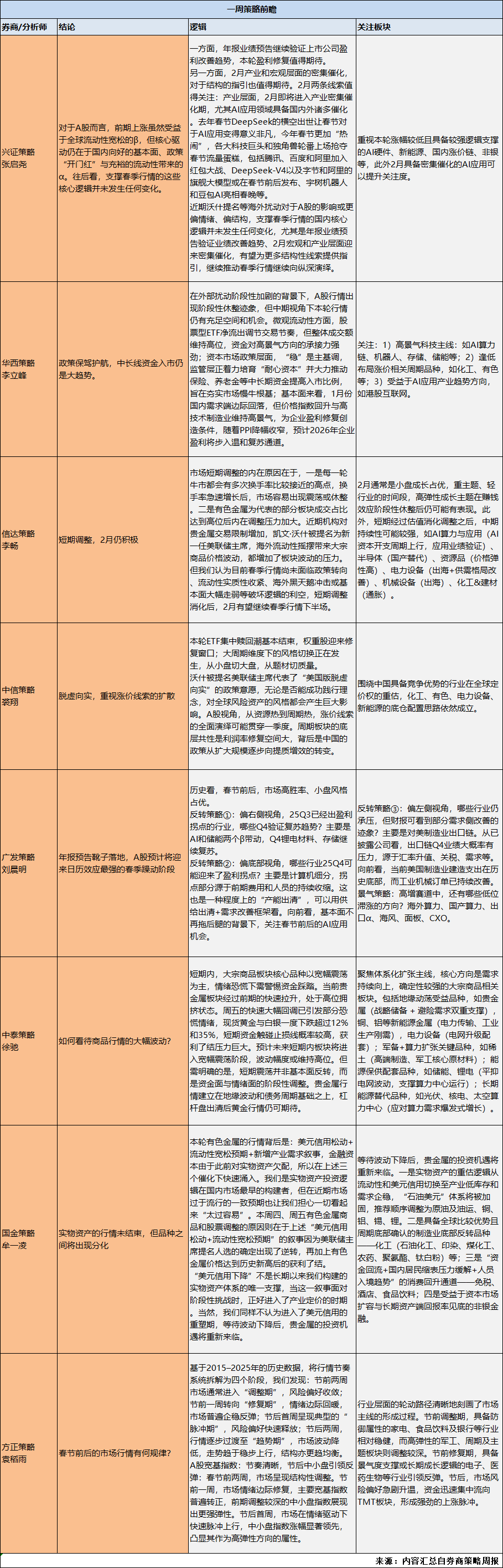
Group 1 - The main focus of brokerage strategies this week revolves around the future performance of the commodity market after significant fluctuations and the historical patterns of index performance leading up to the Spring Festival [1][2] - The core drivers of the recent A-share market rally are attributed to favorable domestic fundamentals, a "good start" in policies, and ample liquidity, which are expected to continue supporting the spring market [1][3] - The market is currently experiencing a phase of adjustment, but there remains ample space and opportunities for growth in the medium term, particularly in high-growth sectors [1][2] Group 2 - The strategy team from Guangfa Securities highlights four key directions for investment, focusing on industries that have shown signs of recovery and those that may see a profit turning point in Q4, particularly in AI and energy storage [2][3] - The analysis indicates that sectors such as lithium battery materials and storage are expected to continue their recovery into Q4, driven by AI and energy storage trends [2][3] - The report emphasizes the importance of monitoring the performance of the US manufacturing export chain, which is likely to face pressure due to factors such as currency appreciation and tariffs [2][3] Group 3 - The strategy from CITIC Securities predicts that the recent wave of ETF redemptions is coming to an end, providing a window for recovery in heavyweight stocks, with a shift in market style from small-cap to large-cap stocks [4][5] - The report notes that the underlying commonality in cyclical sectors is the significant potential for profit margin recovery, reflecting a shift in Chinese policy from expansion to quality improvement [4][5] - The analysis suggests that the spring market is expected to continue its upward trajectory, supported by structural catalysts in February, particularly in the AI application sector [3][4]
招商策略:指数震荡,涨价扩散
Xin Lang Cai Jing· 2026-02-01 12:50
Market Outlook - The market is expected to remain volatile in February, with a stronger performance anticipated post-Spring Festival due to policy catalysts and the upcoming Two Sessions [2][11][19] - The focus will be on cyclical price increases and AI applications, particularly in sectors like oil and petrochemicals, construction materials, and steel [2][11][19] Industry and Sector Recommendations - Recommended sectors include cyclical and technology areas, with a focus on electronics (semiconductors), media (advertising, gaming, film), machinery (automation, engineering), power equipment (batteries, grid equipment, photovoltaic), basic chemicals, and social services [3][5][16] - The investment strategy should emphasize growth style, with a preference for large-cap stocks initially, followed by small-cap stocks [3][16] Liquidity and Capital Supply - February is expected to see continued net inflows of incremental capital, with foreign capital likely to continue net inflows before the Spring Festival and a rebound in financing post-holiday [4][12] - The macro liquidity environment remains stable, supported by government bond issuance and central bank measures to counterbalance liquidity gaps [4][12] Earnings and Profitability Trends - Earnings forecasts indicate a recovery in profitability, particularly in sectors experiencing price increases, such as industrial metals and AI-driven technology [5][13][55] - The performance of high-growth sectors is expected to be strong, with a focus on cyclical price increases and export-oriented high-end manufacturing [5][55][57] ETF and Fund Flow Dynamics - Significant outflows from ETFs have been observed, particularly from broad-based indices, while thematic and sector-specific ETFs have seen inflows [31][34][39] - The adjustment in financing margin requirements has contributed to a cooling effect on market activity, with a notable impact on large-cap stocks [43][44]