
公用事业

Search documents
【盘中播报】沪指跌0.02% 有色金属行业跌幅最大
Zheng Quan Shi Bao Wang· 2025-11-04 04:28
Market Overview - The Shanghai Composite Index decreased by 0.02% as of 10:28 AM, with a trading volume of 603.64 million shares and a turnover of 892.17 billion yuan, representing a 19.08% decrease compared to the previous trading day [1] Industry Performance - The banking sector showed the highest increase with a rise of 1.98%, followed by public utilities at 0.57% and oil and petrochemicals at 0.37% [1] - The largest declines were seen in the non-ferrous metals sector at -1.71%, beauty and personal care at -1.54%, and computers at -1.50% [2] Leading Stocks - Xiamen Bank led the banking sector with a gain of 5.21% [1] - Delong Huineng topped the public utilities sector with a 10.00% increase [1] - Unified Holdings led the oil and petrochemicals sector, also with a 10.00% rise [1] - In the non-ferrous metals sector, Shengxin Lithium Energy experienced a decline of 6.49% [2]

600735,直线“天地板”!此前6连涨停
Zheng Quan Shi Bao· 2025-11-04 03:51
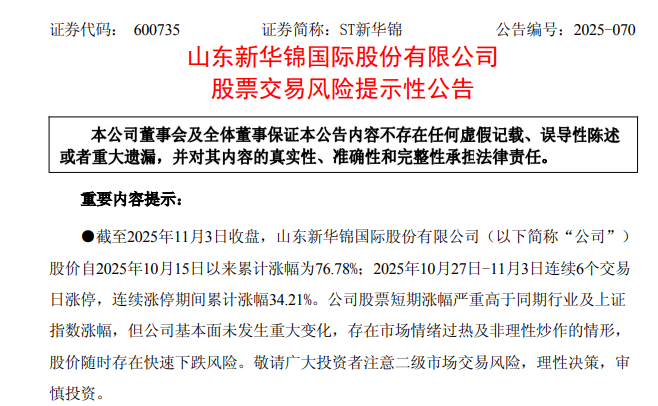
Market Overview - The A-share market opened lower on November 4, with the Shanghai Composite Index and ChiNext Index turning positive by the time of reporting [1] - In the market, sectors such as semiconductors, media and entertainment, and gas supply showed strength, while sectors like non-ferrous metals, pharmaceuticals, and brokerages experienced pullbacks [2] Banking Sector - Bank stocks continued their upward trend, with Shanghai Bank rising over 2%, and other banks such as Chongqing Bank, CITIC Bank, Agricultural Bank of China, China Merchants Bank, Qilu Bank, and Postal Savings Bank of China all increasing by more than 1% [2] Individual Stocks - ST Xinhua Jin (600735) saw its stock price hit the daily limit down at one point, with a trading volume of nearly 300 million yuan. The stock had previously experienced six consecutive trading days of limit-up, with a cumulative increase of 34.21%, significantly higher than the industry and Shanghai Composite Index during the same period. The company’s fundamentals have not changed significantly, indicating potential market overheating and irrational speculation, leading to a risk of rapid price decline [3] Hong Kong Market - The Hang Seng Index and Hang Seng Tech Index showed positive performance. However, the non-ferrous metals sector weakened, with Zijin Mining falling over 1%. Baidu Group rose over 5%, Tencent Holdings increased by over 1%, and SMIC rose over 3%, while companies like Innovent Biologics and Li Auto saw declines of nearly 2% and over 1%, respectively [6] Power Equipment Sector - The power equipment sector saw an initial surge, with Sanbian Technology hitting the daily limit up, followed by gains in companies like New Special Electric, TBEA, Jinpan Technology, Wangbian Electric, Siyuan Electric, Jiangsu Huachen, Zhongneng Electric, and Kelu Electronics [7] Coal Industry - The coal mining and processing sector experienced fluctuations but trended upward, with Antai Group hitting the daily limit up for two consecutive days. Other companies like Yunmei Energy, Zhengzhou Coal Electricity, Liaoning Energy, Jinkong Coal Industry, and Pingmei Shenma also saw gains. The significant rise in thermal coal prices in the second half of the year, coupled with tightening supply-side policies and increased winter heating demand, has improved the industry’s fundamentals. As a result, coal companies reported a notable recovery in third-quarter profits [9] Company Announcements - Tiancheng Holdings in Hong Kong saw a surge of over 80% upon resuming trading, although the gains moderated by the time of reporting. The company announced a revised placement price of HKD 0.121 per share, up from HKD 0.1, for a maximum of 60 million shares [10][11] - Superstar Legend experienced a near 8% increase at the start of trading, following an announcement of a sales contract with ADATA Technology for the procurement of 1,000 quadruped robots, totaling over RMB 20 million [12]


亚马逊指控伯克希尔旗下公用事业公司供电不足
Ge Long Hui A P P· 2025-11-04 01:51
Core Viewpoint - Amazon has accused PacifiCorp, a utility company owned by Berkshire Hathaway, of failing to provide sufficient electricity for four new data center projects, highlighting the pressure that rapid tech facility expansion places on the power grid [1] Group 1: Company Actions - Amazon filed a complaint with the Oregon Public Utility Commission, claiming that PacifiCorp violated its contractual obligations to supply adequate power for the projects since 2021 [1] - The complaint specifies that one data center received insufficient power, another center was not powered at all, and the third and fourth centers refused to complete their standard contract processes [1] Group 2: Industry Implications - The situation underscores the increasing demand for electricity from tech companies as they expand their data center operations, which are essential for cloud computing, mobile applications, and streaming services [1]

中金 | 11月行业配置:风格更均衡
中金点睛· 2025-11-04 00:07
Core Viewpoint - The A-share market is experiencing a phase of oscillation and upward trend, with a shift towards dividend stocks and sectors with strong price increase certainty, such as non-ferrous metals, supported by recent US-China trade negotiations [2] Industry Performance Summary 1) Energy and Basic Materials - The Federal Reserve's interest rate cut has led to a continued rise in gold and industrial metal prices, with coal prices rebounding due to increased demand for the heating season and production cuts. In October, prices for thermal coal, coking coal, coking, and iron ore rose by 10%, 14%, 10%, and 3% respectively [3][10] - Coal production has seen a year-on-year decline of 3.2% in September, maintaining negative growth for three consecutive months, while coal inventory remains historically high at 710 million tons [10] 2) Industrial Products - The energy transition is supporting demand for electrical equipment, with steady growth in the photovoltaic industry. In September, excavator domestic sales grew by 22% year-on-year, and new energy vehicle sales increased by 25% [4] - The price increase pace in the photovoltaic supply chain has slowed, with polysilicon and solar cell prices decreasing by 0.6% and 3% month-on-month [4] 3) Consumer Goods - Domestic demand for home appliances continues to slow, with September sales for washing machines, refrigerators, and air conditioners down by 16%, 26%, and 21% year-on-year respectively. The liquor industry is in a supply clearing phase, with the wholesale price of Feitian Moutai down by 6% year-on-year [5] - The food sector shows mixed performance, with prices for pork, chicken, and eggs declining, while vegetable prices have risen [5] 4) Technology - The AI industry chain is experiencing high prosperity, with strong overseas demand for AI computing driving sales of Chinese communication equipment. The net profit growth rates for software and services, computer equipment, communication equipment, and semiconductors reached 161%, 45%, 25%, and 33% respectively [6] - The gaming sector remains robust, with 166 game licenses issued in October, maintaining a high level [6] 5) Financials - The banking sector's high dividend attributes are attracting medium to long-term capital allocation, with insurance premiums growing by 9% year-on-year in September. The average daily trading volume of A-shares has slightly decreased to 2.2 trillion yuan [6] - The stock market sentiment remains high, with a significant increase in margin trading balances reaching a historical high of approximately 2.5 trillion yuan [6] 6) Real Estate - The real estate market is still in a bottoming phase, with October sales area in 30 major cities down by 27% year-on-year. The price index for new and second-hand residential properties has decreased by 2.7% and 5.2% respectively [7] - The industry is under pressure, with a focus on policy support and demand improvement [7] Investment Recommendations - Focus on sectors such as AI computing, communication equipment, semiconductors, and innovative pharmaceuticals, which are expected to remain attractive until a significant change in industry prosperity occurs [7] - Non-ferrous metals are likely to benefit from the global monetary order reconstruction, while export growth remains strong, enhancing profit margins for companies in engineering machinery, electrical equipment, and white goods [7]

27000亿现金,巴菲特如此操作,意味着什么?
美股研究社· 2025-11-03 10:33
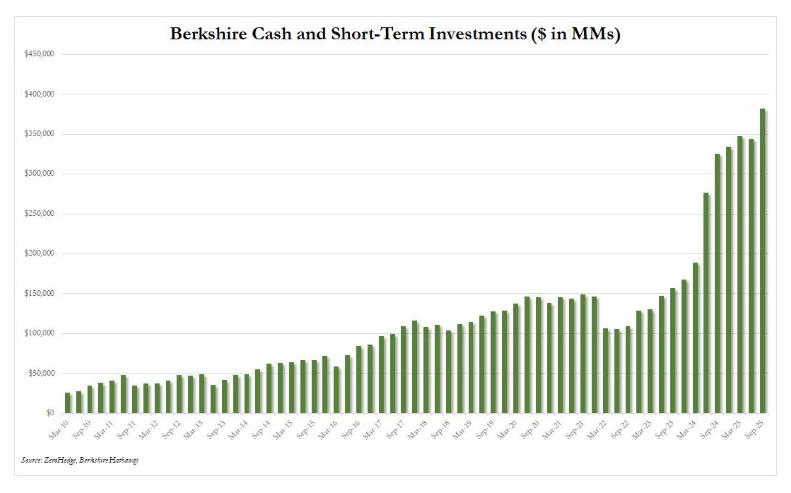
Core Viewpoint - As Warren Buffett prepares to step down, Berkshire Hathaway's cash reserves have reached a historic high of approximately $382 billion, signaling a cautious investment strategy amid limited opportunities in the current market [2][6][22]. Cash Reserves and Stock Sales - Berkshire Hathaway's cash reserves reached $381.7 billion as of the third quarter, an increase of $37.6 billion from the previous quarter, equating to a daily cash increase of $420 million [2]. - Over the past three years, Berkshire has net sold approximately $184 billion in stocks, with a notable $6.1 billion in stock sales during the third quarter alone [4][11]. Investment Strategy - The company has maintained a conservative approach, with stock sales consistently outpacing purchases for 12 consecutive quarters [11]. - Major stock sales included significant reductions in holdings of Apple, American Express, and Bank of America [13]. Market Sentiment and Stock Buybacks - Analysts suggest that Buffett perceives more selling opportunities than buying opportunities in the current market [5][6]. - Since the second quarter of 2024, Berkshire has refrained from repurchasing its own shares, indicating a cautious stance [7][18]. Financial Performance - Despite the conservative investment strategy, Berkshire's operational profit for the third quarter increased by 34% year-over-year, reaching $13.5 billion, primarily driven by its insurance business [20]. Transition to Post-Buffett Era - Buffett will officially step down as CEO at the end of the year, passing leadership to Greg Abel, who will face the challenge of effectively deploying the company's substantial cash reserves [22][23]. - Abel's recent acquisition of Occidental Petroleum's chemical business for $9.7 billion is seen as a preview of capital operations in the post-Buffett era [16][23]. - Investor sentiment is mixed, with some expressing optimism about Abel's leadership while others are eager for the company to deploy its cash more aggressively [23].

11月3日国企改革(399974)指数涨0.25%,成份股金风科技(002202)领涨
Sou Hu Cai Jing· 2025-11-03 10:23
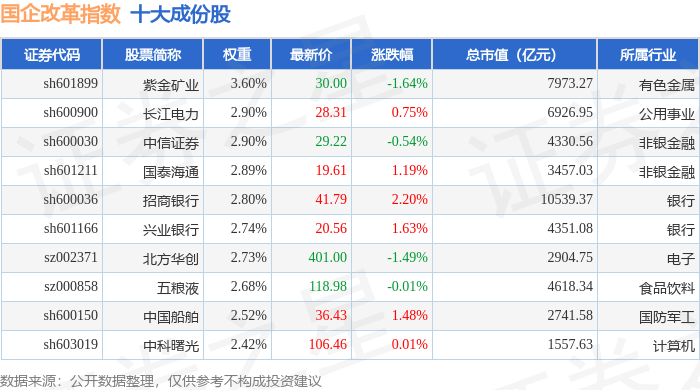
Core Points - The State-Owned Enterprise Reform Index (399974) closed at 1902.39 points, up 0.25%, with a trading volume of 146.44 billion yuan and a turnover rate of 0.74% [1] - Among the index constituents, 56 stocks rose, with Goldwind Technology leading at a 6.94% increase, while 39 stocks fell, with China Rare Earth leading the decline at 5.24% [1] Index Constituents Summary - The top ten constituents of the State-Owned Enterprise Reform Index include: - Yingmei Ge, with a weight of 3.60%, latest price at 30.00, down 1.64%, total market value of 797.33 billion yuan [1] - Changjiang Electric Power, with a weight of 2.90%, latest price at 28.31, up 0.75%, total market value of 692.70 billion yuan [1] - CITIC Securities, with a weight of 2.90%, latest price at 29.22, down 0.54%, total market value of 433.06 billion yuan [1] - Yuanta Haitong, with a weight of 2.89%, latest price at 19.61, up 1.19%, total market value of 345.70 billion yuan [1] - China Merchants Bank, with a weight of 2.80%, latest price at 41.79, up 2.20%, total market value of 1053.94 billion yuan [1] - Industrial Bank, with a weight of 2.74%, latest price at 20.56, up 1.63%, total market value of 435.11 billion yuan [1] - North Huachuang, with a weight of 2.73%, latest price at 401.00, down 1.49%, total market value of 290.48 billion yuan [1] - Wuliangye, with a weight of 2.68%, latest price at 118.98, down 0.01%, total market value of 461.83 billion yuan [1] - China Shipbuilding, with a weight of 2.52%, latest price at 36.43, up 1.48%, total market value of 274.16 billion yuan [1] - Zhongke Shuguang, with a weight of 2.42%, latest price at 106.46, up 0.01%, total market value of 155.76 billion yuan [1] Capital Flow Summary - The net outflow of main funds from the index constituents totaled 4.443 billion yuan, while speculative funds saw a net inflow of 1.03 billion yuan, and retail investors had a net inflow of 3.413 billion yuan [3] - Notable capital flows include: - China Merchants Bank with a net inflow of 433 million yuan, accounting for 11.29% of the total [3] - Allwind Technology with a net inflow of 430 million yuan, accounting for 11.88% of the total [3] - China Petroleum with a net inflow of 326 million yuan, accounting for 14.97% of the total [3] - China Shipbuilding with a net inflow of 284 million yuan, accounting for 10.31% of the total [3]




石油巨头跨界入局AI,拟用碳捕捉为数据中心减排
Hua Er Jie Jian Wen· 2025-11-03 08:08
Core Insights - ExxonMobil plans to apply its carbon capture technology to provide low-carbon power solutions for AI data centers, aiming for significant emissions reductions [1][3] - The company is in discussions with multiple power suppliers and tech companies to capture up to 90% of CO2 emissions from natural gas power plants supplying data centers [1][3] - This strategy aligns with the growing demand for reliable energy sources in the tech industry, particularly as companies shift from renewable energy to natural gas and nuclear power for stable electricity supply [2][4] Group 1: ExxonMobil's Strategy - ExxonMobil's CEO, Darren Woods, emphasized that the company's carbon capture solution may be the only realistic option for large tech companies seeking low-emission facilities in the short to medium term [1][4] - The company is leveraging its expertise in carbon capture, transportation, and storage (CCS) to address emissions from natural gas power generation [3][4] - This strategic pivot connects traditional energy companies with the booming AI sector, potentially creating new revenue streams and improving their environmental image [4] Group 2: Industry Trends - The surge in AI has led to increased energy demands, with tech companies now looking to natural gas as a reliable power source for their data centers [2] - Meta has signed an agreement with Entergy to use natural gas for powering a data center, highlighting the trend of traditional energy sources being repurposed for modern tech needs [2] - The shift towards natural gas and nuclear power reflects the industry's need for consistent energy supply despite ongoing sustainability goals [2]

27000亿现金,巴菲特如此操作,意味着什么?
3 6 Ke· 2025-11-03 06:24
Core Viewpoint - As Warren Buffett prepares to step down, Berkshire Hathaway's cash reserves have reached a record high of approximately $382 billion, signaling a cautious investment strategy amid limited opportunities in the market [1][5][12]. Group 1: Cash Reserves and Investment Strategy - Berkshire Hathaway's cash reserves reached $381.7 billion as of the third quarter, an increase of $37.6 billion from the previous quarter, equating to a daily cash increase of $420 million [1][5]. - The company has been actively selling stocks, with a net sell-off of approximately $184 billion over the past three years, including a $6.1 billion stock sale in the third quarter alone [3][5]. - The investment activity shows a trend where the number of stocks sold has exceeded those bought for 12 consecutive quarters, indicating a preference for selling over buying [5][12]. Group 2: Market Sentiment and Stock Performance - Analysts suggest that Buffett perceives more selling opportunities than buying ones in the current market environment [3][5]. - Since Buffett announced his retirement as CEO, Berkshire's Class A shares have declined by about 12%, while the S&P 500 index has increased by approximately 20% during the same period [8][9]. - The company's stock price has lagged significantly behind the market, returning to levels seen in August of the previous year [9]. Group 3: Future Leadership and Challenges - Warren Buffett will officially step down as CEO at the end of the year, with Greg Abel set to take over, managing a vast empire with nearly 200 subsidiaries and $382 billion in cash [12]. - The effective deployment of this substantial cash reserve will be a primary challenge for Abel, especially in a market filled with uncertainties [12]. - Some investors express impatience for Berkshire to deploy its cash, while others remain optimistic about Abel's leadership capabilities [12].
东北固收转债分析:2025年11月十大转债-2025年11月
NORTHEAST SECURITIES· 2025-11-03 04:12
1. Report Industry Investment Rating No relevant content provided. 2. Core View of the Report The report presents the top ten convertible bonds for November 2025, along with an analysis of the issuing companies, including their financial performance, business models, and key attractions [14][23][36]. 3. Summary by Company 3.1 Zhongte Convertible Bond - Issuer: A globally leading specialized special steel material manufacturing enterprise with a production capacity of approximately 20 million tons of special steel materials per year [14]. - Financial Performance: In 2024, its operating income was 109.203 billion yuan (YoY -4.22%), and the net profit attributable to the parent company was 5.126 billion yuan (YoY -10.41%). In the first three quarters of 2025, the operating income was 81.206 billion yuan (YoY -2.75%), and the net profit attributable to the parent company was 4.33 billion yuan (YoY +12.88%) [14]. - Key Attractions: It is one of the world's steel companies with the most comprehensive variety and specifications, with a production capacity of over 20 million tons of special steel. It has a complete industrial chain, leading cost - control capabilities, and is seeking opportunities for external expansion [15]. 3.2 Shanlu Convertible Bond - Issuer: A company mainly engaged in road and bridge engineering construction and maintenance, with a complete business and management system [23]. - Financial Performance: In 2024, its operating income was 71.348 billion yuan (YoY -2.3%), and the net profit attributable to the parent company was 2.322 billion yuan (YoY +1.47%). In the first three quarters of 2025, the operating income was 41.354 billion yuan (YoY -3.11%), and the net profit attributable to the parent company was 1.41 billion yuan (YoY -3.27%) [23]. - Key Attractions: It has the concept of "China - Special Valuation," potential for improvement in its balance sheet and order volume. It can benefit from infrastructure construction in Shandong Province and the Belt and Road Initiative [26]. 3.3 Hebang Convertible Bond - Issuer: A company with advantages in salt mines, phosphate mines, and natural gas supply, covering the chemical, agricultural, and photovoltaic sectors [36]. - Financial Performance: In 2024, its operating income was 8.547 billion yuan (YoY -3.13%), and the net profit attributable to the parent company was 31 million yuan (YoY -97.55%). In the first three quarters of 2025, the operating income was 5.927 billion yuan (YoY -13.02%), and the net profit attributable to the parent company was 93 million yuan (YoY -57.93%) [36]. - Key Attractions: Its phosphate mines and salt mines contribute to profits, and its liquid methionine production has high - margin potential [37]. 3.4 Aima Convertible Bond - Issuer: A leading enterprise in the electric two - wheeler industry, responsible for R & D, production, and sales [45]. - Financial Performance: In 2024, its operating income was 21.606 billion yuan (YoY +2.71%), and the net profit attributable to the parent company was 1.988 billion yuan (YoY +5.68%). In the first three quarters of 2025, the operating income was 21.093 billion yuan (YoY +20.78%), and the net profit attributable to the parent company was 1.907 billion yuan (YoY +22.78%) [45]. - Key Attractions: The continuation of government subsidies for trade - ins, the implementation of new national standards, and potential improvements in gross margin [46]. 3.5 Xingye Convertible Bond - Issuer: One of the first joint - stock commercial banks approved by the State Council and the People's Bank of China, evolving into a modern financial service group [56]. - Financial Performance: In 2024, its operating income was 212.226 billion yuan (YoY +0.66%), and the net profit attributable to the parent company was 77.205 billion yuan (YoY +0.12%). In the first three quarters of 2025, the operating income was 161.234 billion yuan (YoY -1.82%), and the net profit attributable to the parent company was 63.083 billion yuan (YoY +0.12%) [56]. - Key Attractions: Stable asset quality and continuous growth in scale [57]. 3.6 Huanxu Convertible Bond - Issuer: A global leader in electronic manufacturing design, providing value - added services [67]. - Financial Performance: In 2024, its operating income was 60.691 billion yuan (YoY -0.17%), and the net profit attributable to the parent company was 1.652 billion yuan (YoY -15.16%). In the first three quarters of 2025, the operating income was 43.641 billion yuan (YoY -0.83%), and the net profit attributable to the parent company was 1.263 billion yuan (YoY -2.6%) [67]. - Key Attractions: Leading in smart wearable SiP modules and having a global production layout [68]. 3.7 Chongyin Convertible Bond - Issuer: The earliest local joint - stock commercial bank in the upper reaches of the Yangtze River and Southwest China, with a wide range of business operations [79]. - Financial Performance: In 2024, its operating income was 13.679 billion yuan (YoY +3.54%), and the net profit attributable to the parent company was 5.117 billion yuan (YoY +3.8%). In the first three quarters of 2025, the operating income was 11.74 billion yuan (YoY +10.4%), and the net profit attributable to the parent company was 4.879 billion yuan (YoY +10.19%) [79]. - Key Attractions: Benefiting from the Chengdu - Chongqing economic circle strategy, stable asset growth, and proactive risk management [80]. 3.8 Tianye Convertible Bond - Issuer: A leading enterprise in the chlor - alkali chemical industry in Xinjiang, with an integrated circular economy industrial chain [88]. - Financial Performance: In 2024, its operating income was 11.156 billion yuan (YoY -2.7%), and the net profit attributable to the parent company was 68 million yuan (YoY +108.83%). In the first three quarters of 2025, the operating income was 7.97 billion yuan (YoY +2.2%), and the net profit attributable to the parent company was 7 million yuan (YoY -28.79%) [88]. - Key Attractions: Relatively stable caustic soda production costs and plans to increase dividend frequency and advance coal mine projects [89]. 3.9 Aorui Convertible Bond - Issuer: A company focusing on the R & D, production, and sales of complex APIs and preparations, leading in multiple fields [101]. - Financial Performance: In 2024, its operating income was 1.476 billion yuan (YoY +16.89%), and the net profit attributable to the parent company was 355 million yuan (YoY +22.59%). In the first three quarters of 2025, the operating income was 1.237 billion yuan (YoY +13.67%), and the net profit attributable to the parent company was 354 million yuan (YoY +24.58%) [101]. - Key Attractions: Improving its dealer network, expanding the market for its preparation products, and having high - quality customer resources [102]. 3.10 Yushui Convertible Bond - Issuer: The largest integrated water supply and drainage enterprise in Chongqing, with a monopoly position in the local market [110]. - Financial Performance: In 2024, its operating income was 6.999 billion yuan (YoY -3.52%), and the net profit attributable to the parent company was 785 million yuan (YoY -27.88%). In the first three quarters of 2025, the operating income was 5.568 billion yuan (YoY +7.21%), and the net profit attributable to the parent company was 779 million yuan (YoY +7.1%) [110]. - Key Attractions: Stable water supply and drainage business, expanding market share, and effective cost control [111].




4000点后如何应对?结构性机会仍存,盘整震荡中布局再平衡
Zheng Quan Shi Bao Wang· 2025-11-03 03:05
Group 1 - The current index level is not as critical as the underlying quality of the market, with structural opportunities still present despite a focus on timing being less important [1] - The overall growth is entering a recovery phase, with improvements in net profit margins across various sectors, indicating a broadening of growth prospects [2] - The market is expected to experience a period of horizontal adjustment, suggesting a temporary pause in aggressive investment strategies [4] Group 2 - The recent U.S.-China trade discussions have alleviated external uncertainties, contributing to a favorable policy environment for the A-share market [5] - The focus is shifting towards internal structural optimization, with an emphasis on sectors like AI and cyclical industries that are expected to perform well in the coming year [7] - The market is likely to see a rotation in investment themes, with a potential focus on sectors benefiting from domestic demand and global supply chain dynamics [9] Group 3 - The technology sector remains a key focus, although there may be increased volatility in the short term due to high allocation levels and potential shifts in investment strategies [10] - The outlook for the market remains optimistic in the medium to long term, supported by clear economic growth targets and stable policy environments [8] - The recovery in profitability is expected to solidify the bull market, with a focus on sectors that can leverage both domestic and international opportunities [11][12]