
汽车

Search documents
广汽集团冯兴亚:建议加快构建全国统一的换电标准,健全车电分离制度框架
Xin Lang Cai Jing· 2026-03-04 14:04
Group 1: Automotive Industry Development - The core suggestions from the chairman of GAC Group focus on high-quality development in the automotive industry, emphasizing new energy vehicle (NEV) battery swapping, autonomous driving, and the construction of Chinese automotive brands [2][3] - The battery swapping model is entering its initial stage of large-scale development, with recommendations to accelerate the establishment of a unified national battery swapping standard and enhance operational subsidies for swapping stations [2] - The autonomous driving industry in China is moving towards large-scale application, with calls to improve relevant laws and regulations, and to create a unified national standard and evaluation system to support the rapid development of smart driving technology [3] Group 2: Low-altitude Economy - The low-altitude economy in China has a market size exceeding 600 billion yuan, but it is still in its early stages of development [4] - Suggestions to promote high-quality development in the low-altitude economy include strengthening planning, establishing a "14th Five-Year" development plan, and creating a low-altitude airspace network [4] - Recommendations also include improving regulatory mechanisms and expanding application scenarios in logistics, medical emergencies, and urban transportation to foster sustainable business models [4] Group 3: Rural and Elderly Mobility - The potential for rural new energy vehicle markets is significant, but there are deficiencies in infrastructure; suggestions include enhancing charging and swapping networks and increasing support for rural automotive consumption [5] - Addressing the travel needs of the elderly population, which numbers 323 million, recommendations include implementing a "digital inclusion + human support" travel service model and optimizing travel applications for elderly users [5]



娄勤俭:香港国际金融中心地位更加稳固
IPO日报· 2026-03-04 13:46
Core Viewpoint - The article highlights the significant progress made by Hong Kong in enhancing its status as an international financial center, with notable achievements in IPO activities and economic rankings [2][3][4]. Group 1: Economic Developments - Hong Kong's position as an international financial center has been solidified, ranking third in the Global Financial Centers Index [2]. - The IPO scale in Hong Kong has doubled year-on-year, making it the top global market for IPOs [2]. - The business environment in Hong Kong is characterized by high efficiency and openness, with the highest economic freedom ranking globally [2]. Group 2: IPO Market Insights - In 2025, eight large IPOs are expected in Hong Kong, with four of them entering the global top ten for fundraising: CATL, Zijin Mining International, Sany Heavy Industry, and Seres [3]. - Each of these eight large IPOs is projected to raise over 10 billion HKD, contributing to approximately 50% of the total fundraising [4]. - A total of 19 A-share listed companies, including Naxin Microelectronics, are set to list in Hong Kong, raising around 140 billion HKD, which accounts for nearly half of the total IPO fundraising in the market [4].







ETF资金流向视角下的行业轮动配置
Huafu Securities· 2026-03-04 13:27
Quantitative Models and Construction Methods 1. Model Name: Industry Allocation Model Based on ETF Fund Flows - **Model Construction Idea**: The model leverages ETF fund flow data to identify industry rotation opportunities. It incorporates short-term fund inflows/outflows, style-adjusted holding levels, marginal changes in holdings, and the divergence between ETF and active equity fund holdings to construct an industry allocation strategy[3][69][72] - **Model Construction Process**: 1. **Short-term Fund Flows**: Calculate the first-order difference of weekly ETF holdings to identify industries with significant inflows or outflows[40][44] 2. **Style-Adjusted Holdings**: Adjust industry holdings based on market style (e.g., large-cap vs. small-cap, growth vs. value) using a single-sided HP filter and factor momentum to determine style trends[49][50][57] 3. **Marginal Changes in Holdings**: Analyze the marginal changes in ETF holdings by ranking industries into five groups based on their monthly holding changes[22][25] 4. **Divergence with Active Equity Funds**: Compare ETF holdings with active equity fund holdings to identify industries with higher or lower relative allocations. Use regression-based methods to estimate active fund holdings when real data is unavailable[27][28][31] 5. **Final Strategy**: Combine the above factors equally, select the top six industries, and rebalance the portfolio bi-weekly[72] - **Model Evaluation**: The model effectively captures industry rotation opportunities by integrating multiple dimensions of ETF fund flow data and market style trends[72] --- Model Backtesting Results 1. Industry Allocation Model Based on ETF Fund Flows - **Annualized Return**: 15.57% - **Excess Annualized Return**: 7.56% (compared to equal-weighted industry benchmark) - **Information Ratio (IR)**: 0.93 - **Maximum Drawdown**: 8.30% - **Monthly Excess Win Rate**: 64% - **Payoff Ratio**: 1.38x[72] --- Quantitative Factors and Construction Methods 1. Factor Name: Short-term Fund Flows - **Factor Construction Idea**: Identify industries with significant short-term fund inflows or outflows to capture immediate price impacts[40][44] - **Factor Construction Process**: 1. Calculate the first-order difference of weekly ETF holdings 2. Rank industries based on the magnitude of fund flow changes[40][44] - **Factor Evaluation**: Demonstrates strong monotonicity in short-term returns, with industries experiencing inflows showing higher returns[44] 2. Factor Name: Style-Adjusted Holdings - **Factor Construction Idea**: Adjust industry holdings based on prevailing market styles (e.g., large-cap vs. small-cap, growth vs. value)[46][49] - **Factor Construction Process**: 1. Use a single-sided HP filter to smooth market style data (e.g., CSI 300/CSI 1000 index ratios) 2. Define factor momentum as the difference between the current value and the average of the previous two periods 3. Classify industries into five groups based on their adjusted holdings[49][50][57] - **Factor Evaluation**: Captures the relationship between industry holdings and market style trends, effectively identifying style-driven opportunities[47][57] 3. Factor Name: Marginal Changes in Holdings - **Factor Construction Idea**: Analyze the marginal changes in ETF holdings to identify industries with increasing or decreasing allocations[22][25] - **Factor Construction Process**: 1. Calculate the monthly difference in ETF holdings for each industry 2. Rank industries into five groups based on the magnitude of changes[22][25] - **Factor Evaluation**: Demonstrates a strong correlation with growth and value style trends, providing insights into industry rotation opportunities[47] 4. Factor Name: Divergence with Active Equity Fund Holdings - **Factor Construction Idea**: Compare ETF holdings with active equity fund holdings to identify industries with higher or lower relative allocations[27][28] - **Factor Construction Process**: 1. Use regression-based methods to estimate active fund holdings when real data is unavailable 2. Calculate the difference between ETF and active fund holdings and rank industries into three groups based on the magnitude of divergence[27][28][31] - **Factor Evaluation**: Highlights the pricing power of ETF flows relative to active funds, especially post-2021[31][65] --- Factor Backtesting Results 1. Short-term Fund Flows - **Absolute Return**: 6.17% (highest group) - **Annualized Volatility**: 21.22% - **Sharpe Ratio**: 0.29 - **Maximum Drawdown**: -37.61%[42] 2. Style-Adjusted Holdings - **Annualized Return**: 9.66% - **Excess Annualized Return**: 5.82% - **Information Ratio (IR)**: 0.75 - **Maximum Drawdown**: -29.11%[55] 3. Marginal Changes in Holdings - **Annualized Return**: 7.80% (highest group) - **Excess Annualized Return**: 6.91% - **Information Ratio (IR)**: 1.13 - **Maximum Drawdown**: -16.10%[71] 4. Divergence with Active Equity Fund Holdings - **Annualized Return**: 14.01% - **Excess Annualized Return**: 6.11% - **Information Ratio (IR)**: 0.76 - **Maximum Drawdown**: -28.80%[64][65]
蓝思科技:深度AI硬件+商业航天,平台型龙头开启新征程-20260304
ZHONGTAI SECURITIES· 2026-03-04 13:25
Investment Rating - The report assigns a "Buy" rating for the company for the first time [3]. Core Insights - The company is positioned as a platform-type precision manufacturing leader, expanding into AI hardware and commercial aerospace, which is expected to drive new growth [5]. - The company has a solid foundation in consumer electronics, with a focus on innovation to drive growth, particularly benefiting from major clients' hardware innovations [5][11]. - The company is expected to achieve significant revenue growth, with projected revenues of 83.1 billion yuan in 2025 and 117.4 billion yuan in 2027, reflecting a compound annual growth rate (CAGR) of 18.8% from 2025 to 2027 [3][5]. Summary by Sections 1. Full Industry Chain Layout and Multi-Business Synergy - The company has evolved from a glass processing business to a comprehensive provider of intelligent hardware solutions, establishing a strong presence in the consumer electronics sector [10][11]. - The company has expanded its product offerings to include precision ceramics, sapphire, and metal components, solidifying its position as a core supplier in the consumer electronics industry [10][11]. 2. Consumer Electronics: Solid Platform Foundation and Innovation-Driven Growth - The company has deep ties with major clients, particularly Apple, with revenue from Apple increasing from 49.4% in 2017 to 71.0% in 2022, and projected to contribute 345.66 billion yuan in 2024 [29]. - The company is expected to benefit from the AI narrative reboot by Apple, which may shorten the replacement cycle for iPhones and boost sales [35]. 3. Automotive Business: Continuous Client and Product Expansion - The company has established itself as a Tier 1 supplier for Tesla and has expanded its client base to over 30 domestic and international customers, driving revenue growth in the automotive sector [60]. - The automotive business is projected to generate 59.4 billion yuan in revenue in 2024, reflecting an 18.8% year-over-year growth [60]. 4. Other Intelligent Terminals: Deep Layout in Robotics and AI Servers - The company is actively involved in the robotics sector, with products already integrated into major North American and domestic robotics clients, providing long-term growth potential [14]. - The acquisition of Yuan Shi Technology is expected to enhance the company's capabilities in AI server infrastructure, tapping into a rapidly growing market [14][60].


大类资产配置月报第56期:2026年3月:地缘冲突与美国关税扰动加剧
Huaan Securities· 2026-03-04 10:25
Market Overview - Geopolitical conflicts and US tariff disturbances are increasing, leading to heightened volatility in risk asset prices[2] - The Shanghai Composite Index rose from 4117.95 to 4162.88, an increase of 1.09%[2] - The NASDAQ Index fell from 23461.82 to 22668.21, a decrease of 3.38%[2] Investment Recommendations - Strong upward support for the Growth style index, which increased from 9588.03 to 9882.89, a rise of 3.08%[2] - The Cycle style index showed a significant increase from 6693.64 to 6967.09, up by 4.09%[2] - The Financial style index decreased from 9024.89 to 8873.67, down by 1.68%[2] Bond Market Insights - The 1Y government bond yield increased slightly from 1.30% to 1.322%, a change of 2 basis points[2] - The 10Y US Treasury yield decreased from 4.26% to 3.97%, a drop of 29 basis points[2] Commodity Trends - Brent crude oil prices rose from $65.21 to $67.02 per barrel, an increase of 2.78%[2] - COMEX gold prices increased from $4879.6 to $5280 per ounce, up by 8.21%[2] Currency Movements - The US Dollar Index rose from 97.12 to 97.64, an increase of 0.54%[2] - The exchange rate of USD to CNY decreased from 6.95 to 6.86, a decline of 1.33%[2]
阿里Qwen负责人离职;高盛CEO表示市场对伊朗战争反应“温和”令人意外;两天熔断!韩国股市暴跌12%,100万亿韩元救市基金待命
新财富· 2026-03-04 09:42
Group 1 - Goldman Sachs CEO David Solomon expressed surprise at the "mild" market reaction to the Middle East conflict, indicating that it may take weeks to fully understand the situation and its impacts [2][4] - The conflict has led to a surge in oil prices, with Brent crude surpassing $82 per barrel, marking the largest two-day increase since 2020, prompting traders to significantly lower expectations for Federal Reserve rate cuts [3] - The market sentiment is partly supported by the U.S. commitment to ensure the safety of shipping in the Strait of Hormuz, despite the high shipping risks due to Iranian naval control and attacks on oil tankers [4][5] Group 2 - The ongoing conflict in the Middle East is causing significant panic in Japan and South Korea, with the KOSPI index in South Korea plummeting by 12%, raising concerns over energy supply and regional security [5][11][31] - The South Korean government is prepared to activate a market stabilization plan worth approximately 100 trillion won (about $68 billion) in response to the stock market turmoil, which has been exacerbated by rising oil prices and inflation expectations [32][31] Group 3 - The Chinese smart glasses market saw a dramatic increase in sales, reaching 1.454 million units, a 211% rise, indicating strong demand and growth potential in the emerging consumer electronics sector [6] - The Ministry of Science and Technology and other departments have issued opinions to promote high-quality development of technology insurance, focusing on the risk protection needs of technology enterprises throughout their lifecycle [15]

中观景气跟踪 3月第1期:周期资源价格大涨,建工复产偏强
GUOTAI HAITONG SECURITIES· 2026-03-04 09:30
1. Report Industry Investment Rating No information provided. 2. Core Viewpoints of the Report - In the week from 02.23 - 03.01, the mid - level economic performance showed differentiation. The rising Middle - East situation led to significant price increases in cyclical resources such as crude oil, chemical, shipping, and non - ferrous metals. The construction industry's resumption of work was stronger than the same period in the lunar calendar, possibly supported by the warming of real - estate sales and the early implementation of fiscal funds in 2026. The AI computing power industry's prosperity center continued to move up, while the traditional commodity consumption was under pressure [4]. 3. Summary According to the Table of Contents 3.1 Upstream Resources: Soaring Crude Oil Chain Prices and Significant Increase in Non - ferrous Metal Prices - **Oil and Chemicals & Shipping**: Due to the escalating Middle - East situation after the US - Israel air strike on Iran on 2026.02.28, the threat to the safety of crude oil transportation in the Strait of Hormuz led to significant disruptions in global crude oil supply. As of 03.03, the Brent crude oil futures settlement price increased by 12.3% compared to 02.27, and the domestic chemical product price index rose by 4.8%. The crude oil transportation index (BDTI) and refined oil transportation index (BCTI) increased by 43.9% and 54.0% respectively [7]. - **Coal**: As of 02.28, the ex - works price of Qinhuangdao Port's Q5500 steam coal was 751 yuan/ton, with a week - on - week increase of 4.0%. The increase was mainly due to the uncertainty of coal supply from Indonesia and the rise in international coal prices [8]. - **Non - ferrous Metals**: As of 02.27, the COMEX gold price increased by 3.3% week - on - week. Industrial metals such as SHFE copper and aluminum also saw price increases. Small metals like black tungsten, molybdenum, and cobalt rose by 6.5%, 2.1%, and 13.1% respectively, driven by AI capital expenditure [10]. 3.2 Technology & Manufacturing: Increasing Growth Rate of Technology Hardware Prosperity and Fast Post - Festival Resumption of Work - **Electronics**: Driven by AI infrastructure demand, the prosperity of technology hardware continued to grow. In January 2026, South Korea's semiconductor export volume (TTM) reached 183.82 billion US dollars, a year - on - year increase of 28.8%, and the export volume of memory chips reached 128.53 billion US dollars, a year - on - year increase of 44.1%. As of 02.27, the average prices of DRAM DDR4 and DDR5 increased by 1.9% and 3.8% respectively [20]. - **Infrastructure and Real - Estate Chain**: Steel prices fluctuated slightly. As of 02.28, the prices of rebar and hot - rolled coils changed by - 0.3% and + 0.6% week - on - week respectively. The apparent consumption of rebar increased by 25.5% compared to the same period in the lunar calendar. As of 02.27, the blast furnace operating rate increased by 0.6% week - on - week and 2.2% compared to the same period in the lunar calendar. Building material prices fluctuated slightly. As of 02.26, the average price of domestic float glass increased by 1.2% week - on - week, and the inventory increased by 26.5% compared to the same period in 2025. As of 02.28, the national cement price index decreased by 0.4% week - on - week, and the cement shipping rate increased by 9.0% compared to the same period in 2025 [23][27]. 3.3 Downstream Consumption: Strong Post - Festival Real - Estate Sales and High Tourism Prosperity Year - on - Year - **Real - Estate**: As of the week of 03.01, the commercial housing transaction area of 30 large and medium - sized cities increased by 55.4% compared to the same period in the lunar calendar of 2025. The second - hand housing transaction area of 10 key cities increased by 14.5% compared to the same period in 2025. After the new policy in Shanghai, the real - estate sales consultation heat increased significantly [31]. - **Durable Goods**: In March 2026, the production plan of household air conditioners decreased by 6.1% year - on - year. The domestic sales and export production plans decreased by 1.5% and 7.1% respectively. In February 2026, the inventory warning index of Chinese automobile dealers was 56.2%, a year - on - year decrease of 0.7% and a month - on - month decrease of 3.2% [39]. - **Beverages**: As of 2026.02.28, the wholesale reference prices of original and bulk Feitian Moutai increased by 0.3% and 0.0% respectively. As of 2026.02.27, the retail prices of Chinese milk and yogurt increased by 0.1% and 0.0% respectively [41]. - **Pigs & Planting**: As of 03.01, the national price of live pigs (inner ternary) decreased by 6.8% week - on - week. As of 02.28, the domestic spot weekly average prices of soybeans, soybean meal, wheat, and corn increased by 0.0%, 0.5%, 0.1%, and 0.5% respectively. The weekly average prices of CBOT soybeans and corn increased by 1.1% and 3.7% respectively [43]. - **Service Consumption**: As of the week of 03.01, the domestic movie box office decreased by 63.1% compared to the same period in the lunar calendar of 2025. From 02.22 - 02.28, the average congestion degree of Shanghai Disneyland was 75%, a 32.3% increase compared to the same period in 2025 [51]. 3.4 Logistics and People Flow: Significantly Increased Freight Prosperity Compared to the Same Period in the Lunar Calendar and Post - Festival Recovery of Port Throughput - **Passenger Transport**: As of the week of 03.01, the subway passenger volume of 10 major cities increased by 77.0% week - on - week and decreased by 10.3% year - on - year. The Baidu Migration Scale Index increased by 7.4% week - on - week and 130.8% year - on - year. The number of domestic flights increased by 3.9% week - on - week and 21.6% year - on - year, and 27.0% compared to the same period in 2019. The number of international flights decreased by 1.4% week - on - week and recovered to 93.8% of the same period in 2019 [53]. - **Freight Transport**: As of the week of 03.01, the national highway and railway freight volumes increased by 26.0% and 3.2% respectively compared to the same period in the lunar calendar of 2025. The national postal express pick - up and delivery volumes increased by 21.9% and 32.8% respectively compared to the same period in 2025 [59]. - **Maritime Transport**: As of 02.27, the SCFI index increased by 6.5% compared to before the festival. The Baltic Dry Index (BDI) increased by 2.7% compared to before the festival. As of the week of 03.01, the cargo throughput and container throughput of Chinese ports increased by 25.5% and 12.3% respectively compared to the same period in the lunar calendar of 2025 [61].
“特斯拉铁粉”股东大举购入100万股英伟达(NVDA.US),力挺AI非泡沫!
智通财经网· 2026-03-04 09:19
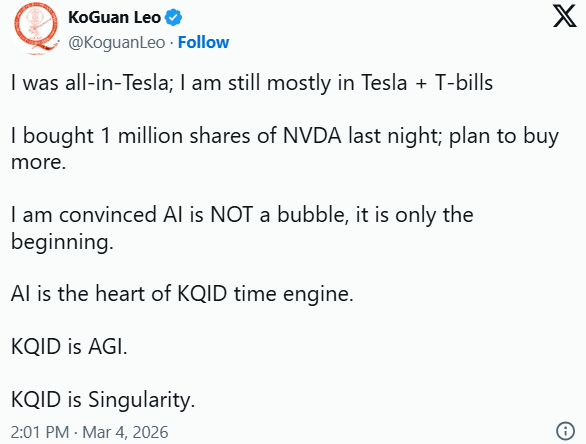
智通财经APP获悉,几年前成为特斯拉(TSLA.US)最大个人股东之一的亿万富翁廖凯原(Leo KoGuan)表 示,他周二购买了英伟达(NVDA.US)100万股股票。英伟达股票周二收于180.05美元,这意味着这位71 岁的亿万富翁大约支付了1.8亿美元。根据数据,他的财富为128亿美元。 廖凯原周三在X上发帖说:"我确信人工智能不是泡沫,它仅仅是个开始。计划很快再买入更多英伟达 股票,以安抚紧张的市场。" 尽管廖凯原对埃隆·马斯克和特斯拉越来越持怀疑态度,包括特斯拉决定向其首席执行官提供价值可能 高达1万亿美元的薪酬方案,但他表示自己"仍然主要持有特斯拉股票"和美国国债。他拒绝透露这些年 来他减持了多少特斯拉股份。 他在社交媒体平台上写道:"我认为特斯拉的能源、网络安全和Teslabot的价值还没有完全反映在股价 中。所以,有胆识的投资者现在仍然可以买入特斯拉股票,以期未来获得巨额财富。特斯拉是全球领先 的智能人机交互公司。" 廖凯原出生于印度尼西亚,在纽约接受教育,现居新加坡。他最初通过与前妻共同经营的位于新泽西州 萨默塞特的SHI国际公司积累了财富。这家企业软件公司由他本人创立。他曾表示,自己从20 ...


中国县城生意变了
投资界· 2026-03-04 08:01
Core Viewpoint - The article discusses the transformation of consumption patterns in China's county-level cities, highlighting the rise of brand chains and the increasing consumer power in these areas, which were previously considered economically underdeveloped [4][14]. Group 1: Brand Expansion in County Cities - KFC has opened its first store in a small county in Jiangxi, marking a significant shift in local consumption habits, with the store being a popular spot for young people and families despite higher prices compared to first-tier cities [6][7]. - KFC's strategy involves a "town store" model, with lower investment costs of around 500,000 yuan compared to over 5 million yuan in larger cities, allowing for rapid expansion into previously untapped markets [7][8]. - By 2025, KFC plans to add 1,349 new stores, reaching over 12,000 nationwide, with 3,600 located in third-tier cities, achieving a penetration rate exceeding 60% in these areas [7][8]. Group 2: Consumer Trends and Preferences - The consumer base in county cities is shifting, with a focus on quality over brand prestige, driven by younger returnees and local entrepreneurs who prioritize trust and quality in their purchasing decisions [15][16]. - The rise of local entertainment and cultural events, such as concerts and comedy shows, indicates a growing demand for diverse experiences in county cities, with significant attendance and engagement from local populations [12][13]. Group 3: Market Dynamics and Economic Potential - The retail growth in non-first-tier cities is outpacing national averages, with third-tier cities showing a remarkable retail sales growth rate of 72.1% [14]. - By 2030, it is projected that over 66% of personal consumption growth will come from lower-tier cities and county markets, underscoring the potential of the "hometown economy" [14]. - The article emphasizes the structural changes in county-level consumption, driven by lower operating costs and unique local business models that cater to community needs [17][18].





【权威解读】2月份制造业采购经理指数有所回落 非制造业商务活动指数小幅回升
中汽协会数据· 2026-03-04 07:53
Group 1: Manufacturing Purchasing Managers Index (PMI) - In February, the manufacturing PMI decreased to 49.0%, down by 0.3 percentage points from the previous month, indicating a decline in economic activity [2][3] - Both production index and new orders index fell to 49.6% and 48.6% respectively, showing a slowdown in production and market demand [3] - Large enterprises maintained expansion with a PMI of 51.5%, while small and medium-sized enterprises faced significant impacts from the Spring Festival, with PMIs of 47.5% and 44.8% respectively [3] Group 2: Non-Manufacturing Business Activity Index - The non-manufacturing business activity index rose slightly to 49.5%, an increase of 0.1 percentage points from the previous month, indicating an overall improvement in the non-manufacturing sector [6] - The service sector's business activity index increased to 49.7%, driven by growth in travel-related industries, with hospitality and entertainment sectors showing indices above 60.0% [6] - The construction sector's business activity index fell to 48.2%, reflecting a decline due to the Spring Festival, although the market expectation index for construction improved to 50.9% [6] Group 3: Comprehensive PMI Output Index - The comprehensive PMI output index decreased to 49.5%, down by 0.3 percentage points from the previous month, indicating a general slowdown in production and business activities [7] - The manufacturing production index and non-manufacturing business activity index were recorded at 49.6% and 49.5% respectively, contributing to the overall decline in the comprehensive PMI [7]
