大宗商品

Search documents
专访许正宇:打造国家“国际资产保管箱” 香港金融现新棋局
2 1 Shi Ji Jing Ji Bao Dao· 2025-11-18 23:17
Core Insights - Hong Kong's financial markets have shown significant growth, with the Hang Seng Index rising over 30% and the Hang Seng Tech Index nearly 40% this year, outperforming major global markets [1] - The Hong Kong government is leveraging its unique "One Country, Two Systems" advantage to explore new growth areas in asset management, fintech, and commodity markets, aligning with national strategies [1] Financial Technology and Digital Assets - Hong Kong has risen to the top position in the Global Financial Center Index (GFCI) for fintech, reflecting a clear focus on empowering the real economy rather than speculative activities [2] - The government successfully priced its third batch of digital green bonds at 10 billion HKD, marking the largest issuance of tokenized government bonds globally [2] - The government is cautious about stablecoins, emphasizing their role in addressing real economic issues rather than speculation, with limited initial licensing planned for next year [3] Capital Market Reforms - The implementation of T+1 settlement is a key reform aimed at enhancing market efficiency, with plans to transition from T+2 to T+1 by next year [4] - The Hong Kong Stock Exchange anticipates that by 2027, 88% of global stock markets will adopt T+1 or T+0 settlement cycles, which will improve synergy with A-shares [4] - The government is working on optimizing the dual-class share structure to balance international market integration and protection for small investors [4][17] Asset Management and Global Capital - As of the end of 2024, Hong Kong manages over 4 trillion USD in assets, with approximately 60% from overseas, highlighting its role as a global asset custodian [5] - The government is actively attracting family offices and optimizing tax exemption policies to enhance its appeal as a financial hub [11] Commodity Market Development - Hong Kong has made significant strides in the commodity market, including being integrated into the London Metal Exchange's global delivery network and achieving over 8000 tons of metal storage in just nine months [6] - The government plans to increase gold storage capacity to 2000 tons and is working on a central clearing system for gold, aiming to enhance its influence in the global gold market [7][15] Supporting Mainland Enterprises - Hong Kong is increasingly becoming a platform for mainland enterprises to expand internationally, with a record number of companies registered in Hong Kong for overseas operations [8] - The government is consolidating various agencies to create a one-stop platform to support mainland companies in their overseas ventures [8] Legal and Regulatory Framework - Recent legal revisions allow companies registered abroad to re-domicile in Hong Kong, with nearly 20 applications received, including from large international firms [9] - The government is focused on creating a secure environment for global operations, enhancing Hong Kong's attractiveness as a stable financial center [13]
【宏观经济】一周要闻回顾(2025年11月5日-11月12日)
乘联分会· 2025-11-12 08:53
Core Viewpoint - In the first ten months of 2025, China's goods trade maintained a steady growth trend, with a total import and export value of 37.31 trillion yuan, an increase of 3.6% year-on-year, driven by exports and stable imports [5][6]. Group 1: Trade Performance - The total export value reached 22.12 trillion yuan, growing by 6.2%, while imports were 15.19 trillion yuan, remaining stable compared to the previous year [5]. - In October 2025, the total trade value was 3.7 trillion yuan, showing a slight increase of 0.1%, with exports at 2.17 trillion yuan, down by 0.8%, and imports at 1.53 trillion yuan, up by 1.4%, marking five consecutive months of growth in imports [5]. Group 2: Trade Composition - General trade and processing trade both saw growth, with general trade imports and exports at 23.64 trillion yuan (up 2.3%) and processing trade at 6.94 trillion yuan (up 6.5%) [5]. - The ASEAN region became China's largest trading partner, with trade totaling 6.18 trillion yuan (up 9.1%), followed by the EU at 4.88 trillion yuan (up 4.9%), and the US at 3.38 trillion yuan (down 15.9%) [6]. Group 3: Enterprise Contributions - Private enterprises contributed significantly, with imports and exports totaling 21.28 trillion yuan (up 7.2%), accounting for 57% of total foreign trade [7]. - Foreign-invested enterprises had a trade value of 10.91 trillion yuan (up 2.9%), while state-owned enterprises saw a decline to 5.04 trillion yuan (down 8.1%) [7]. Group 4: Export Products - Mechanical and electrical products accounted for over 60% of exports, with a total value of 13.43 trillion yuan (up 8.7%) [7]. - Notable growth was observed in integrated circuits (up 24.7% to 1.16 trillion yuan) and automobiles (up 14.3% to 798.39 billion yuan) [7]. Group 5: Import Trends - Major commodity import prices fell, with iron ore imports at 1.03 billion tons (up 0.7%) and crude oil at 471 million tons (up 3.1%), both experiencing price declines of 10.7% and 12.1% respectively [8]. - The import value of mechanical and electrical products increased to 6.05 trillion yuan (up 5.5%) [8].


全球风险资产
Sou Hu Cai Jing· 2025-11-12 07:59
Core Viewpoint - The expectation of a Federal Reserve interest rate cut has diminished, leading to pressure on global risk assets through two main channels [1] Group 1: Impact on Currency and Commodities - A decline in interest rate cut expectations supports the US dollar index in the short term, which, as a core global pricing currency, makes dollar-denominated commodities and emerging market assets less attractive, potentially causing capital to flow back to dollar assets [1] - The continued restrictive monetary policy will elevate real interest rates, negatively impacting the valuation logic of risk assets, particularly high-valuation growth assets, as rising discount rates compress their valuation space [1] Group 2: Market Performance - Recent market performance indicates a pullback in the US Nasdaq index, emerging market equities, and cyclical commodities like oil, reflecting the pressure on risk assets [1]
天风策略:12月美联储预计仍有较大概率降息
Sou Hu Cai Jing· 2025-11-09 10:52
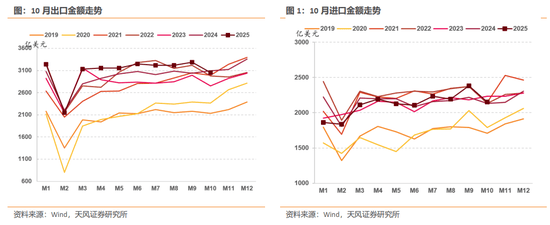
Group 1: Domestic Trade Data - In October, China's exports (in USD) decreased by 1.1% year-on-year, down from an increase of 8.3% in the previous month, while imports rose by 1.0%, down from 7.4% [3][5] - The trade surplus for October was reported at $90.07 billion, slightly down from $90.447 billion in the previous month [3] - The contribution of major trading partners to export growth showed a decline for the EU, ASEAN, Japan, and South Korea, while the US's contribution increased [5] Group 2: Transportation and Industrial Indicators - The subway passenger volume index in first-tier cities showed a slight recovery, reporting 40.61 million trips, up from 40.55 million [12] - The industrial production index increased to 117 from 113, with specific sectors like methanol and tires showing recovery, while soda ash declined [14] Group 3: Domestic Policy Developments - Premier Li Qiang co-hosted the 30th regular meeting of Chinese and Russian Prime Ministers with Russian Prime Minister Mishustin, emphasizing the deepening of Sino-Russian friendship [16][17] - Li Qiang also met with Georgian Prime Minister Kobakhidze to discuss economic cooperation and the Belt and Road Initiative [17] Group 4: International Monetary Policy Outlook - There is a significant probability of the Federal Reserve lowering interest rates by 25 basis points in December 2025, with a 66.9% chance of this occurring [26] - The current economic conditions and geopolitical tensions are influencing the Fed's potential policy decisions [26] Group 5: Industry Investment Recommendations - Investment strategies are suggested to focus on three main areas: breakthroughs in AI technology, economic recovery leading to a "stronger stronger" market trend, and the resurgence of undervalued sectors [28] - The initial phase of the bull market favors high-growth sectors, while later phases may see a shift towards cyclical stocks with better performance as the economic fundamentals improve [28]
欧洲主要股市普遍上涨,黄金小麦价格同步走高
Shang Wu Bu Wang Zhan· 2025-11-05 16:54
Core Viewpoint - European major stock markets experienced a positive start, with significant gains in indices and rising commodity prices, indicating a bullish sentiment in the market [1] Group 1: Stock Market Performance - The German DAX index increased by 0.72% [1] - The French CAC40 index saw a slight rise of 0.09% [1] - The UK FTSE 100 index rose by 0.18% [1] - The Russian MOEX index performed notably well with a gain of 1.35% [1] - In the US pre-market, the three major indices collectively rose, with Nasdaq futures up by 1.35% [1] Group 2: Commodity Prices - Gold prices surpassed the $4000 mark, reaching $4014.59 per ounce [1] - Wheat prices increased to $5.40 per bushel [1] - International oil prices also rose, with US crude at $61.19 per barrel and Brent crude at $65.01 per barrel [1] Group 3: Currency Exchange - The euro appreciated against the US dollar, rising by 0.33% to 1.1527 [1]
宏观经济专题:10月出口或仍有韧性
KAIYUAN SECURITIES· 2025-11-03 12:43
Supply and Demand - Construction starts remain at historically low levels, with asphalt plant operating rates at 31.5%, cement dispatch rates at 37.4%, and grinding mill operation rates at 37.2% compared to historical averages[13][14]. - Industrial production is at a historically high level, with PX operating rates at 86.3% and PTA rates at 76.5%[24][25]. - Demand for construction materials is weak, with rebar, wire rod, and building materials at historical lows, and automotive sales showing a decline[32][33]. Price Trends - International commodity prices have rebounded, with crude oil and copper prices increasing, while gold prices have decreased[41][43]. - Domestic industrial prices are experiencing mixed trends, with iron ore and rebar prices rising, while chemical products are showing weakness[44][50]. Real Estate Market - New housing transactions have seen a year-on-year decline, with a 21% increase in transaction area compared to the previous two weeks, but still down 34% and 33% compared to 2023 and 2024 respectively[64][66]. - Second-hand housing transactions remain weak, with year-on-year declines of 24%, 16%, and 31% in Beijing, Shanghai, and Shenzhen respectively[68][69]. Export Performance - October exports are projected to show a year-on-year increase of approximately 1.9%, with port throughput up 8.9% compared to 2024[71][72]. Liquidity Conditions - Recent weeks have seen an upward trend in funding rates, with R007 at 1.49% and DR007 at 1.46% as of October 31[76][78].
生活在通缩的国家,赚通胀的钱,还有这好事?
虎嗅APP· 2025-10-28 09:25
Group 1 - The core viewpoint of the article discusses the concept of living in a deflationary country while investing in inflationary assets, highlighting the potential benefits of such a strategy [4][6][8] - The article emphasizes the importance of finding inflationary assets that can maintain or increase value in an inflationary environment, categorizing them into seven types [17][31] - It provides examples of successful cases, such as Swiss and Japanese high-net-worth individuals who have effectively invested overseas while residing in low-inflation environments [10][12][14] Group 2 - The article outlines three conditions necessary for effective cross-border asset allocation: the ability to allocate assets internationally, living in a stable or deflationary country without compromising quality of life, and ensuring investment targets are decoupled from the local deflation [10] - It identifies seven categories of inflationary assets, including precious metals, commodities, high pricing power stocks, emerging market stocks, inflation-linked bonds, rental real estate, and technology stocks in deflationary environments [17][18][20][22][24][26][28][29] - The article concludes that understanding inflation is crucial for making informed investment decisions, as it serves as a fundamental principle that can clarify various investment phenomena [32][34][35]

策略周末谈(1026):战略反攻
Western Securities· 2025-10-26 09:33
Group 1 - Global capital is hesitant, indicating a "noise" before a major market rebound, with A-shares returning to a defensive style focused on dividends and micro-cap stocks [1][10] - The "14th Five-Year Plan" has shifted its strategic focus from "technological innovation" to "supply chain enhancement," ensuring supply chain security and high-end manufacturing autonomy [2][18] - The emphasis on domestic consumption has upgraded from "comprehensive promotion of consumption" to "strongly boosting consumption," reflecting a stronger policy commitment [2][18] Group 2 - Cross-border capital is significantly returning, which is a crucial material guarantee for the "15th Five-Year Plan" strategy and the macro engine for China's asset revival [3][20] - The return of cross-border capital is expected to fundamentally improve cash flow for enterprises and households, providing a material basis for boosting consumption and supporting manufacturing [3][20] Group 3 - China is adopting a steady path, focusing on solidifying competitive advantages through capital expenditure expansion and policy adjustments, while the U.S. faces challenges due to premature and excessive investment in AI infrastructure [4][23] - The U.S. is experiencing a "Ponzi-like" dilemma, where high unit costs of AI infrastructure hinder commercialization, potentially leading to a significant economic crisis [4][23] Group 4 - The report suggests a strategic layout for the "golden era" of Chinese assets, emphasizing a combination of sectors that are expected to reach new highs, including non-ferrous metals, new consumption, and high-end manufacturing [5][26] - The anticipated "ice-fire conversion" moment for manufacturing and consumption assets is supported by the return of cross-border capital and the strategic shift in the "15th Five-Year Plan" [5][26]
金银暴跌!盘中分别创十二年来和四年多来最大跌幅,“所有目光聚焦沪金开盘”
Sou Hu Cai Jing· 2025-10-22 01:09
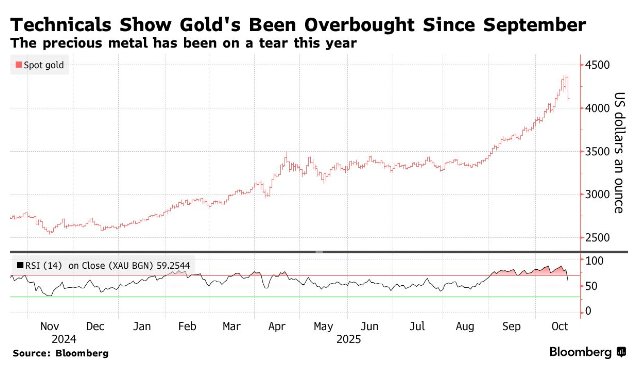
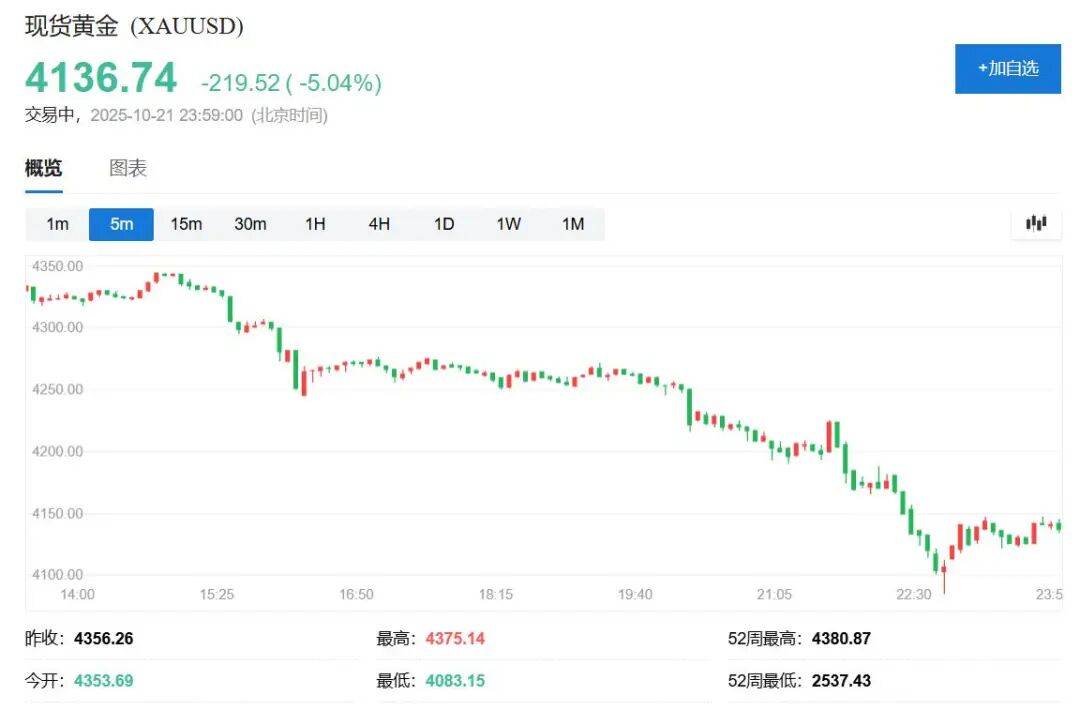
Core Viewpoint - The precious metals market experienced a significant downturn after a period of record highs, with gold and silver prices plummeting to their largest daily declines in years, raising concerns among investors about future price movements [1][4][7]. Price Movements - Gold reached a historical intraday high before falling approximately 6.3% to around $4,082, marking its largest daily drop since April 2013, with a closing price of $4,130.41 per ounce [1]. - Silver also saw a dramatic decline, dropping nearly 8.7% to below $47.90, the largest intraday drop since February 2021, with a closing price of $48.7050 per ounce [4]. Market Influences - Multiple factors contributed to the pressure on precious metal prices, including expectations of easing trade tensions, a strengthening dollar, and overbought technical indicators, which diminished the safe-haven demand for these metals [7][10]. - The ongoing U.S. government shutdown has led to a lack of critical positioning data, increasing uncertainty in the market and potentially allowing speculative long positions to accumulate excessively [10][12]. Technical Analysis - The relative strength index for gold indicated that prices had entered an overbought territory, prompting concerns about potential corrections and profit-taking among traders [8][11]. - Analysts noted that the absence of significant media catalysts on the day of the price drop suggested that the market was due for a correction due to extreme overbought conditions [11][12]. Investor Sentiment - Despite the sharp declines, some analysts believe that the fundamental factors supporting precious metals have not changed, and potential buying interest may limit the extent of any corrections [7][13]. - The recent lack of significant physical demand from India and the absence of key buyers in the Shanghai Gold Exchange were highlighted as notable factors contributing to the market's weakness [12][16]. Future Outlook - Analysts from various firms expressed differing views on the future of gold and silver prices, with some maintaining a bullish outlook while acknowledging the potential for a consolidation phase [10][13]. - The global largest gold ETF, GLD, saw unprecedented trading volumes, indicating heightened interest and activity in the market despite the recent downturn [14].
涨得猛跌得狠!金银高位“跳水” 创纪录涨势暂告一段落
智通财经网· 2025-10-22 00:29
Core Viewpoint - Recent sharp sell-off in gold and silver prices is attributed to investor concerns over high valuations following a historic price surge, leading to profit-taking [1][4] Group 1: Price Movements - Spot gold prices fell over 6.3%, marking the largest single-day drop in over a decade, while spot silver dropped by 8.7% [1] - The recent decline ended a bullish trend for both metals, which had reached historical highs just a week prior [1] - The surge in gold prices was driven by expectations of significant interest rate cuts by the Federal Reserve and a shift away from sovereign debt due to concerns over budget deficits [1] Group 2: Market Dynamics - Strong technical indicators contributed to the gold price correction, with support expected in the $4,000 to $4,050 range [3] - The influx of $8 billion into physical gold ETFs last week was the largest weekly inflow recorded since 2018, driven by concerns over U.S. economic credit quality [4] - The strong U.S. dollar has diminished the appeal of precious metals, coinciding with reduced market liquidity due to India's Diwali holiday [3] Group 3: Future Outlook - Analysts expect that the long-term factors supporting gold prices, such as central bank purchases, remain intact, with predictions of gold prices reaching around $4,500 per ounce next year [5] - The current speculative long positions in gold and silver may have accumulated, making them more susceptible to corrections [5] - Market volatility during upward trends is seen as a normal occurrence, and analysts maintain a positive outlook on the gold market fundamentals [5]