
锂离子电池制造

Search documents
11月通胀数据点评:食品项拉动CPI同比创年内新高
Mai Gao Zheng Quan· 2025-12-11 09:11
Group 1: CPI Analysis - In November 2025, the CPI increased by 0.7% year-on-year, marking the highest level in 2025 and the highest since March 2024, while it slightly decreased by 0.1% month-on-month[1] - Core CPI, excluding food and energy, rose by 1.2% year-on-year, remaining above 1% for three consecutive months, indicating a gradual recovery in consumer spending[1] - Food prices shifted from a 2.9% decline in October to a 0.2% increase in November, primarily driving the CPI increase[1] Group 2: PPI Insights - In November 2025, the PPI increased by 0.1% month-on-month, achieving positive growth for two consecutive months, but the year-on-year decline widened to -2.2%[2] - Key industries such as coal mining and photovoltaic equipment manufacturing showed narrowing year-on-year price declines, reflecting effective supply-demand optimization policies[2] - The prices of new materials and intelligent technologies rose significantly, with external storage devices increasing by 13.9% year-on-year, indicating a shift towards industrial upgrading[2] Group 3: Market Outlook - The CPI's recovery is largely dependent on short-term supply shocks from fresh produce, while long-term food prices, such as pork, remain low[4] - The divergence in price trends between traditional and emerging industries reflects ongoing economic transformation, with traditional sectors still undergoing capacity reduction[4] - Future expectations suggest a gradual recovery in prices across key industries, with CPI likely to continue a moderate upward trend and PPI expected to turn positive in 2026[4]
11月物价温和回暖,CPI创21个月新高,PPI环比连涨现企稳信号
Hua Xia Shi Bao· 2025-12-11 08:59
Core Viewpoint - In November, China's macroeconomic policies began to show positive effects, leading to a notable increase in the Consumer Price Index (CPI) and a recovery in consumer spending [2] CPI Analysis - The CPI rose by 0.7% year-on-year in November, an increase of 0.5 percentage points from the previous month, marking the highest level since March 2024 and matching the peak since February 2023 [2] - The core CPI, excluding food and energy, also increased by 1.2% year-on-year, remaining above 1.0% for three consecutive months, indicating a steady recovery in consumer willingness and capacity [2] - Food prices shifted from a decline of 2.9% in October to an increase of 0.2% in November, contributing positively to the CPI [3] Food Price Dynamics - Fresh vegetable prices rose by 14.5% year-on-year after nine months of decline, significantly impacting the CPI [4] - Beef and lamb prices continued to rise, with increases of 6.2% and 3.7% respectively, while pork prices, although still down 15.0%, showed a narrowing decline from 16.0% [4] - Egg prices further declined to -12.5% year-on-year, indicating reduced internal deflationary pressure on food prices [4] Non-Food Price Trends - Service prices and industrial consumer goods prices (excluding energy) increased by 0.7% and 2.1% respectively, contributing approximately 0.29 and 0.53 percentage points to the CPI [5] - Core consumer goods prices rose by 2.1%, marking the seventh consecutive month of growth, with notable increases in gold jewelry (over 50%), household appliances (4.9%), and clothing (2.0%) [5] - Housing rental prices showed a slight decline of 0.2% year-on-year, reflecting a weak real estate market [5] PPI Insights - The Producer Price Index (PPI) decreased by 2.2% year-on-year, but showed a month-on-month increase of 0.1%, indicating a stabilization in industrial prices [6] - The reduction in price declines for certain industries, such as coal mining and photovoltaic equipment, suggests improvements in market competition and pricing structures [7] - New industries, including new materials and intelligent manufacturing, are driving price increases in related sectors, with significant year-on-year rises in external storage devices (13.9%) and integrated circuit manufacturing (1.7%) [7] Consumer Demand and Seasonal Effects - Seasonal demand increases due to winter preparations and supply constraints have led to significant price increases in coal mining and washing industries, with a month-on-month rise of 4.1% [8] - The overall price level remains moderate, with life material prices showing a year-on-year decline of 1.5%, indicating a stable inflation environment [9]


多维度感知中国活力 各领域“拔节向上”绘就高质量发展万千气象
Yang Shi Wang· 2025-12-11 06:39
Economic Indicators - In November, China's Consumer Price Index (CPI) rose by 0.7% year-on-year, an increase of 0.5 percentage points from the previous month [3] - The core CPI, excluding food and energy, increased by 1.2% year-on-year, maintaining a growth rate above 1% for three consecutive months [3] - The Producer Price Index (PPI) rose by 0.1% month-on-month in November, marking two consecutive months of increase [3] Light Industry Performance - In the first ten months, revenue of large-scale light industry enterprises reached 19 trillion yuan, a year-on-year increase of 1.9%, with profits of 1.14 trillion yuan, up 1.6% [7] - The added value of large-scale light industry grew by 5.8% year-on-year, with significant growth in battery and plastic furniture manufacturing [7] - Retail sales of 11 categories of light industry products exceeded 7.1 trillion yuan, growing by 9.8% year-on-year, with home appliances and audio-visual equipment sales increasing by 20.1% [9] Robotics and AI Development - The robotics industry has seen rapid development, with service robot production exceeding 13.5 million units in the first three quarters of the year [17] - AI applications have surged, with the number of AI applications reaching 657, a year-on-year increase of 61.8%, and mobile user scale surpassing 700 million [21] - China's AI industry has surpassed 900 billion yuan, with over 6,000 companies contributing to a competitive technological landscape [21] Low-altitude Economy - The State Council has issued guidelines to promote the application of low-altitude economy, including the use of unmanned systems across various sectors [23] - In cities like Jingdezhen and Anyang, low-altitude applications are being utilized for tourism, emergency services, and urban management, significantly improving efficiency [25][27] - By 2024, over 140 new low-altitude logistics routes are expected to be established, with the drone logistics market projected to exceed 1 trillion yuan by 2035, maintaining an annual growth rate of around 20% [29]
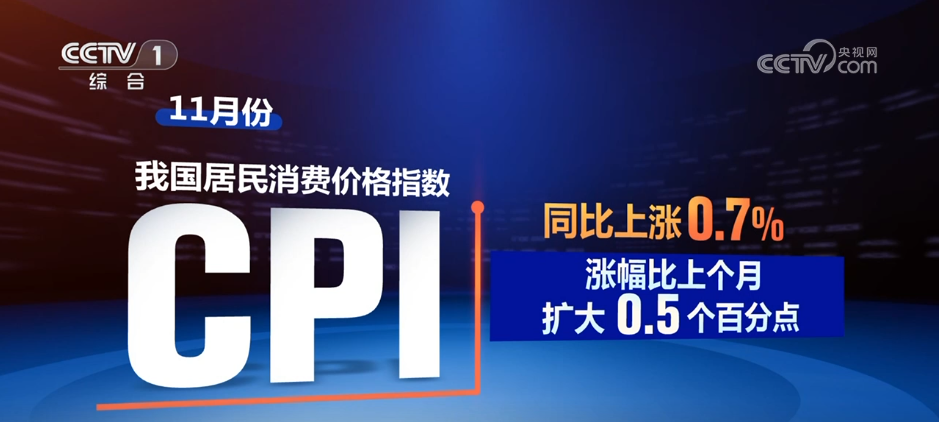
11月国内CPI同比上涨0.7%
Qi Huo Ri Bao Wang· 2025-12-11 05:56
Group 1 - The consumer price index (CPI) increased by 0.7% year-on-year in November, the highest since March 2024, driven mainly by a turnaround in food prices, which shifted from a 2.9% decline to a 0.2% increase [1] - The core CPI, excluding food and energy, rose by 1.2% year-on-year, maintaining above 1% for three consecutive months, indicating stable inflationary pressures in the service and industrial sectors [1] - The producer price index (PPI) decreased by 2.2% year-on-year, with the decline slightly widening compared to the previous month, primarily due to a high base effect from the previous year [1] Group 2 - The PPI data across various industries shows positive trends due to effective macro policies, with price declines in sectors like coal mining, photovoltaic equipment manufacturing, and lithium-ion battery manufacturing narrowing significantly [2] - The "old-for-new" policy has positively impacted prices in the automotive and home appliance sectors, contributing to the recent increase in core CPI [2] - Analysts suggest that while the price level has stabilized, further policies are needed to boost demand and support industrial prices, indicating a cautious outlook for future price movements [2][3]
2025年11月物价数据点评:菜价金价上行,出行链价格下行
BOHAI SECURITIES· 2025-12-11 02:30
Group 1: CPI Analysis - In November 2025, the CPI increased by 0.7% year-on-year, up from a previous increase of 0.2%[10] - The CPI's month-on-month change shifted from an increase to a decrease, primarily due to seasonal declines in service prices and lower energy prices[3] - Fresh vegetable prices rose significantly by 7.2%, exceeding the seasonal average decline of 3.2%, contributing approximately 0.17 percentage points to the CPI increase[13] - Pork prices decreased by 2.2%, impacting the CPI by approximately 0.07 percentage points due to sufficient market supply[13] Group 2: PPI Analysis - In November 2025, the PPI's year-on-year decline widened, while the month-on-month change remained stable[4] - The PPI is expected to show a month-on-month increase in December, with a year-on-year decline projected at -1.8%[24] - The prices of upstream raw materials, such as coal and gas, are expected to rise seasonally due to increased demand[23] - The "anti-involution" policy is expected to gradually improve prices in key industries, positively impacting the PPI in the long term[24] Group 3: Market Outlook - The CPI is projected to maintain a month-on-month growth rate near zero in December, with a year-on-year growth rate of approximately 0.5% expected for 2025[3] - The ongoing OPEC+ production increase is likely to keep oil prices under pressure, affecting the CPI negatively[3] - Core inflation is anticipated to see reduced support from gold prices, while seasonal increases in service prices are expected[3]
通胀修复,从PPI切换至CPI
HUAXI Securities· 2025-12-11 01:12
Inflation Data Summary - November CPI year-on-year increased by 0.7%, matching expectations, and up from 0.2% in the previous month[1] - Core CPI, excluding food and energy, remained at 1.2% year-on-year, with a month-on-month decrease of 0.1%[1] - PPI year-on-year decreased by 2.2%, slightly worse than the expected -2.0%, and unchanged from the previous month[1] Key Drivers of CPI Changes - Food prices rose by 0.5% month-on-month, significantly above the seasonal average of -0.5%, primarily driven by a 7.2% increase in fresh vegetable prices due to supply shocks[2] - Non-food items showed resilience, with clothing prices up 0.7% and medical services prices increasing by 0.3% for eight consecutive months[2] - Service prices fell by 0.4% month-on-month, negatively impacting core CPI, particularly due to a 5.7% drop in tourism-related prices[2] PPI Insights - PPI has shown a month-on-month increase of 0.1% for two consecutive months, indicating stabilization in industrial product prices[3] - The mining sector saw a significant month-on-month increase of 1.7%, while the raw materials sector experienced a decline of 0.2%[3] - Manufacturing prices in high-weight sectors like photovoltaic equipment and lithium-ion batteries showed reduced year-on-year declines, supporting PPI stability[4] Future Outlook - December inflation readings are expected to remain stable, with CPI likely holding at 0.7% year-on-year if month-on-month changes align with seasonal trends[7] - PPI year-on-year may narrow to -2.0% if the recovery trend continues[7] - The necessity for monetary policy adjustments may increase due to inflation trends and PMI remaining below the growth threshold[7]
11月核心CPI继续上涨 扩内需政策措施继续显效
Zhong Guo Jing Ji Wang· 2025-12-11 00:29
Group 1: Consumer Price Index (CPI) Insights - In November, the CPI increased by 0.7% year-on-year, marking the highest growth since March 2024, with a month-on-month decrease of 0.1% [2][3] - The rise in CPI was primarily driven by a shift in food prices from decline to increase, with fresh vegetable prices rising by 14.5% after nine consecutive months of decline [2][3] - Core CPI, excluding food and energy, rose by 1.2% year-on-year, maintaining above 1% for three consecutive months, indicating stable inflationary pressures [2][3] Group 2: Producer Price Index (PPI) Insights - The PPI increased by 0.1% month-on-month in November, marking the second consecutive month of growth, influenced by seasonal demand increases in certain industries [4] - Year-on-year, the PPI decreased by 2.2%, with the decline slightly widening compared to the previous month, primarily due to high comparison bases from the previous year [4] - The increase in PPI was supported by rising prices in coal and gas sectors, while international oil price fluctuations led to a decrease in domestic oil and gas extraction prices [4] Group 3: Market Trends and Predictions - The ongoing "anti-involution" measures are showing results, with price declines in key industries narrowing, indicating improved market competition [5] - Emerging industries are rapidly developing, contributing to price increases in related sectors, such as a 13.9% rise in external storage devices and components [6] - Future inflation is expected to remain low, providing room for growth-stimulating policies, with a gradual recovery in consumer prices anticipated [7][8]
国家统计局:整治“内卷式”竞争成效显现;云天化:拟收购天耀化工100%股权 | 新能源早参
Mei Ri Jing Ji Xin Wen· 2025-12-10 23:22
Group 1 - The National Bureau of Statistics reported that the effects of rectifying "involutionary" competition are becoming evident, with price declines in industries such as coal mining, photovoltaic equipment manufacturing, and lithium-ion battery manufacturing narrowing year-on-year [1] - The price decline for new energy vehicle manufacturing also narrowed by 0.6 percentage points compared to the previous month, indicating a gradual improvement in the supply-demand dynamics of the new energy industry chain [1] - This stabilization in prices is expected to enhance corporate profitability, with leading companies benefiting first due to their cost and technological advantages [1] Group 2 - Glencore has not commented on reports suggesting it may become the first cobalt exporter under the new quota system in the Democratic Republic of Congo, which could strengthen supply constraints and improve the long-term supply-demand dynamics of the cobalt industry [2] - If confirmed, this development may boost cobalt prices and market sentiment in the short term, with leading companies benefiting from resource and channel advantages [2] - The stabilization of cobalt prices in the medium to long term is anticipated to enhance the performance of mining companies, necessitating close monitoring of export dynamics and inventory changes [2] Group 3 - Yuntianhua announced plans to acquire 100% of Tianyao Chemical for 36.8858 million yuan, which will enhance its market position in the high-end phosphorus product sector [3] - The acquisition will allow Yuntianhua to create a complete industrial chain from yellow phosphorus to phosphorus-based flame retardants, significantly improving resource utilization efficiency and industry synergy [3] - This strategic move is expected to bolster the company's performance and solidify its leading position in the market [3]

食品价格回升拉动 CPI涨幅创近21个月新高
Zheng Quan Shi Bao· 2025-12-10 18:54
Group 1 - The Consumer Price Index (CPI) increased by 0.7% year-on-year in November, marking the highest growth since March 2024, primarily driven by a turnaround in food prices [1][2] - The core CPI, excluding food and energy, rose by 1.2% year-on-year, maintaining a growth rate above 1% for three consecutive months [2] - Food prices increased by 0.2% year-on-year, while non-food prices rose by 0.8%, with fresh vegetable prices experiencing a significant increase of 14.5% after a decline of 7.3% in the previous month [1][3] Group 2 - The Producer Price Index (PPI) saw a month-on-month increase of 0.1% for two consecutive months, but the year-on-year decline expanded to 2.2%, influenced by high comparison bases from the previous year [2] - The narrowing of year-on-year price declines in certain industries, such as coal mining and photovoltaic equipment manufacturing, indicates the effectiveness of macroeconomic policies [3] - Emerging industries are driving price increases, with external storage devices and components seeing a year-on-year price rise of 13.9%, and arts and crafts manufacturing prices increasing by 20.6% [3]
11月CPI同比涨幅扩大 PPI连续两个月上涨
Shang Hai Zheng Quan Bao· 2025-12-10 17:56
Group 1: CPI and Core CPI Trends - In November, the Consumer Price Index (CPI) increased by 0.7% year-on-year, marking the highest level since March 2024, with the core CPI rising by 1.2% year-on-year [1][2] - The increase in CPI was primarily driven by a turnaround in food prices, which shifted from a 2.9% decline in October to a 0.2% increase in November [2] - Fresh vegetable prices saw a significant increase, rising by 14.5% year-on-year in November after nine consecutive months of decline, attributed to adverse weather affecting supply [2] Group 2: PPI Trends - The Producer Price Index (PPI) rose by 0.1% month-on-month in November, marking the second consecutive month of increase [1][4] - The rise in PPI was influenced by seasonal demand increases in industries such as coal mining, with coal prices increasing by 4.1% month-on-month [4] - Year-on-year, PPI decreased by 2.2%, with the decline slightly widening compared to October, largely due to high base effects from the previous year [4] Group 3: Emerging Industries and Price Trends - Prices in emerging industries showed signs of recovery, with significant year-on-year increases in sectors such as external storage devices (up 13.9%) and integrated circuit manufacturing (up 1.7%) [5] - The price declines in photovoltaic equipment and lithium-ion battery manufacturing narrowed, indicating a potential stabilization in these sectors [5] - Overall, the outlook for prices suggests a moderate recovery, supported by improving international trade conditions and ongoing domestic demand policies [5]