
建筑

Search documents
固投增速持续回落,基建投资承压:——2025年1-9月投资数据点评
Shenwan Hongyuan Securities· 2025-10-20 10:29
Investment Rating - The industry investment rating is currently neutral, indicating that the industry is expected to perform in line with the overall market [22]. Core Insights - The fixed asset investment and manufacturing investment growth rates have continued to decline, with a cumulative year-on-year decrease of 0.5% for fixed asset investment from January to September 2025, and a 4.0% year-on-year increase in manufacturing investment, which is a decline of 1.1 percentage points compared to the previous month [3][4]. - Infrastructure investment is under pressure, with a year-on-year growth of 3.3% for total infrastructure investment and 1.1% for infrastructure investment excluding electricity, both showing a decline in growth rates compared to the previous month [4]. - Real estate investment remains low, with a year-on-year decrease of 13.9% from January to September 2025, and construction starts down by 18.9% [10]. Summary by Sections Economic Overview - The GDP growth for the first three quarters of 2025 is reported at 5.2%, with quarterly growth rates of 5.4%, 5.2%, and 4.8% respectively [3]. Infrastructure Investment - Infrastructure investment growth is under pressure, with specific sectors like transportation, water conservancy, and public utilities showing varying degrees of decline [4]. - Eastern regions experienced a year-on-year investment decline of 4.5%, while central and western regions saw a slight increase of 1.5% [4]. Real Estate Investment - Real estate investment has shown a significant decline, with expectations of a slow recovery due to challenges in supply and inventory replenishment [10]. Investment Recommendations - The report suggests that the overall industry is weak, but regional investments may gain traction with the implementation of national strategic layouts. Recommended companies include China Chemical, China Energy Construction, China Railway, and China Railway Construction among others [14].




“羊城邀约”粤港澳大湾区专场招聘活动在广州举办 400余家企业供岗上万个
Nan Fang Ri Bao Wang Luo Ban· 2025-10-20 08:02
Group 1 - The "Yangcheng Invitation" recruitment event for the Guangdong-Hong Kong-Macao Greater Bay Area was held at Jinan University, integrating online and offline modes to provide comprehensive employment and entrepreneurship services for youth from Guangdong, Hong Kong, and Macao [1] - Over 400 quality enterprises participated in the event, including major companies like GAC Group, Guangzhou Pharmaceutical Group, and HSBC Global, offering more than 10,000 job positions across key sectors such as advanced manufacturing and technology innovation [1] - The event featured five specialized recruitment zones to enhance job matching efficiency, attracting nearly 10,000 online viewers during the live broadcast [1] Group 2 - Graduates expressed interest in competitive salaries, with a master's graduate from Jinan University noting an annual salary of approximately 500,000 yuan offered by Guangzhou Pharmaceutical Group [1] - Companies emphasized the importance of career advancement opportunities for "post-00s" job seekers, with a focus on attracting high-caliber talent [2] - Innovative employee benefits were introduced by companies, such as special leave policies, reflecting a people-oriented approach to talent acquisition in Guangzhou [2] Group 3 - The event also included a youth innovation and entrepreneurship expo, showcasing over 120 entrepreneurial projects in fields like artificial intelligence and biomedicine, highlighting the vibrant entrepreneurial spirit among youth [2]

西安-咸阳一体化发展联合招聘会举行
Xi An Ri Bao· 2025-10-20 03:45
Group 1 - The core event is the joint recruitment fair held on October 17, organized by the Human Resources and Social Security Bureaus of Xi'an and Xianyang, aiming to integrate development and provide job opportunities [1][2] - The recruitment fair attracted 219 key enterprises and quality private companies from various sectors, offering a total of 7,335 job positions, including roles in market operations, business supervision, design, and teaching [1] - Approximately 3,100 graduates attended the fair, submitting a total of 2,200 resumes, indicating a strong interest in available job opportunities [1] Group 2 - The collaboration between Xi'an and Xianyang will continue to strengthen, focusing on providing more quality job resources and enhancing employment efforts for college graduates [2] - The initiative aims to improve the efficiency of human resource supply and demand, as well as talent recruitment, promoting the integrated development of public employment services between Xi'an and Xianyang [2]
佛山百强民企,南海居然超顺德?
3 6 Ke· 2025-10-20 02:59
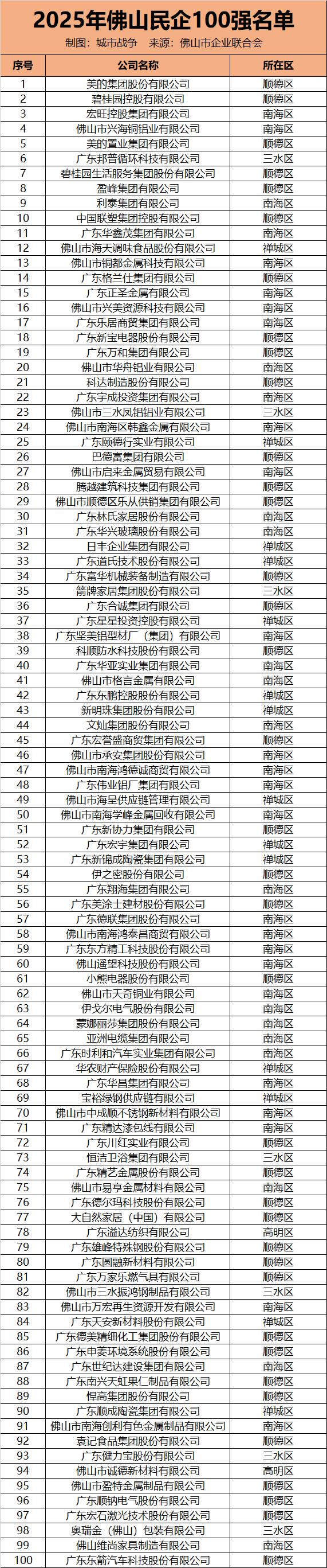
Core Insights - The recent release of the "Top 100 Private Enterprises in Foshan" highlights the competitive landscape of private companies in the region, with Nanhai District surprisingly surpassing Shunde in the number of top enterprises, although Shunde still has more leading firms with higher brand recognition [1][2][6]. Group 1: Company Rankings - The top ten private enterprises in Foshan are led by Midea Group, with 2024 revenue and net profit reaching CNY 409.1 billion and CNY 38.5 billion respectively [1][2]. - The complete list of the top 100 private enterprises includes notable companies such as Country Garden Holdings, Hongwang Holdings, and Foshan Xinghai Copper Aluminum [2][3]. Group 2: Regional Distribution - The distribution of the top 100 private enterprises shows that Nanhai District has 40 companies, Shunde District has 37, Zhaoqing District has 14, Sanshui District has 7, and Gaoming District has 2 [1][2]. - Among the top ten enterprises, Shunde District accounts for 6, while Nanhai District has 3, and Sanshui District has 1 [1][2]. Group 3: Industry Distribution - The industry breakdown of the top ten private enterprises reveals that 6 are in manufacturing, 3 are in real estate, and 1 is in automotive services [1][2]. - The overall top 100 list reflects a diverse range of industries, indicating a robust private sector in Foshan [1][2]. Group 4: Tax Contribution Rankings - The "Top 30 Enterprises by Tax Contribution" includes Midea Group, Haitian Flavoring & Food, and Hisense Home Appliances, showcasing the significant economic impact of these companies [5][6]. - Among the top 30 contributors, 13 are located in Shunde District, 9 in Zhaoqing District, and 4 each in Nanhai and Sanshui Districts [6][7].





欧盟内爱尔兰就业者受美国关税影响最大
Shang Wu Bu Wang Zhan· 2025-10-19 17:18
Core Insights - The European Central Bank (ECB) indicates that tariff measures may continue to "weigh on business and consumer confidence" [1] - Irish workers are the most affected group within the EU by U.S. tariffs, with heightened concerns about potential unemployment risks [1] Group 1: Tariff Impact on Employment - In July, the U.S. agreed to impose a 15% tariff on all EU goods, finalized in August, significantly impacting Irish exports, particularly pharmaceuticals [1] - The ECB's analysis shows that since the announcement of the tariffs, the majority of EU workers have not increased their concerns about unemployment, with 85% reporting unchanged or reduced unemployment expectations [1] - Only 15% of workers expressed increased concerns about job loss, suggesting that most employers are not directly affected by declining U.S. consumer demand [1] Group 2: Sector-Specific Vulnerabilities - Workers in industries such as manufacturing, construction, and trade are more susceptible to the negative impacts of tariffs due to their reliance on exports to the U.S. [2] - Financial services and information and communication technology sectors also show heightened unemployment concerns among employees due to U.S. tariffs [2] - Ireland and the Netherlands have a higher proportion of jobs dependent on U.S. exports, with Ireland at 6.7%, more than double that of the Netherlands at 3.2% [1][2]
基建受益增量资金和政策催化,重视低估值及高股息投资机会
Tianfeng Securities· 2025-10-19 14:14
Investment Rating - The industry rating is maintained as "Outperform" [5] Core Viewpoints - The construction sector is expected to benefit from increased funding and policy catalysts, with a focus on undervalued and high-dividend investment opportunities [13][19] - The construction index decreased by 1.06% during the week, underperforming the broader market by 0.74 percentage points, while the construction transformation and M&A sectors showed positive growth [4][30] - The government is accelerating the implementation of 500 billion yuan in new policy financial tools to support major projects, which is expected to enhance infrastructure growth in the fourth quarter [2][13] Summary by Sections Infrastructure Funding and Policy - The Ministry of Finance will continue to advance the 2026 new local government debt limit to ensure funding for key projects, with an increase of 100 billion yuan from the previous year, totaling 500 billion yuan [2][13] - The issuance of special bonds and long-term special government bonds is progressing rapidly, with a total issuance of 1.148 trillion yuan for the year, nearing 90% of the target [15][16] Valuation and Dividend Analysis - Central state-owned enterprises in the construction sector are showing significantly low price-to-earnings (PE) ratios, with China Chemical at a PE of less than 5%, and price-to-book (PB) ratios also low, indicating potential undervaluation [3][24] - China Construction currently has a dividend yield of 4.86%, outperforming other central state-owned enterprises [3][24] Regional Investment Opportunities - The western region's fixed asset investment grew by 6.6% in the first half of the year, with significant projects in Xinjiang and Tibet expected to catalyze further investment opportunities [19][20] - Key projects include the China-Kyrgyzstan-Uzbekistan railway and the Yaxia hydropower station, which are anticipated to drive demand for construction and related services [20][21] Recommended Stocks - Recommended stocks include China Chemical, China Railway Construction, and China Communications Construction, which are expected to benefit from strategic infrastructure projects and regional growth [9][37] - The report highlights the importance of focusing on high-dividend and low-valuation stocks within the construction sector, particularly in the context of ongoing government support for infrastructure development [3][21]




The Best Small-Cap Stock ETF to Invest $100 in Right Now Is the Avantis U.S. Small Cap Value ETF (AVUV)
The Motley Fool· 2025-10-19 13:17
Core Insights - The Avantis U.S. Small Cap Value ETF has outperformed the S&P 500 over the past five years, making it a compelling option for investors interested in small-cap stocks [1][5]. Fund Overview - The Avantis U.S. Small Cap Value ETF is actively managed, with professional analysts selecting which smaller companies to buy and sell, distinguishing it from passively managed funds [3]. - This ETF is value-oriented, focusing on undervalued investments rather than high-growth stocks, which may lead to a portfolio of slower-growing but potentially undervalued companies [4]. Performance Metrics - The ETF has a modest expense ratio of 0.25%, costing $25 annually for every $10,000 invested [5]. - Performance over various time frames includes: - 1 year: 5.6% - 3 years: 16.7% - 5 years: 20.4% - Since inception (Sept. 24, 2019): 14% [5]. Holdings Composition - The ETF consists of 777 holdings, with the top 10 holdings accounting for approximately 8% of its total value, indicating a more evenly distributed investment compared to large-cap ETFs [6]. - Recent top 10 stocks include: - Air Lease Corp. Class A: 1.04% - GATX: 0.93% - Five Below: 0.90% - Macy's: 0.87% - SkyWest: 0.78% [6][7]. Growth Potential - The ETF could significantly boost wealth over time, with hypothetical growth rates of 8%, 10%, and 12% showing substantial returns on an annual investment of $1,200 [8][9].
【广发宏观团队】如何看宏大叙事对资产定价的影响
郭磊宏观茶座· 2025-10-19 08:21
Group 1 - The article discusses the impact of grand narratives on asset pricing, emphasizing that economic behavior is influenced not only by rational analysis but also by prevailing narratives, as proposed by economist Robert Shiller [1] - It identifies five leading asset classes in 2025: precious metals, non-ferrous metals, emerging market stocks, technology assets, and alternative assets, all influenced by narratives such as the reconstruction of the dollar credit system and the reshaping of global supply chains [1] - The interconnectedness of these narratives creates a "narrative constellation," which is more influential than individual narratives [1] Group 2 - The rise of narratives is linked to changes in global macro variables, where traditional economic assumptions of continuity are challenged by significant non-continuous changes in fiscal and monetary conditions, trade environments, and geopolitical factors [2] - The influence of narratives poses challenges to traditional investment research methodologies, as the long timelines of grand narratives can bypass short-term validations and disrupt mean reversion assumptions [2] Group 3 - To adapt to the influence of narratives, the article suggests differentiating narrative levels for better risk-return matching, utilizing thematic asset categories that align with narratives, and increasing the use of momentum strategies during narrative-driven phases [3] - It also recommends establishing objective indicators for narrative validation and recognizing the potential for narrative bubbles, advocating for a diversified approach to narrative investments [4] Group 4 - The article notes a divergence in asset narratives during the third week of October, with U.S. stock markets rebounding amid the end of the Fed's balance sheet reduction, while Japanese stocks experienced a pullback [5] - Precious metals narratives strengthened, with gold and silver prices reaching new highs, while copper prices showed signs of retreat [6] Group 5 - The article highlights the performance of global stock markets, noting a rebound in U.S. stocks, while European stocks remained subdued due to fiscal expectations and export concerns [5] - It also discusses the dynamics of commodity prices, with gold and silver showing strong performance, while oil prices declined due to geopolitical factors and OPEC+ production increases [7] Group 6 - The article emphasizes the importance of monitoring the U.S. government's ongoing shutdown, which could impact market confidence and policy risks if it extends into November [11] - It also mentions the potential for the Fed to end its balance sheet reduction in the coming months, shifting focus towards employment risks and liquidity stability [13] Group 7 - The article discusses the recent credit fraud incidents in U.S. regional banks, highlighting vulnerabilities in the credit system under high-interest rate conditions [15] - It suggests that these incidents may not pose systemic risks but indicate weaknesses in the credit structure that could lead to further risk reassessment in the market [16] Group 8 - The article outlines the current state of China's asset pricing, noting a rise in the pricing power of Chinese assets amid global market uncertainties [9] - It highlights the performance of various sectors within the Chinese market, with a shift towards value styles and a pullback in high-growth narratives [10] Group 9 - The article reports on the recent developments in China's fiscal and monetary policies, including the expansion of the central bank's balance sheet and the need for effective credit support for the real economy [21] - It emphasizes the importance of infrastructure investment and the government's commitment to enhancing domestic demand and stabilizing the economy [29] Group 10 - The article discusses the ambitious goals set by China's government for electric vehicle charging infrastructure, aiming to significantly increase the number of charging facilities by 2027 [25][26] - It highlights the expected compound annual growth rate of 29.8% for charging facilities from 2025 to 2027, reflecting the government's commitment to supporting the electric vehicle industry [26]

行业轮动策略周报:CANSLIM行业轮动策略周度配置建议:关注钢铁、银行、化工、电新和建筑等行业-20251018
Guoxin Securities· 2025-10-18 13:43
Core Insights - The report emphasizes the importance of the CANSLIM industry rotation strategy, suggesting a focus on sectors such as steel, banking, chemicals, electric power, and construction for investment opportunities [1][4][14] - The CANSLIM composite score has shown strong performance since 2013, with an average RankIC of 11.6% and a monthly win rate of 64.7%, indicating its effectiveness in distinguishing future industry returns [5][31] Industry Rotation Factor Performance - For the period from October 9 to October 17, 2025, factors such as broker stock changes, net inflow of large orders, and analyst upgrades performed well, while volume-adjusted momentum and price-to-book (PB) ratios lagged [2][16] - Year-to-date performance shows that SUE, analyst recognition, and broker stock changes have been strong, while volume-adjusted momentum and public fund holdings have underperformed [2][16] Last Month's Portfolio Performance Review - The industry rotation portfolio yielded a return of -3.56% from October 9 to October 17, 2025, compared to -2.23% for the CITIC first-level industry equal-weight index, resulting in an excess return of -1.33% [3][21] - Year-to-date, the portfolio has returned 14.70%, while the benchmark index returned 17.59%, leading to an excess return of -2.89% [3][21] Current Portfolio Recommendations - The top five industries based on the CANSLIM composite score are steel, banking, basic chemicals, electric power and new energy, and construction [4][23] - The report provides detailed scoring metrics for each industry, highlighting the importance of various dimensions such as industry crowding, analyst expectations, and fundamental conditions [4][25] CANSLIM Industry Rotation Strategy Construction and Performance - The CANSLIM strategy has demonstrated a robust annualized return of 22.94% since 2013, outperforming the industry equal-weight benchmark by 13.80% [5][36] - The strategy's maximum drawdown is 23.75%, with an information ratio of 1.29 and a monthly win rate of 73%, indicating strong risk-adjusted performance [5][36] Strategy Overview - The CANSLIM strategy incorporates multiple dimensions including industry crowding, analyst expectations, fundamental conditions, smart money flows, price momentum, institutional views, and macroeconomic valuation adjustments [26][30] - Each dimension is quantitatively assessed to guide investment decisions, ensuring a comprehensive approach to industry rotation [26][30]
高频经济周报(2025.10.12-2025.10.18):地产市场回升,港口吞吐量下行-20251018
Shenwan Hongyuan Securities· 2025-10-18 12:14
Report Information - Report Title: High - frequency Economic Weekly (2025.10.12 - 2025.10.18) [3] - Date: October 18, 2025 [1] - Analysts: Huang Weiping, Lv Qiang, Wang Zheyi [1] 1. Industry Investment Rating No information provided in the report. 2. Core View The report presents an analysis of the economic situation from multiple aspects during the period of 2025.10.12 - 2025.10.18, indicating that the industrial production shows a seasonal rebound, personnel flow increases while freight prices decline slightly, consumption has mixed performance, construction investment is weak but the real - estate market rebounds seasonally, and export port throughput decreases with differentiated shipping indices. Also, various major policy events have occurred during this period [3]. 3. Summary by Directory 3.1. Large - Scale Assets - This week, bond indices generally rose, stock indices generally fell, most commodities declined, and foreign currencies generally appreciated. The ChinaBond 7 - 10 - year China Development Bank Bond Index had the largest weekly increase of 0.33%. The STAR 50 Index had the largest weekly decline of 6.16%. The Nanhua Precious Metals Index had the largest increase of 10.76%, and the Nanhua Energy and Chemicals Index had the largest decline of 3.43%. The Japanese yen had the largest increase against the RMB with a weekly increase of 1.22%, and the US dollar appreciated against the RMB with a weekly increase of 0.05% [3]. 3.2. Industrial Production - Production showed a seasonal rebound. From the upstream, the weekly coal consumption in the national power plant sample area decreased by 1.27% week - on - week. The petroleum asphalt plant operation rate increased by 1.30 percentage points to 35.80% week - on - week, the blast furnace operation rate remained the same as last week at 84.25%, and the crude steel output increased by 7.57% week - on - week. In the real - estate chain, the rebar operation rate increased by 1.35 percentage points to 41.33% week - on - week, the float glass operation rate increased by 0.34 percentage points to 76.65%, and the mill operation rate decreased by 0.49 percentage points to 37.89% week - on - week. In the consumer goods chain, the polyester filament operation rate decreased by 0.03 percentage points to 91.06% week - on - week, the PTA operation rate decreased by 1.92 percentage points to 75.56%, and the methanol operation rate increased by 4.00 percentage points to 84.38% week - on - week. In the automobile chain, the automobile semi - steel tire operation rate increased by 26.21 percentage points to 72.72% week - on - week, and the automobile all - steel tire operation rate increased by 20.56 percentage points to 64.52% week - on - week [3]. 3.3. People and Goods Flow - Personnel flow increased, and freight prices declined slightly. The 7 - day moving average (7DMA) of the national migration scale index increased by 3.25% week - on - week. The 7DMA of the number of domestic flights decreased by 0.66% week - on - week, and the 7DMA of the number of international flights decreased by 0.11% week - on - week. The subway passenger volumes in Beijing, Shanghai, Shenzhen, and Guangzhou all decreased. The 4 - week moving average (4WMA) of the road logistics freight rate index decreased by 0.02% week - on - week, and the total volume was higher than the same period in previous years [3]. 3.4. Consumption - Automobile retail sales declined, and prices showed a mixed performance. The previous - period automobile wholesale decreased by 1.00% year - on - year, and retail increased by 7.00% year - on - year. Both the 4WMA of the wholesale year - on - year growth rate and the 4WMA of the retail year - on - year growth rate declined. The weekly box office of movies decreased by 73% week - on - week, and the 7DMA of the number of movie - goers decreased by 73% week - on - week. Agricultural product prices showed a mixed performance. The pork price decreased by 2.38% week - on - week, and the vegetable price increased by 0.13% week - on - week [3]. 3.5. Investment - Construction showed weak performance, and the real - estate market rebounded seasonally. The cement storage capacity ratio increased by 1.6 percentage points week - on - week, the cement price index increased by 0.01% week - on - week, and the cement shipment rate decreased by 2.1 percentage points week - on - week. The rebar inventory decreased by 2.4% week - on - week, the proportion of profitable steel mills nationwide decreased by 0.9 percentage points week - on - week, and the apparent demand for rebar decreased by 39.4% week - on - week. Overall, the terminal demand for construction was weak. The 7DMA of the commercial housing transaction area in 30 large and medium - sized cities increased by 171.0% week - on - week. By city - tier, the commercial housing transaction areas in first - tier, second - tier, and third - tier cities all increased. The 7DMA of the second - hand housing transaction area in 16 cities increased by 165.6% week - on - week, and the national second - hand housing listing price index decreased by 0.1% week - on - week. The land transaction area in 100 large and medium - sized cities increased, and the land transaction premium rate decreased week - on - week [3]. 3.6. Export - Port throughput decreased, and shipping indices showed a mixed performance. The weekly port cargo throughput decreased by 8.4% week - on - week, and the container throughput decreased by 6.1% week - on - week. The Baltic Dry Index (BDI) increased by 6.87% week - on - week, the Shanghai Containerized Freight Index (SCFI) increased by 12.92% week - on - week, and the China Containerized Freight Index (CCFI) decreased by 4.11% week - on - week [3]. 3.7. Major Policies/Events - On October 13, the year - on - year export in September 2025 was 8.3%, exceeding expectations. On October 14, China imposed countermeasures on 5 US subsidiaries of South Korea's Hwa Ocean Co., Ltd. On October 14, the central bank announced a 6 - month repurchase of 600 billion yuan on October 15. On October 15, the year - on - year growth rates of CPI and PPI improved moderately. On October 15, the year - on - year growth rate of the stock of social financing decreased. On October 17, the central government allocated 500 billion yuan from the local government debt balance limit to local governments [3].