
消费

Search documents
港股估值持续修复 四大赛道ETF受机构关注
Zhong Zheng Wang· 2025-08-05 09:13
Group 1 - The Hong Kong stock market experienced a significant rise in July, with the Hang Seng Index and Hang Seng Tech Index both increasing by over 2.8%, and the Hang Seng Stock Connect rising by 4.7% [1] - There has been a resonance inflow of both domestic and foreign capital into the Hong Kong stock market this year, leading to a sustained liquidity environment [1] - According to Guosen Securities, Hong Kong stocks remain in a reasonable valuation range compared to A-shares, with a focus on five key investment directions: undervalued internet and AI leaders, innovative pharmaceuticals, resources and commodities benefiting from anti-involution, strong fundamentals in new consumption, and improving performance in non-bank financial institutions [1][2] Group 2 - The Hong Kong Innovative Pharmaceutical ETF (513120) has seen a year-to-date return exceeding 100% as of July 29, with its latest scale surpassing 16 billion yuan, making it the largest innovative pharmaceutical ETF in the market [2] - The Hang Seng Consumption ETF (159699) tracks the Hang Seng Consumption Index, including 50 leading Hong Kong consumer stocks, and offers a balanced distribution that aligns with the consumption trends of Generation Z [2] - The Hong Kong Non-Bank Financial ETF (513750) is the only ETF tracking the Hong Kong non-bank financial index, with significant holdings in major insurance companies and has seen continuous net inflows, reaching a scale of 12.5 billion yuan and a year-to-date return of over 40% [2] Group 3 - Fund professionals believe that the four ETFs covering technology, innovative pharmaceuticals, new consumption, and non-bank financial sectors provide investors with a convenient tool for a diversified exposure to Hong Kong stock opportunities [3] - Institutional analysis highlights the long-term allocation value of the Hong Kong technology and pharmaceutical sectors, especially with the deepening of anti-involution policies and rising global inflation expectations [3]
七成投资者看好三季度A股 市场乐观情绪进一步酝酿
Shang Hai Zheng Quan Bao· 2025-08-04 22:59
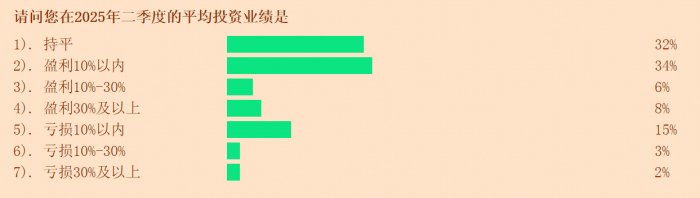
Core Viewpoint - The A-share market has shown strong resilience in the past quarter, leading to a recovery in individual investors' profitability. With index repair and low-risk interest rates, individual investors' willingness to allocate to equity assets has increased. For the third quarter, 70% of investors are bullish on the A-share market, indicating a more optimistic sentiment compared to the previous quarter. However, the performance of the A-share market in the third quarter may exceed the expectations of most investors, as the Shanghai Composite Index has successfully surpassed 3600 points in July [23]. Group 1: Market Performance and Investor Sentiment - In the second quarter, the A-share market experienced a "V"-shaped rebound after a significant drop in early April, with 48% of surveyed investors reporting profitability, an increase of 6 percentage points from the previous quarter [4][5]. - The proportion of investors who believe the Shanghai Composite Index will close positively in the third quarter has risen to 70%, a 12 percentage point increase from the previous quarter [17][19]. - Investors' expectations for the index's upper limit in the third quarter show that 39% anticipate it will reach around 3500 points, while 48% expect the lower limit to be around 3400 points [19]. Group 2: Asset Allocation and Investment Preferences - The proportion of individual investors who have increased their equity asset allocation has risen, with 36% planning to increase their overall equity asset size, a 7 percentage point increase from the previous quarter [8]. - Investors are showing a preference for technology growth stocks, with an average holding of 23.94%, while the average holding for cyclical stocks has increased to 20.21% [12][14]. - The investment sentiment towards new consumption concept stocks has also grown, with 55% of investors participating in this sector, indicating a shift in focus from traditional consumption stocks [15][21]. Group 3: Market Liquidity and External Factors - 44% of investors believe that the liquidity in the A-share market will remain at current levels, reflecting a significant increase in confidence compared to previous quarters [20]. - The expectation for the Federal Reserve's monetary policy remains optimistic, with 42% of investors anticipating continued accommodative policies and potential rate cuts [20]. - The inflow of southbound funds into the Hong Kong stock market has reached a historical high, with net inflows totaling 731.19 billion HKD in the first half of the year [21].

【宏观月报】7月全球投资十大主线-20250804
Huachuang Securities· 2025-08-04 15:10
Group 1: Macroeconomic Insights - Japan's government bond liquidity has deteriorated beyond the levels seen during the 2008 financial crisis, with the Bloomberg Japan government bond liquidity index surpassing the post-Lehman Brothers bankruptcy levels[2] - The relative performance of U.S. cyclical stocks versus defensive stocks is closely tied to forward swap rates linked to interest rates, indicating market optimism about sustained high rates despite expectations of Fed rate cuts[5] - The relative performance of MSCI Japan bank stocks is highly correlated with the 10-year Japanese government bond yield, benefiting from rising inflation expectations in Japan[5] Group 2: Investment Trends - Global fund managers have increased their allocation to technology stocks, reaching the highest level since March 2009, while reducing positions in cash and consumer staples[6] - Emerging market sovereign debt and U.S. Treasury yield spreads have narrowed to a 15-year low, reducing the attractiveness of emerging market debt strategies[6] - The relative performance of European consumer staples has diverged from the gold-to-copper ratio since 2024, indicating a weakening relationship with macroeconomic conditions[7] Group 3: Market Dynamics - The relative P/E ratios of U.S. and European stock indices are closely linked to the uncertainty of economic policies, with European valuations rising as U.S. policy uncertainty increases[9] - China's 5-year and 1-year interest rate swap spread turned positive in July 2025, reflecting increased investor confidence in inflation due to domestic policies and infrastructure projects[8] - The South African stock index has risen approximately 19% since 2025, driven by increasing gold and platinum prices, outperforming other emerging market indices[13] Group 4: Sentiment and Risk - The SPDR U.S. Dollar ETF's call option volume has been declining, suggesting limited upward momentum for the dollar index in the near future[13] - A significant portion of fund managers (38%) view global trade conflicts as the biggest tail risk, with "shorting the U.S. dollar" identified as the most crowded trade[6]
港股科技股普遍回暖,港股通互联网ETF(513040)、恒生科技ETF易方达(513010)标的指数均涨超1%
Mei Ri Jing Ji Xin Wen· 2025-08-04 14:27
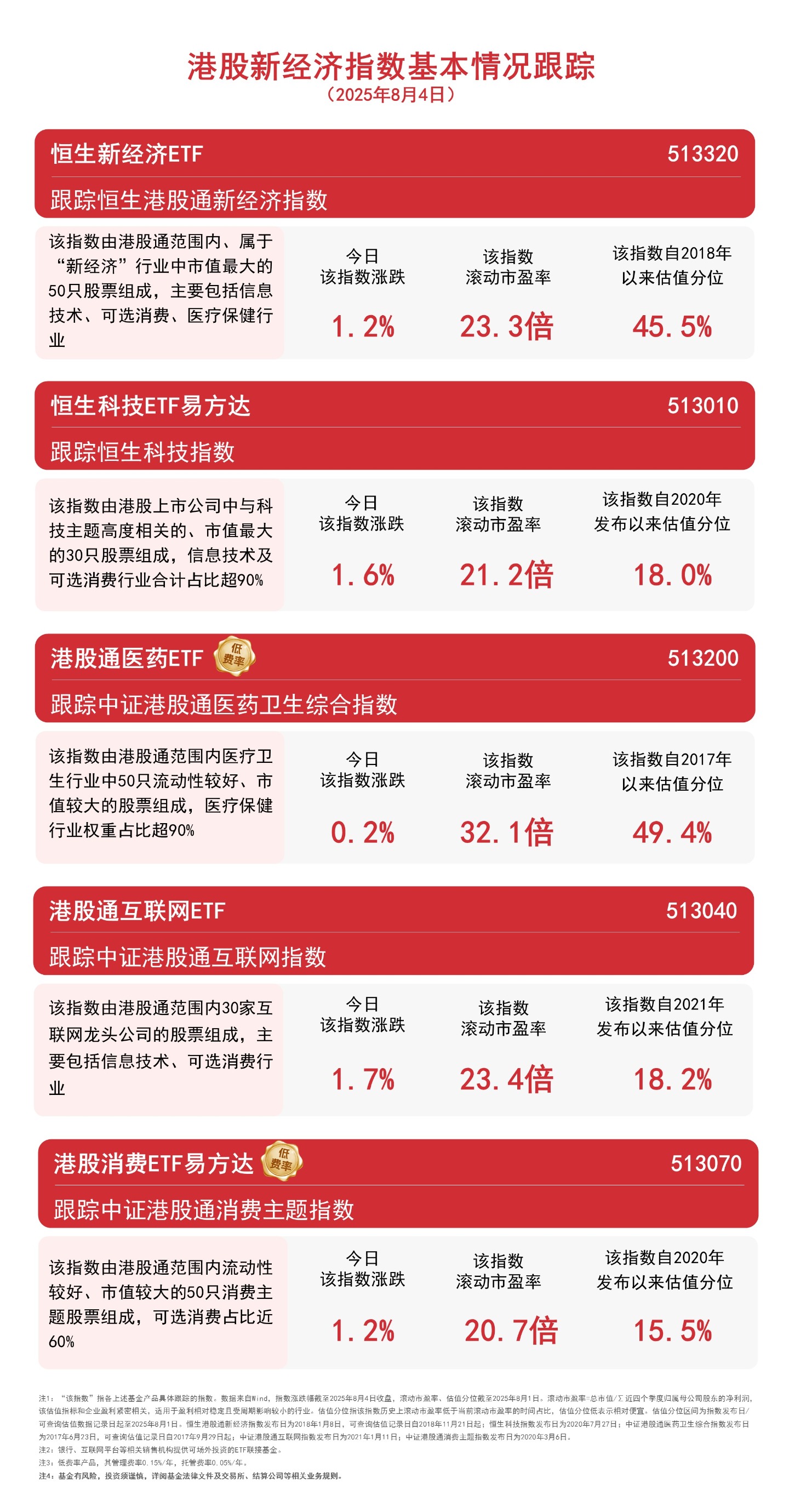
Group 1 - The Hang Seng New Economy Index tracks the largest 50 stocks in the "new economy" sector within the Hong Kong Stock Connect, primarily including information technology, consumer discretionary, and healthcare [2] - The index experienced a daily change of 1.2% and has a rolling price-to-earnings (P/E) ratio of 23.3 times [2] - The Hang Seng Technology ETF follows the Hang Seng Technology Index, which consists of the 30 largest stocks related to technology, with over 90% of the index comprising information technology and consumer discretionary sectors [2] Group 2 - The Hong Kong Stock Connect Pharmaceutical ETF tracks the CSI Hong Kong Stock Connect Pharmaceutical and Healthcare Composite Index, which includes 50 liquid and large-cap stocks in the healthcare sector, accounting for over 90% of the index [2] - The index had a daily change of 2% and a rolling P/E ratio of 21.2 times [2] - The Hong Kong Stock Connect Internet ETF follows the CSI Hong Kong Stock Connect Internet Index, consisting of 30 leading internet companies, primarily in information technology and consumer discretionary [3] Group 3 - The Hong Kong Stock Connect Consumer ETF tracks the CSI Hong Kong Stock Connect Consumer Theme Index, which includes 50 liquid and large-cap consumer stocks, with nearly 60% in consumer discretionary [3] - The index experienced a daily change of 1.2% and has a rolling P/E ratio of 20.7 times [3] - The data for the indices is sourced from Mind, with the closing data as of August 4, 2025, and rolling P/E ratios as of August 1, 2025 [2][3]
7月高频数据跟踪
LIANCHU SECURITIES· 2025-08-04 13:27
Production Side - As of the fourth week of July, the blast furnace operating rate was 83.48%, stable compared to the previous period and above last year's average[19] - The rebar operating rate increased to 43.95%, up 2.38 percentage points from the previous period, exceeding last year's average[19] - The cement mill operating rate recorded 36.95%, a slight decrease compared to the previous period[19] - The asphalt inventory saw a significant decline, indicating an acceleration in physical work volume in the infrastructure sector[7] Demand Side - In July, the real estate market remained weak, with the transaction area of commercial housing in 30 cities down by 27.43% month-on-month and 11.26% year-on-year[7] - The average daily sales of passenger cars were 53,006.50 units, reflecting a month-on-month decrease of 21.88%[8] - The total box office revenue for movies was 84,200.00 million yuan, showing a month-on-month increase of 99.53% but a year-on-year decline of 14.85%[8] Trade and Prices - The CCFI (China Containerized Freight Index) rose to 1,305.40, with a month-on-month growth of 2.19%[9] - The SCFI (Shanghai Containerized Freight Index) decreased to 1,684.07, reflecting a month-on-month decline of 16.42%[9] - The CPI showed a mild increase in consumer prices, while industrial product prices fluctuated, with PPI pressures from weak energy prices[9]
宏观经济点评:7月高频数据跟踪
LIANCHU SECURITIES· 2025-08-04 12:23
Production Insights - As of the fourth week of July, the national blast furnace operating rate was 83.48%, stable compared to the previous period and above last year's average[11] - The rebar operating rate increased to 43.95%, up by 2.38 percentage points from the previous period, also above last year's average[11] - The cement mill operating rate recorded 36.95%, showing a slight decline compared to the previous period[3] Inventory and Capacity Utilization - As of the fourth week of July, rebar inventory decreased by 4.29% compared to the previous period, indicating a reduction in stock levels[27] - The capacity utilization rate for electric furnaces was 53.48%, up by 2.51 percentage points from the previous month, slightly above last year's average[46] - Cement clinker capacity utilization was 58.10%, down by 0.45 percentage points from the previous month, below last year's average[46] Demand Trends - In July, the sales area of commercial housing in 30 cities decreased by 27.43% month-on-month and 11.26% year-on-year[4] - The average daily sales of passenger cars were 53,006.50 units, reflecting a month-on-month decline of 21.88%[4] - The volume of postal express collection was 3.704 billion pieces, down by 5.29% month-on-month but up by 15.14% year-on-year[4] Price Movements - The average price of cement was 338.17 yuan/ton, down by 0.33% month-on-month, below last year's average[67] - The price of rebar increased by 4.14% month-on-month to 3,310.40 yuan/ton, still below last year's average[68] - The price of asphalt rose by 0.40% month-on-month to 3,823.00 yuan/ton, above last year's average[69]
【公募基金】市场波动放大,景气板块占优——公募基金权益指数跟踪周报(2025.07.28-2025.08.01)
华宝财富魔方· 2025-08-04 09:43
Group 1 - The core viewpoint of the article highlights the recent market adjustments, with major indices mostly declining, while specific sectors like PCB and innovative pharmaceuticals continue to accelerate trends, indicating a shift in market dynamics [3][12] - The AI computing sector shows increased capital expenditure from overseas tech giants, confirming the rationality of North American computing demand, while domestic computing's self-control is seen as an inevitable trend [4][13] - The innovative pharmaceutical theme has surged significantly, with the Wind data indicating a 25.61% increase in the innovative drug index for July, driven by clinical advancements and overseas breakthroughs [14] Group 2 - As of August 1, 2025, over 91.81% of actively managed equity funds have achieved positive returns this year, with an average return of 13.50%, significantly outperforming the Shanghai-Shenzhen 300 index [15] - The active equity fund index tracking shows varied performances, with the growth stock index rising by 0.63% and achieving a cumulative excess return of 20.58% since inception [8][12] - The pharmaceutical stock index rose by 3.48% last week, reflecting strong performance in the sector, while the consumer stock index fell by 1.78% [9][12]

港股市场今日调整,港股通创新药ETF(159570)跌超2%
news flash· 2025-08-04 02:01
Group 1 - The Hong Kong stock market experienced a correction today, with the Hong Kong Stock Connect Innovative Drug ETF (159570) falling over 2% and marking a three-day decline [1] - The trading volume for the ETF reached 763 million yuan, with an increase of 903 million shares traded in the past month [1] - Other related ETFs also showed declines, including the E Fund Hong Kong Consumption ETF (513070) down 1.12%, the Hong Kong Automotive ETF (159210) down 0.71%, the Hong Kong Stock Connect Non-Bank ETF (513750) down 0.67%, and the Hong Kong Stock Connect Technology 30 ETF (520980) down 0.46% [1] Group 2 - The mentioned ETFs allow investment in the Hong Kong market without the need for a Hong Kong stock account [1]
股指期货:驱动回潮,震荡格局
Guo Tai Jun An Qi Huo· 2025-08-04 02:00
Group 1: Report Summary - Report date: August 4, 2025 [1] - Report author: Mao Lei [8] - Report institution: Guotai Junan Futures [9] Group 2: Market Review and Outlook - Market performance last week: The overall market declined, reaching a phased high during the week and then oscillating downward. The top three sectors in terms of gains were medicine and biology, communication, and media, while the bottom three were coal, non - ferrous metals, and real estate [3] - Policy impact: The Politburo meeting announced the main economic work direction for the second half of the year. The policy on stabilizing growth weakened marginally due to the improved external environment and good economic data in the first half. In the anti - involution area, the policy on prices was diluted, causing a significant decline in related commodity futures prices and dragging down relevant stock market sectors [3] - Overseas factors: Tariff fluctuations increased. The deadline for the equal - tariff negotiation for non - Chinese countries was approaching on August 1st, and the market's interpretation of the China - related trade negotiation in Sweden was not optimistic, suppressing investors' risk appetite [3] - Market turning points: In a bull market driven by risk preference, market turning points are mainly driven by policy shifts and the fermentation of external risks. Last week's market performance basically conformed to this adjustment logic [4] - Future market outlook: After the policy meeting, the actual future direction is uncertain. There is also uncertainty regarding the Sino - US equal - tariff deadline in the middle of this month. The upward market space may be limited, and the downward space is also restricted as market sentiment remains positive [4] - Factors to watch: The release of China's economic data in July, the Fed's policy direction, and the progress of tariff negotiations [5] Group 3: Strategy Recommendations Short - term strategy - Intraday trading frequency can refer to 1 - minute and 5 - minute K - line charts. The stop - loss and take - profit levels for IF, IH, IC, and IM can be set at 76/95 points, 58/31 points, 66/121 points, and 84/142 points respectively [6] Trend strategy - Adopt a long - after - correction approach. The core operating ranges for the IF2508, IH2508, IC2508, and IM2508 contracts are 3909 - 4110 points, 2727 - 2853 points, 6030 - 6434 points, and 6375 - 6804 points respectively [6] Cross - variety strategy - Cautiously participate in the strategy of going long on IF (or IH) and shorting IC (or IM) [7] Group 4: Market Data Summary Spot market review - Global stock indices: Most global stock indices declined last week. The Taiwan Weighted Index rose by 0.30%, while others such as the Russian RTS, NASDAQ, and Brazil BOVESPA Index fell [11] - Major domestic indices: All major domestic indices declined last week. The Taiwan Weighted Index was an exception with a 0.30% increase. Since 2025, major domestic indices have shown varying degrees of increase [11][12][13] - Industry performance: In the CSI 300 index, the medicine sector rose by 2.17%, while sectors such as industry, materials, and optional consumption declined. In the CSI 500 index, the medicine and telecommunications sectors rose, while others such as finance and real estate declined [15] Futures market review - Futures contract performance: The IF futures contract had the largest decline and the largest amplitude last week. The trading volume and open interest of股指期货 declined [15] Index valuation - PE ratios: The PE (TTM) ratios of the Shanghai Composite Index, CSI 300 Index, SSE 50 Index, CSI 500 Index, and CSI 1000 Index are 15.57 times, 13.5 times, 11.39 times, 30.79 times, and 41.44 times respectively [18][19] Market funds - Newly - established funds and investors: The data on newly - established equity - biased fund shares and the number of new investors in the two markets are presented [22] - Fund rates and central bank operations: The fund rate declined last week, and the central bank's net investment situation is shown [22]
综合价值管理赋能上市公司形成四大合力
Shang Hai Zheng Quan Bao· 2025-08-03 19:14
Core Viewpoint - The core argument emphasizes that listed companies are not solely the assets of major shareholders but are jointly owned by diverse investors, necessitating the transformation of differing expectations into collaborative development to enhance comprehensive value management [1][2]. Group 1: Importance of Diverse Investor Participation - The trend of socialized equity structure in China's A-share market shows a decline in the proportion of institutional holdings from 50.7% in 2018 to 42.0% in 2024, indicating an increase in the influence of individual and institutional investors [3]. - Attracting diverse social capital is crucial for the development of listed companies, especially in sectors like biotechnology and information technology, where early-stage investments are vital for overcoming innovation challenges [4]. Group 2: Comprehensive Value Management - Comprehensive value management aims to align the interests of various investors, addressing the financial stability needs of financial investors, the innovation expectations of industrial investors, and the social responsibility demands of societal investors [8]. - Companies should elevate comprehensive value management to a strategic level, integrating financial, industrial, and social value dimensions into their evaluation systems [8]. Group 3: Addressing Investor Discrepancies - Discrepancies between major shareholders and minority investors pose challenges in decision-making regarding profit distribution, mergers, and R&D investments, necessitating a balanced approach to governance [10][11]. - Companies should optimize shareholder checks and balances to foster collaboration between major and minor shareholders, ensuring that both long-term growth and short-term returns are addressed [12]. Group 4: Innovation and Technology Development - Disparities in understanding technology innovation between industrial investors and company management can hinder progress, necessitating a collaborative approach to decision-making in technology paths and innovation outcomes [14][16]. - Companies should establish processes that involve both management and industrial investors in technology decisions to align their interests and enhance innovation [16]. Group 5: Risk Sharing Mechanisms - Financial and industrial investors often have differing risk preferences, complicating the establishment of effective risk-sharing mechanisms in innovation [19][21]. - Companies should adopt diversified financing strategies to distribute risks among various investor groups, enhancing stability and flexibility in funding [21]. Group 6: Balancing Economic and Social Value - Social investors prioritize long-term societal impacts over short-term economic benefits, creating potential conflicts in corporate decision-making [24]. - Companies must recognize the influence of social perceptions on their investment value and strive to balance economic performance with social responsibility [25][26].